Explore the various types of rate relief mechanisms available to Class C water and wastewater utilities, including Staff Assisted Rate Cases, Limited Proceedings, File & Suspend Rate Cases, Annual Price Index adjustments, and more. Learn about the SARC application process and noticing requirements for new rates.
Please find below an Image/Link to download the presentation.
The content on the website is provided AS IS for your information and personal use only. It may not be sold, licensed, or shared on other websites without obtaining consent from the author. If you encounter any issues during the download, it is possible that the publisher has removed the file from their server.
You are allowed to download the files provided on this website for personal or commercial use, subject to the condition that they are used lawfully. All files are the property of their respective owners.
The content on the website is provided AS IS for your information and personal use only. It may not be sold, licensed, or shared on other websites without obtaining consent from the author.
Types of Rate Relief There are multiple mechanisms of rate relief available to Class C water and wastewater utilities. These types of rate relief are discussed in separate sections of this manual and include the following: Staff Assisted Rate Case (SARC) - procedure whereby a utility qualifying for staff assistance petitions for approval to increase rates based on based on financial and operating data determined by staff Limited Proceeding - a procedure whereby a utility can seek an increase in rates for specifically identified costs Water & Wastewater Reference Manual 2
Types of Rate Relief (cont.) There are multiple mechanisms of rate relief available to Class C water and wastewater utilities. These types of rate relief are discussed in separate sections of this manual and include the following (cont.): File & Suspend Rate Case a procedure whereby the utility petitions for approval to increase rates and files detailed financial and operating data to support its proposed rates. Annual Price Index an annual application that allows a utility to adjust rates based on current specific expenses without applying for a rate case Water & Wastewater Reference Manual 3
Types of Rate Relief (cont.) There are multiple mechanisms of rate relief available to Class C water and wastewater utilities. These types of rate relief are discussed in separate sections of this manual and include the following (cont.): Pass Through Rate Adjustment a process that allows a utility to recover increases or decreases in certain eligible expenses within a 45-day time frame Alternate Rate Setting procedure whereby a utility qualifying for staff assistance can obtain a rate increase, limited to 50 percent of test year revenues, in an expedited manner to recover specifically identified costs Water & Wastewater Reference Manual 4
The SARC Application The SARC Application requires a utility to provide general, accounting, engineering, and rate data, as well as an affirmation that the data provided is true and correct. The SARC application can be accessed at the following link: http://www.floridapsc.com/utilities/waterwastewater/ Water & Wastewater Reference Manual 5
Notice to County for New Rates Section 367.091(2), F.S., Rates, tariffs; new class of service, sets forth the following noticing requirements: Upon filing an application for new rates, the utility shall mail a copy of the application to the chief executive officer of the governing body of each county within the service areas included in the rate request The governing body may petition the Commission for leave to intervene in the rate change proceeding and the Commission shall grant intervener status to any governing body that files a petition Water & Wastewater Reference Manual 6
Staff Assignments Once a SARC application is received by the Commission, the following staff assignments are made: Accountant Engineer Attorney Economic Analyst Auditor Water & Wastewater Reference Manual 7
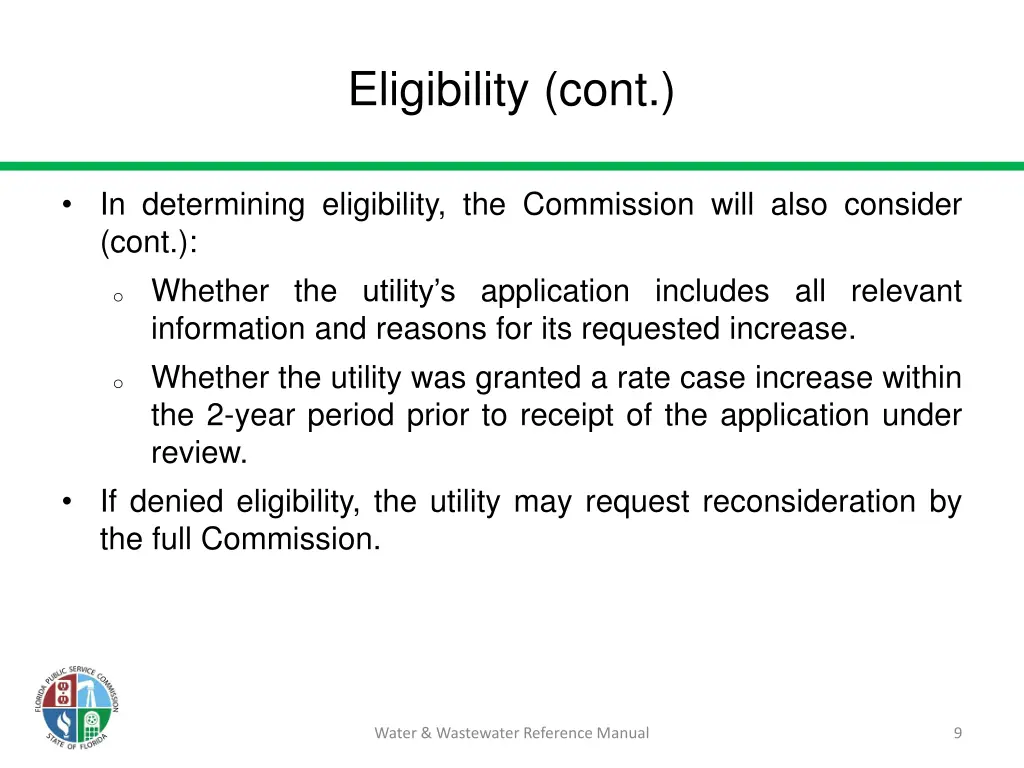
Eligibility To be eligible for staff assistance, gross annual operating revenue must be less than: o $275,000 for water service. o $275,000 for wastewater service. o $550,000 on a combined basis. In determining eligibility, the Commission will also consider: o Whether the utility is current with annual reports and regulatory assessment fees (RAFs). Calendar year RAFs are due the following March 31. Water & Wastewater Reference Manual 8
Eligibility (cont.) In determining eligibility, the Commission will also consider (cont.): o Whether the utility s application includes all relevant information and reasons for its requested increase. o Whether the utility was granted a rate case increase within the 2-year period prior to receipt of the application under review. If denied eligibility, the utility may request reconsideration by the full Commission. Water & Wastewater Reference Manual 9
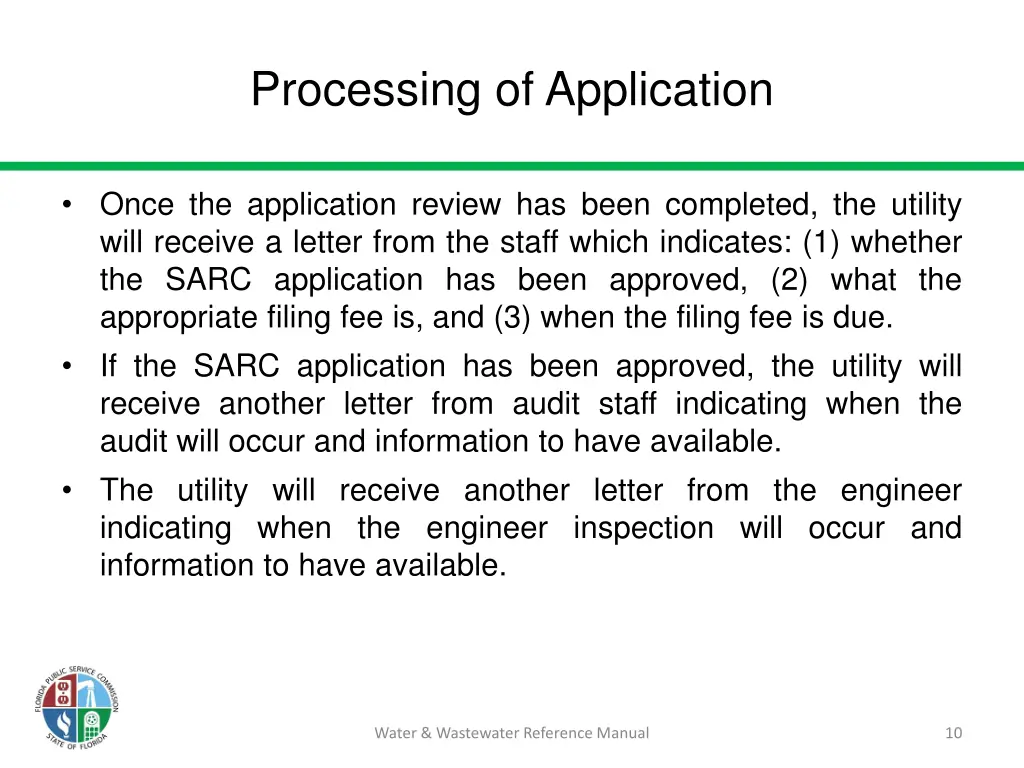
Processing of Application Once the application review has been completed, the utility will receive a letter from the staff which indicates: (1) whether the SARC application has been approved, (2) what the appropriate filing fee is, and (3) when the filing fee is due. If the SARC application has been approved, the utility will receive another letter from audit staff indicating when the audit will occur and information to have available. The utility will receive another letter from the engineer indicating when the engineer inspection will occur and information to have available. Water & Wastewater Reference Manual 10
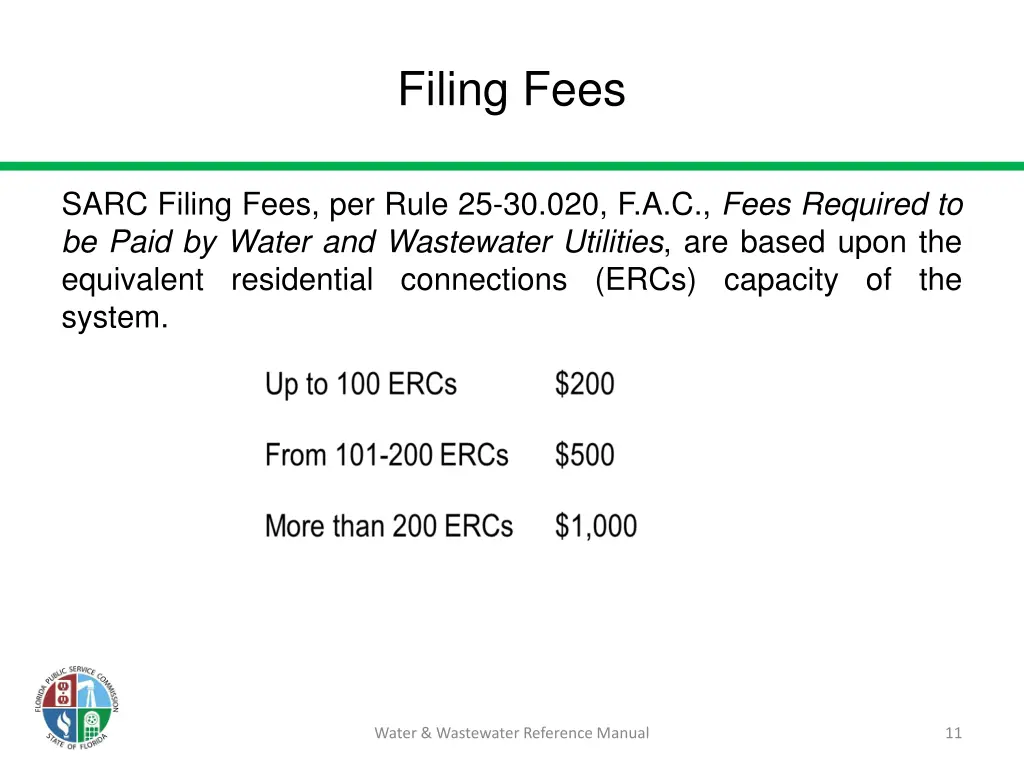
Filing Fees SARC Filing Fees, per Rule 25-30.020, F.A.C., Fees Required to be Paid by Water and Wastewater Utilities, are based upon the equivalent residential connections (ERCs) capacity of the system. Water & Wastewater Reference Manual 11
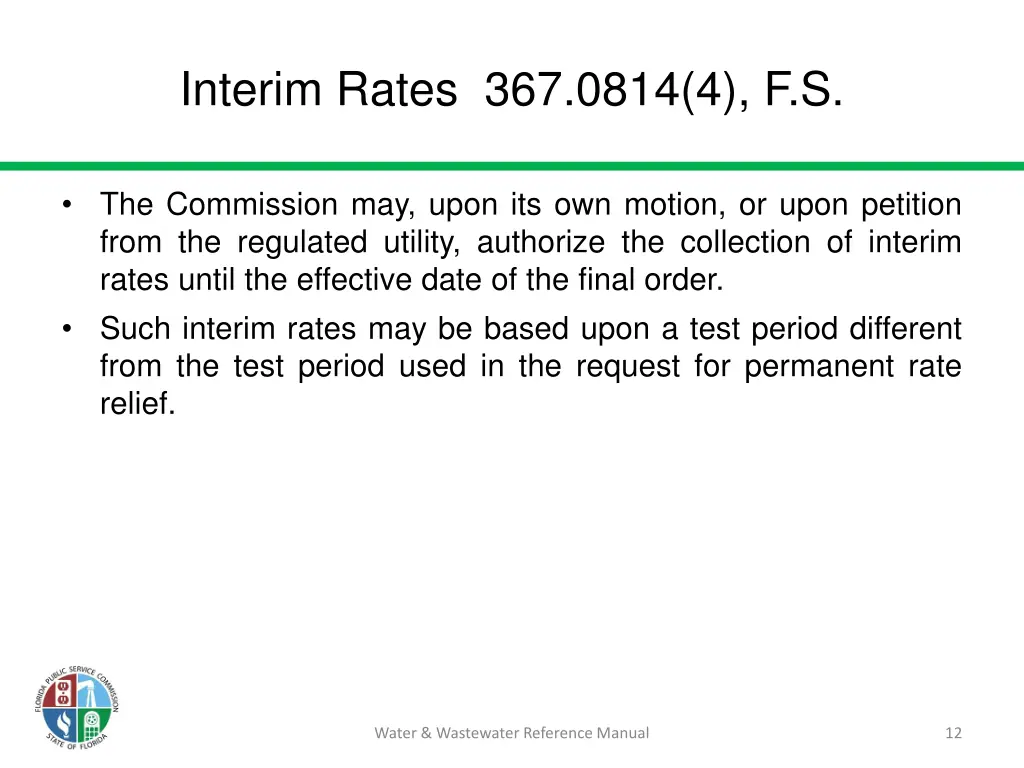
Interim Rates 367.0814(4), F.S. The Commission may, upon its own motion, or upon petition from the regulated utility, authorize the collection of interim rates until the effective date of the final order. Such interim rates may be based upon a test period different from the test period used in the request for permanent rate relief. Water & Wastewater Reference Manual 12
Interim Rates 367.0814(4), F.S. (cont.) To establish interim relief, there must be a demonstration that the operation and maintenance expenses exceed the revenues of the regulated utility. Interim rates shall not exceed the level necessary to cover operation and maintenance expenses as defined by the Uniform System of Accounts for Class C Water and Wastewater Utilities (1996) of the National Association of Regulatory Utility Commissioners. Water & Wastewater Reference Manual 13
SARC Interim Rates The Commission may require that the difference between the interim rates and the previously authorized rates be collected under bond, escrow, letter of credit, or corporate undertaking subject to refund with interest at a rate ordered by the Commission. Water & Wastewater Reference Manual 14
Staff Assistance Statute - 367.0814(8), F.S. If a utility becomes exempt from Commission regulation or jurisdiction during pendency of a staff assisted rate case: The request for rate relief is deemed to have been withdrawn. Interim rates, if previously approved, shall become final. Temporary rates, if previously approved, must be discontinued, and any money collected pursuant to the temporary rates, or the difference between temporary and interim rates, if previously approved, must be refunded to the customers of the utility with interest. Water & Wastewater Reference Manual 15
Case Assignment & Scheduling Record (CASR) The CASR lists actions to be undertaken in a filed case along with the due date for each action. A CASR can be accessed from the Commission s website as follows: (1) Follow the link below: http://www.floridapsc.com/dockets/cms/ (2) Search By Docket Number using only the first six digits of the docket number The table on this page details the actions to be taken in the case and the due date for each action. Water & Wastewater Reference Manual 16
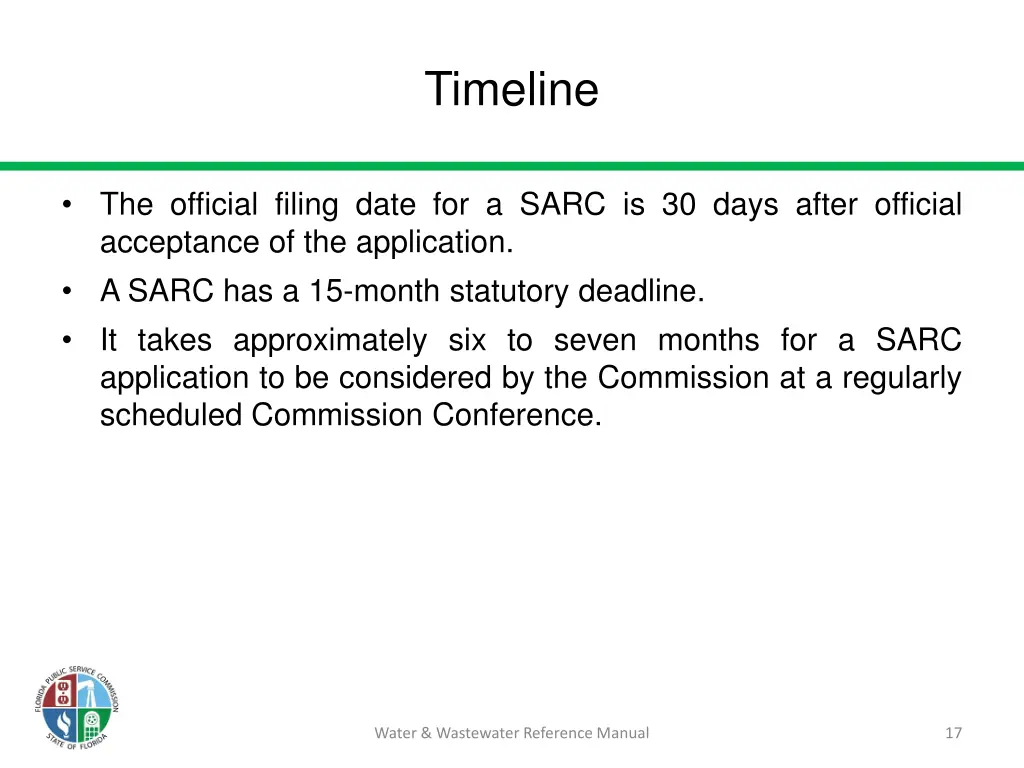
Timeline The official filing date for a SARC is 30 days after official acceptance of the application. A SARC has a 15-month statutory deadline. It takes approximately six to seven months for a SARC application to be considered by the Commission at a regularly scheduled Commission Conference. Water & Wastewater Reference Manual 17
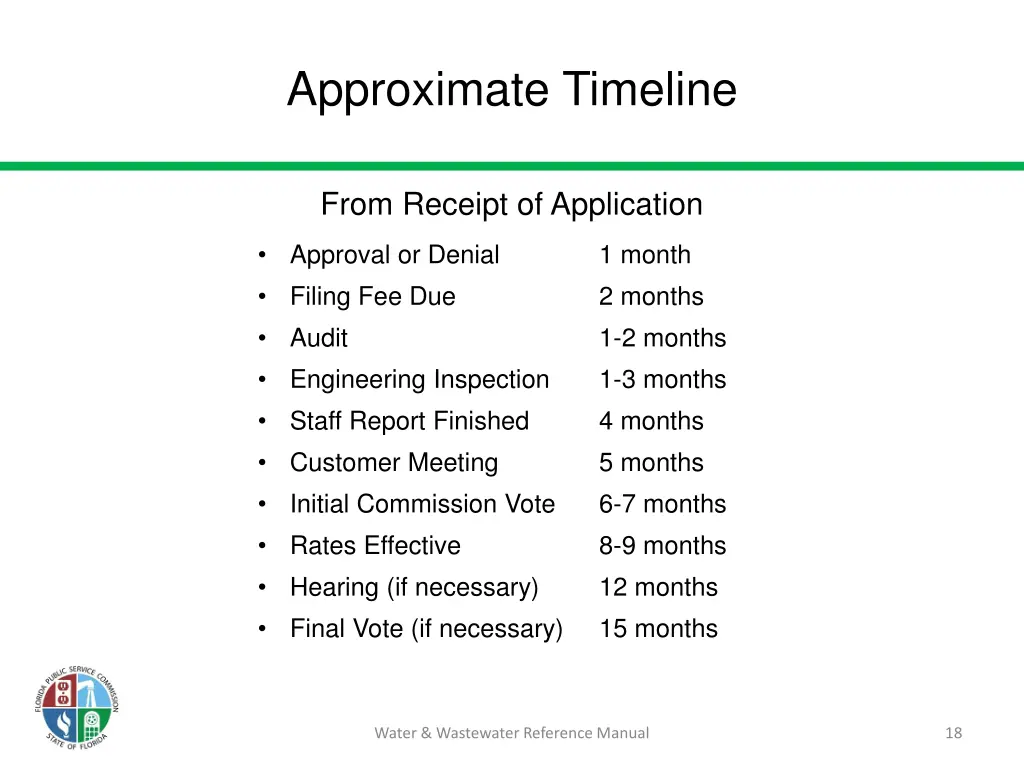
Approximate Timeline From Receipt of Application Approval or Denial Filing Fee Due Audit Engineering Inspection Staff Report Finished Customer Meeting Initial Commission Vote Rates Effective Hearing (if necessary) Final Vote (if necessary) 1 month 2 months 1-2 months 1-3 months 4 months 5 months 6-7 months 8-9 months 12 months 15 months Water & Wastewater Reference Manual 18
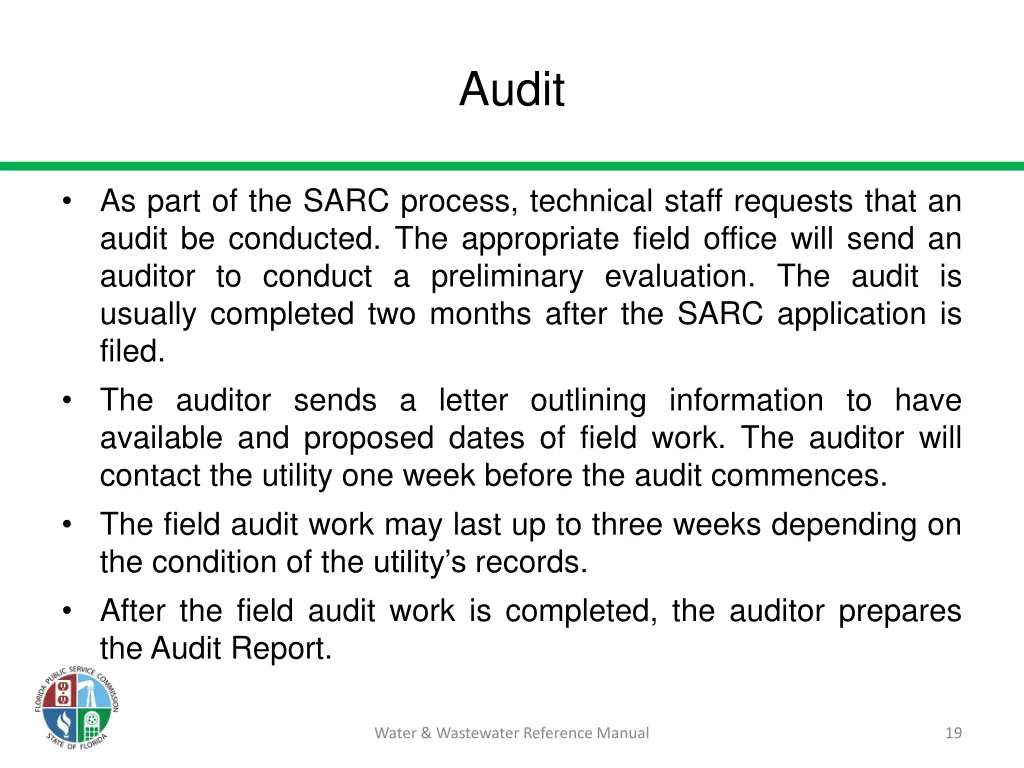
Audit As part of the SARC process, technical staff requests that an audit be conducted. The appropriate field office will send an auditor to conduct a preliminary evaluation. The audit is usually completed two months after the SARC application is filed. The auditor sends a letter outlining information to have available and proposed dates of field work. The auditor will contact the utility one week before the audit commences. The field audit work may last up to three weeks depending on the condition of the utility s records. After the field audit work is completed, the auditor prepares the Audit Report. Water & Wastewater Reference Manual 19
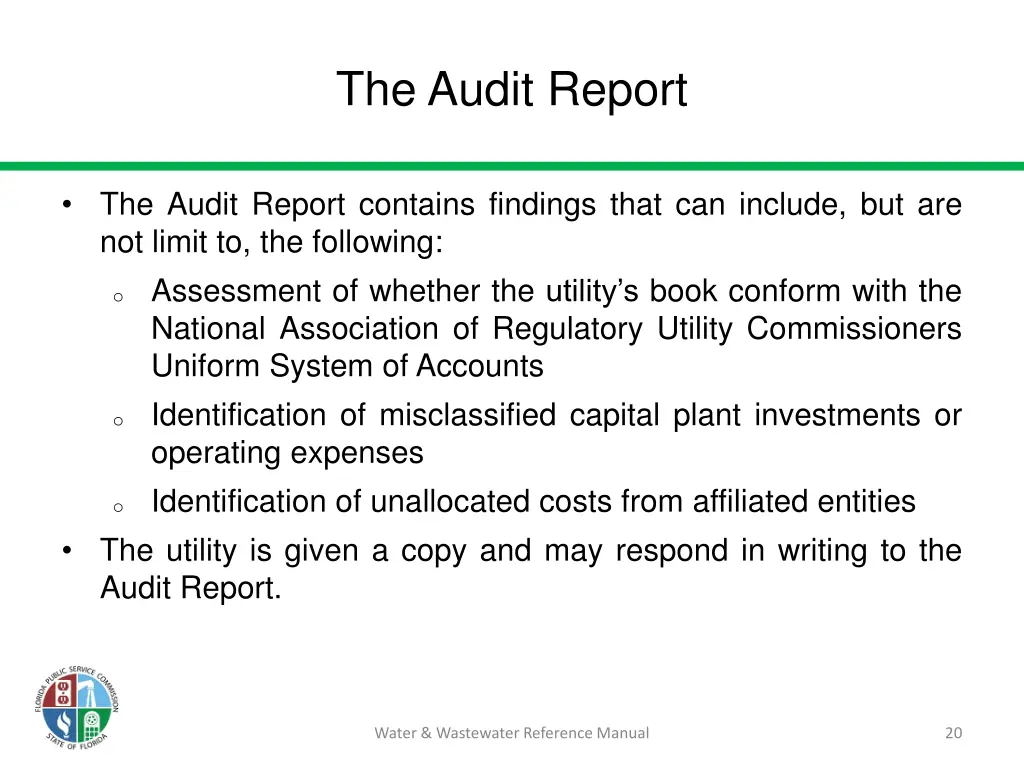
The Audit Report The Audit Report contains findings that can include, but are not limit to, the following: o Assessment of whether the utility s book conform with the National Association of Regulatory Utility Commissioners Uniform System of Accounts o Identification of misclassified capital plant investments or operating expenses o Identification of unallocated costs from affiliated entities The utility is given a copy and may respond in writing to the Audit Report. Water & Wastewater Reference Manual 20
Books and Records Water and wastewater utilities should: Use the 1996 NARUC Uniform System of Accounts. Keep all receipts, check stubs, and cancelled checks for all expenses. Keep all contracts. Keep all documentation of cost and work done for all capital expenditures. Properly record all allocated expenses. Water & Wastewater Reference Manual 21
25-30.433(10), F.A.C. - Water Treatment and Storage Used and Useful Calculations A utility is required to own the land upon which the utility treatment facilities are located, or possess the right to the continued use of the land, such as a 99-year lease. The Commission may consider a written easement or other cost-effective alternative. Water & Wastewater Reference Manual 22
The Engineering Analysis As part of the SARC, an engineering analysis is undertaken. The engineering analysis can include an examination of plant in service, used and usefulness of water and wastewater facilities, quality of service, original cost study, pro forma improvements, and operational and maintenance expenses. Water & Wastewater Reference Manual 23
Field Inspection As applicable, the staff engineer s inspection will include an on-site review of the utility s water treatment facilities, wastewater treatment facilities, reuse facilities, and general service area. The staff engineer also reviews the utility s operation and maintenance records, plant monthly operator reports (MORs), customer complaint records, and customer consumption data. Water & Wastewater Reference Manual 24
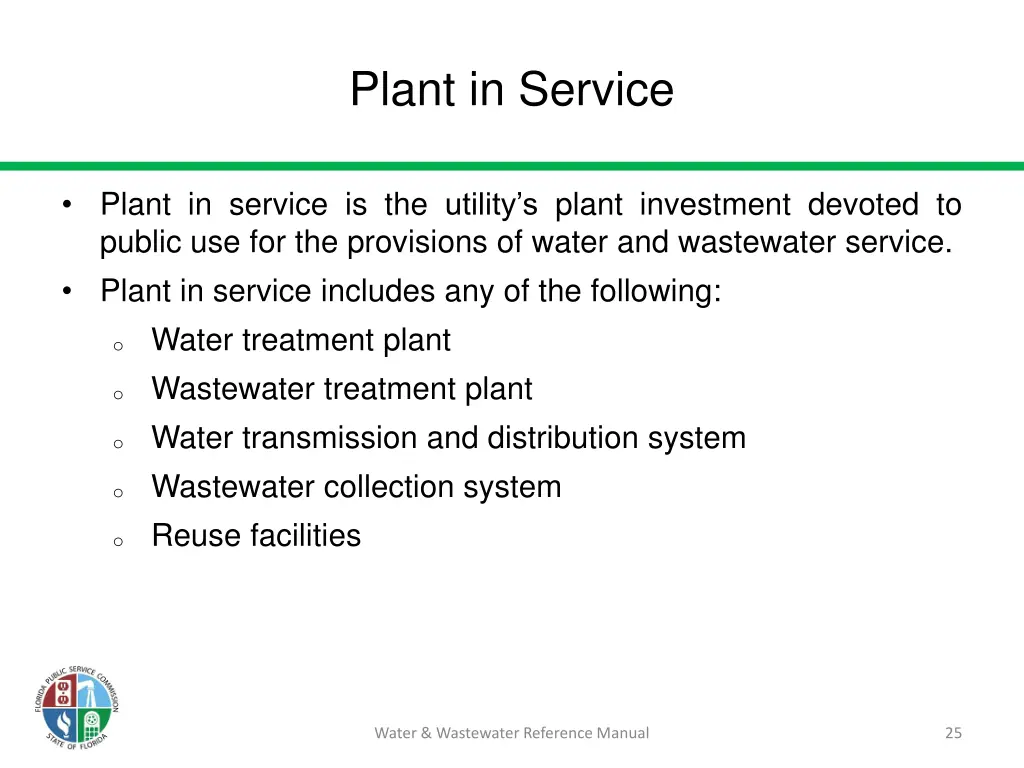
Plant in Service Plant in service is the utility s plant investment devoted to public use for the provisions of water and wastewater service. Plant in service includes any of the following: o Water treatment plant o Wastewater treatment plant o Water transmission and distribution system o Wastewater collection system o Reuse facilities Water & Wastewater Reference Manual 25
Original Cost Study An original cost study is necessary when sufficient records are not available to support utility rate base and/or total system cost. The utility should provide the staff engineer anything that would help orient him/her to area-specific pricing and construction cost to the utility, as well as in-service dates. Water & Wastewater Reference Manual 26
Used & Useful Definition Section 367.081, F.S. A utility is only allowed a rate of return on used and useful plant in service. The Commission shall consider property constructed or to be constructed to serve current customers. The Commission shall consider property constructed (or to be constructed) that is needed to serve customers five years after the end of test year at a growth rate not to exceed five percent per year. The Commission shall consider property constructed (or which needs to be constructed) to serve customers more than five years after the end of test year only to extent the utility provides clear and convincing evidence. Water & Wastewater Reference Manual 27
Used & Useful Section 367.081, F.S. (cont.) All environmental compliance costs shall be considered 100 percent used and useful. Environmental compliance costs shall include all reasonable expenses and fair return on any prudent investment incurred in complying with the requirements or conditions contained in any permitting, enforcement, or similar decisions of the US Environmental Protection Agency (EPA), Florida Department of Environmental Protection (DEP), Water Management Districts (WMDs), or any other similar governmental entity. Water & Wastewater Reference Manual 28
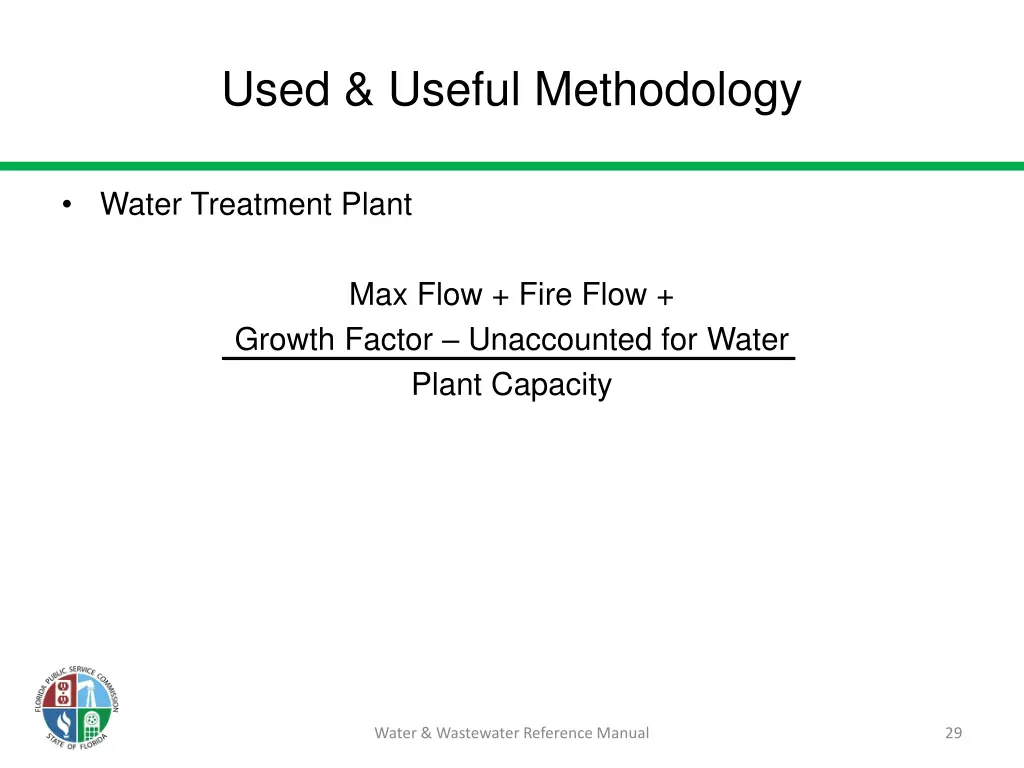
Used & Useful Methodology Water Treatment Plant Max Flow + Fire Flow + Growth Factor Unaccounted for Water Plant Capacity Water & Wastewater Reference Manual 29
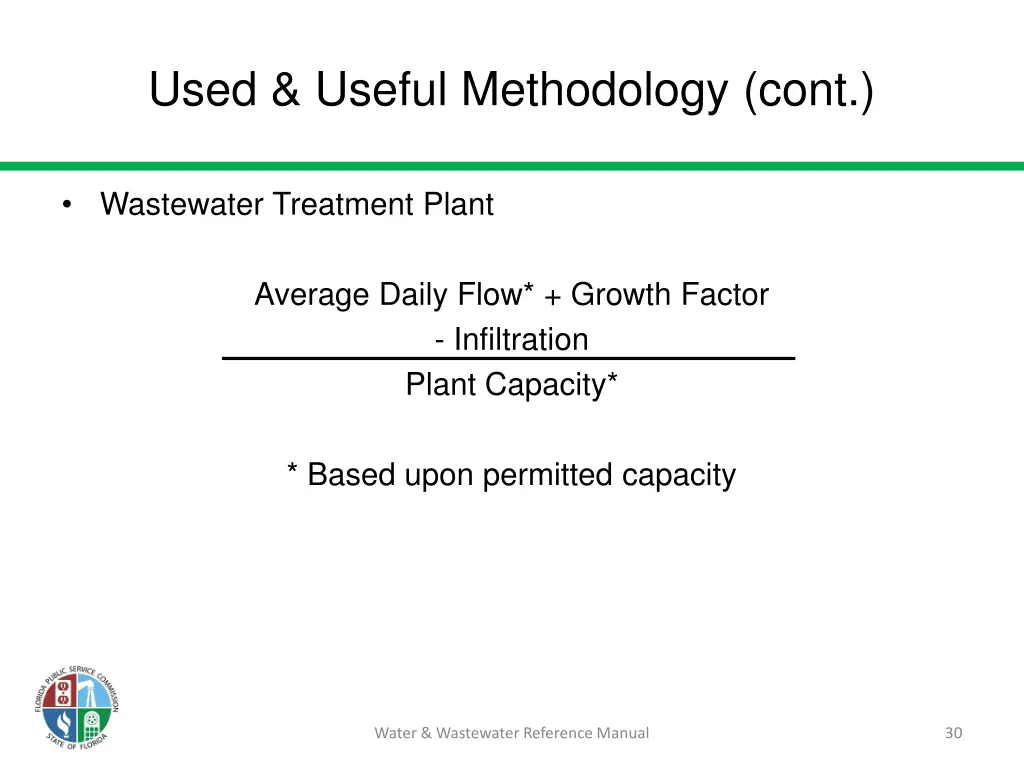
Used & Useful Methodology (cont.) Wastewater Treatment Plant Average Daily Flow* + Growth Factor - Infiltration Plant Capacity* * Based upon permitted capacity Water & Wastewater Reference Manual 30
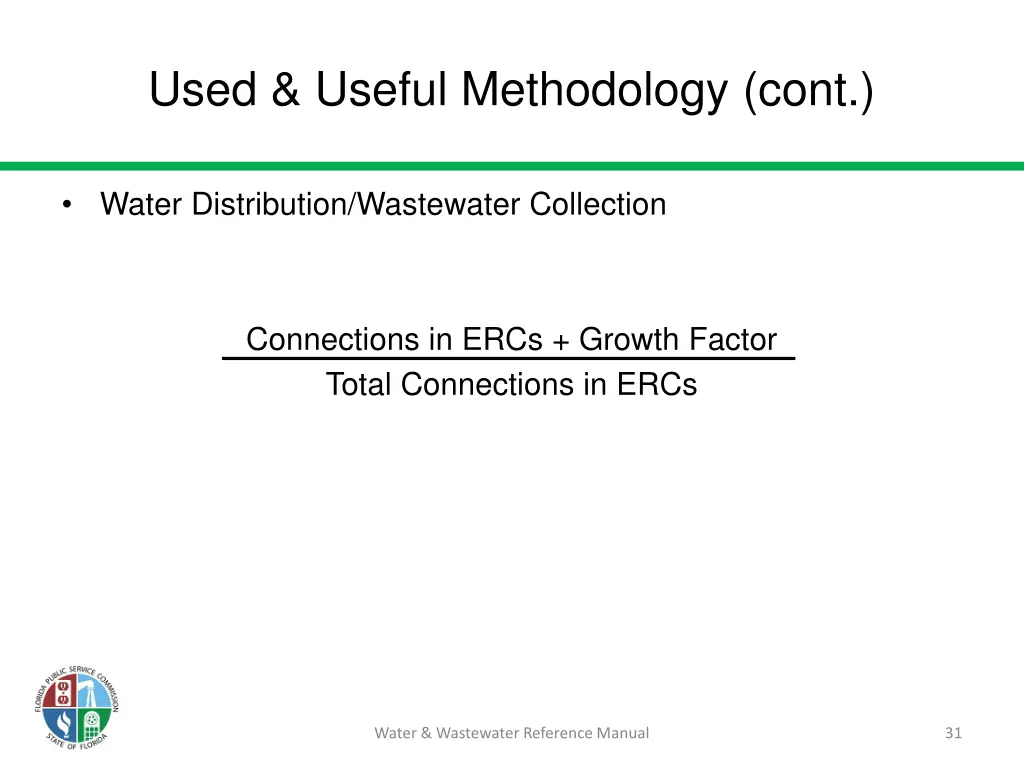
Used & Useful Methodology (cont.) Water Distribution/Wastewater Collection Connections in ERCs + Growth Factor Total Connections in ERCs Water & Wastewater Reference Manual 31
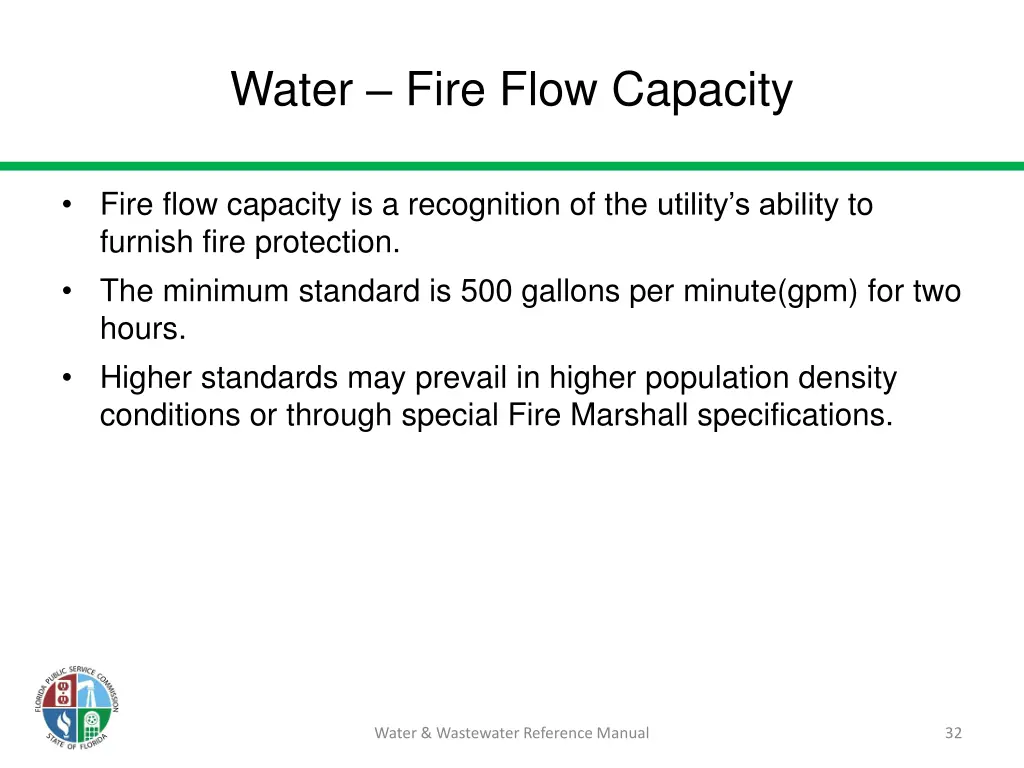
Water Fire Flow Capacity Fire flow capacity is a recognition of the utility s ability to furnish fire protection. The minimum standard is 500 gallons per minute(gpm) for two hours. Higher standards may prevail in higher population density conditions or through special Fire Marshall specifications. Water & Wastewater Reference Manual 32
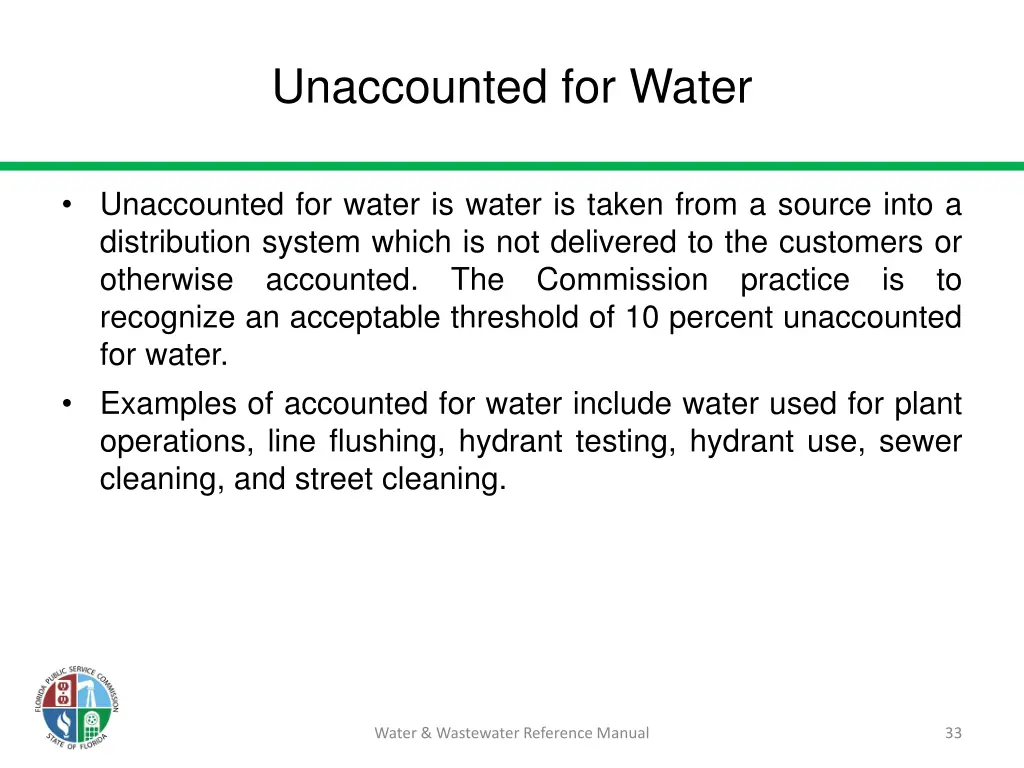
Unaccounted for Water Unaccounted for water is water is taken from a source into a distribution system which is not delivered to the customers or otherwise accounted. The Commission practice is to recognize an acceptable threshold of 10 percent unaccounted for water. Examples of accounted for water include water used for plant operations, line flushing, hydrant testing, hydrant use, sewer cleaning, and street cleaning. Water & Wastewater Reference Manual 33
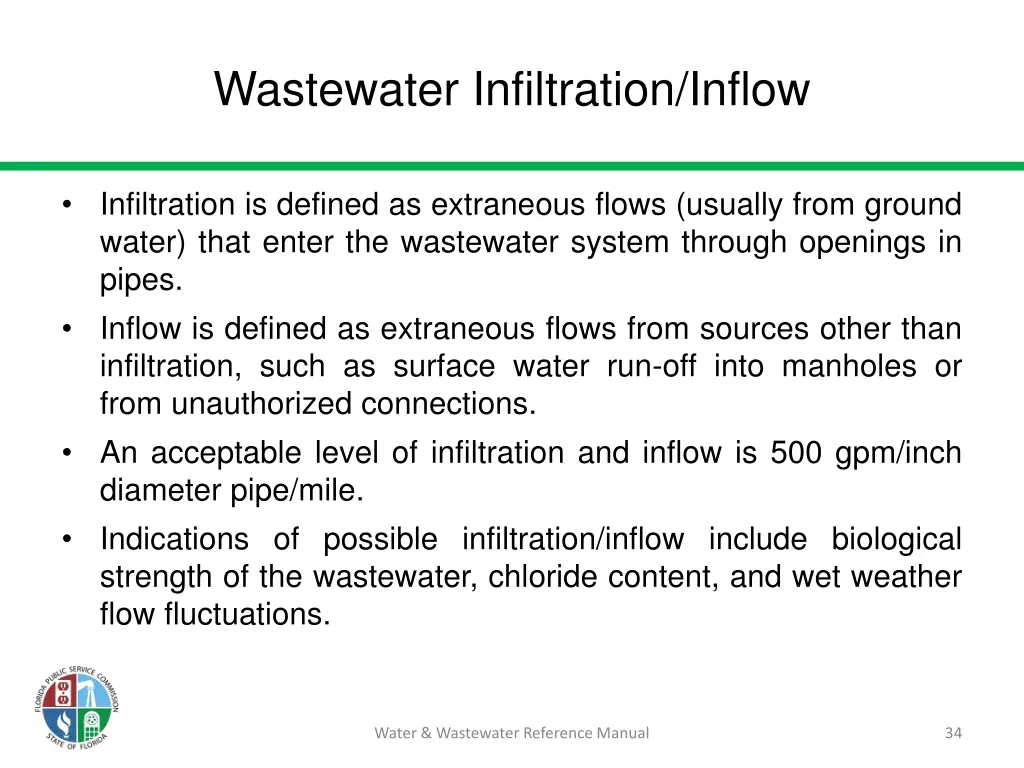
Wastewater Infiltration/Inflow Infiltration is defined as extraneous flows (usually from ground water) that enter the wastewater system through openings in pipes. Inflow is defined as extraneous flows from sources other than infiltration, such as surface water run-off into manholes or from unauthorized connections. An acceptable level of infiltration and inflow is 500 gpm/inch diameter pipe/mile. Indications of possible infiltration/inflow include biological strength of the wastewater, chloride content, and wet weather flow fluctuations. Water & Wastewater Reference Manual 34
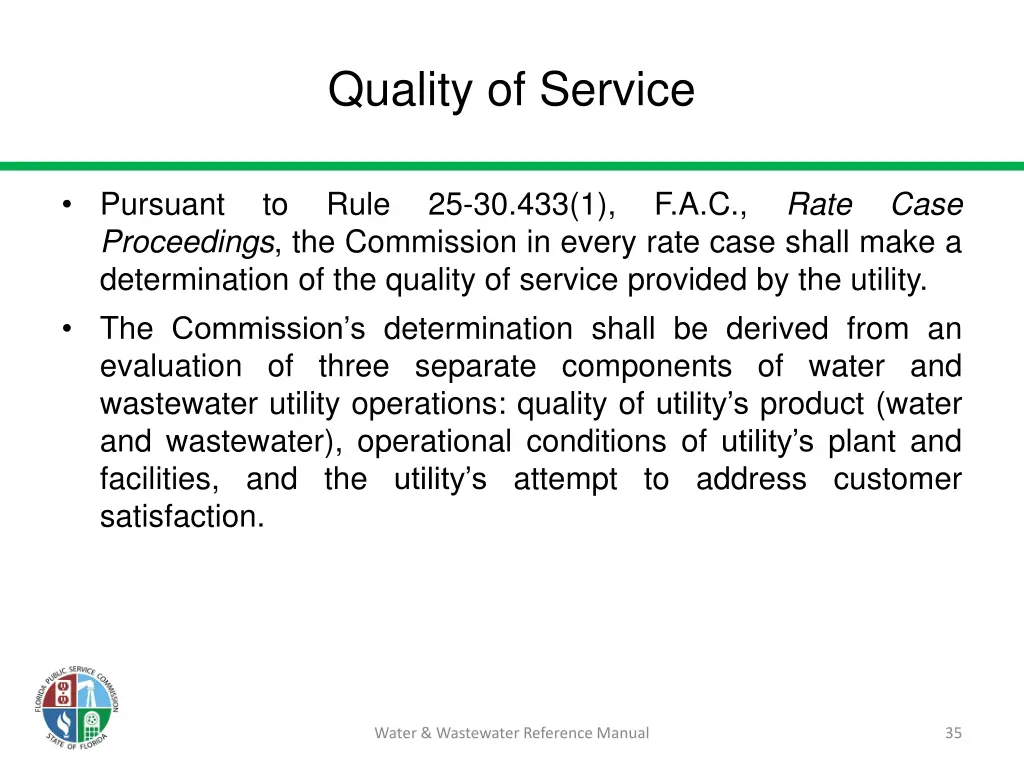
Quality of Service Pursuant Proceedings, the Commission in every rate case shall make a determination of the quality of service provided by the utility. The Commission s determination shall be derived from an evaluation of three separate components of water and wastewater utility operations: quality of utility s product (water and wastewater), operational conditions of utility s plant and facilities, and the utility s attempt to address customer satisfaction. to Rule 25-30.433(1), F.A.C., Rate Case Water & Wastewater Reference Manual 35
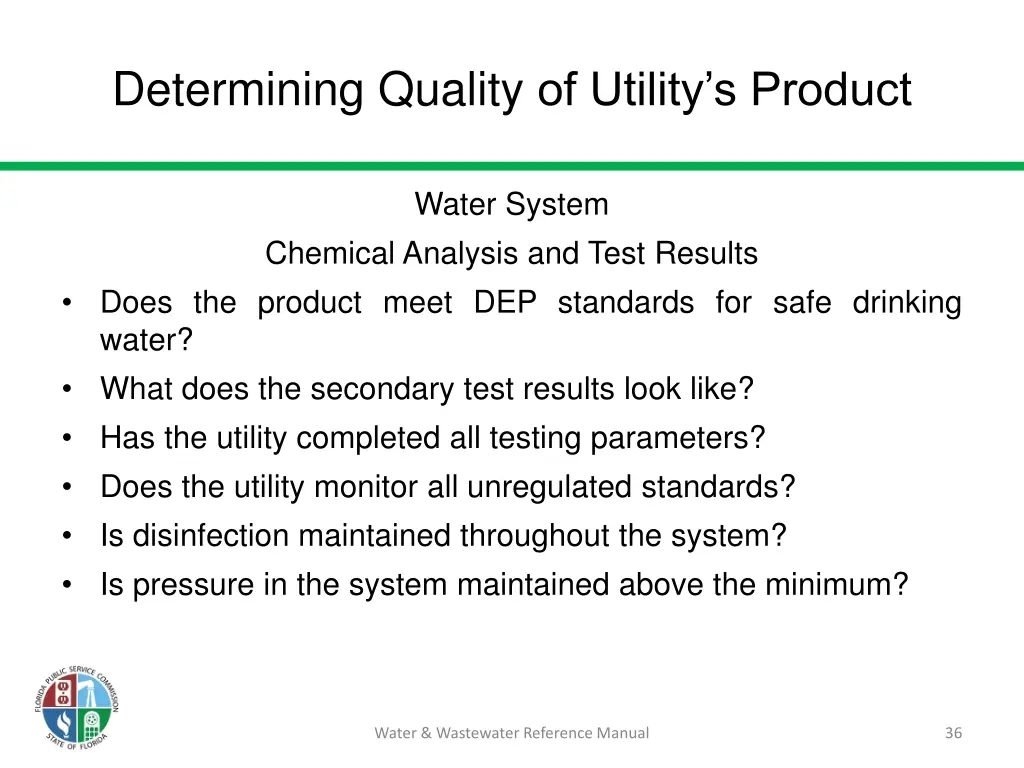
Determining Quality of Utilitys Product Water System Chemical Analysis and Test Results Does the product meet DEP standards for safe drinking water? What does the secondary test results look like? Has the utility completed all testing parameters? Does the utility monitor all unregulated standards? Is disinfection maintained throughout the system? Is pressure in the system maintained above the minimum? Water & Wastewater Reference Manual 36
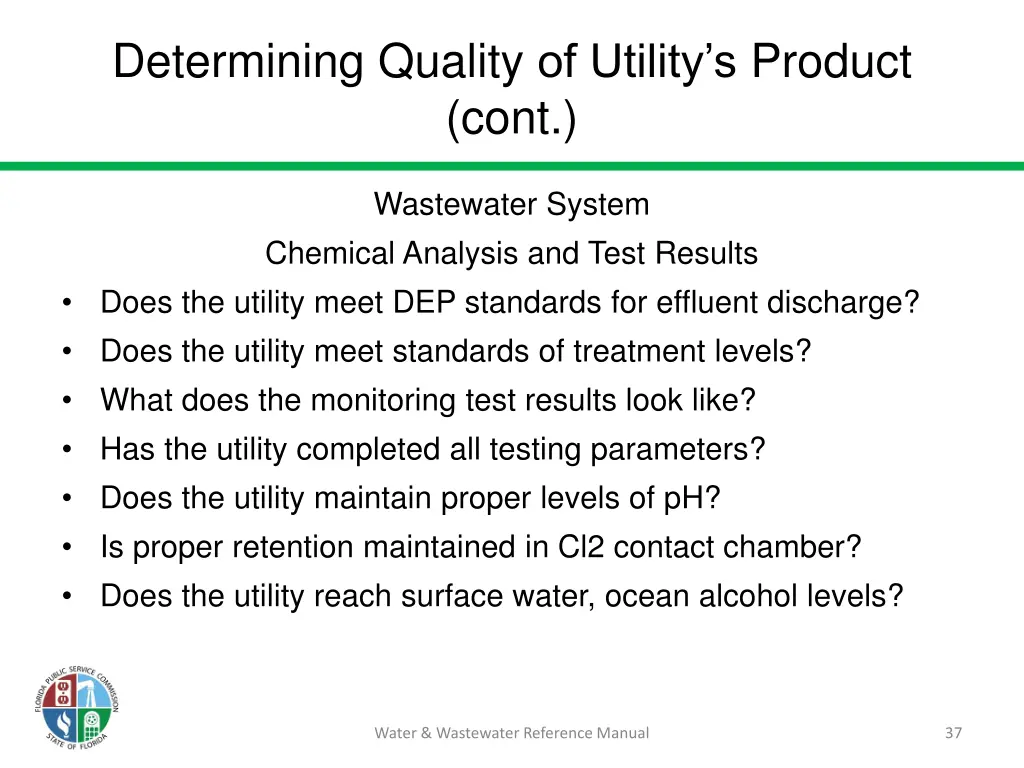
Determining Quality of Utilitys Product (cont.) Wastewater System Chemical Analysis and Test Results Does the utility meet DEP standards for effluent discharge? Does the utility meet standards of treatment levels? What does the monitoring test results look like? Has the utility completed all testing parameters? Does the utility maintain proper levels of pH? Is proper retention maintained in Cl2 contact chamber? Does the utility reach surface water, ocean alcohol levels? Water & Wastewater Reference Manual 37
Determining Quality of Utilitys Product (cont.) Wastewater System Chemical Analysis and Test Results (cont.) Does the utility discharge wastewater through spray irrigation or wetland discharge? Water & Wastewater Reference Manual 38
Determining Quality of Utilitys Plant Operational Conditions at the Water & Wastewater Treatment Plant What is the general condition of the facilities? Does repair and maintenance occur on a regular basis? Are there any plant in service citations? Are there any violations or corrective orders? Water & Wastewater Reference Manual 39
Determining Quality of Utilitys Public Relations Customer Satisfaction Are there any customer complaints? Does the utility keep a complaint log? How quickly do complaints get resolved? How many billing and service complaints are there? Are there frequent service interruptions? Are there frequent sewer backups? Is the company testing meter accuracy upon request? Is the company proactively monitoring meter accuracy? Water & Wastewater Reference Manual 40
Pro Forma Adjustments Pro Forma Plant is defined as plant improvements to be completed after the end of the test year. Pro Forma Expense is increase/decrease to be incurred after the end of the test year. defined as an expense Water & Wastewater Reference Manual 41
Factors Analyst Considers Factors staff analysts consider include the following: The engineer s recommendations on plant, related operation expenses, and used and useful Reasonableness of hours spent by the utility s employees performing their tasks (considerations include size, condition of plant, location, etc.) Comparison to previous cases and other utilities Adequate documentation of plant in service since last applicable Commission Order balance Water & Wastewater Reference Manual 42
Factors Analyst Considers (cont.) Factors staff analysts consider include the following (cont.): Depreciation maintained in accordance with Rule 25- 30.140, F.A.C. after March 1, 1984 Balance of contributions-in-aid-of-construction (CIAC) and amortization of CIAC using composite rate Imputation of CIAC Application of used and useful percentage to depreciation and CIAC Water & Wastewater Reference Manual 43
Factors Analyst Considers (cont.) Factors staff analysts consider include the following (cont.): Calculation of working capital allowance Capital structure issues such as return on equity (ROE) determination using the leverage graph, the cost of debt, and the weighted average rate on return Miscellaneous Service Charges Customer deposits Service Availability Charges Water & Wastewater Reference Manual 44
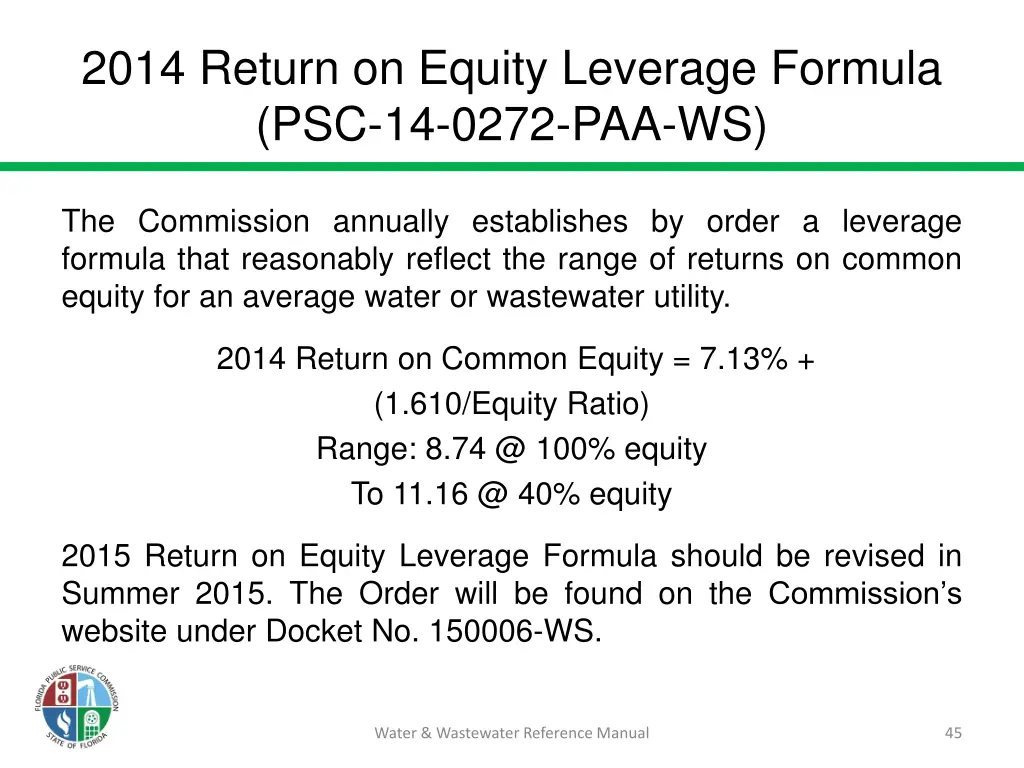
2014 Return on Equity Leverage Formula (PSC-14-0272-PAA-WS) The Commission annually establishes by order a leverage formula that reasonably reflect the range of returns on common equity for an average water or wastewater utility. 2014 Return on Common Equity = 7.13% + (1.610/Equity Ratio) Range: 8.74 @ 100% equity To 11.16 @ 40% equity 2015 Return on Equity Leverage Formula should be revised in Summer 2015. The Order will be found on the Commission s website under Docket No. 150006-WS. Water & Wastewater Reference Manual 45
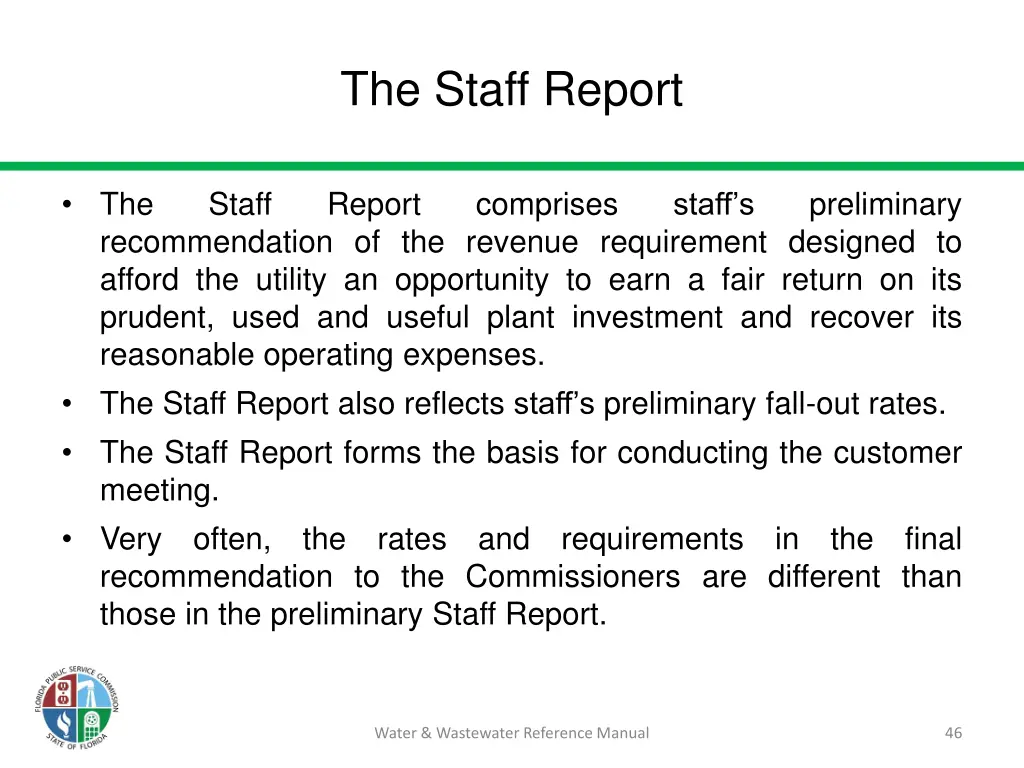
The Staff Report The recommendation of the revenue requirement designed to afford the utility an opportunity to earn a fair return on its prudent, used and useful plant investment and recover its reasonable operating expenses. The Staff Report also reflects staff s preliminary fall-out rates. The Staff Report forms the basis for conducting the customer meeting. Very often, the rates and requirements in the final recommendation to the Commissioners are different than those in the preliminary Staff Report. Staff Report comprises staff s preliminary Water & Wastewater Reference Manual 46
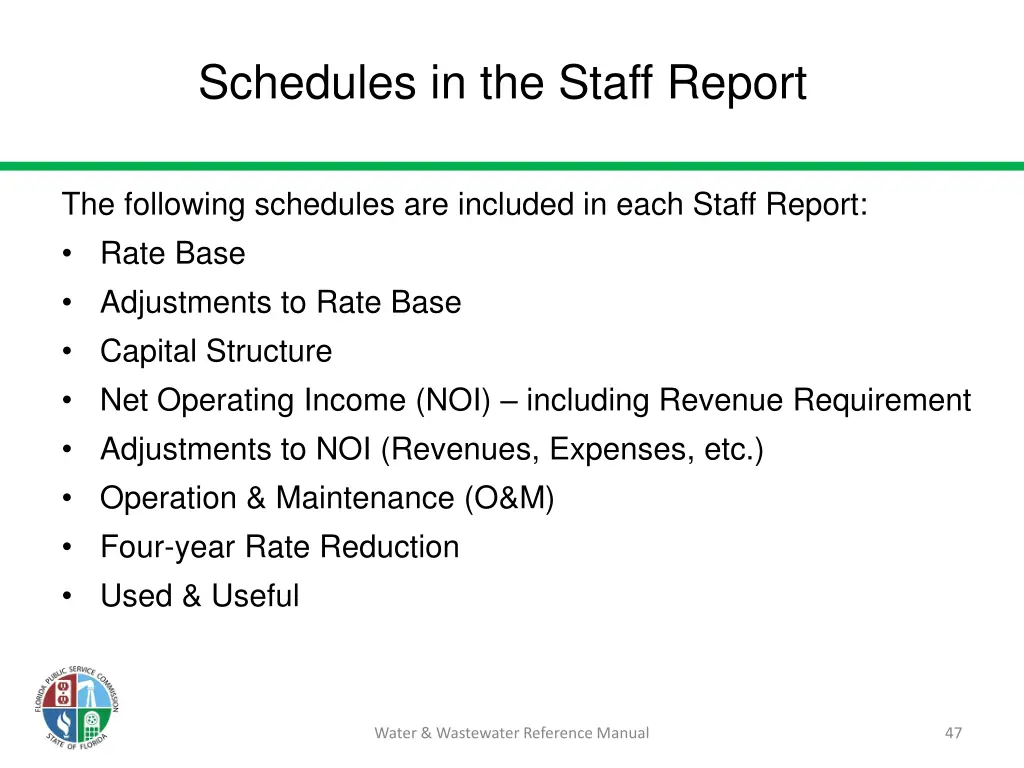
Schedules in the Staff Report The following schedules are included in each Staff Report: Rate Base Adjustments to Rate Base Capital Structure Net Operating Income (NOI) including Revenue Requirement Adjustments to NOI (Revenues, Expenses, etc.) Operation & Maintenance (O&M) Four-year Rate Reduction Used & Useful Water & Wastewater Reference Manual 47
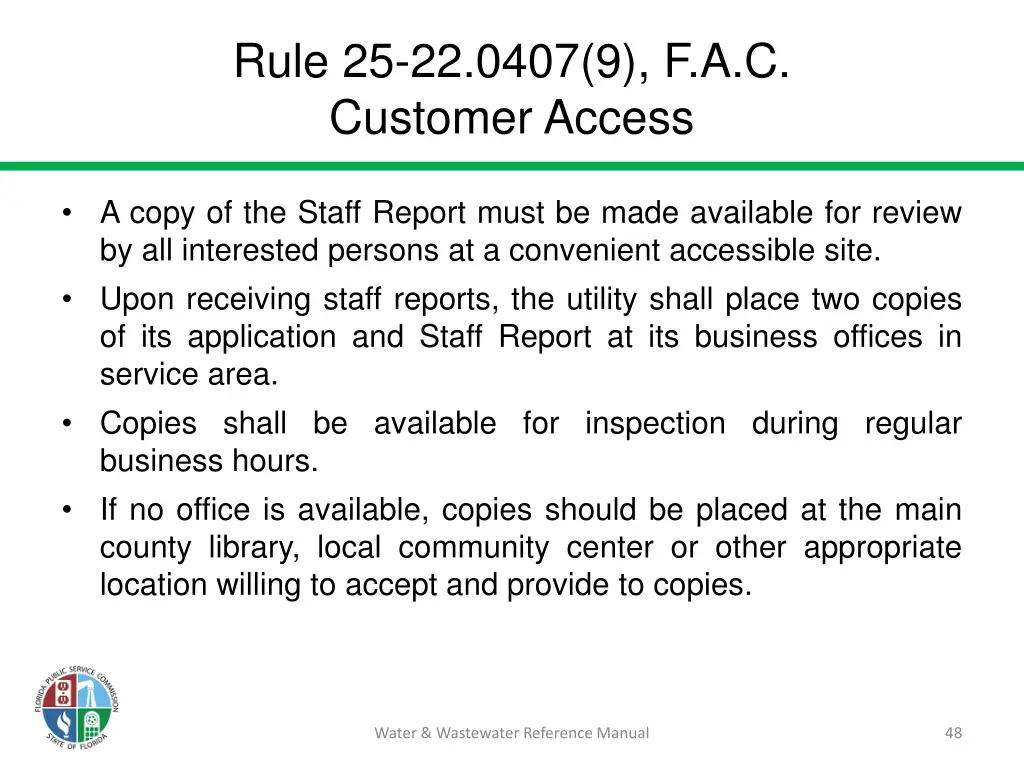
Rule 25-22.0407(9), F.A.C. Customer Access A copy of the Staff Report must be made available for review by all interested persons at a convenient accessible site. Upon receiving staff reports, the utility shall place two copies of its application and Staff Report at its business offices in service area. Copies shall be available for inspection during regular business hours. If no office is available, copies should be placed at the main county library, local community center or other appropriate location willing to accept and provide to copies. Water & Wastewater Reference Manual 48
The Customer Meeting Notice The customer meeting notice will be mailed from Commission staff to the utility for customer distribution approximately 30 days prior to the customer meeting. A copy of the customer notice, as reproduced at the time, as it is distributed to customers, together with a cover letter indicating the exact date on which the notice was mailed or otherwise delivered to customers, must be sent to the Commission staff. Water & Wastewater Reference Manual 49
Notice of Customer Meeting Utility shall provide Commission-approved written notice of customer meeting conducted by Commission staff no less than 14 days and no sooner than 30 days prior to the meeting date. The customer notice should be: Provided to all customers in service area. Provided to all persons who have been provided a written estimate for service within 12 calendar months prior to month application was filed. Mailed to out-of-town customers who have provided address to the utility. Water & Wastewater Reference Manual 50