WCC Conference Agenda

Explore the jurisdiction of IOD-based claims at the WCC Conference. Delve into employee definitions, exclusions, and WCC's limited jurisdiction over retirement board claims. Gain insights into IOD-related matters, statutes, and differing treatment for case management. Discover the intricacies of MERS, ERSRI, and quasi-public agencies as discussed by Dominique Tannous, Linda Cowen, and Carolyn Maiorana in their comprehensive PowerPoint.

Download Presentation

Please find below an Image/Link to download the presentation.
The content on the website is provided AS IS for your information and personal use only. It may not be sold, licensed, or shared on other websites without obtaining consent from the author.If you encounter any issues during the download, it is possible that the publisher has removed the file from their server.
You are allowed to download the files provided on this website for personal or commercial use, subject to the condition that they are used lawfully. All files are the property of their respective owners.
The content on the website is provided AS IS for your information and personal use only. It may not be sold, licensed, or shared on other websites without obtaining consent from the author.
E N D
Presentation Transcript
Jurisdiction of IOD-based claims WCC Conference April 10, 2025 - April 11, 2025 PowerPoint by Dominique Tannous, Linda Cowen and Carolyn Maiorana
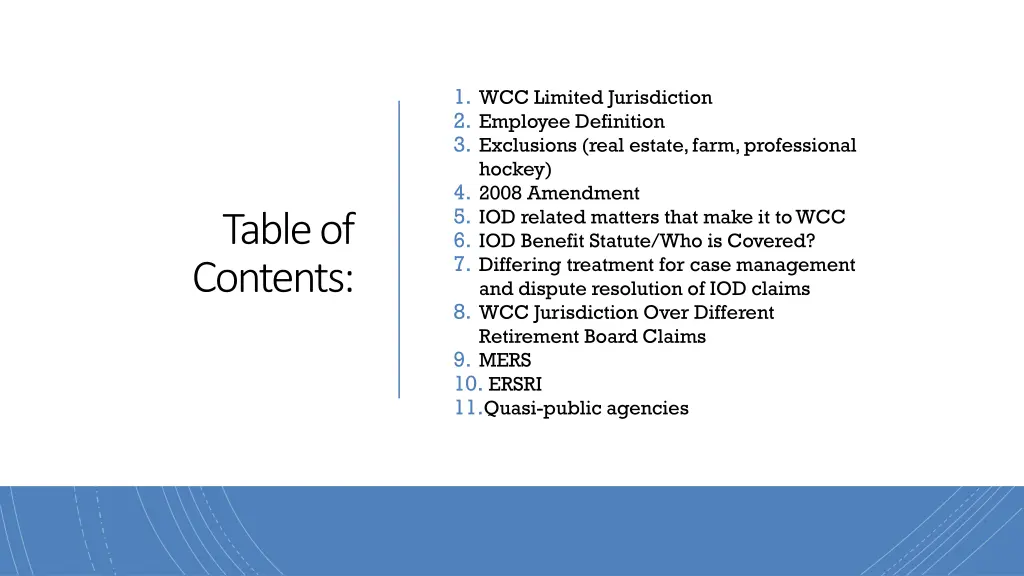
1. WCC Limited Jurisdiction 2. Employee Definition 3. Exclusions (real estate, farm, professional hockey) 4. 2008 Amendment 5. IOD related matters that make it to WCC 6. IOD Benefit Statute/Who is Covered? 7. Differing treatment for case management and dispute resolution of IOD claims 8. WCC Jurisdiction Over Different Retirement Board Claims 9. MERS 10. ERSRI 11.Quasi-public agencies Table of Contents:
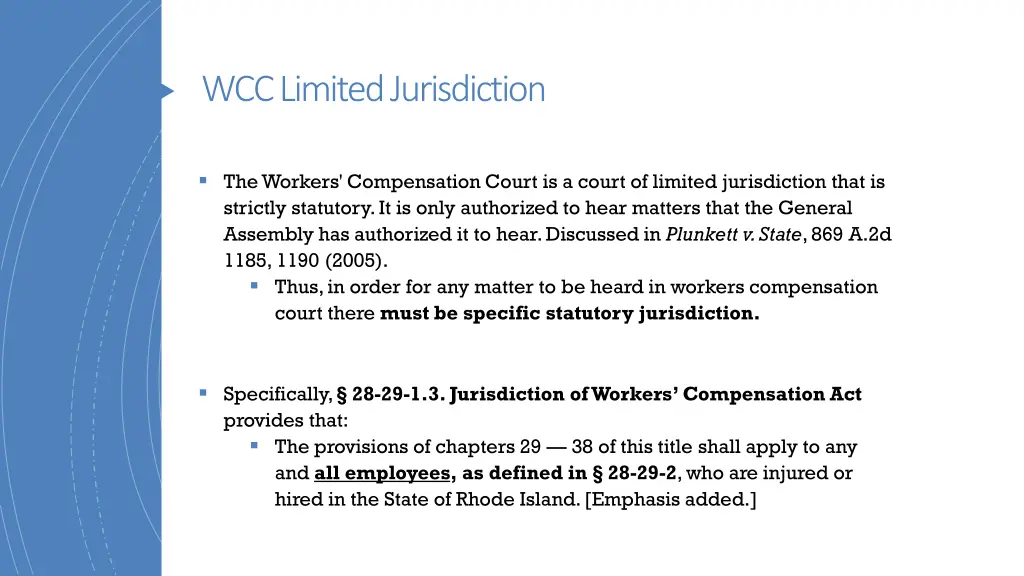
WCC Limited Jurisdiction The Workers' Compensation Court is a court of limited jurisdiction that is strictly statutory. It is only authorized to hear matters that the General Assembly has authorized it to hear. Discussed in Plunkett v. State, 869 A.2d 1185, 1190 (2005). Thus, in order for any matter to be heard in workers compensation court there must be specific statutory jurisdiction. Specifically, 28-29-1.3. Jurisdiction of Workers Compensation Act provides that: The provisions of chapters 29 38 of this title shall apply to any and all employees, as defined in 28-29-2, who are injured or hired in the State of Rhode Island. [Emphasis added.]
Employee Definition 28-29-2. Definitions (4)(i) Employee means any person who has entered into the employment of or works under contract of service or apprenticeship with any employer, except that in the case of a city or town other than the city of Providence it shall only mean that class or those classes of employees as may be designated by a city, town, or regional school district in a manner provided in this chapter to receive compensation under chapters 29 38 of this title. Any person employed by the State of Rhode Island, except for sworn employees of the Rhode Island state police, or by the Rhode Island airport corporation who is otherwise entitled to the benefits of chapter 19 of title 45 shall be subject to the provisions of chapters 29 38 of this title for all case management procedures and dispute resolution for all benefits. [Emphasis added.]
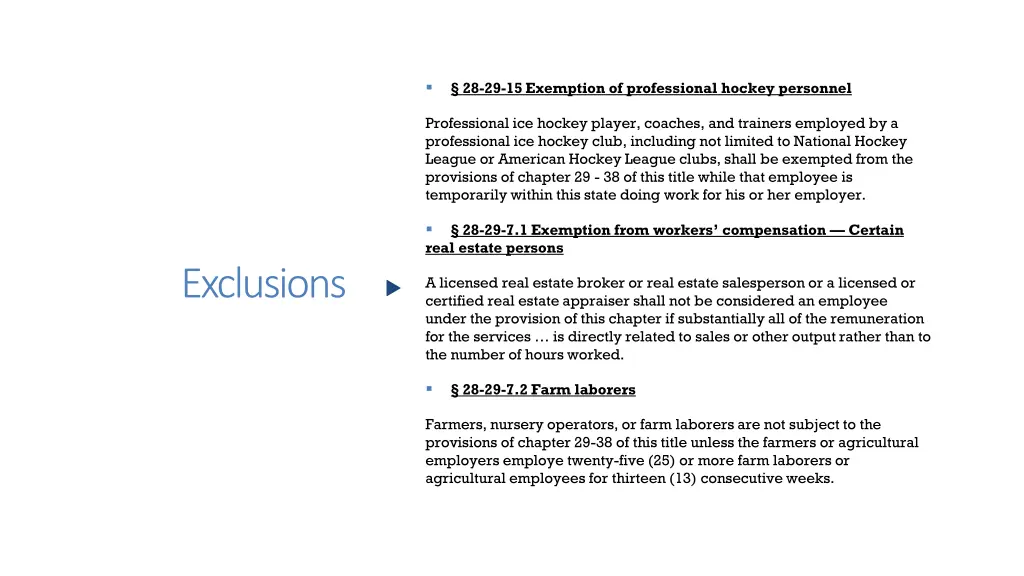
28-29-15 Exemption of professional hockey personnel Professional ice hockey player, coaches, and trainers employed by a professional ice hockey club, including not limited to National Hockey League or American Hockey League clubs, shall be exempted from the provisions of chapter 29 - 38 of this title while that employee is temporarily within this state doing work for his or her employer. real estate persons 28-29-7.1 Exemption from workers compensation Certain Exclusions A licensed real estate broker or real estate salesperson or a licensed or certified real estate appraiser shall not be considered an employee under the provision of this chapter if substantially all of the remuneration for the services is directly related to sales or other output rather than to the number of hours worked. 28-29-7.2 Farm laborers Farmers, nursery operators, or farm laborers are not subject to the provisions of chapter 29-38 of this title unless the farmers or agricultural employers employe twenty-five (25) or more farm laborers or agricultural employees for thirteen (13) consecutive weeks.
2008 Amendment 2008 Senate Bill 3111 amended RIGL 28-29-2 to include RIAC: Employee means any person who has entered into the employment of or works under contract of service or apprenticeship with any employer, except that in the case of a city or town other than the city of Providence it shall only mean that class or those classes of employees as may be designated by a city, town, or regional school district in a manner provided in this chapter to receive compensation under chapters 29 38 of this title. Any person employed by the State of Rhode Island, except for sworn employees of the Rhode Island State Police, or by the Rhode Island Airport Corporation who is otherwise entitled to the benefits of chapter 19 of title 45 shall be subject to the provisions of chapter 29 38 of this title for all case management and procedures and dispute resolution for all benefits. The term employee does not include provided, however, that it shall include the members of the police and aircraft rescue and firefighting (ARFF) units of the Rhode Island Airport Corporation. [Emphasis added] members of the police and aircraft rescue and firefighter (ARFF) units of Rhode Island Airport Corporation to be covered relative to injuries sustained while in the performance of his/her duties by the workers compensation system. This act would take effect upon passage. The Bill Explanation attached to the 2008 Senate Bill 3111 stated: This would allow for
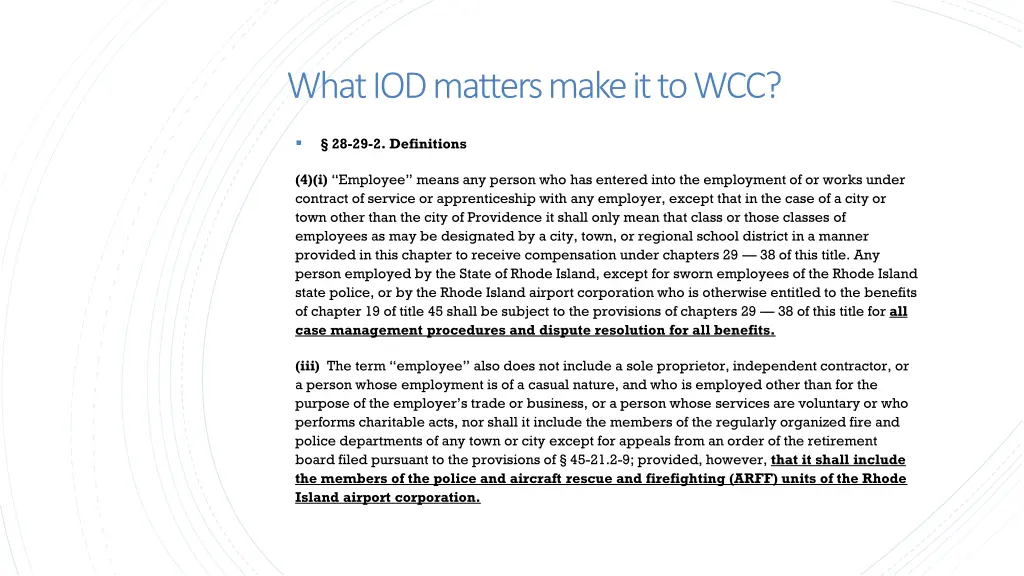
What IOD matters make it to WCC? 28-29-2. Definitions (4)(i) Employee means any person who has entered into the employment of or works under contract of service or apprenticeship with any employer, except that in the case of a city or town other than the city of Providence it shall only mean that class or those classes of employees as may be designated by a city, town, or regional school district in a manner provided in this chapter to receive compensation under chapters 29 38 of this title. Any person employed by the State of Rhode Island, except for sworn employees of the Rhode Island state police, or by the Rhode Island airport corporation who is otherwise entitled to the benefits of chapter 19 of title 45 shall be subject to the provisions of chapters 29 38 of this title for all case management procedures and dispute resolution for all benefits. (iii)The term employee also does not include a sole proprietor, independent contractor, or a person whose employment is of a casual nature, and who is employed other than for the purpose of the employer s trade or business, or a person whose services are voluntary or who performs charitable acts, nor shall it include the members of the regularly organized fire and police departments of any town or city except for appeals from an order of the retirement board filed pursuant to the provisions of 45-21.2-9; provided, however, that it shall include the members of the police and aircraft rescue and firefighting (ARFF) units of the Rhode Island airport corporation.
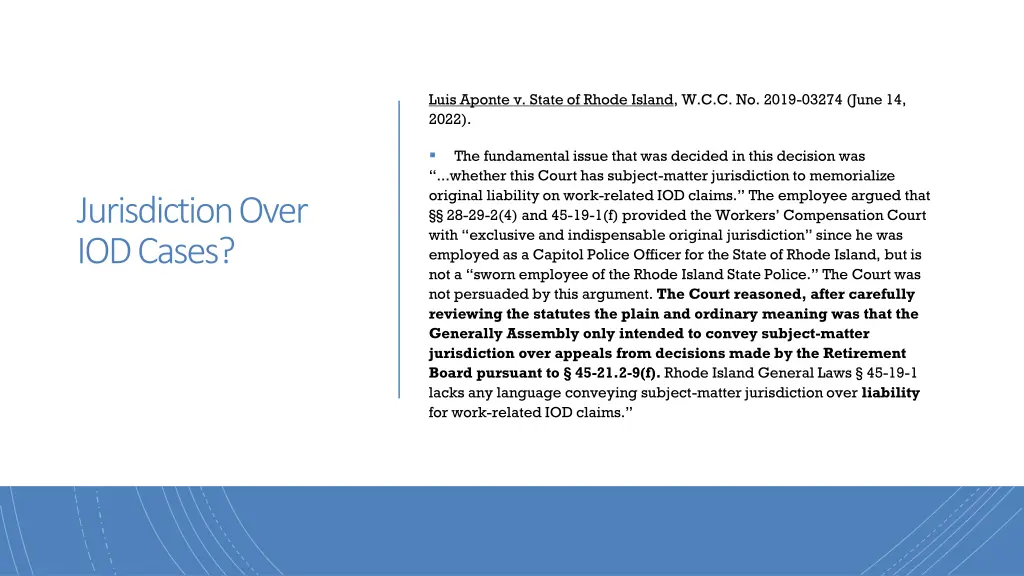
Luis Aponte v. State of Rhode Island, W.C.C. No. 2019-03274 (June 14, 2022). ...whether this Court has subject-matter jurisdiction to memorialize original liability on work-related IOD claims. The employee argued that 28-29-2(4) and 45-19-1(f) provided the Workers Compensation Court with exclusive and indispensable original jurisdiction since he was employed as a Capitol Police Officer for the State of Rhode Island, but is not a sworn employee of the Rhode Island State Police. The Court was not persuaded by this argument. The Court reasoned, after carefully reviewing the statutes the plain and ordinary meaning was that the Generally Assembly only intended to convey subject-matter jurisdiction over appeals from decisions made by the Retirement Board pursuant to 45-21.2-9(f). Rhode Island General Laws 45-19-1 lacks any language conveying subject-matter jurisdiction over liability for work-related IOD claims. The fundamental issue that was decided in this decision was Jurisdiction Over IOD Cases?
IOD Benefits Statute & Who is Covered firefighter, crash rescue crewperson, fire marshal, chief deputy fire marshal, is injured or becomes sick while performing his or her duties or rendering emergency assistance within the physical boundaries of Rhode Island (off duty), the employer shall during the incapacity pay the salary or wage and benefits to the employee that they would be entitled to had they not been incapacitated. Additionally, they shall pay for the medical, surgical, dental, optical, or other attendance, or treatment, nurses, and hospital services, medicines, crutches, and apparatus for the necessary period. RIGL 45-19-1(a): Any police officer of the Rhode Island airport corporation or when ever any police officer, Except if there is insurance coverage for the related treatment they need only pay the difference between the maximum amount allowable under the insurance coverage and the actual cost of the treatment. regularly employed at a fixed salary or wage and any deputy sheriff, member of the fugitive task force, or capital police officer, permanent environmental police officer or criminal investigator of the department of environmental management, or airport police officer. 45-19-1(b). Defines Police Officer - Includes any chief or other member of the police department of any city or town city, town, or fire district, any person employed as a member of the fire department. 45-19-1(c). Defines Firefighter - includes any chief or other member of the fire department or rescue personnel of any section, division of airports, or department of transportation of the State of Rhode Island regularly employed at a fixed salary or wage. 45-19-1(d). Defines Crash Rescue Crewperson - includes any chief or other member of the emergency crash rescue regularly employed by the State of Rhode Island pursuant to the provision of chapter 28.2 of title 23. 45-19-1(e). Defines Fire Marshall - Includes the fire marshal, chief deputy fire marshal, and deputy fire marshals
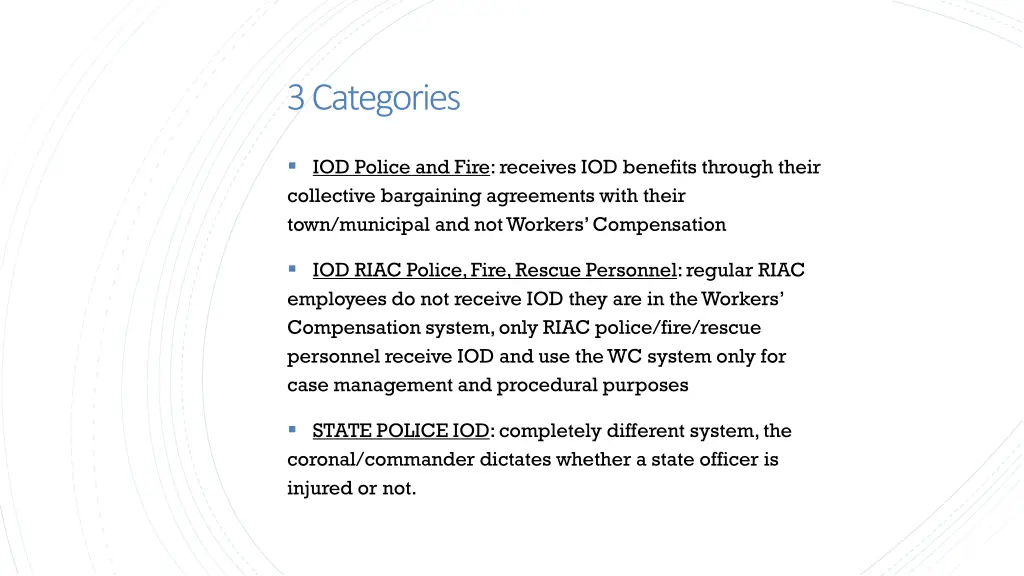
3 Categories IOD Police and Fire: receives IOD benefits through their collective bargaining agreements with their town/municipal and not Workers Compensation IOD RIAC Police, Fire, Rescue Personnel: regular RIAC employees do not receive IOD they are in the Workers Compensation system, only RIAC police/fire/rescue personnel receive IOD and use the WC system only for case management and procedural purposes STATE POLICE IOD: completely different system, the coronal/commander dictates whether a state officer is injured or not.
Different Treatment for Case management and dispute resolution of IOD claims Thomas Martin v. RIAC, W.C.C. No. 2022-02577, W.C.C. No. 2022-02746, W.C.C. No. 2022-02747 (Nov. 22, 2024). alternative employment ( SAE ) from the WCA are applicable given the statutory enablement from 2008 that brings RIAC police and crash rescue personnel to this court. The issue in this case was whether the statutory definition and remedies for refusal of suitable this Court deems itself bound by the Pion decision and the earlier cited case law of Wayland Health Center v. Loweto accept the SAE as being procedural. The Court found that a Statute cannot be both procedural and substantive simultaneously and thus procedure and would apply to the case at hand to determine if the offer for SAE was appropriate and/or if the refusal was wrongful. Thus, the procedural statute, R.I. Gen. Laws 28-33-18.2 for SAE, is considered case management Carlos Jerez v. Rhode Island Airport Corporation, W.C.C. No. 2025-00389 (Pr. Tr. Order Feb. 19, 2025). for the successful petition. The Employer took a Claim for Trial on February 20, 2025, for the Award of disfigurement and attorney s fees. At the Pretrial Level, the Judge awarded the injured worker Disfigurement Benefits and Attorney s fees
WCC Jurisdiction Over Different Retirement Board Claims There are two central Retirement systems in the State of RIMunicipal employees retirement system ( MERS ) and Employee s Retirement system of the State of Rhode Island ( ERSRI ) RIAC Police and Fire used to have to go to Superior Court for appeal when pension board denied them, now they come to Workers Compensation Court to hear their appeal for accidental disability Teachers cannot Accidental disability pension appeal comes de novo An aggrieved party of MERS has a right to appeal to the Worker s Compensation court, whereas an aggrieved party applying to the ERSRI system does not have such a right. Sean M. O Connell vs. Employee s Retirement System of Rhode Island At a hearing on the Employer s the Motion to Dismiss for lack of jurisdiction, the Judge found that there was jurisdiction. The Judge found the argument that since the Employee was part of ERSRI and not MERS, did not take away jurisdiction through 45-21.2-9. The Court reasoned that a deputy sheriff under the statute is included in the definition of a police officer, which the Court has jurisdiction over in 45-19-1 IOD matters. Status: On October 14, 2024, the Supreme Court granted Writ of Certiorari, and the Case is in the pre- briefing Process
MERS The Municipal Employees Retirement System (MERS) is established in 45-21-32 Retirement system for employees of participating municipal employers Includes an optional retirement plan that is an alternative retirement plan for municipal police and firefighters - established through - 45-21.2-1 45-21.2-25 Optional Retirement for Members of Police Force and Firefighters opted into the Optional Retirement Plan for police and firefighters outlined in chapter 21.2 of title 45 45-21-2-9 (f) creates the right to appeal in the WCC for aggrieved municipal police officers and firemen who have injury or illness occurring on or after July 1, 2011,the party may submit an appeal to the Rhode Island workers compensation court. The appellant shall file a notice of appeal with the retirement board and with the workers compensation court within twenty (20) days of the entry of the retirement board s decision and shall serve a copy of the notice of appeal upon the opposing party. (f) In the event that any party is aggrieved by the determination of the retirement board pursuant to 45-19-1, for an In these instances, the WCC hears these appeals de novo 45-21.2-9 Lays out Accidental Disability Retirement (ADR) (for police officers and firefighters 45-21.2) (note: NOT for state employees) After IOD benefits are awarded for a period of time, Cops and firefighters MUST file for accidental disability retirement or risk losing their IOD benefits This does NOT apply to RIAC members, who can continue to keep receiving IOD they are not eligible for ADR
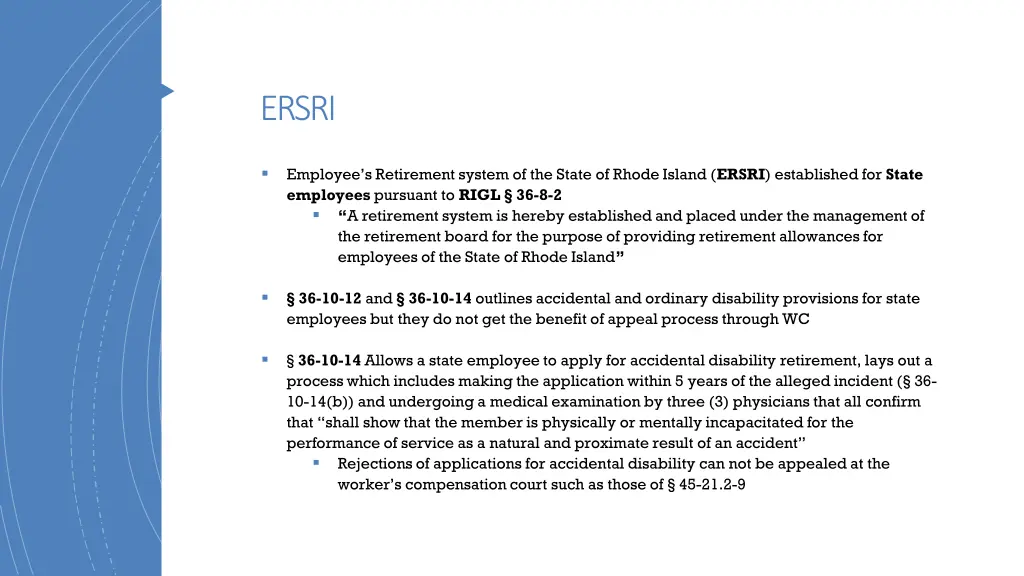
ERSRI Employee s Retirement system of the State of Rhode Island (ERSRI) established for State employees pursuant to RIGL 36-8-2 A retirement system is hereby established and placed under the management of the retirement board for the purpose of providing retirement allowances for employees of the State of Rhode Island 36-10-12 and 36-10-14 outlines accidental and ordinary disability provisions for state employees but they do not get the benefit of appeal process through WC 36-10-14 Allows a state employee to apply for accidental disability retirement, lays out a process which includes making the application within 5 years of the alleged incident ( 36- 10-14(b)) and undergoing a medical examination by three (3) physicians that all confirm that shall show that the member is physically or mentally incapacitated for the performance of service as a natural and proximate result of an accident Rejections of applications for accidental disability can not be appealed at the worker s compensation court such as those of 45-21.2-9
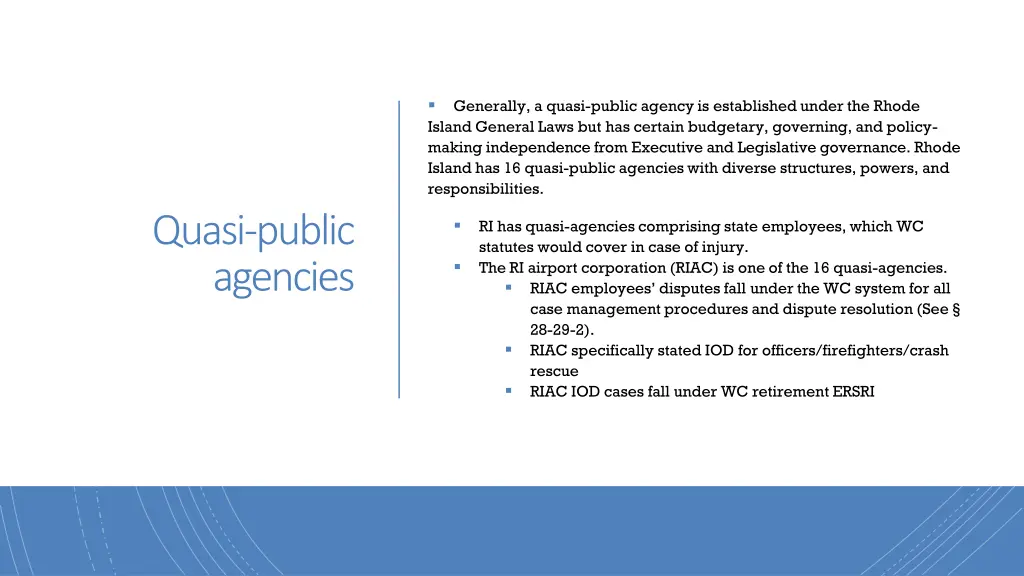
Island General Laws but has certain budgetary, governing, and policy- making independence from Executive and Legislative governance. Rhode Island has 16 quasi-public agencies with diverse structures, powers, and responsibilities. Generally, a quasi-public agency is established under the Rhode Quasi-public agencies RI has quasi-agencies comprising state employees, which WC statutes would cover in case of injury. The RI airport corporation (RIAC) is one of the 16 quasi-agencies. RIAC employees disputes fall under the WC system for all case management procedures and dispute resolution (See 28-29-2). RIAC specifically stated IOD for officers/firefighters/crash rescue RIAC IOD cases fall under WC retirement ERSRI
RIAC Collective Bargaining Agreement (July 1, 2021 June 30, 2024) Article 13 SICK LEAVE
RIAC Collective Bargaining Agreement (July 1, 2021 June 30, 2024) (cont.) Article 46 TRANSITIONAL EMPLOYMENT / LIGHT DUTY/ RETIREMENT AGE