Welfare Analysis in Economic Surplus

Economic surplus, the net gains from market trades, comprises consumer and producer surplus. Understanding marginal benefit of consumers and demand curves is crucial in evaluating market outcomes and government interventions. Consumer surplus represents total benefit from consuming a good, exceeding the cost paid. Explore more on welfare analysis and its significance in economic evaluations.

Download Presentation

Please find below an Image/Link to download the presentation.
The content on the website is provided AS IS for your information and personal use only. It may not be sold, licensed, or shared on other websites without obtaining consent from the author.If you encounter any issues during the download, it is possible that the publisher has removed the file from their server.
You are allowed to download the files provided on this website for personal or commercial use, subject to the condition that they are used lawfully. All files are the property of their respective owners.
The content on the website is provided AS IS for your information and personal use only. It may not be sold, licensed, or shared on other websites without obtaining consent from the author.
E N D
Presentation Transcript
Economics 2 Emmanuel Saez Fall 2024 LECTURE 4 Welfare Analysis
Welfare Analysis An extension of the supply and demand framework: It is a tool that helps us evaluate the desirability of market outcomes. It is a tool that we will use over and over: To evaluate the effects of government intervention. To understand market failures.
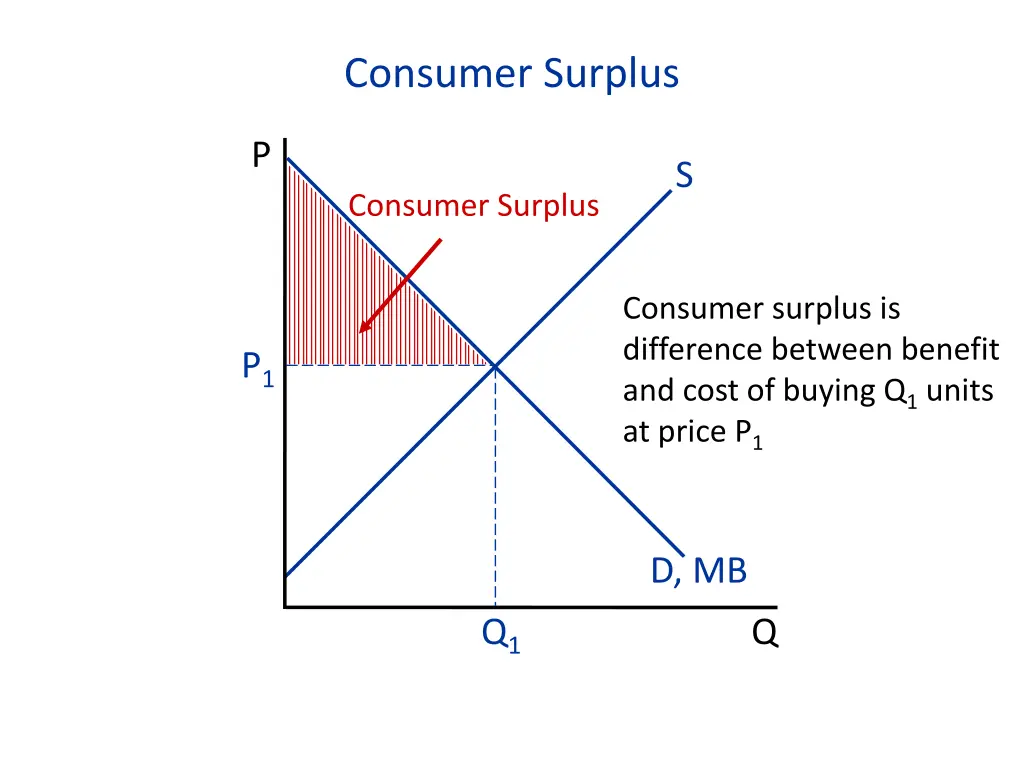
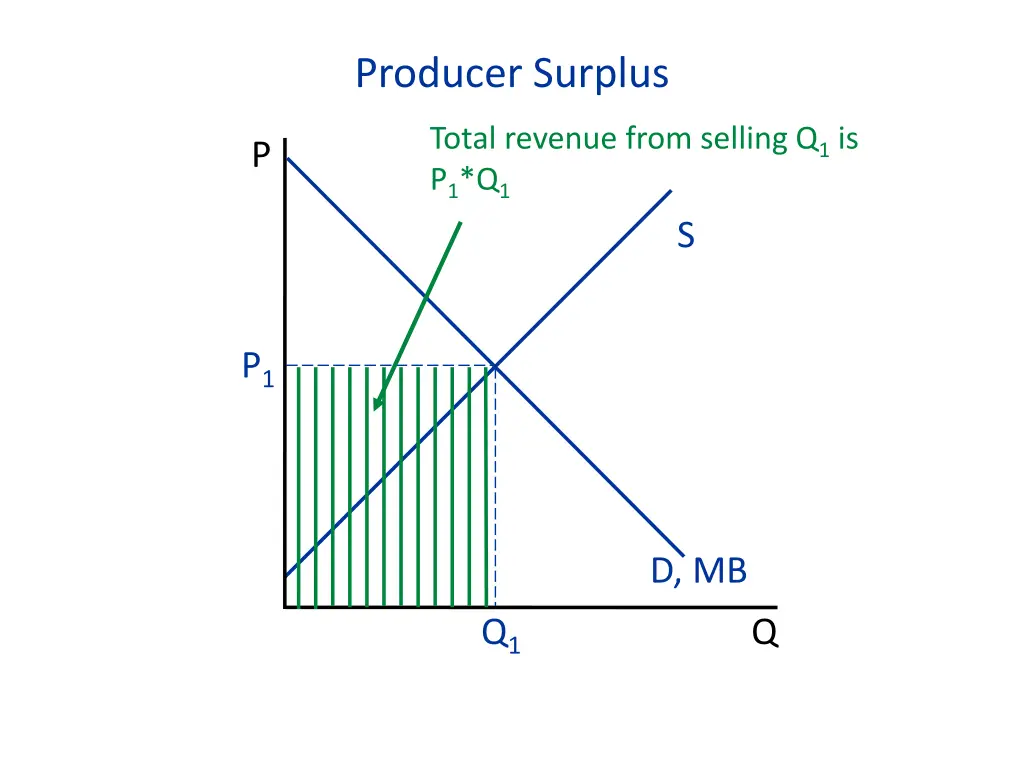
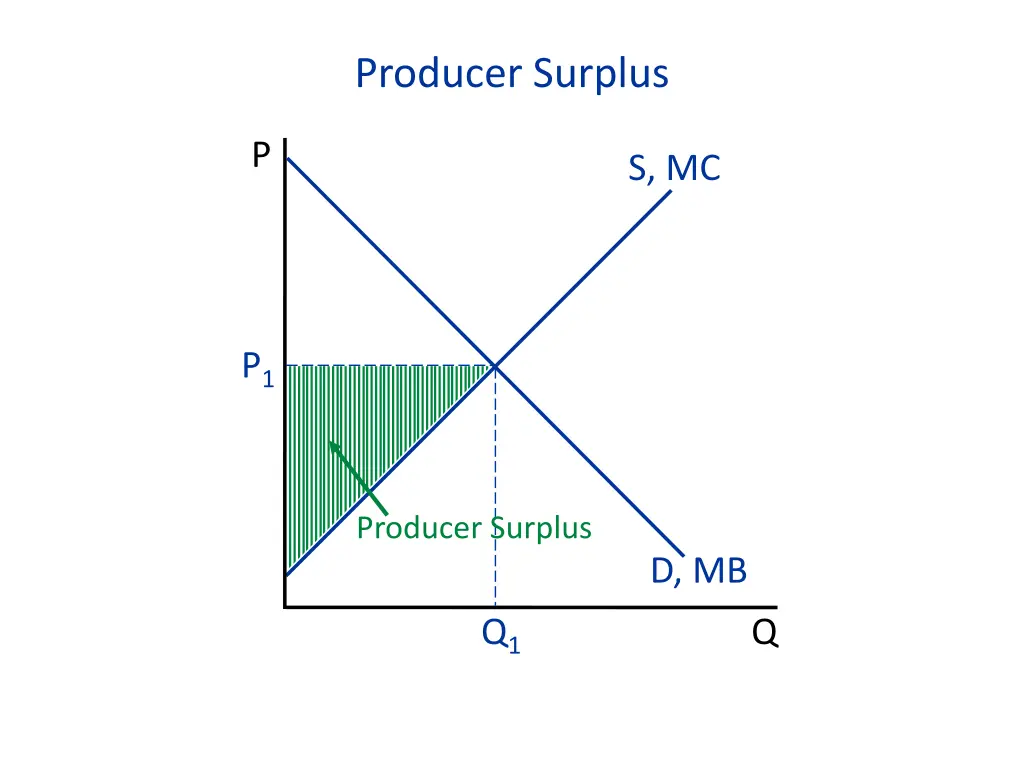
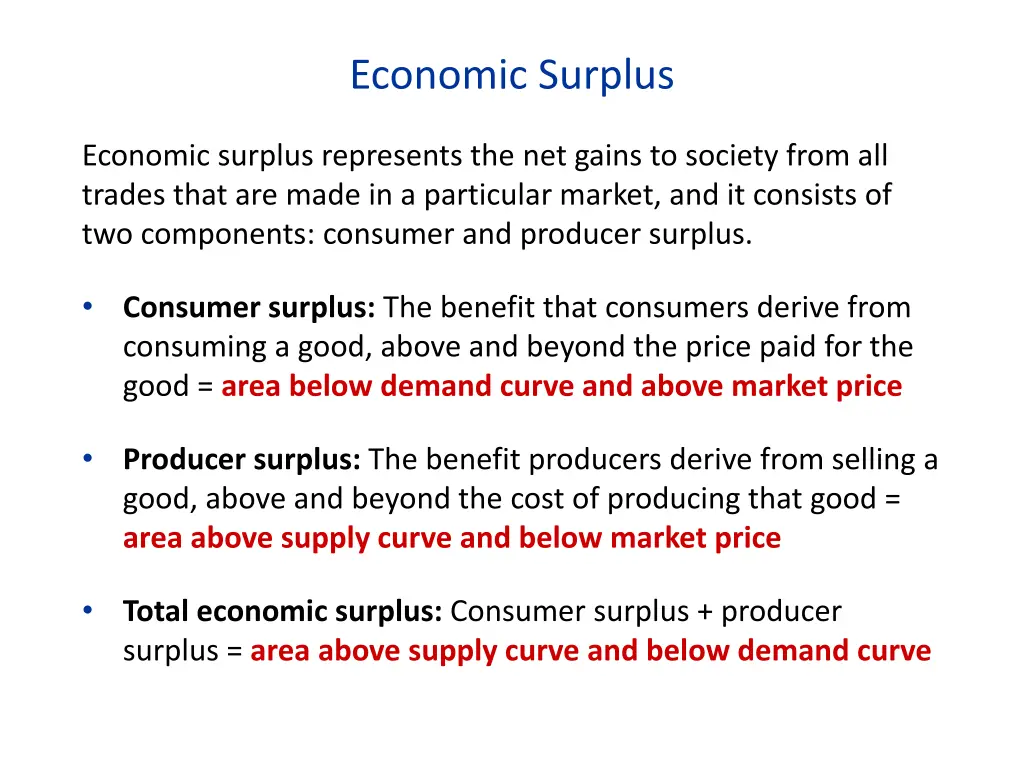
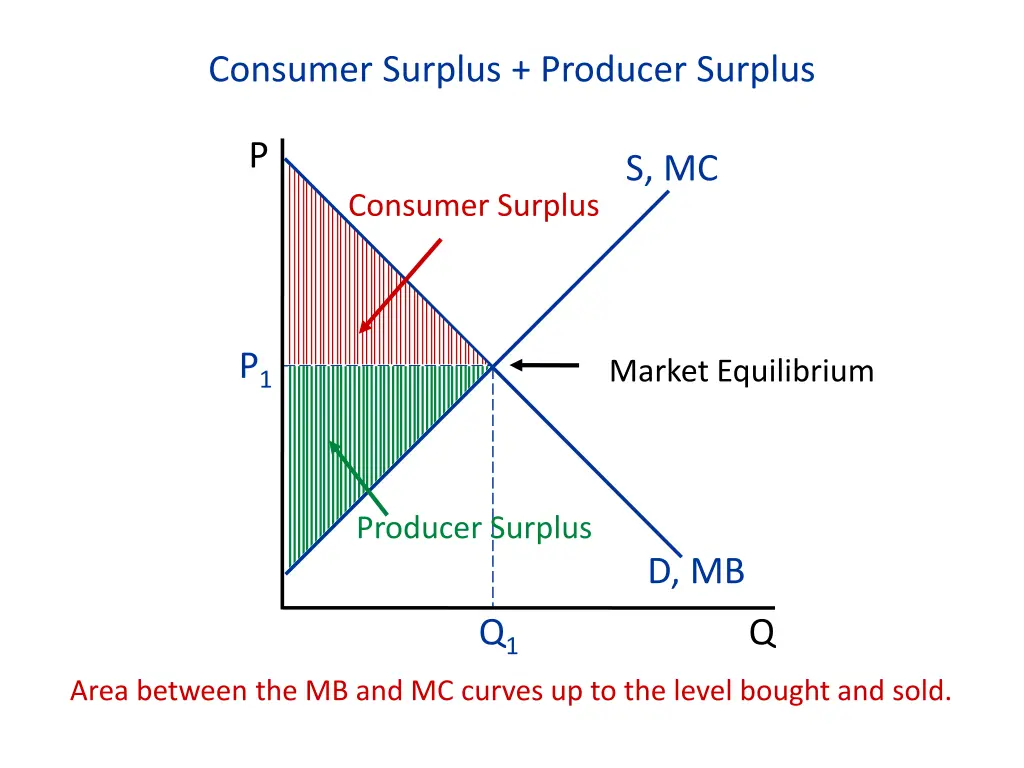
Economic Surplus Economic surplus represents the net gains to society from all trades that are made in a particular market, and it consists of two components: consumer and producer surplus. Consumer surplus: The benefit that consumers derive from consuming a good, above and beyond the price paid for the good Producer surplus: The benefit producers derive from selling a good, above and beyond the cost of producing that good Total economic surplus: Consumer surplus + producer surplus
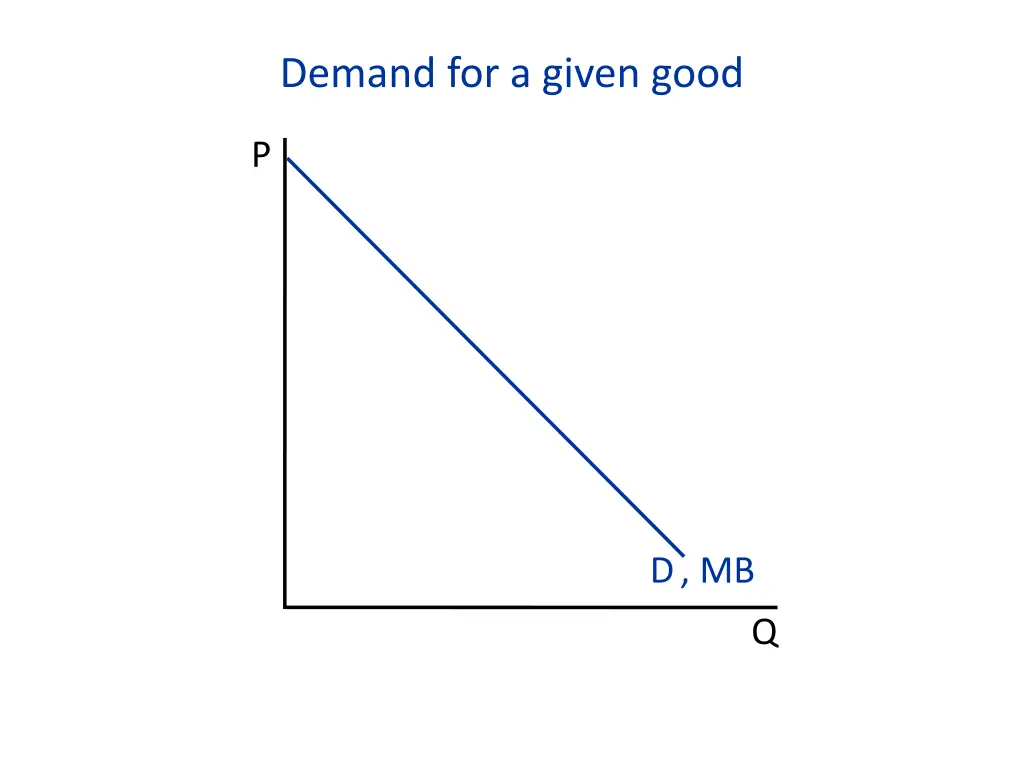
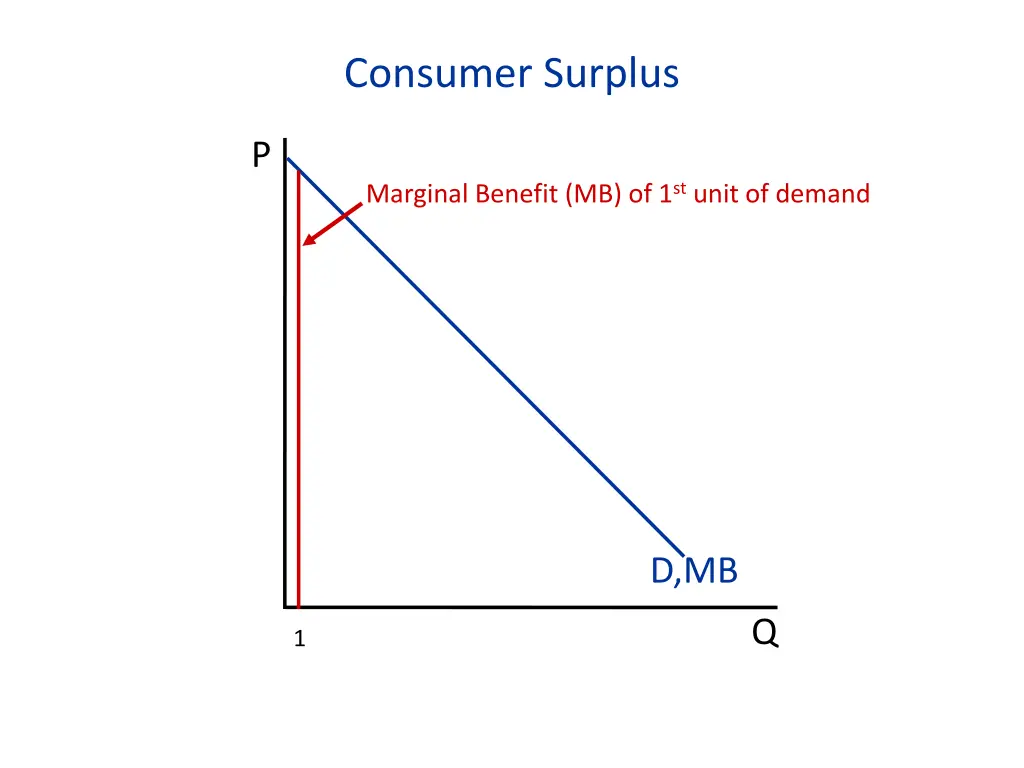
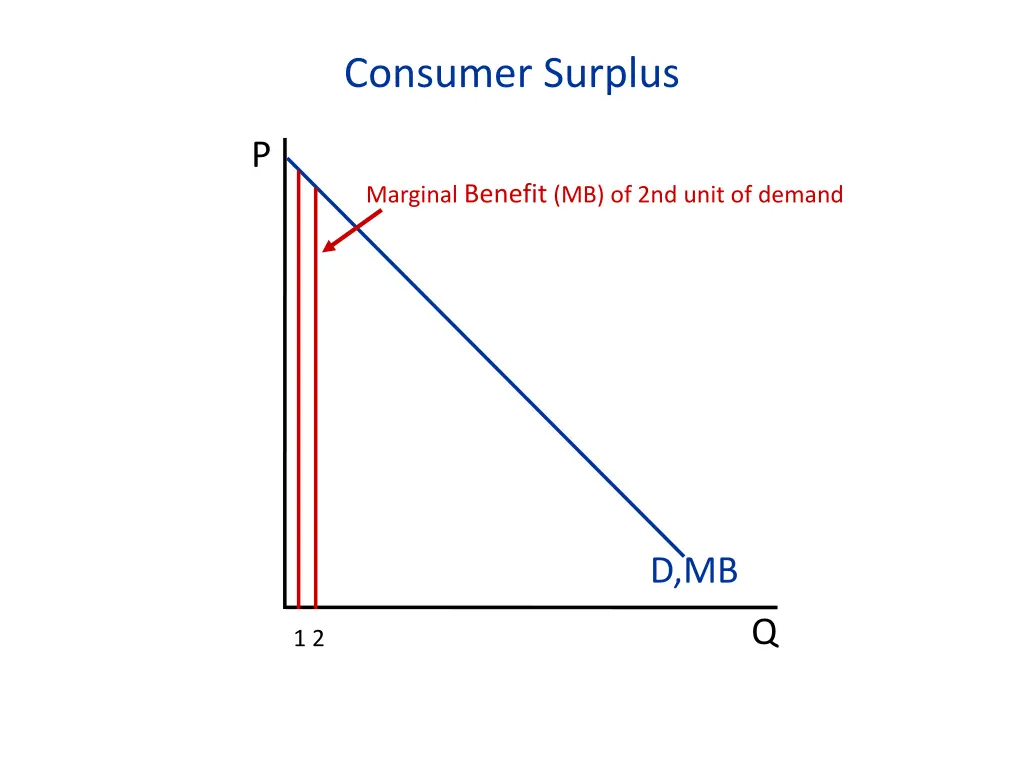
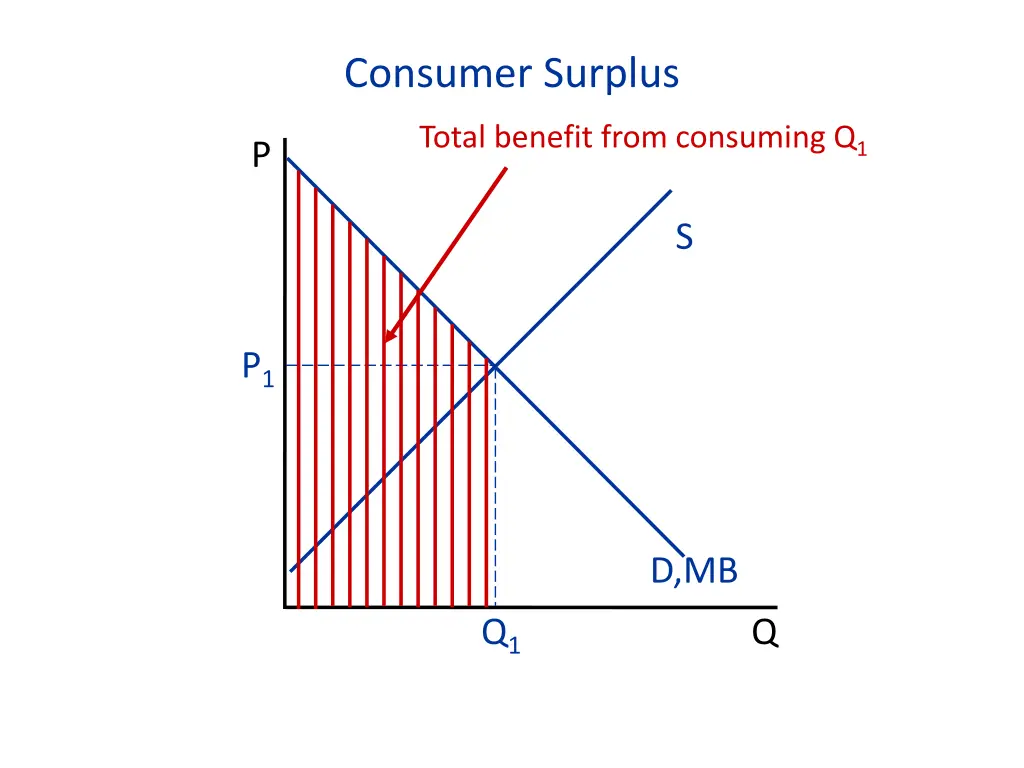
Marginal Benefit of Consumers The dollar value to consumers of another unit of a good. What they would be willing to pay for one more unit. The vertical distance of the demand curve gives the marginal benefit of an extra unit of good Demand curve can be read as: Demand as a function of price: Q=D(P) Marginal benefit of Qth unit of good: P=MB(Q)
Demand for a given good P D, MB Q
Consumer Surplus P Marginal Benefit (MB) of 1st unit of demand D,MB Q 1
Consumer Surplus P Marginal Benefit (MB) of 2nd unit of demand D,MB Q 1 2
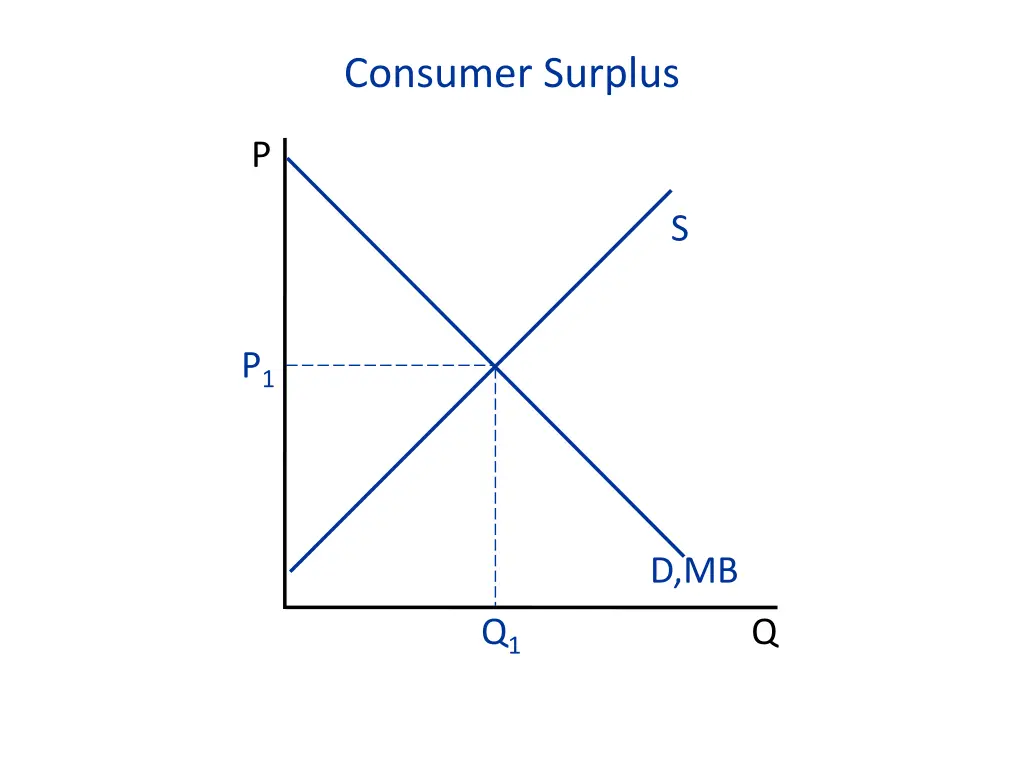
Consumer Surplus P S P1 D,MB Q1 Q
Consumer Surplus Total benefit from consuming Q1 P S P1 D,MB Q1 Q
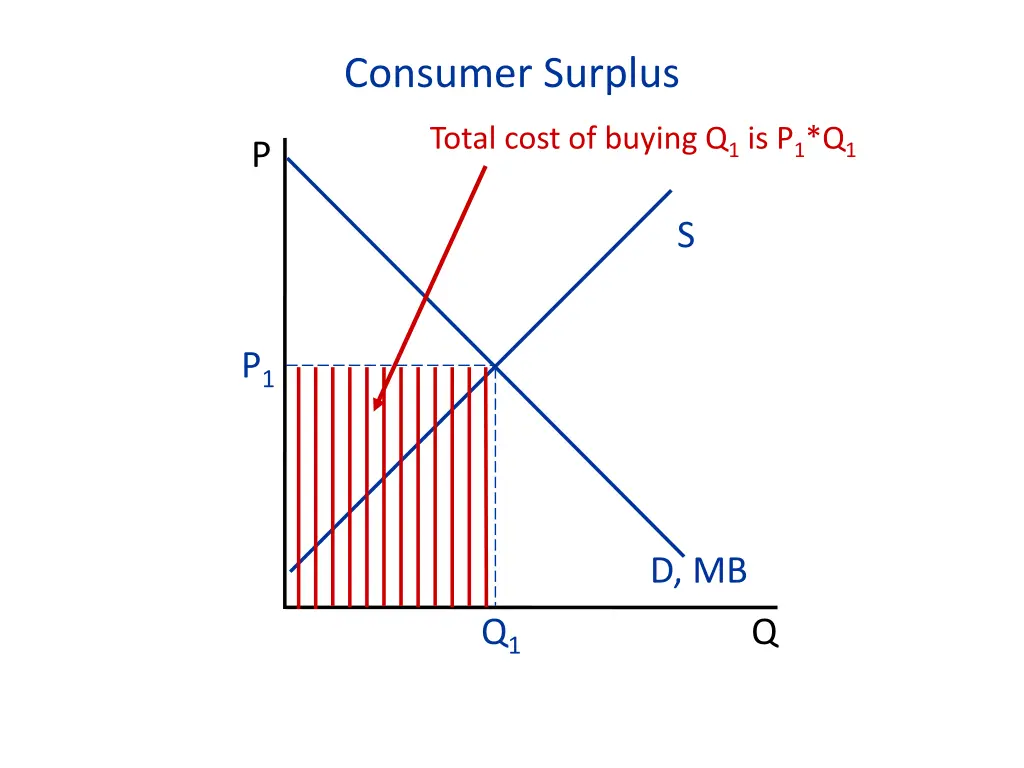
Consumer Surplus Total cost of buying Q1 is P1*Q1 P S P1 D, MB Q1 Q
Consumer Surplus P S Consumer Surplus Consumer surplus is difference between benefit and cost of buying Q1 units at price P1 P1 D, MB Q1 Q
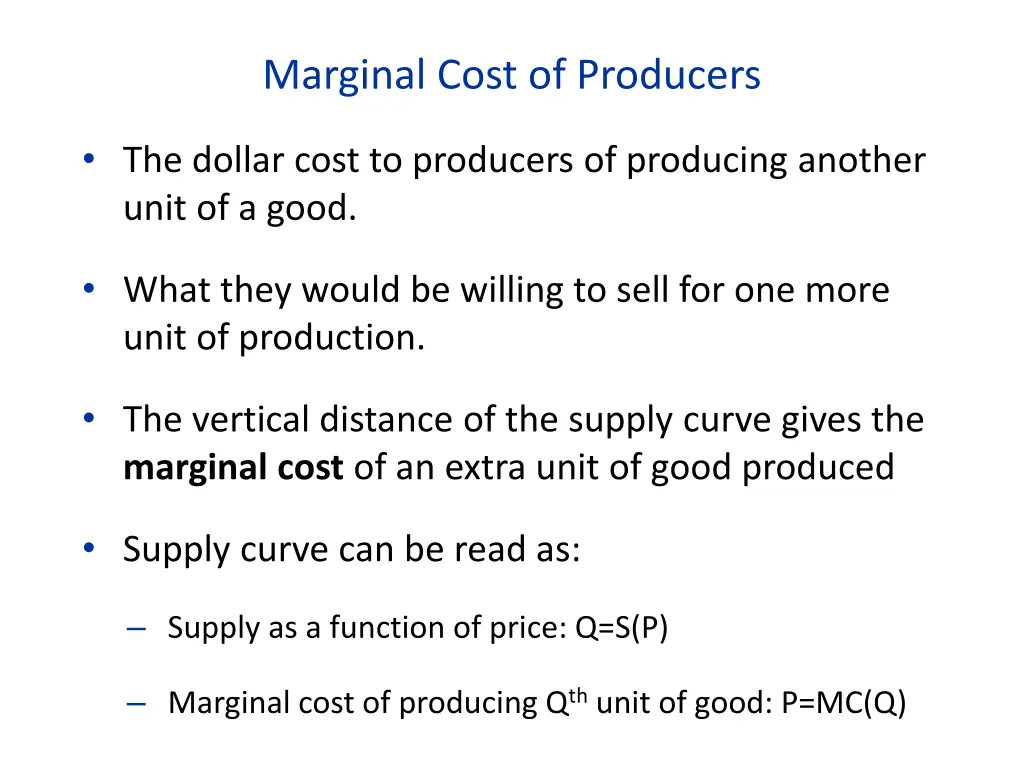
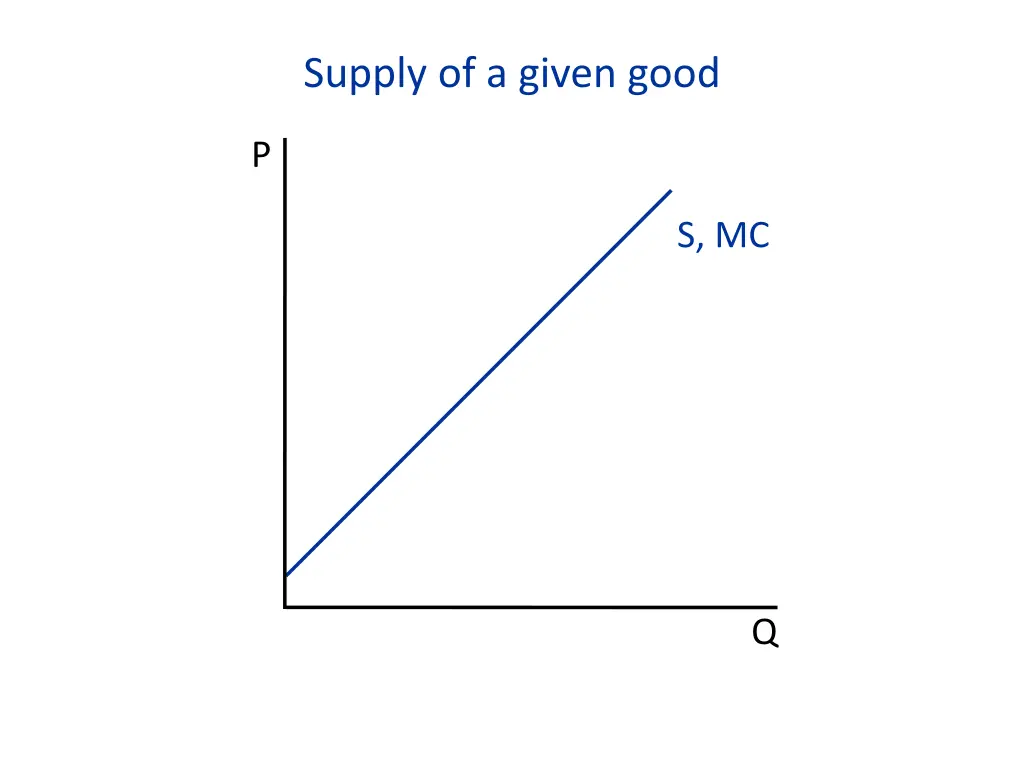
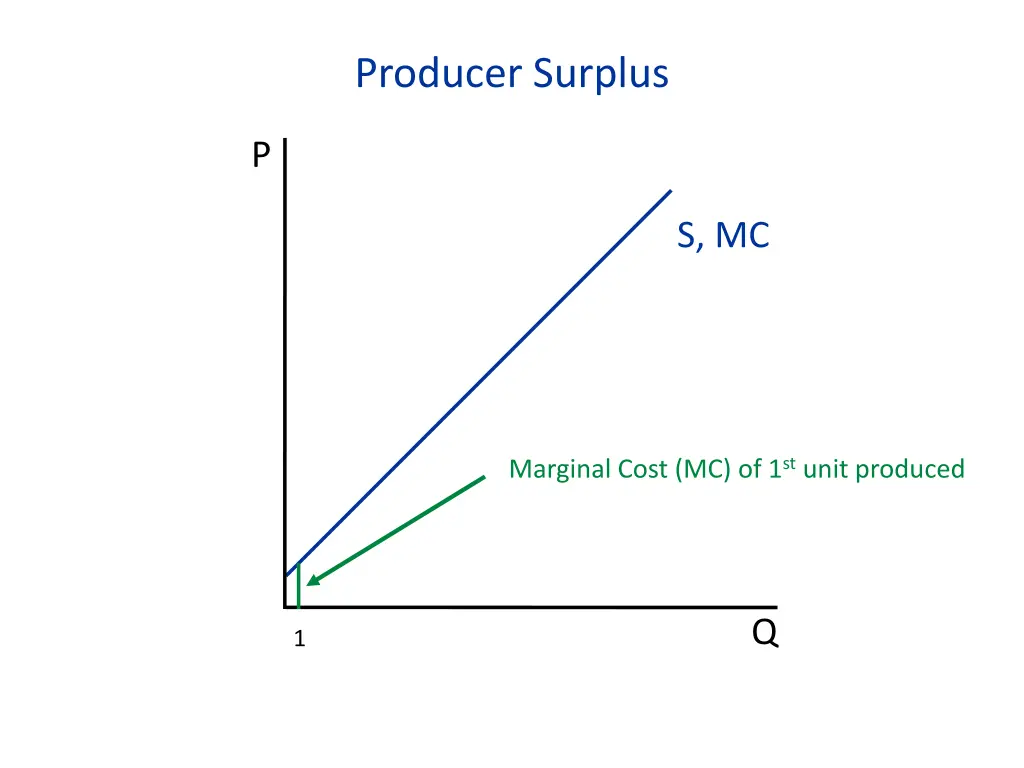
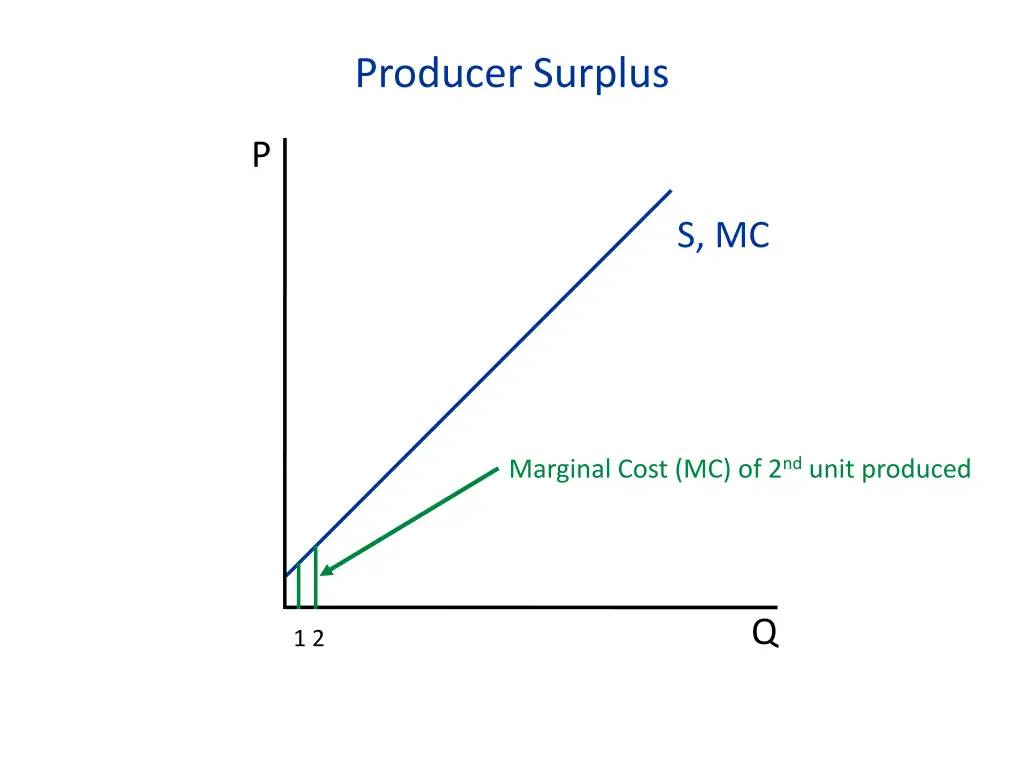
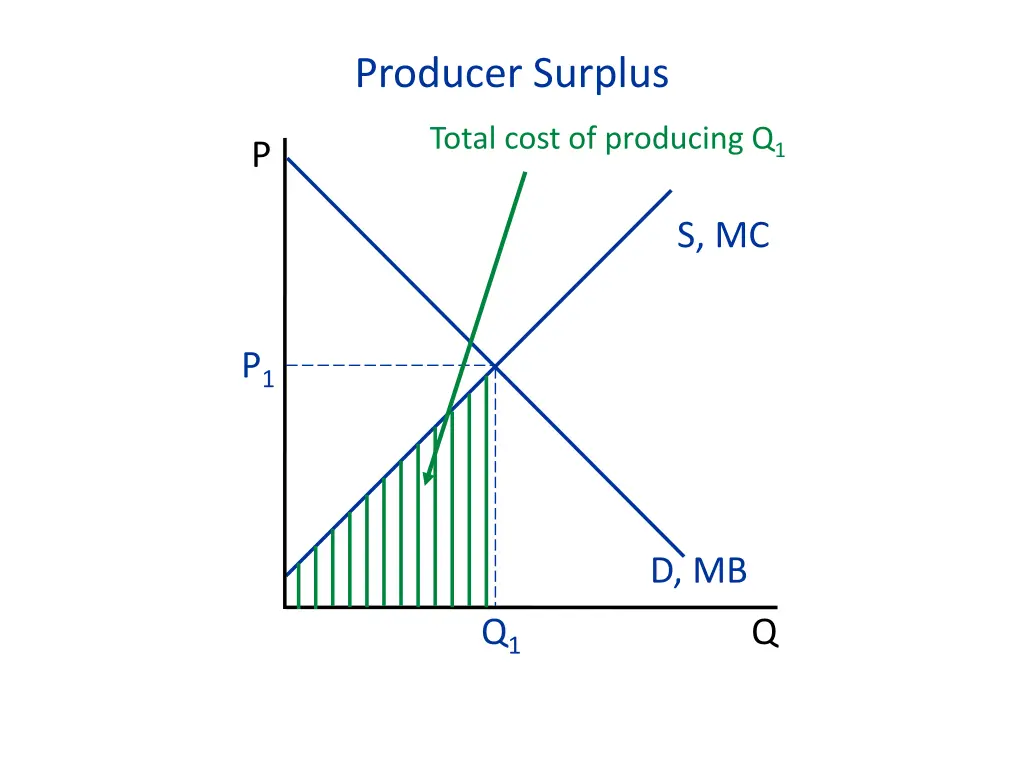
Marginal Cost of Producers The dollar cost to producers of producing another unit of a good. What they would be willing to sell for one more unit of production. The vertical distance of the supply curve gives the marginal cost of an extra unit of good produced Supply curve can be read as: Supply as a function of price: Q=S(P) Marginal cost of producing Qth unit of good: P=MC(Q)
Supply of a given good P S, MC Q
Producer Surplus P S, MC Marginal Cost (MC) of 1st unit produced Q 1
Producer Surplus P S, MC Marginal Cost (MC) of 2nd unit produced Q 1 2
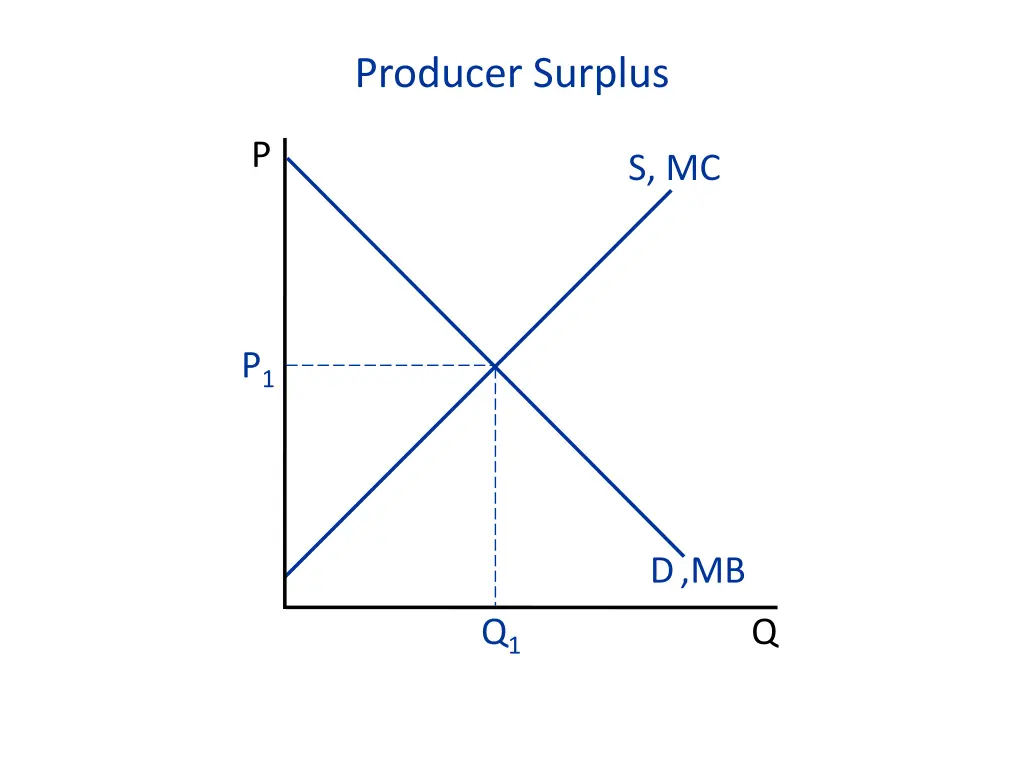
Producer Surplus P S, MC P1 D,MB Q1 Q
Producer Surplus Total cost of producing Q1 P S, MC P1 D, MB Q1 Q
Producer Surplus Total revenue from selling Q1 is P1*Q1 P S P1 D, MB Q1 Q
Producer Surplus P S, MC P1 Producer Surplus D, MB Q1 Q
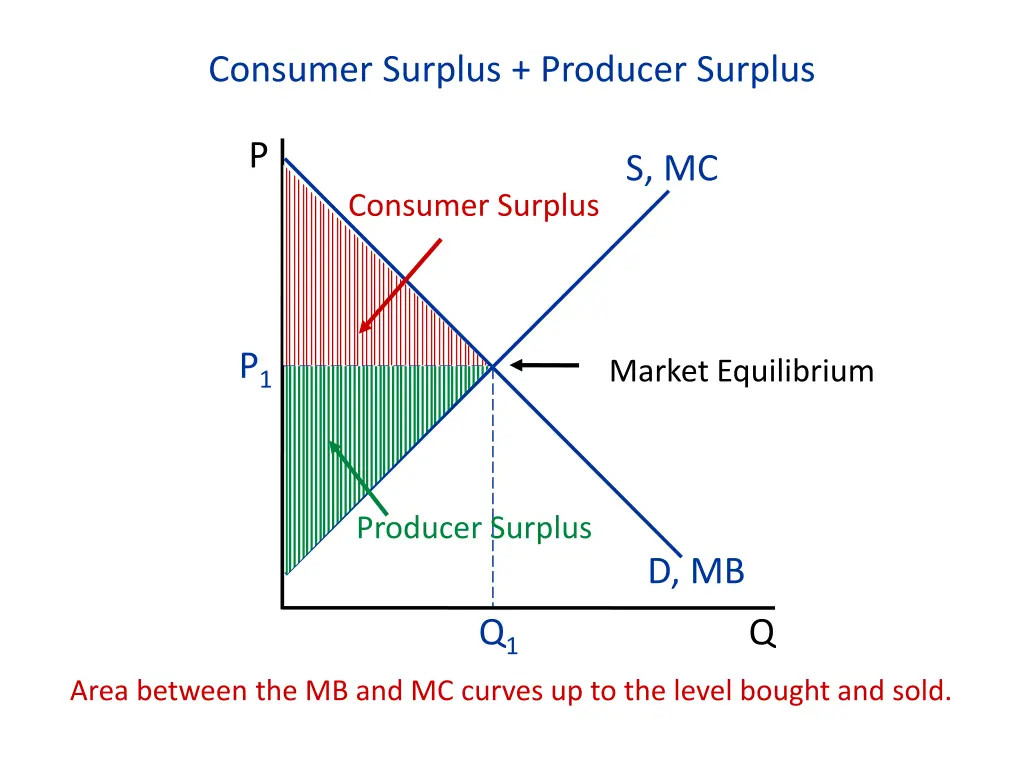
Consumer Surplus + Producer Surplus P S, MC Consumer Surplus P1 Market Equilibrium Producer Surplus D, MB Q1 Q Area between the MB and MC curves up to the level bought and sold.
Economic Surplus Economic surplus represents the net gains to society from all trades that are made in a particular market, and it consists of two components: consumer and producer surplus. Consumer surplus: The benefit that consumers derive from consuming a good, above and beyond the price paid for the good = area below demand curve and above market price Producer surplus: The benefit producers derive from selling a good, above and beyond the cost of producing that good = area above supply curve and below market price Total economic surplus: Consumer surplus + producer surplus = area above supply curve and below demand curve
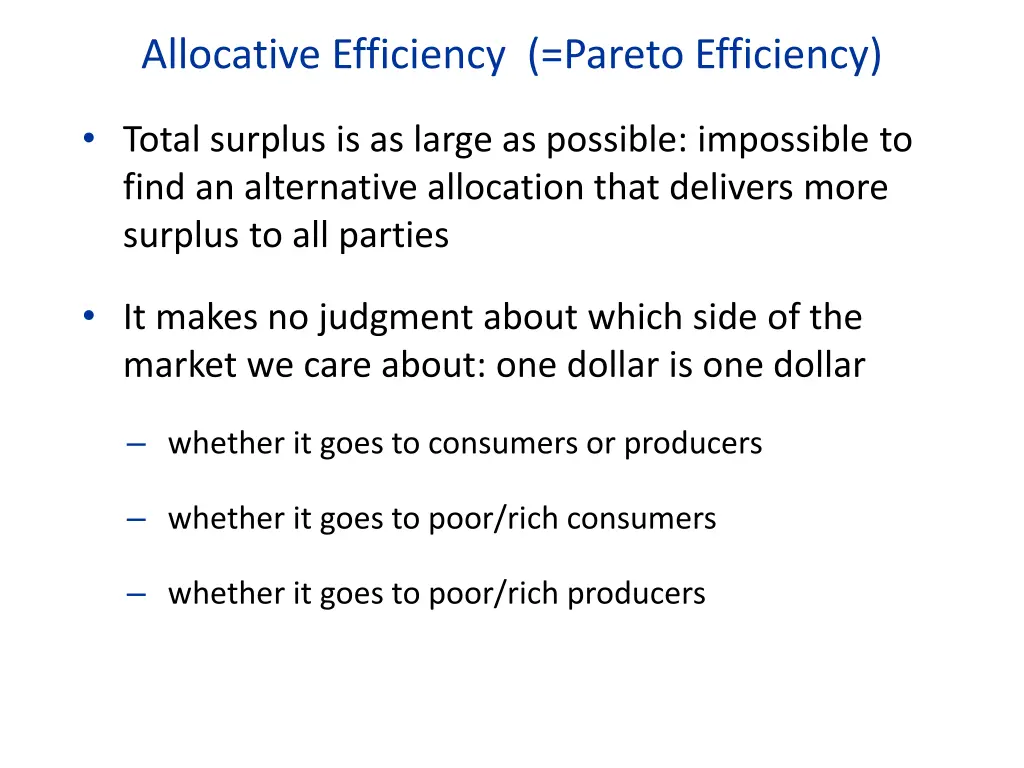
Allocative Efficiency (=Pareto Efficiency) Total surplus is as large as possible: impossible to find an alternative allocation that delivers more surplus to all parties It makes no judgment about which side of the market we care about: one dollar is one dollar whether it goes to consumers or producers whether it goes to poor/rich consumers whether it goes to poor/rich producers
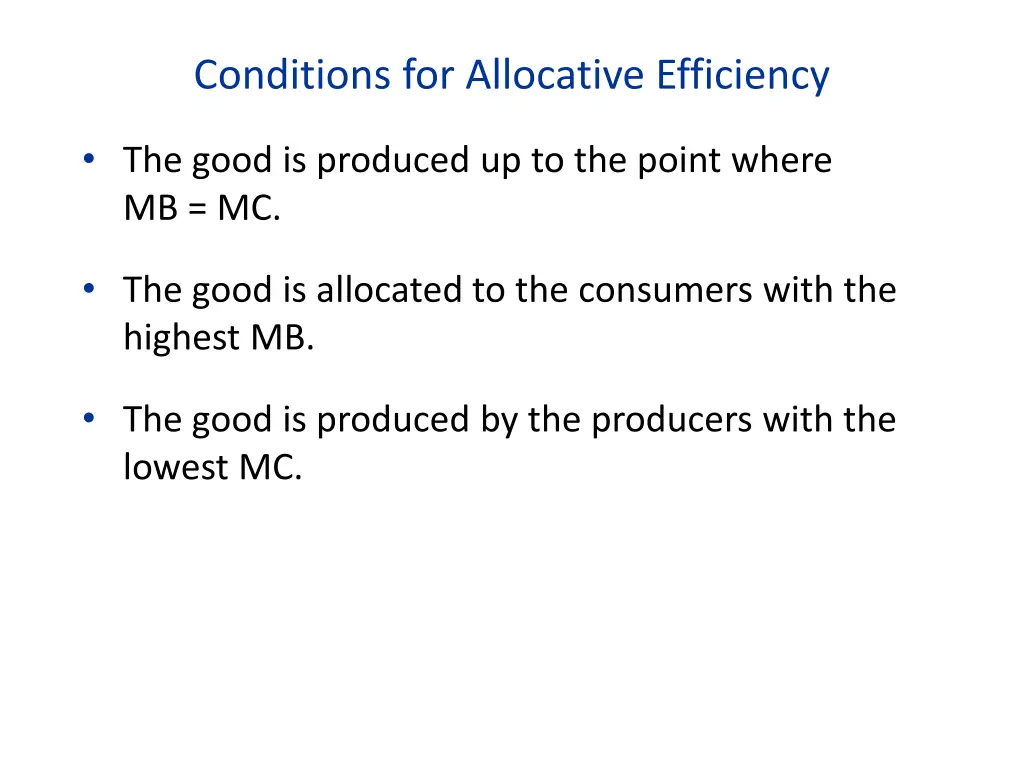
Conditions for Allocative Efficiency The good is produced up to the point where MB = MC. The good is allocated to the consumers with the highest MB. The good is produced by the producers with the lowest MC.
Consumer Surplus + Producer Surplus P S, MC Consumer Surplus P1 Market Equilibrium Producer Surplus D, MB Q1 Q Area between the MB and MC curves up to the level bought and sold.
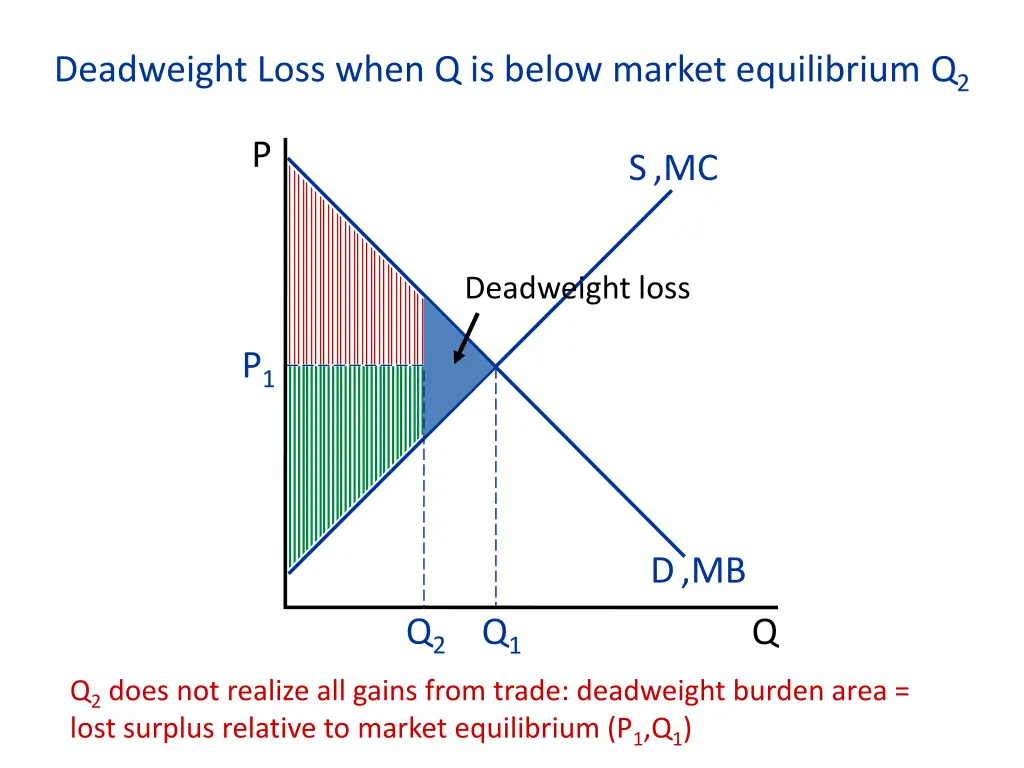
Deadweight Loss when Q is below market equilibrium Q2 P S,MC Deadweight loss P1 D,MB Q2 Q1 Q Q2 does not realize all gains from trade: deadweight burden area = lost surplus relative to market equilibrium (P1,Q1)
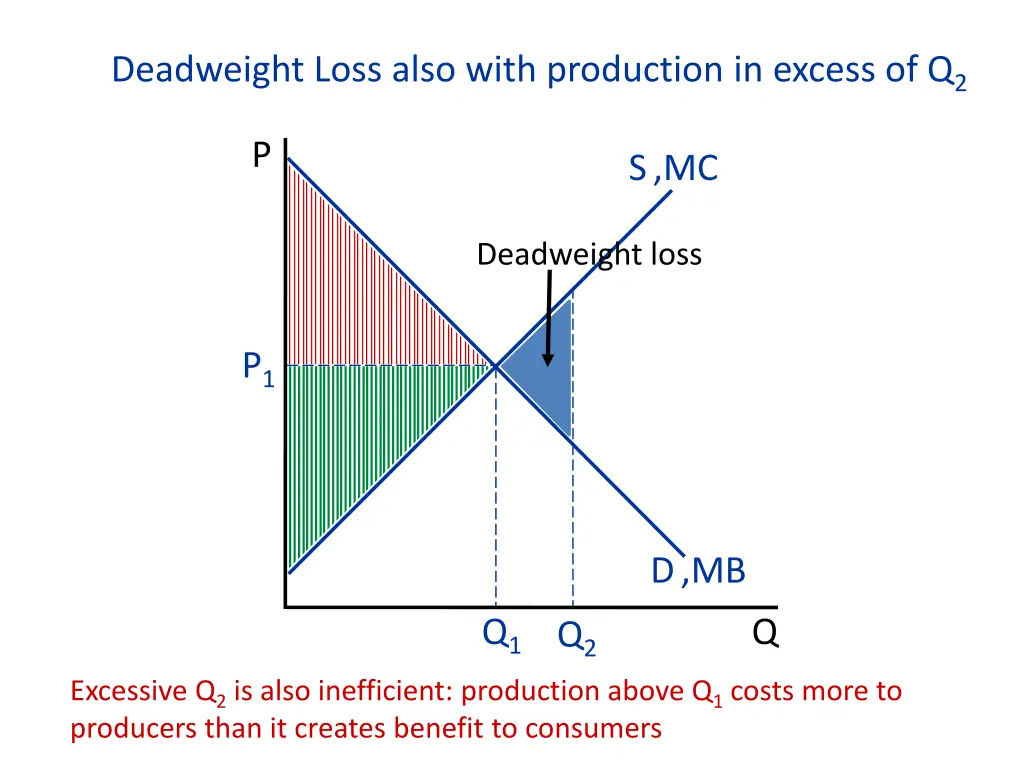
Deadweight Loss also with production in excess of Q2 P S,MC Deadweight loss P1 D,MB Q1 Q Q2 Excessive Q2 is also inefficient: production above Q1 costs more to producers than it creates benefit to consumers
Deadweight loss (=deadweight burden) Deadweight loss: The reduction in economic surplus from denying trades for which benefits exceed costs when quantity differs from the efficient quantity Implication: Both too little or too much production relative to efficiency create deadweight loss Key practical rule: Deadweight loss triangle points toward the efficient allocation, and grows outward to current quantity
Competitive Equilibrium Maximizes Economic Surplus First Theorem of Welfare Economics: Competitive equilibrium where supply equals demand, maximizes total economic surplus (=efficiency) The simple efficiency result from the 1-good diagram can be generalized into the first welfare theorem (Arrow-Debreu, 1940s): competitive markets are efficient.
Equity Issues Willingness to pay (which underlies consumer surplus) depends a lot on income. Economists measure of welfare doesn t take into account that consumers may enter the market with vastly different incomes. Economic surplus just counts dollars regardless of who gets them 1st welfare theorem is blind to distributional aspects
Equity and Efficiency Allocative efficiency is still a worthy goal. Interfering with the price system to improve equity may reduce efficiency. In general, there are equity vs. efficiency tradeoffs: we have to sacrifice some economic surplus to get a more equitable outcome
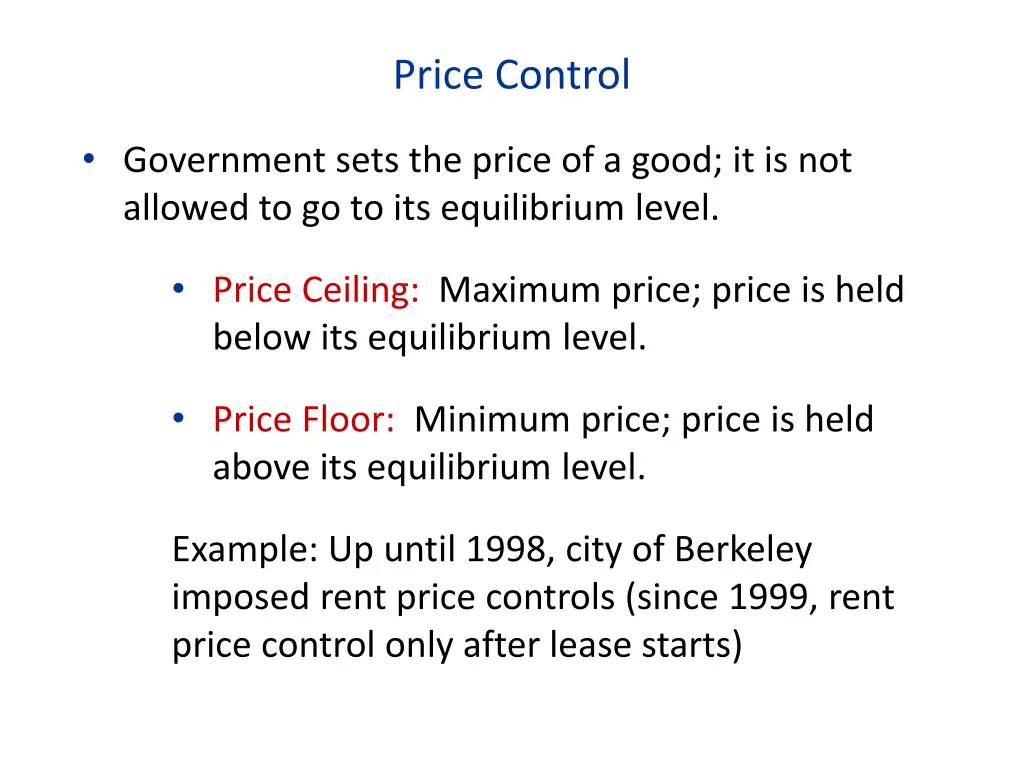
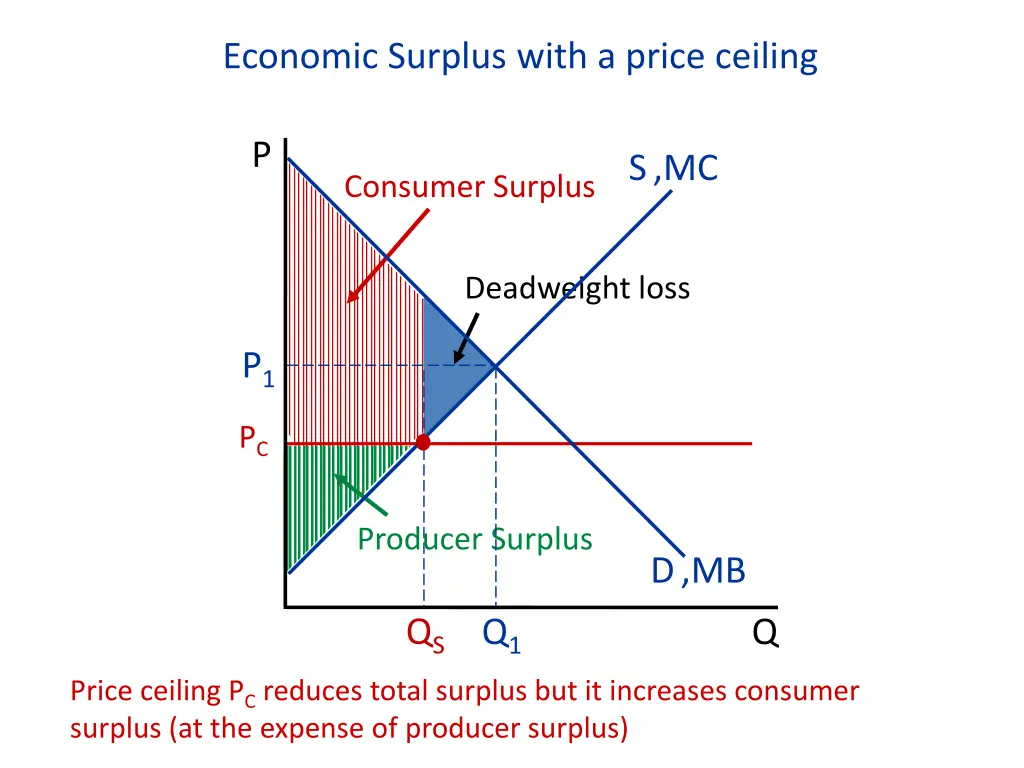
Price Control Government sets the price of a good; it is not allowed to go to its equilibrium level. Price Ceiling: Maximum price; price is held below its equilibrium level. Price Floor: Minimum price; price is held above its equilibrium level. Example: Up until 1998, city of Berkeley imposed rent price controls (since 1999, rent price control only after lease starts)
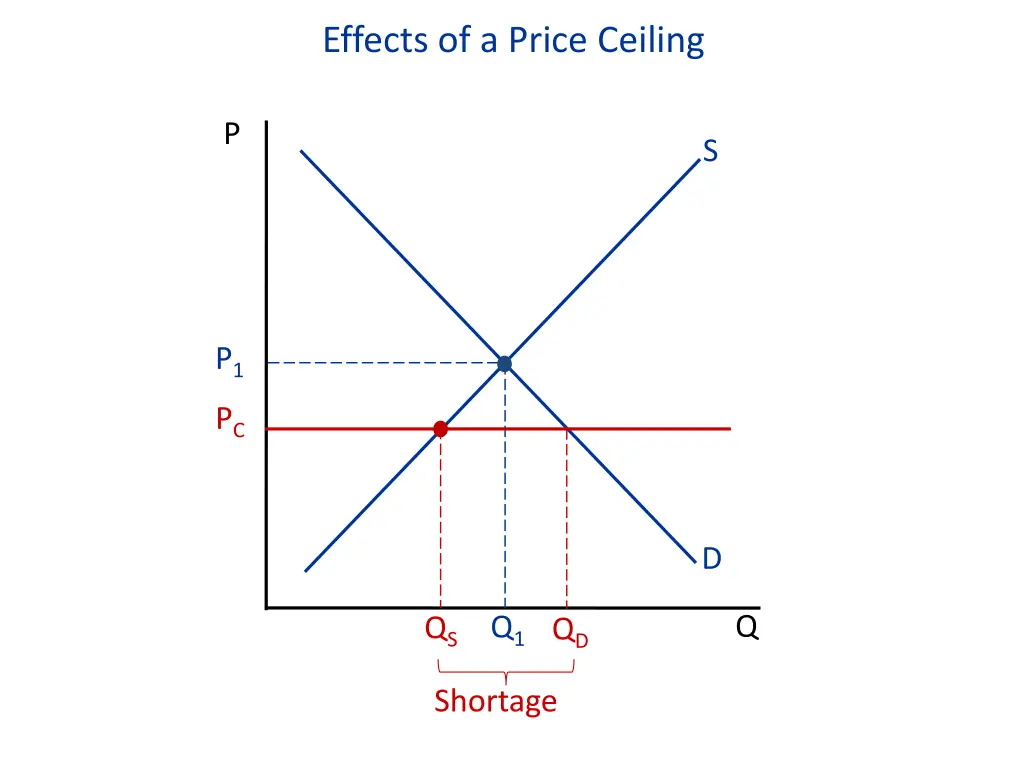
Effects of a Price Ceiling P S P1 PC D Q Q1 QS QD Shortage
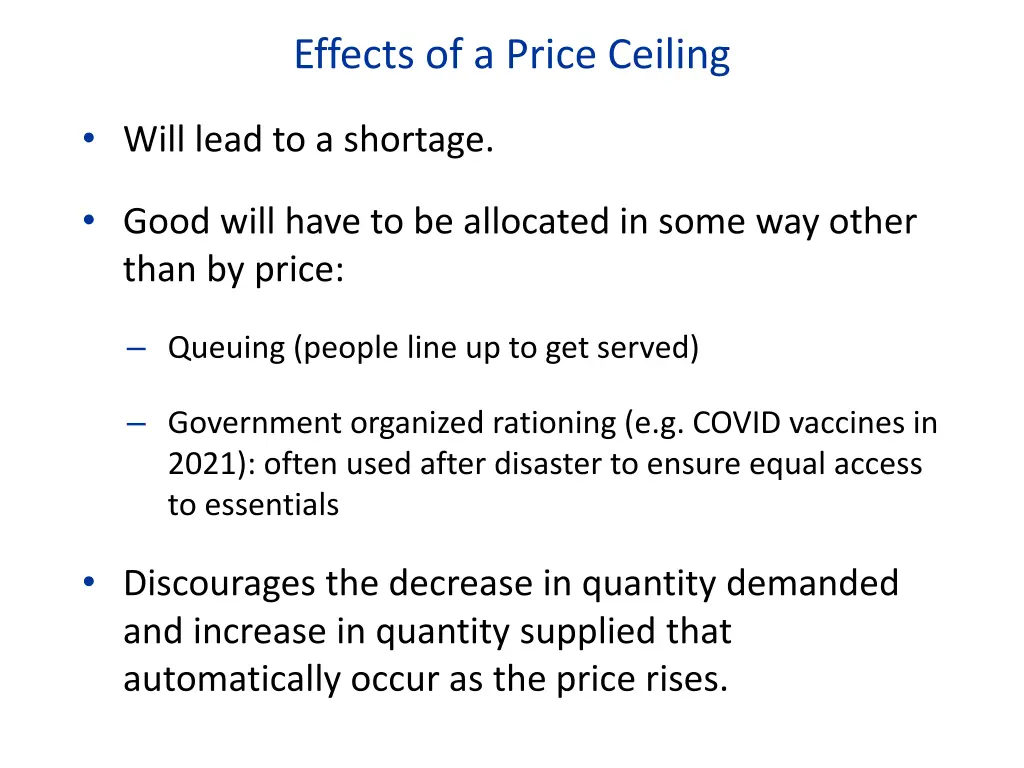
Effects of a Price Ceiling Will lead to a shortage. Good will have to be allocated in some way other than by price: Queuing (people line up to get served) Government organized rationing (e.g. COVID vaccines in 2021): often used after disaster to ensure equal access to essentials Discourages the decrease in quantity demanded and increase in quantity supplied that automatically occur as the price rises.
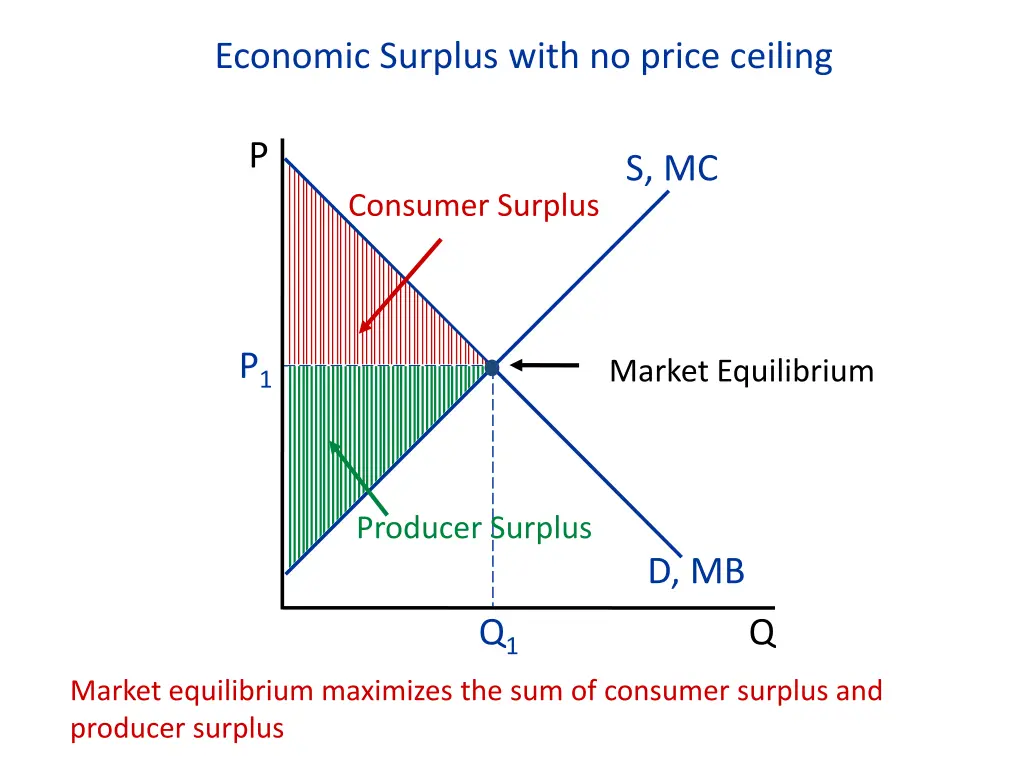
Economic Surplus with no price ceiling P S, MC Consumer Surplus P1 Market Equilibrium Producer Surplus D, MB Q1 Q Market equilibrium maximizes the sum of consumer surplus and producer surplus
Economic Surplus with a price ceiling P S,MC Consumer Surplus Deadweight loss P1 PC Producer Surplus D,MB QS Q1 Q Price ceiling PC reduces total surplus but it increases consumer surplus (at the expense of producer surplus)
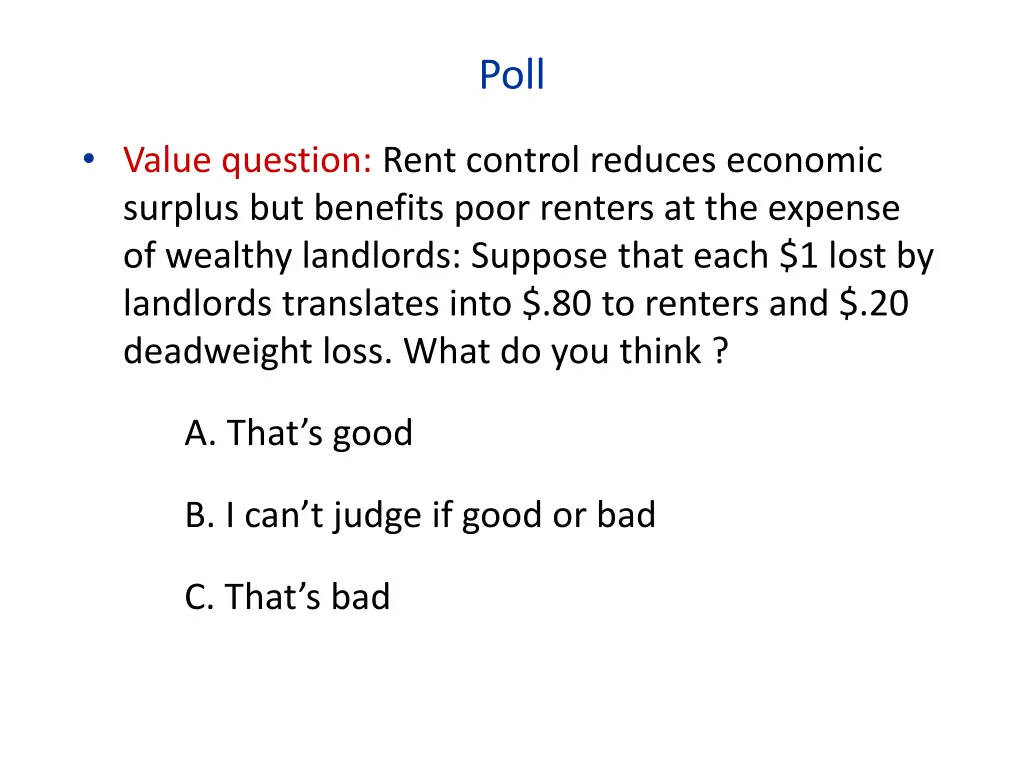
Poll Value question: Rent control reduces economic surplus but benefits poor renters at the expense of wealthy landlords: Suppose that each $1 lost by landlords translates into $.80 to renters and $.20 deadweight loss. What do you think ? A. That s good B. I can t judge if good or bad C. That s bad
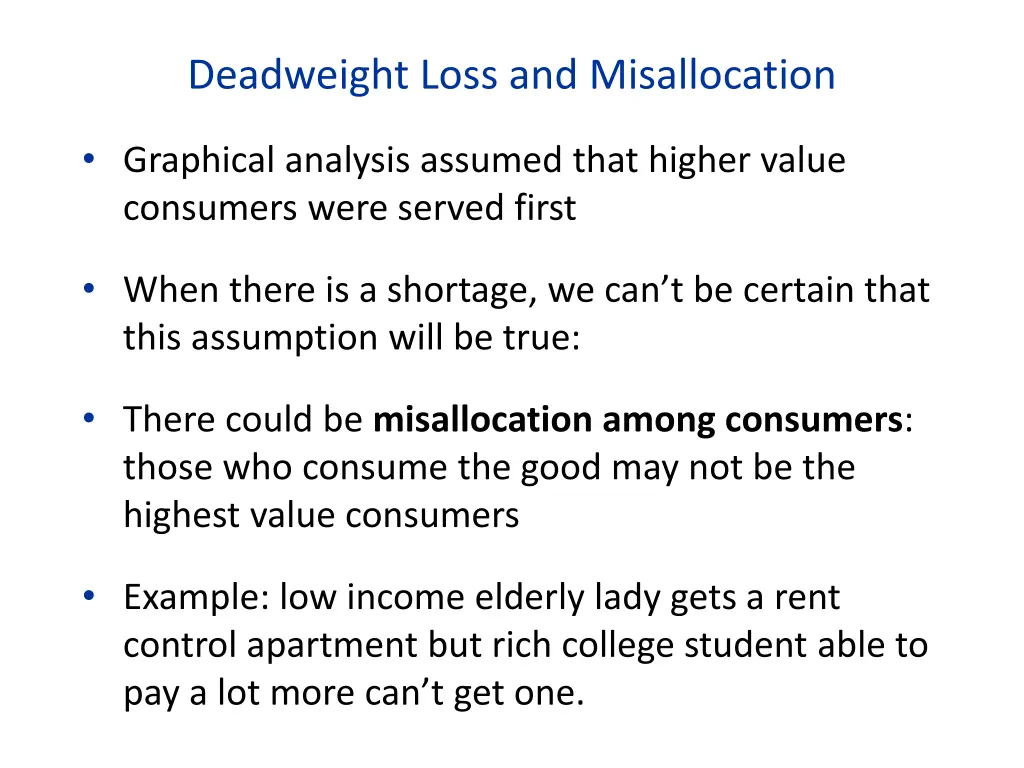
Deadweight Loss and Misallocation Graphical analysis assumed that higher value consumers were served first When there is a shortage, we can t be certain that this assumption will be true: There could be misallocation among consumers: those who consume the good may not be the highest value consumers Example: low income elderly lady gets a rent control apartment but rich college student able to pay a lot more can t get one.
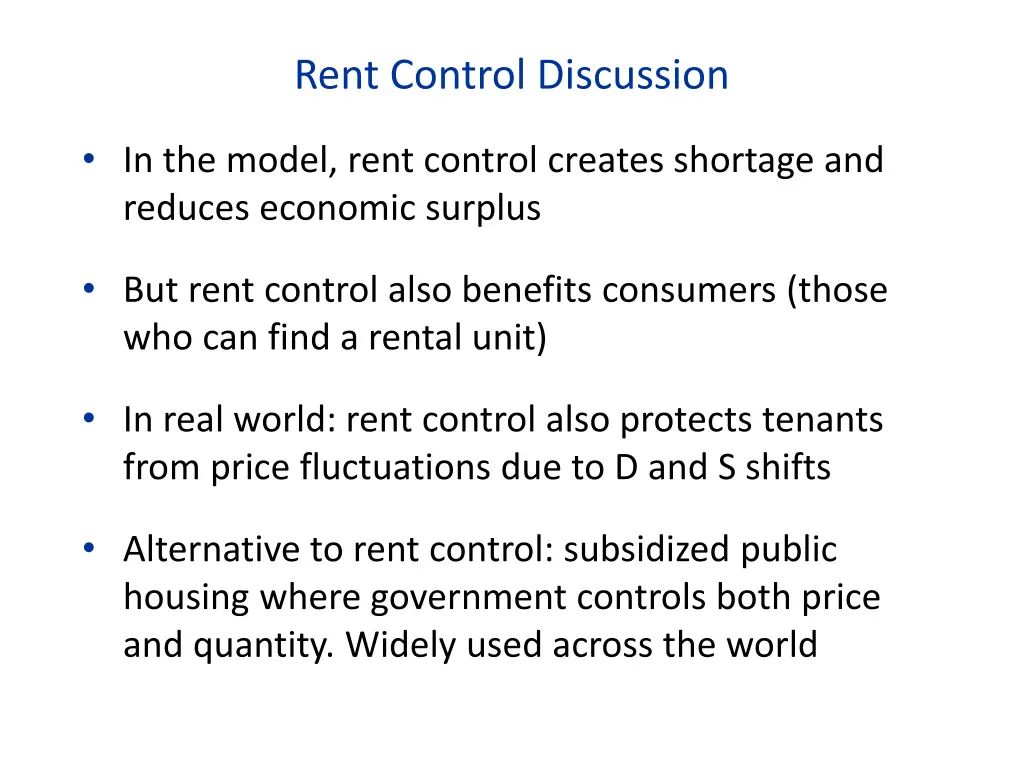
Rent Control Discussion In the model, rent control creates shortage and reduces economic surplus But rent control also benefits consumers (those who can find a rental unit) In real world: rent control also protects tenants from price fluctuations due to D and S shifts Alternative to rent control: subsidized public housing where government controls both price and quantity. Widely used across the world
Poll Value question: What is the best way for a city to organize housing for residents? A. Just let free markets of supply and demand work. B. Add rent control once a lease has started to insulate tenants from market price increases (current Berkeley model) C. Add rent control to protect both current and new tenants from market price increases (old Berkeley model) D. Add public housing to increase supply and stabilize prices.
Even without price controls, shortages and queuing can happen in real world markets due to price rigidity Some goods are in higher demand at some times: e.g., restaurants on a Saturday night; parking on streets during football games; etc. Not practical or upsetting to customers if sellers adjust prices in real time (e.g. Uber surge pricing backlash). This creates shortages resolved through inefficient queuing [rich person cannot bribe his way to the front] Labor market also has queuing: In recessions, unemployed are queuing for jobs and can t bid wages down instantaneously. In booms, employers struggle to find workers, and can t bid up wages for new hires only
References CORE-The Economy 2.0, micro, Unit 8. Principles of Economics, Chapters 5-6. Paul, Mark. 2023. Economists Hate Rent Control. Here s Why They re Wrong. American Prospect.