What is a good outcome?
Recent guidelines discuss important outcomes like intact survival, neurodevelopmental impairment, and more for decision-making in neonatal care. The article explores challenges in defining "intact" survival, dichotomizing continuous outcomes, and the impact of composite outcomes on decision-making. It also touches on the differences in preferences and perspectives between parents and healthcare providers in neonatal care settings.

Download Presentation

Please find below an Image/Link to download the presentation.
The content on the website is provided AS IS for your information and personal use only. It may not be sold, licensed, or shared on other websites without obtaining consent from the author.If you encounter any issues during the download, it is possible that the publisher has removed the file from their server.
You are allowed to download the files provided on this website for personal or commercial use, subject to the condition that they are used lawfully. All files are the property of their respective owners.
The content on the website is provided AS IS for your information and personal use only. It may not be sold, licensed, or shared on other websites without obtaining consent from the author.
E N D
Presentation Transcript
What is a good outcome? Keith J Barrington
What is a good outcome? Which outcomes are important? Which should be used in decision making? Which are predictable? Who decides?
Recent guidelines of learned societies refer to the following terms as important outcomes that should be considered in decision making: Intact survival Neurodevelopmental impairment Severe or profound NDI Survival without NDI
We all want intact survival But what is intact ? Who decides? Can we really divide NICU graduates into those who are intact and those who are not? Is an infant with a mild hemiplegia intact ? An infant with a low Bayley score? An infant without NDI but who has oral aversion and is gastrostomy fed?
Dichotomizing continuous outcomes Lung Injury is a continuum BPD diagnosed by need for O2 at 36 weeks, 0 days. What is the impact on the family of this diagnosis? Compared to: Home O2 Readmissions during the first year of life For decision-making, if an intervention decreases BPD but has no effect on perhaps more important outcomes?
Composite outcomes: death or NDI Composite outcomes should be considered when they are of similar value for patients and are affected in the same way by the intervention (or risk factor)
Parents and healthcare providers disagree Disagree on the quality of life of children with serious disabilities Disagree on the impact of disabled children on the lives of the family And sometimes agree Agree (mostly) on the importance of parental participation in decision making
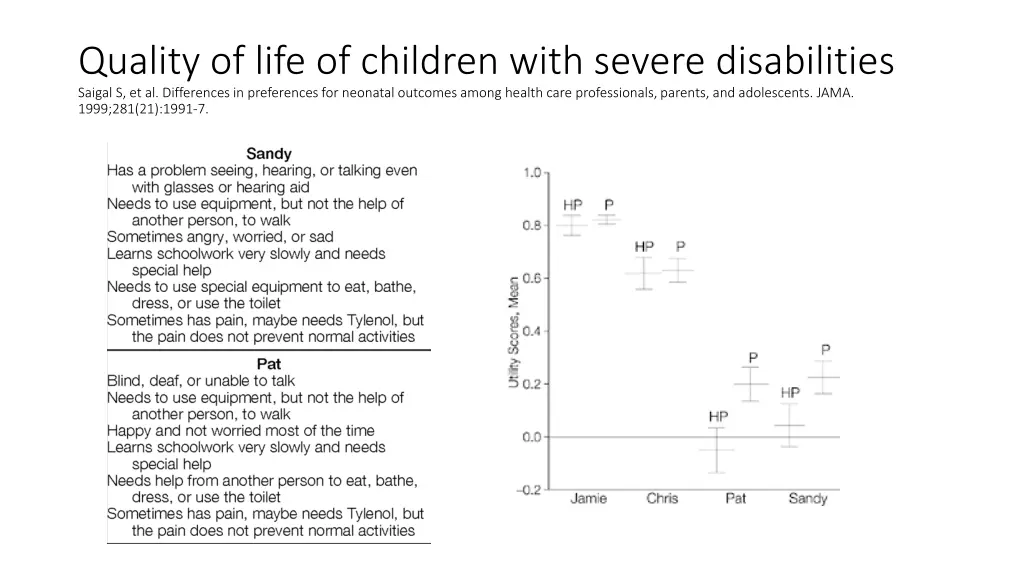
Quality of life of children with severe disabilities Saigal S, et al. Differences in preferences for neonatal outcomes among health care professionals, parents, and adolescents. JAMA. 1999;281(21):1991-7.
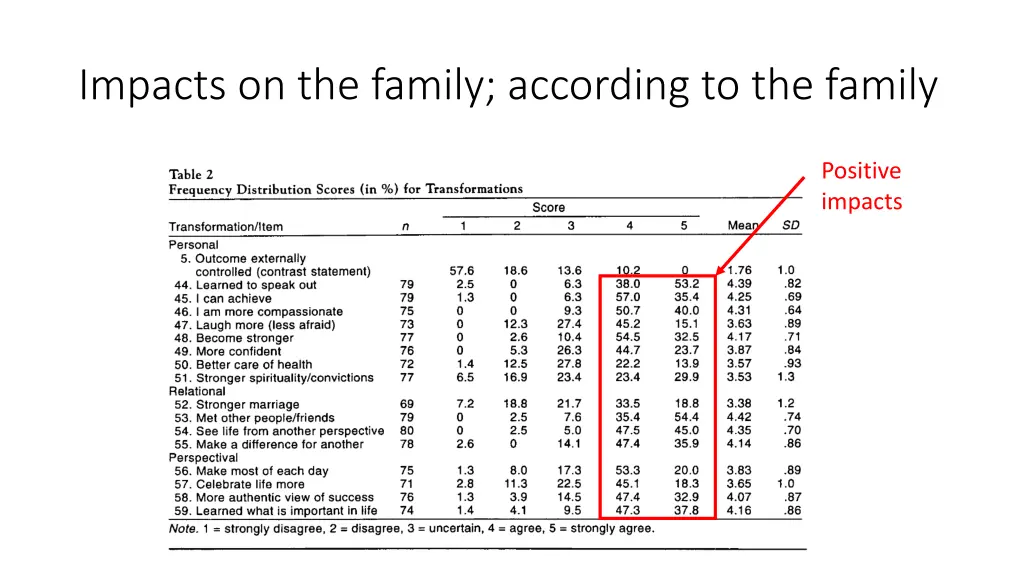
Impacts on the family of a child with disability Scorgie K, Sobsey D. Transformational outcomes associated with parenting children who have disabilities. Mental retardation. 2000;38(3):195-206. Interviewed 80 families of children with disabilities (ranging from moderate to severe) Compared the families own evaluation of their experiences to: Professional myths of family devastation, unending stress, near- universal divorce, and endless drudgery
Impacts on the family; according to the family Positive impacts
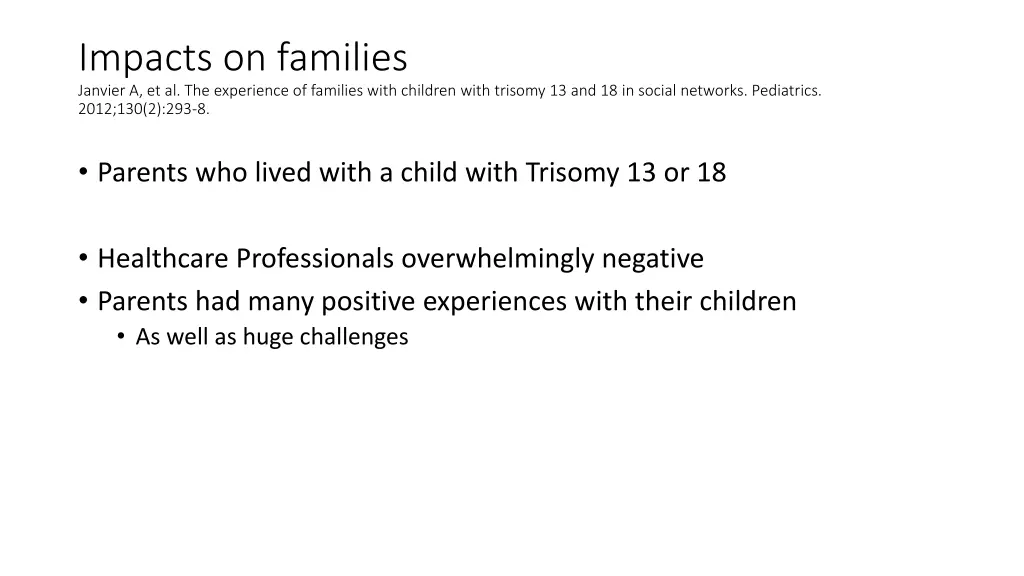
Impacts on families Janvier A, et al. The experience of families with children with trisomy 13 and 18 in social networks. Pediatrics. 2012;130(2):293-8. Parents who lived with a child with Trisomy 13 or 18 Healthcare Professionals overwhelmingly negative Parents had many positive experiences with their children As well as huge challenges
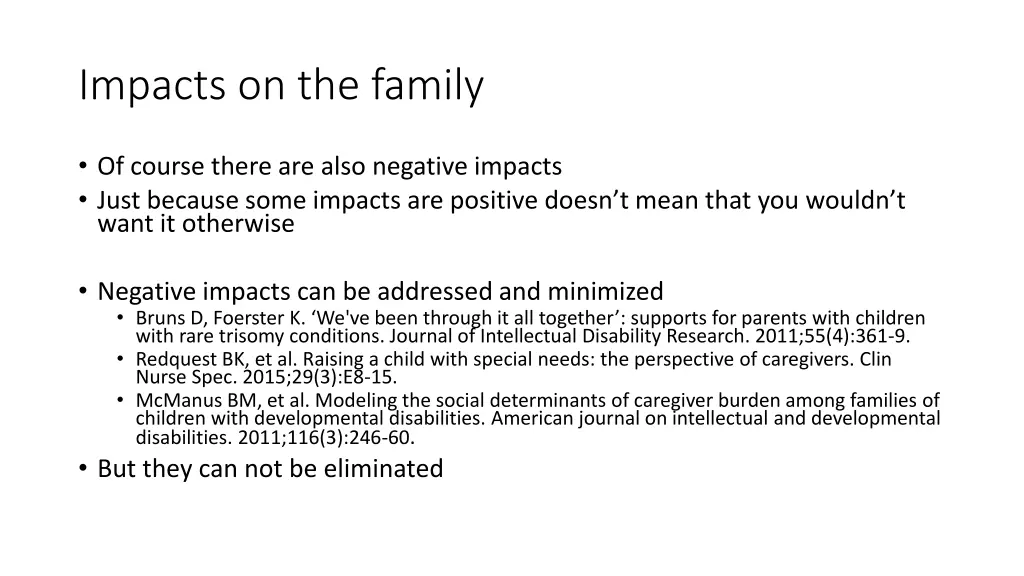
Impacts on the family Of course there are also negative impacts Just because some impacts are positive doesn t mean that you wouldn t want it otherwise Negative impacts can be addressed and minimized Bruns D, Foerster K. We've been through it all together : supports for parents with children with rare trisomy conditions. Journal of Intellectual Disability Research. 2011;55(4):361-9. Redquest BK, et al. Raising a child with special needs: the perspective of caregivers. Clin Nurse Spec. 2015;29(3):E8-15. McManus BM, et al. Modeling the social determinants of caregiver burden among families of children with developmental disabilities. American journal on intellectual and developmental disabilities. 2011;116(3):246-60. But they can not be eliminated
Agreement that parents should be involved But who has asked parents what outcomes are important for decision-making? In the context of a choice of withholding or withdrawing Life- sustaining interventions? (LSI) Or indeed in terms of choice of interventions to reduce lung injury, etc.
What do parents think are important outcomes for decision-making? Einarsdottir J. Emotional experts: parents' views on end-of-life decisions for preterm infants in Iceland. Medical anthropology quarterly. 2009;23(1):34-50 For parents: quality of life turned out to be a tricky criterion for withdrawal of LSI To know a severely disabled person influenced parents to refuse or accept quality of life as a valid argument. Only a few of the parents were aware of the uncertainty of prognosis, and the disagreements among professionals.
Criteria for forgoing LSI? Parents views No life was commonly stated to be a valid criterion for withdrawal of treatment. No life could signify postponement of inevitable death for a short period by painful treatment, Or living without crucial human qualities, such as an ability to take part in human communication and interaction. Certainty of brain damage that would lead to inability to take part in human communication most frequently named as an acceptable criterion for termination of treatment.
Poor quality of life Michelson KN, et al. Parental Views on Withdrawing Life-Sustaining Therapies in Critically Ill Children. Archives of pediatrics & adolescent medicine. 2009;163(11):986-92. 51% of parents (of PICU patients) agreed that a poor quality of life could be a reason for withdrawing LSI, (24% said no) What did they mean by that? Many described scenarios in which their child could not interact with his/her surroundings. For example, participants used phrases like, [T]hey have no ability to communicate. They don't have any feelings. They are not thinking.
Professional guidelines for withholding LSI Usually based on survival without severe NDI Which conflates 2 very different outcomes Death Survival with NDI NDI is a composite of 4 different outcomes, With differing impacts and importance CP, blindness, deafness, developmental impairment A composite created by physicians
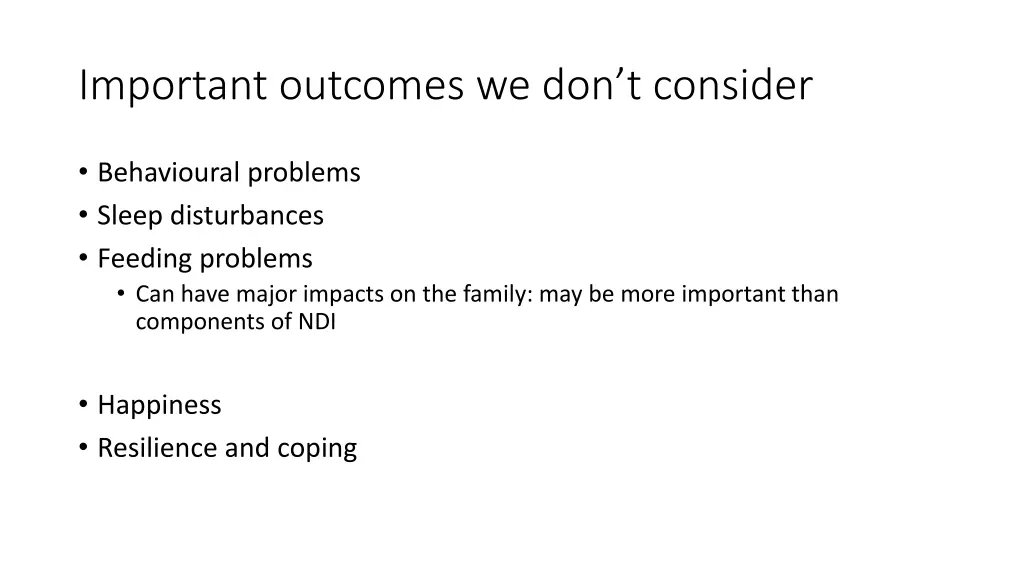
Important outcomes we dont consider Behavioural problems Sleep disturbances Feeding problems Can have major impacts on the family: may be more important than components of NDI Happiness Resilience and coping
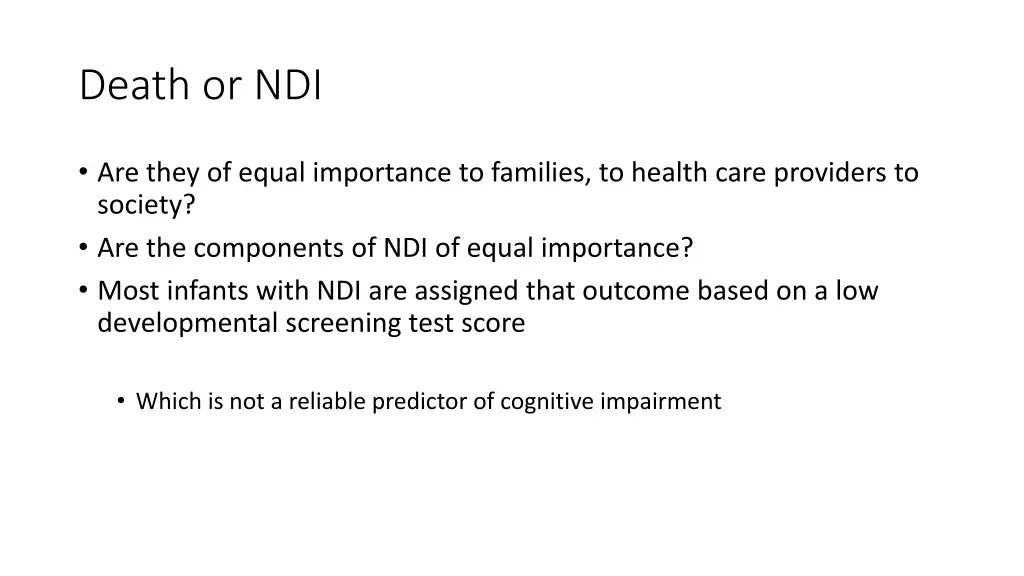
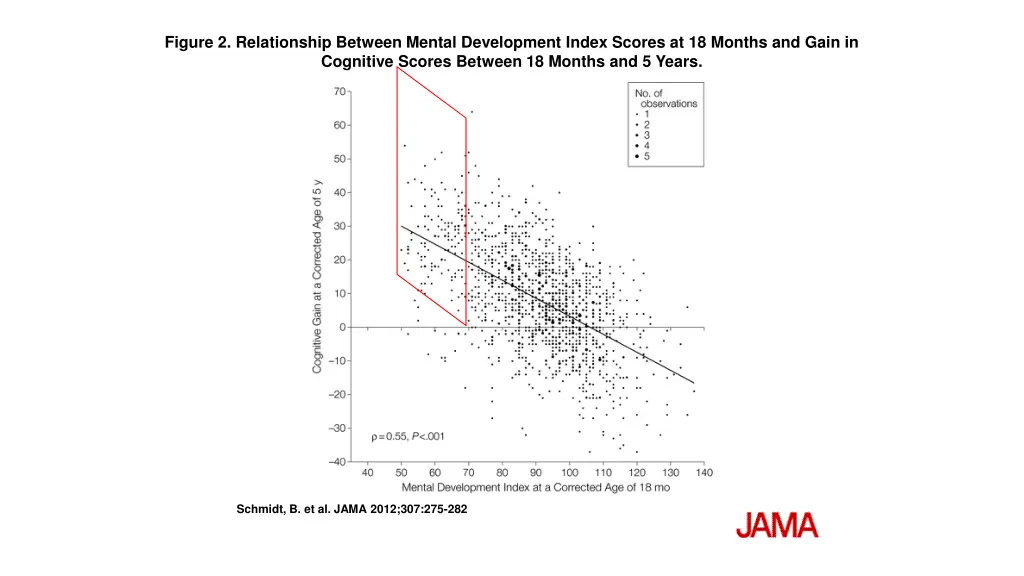
Death or NDI Are they of equal importance to families, to health care providers to society? Are the components of NDI of equal importance? Most infants with NDI are assigned that outcome based on a low developmental screening test score Which is not a reliable predictor of cognitive impairment
Figure 2. Relationship Between Mental Development Index Scores at 18 Months and Gain in Cognitive Scores Between 18 Months and 5 Years. Schmidt, B. et al. JAMA 2012;307:275-282
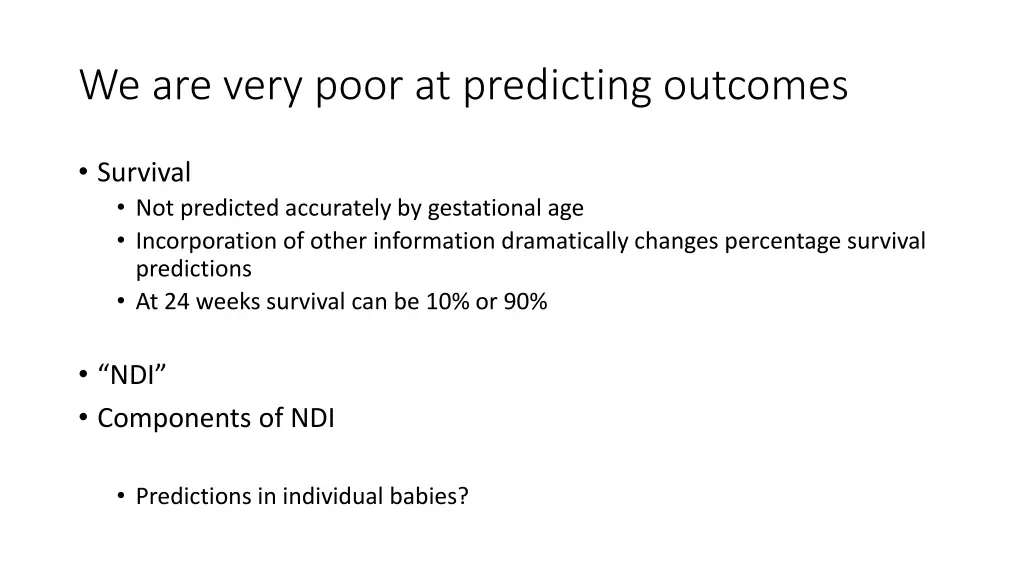
We are very poor at predicting outcomes Survival Not predicted accurately by gestational age Incorporation of other information dramatically changes percentage survival predictions At 24 weeks survival can be 10% or 90% NDI Components of NDI Predictions in individual babies?
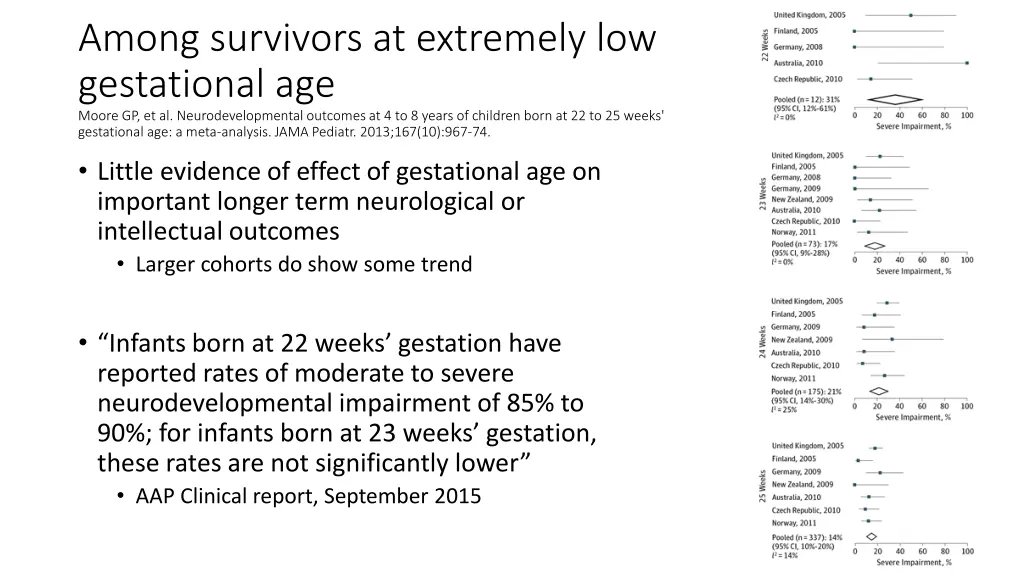
Among survivors at extremely low gestational age Moore GP, et al. Neurodevelopmental outcomes at 4 to 8 years of children born at 22 to 25 weeks' gestational age: a meta-analysis. JAMA Pediatr. 2013;167(10):967-74. Little evidence of effect of gestational age on important longer term neurological or intellectual outcomes Larger cohorts do show some trend Infants born at 22 weeks gestation have reported rates of moderate to severe neurodevelopmental impairment of 85% to 90%; for infants born at 23 weeks gestation, these rates are not significantly lower AAP Clinical report, September 2015
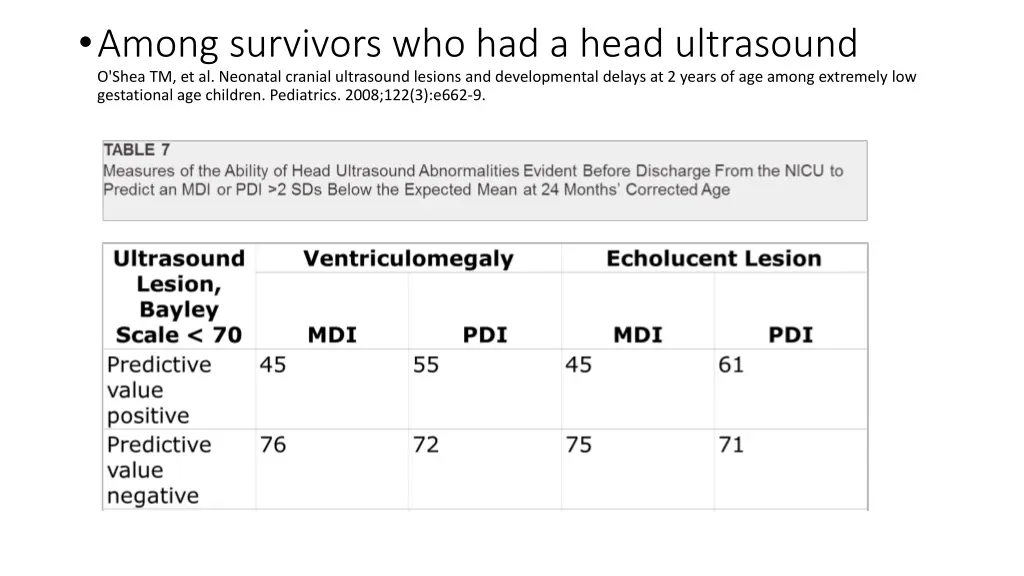
Among survivors who had a head ultrasound O'Shea TM, et al. Neonatal cranial ultrasound lesions and developmental delays at 2 years of age among extremely low gestational age children. Pediatrics. 2008;122(3):e662-9.
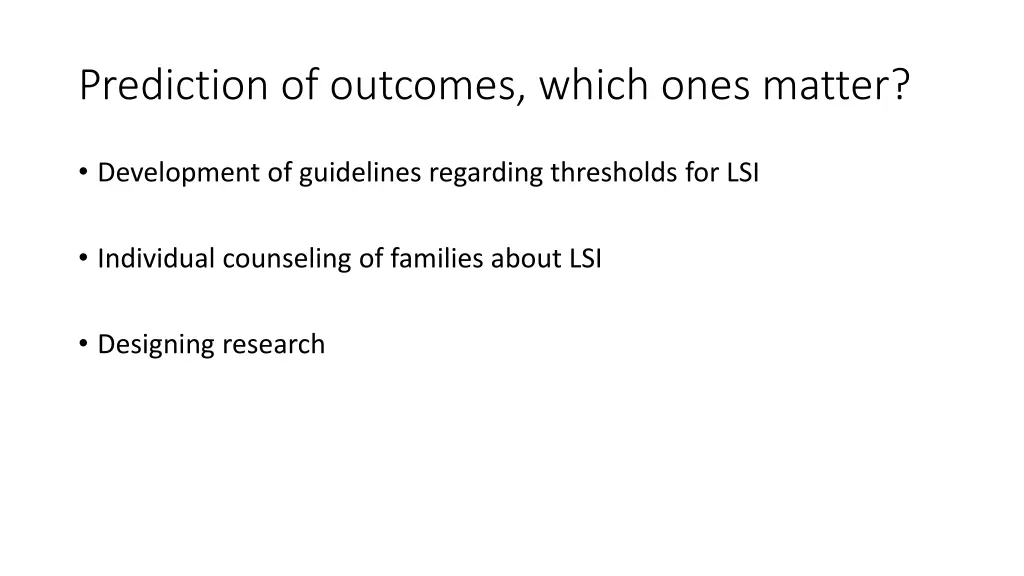
Prediction of outcomes, which ones matter? Development of guidelines regarding thresholds for LSI Individual counseling of families about LSI Designing research
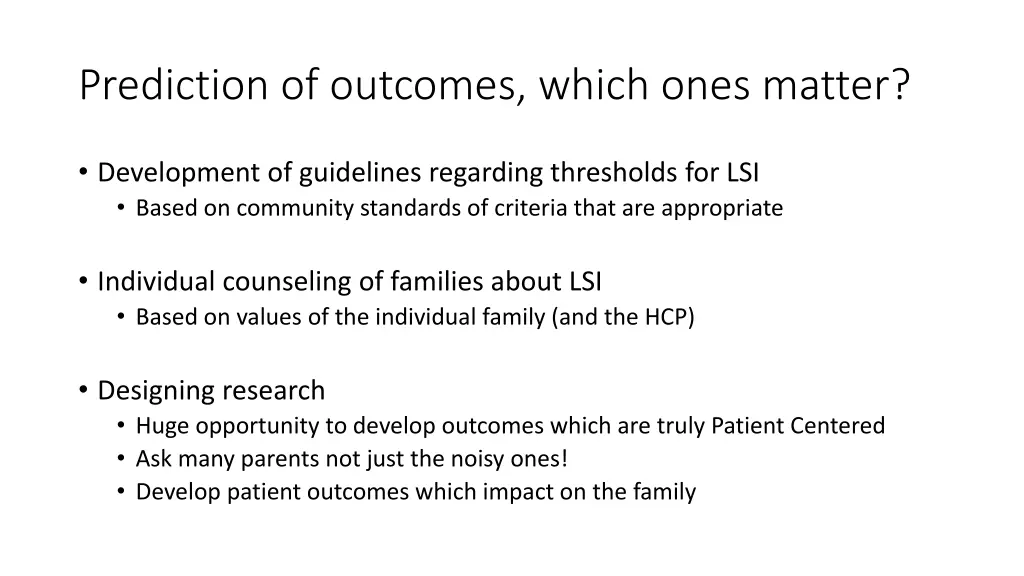
Prediction of outcomes, which ones matter? Development of guidelines regarding thresholds for LSI Based on community standards of criteria that are appropriate Individual counseling of families about LSI Based on values of the individual family (and the HCP) Designing research Huge opportunity to develop outcomes which are truly Patient Centered Ask many parents not just the noisy ones! Develop patient outcomes which impact on the family
Conclusion Mortality predictions are important for families, who are not aware of how poor we are at predicting death or survival Before birth: incorporating other factors (rather than just GA), improves prediction, but does not eliminate uncertainty After birth all bets are off. The longer a baby survives the more likely they are to survive (!) When everyone in the NICU thinks a baby will die, they often still survive.
Conclusion 2 Avoid death or disability Evaluation of survival probability and separately Evaluation of probable outcomes among survivors Only put them together if you can explore and agree with parents which outcomes are equally bad (or worse) than being dead. 65% chance of death or colostomy
Conclusion 3 Confident predictions of a child who will be unable to communicate are seen as a reasonable indication for withholding or withdrawing LSI by many parents ? Some patients with stage 3 HIE ? Some patients with brain malformations ? Is there any way to predict this for preterm infants? Families differ, work with the family to find out what is important for them
Conclusion 4 In this era of Patient-centered outcomes research We should be asking patients/parents what outcomes are important To them And their families Both when we counsel regarding LSI And when designing research