"Explore Winter 2020 modules and the C preprocessor in CSE333. Topics include memory diagrams, linked lists, memory leaks, lectures on structuring interfaces, and the use of header guards. Learn about symbol visibility, extern and static keywords, and more."
Please find below an Image/Link to download the presentation.
The content on the website is provided AS IS for your information and personal use only. It may not be sold, licensed, or shared on other websites without obtaining consent from the author. If you encounter any issues during the download, it is possible that the publisher has removed the file from their server.
You are allowed to download the files provided on this website for personal or commercial use, subject to the condition that they are used lawfully. All files are the property of their respective owners.
The content on the website is provided AS IS for your information and personal use only. It may not be sold, licensed, or shared on other websites without obtaining consent from the author.
E N D
Presentation Transcript
L05: Modules, C Preprocessor CSE333, Winter 2020 Modules and The C Preprocessor CSE 333 Winter 2020 Instructor: Justin Hsia Teaching Assistants: Andrew Hu Cheng Ni Guramrit Singh Rehaan Bhimar Zachary Keyes Austin Chan Cosmo Wang Mengqi Chen Renshu Gu Brennan Stein Diya Joy Pat Kosakanchit Travis McGaha
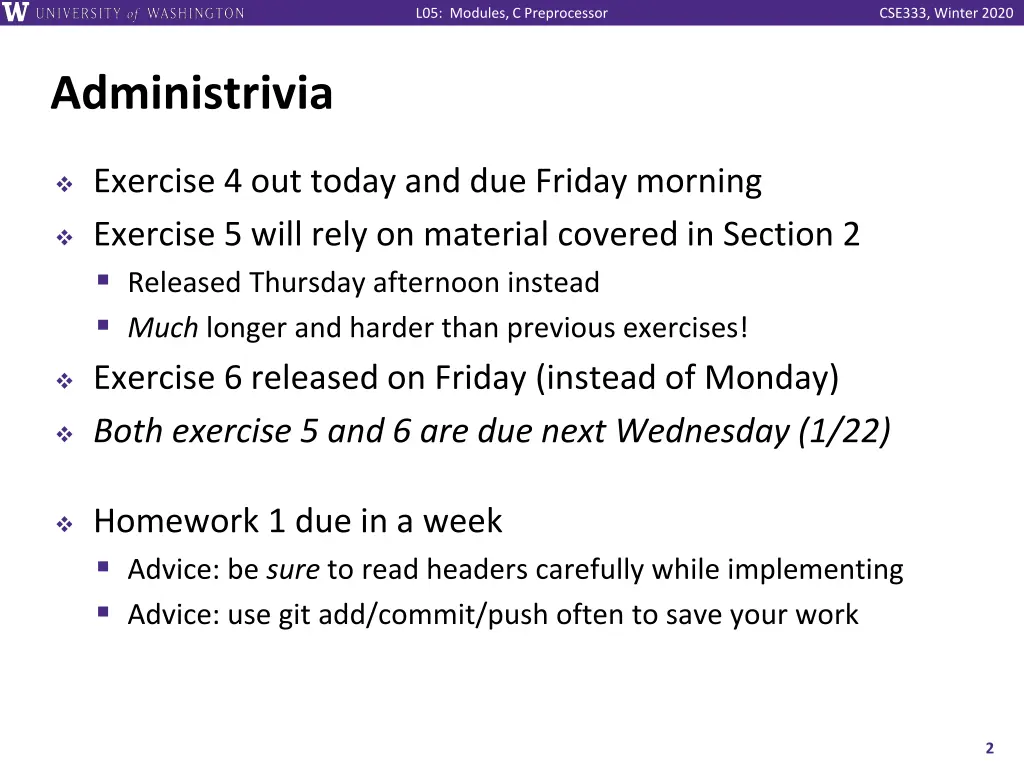
L05: Modules, C Preprocessor CSE333, Winter 2020 Administrivia Exercise 4 out today and due Friday morning Exercise 5 will rely on material covered in Section 2 Released Thursday afternoon instead Much longer and harder than previous exercises! Exercise 6 released on Friday (instead of Monday) Both exercise 5 and 6 are due next Wednesday (1/22) Homework 1 due in a week Advice: be sure to read headers carefully while implementing Advice: use git add/commit/push often to save your work 2
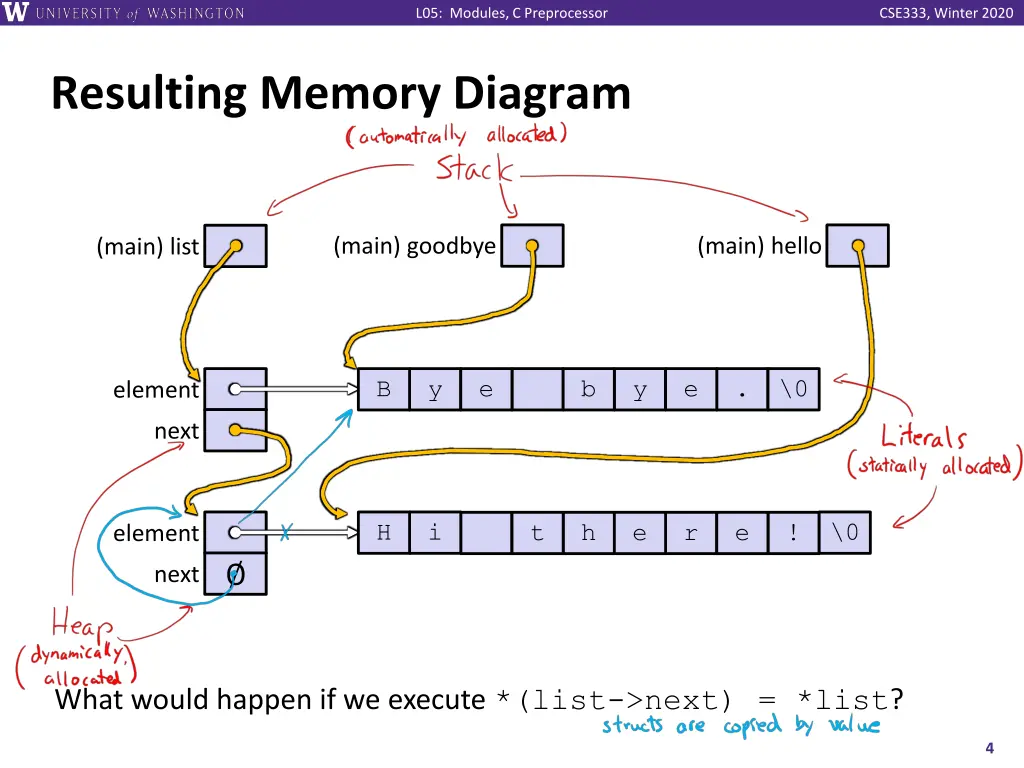
L05: Modules, C Preprocessor CSE333, Winter 2020 Resulting Memory Diagram (main) hello (main) goodbye (main) list B y e b y e . \0 element next H i \0 t h e r e ! element next What would happen if we execute *(list->next) = *list? 4
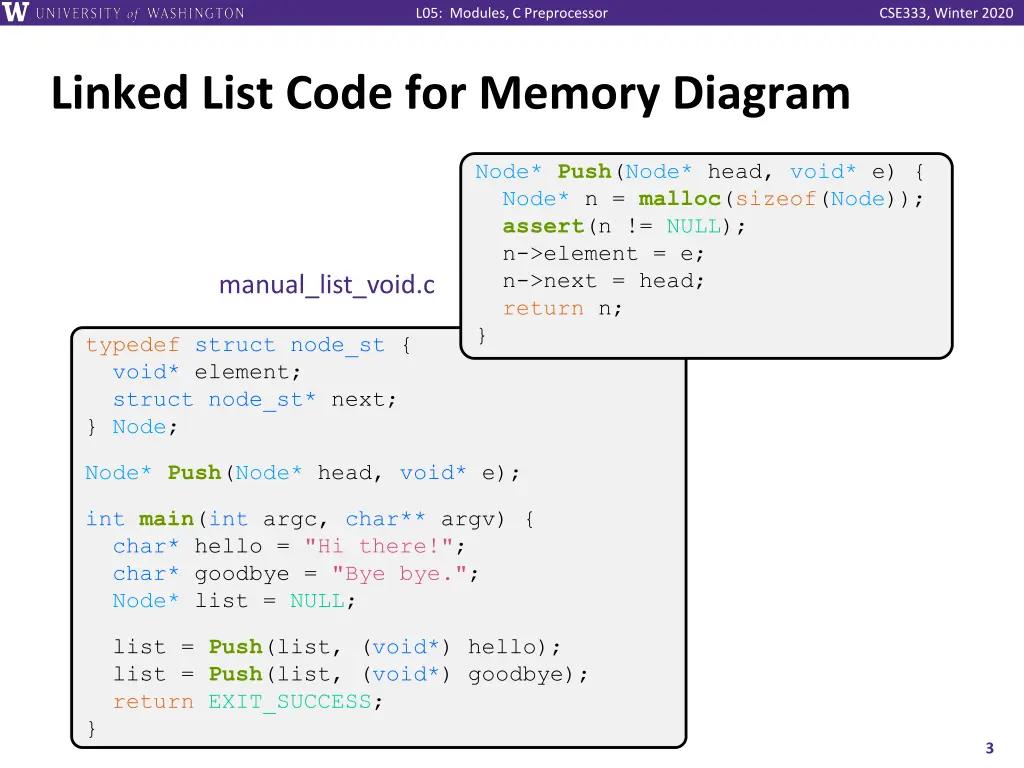
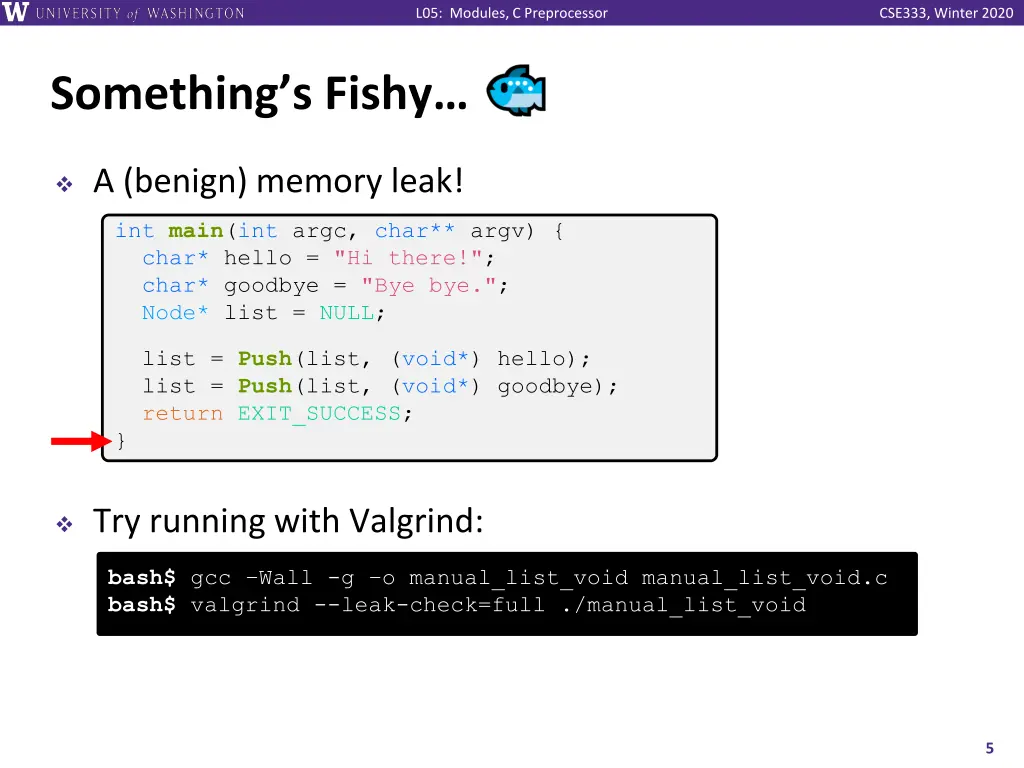
L05: Modules, C Preprocessor CSE333, Winter 2020 Something s Fishy A (benign) memory leak! int main(int argc, char** argv) { char* hello = "Hi there!"; char* goodbye = "Bye bye."; Node* list = NULL; list = Push(list, (void*) hello); list = Push(list, (void*) goodbye); return EXIT_SUCCESS; } Try running with Valgrind: bash$ gcc Wall -g o manual_list_void manual_list_void.c bash$ valgrind --leak-check=full ./manual_list_void 5
L05: Modules, C Preprocessor CSE333, Winter 2020 Lecture Outline Structuring Interfaces C Preprocessor and Header Guards Visibility of Symbols extern, static 6
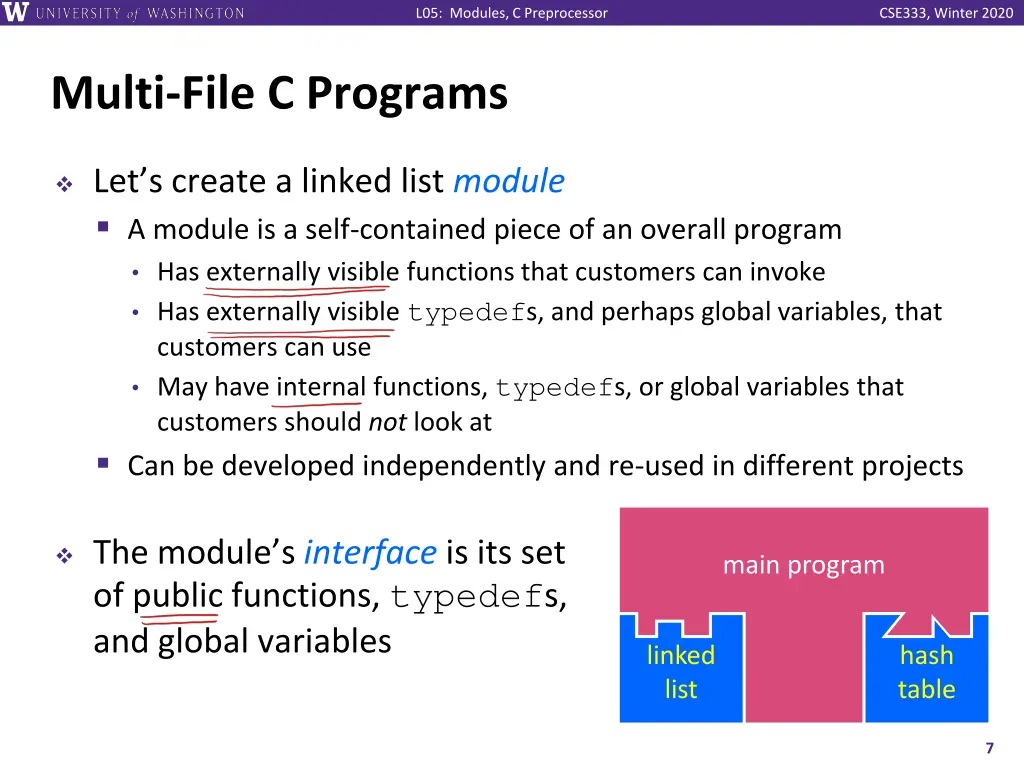
L05: Modules, C Preprocessor CSE333, Winter 2020 Multi-File C Programs Let s create a linked list module A module is a self-contained piece of an overall program Has externally visible functions that customers can invoke Has externally visible typedefs, and perhaps global variables, that customers can use May have internal functions, typedefs, or global variables that customers should not look at Can be developed independently and re-used in different projects The module s interface is its set of public functions, typedefs, and global variables main program linked list hash table 7
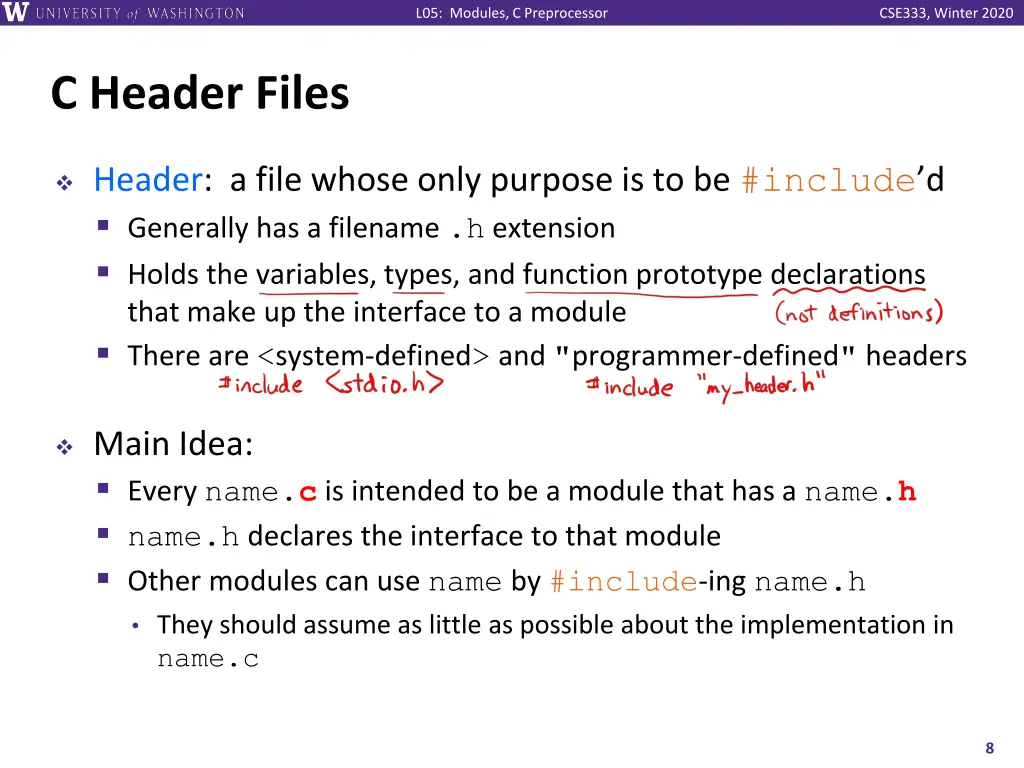
L05: Modules, C Preprocessor CSE333, Winter 2020 C Header Files Header: a file whose only purpose is to be #include d Generally has a filename .h extension Holds the variables, types, and function prototype declarations that make up the interface to a module There are <system-defined> and "programmer-defined" headers Main Idea: Every name.c is intended to be a module that has a name.h name.h declares the interface to that module Other modules can use name by #include-ing name.h They should assume as little as possible about the implementation in name.c 8
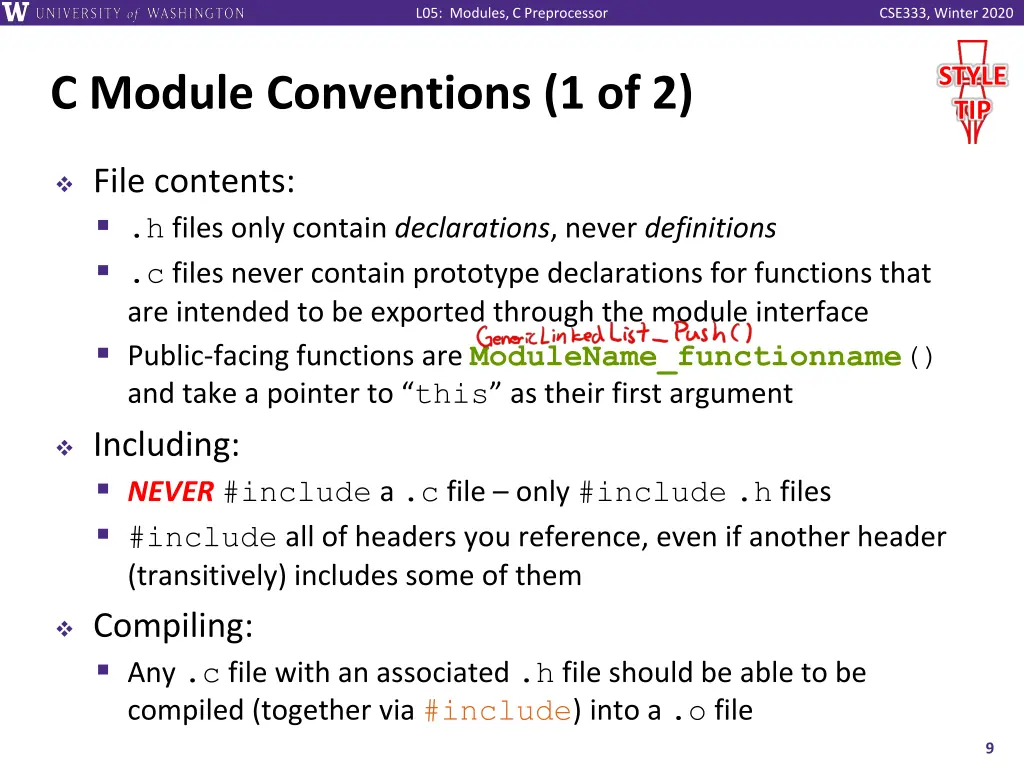
L05: Modules, C Preprocessor CSE333, Winter 2020 STYLE TIP C Module Conventions (1 of 2) File contents: .h files only contain declarations, never definitions .c files never contain prototype declarations for functions that are intended to be exported through the module interface Public-facing functions are ModuleName_functionname() and take a pointer to this as their first argument Including: NEVER#include a .c file only #include.h files #include all of headers you reference, even if another header (transitively) includes some of them Compiling: Any .c file with an associated .h file should be able to be compiled (together via #include) into a .o file 9
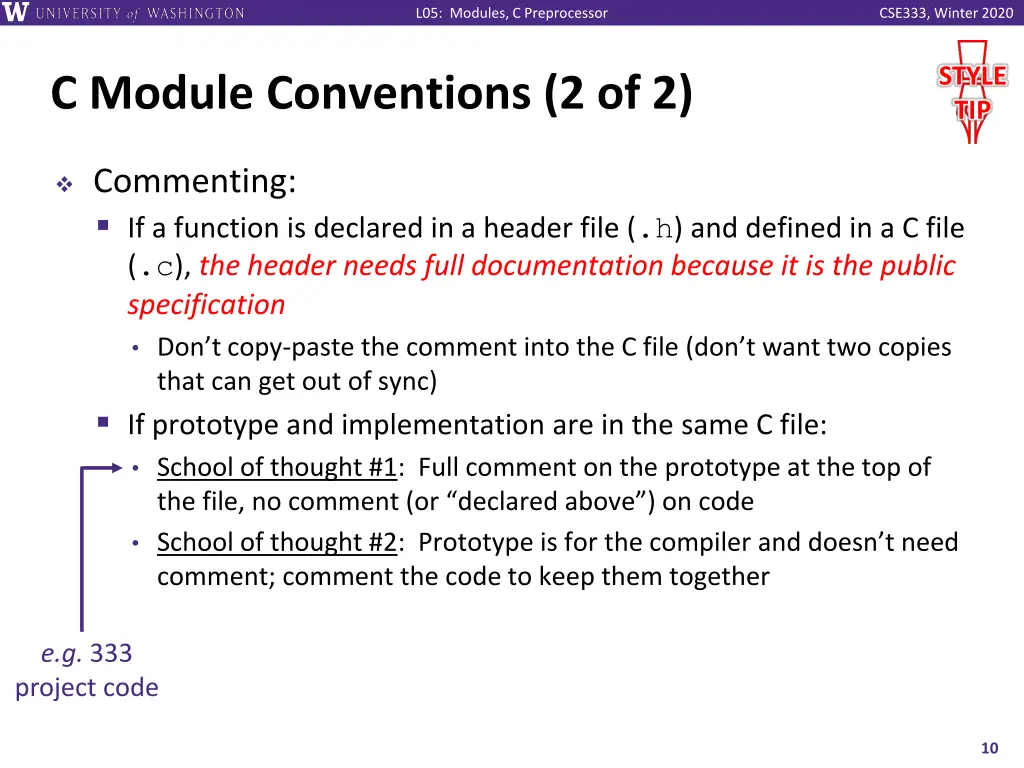
L05: Modules, C Preprocessor CSE333, Winter 2020 STYLE TIP C Module Conventions (2 of 2) Commenting: If a function is declared in a header file (.h) and defined in a C file (.c), the header needs full documentation because it is the public specification Don t copy-paste the comment into the C file (don t want two copies that can get out of sync) If prototype and implementation are in the same C file: School of thought #1: Full comment on the prototype at the top of the file, no comment (or declared above ) on code School of thought #2: Prototype is for the compiler and doesn t need comment; comment the code to keep them together e.g. 333 project code 10
L05: Modules, C Preprocessor CSE333, Winter 2020 Lecture Outline Structuring Interfaces C Preprocessor and Header Guards Visibility of Symbols extern, static 11
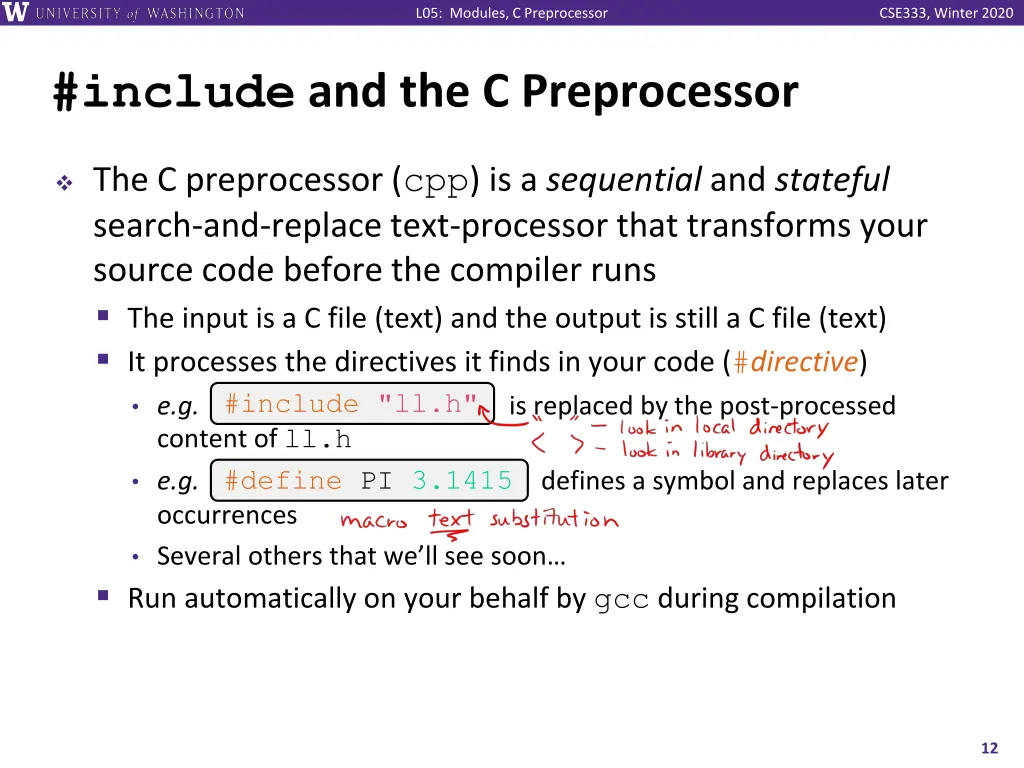
L05: Modules, C Preprocessor CSE333, Winter 2020 #include and the C Preprocessor The C preprocessor (cpp) is a sequential and stateful search-and-replace text-processor that transforms your source code before the compiler runs The input is a C file (text) and the output is still a C file (text) It processes the directives it finds in your code (#directive) is replaced by the post-processed content of ll.h defines a symbol and replaces later occurrences e.g. #include "ll.h" #include "ll.h" e.g. #define PI 3.1415 #define PI 3.1415 Several others that we ll see soon Run automatically on your behalf by gcc during compilation 12
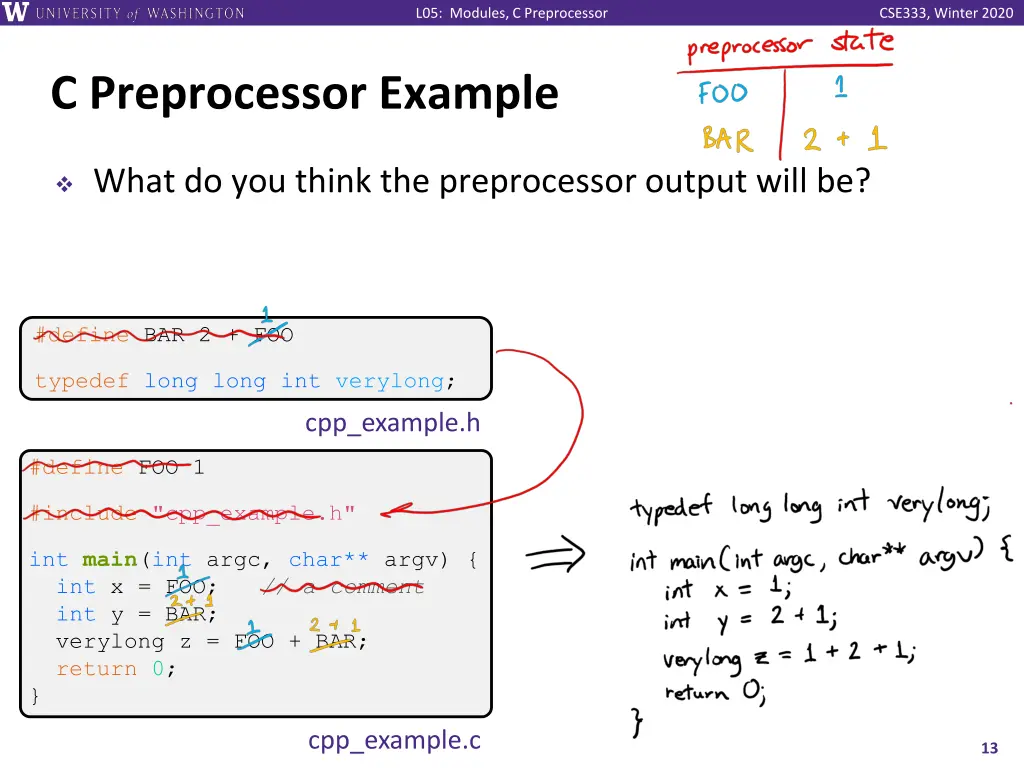
L05: Modules, C Preprocessor CSE333, Winter 2020 C Preprocessor Example What do you think the preprocessor output will be? #define BAR 2 + FOO typedef long long int verylong; cpp_example.h #define FOO 1 #include "cpp_example.h" int main(int argc, char** argv) { int x = FOO; // a comment int y = BAR; verylong z = FOO + BAR; return 0; } cpp_example.c 13
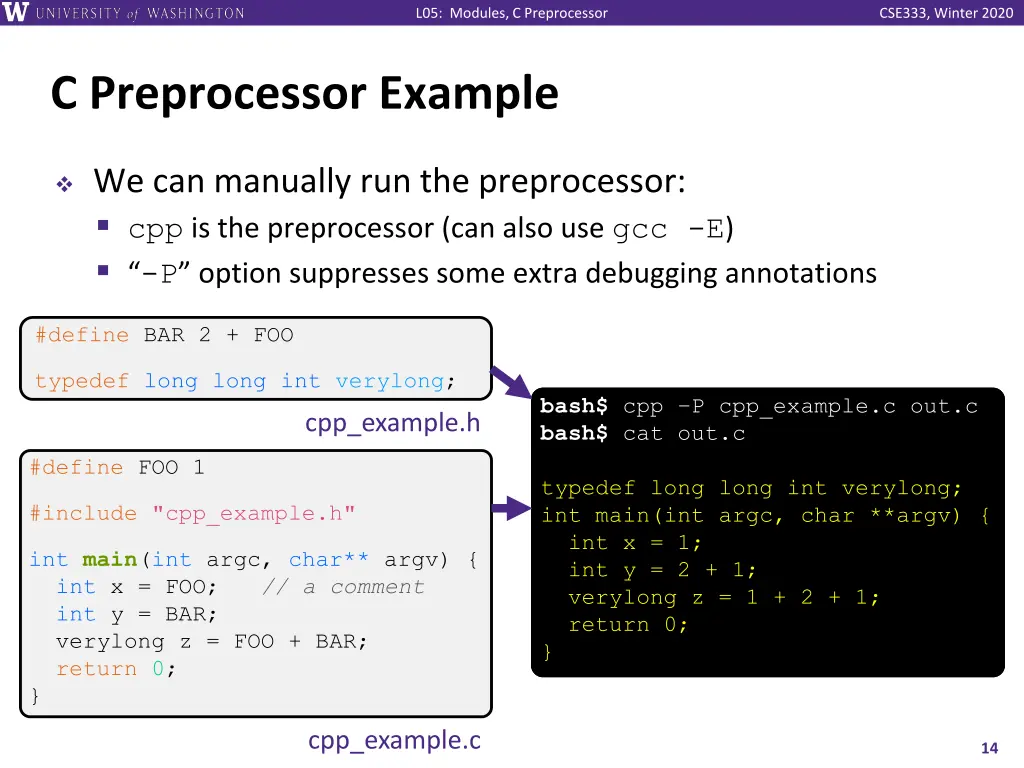
L05: Modules, C Preprocessor CSE333, Winter 2020 C Preprocessor Example We can manually run the preprocessor: cpp is the preprocessor (can also use gcc -E) -P option suppresses some extra debugging annotations #define BAR 2 + FOO typedef long long int verylong; bash$ cpp P cpp_example.c out.c bash$ cpp P cpp_example.c out.c bash$ cat out.c cpp_example.h #define FOO 1 typedef long long int verylong; int main(int argc, char **argv) { int x = 1; int y = 2 + 1; verylong z = 1 + 2 + 1; return 0; } #include "cpp_example.h" int main(int argc, char** argv) { int x = FOO; // a comment int y = BAR; verylong z = FOO + BAR; return 0; } cpp_example.c 14
L05: Modules, C Preprocessor CSE333, Winter 2020 Program Using a Linked List #include <stdlib.h> #include <assert.h> #include "ll.h" #include "ll.h" Node* Push(Node* head, void* element) { ... // implementation here } int main(int argc, char** argv) { Node* list = NULL; char* hi = "hello"; char* bye = "goodbye"; ll.c list = Push(list, (void*)hi); list = Push(list, (void*)bye); typedef struct node_st { void* element; struct node_st* next; } Node; ... return 0; } example_ll_customer.c Node* Push(Node* head, void* element); ll.h 15
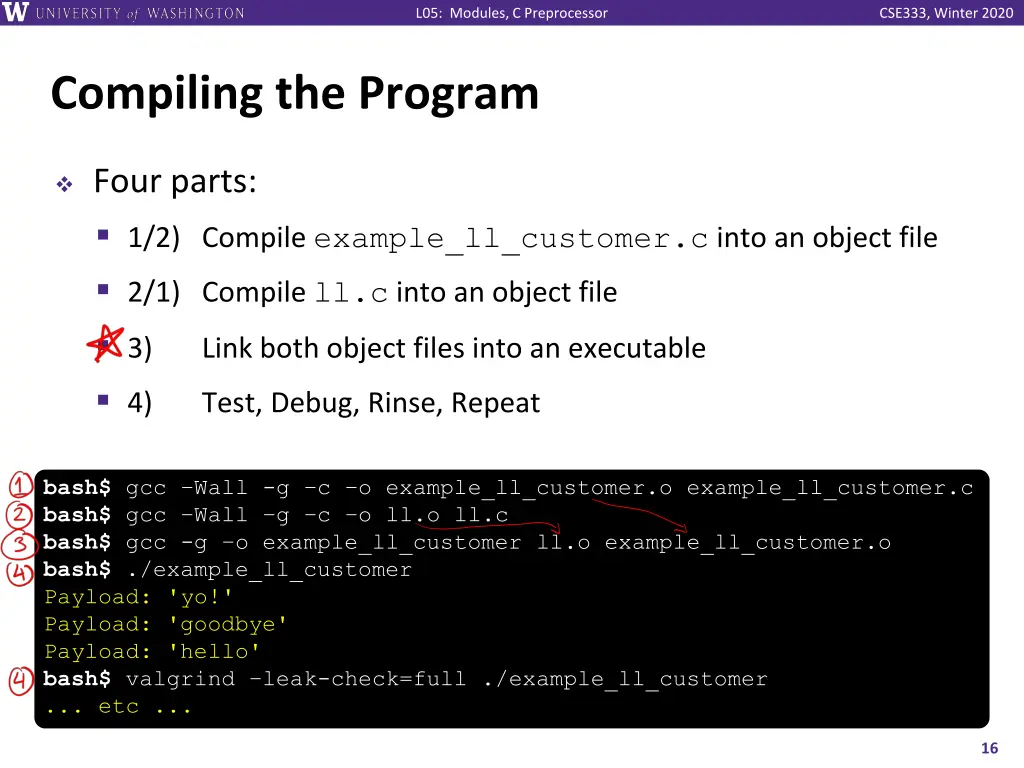
L05: Modules, C Preprocessor CSE333, Winter 2020 Compiling the Program Four parts: 1/2) Compile example_ll_customer.c into an object file 2/1) Compile ll.c into an object file 3) Link both object files into an executable 4) Test, Debug, Rinse, Repeat bash$ gcc Wall -g c o example_ll_customer.o example_ll_customer.c bash$ gcc Wall g c o ll.o ll.c bash$ gcc -g o example_ll_customer ll.o example_ll_customer.o bash$ ./example_ll_customer Payload: 'yo!' Payload: 'goodbye' Payload: 'hello' bash$ valgrind leak-check=full ./example_ll_customer ... etc ... 16
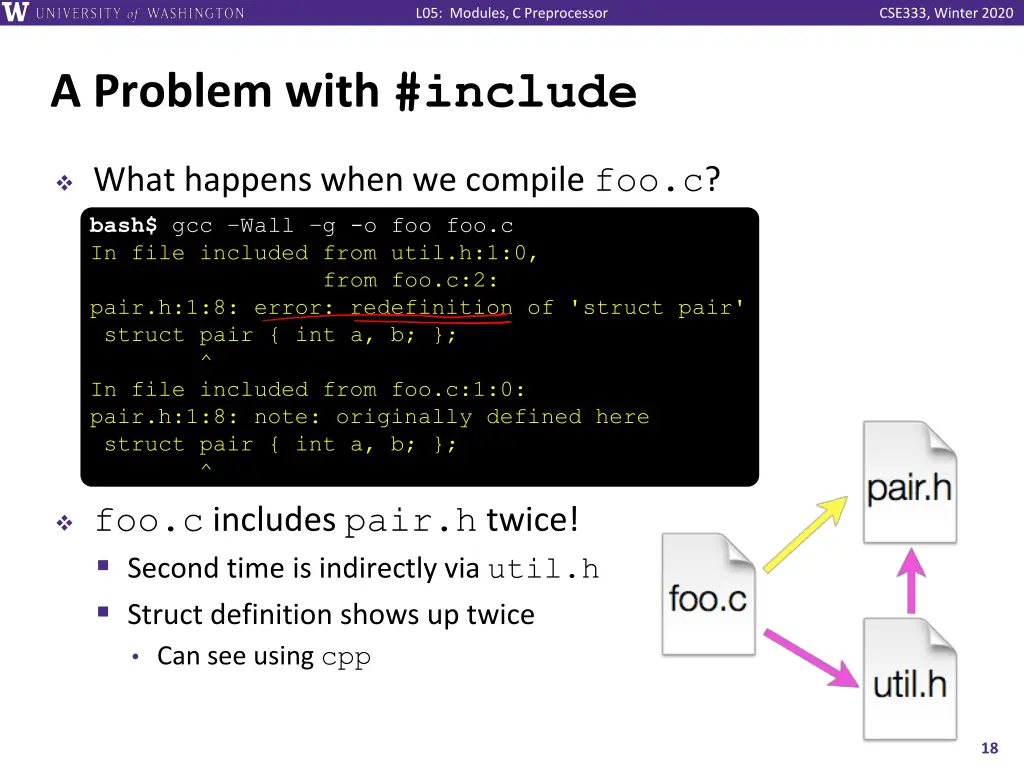
L05: Modules, C Preprocessor CSE333, Winter 2020 But There s a Problem with #include What happens when we compile foo.c? #include "pair.h" struct pair { int a, b; }; // a useful function struct pair* make_pair(int a, int b); pair.h util.h #include "pair.h" #include "util.h" int main(int argc, char** argv) { // do stuff here ... return 0; } foo.c 17
L05: Modules, C Preprocessor CSE333, Winter 2020 A Problem with #include What happens when we compile foo.c? bash$ gcc Wall g -o foo foo.c In file included from util.h:1:0, from foo.c:2: pair.h:1:8: error: redefinition of 'struct pair' struct pair { int a, b; }; ^ In file included from foo.c:1:0: pair.h:1:8: note: originally defined here struct pair { int a, b; }; ^ foo.c includes pair.h twice! Second time is indirectly via util.h Struct definition shows up twice Can see using cpp 18
L05: Modules, C Preprocessor CSE333, Winter 2020 STYLE TIP Preprocessor Tricks: Header Guards A standard C Preprocessor trick to deal with this Uses macro definition (#define) in combination with conditional compilation (#ifndef and #endif) #ifndef PAIR_H_ #define PAIR_H_ #ifndef UTIL_H_ #define UTIL_H_ struct pair { int a, b; }; #include "pair.h" // a useful function struct pair* make_pair(int a, int b); #endif // PAIR_H_ #endif // UTIL_H_ pair.h util.h foo.c #include "pair.h" #include "util.h" int main(int argc, char** argv) { // do stuff here 19
L05: Modules, C Preprocessor CSE333, Winter 2020 STYLE TIP Preprocessor Tricks: Constants A way to deal with magic constants #define BUFSIZE 1000 #define PI 3.14159265359 int globalbuffer[1000]; int globalbuffer[BUFSIZE]; void circalc(float rad, float* circumf, float* area) { *circumf = rad * 2.0 * 3.1415; *area = rad * 3.1415 * 3.1415; } void circalc(float rad, float* circumf, float* area) { *circumf = rad * 2.0 * PI; *area = rad * PI * PI; } Bad code Better code (littered with magic constants) 20
L05: Modules, C Preprocessor CSE333, Winter 2020 Preprocessor Tricks: Macros You can pass arguments to macros #define ODD(x) ((x) % 2 != 0) cpp void foo() { if ( ODD(5) ) printf("5 is odd!\n"); } void foo() { if ( ((5) % 2 != 0) ) printf("5 is odd!\n"); } Beware of operator precedence issues! Use parentheses #define ODD(x) ((x) % 2 != 0) #define WEIRD(x) x % 2 != 0 cpp ODD(5 + 1); ((5 + 1) % 2 != 0); WEIRD(5 + 1); 5 + 1 % 2 != 0; 21
L05: Modules, C Preprocessor CSE333, Winter 2020 Preprocessor Tricks: Defining Tokens Besides #defines in the code, preprocessor values can be given as part of the gcc command: bash$ gcc -Wall -g -DTRACE -o ifdef ifdef.c assert can be controlled the same way defining NDEBUG causes assert to expand to empty It s a macro see assert.h bash$ gcc -Wall -g -DNDEBUG -o faster useassert.c 22
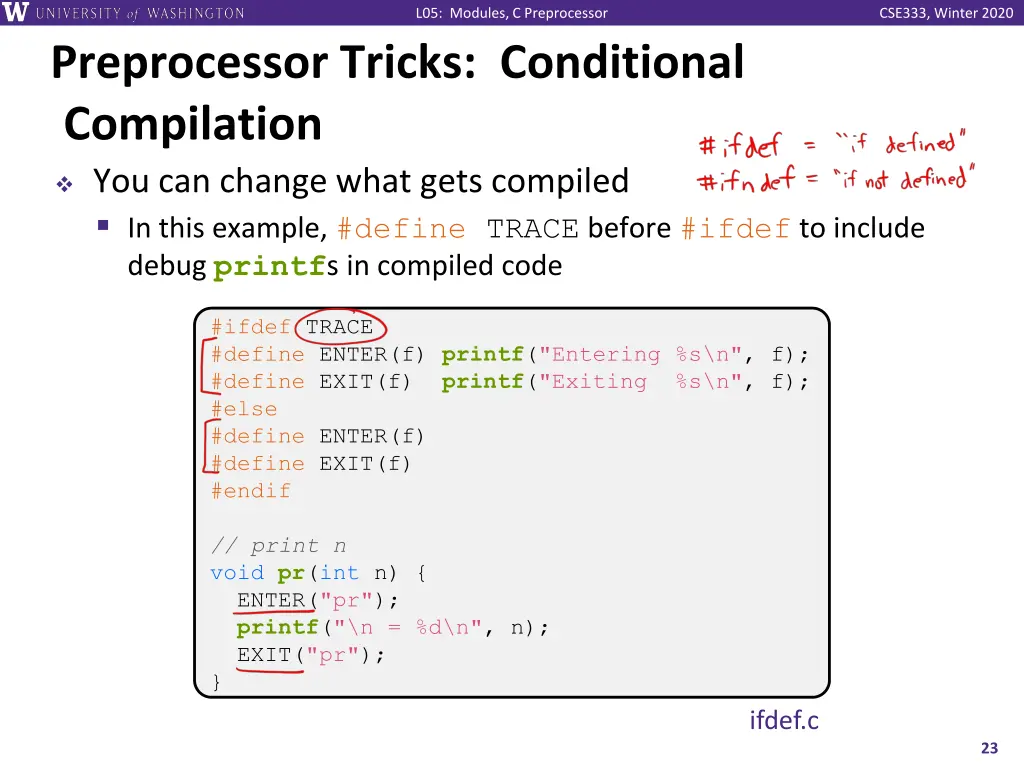
L05: Modules, C Preprocessor CSE333, Winter 2020 Preprocessor Tricks: Conditional Compilation You can change what gets compiled In this example, #define TRACE before #ifdef to include debug printfs in compiled code #ifdef TRACE #define ENTER(f) printf("Entering %s\n", f); #define EXIT(f) printf("Exiting %s\n", f); #else #define ENTER(f) #define EXIT(f) #endif // print n void pr(int n) { ENTER("pr"); printf("\n = %d\n", n); EXIT("pr"); } ifdef.c 23
L05: Modules, C Preprocessor CSE333, Winter 2020 Polling Question What will happen when we try to compile and run? Vote at http://PollEv.com/justinh bash$ gcc -Wall DFOO -DBAR -o condcomp condcomp.c bash$ ./condcomp A. Output "333" B. Output "334" C. Compiler message about EVEN D. Compiler message about BAZ E. We re lost #include <stdio.h> #ifdef FOO #define EVEN(x) !(x%2) #endif #ifndef DBAR #define BAZ 333 #endif int main(int argc, char** argv) { int i = EVEN(42) + BAZ; printf("%d\n",i); return 0; } 24
L05: Modules, C Preprocessor CSE333, Winter 2020 Extra Exercise #1 Implement and test a binary search tree https://en.wikipedia.org/wiki/Binary_search_tree Don t worry about making it balanced Implement key insert() and lookup() functions Bonus: implement a key delete() function Implement it as a C module bst.c, bst.h Implement test_bst.c Contains main() and tests out your BST 25
L05: Modules, C Preprocessor CSE333, Winter 2020 Extra Exercise #2 Implement a Complex number module complex.c, complex.h Includes a typedef to define a complex number a + b?, where a and b are doubles Includes functions to: add, subtract, multiply, and divide complex numbers Implement a test driver in test_complex.c Contains main() 26