Explore the detailed discussion on WLAN sensing measurement feedback procedures, background, advantages, and feedback mechanisms outlined in IEEE 802.11-20/xxxxr0 document submitted by Chenchen LIU from Huawei. The document delves into channel measurement procedures, feedback from responders, advantages of WLAN sensing, and the importance of feedback diversity in sensing applications.
Please find below an Image/Link to download the presentation.
The content on the website is provided AS IS for your information and personal use only. It may not be sold, licensed, or shared on other websites without obtaining consent from the author. If you encounter any issues during the download, it is possible that the publisher has removed the file from their server.
You are allowed to download the files provided on this website for personal or commercial use, subject to the condition that they are used lawfully. All files are the property of their respective owners.
The content on the website is provided AS IS for your information and personal use only. It may not be sold, licensed, or shared on other websites without obtaining consent from the author.
E N D
Presentation Transcript
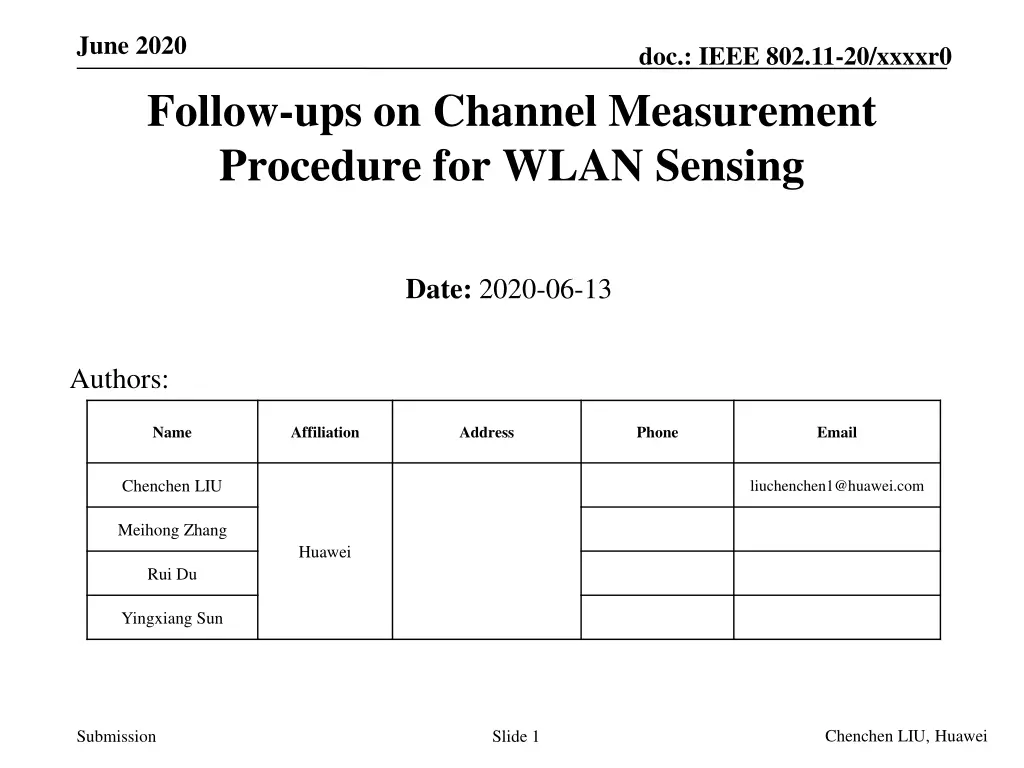
June 2020 doc.: IEEE 802.11-20/xxxxr0 Follow-ups on Channel Measurement Procedure for WLAN Sensing Date: 2020-06-13 Authors: Name Affiliation Address Phone Email Chenchen LIU liuchenchen1@huawei.com Meihong Zhang Huawei Rui Du Yingxiang Sun Chenchen LIU, Huawei Submission Slide 1
June 2020 doc.: IEEE 802.11-20/xxxxr0 Abstract In this contribution, we discuss the sensing measurement feedback procedure Chenchen LIU, Huawei Submission Slide 2
June 2020 doc.: IEEE 802.11-20/xxxxr0 Outline Background of WLAN sensing Feedback from the responders No feedback Threshold based NDP feedback Comparation References Chenchen LIU, Huawei Submission Slide 3
June 2020 doc.: IEEE 802.11-20/xxxxr0 Background of WLAN sensing Basic principle Signal reflected from the target carriers info of the target(e.g. velocity, location, etc.) Advantages Ubiquitous Device-free Privacy High precision field of view intruder detection Fall detection Gesture recognition Gesture recognition Chenchen LIU, Huawei Submission Slide 4
June 2020 doc.: IEEE 802.11-20/xxxxr0 Background of WLAN sensing Sensing based on channel sounding Explicit Implicit Channel direction not crucial Typical use cases only track changes over time Periodicity Some use cases like intruder detection might need a reliable periodicity of CSI feedback Most of the feedbacks over a period may be highly correlated Chenchen LIU, Huawei Submission Slide 5
June 2020 doc.: IEEE 802.11-20/xxxxr0 Feedback from the responders TX STA and RX STA diversity is very important in sensing applications [2] The ISTA broadcast the NDP to all the RSTAs The RSTAs feedback the sensing measurement report to the ISTA RSTA RSTA RSTA RSTA ISTA RSTA Chenchen LIU, Huawei Submission Slide 6
June 2020 doc.: IEEE 802.11-20/xxxxr0 Feedback from the responders An example of the sensing procedure with feedback from multiple RSTA One or more sequences NDPA NDP Trigger SIFS SIFS SIFS ISTA Sensing Measurement Report 1 RSTA1 Sensing Measurement Report 2 RSTA2 Sensing Measurement Report n RSTAn Problems: Large overhead Need special coordination Capability mismatch Chenchen LIU, Huawei Submission Slide 7
June 2020 doc.: IEEE 802.11-20/xxxxr0 No feedback The ISTA trigger each RSTA to send the NDP to the ISTA The ISTA receive the NDP from each RSTA and do the sensing measurement within itself RSTA RSTA RSTA RSTA ISTA RSTA Chenchen LIU, Huawei Submission Slide 8
June 2020 doc.: IEEE 802.11-20/xxxxr0 No feedback Examples of the sensing procedure with no feedback from the ISTA Freqeuncy Freqeuncy NDP TF TF NDP NDP TF Sensing Sounding Sensing Sounding Sensing Sounding Nss=4 Nss=3 Nss=2 time RSTA2 time RSTA1 Nss=1 SIFS SIFS SIFS SIFS SIFS Problems: MU may cause interference, ISTA may need some processing time before processing the next NDP Non-MU cost more airtime Complexity at the ISTA Chenchen LIU, Huawei Submission Slide 9
June 2020 doc.: IEEE 802.11-20/xxxxr0 Threshold based NDP feedback The ISTA set the threshold for Each RSTA, and periodically transmit the NDP to all RSTAs The RSTA measure the CSI and compare it with previous measurement result If the CSI difference exceeds the threshold, the RSTA sends a NDP to the ISTA(schedule may needed). Otherwise, the RSTA store measurement result and feedback nothing The ISTA do the sensing measurement within itself based on the NDP feedback Chenchen LIU, Huawei Submission Slide 10
June 2020 doc.: IEEE 802.11-20/xxxxr0 Threshold based NDP feedback An example of the sensing procedure with threshold based NDP feedback Freqeuncy CTS- to- STA2 NDP TF TF TF Sensing Soundin g Sensing NDPA Sensing Soundin g Sensing Poll NDP NDP Nss=4 Nss=3 CTS- to- STA1 Nss=2 STA1 Nss=1 STA2 Nss=2 time Nss=1 SIFS SIFS SIFS SIFS SIFS SIFS SIFS Problems: May cause some delay for certain application Chenchen LIU, Huawei Submission Slide 11
June 2020 doc.: IEEE 802.11-20/xxxxr0 Comparation Feedback procedure from the responders No feedback Threshold based Pros Cons Simple measurement No feedback needed Small overhead Large overhead Interference Latency Chenchen LIU, Huawei Submission Slide 12
June 2020 doc.: IEEE 802.11-20/xxxxr0 Summary In this contribution, three sensing and feedback procedures and their corresponding pros and cons are discussed. Chenchen LIU, Huawei Submission Slide 13
June 2020 doc.: IEEE 802.11-20/xxxxr0 References [1] CSI-based Wi-Fi Sensing: Results and Standardization Challenges, doc.: IEEE 802.11-19/1769 [2] Wi-Fi Sensing: Cooperation and Standard Support, doc.: IEEE 802.11-19/1416r0 [3] Z. Wu, Y. Han, Y. Chen and K. J. R. Liu, "A Time-Reversal Paradigm for Indoor Positioning System," in IEEE Transactions on Vehicular Technology, vol. 64, no. 4, pp. 1331-1339, April 2015 Chenchen LIU, Huawei Submission Slide 14
June 2020 doc.: IEEE 802.11-20/xxxxr0 Backup Threshold could be TRRS Chenchen LIU, Huawei Submission Slide 15