Polymers and Their Properties
Polymers are long chains of repeating monomers, with both natural and synthetic varieties. Natural polymers include silk, cellulose, and DNA, while synthetic ones encompass plastics, fibers, and elastomers. The properties of polymers, such as molar mass and monomer structure, determine their functio
1 views • 15 slides
Composition of Soil Organic Matter in Soil Microbiology
Soil organic matter is vital for soil properties and plant nutrition. It consists of plant residues, animal remains, and microbial tissues, comprising complex compounds like carbohydrates, proteins, fats, and more. The composition varies with plant type, age, and nature. Leguminous plants are rich i
2 views • 19 slides
Carbohydrates in Living Organisms
Carbohydrates, along with proteins, lipids, and nucleic acids, are essential macromolecules in living organisms. They are made up of carbon, hydrogen, and oxygen in a 1:2:1 ratio. Carbohydrates provide the main energy source for living things, with examples including glucose, fructose, and sucrose.
3 views • 58 slides

Easy-Care and Durable Press Finishes for Textiles
Easy-care and durable press finishes play a vital role in enhancing the quality and longevity of textiles, particularly those made of cellulose fibers. These finishes reduce shrinkage, improve wrinkle recovery, and maintain fabric appearance. While beneficial, they may impact fiber flexibility and s
2 views • 25 slides
Stabilizers in Dairy Technology by B.K. Singh
Stabilizers are key ingredients used in ice cream and related products to enhance viscosity, stability, texture, and shelf life. They help in preventing wheying off, controlling crystal growth, and maintaining product quality during storage. Various types of stabilizers, including proteins, plant ex
5 views • 15 slides
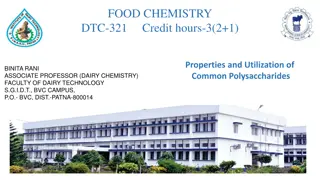
Properties and Utilization of Common Polysaccharides in Food Chemistry
Polysaccharides are carbohydrates with more than 10 monosaccharide units, commonly found in foods like starch, cellulose, glycogen, hemicellulose, and pectic substances. Starch, a natural polymer of D-glucose, is a major energy source in the human diet, present in cereals, roots, and tubers. It cons
7 views • 22 slides
The Digestive System of Ruminant Animals
Ruminant animals have a unique digestive system that allows them to efficiently digest cellulose. Their stomach consists of four chambers, each serving a specific function in the digestion process. The breakdown of cellulose by microbes in the rumen produces glucose, which provides energy for the an
2 views • 22 slides
Structural Roles of Biomolecules in Living Organisms
Explore the essential roles of carbohydrates, proteins, and lipids in cell structure and function. Learn how cellulose, keratin, myosin, phospholipids, and more contribute to the structural integrity and metabolic activities within living organisms. Discover the significance of these biomolecules in
5 views • 23 slides
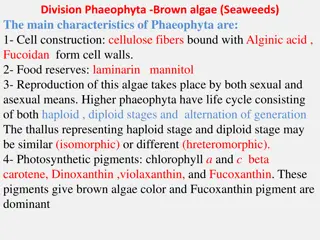
Characteristics of Phaeophyta - Brown Algae (Seaweeds)
Phaeophyta, also known as brown algae or seaweeds, exhibit unique characteristics including cellulose fibers with Alginic acid, food reserves like laminarin and mannitol, and a life cycle consisting of both haploid and diploid stages. They possess photosynthetic pigments giving them their brown colo
2 views • 26 slides
Affinity Chromatography: A Breakthrough in Biochemical Research
Affinity chromatography, developed in the 1930s by A. Wilhelm Tiselius, is a vital technique for studying enzymes and proteins. It relies on the specific affinity between biochemical compounds and utilizes matrices like agarose for binding sites. Ligands such as amino and hydroxyl groups play crucia
2 views • 27 slides
Sawdust as a Low-Cost Adsorbent for Water Treatment
Sawdust, a renewable natural resource, has been studied for its effectiveness as an adsorbent for removing contaminants from water. It contains cellulose, hemicellulose, lignin, and other components that aid in adsorption. Research indicates its suitability for removing dyes, toxic salts, and heavy
4 views • 22 slides
Topical Hemostats, Glues, and Lasers in Neurosurgery at AIIMS
Hemostasis is crucial in neurosurgery for controlling bleeding without ligatures. Various topical hemostats like chemical, mechanical, collagen, thrombin, and fibrin glues are used. Surgicel and Oxycel, oxidized cellulose polymers, act as physical matrices aiding in clot formation. Gelatin sponges l
4 views • 22 slides
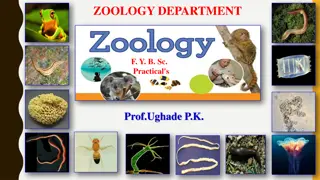
Classification and Characteristics of Phylum Protozoa
Phylum Protozoa comprises unicellular, microscopic, eukaryotic organisms found mostly in aquatic habitats. They exhibit diverse locomotory structures such as cilia, flagella, or pseudopodia. These protists may possess a cellulose cell wall and various membrane-bound organelles like mitochondria and
5 views • 21 slides

Carbohydrates: Composition, Structure, and Function
Carbohydrates are composed of carbon, hydrogen, and oxygen in a specific ratio. Monosaccharides such as glucose, fructose, and galactose are carbohydrate monomers, while polysaccharides like lactose, sucrose, starch, cellulose, and glycogen are carbohydrate polymers. The chemical formula for glucose
1 views • 8 slides
Starches, Cellulose, Gums, and Pectins in Food
Explore the roles of starches, cellulose, gums, and pectins in the diet. Learn about their structures, functions, and how they affect food texture and properties. Discover how these components bind, thicken, and provide structure in various food preparations.
6 views • 29 slides

CMF Twist in Cellulose Nanocrystals: Simulations, Experiments, and Implications
Explore the twist phenomenon in cellulose nanocrystals known as CMF through simulations and experimental evidence. Discover how isolated cellulose chains twist, the challenges in visualizing CMF twist, proposed alterations upon drying, and the implications of CMF twist in forming a liquid crystal ph
3 views • 7 slides
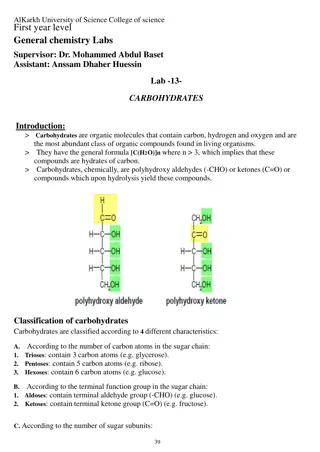
Carbohydrates: A Comprehensive Overview
Carbohydrates are essential organic compounds found abundantly in living organisms, containing carbon, hydrogen, and oxygen. This summary delves into the classification of carbohydrates based on characteristics like the number of carbon atoms, terminal function groups, and the number of sugar subuni
4 views • 5 slides

Advanced Moisture Renewal Mask for Oncology Spa Services
Bel Mondo Beauty introduces a breakthrough Moisture Renewal Mask made from bio cellulose, a fabric with incredible skin affinity and efficient ingredient transfer. This professional series mask targets oncology spa services, developed in collaboration with Oncology Spa Solutions to care for clients
3 views • 19 slides
Carbohydrates in Science: Structure, Types, and Applications
Explore the comprehensive study of carbohydrates, including their types such as monosaccharides, disaccharides, and polysaccharides. Learn about the molecular structure and functions of cellulose, starch, and other key carbohydrates. Delve into the chemistry of sugars, nucleic acids, and protein syn
0 views • 32 slides
Revolutionizing Plastics: Making Cellulose-Based Plastic from Hemp in New Mexico
New Mexico State University could lead the way in establishing a plastics industry using cellulose plant fibers, such as hemp, to create eco-friendly and sustainable plastic products. Zeoform, a material made from cellulose fibers and water, offers a patented process to form industrial-strength plas
4 views • 14 slides
Electronic Structure and Auger Recombination in Silicon Nanocrystals Doped with P, Li, S
This study investigates the electronic structure and Auger recombination rates in silicon nanocrystals doped with phosphorus, lithium, and sulfur. It includes published data on radiative recombination lifetimes, relative rates of recombination, and modeling of nanocrystal structures using computatio
0 views • 13 slides
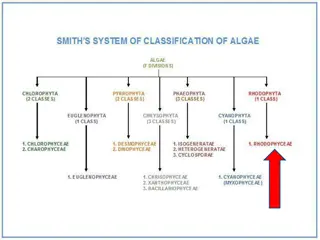
Main Characteristics of Rhodophyta: The Red Algae Division
Rhodophyta, or red algae, are mostly marine algae with distinct photosynthetic pigments giving them a red color. Their main characteristics include the presence of phycoerythrin pigment, floridean starch as food reserve, thalloid plant body structure, oogamous sexual reproduction, and cell walls con
5 views • 27 slides
Overview of Fiber Chemical Composition and Types
Fibers consist of polymers made from simple molecules, with natural fibers like wool, silk, cotton, and linen having specific compositions including proteins, cellulose, and glucose. Man-made fibers like rayon and acetate are chemically altered cellulose, while synthetic fibers like nylon and polyes
21 views • 11 slides
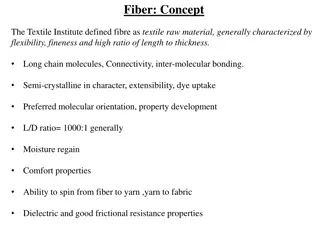
Cellulosic Fibres in Textile Raw Materials
Fiber concept includes the flexibility and characteristics of fibers as textile raw materials, with a focus on cellulose, the most abundant polymer in nature. Cellulose fibers, such as cotton, exhibit unique structural properties and molecular formations that contribute to their properties in fabric
0 views • 25 slides
Plant Cell Walls: Structure and Function
Plant cell walls play a crucial role in providing structure and protection to plant cells. This article delves into the composition of primary and secondary cell walls, highlighting the presence of cellulose, pectins, and glycans. The secondary cell wall, rich in lignin, offers mechanical support, e
4 views • 38 slides
Polysaccharides: Structure and Function in Chemistry
Polysaccharides are complex carbohydrates made up of multiple monosaccharide units linked by glycosidic linkages. Examples include starch, cellulose, and glycogen. Starch, a major plant carbohydrate, consists of amylose and amylopectin. Amylose forms a linear structure, while amylopectin is highly b
1 views • 13 slides
Obtention of Cellulose Nanofiber from Almond Shell Using Different Chemical Treatments
This study conducted in Trabzon, Turkey, focused on obtaining cellulose nanofibers from almond shells through various chemical treatments. Different procedures involving alkaline solutions, bleaching, hydrolysis, and acetylation were used to remove lignin content and achieve optimal crystallinity. A
0 views • 7 slides
Plant Evolution and Characteristics
Plants colonized land through various adaptations such as multicellularity and photosynthesis. They exhibit characteristics like chlorophyll, cellulose cell walls, and apical meristems. Plant evolution includes alternation of generations, with gametophytes and sporophytes undergoing meiosis and mito
4 views • 15 slides
Classification of Nanomaterials and Quantum Phenomena
Nanomaterials are classified into different types such as nanocrystals and quantum dots, each exhibiting unique properties at the nanoscale. Quantum dots, zero-dimensional systems, show quantum confinement effects leading to tuneable light emission. One-dimensional structures like nanowires and nano
3 views • 18 slides
Polymer Reactivity and Modification: Synthesis and Reactions
Reactions of polymers involve the synthesis of new polymers through modification, such as esterification of cellulose, crosslinking of polyisoprene, hydrolysis of poly(vinyl acetate), and chlorination of polyethylene. Polymer reactions utilize chemical processes to create new materials, carriers, or
2 views • 48 slides
Fish Packaging Technology Overview
Explore the use of nonethylenic thermoplastics like polyamides or nylons in fish packaging technology, citing examples such as Nylon 6, Nylon 6:6, and Nylon 6:10. Learn about their important properties, applications in gas/vacuum packaging and boil-in-bag pouches, as well as the benefits of combinin
1 views • 21 slides
Plant & Animal Cell Structures and Photosynthesis Process
Plant and animal cells have distinct structures, notably cellulose cell walls in plants and chloroplasts for photosynthesis. Photosynthesis is crucial for plants to produce food. Factors influencing photosynthesis include carbon dioxide concentration, light intensity, temperature, and water availabi
1 views • 28 slides
Crystallite Size & Band Gap of Tungsten Trioxide Dihydrate Nanocrystals
Tungsten trioxide dihydrate (WO3.2H2O) nanocrystals were prepared under various conditions, showcasing different crystallite sizes and band gaps. The structural properties, applications, and unique features of WO3.2H2O are explored in this study, contributing to the understanding of its potential in
0 views • 12 slides
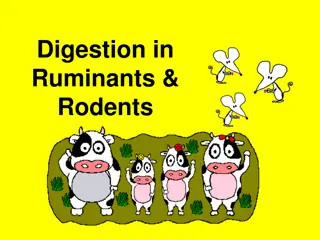
Digestion in Ruminants & Rodents
Unique digestive systems of herbivorous ruminants like cows and rodents such as rabbits and rats. Discover how ruminants process cellulose and rely on specialized adaptations for digestion, including the importance of bacteria in the rumen and reticulum. Dive into the fascinating world of plant mate
3 views • 38 slides
Potential of Pentose Sugars as Fermentation Substrate
Plant cell walls consist of cellulose and hemicellulose, which include various pentose sugars like xylose, mannose, galactose, and more. These sugars can be used as fermentation substrates, leading to the production of biofuels and other valuable products. Methods to utilize pentose sugars effective
1 views • 14 slides
Rumen Microbes: Degradation, Transport, Synthesis
Rumen microbes play a crucial role in the degradation, transport, and synthesis of nutrients in the digestive system of ruminant animals. These microbes carry out microbial fermentations with a short life cycle, forming a synergistic relationship based on substrates like starch and cellulose. Origin
7 views • 59 slides
Materials for Membrane Construction in Filtration Units
This informative content delves into various materials utilized in membrane construction for filtration units in dairy process engineering. It covers different types of materials such as Cellulose Acetate, Synthetic Polymers, Polyvinylidene Fluoride, Ceramic Membrane Materials like Alumina, Titania,
0 views • 11 slides
Torrefaction and Pyrolysis of Lignocellulosic Biomass for Renewable Fuel Production
This research project focuses on the torrefaction and pyrolysis processes to convert lignocellulosic biomass, such as switchgrass and corn stover, into fungible fuels. The aim is to isolate lignin from biomass using Deep Eutectic Solvents (DES) Fractionation and then convert this lignin into drop-in
2 views • 20 slides
Plant Cell Wall: Structure, Functions, and Components
Learn about the essential aspects of plant cell walls, including their structure, functions, and macromolecular components such as cellulose, hemicellulose, and pectins. Discover how these layers, including the middle lamella, primary wall, and secondary wall, contribute to the strength, shape, and
2 views • 24 slides

Growth and Development of Plant Cells: Understanding the Intricacies
Explore the fascinating world of cellular development in plants, diving into topics like cell walls, growth dynamics, and signal perception. Delve into the complexities of plant cell growth, from primary walls to cellulose microfibrils, unraveling the structural components that shape plant life.
3 views • 29 slides