
Enhancing Healthcare Services in Malawi through the Master Patient Index (MPI)
The Master Patient Index (MPI) plays a crucial role in Malawi's healthcare system by providing a national patient identification system to improve healthcare quality and treatment accuracy. Leveraging the MPI aims to dispense unique patient IDs, connect with existing registries, enhance data managem
13 views • 8 slides

Proposal for National MPI using SHDS Data in Somalia
The proposal discusses the creation of a National Multidimensional Poverty Index (MPI) for Somalia using data from the Somali Health and Demographic Survey (SHDS). The SHDS, with a sample size of 16,360 households, aims to provide insights into the health and demographic characteristics of the Somal
1 views • 26 slides
Open MPI: A Comprehensive Overview
Open MPI is a high-performance implementation of MPI, widely used in academic, research, and industry settings. This article delves into the architecture, implementation, and usage of Open MPI, providing insights into its features, goals, and practical applications. From a high-level view to detaile
5 views • 33 slides
Introduction to Message Passing Interface (MPI) in IT Center
Message Passing Interface (MPI) is a crucial aspect of Information Technology Center training, focusing on communication and data movement among processes. This training covers MPI features, types of communication, basic MPI calls, and more. With an emphasis on MPI's role in synchronization, data mo
4 views • 29 slides
Optimization Strategies for MPI-Interoperable Active Messages
The study delves into optimization strategies for MPI-interoperable active messages, focusing on data-intensive applications like graph algorithms and sequence assembly. It explores message passing models in MPI, past work on MPI-interoperable and generalized active messages, and how MPI-interoperab
3 views • 20 slides
Communication Costs in Distributed Sparse Tensor Factorization on Multi-GPU Systems
This research paper presented an evaluation of communication costs for distributed sparse tensor factorization on multi-GPU systems. It discussed the background of tensors, tensor factorization methods like CP-ALS, and communication requirements in RefacTo. The motivation highlighted the dominance o
4 views • 34 slides
Leveraging MPI's One-Sided Communication Interface for Shared Memory Programming
This content discusses the utilization of MPI's one-sided communication interface for shared memory programming, addressing the benefits of using multi- and manycore systems, challenges in programming shared memory efficiently, the differences between MPI and OS tools, MPI-3.0 one-sided memory model
9 views • 20 slides

The Multidimensional Poverty Index (MPI)
The MPI, introduced in 2010 by OPHI and UNDP, offers a comprehensive view of poverty by considering various dimensions beyond just income. Unlike traditional measures, the MPI captures deprivations in fundamental services and human functioning. It addresses the limitations of monetary poverty measur
3 views • 56 slides
OpenACC Compiler for CUDA: A Source-to-Source Implementation
An open-source OpenACC compiler designed for NVIDIA GPUs using a source-to-source approach allows for detailed machine-specific optimizations through the mature CUDA compiler. The compiler targets C as the language and leverages the CUDA API, facilitating the generation of executable files.
3 views • 28 slides
Enhancing HPC Performance with Broadcom RoCE MPI Library
This project focuses on optimizing MPI communication operations using Broadcom RoCE technology for high-performance computing applications. It discusses the benefits of RoCE for HPC, the goal of highly optimized MPI for Broadcom RoCEv2, and the overview of the MVAPICH2 Project, a high-performance op
2 views • 27 slides
Message Passing Interface (MPI) Standardization
Message Passing Interface (MPI) standard is a specification guiding the development and use of message passing libraries for parallel programming. It focuses on practicality, portability, efficiency, and flexibility. MPI supports distributed memory, shared memory, and hybrid architectures, offering
7 views • 29 slides
Master Patient Index (MPI) in Healthcare Systems
Explore the significance of Master Patient Index (MPI) in healthcare settings, its role in patient management, patient identification, and linking electronic health records (EHRs). Learn about the purpose, functions, and benefits of MPI in ensuring accurate patient data and seamless healthcare opera
1 views • 16 slides

Insights into Pilot National MPI for Botswana
This document outlines the structure, dimensions, and indicators of the Pilot National Multidimensional Poverty Index (MPI) for Botswana. It provides detailed criteria for measuring deprivation in areas such as education, health, social inclusion, living standards, and more. The presentation also in
6 views • 10 slides
Fast Noncontiguous GPU Data Movement in Hybrid MPI+GPU Environments
This research focuses on enabling efficient and fast noncontiguous data movement between GPUs in hybrid MPI+GPU environments. The study explores techniques such as MPI-derived data types to facilitate noncontiguous message passing and improve communication performance in GPU-accelerated systems. By
4 views • 18 slides
Emerging Trends in Bioinformatics: Leveraging CUDA and GPGPU
Today, the intersection of science and technology drives advancements in bioinformatics, enabling the analysis and visualization of vast data sets. With the utilization of CUDA programming and GPGPU technology, researchers can tackle complex problems efficiently. Massive multithreading and CUDA memo
5 views • 32 slides
GPU Programming with CUDA
Dive into GPU programming with CUDA, understanding matrix multiplication implementation, optimizing performance, and utilizing debugging & profiling tools. Explore translating matrix multiplication to CUDA, utilizing SPMD parallelism, and implementing CUDA kernels for improved performance.
3 views • 50 slides
Advanced Features of CUDA APIs for Data Transfer and Kernel Launch
This lecture covers advanced features of the CUDA APIs for data transfer and kernel launch, focusing on task parallelism for overlapping data transfer with kernel computation using CUDA streams. Topics include serialized data transfer and GPU computation, device overlap, overlapped (pipelined) timin
4 views • 22 slides
Implementing SHA-3 Hash Submissions on NVIDIA GPU
This work explores implementing SHA-3 hash submissions on NVIDIA GPU using the CUDA framework. Learn about the benefits of utilizing GPU for parallel tasks, the CUDA framework, CUDA programming steps, example CPU and GPU codes, challenges in GPU debugging, design considerations, and previous works o
3 views • 26 slides
Designing In-network Computing Aware Reduction Collectives in MPI
In this presentation at SC'23, discover how in-network computing optimizes MPI reduction collectives for HPC/DL applications. Explore SHARP protocol for hierarchical aggregation and reduction, shared memory collectives, and the benefits of offloading operations to network devices. Learn about modern
0 views • 20 slides
Can near-data processing accelerate dense MPI collectives? An MVAPICH Approach
Memory growth trends like DRAM, the MVAPICH2 Project for high-performance MPI library support, and the importance of MPI collectives in data-intensive workloads are discussed in this presentation by Mustafa Abduljabbar from The Ohio State University.
0 views • 28 slides

Introduction to MPI: Basics of Message Passing Interface
Message Passing Interface (MPI) is a vital API for communication in distributed memory systems, enabling processes to exchange data and synchronize. This standard API supports scalable message passing programs, utilizing communication routines and library approach with features like topology. Learn
1 views • 9 slides

Introduction to MPI Basics
Message Passing Interface (MPI) is an industrial standard API for communication, essential in developing scalable and portable message passing programs for distributed memory systems. MPI execution model revolves around coordinating processes with separate address spaces. The data model involves par
2 views • 21 slides

Context-Aware Computing via Mobile Social Cloud
The realm of context-aware computing through the mobile social cloud, as Prof. Rick Han from the University of Colorado at Boulder delves into the intricate interplay of mobile social networks, the SocialFusion project, distributing SocialFusion in the cloud, and the importance of privacy in the con
0 views • 7 slides
Distance-Aware Influence Maximization in Geo-social Networks
This research paper explores the concept of distance-aware influence maximization in geo-social networks to improve targeted marketing strategies. It discusses the impact of location-aware influence maximization and diffusion models on social network platforms like Foursquare and Twitter. The study
3 views • 24 slides

Scalability Challenges in MPI Implementations
This content explores the scalability challenges faced by MPI implementations on million-core systems. It discusses factors affecting scalability, performance issues, and ongoing efforts to address scalability issues in the MPI specification.
0 views • 7 slides
Time-Aware User Embeddings as a Service
Providing time-aware user/activity embeddings as a service to different teams within a company offers a centralized and task-independent solution. The approach involves learning universal, compact, and time-aware user embeddings that preserve temporal dependencies, catering to various applications s
5 views • 15 slides
GPU Architecture and Parallel Programming Lecture 10: Data Transfer and CUDA Streams
This lecture covers advanced features of the CUDA APIs for data transfer and kernel launch task parallelism, focusing on overlapping data transfer with kernel computation using CUDA streams. Topics include serialized data transfer and GPU computation, device overlap, overlapped timing for pipeline e
0 views • 26 slides
MPI Network Layer Requirements for Efficient Communication
Discover the essential requirements of the MPI network layer for efficient communication, including message handling, asynchronous progress, scalable communications, and more. Learn about the need for low latency, high bandwidth, separation of local actions, and scalable peer-to-peer interactions in
2 views • 45 slides
Introduction to Message Passing Interface (MPI) in ARIS Training
Learn about Message Passing Interface (MPI) and its use in communication and data movement among processes in ARIS Training provided by the AUTH Information Technology Center. Understand the basics, features, types of communication, and basic MPI calls. Enhance your understanding of MPI for efficien
2 views • 29 slides
MPI Basics: Communicators, Datatypes, and Parallel Programming
Delve into the fundamentals of MPI (Message Passing Interface) involving communicators, datatypes, building and running MPI programs, message sending and receiving, synchronization, data movement, Flynn Parallelism Taxonomy, and the explicit data movement required in MPI programming. Explore the coo
3 views • 48 slides
MPI: Requirements, Overview, and Community Feedback
Explore the MPI network layer requirements presented to the OpenFabrics libfabric working group. Learn about communication modes, MPI specifications, and the diverse perspectives within the MPI community.
1 views • 20 slides
MPI Network Layer Requirements and Mapping Insights
Explore the essential requirements of the MPI network layer as assembled by industry experts from Cisco Systems and Intel Corporation. Discover key elements such as efficient APIs, asynchronous data transfers, scalable communications, and more for optimal MPI functionality.
1 views • 45 slides
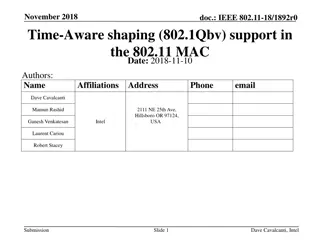
Enabling Time-Aware Traffic Shaping in IEEE 802.11 MAC
This presentation discusses solutions to implement Time-Aware Traffic Shaping (802.1Qbv) in the 802.11 MAC for controlling latency in time-sensitive and real-time applications. It delves into TSN standards, TSN components, and the benefits of Time-Aware Shaping in managing frame transmissions effect
0 views • 15 slides

Explore Parallel Programming with MPI in Physics Lab
Delve into the world of parallel programming with MPI in the PHYS 4061 lab. Access temporary cluster accounts, learn how MPI works, and understand the basics of message passing interfaces for high-performance computing.
2 views • 27 slides
Challenges in Memory Registration and Fork Support for MPI Implementations
Explore the feedback and challenges faced by major commercial MPI implementations in 2009, focusing on memory registration and fork support issues discussed at the Sonoma OpenFabrics Workshop. Discover insights on optimizing memory registration performance, handling fork support limitations, and mor
4 views • 20 slides
Universal Language for GPU Computing: OpenCL vs CUDA
Explore the realm of parallel programming with OpenCL and CUDA, comparing their pros and cons. Understand the challenges and strategies for converting CUDA to OpenCL, along with insights into modifying GPU kernel code for optimal performance.
0 views • 7 slides
MPI Programming: Deriving Datatypes for Parallel Computing
Explore the concept of MPI derived datatypes for efficient parallel programming, focusing on necessary data transfers, local data structure communication, introduction to datatypes in MPI, predefined datatypes, and examples of derived datatypes. Learn about MPI_Type_contiguous and how to utilize it
2 views • 23 slides
Understanding CUDA Programming for GPU Acceleration
Explore the world of GPU programming with CUDA, NVIDIA's parallel computing model. Learn about heterogeneous programming, CUDA kernels, memory management, and the basic structure of CUDA programs. Dive into allocating memory in the GPU and host, and discover the fork-join model for parallel processi
2 views • 14 slides
MPI Forum Tools Working Group Details
Explore the latest updates from the MPI Forum Tools Working Group regarding Function Pointer Interception (QMPI) and current state-of-the-art MPI interfaces. Discover desired features for multiple tool support and how QMPI enables simultaneous tool usage in MPI applications.
0 views • 20 slides
MPI Introduction and Tuning for Better Performance
Explore the fundamentals of MPI (Message Passing Interface) and optimize MATLAB for improved performance. Learn about parallel computing paradigms, MPI topics, and the benefits of using MPI for efficient communication in network clusters. Get insights into MPI preliminaries and essential functions f
1 views • 87 slides