Approval and Validation Updates for NR MIMO OTA in 3GPP TSG-RAN.WG4 Meeting
The 3GPP TSG-RAN.WG4 Meeting discussed approval for the NR MIMO OTA workplan, addressed FR2 blocking issues, and emphasized the use of polarized antenna models. Updates were made to the power validation procedure and gNB beams usage criteria for FR1 MIMO OTA channel model validation. Collaboration w
2 views • 8 slides
Discussion on Enabling MIMO in IMMW: IEEE 802.11-23/1991
Enabling MIMO in mmWave technology is essential for improving throughput performance. While IEEE 802.11ad supports single-stream communications, 802.11ay introduces SU-MIMO, MU-MIMO, and hybrid beamforming. This document discusses the necessity of MIMO in IMMW and explores various MIMO options for e
8 views • 12 slides

Enhancing DL MU-MIMO with Improved Precoding Techniques
In this document, Dzevdan Kapetanovic from Ericsson discusses the limitations of standard DL MU-MIMO precoding for BPSK and proposes enhanced precoding and decoding methods for better performance. By applying these strategies to complex-valued alphabets, significant improvements are observed based o
3 views • 12 slides
Discussion on Rank Adaptation for SU-MIMO Transmission in IEEE 802.11-17/1253
MIMO transmission in IEEE 802.11ay supports up to 8 data streams with a focus on SU-MIMO. The need for efficient rank adaptation procedures and corresponding signaling mechanisms is highlighted. The document addresses rank adaptation procedures, example implementations, challenges faced, and propose
3 views • 6 slides
Energy Efficient Relay Antenna Selection for AF MIMO Two-Way Relay Channels
The study explores energy-efficient relay antenna selection for AF MIMO two-way relay channels, aiming to optimize energy efficiency while maintaining performance. It discusses the advantages and disadvantages of two-way MIMO relay systems, emphasizing higher spectral efficiency, improved reliabilit
2 views • 17 slides
MIMO option for NG60
This document discusses a MIMO option for NG60 that allows for increased bit-rate without consuming more bandwidth. The proposed MIMO option works effectively in line-of-sight scenarios based on polarization. Capacity results are presented without delving into implementation details, assuming a prac
9 views • 7 slides
Coordinated Per-Antenna Power Minimization for Multicell Massive MIMO Systems with Low-Resolution Data Converters
Massive MIMO systems with low-resolution data converters can achieve significant gains in capacity and spectral efficiency while minimizing power consumption. This study focuses on minimizing transmit power using optimal beamforming solutions for both uplink and downlink channels in a multi-cell, mu
3 views • 15 slides
Enhancing Performance of OCC System Using MIMO-COOK Scheme
This document explores the MIMO-COOK technique applied in the Optical Camera Communication (OCC) system to increase performance. The MIMO-COOK scheme captures data from multiple transmitters, improving data rate, distance communication, and system efficiency. With advantages like frame rate variatio
0 views • 6 slides
MIMO Systems and Applications for Wireless Communication
This content discusses the utilization of multi-antenna systems, including various MIMO types like Space-Time Block Coding, Selective Transmit Diversity, and more, to enhance performance in 4G wireless communication systems. It covers system characterization, types of MIMO systems, and specific tech
1 views • 31 slides

Capacity-Approaching Linear Precoding for Large-Scale MIMO Systems
Capacity-approaching linear precoding methods with low complexity are crucial for enhancing the performance of multi-user large-scale MIMO systems. This study explores the advantages, challenges, and various precoding schemes in the context of large-scale MIMO technology, emphasizing the need for ef
4 views • 20 slides

Machine Learning Inspired Energy-Efficient Hybrid Precoding for mmWave Massive MIMO Systems
This study presents a novel approach using machine learning to design energy-efficient hybrid precoding schemes for mmWave massive MIMO systems. The advantages of mmWave technology, challenges faced in traditional MIMO setups, and solutions such as hybrid analog and digital precoding are discussed.
3 views • 46 slides

Hybrid Analog and Digital Precoding for mmWave Massive MIMO Systems
Explore the near-optimal hybrid analog and digital precoding techniques for downlink mmWave massive MIMO systems. Learn about the advantages of using short wavelengths and massive MIMO technology, as well as the implementation of hybrid precoding to improve performance while reducing hardware comple
0 views • 17 slides
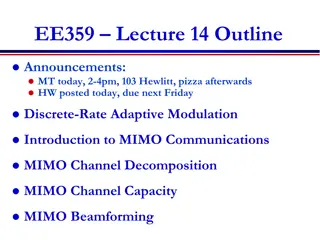
Adaptive Modulation, MIMO Communications, and Channel Capacity Overview
Dive into the world of adaptive modulation, MIMO communications, and channel capacity in this comprehensive lecture outline. Explore topics such as discrete-rate adaptive modulation, MIMO channel decomposition, MIMO beamforming, and more. Understand the principles behind optimal power and rate adapt
2 views • 9 slides
Feasibility of SU-MIMO Under Array Alignment Method
Investigate the feasibility of Single-User Multiple-Input Multiple-Output (SU-MIMO) using array alignment method based on channel models adopted in IEEE 802.11 standards. Simulation methodology proposed for evaluating performance in an IEEE 802.11ay environment, analyzing factors such as MIMO channe
3 views • 17 slides

Unlocking the Potential of Massive MIMO Technology for 5G Networks
Discover the cutting-edge research on Scalable Distributed Massive MIMO, the significance of massive MIMO in achieving higher data rates in 5G networks, challenges in computation and wired communication, and solutions for scalability and efficiency in massive MIMO systems.
0 views • 25 slides
Enhancing SU-MIMO Performance in IEEE 802.11-16: Closed Loop Insights
Explore the improvements in Single User Multiple Input Multiple Output (SU-MIMO) transmissions within the IEEE 802.11-16 standard. Discover the benefits of Closed Loop SU-MIMO with quantized feedback compared to Open Loop SU-MIMO. Learn about baseband precoding methods and simulation assumptions for
4 views • 12 slides
MU-MIMO Codebook Based Transmission Flow in IEEE802.11ay
Explore the proposed MU-MIMO codebook based transmission flow for IEEE802.11ay, including Enhanced SLS beamforming for extended coverage, beam training, and scheduling procedures. System level simulations demonstrate high throughput MU-MIMO links. Find out more about channel access, transmission flo
3 views • 11 slides
Discussion on MU-MIMO Hybrid Beamforming System in 802.11ay
Explore the need for MU-MIMO in 802.11ay and parameters for supporting it, with a focus on hybrid beamforming and codebooks. Delve into the design challenges and considerations for efficient beamforming in MU-MIMO systems.
4 views • 11 slides
Framework for MIMO Operation over mmWave Links
Explore the framework for MIMO operation over mmWave links, focusing on scenarios, beamforming, diversity, and the impact of phase noise. Discusses the applicability of MIMO in a 2x2 mmWave system and SVD multiplexing in LOS MIMO channels.
2 views • 24 slides
MU-MIMO Channel Access Flow for IEEE 802.11ay Standard
Explore the proposed schemes for MU-MIMO channel access flow in IEEE 802.11-16/1408r0 presentation, aiming to facilitate MU-MIMO data transmission efficiently through detailed outlined processes and methods discussed by industry experts from various technological backgrounds.
1 views • 11 slides
Potential Benefit of Closed Loop SU-MIMO for 11ay Communication
Demonstration of the benefits of closed loop SU-MIMO over open loop SU-MIMO in mmWave communication through system level simulations with different antenna configurations and deployment scenarios. Explore the impact of inter-stream interference and the effectiveness of channel-dependent precoding in
1 views • 12 slides
Enhancing Uplink Reliability with MIMO Interference Suppression in WLAN
Explore how MIMO interference suppression techniques can improve uplink reliability in WLAN environments, addressing the challenges of unpredictable interference from non-cooperative OBSS and other technologies. The presentation discusses the importance of covariance matrix estimation, spatial direc
3 views • 12 slides
Experimental Measurements for Short Range LOS SU-MIMO System
This document presents experimental measurements for a Line-of-Sight (LOS) short-range 2x2 Single-User Multiple-Input Multiple-Output (SU-MIMO) system. The results highlight the impact of factors such as phase difference, cross links, antenna separation, and polarization on the system's performance.
1 views • 13 slides
SU-MIMO Configurations for IEEE 802.11ay Standard
This presentation discusses SU-MIMO configurations proposed for inclusion in the IEEE 802.11ay standard. These configurations leverage spatial and polarization diversity channel properties to enable operation in various conditions, supporting the development of evaluation methodologies. Topics cover
2 views • 14 slides
IEEE 802.11-16/0988r1 Non-EDMG Part of Preamble for MIMO in 11ay
Discover the non-EDMG portion of the preamble for MIMO in IEEE 802.11-16/0988r1 document dated July 25, 2016. Explore options for preamble frame format and channel bonding configurations in MIMO setups.
0 views • 18 slides
Signalling Support for Full Bandwidth MU-MIMO Compressed SIG-B Mode in IEEE 802.11-16/0203r0
Explore the February 2016 document on signalling support for Full Bandwidth MU-MIMO compressed SIG-B mode in IEEE 802.11-16/0203r0, detailing the differentiation of full BW MU-MIMO from OFDMA MU PPDU, SIG-A signalling, SIG-B structures, and more in the proposed TGax draft specification.
3 views • 9 slides
Cooperation in Wireless Networks: Virtual MIMO, Routing, and Channel Optimization
Explore the concepts of cooperation in wireless networks, including Virtual MIMO, routing strategies, and channel optimization techniques. Topics covered include the benefits of cooperation, different cooperation strategies, and tradeoffs among them. Learn about Virtual MIMO setups, channel gain con
1 views • 30 slides
Impact of Tx EVM on MIMO Detection in WLAN Systems
Explore the impact of transmit error vector magnitude (Tx EVM) on MIMO detection in wireless systems, specifically WLAN. Understand the challenges of nonlinear detection in the presence of RF impairments and how it affects performance compared to linear detection. Discover the expected gains of a no
1 views • 9 slides
IEEE 802.11-16/0912r0 EDMG-CEF Design for MIMO Modes
In this contribution, two EDMG-CEF design options for control and single carrier PHY to support 11ay SU and MU MIMO are proposed. The document discusses the background, properties of CEF in 11ad, variants of 11ad CEF, and more, aiming to enable MIMO schemes effectively within the specified formats.
2 views • 13 slides
IEEE 802.11 MIMO Calibration Analysis
Explore the detailed analysis of MIMO calibration for IEEE 802.11 standards in March 2015. The document covers topics such as MIMO box calibration, per-tone SINR processing, precoding matrix decisions, MMSE receiver assumptions, and more, providing valuable insights into wireless communication stand
3 views • 12 slides
Impact of Tx EVM on MIMO Detection in Wireless Systems
Explore the impact of Transmit Error Vector Magnitude (Tx EVM) on MIMO detection in wireless systems, specifically focusing on the sensitivity of nonlinear detection methods to RF impairments and the challenges of setting transmit power accurately for MIMO transmission. Discover strategies to ensure
3 views • 8 slides
IEEE 802.15.3e PHY MIMO Proposal Overview
Explore the proposal for IEEE 802.15.3e PHY MIMO technology submitted in September 2015 by various contributors from ETRI, JRC, NTT, Sony, and Toshiba. The document outlines key features for achieving high transmission rates using MIMO transmission, including channel model parameters, BER simulation
0 views • 26 slides
Proposed Resolution to MIMO CES Sequences
This document proposes a resolution to MIMO channel estimation sequences, addressing issues related to BPSK-modulated signals and Golay sequences in the frequency domain. The resolution offers two options for channel estimation using correlators in the time domain, aiming to enhance the MIMO CES pro
1 views • 11 slides
IEEE 802.11-16/0911r1 Link Level Performance Comparisons & Configurations
Explore the performance of open-loop, closed-loop, and antenna selection for SU-MIMO in IEEE 802.11-16/0911r1 document from July 2016. The study delves into baseband precoding methods, simulation assumptions, and simulated SU-MIMO configurations with beamforming implementations. Gain insights into t
2 views • 14 slides
Orthogonal Sequence-based Reference Signal Design for Multi-Stream Channel Estimation
Proposed Orthogonal Sequence-based Reference Signal (OSRS) for accommodating 16 streams in WLAN MIMO DL frame. Application to 802.11 MIMO systems with detailed 20 MHz Tone Plan. Simulation verification for OL SU-MIMO.
3 views • 17 slides
IEEE 802.11ay DL MU-MIMO Hybrid BF and CSI Feedback
Explore the DL MU-MIMO scheme and CSI feedback for IEEE 802.11ay introduced in July 2016. Delve into a new hybrid BF method that controls pencil beams, enabling DL MU-MIMO without CSI feedback. Understand the implications of CSI feedback overhead and the role it plays in managing interference in MU-
3 views • 14 slides
Reducing Beamforming Training Overhead in MU-MIMO
This document discusses proposed changes to MIMO phase in MU-MIMO Beamforming to minimize beamforming training overhead. It covers the background of MU-MIMO beamforming, motivation for shorter training periods in certain scenarios, and a proposal to exclude some responders from the training phases b
1 views • 8 slides
Symbol Blocking and Guard Interval Definition for SC MIMO in 11ay
This presentation discusses the proposal for symbol blocking and Guard Interval (GI) definition for MIMO SC PHY in 11ay, extending the existing SISO definition. It covers the MIMO EDMG PPDU format, proposed Guard Interval types, and details of Single Channel SU-MIMO and MU-MIMO frame structures.
0 views • 19 slides
SISO and MU-MIMO Beamforming Proposal in IEEE 802.11-17
Explore the proposal for enhancing Single User (SU) and Multi-User (MU) Multiple Input Multiple Output (MIMO) beamforming in IEEE 802.11-17 through the integration of BRP frames for sector sweep feedback information instead of traditional feedback frames. Addressing the need for defined frames in bo
1 views • 7 slides
Unified AutoEncoder based CSI Feedback in MU-MIMO
Explore the application of unsupervised learning techniques like K-means algorithm and Deep Neural Network AutoEncoder (DNN-AE) for CSI feedback compression in MU-MIMO for next-generation WLANs. The study aims to minimize CSI feedback overhead while ensuring packet error rate performance, with a foc
1 views • 15 slides