Discover the main decisions from the EB in 2018, including the adoption of the Long Term Strategy, guidance on air pollutant emission inventories, and the extension of mandates for mitigation strategies. Learn about the review of the Gothenburg Protocol and discussions on black carbon emissions and health impacts. Stay informed about key developments in air quality management and cooperation initiatives.
Please find below an Image/Link to download the presentation.
The content on the website is provided AS IS for your information and personal use only. It may not be sold, licensed, or shared on other websites without obtaining consent from the author. If you encounter any issues during the download, it is possible that the publisher has removed the file from their server.
You are allowed to download the files provided on this website for personal or commercial use, subject to the condition that they are used lawfully. All files are the property of their respective owners.
The content on the website is provided AS IS for your information and personal use only. It may not be sold, licensed, or shared on other websites without obtaining consent from the author.
Main decisions from the EB (2018) Adoption of the Long Term Strategy (LTS 2020-2030 and beyond) with a number of scientific challenges to be covered Ozone and its impacts on vegetation Nitrogen cycle PM and impact on health HM and POP Linkages between the scales from urban to global, regional being at the intersection of both Linkages with climate change and biodiversity Outreach developments : links with other organisations, projects and conventions Process for the review of the Gothenburg Protocol should start (WGSR- may 2019) Provisional adoption of the WGE and EMEP mandates except the TFHTAP, CCE and ICP Modelling and Mapping mandates Provisional means editorial and small changes could be made but no more discussions during before formal adoption
Main decisions from the EB (2018) Adoption of the Guidance on Updated methods and procedures for the technical reviews of air pollutant emission inventories reported under the Convention (Advance_version_ECE_EB.AIR_142_Add.1.pdf) To help in increasing quality assurance processes for emission inventories Focus on countries where recurrent problems occur Technical correction proposed by the review teams Close cooperation to ensure consistency with the EU-NEC processes (adjustment issues) Mandate to EMEP to propose a relevant and scientific approach to deal with condensables in PM: they should be taken into account in the inventories used for modelling and assessment Impact on compliance issues within the Gothenburg protocol must be investigated Cooperative work between TFEIP/TFMM/TFIAM
Main decisions from the EB (2018) Extension of the mandate of TFIAM to develop multiscale mitigation strategies From the global to the urban scale Expert group on clean air cities (1stmeeting in 2018) Include emissions/monitoring/modelling aspects Request to the scientific bodies of the Convention (EMEP/WGE) to support global initiatives of the Convention (which come from policy bodies) Global platform to share good practices Cooperation to reduce background air pollution (ozone)
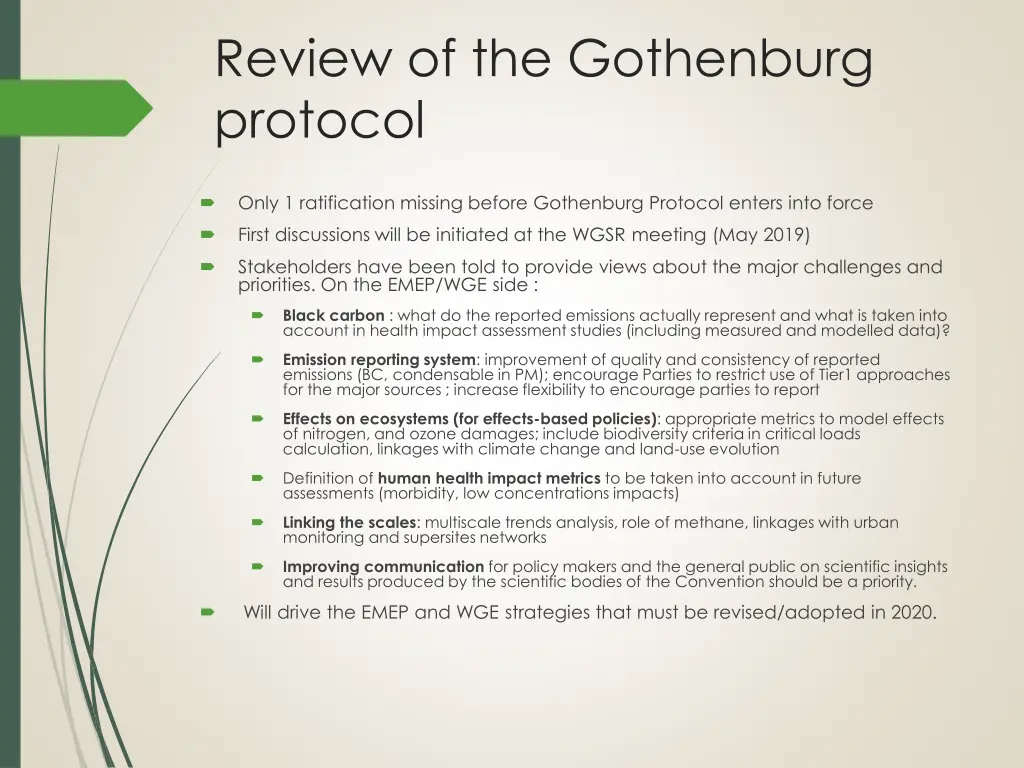
Review of the Gothenburg protocol Only 1 ratification missing before Gothenburg Protocol enters into force First discussions will be initiated at the WGSR meeting (May 2019) Stakeholders have been told to provide views about the major challenges and priorities. On the EMEP/WGE side : Black carbon : what do the reported emissions actually represent and what is taken into account in health impact assessment studies (including measured and modelled data)? Emission reporting system: improvement of quality and consistency of reported emissions (BC, condensable in PM); encourage Parties to restrict use of Tier1 approaches for the major sources ; increase flexibility to encourage parties to report Effects on ecosystems (for effects-based policies): appropriate metrics to model effects of nitrogen, and ozone damages; include biodiversity criteria in critical loads calculation, linkages with climate change and land-use evolution Definition of human health impact metrics to be taken into account in future assessments (morbidity, low concentrations impacts) Linking the scales: multiscale trends analysis, role of methane, linkages with urban monitoring and supersites networks Improving communication for policy makers and the general public on scientific insights and results produced by the scientific bodies of the Convention should be a priority. Will drive the EMEP and WGE strategies that must be revised/adopted in 2020.
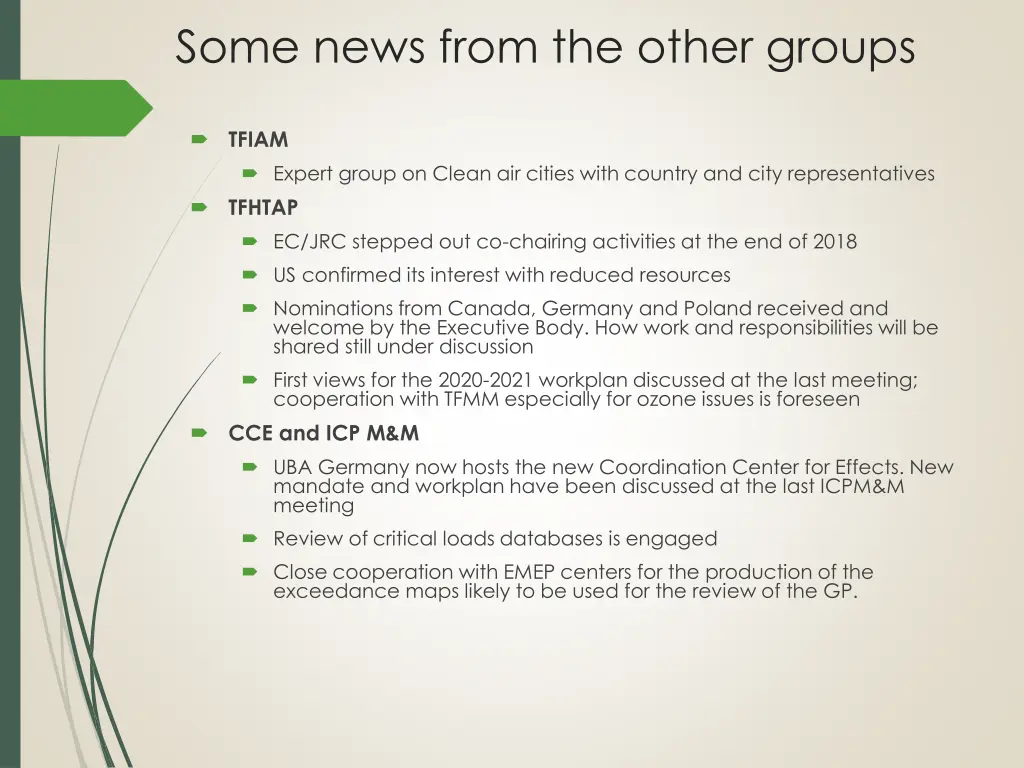
Some news from the other groups TFIAM Expert group on Clean air cities with country and city representatives TFHTAP EC/JRC stepped out co-chairing activities at the end of 2018 US confirmed its interest with reduced resources Nominations from Canada, Germany and Poland received and welcome by the Executive Body. How work and responsibilities will be shared still under discussion First views for the 2020-2021 workplan discussed at the last meeting; cooperation with TFMM especially for ozone issues is foreseen CCE and ICP M&M UBA Germany now hosts the new Coordination Center for Effects. New mandate and workplan have been discussed at the last ICPM&M meeting Review of critical loads databases is engaged Close cooperation with EMEP centers for the production of the exceedance maps likely to be used for the review of the GP.