Design and Analysis of Engineering Experiments
The principles behind Engineering Experiments with a focus on Analysis of Variance and its applications in various fields. Delve into ANOVA methodology for experiments with multiple factor levels, as illustrated through practical examples. Gain insights into modeling relationships and optimizing settings for desired outcomes."

Download Presentation

Please find below an Image/Link to download the presentation.
The content on the website is provided AS IS for your information and personal use only. It may not be sold, licensed, or shared on other websites without obtaining consent from the author.If you encounter any issues during the download, it is possible that the publisher has removed the file from their server.
You are allowed to download the files provided on this website for personal or commercial use, subject to the condition that they are used lawfully. All files are the property of their respective owners.
The content on the website is provided AS IS for your information and personal use only. It may not be sold, licensed, or shared on other websites without obtaining consent from the author.
E N D
Presentation Transcript
Design and Analysis of Engineering Experiments Ali Ahmad, PhD Based on Design & Analysis of Experiments 7E 2009 Montgomery Chapter 3 1
Analysis of Variance Chapter 3 Design & Analysis of Experiments 7E 2009 Montgomery 2
What If There Are More Than Two Factor Levels? The t-test does not directly apply There are lots of practical situations where there are either more than two levels of interest, or there are several factors of simultaneous interest The analysis of variance (ANOVA) is the appropriate analysis engine for these types of experiments The ANOVA was developed by Fisher in the early 1920s, and initially applied to agricultural experiments Used extensively today for industrial experiments Chapter 3 Design & Analysis of Experiments 7E 2009 Montgomery 3
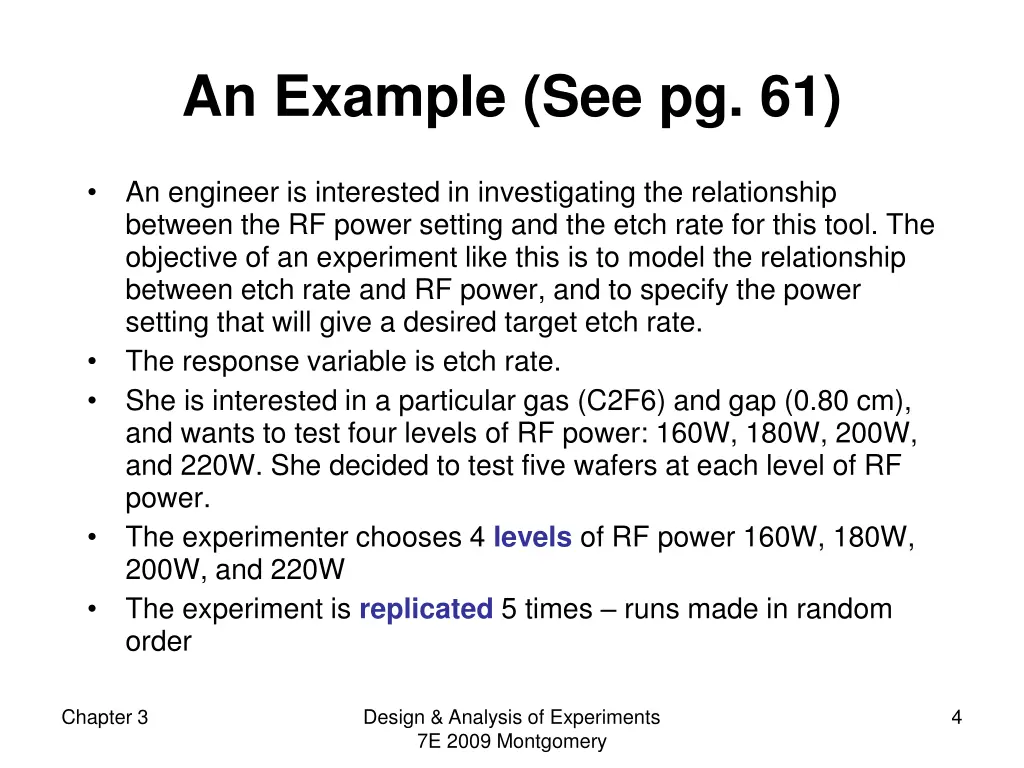
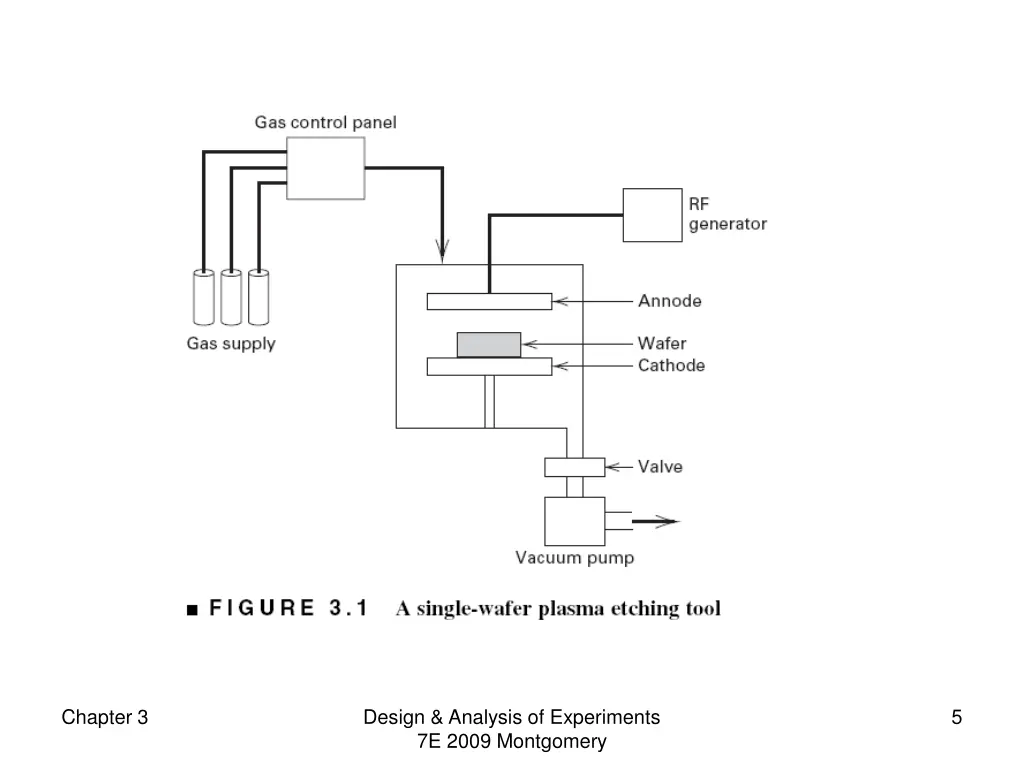
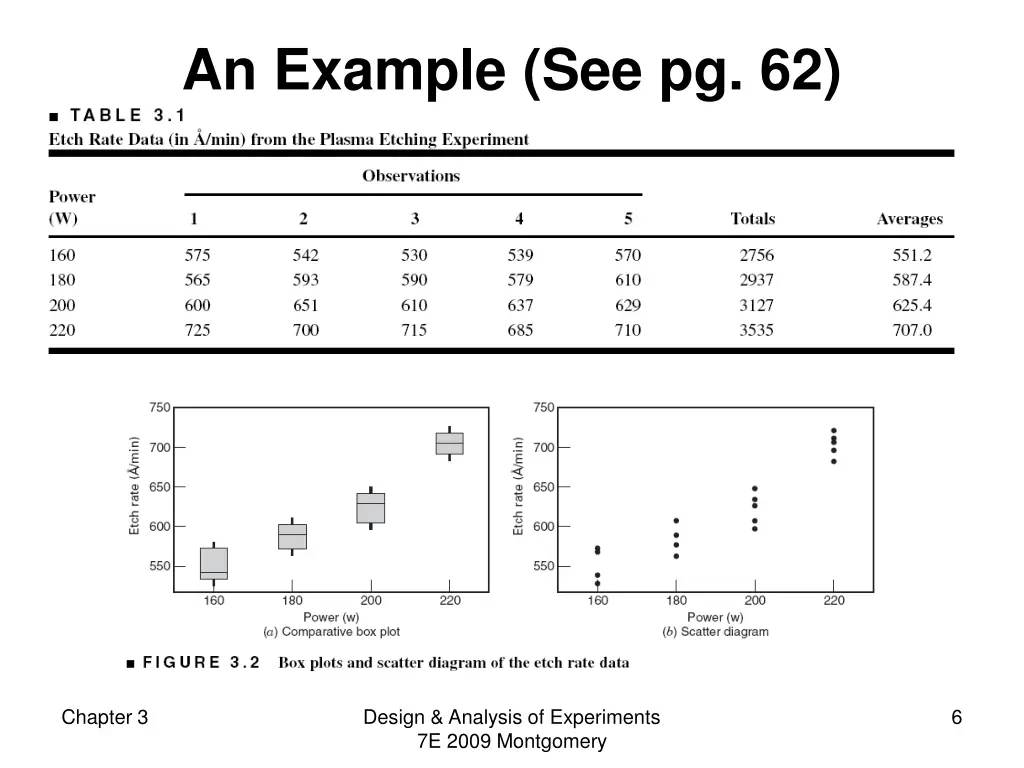
An Example (See pg. 61) An engineer is interested in investigating the relationship between the RF power setting and the etch rate for this tool. The objective of an experiment like this is to model the relationship between etch rate and RF power, and to specify the power setting that will give a desired target etch rate. The response variable is etch rate. She is interested in a particular gas (C2F6) and gap (0.80 cm), and wants to test four levels of RF power: 160W, 180W, 200W, and 220W. She decided to test five wafers at each level of RF power. The experimenter chooses 4 levels of RF power 160W, 180W, 200W, and 220W The experiment is replicated 5 times runs made in random order Chapter 3 Design & Analysis of Experiments 7E 2009 Montgomery 4
Chapter 3 Design & Analysis of Experiments 7E 2009 Montgomery 5
An Example (See pg. 62) Chapter 3 Design & Analysis of Experiments 7E 2009 Montgomery 6
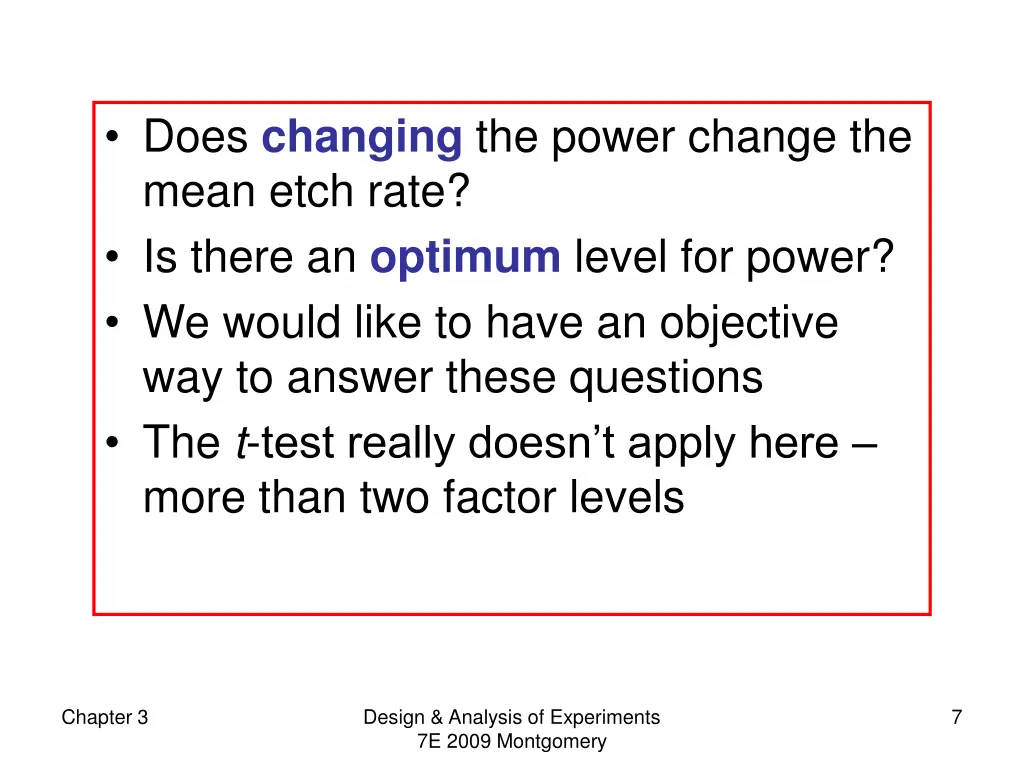
Does changing the power change the mean etch rate? Is there an optimum level for power? We would like to have an objective way to answer these questions The t-test really doesn t apply here more than two factor levels Chapter 3 Design & Analysis of Experiments 7E 2009 Montgomery 7
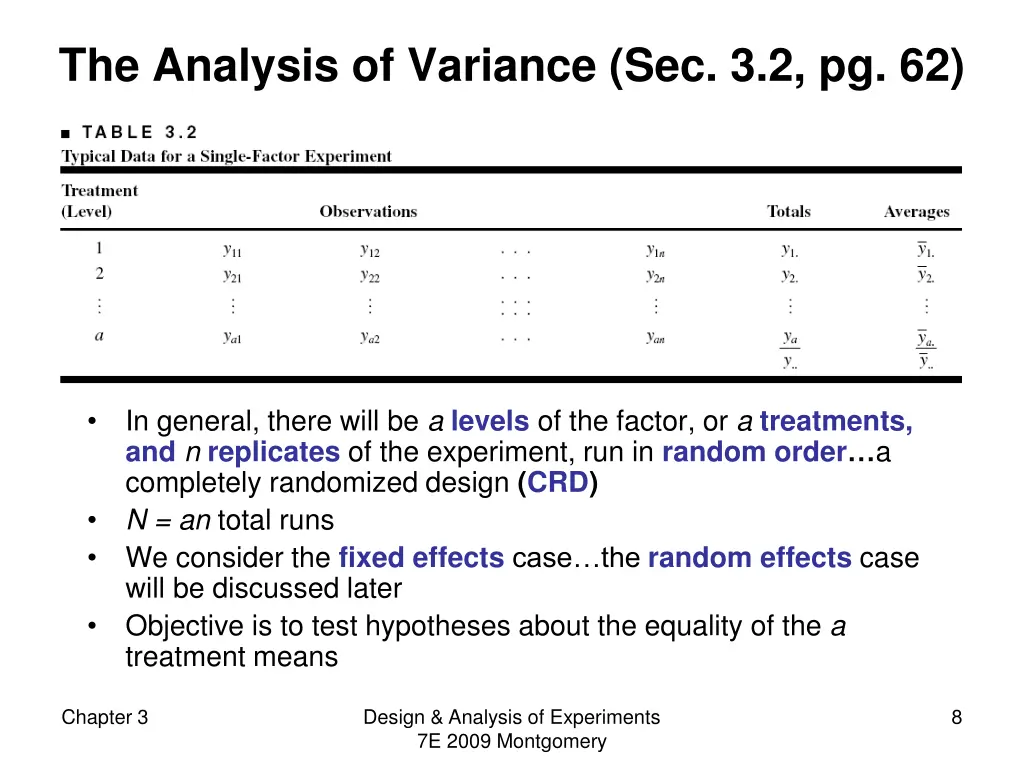
The Analysis of Variance (Sec. 3.2, pg. 62) In general, there will be alevels of the factor, or atreatments, andnreplicates of the experiment, run in randomorder a completely randomized design (CRD) N = an total runs We consider the fixed effectscase the random effects case will be discussed later Objective is to test hypotheses about the equality of the a treatment means Chapter 3 Design & Analysis of Experiments 7E 2009 Montgomery 8
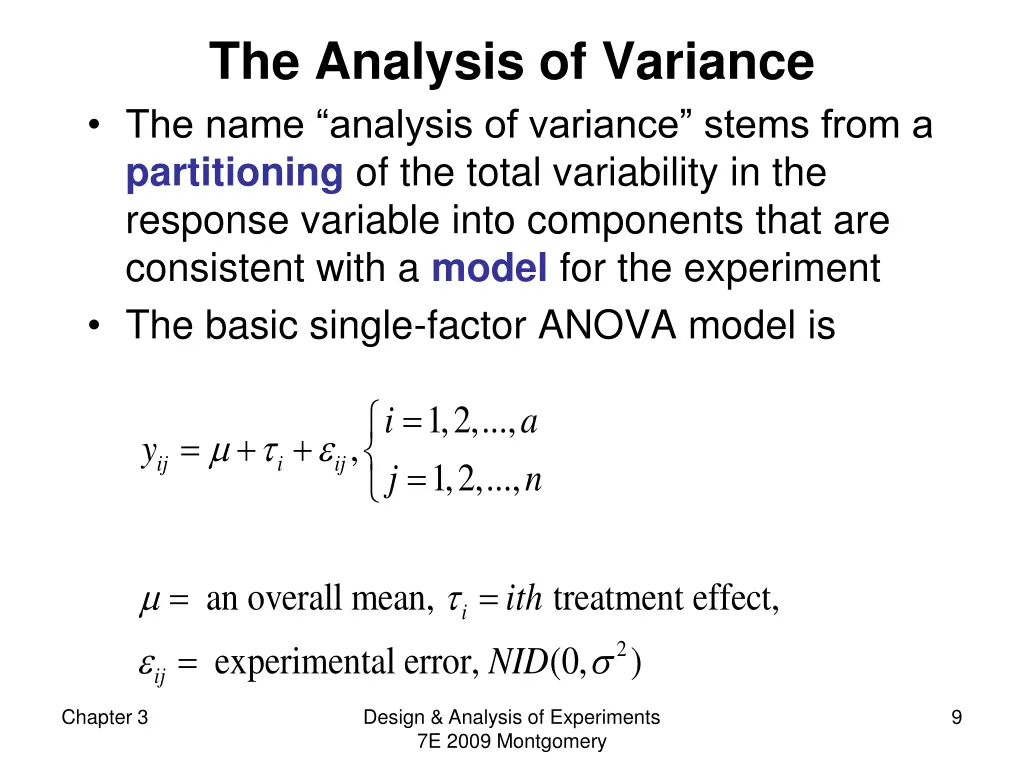
The Analysis of Variance The name analysis of variance stems from a partitioning of the total variability in the response variable into components that are consistent with a model for the experiment The basic single-factor ANOVA model is = 1,2,..., 1,2,..., = i j a n = + + , y ij i ij = = an overall mean, = treatment effect, ith i 2 experimental error, (0, ) NID ij Chapter 3 Design & Analysis of Experiments 7E 2009 Montgomery 9
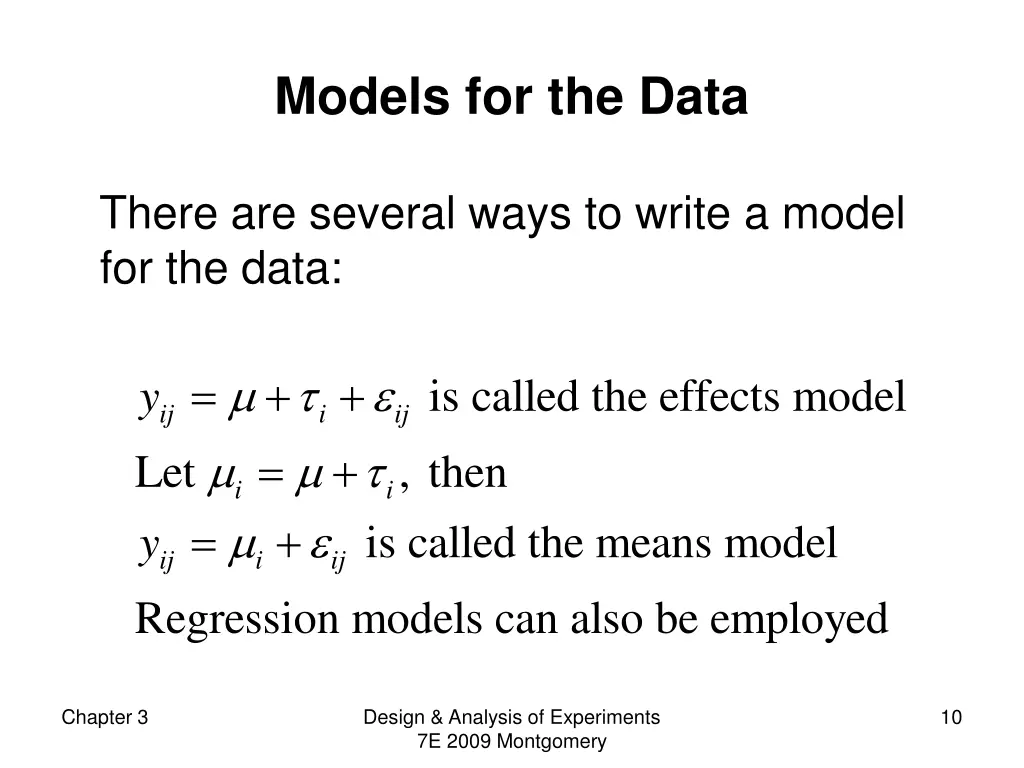
Models for the Data There are several ways to write a model for the data: = = + = + + is called the effects model y ij i ij + Let y , then is called the means model i i ij i ij Regression models can also be employed Chapter 3 Design & Analysis of Experiments 7E 2009 Montgomery 10
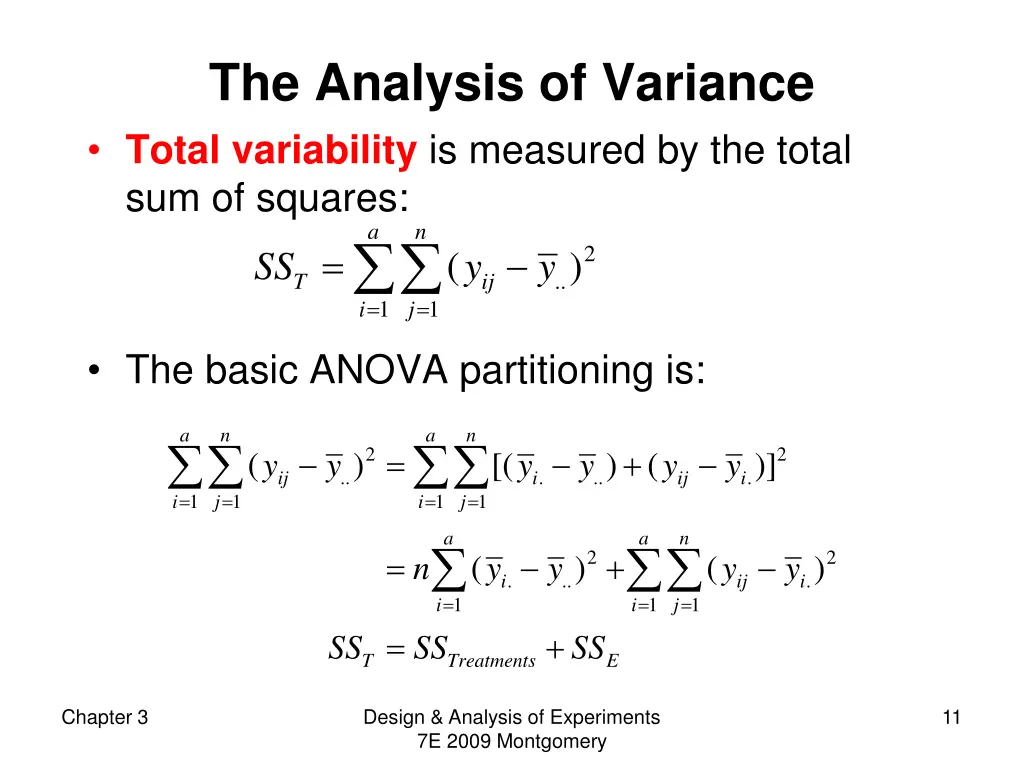
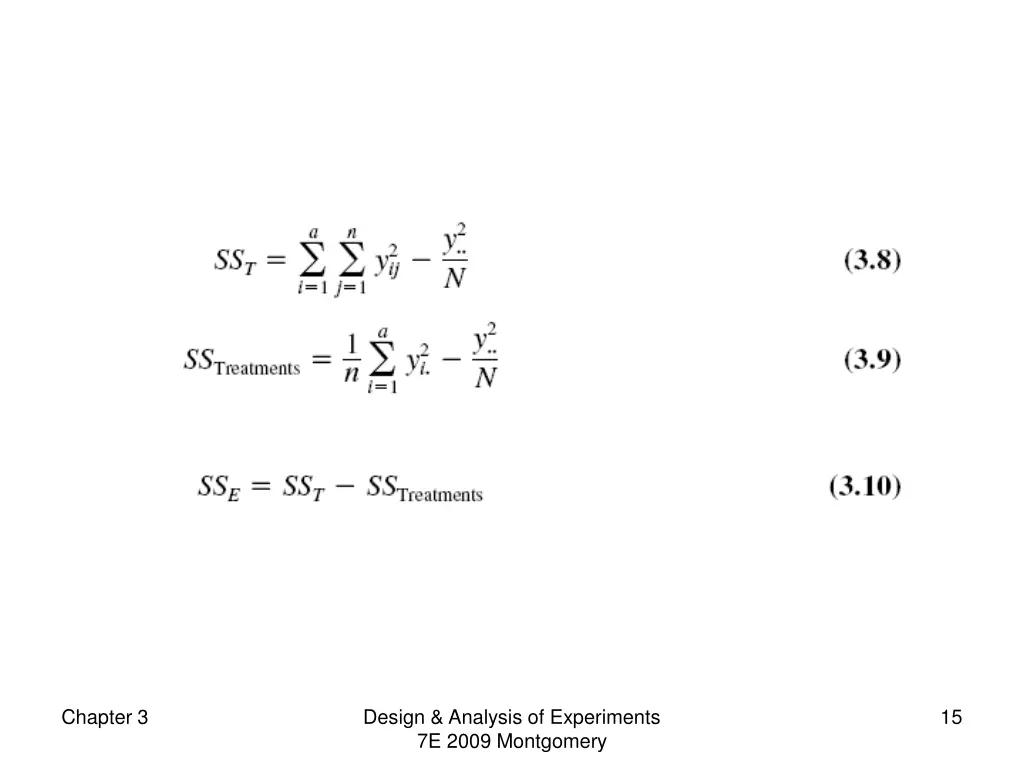
The Analysis of Variance Total variability is measured by the total sum of squares: a n SS y = = = 2 ( ) y .. T ij 1 1 i j The basic ANOVA partitioning is: a n a n = ) ( + 2 2 ( ) [( )] y y y y y y .. . .. . ij i ij i = = = = 1 1 1 1 i j i j a a n = + 2 2 ( ) ( ) n y y y y . .. . i ij i = = = 1 1 1 i i j = + SS Treatments SS SS T E Chapter 3 Design & Analysis of Experiments 7E 2009 Montgomery 11
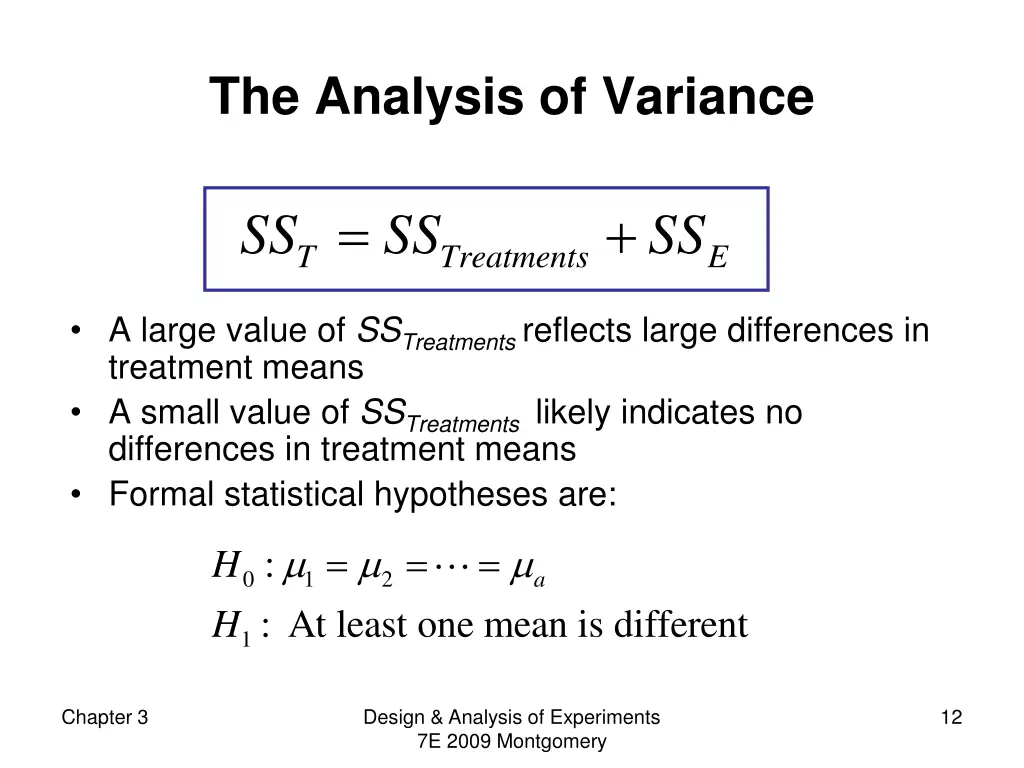
The Analysis of Variance = + SS Treatments SS SS T E A large value of SSTreatments reflects large differences in treatment means A small value of SSTreatments likely indicates no differences in treatment means Formal statistical hypotheses are: = = = : : At least one mean is different H H 0 1 2 a 1 Chapter 3 Design & Analysis of Experiments 7E 2009 Montgomery 12
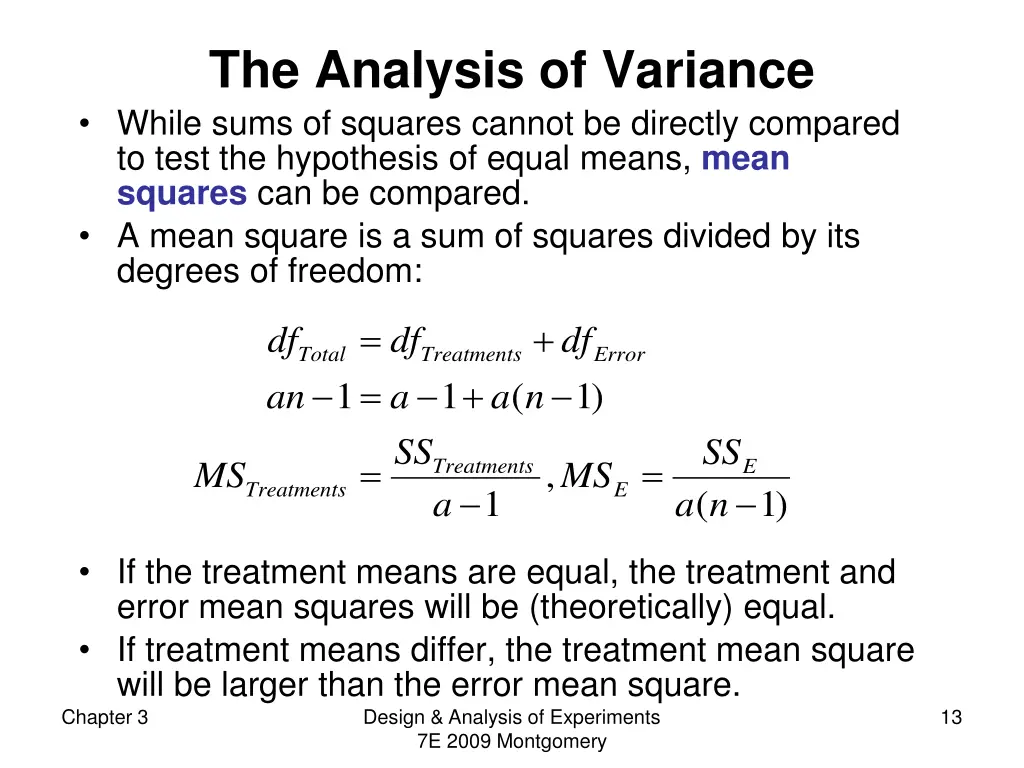
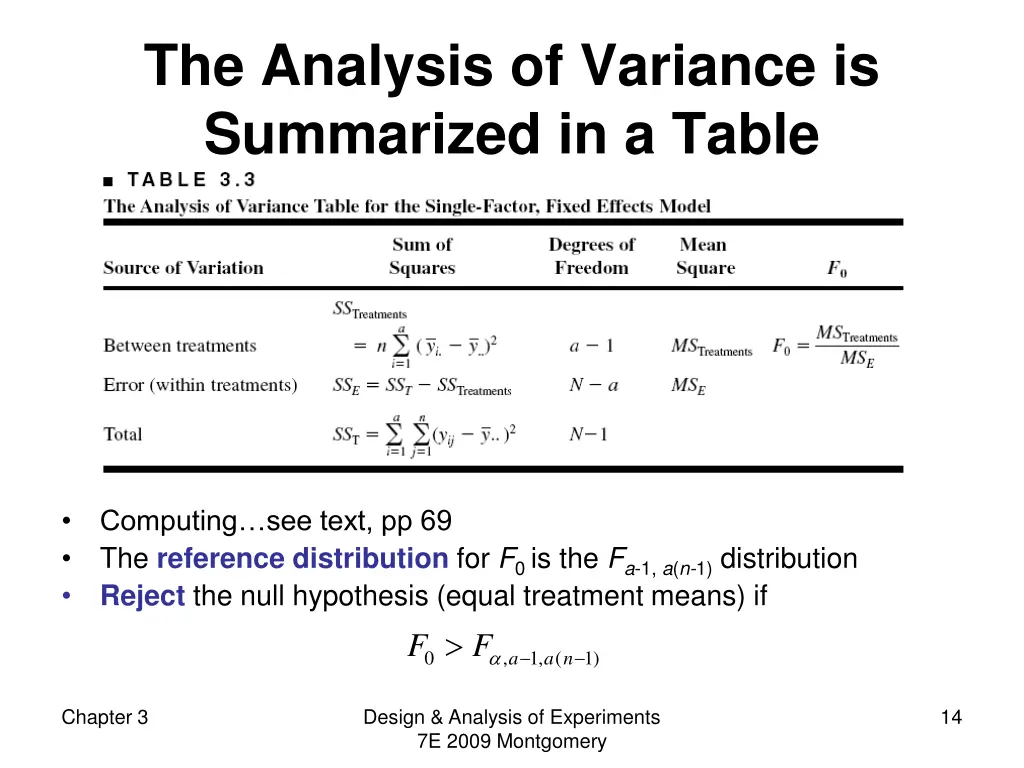
The Analysis of Variance While sums of squares cannot be directly compared to test the hypothesis of equal means, mean squares can be compared. A mean square is a sum of squares divided by its degrees of freedom: = + df an df a df Total = Treatments + Error 1 1 ( 1) a n Treatments SS a SS = = , E MS MS Treatments E 1 ( 1) a n If the treatment means are equal, the treatment and error mean squares will be (theoretically) equal. If treatment means differ, the treatment mean square will be larger than the error mean square. Chapter 3 Design & Analysis of Experiments 7E 2009 Montgomery 13
The Analysis of Variance is Summarized in a Table Computing see text, pp 69 The reference distribution for F0 is the Fa-1, a(n-1) distribution Reject the null hypothesis (equal treatment means) if F F 1, ( a n 0 , 1) a Chapter 3 Design & Analysis of Experiments 7E 2009 Montgomery 14
Chapter 3 Design & Analysis of Experiments 7E 2009 Montgomery 15
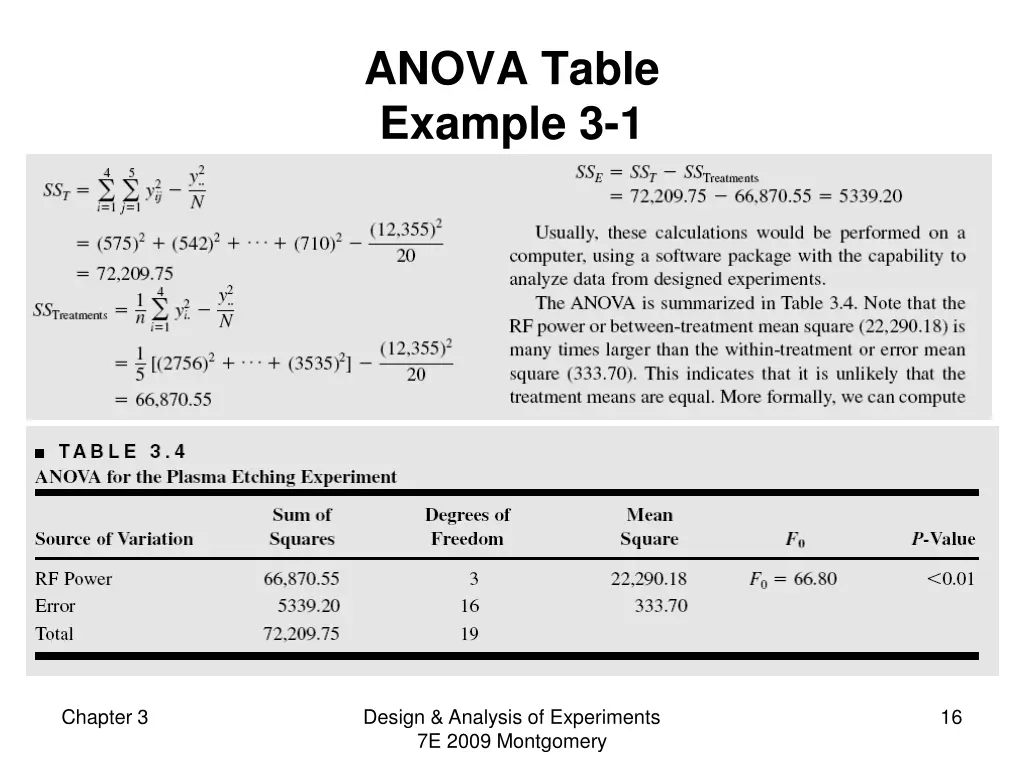
ANOVA Table Example 3-1 Chapter 3 Design & Analysis of Experiments 7E 2009 Montgomery 16
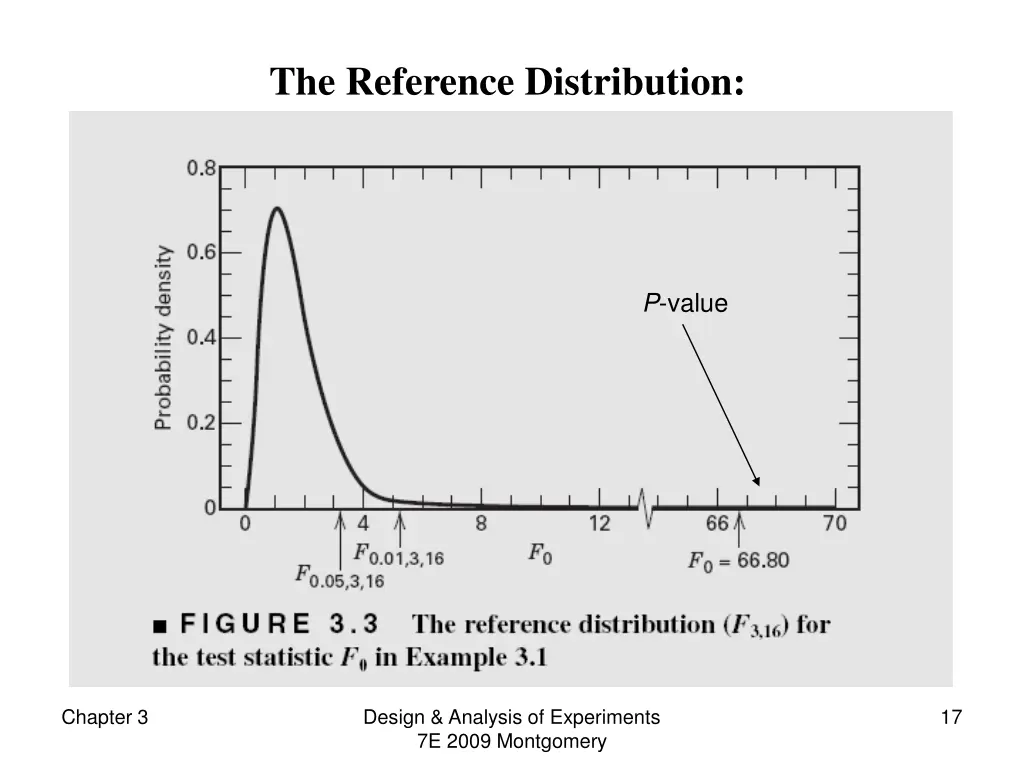
The Reference Distribution: P-value Chapter 3 Design & Analysis of Experiments 7E 2009 Montgomery 17
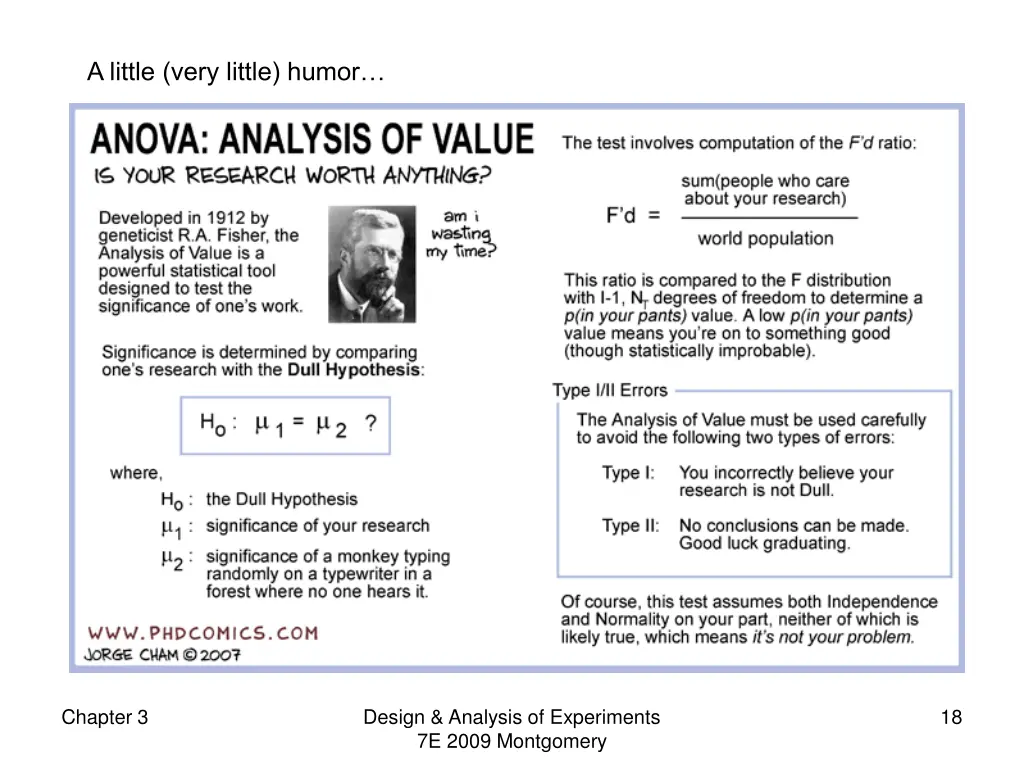
A little (very little) humor Chapter 3 Design & Analysis of Experiments 7E 2009 Montgomery 18
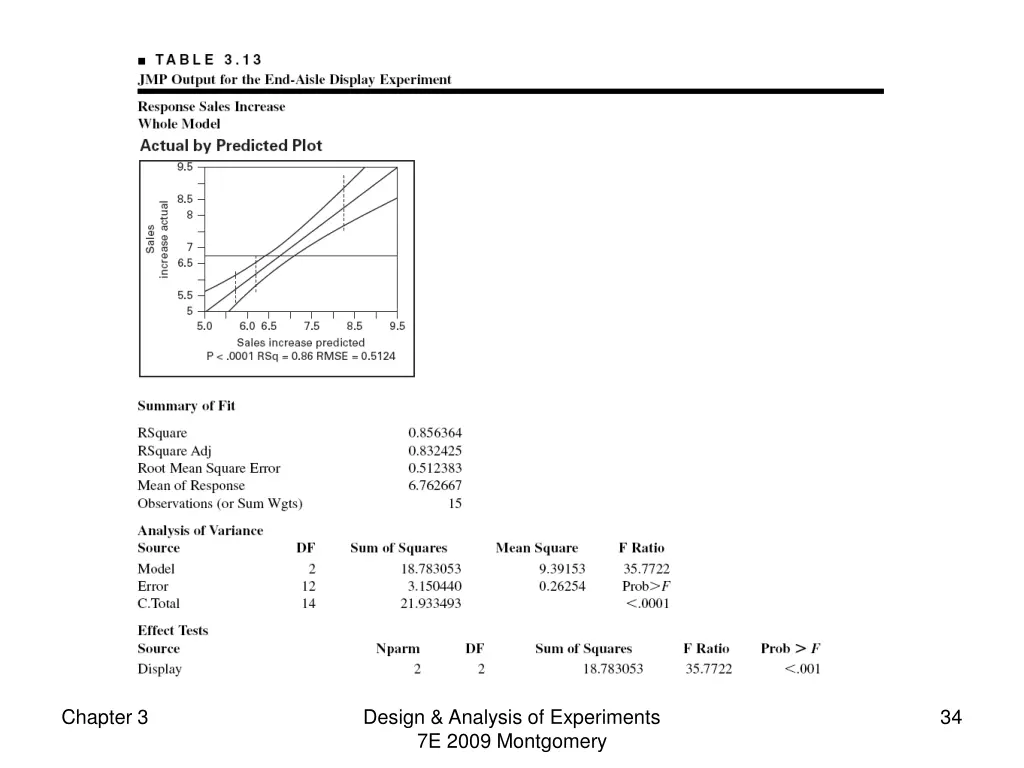
ANOVA calculations are usually done via computer Text exhibits sample calculations from three very popular software packages, Design-Expert, JMP and Minitab See pages 98-100 Text discusses some of the summary statistics provided by these packages Chapter 3 Design & Analysis of Experiments 7E 2009 Montgomery 19
Model Adequacy Checking in the ANOVA Text reference, Section 3.4, pg. 75 Checking assumptions is important Normality Constant variance Independence Have we fit the right model? Later we will talk about what to do if some of these assumptions are violated Chapter 3 Design & Analysis of Experiments 7E 2009 Montgomery 20
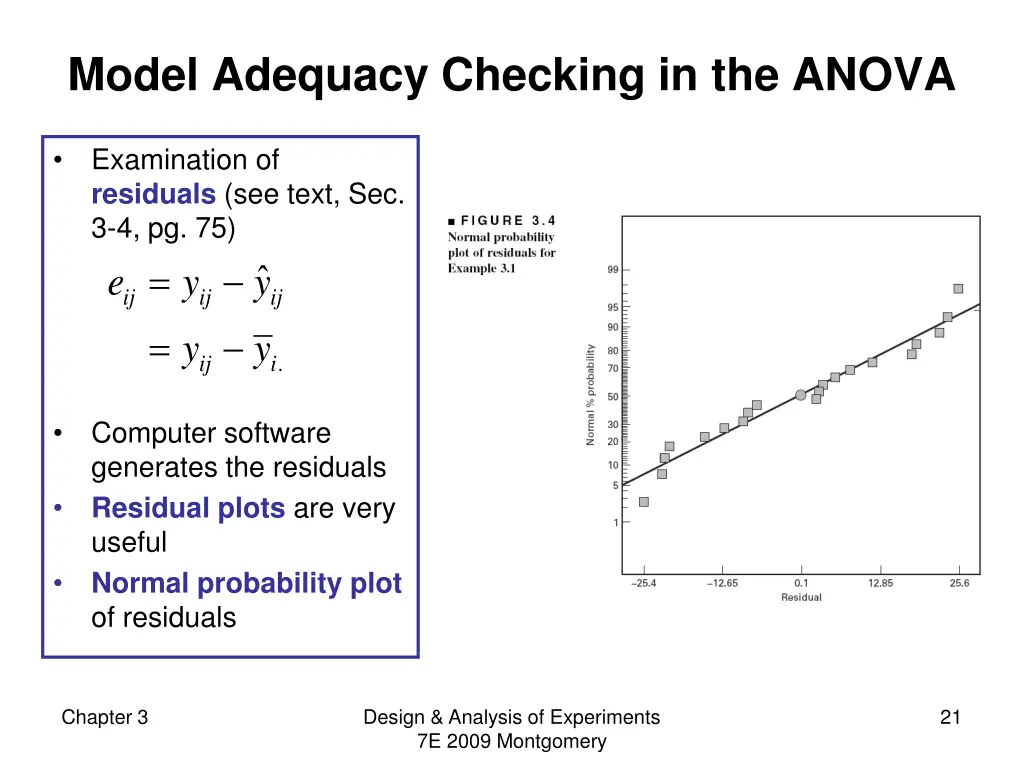
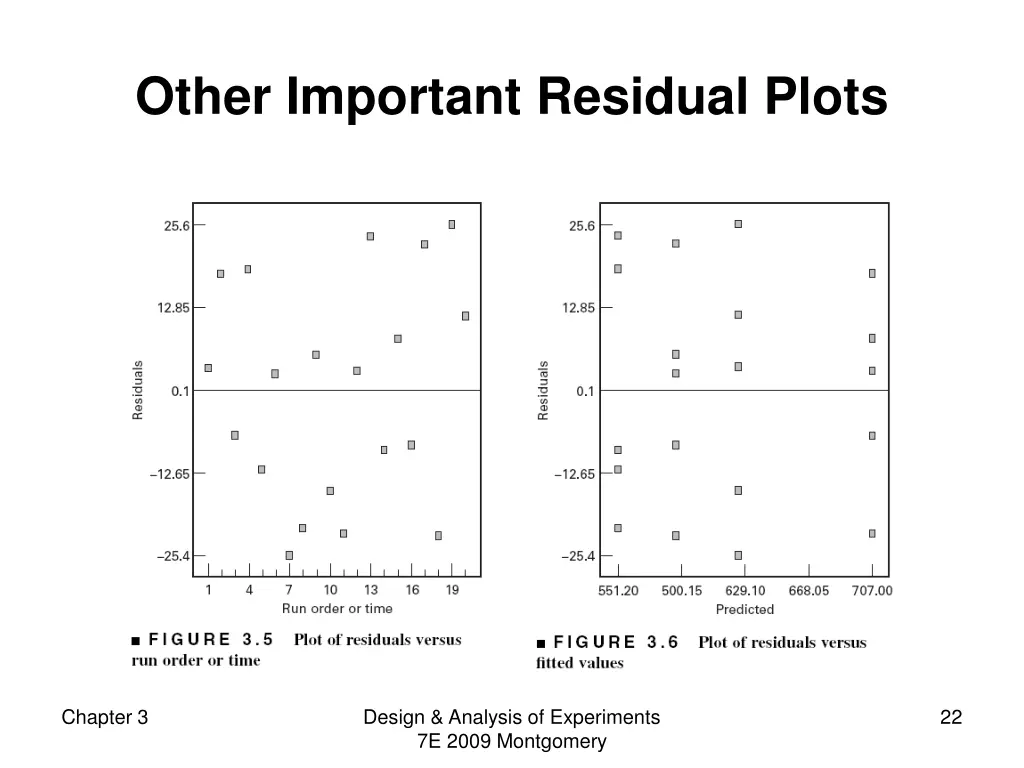
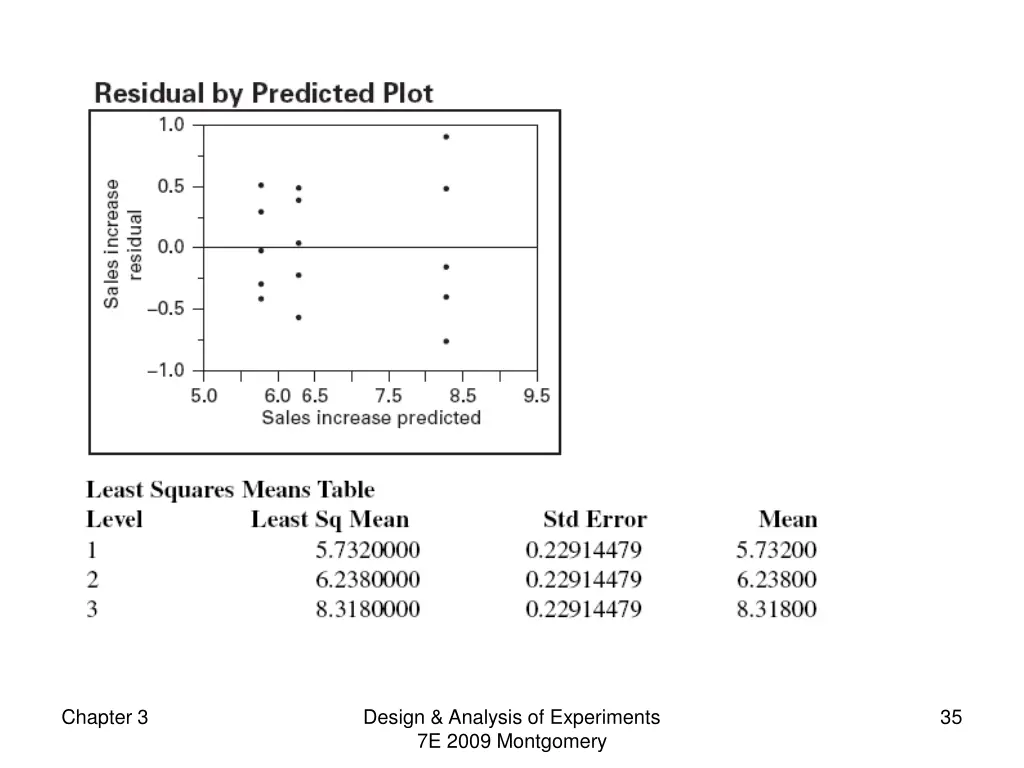
Model Adequacy Checking in the ANOVA Examination of residuals (see text, Sec. 3-4, pg. 75) e y = = y ij ij ij y y . ij i Computer software generates the residuals Residual plots are very useful Normal probability plot of residuals Chapter 3 Design & Analysis of Experiments 7E 2009 Montgomery 21
Other Important Residual Plots Chapter 3 Design & Analysis of Experiments 7E 2009 Montgomery 22
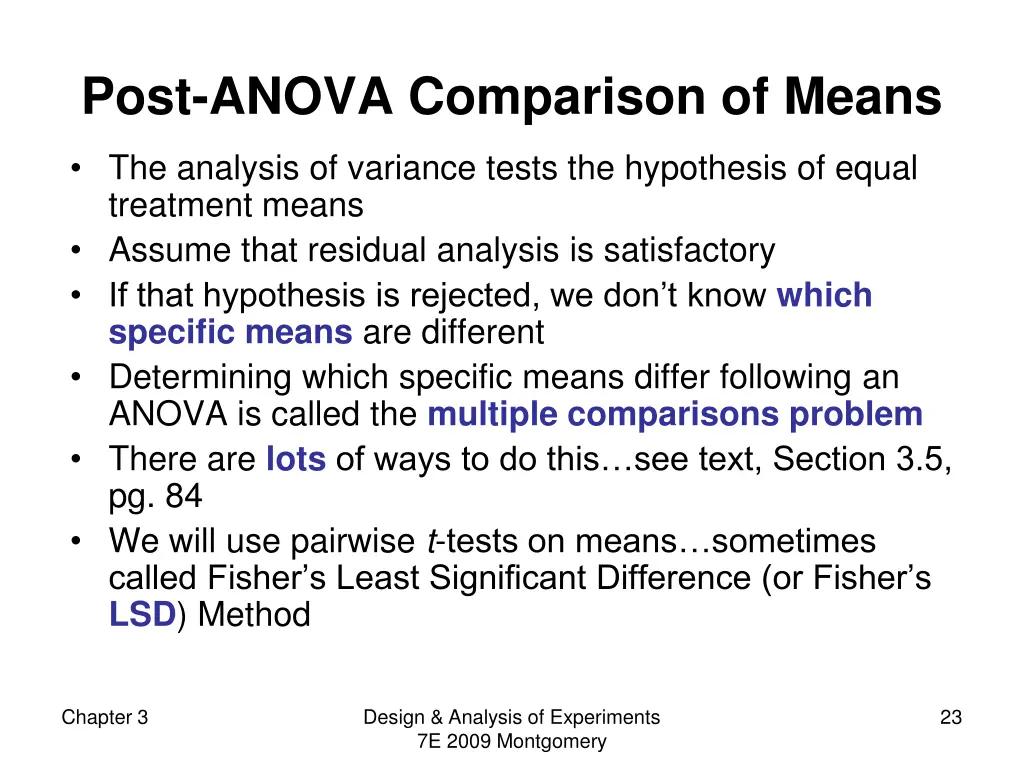
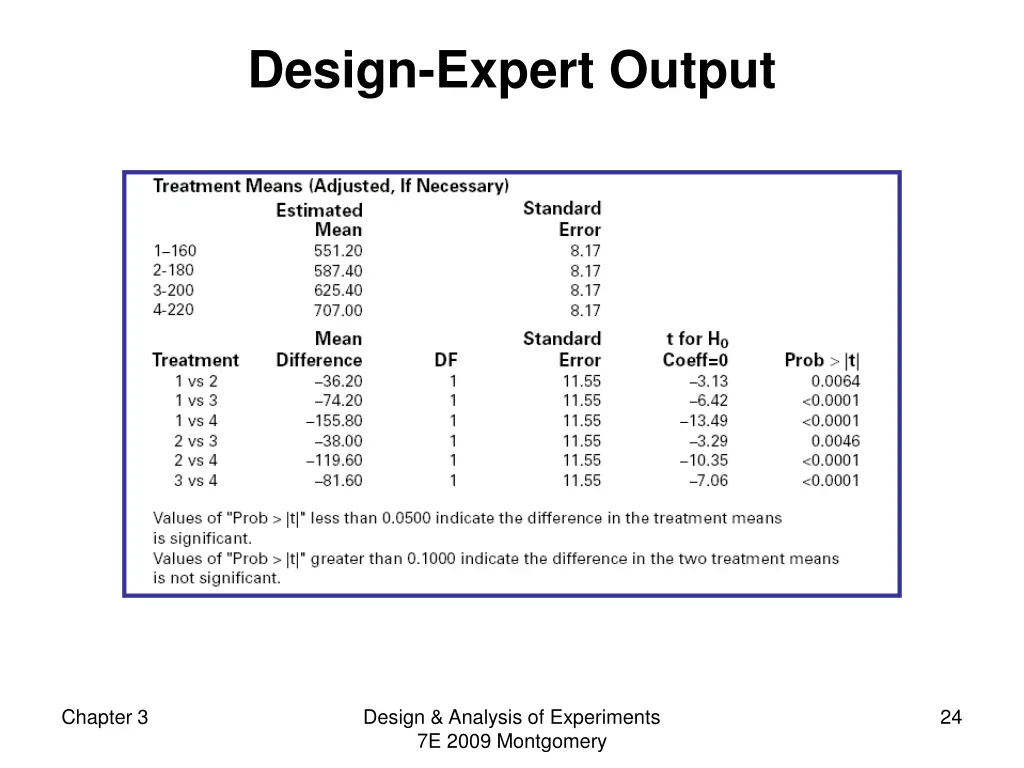
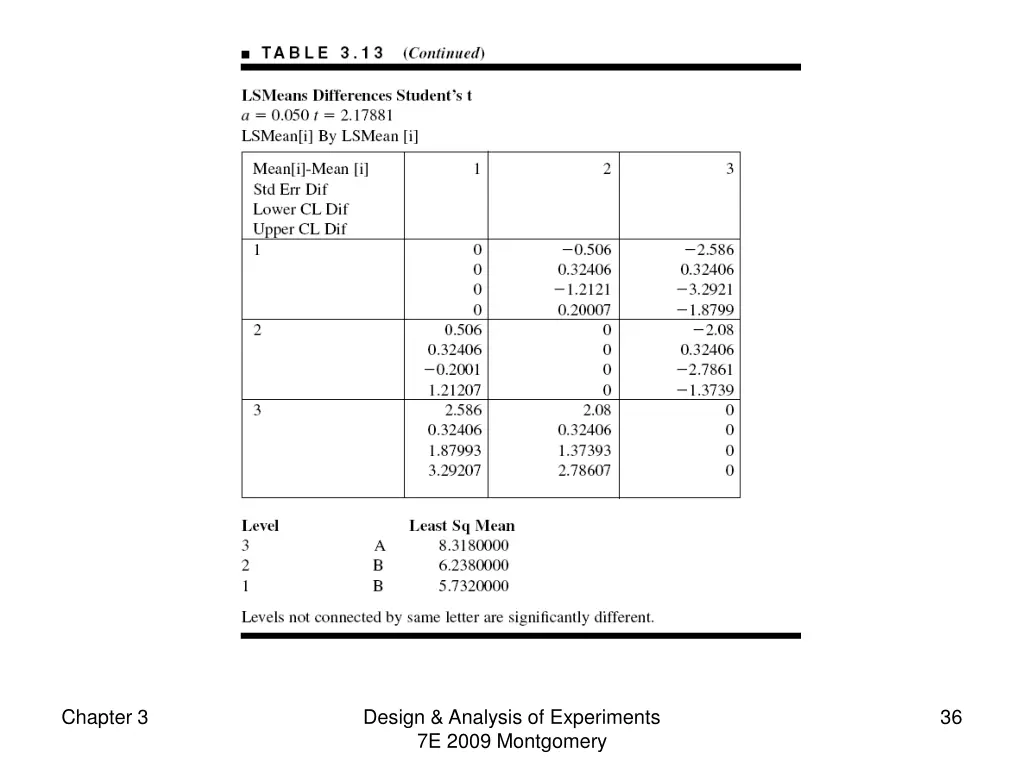
Post-ANOVA Comparison of Means The analysis of variance tests the hypothesis of equal treatment means Assume that residual analysis is satisfactory If that hypothesis is rejected, we don t know which specificmeans are different Determining which specific means differ following an ANOVA is called the multiple comparisons problem There are lotsof ways to do this see text, Section 3.5, pg. 84 We will use pairwise t-tests on means sometimes called Fisher s Least Significant Difference (or Fisher s LSD) Method Chapter 3 Design & Analysis of Experiments 7E 2009 Montgomery 23
Design-Expert Output Chapter 3 Design & Analysis of Experiments 7E 2009 Montgomery 24
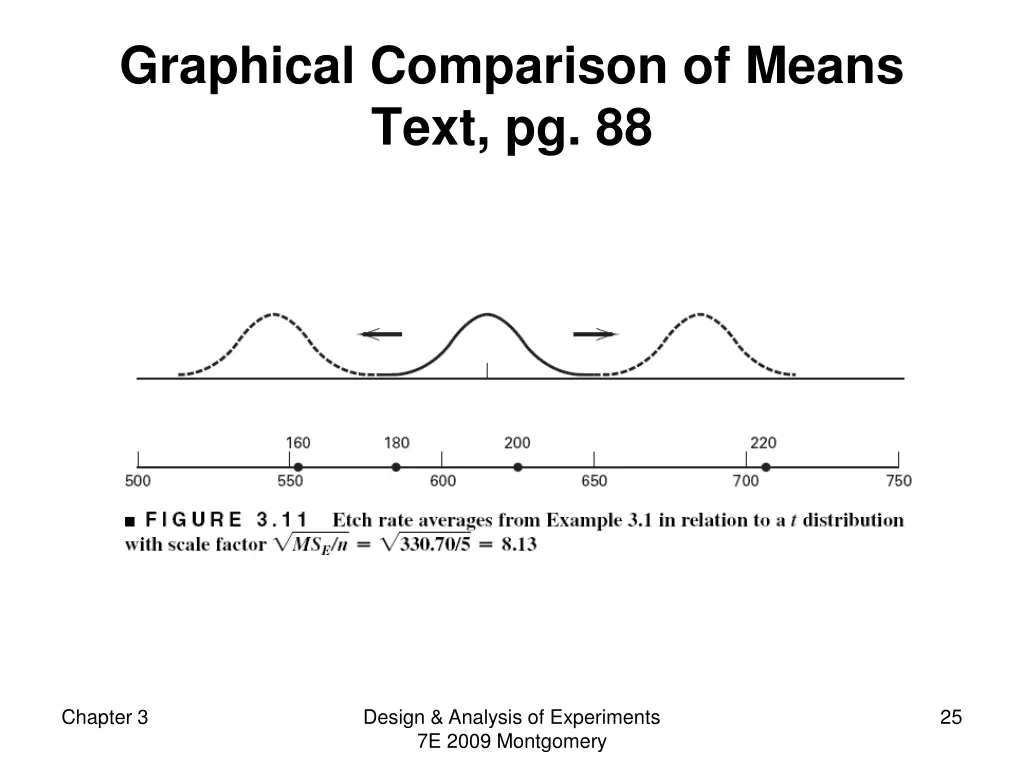
Graphical Comparison of Means Text, pg. 88 Chapter 3 Design & Analysis of Experiments 7E 2009 Montgomery 25
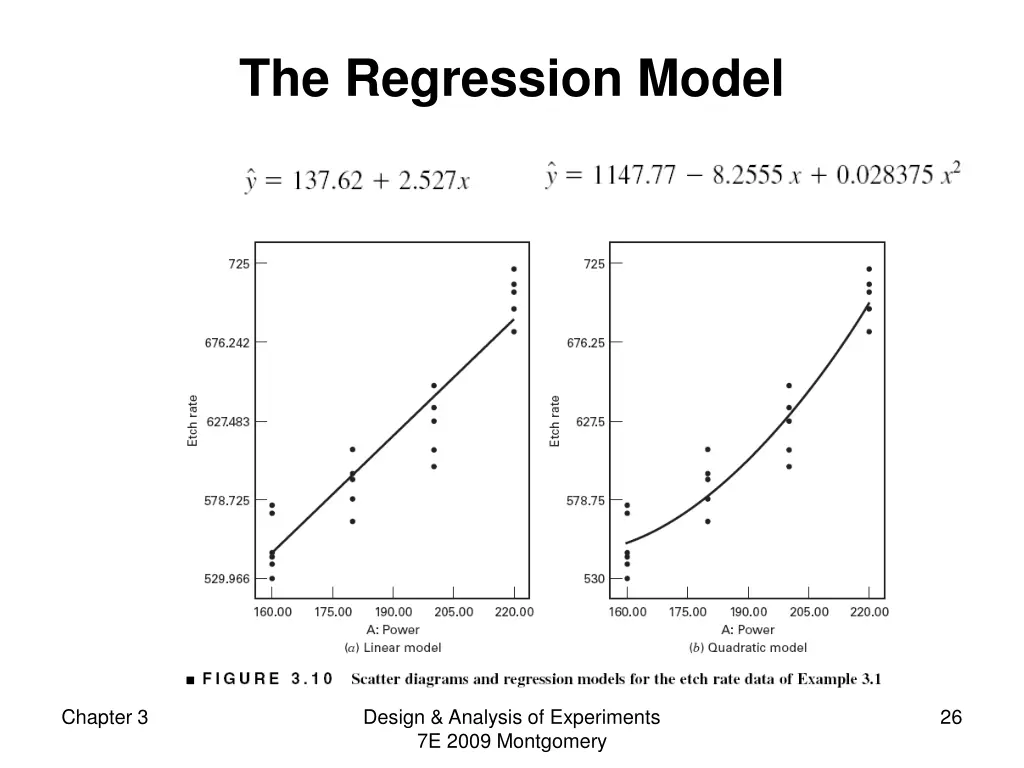
The Regression Model Chapter 3 Design & Analysis of Experiments 7E 2009 Montgomery 26
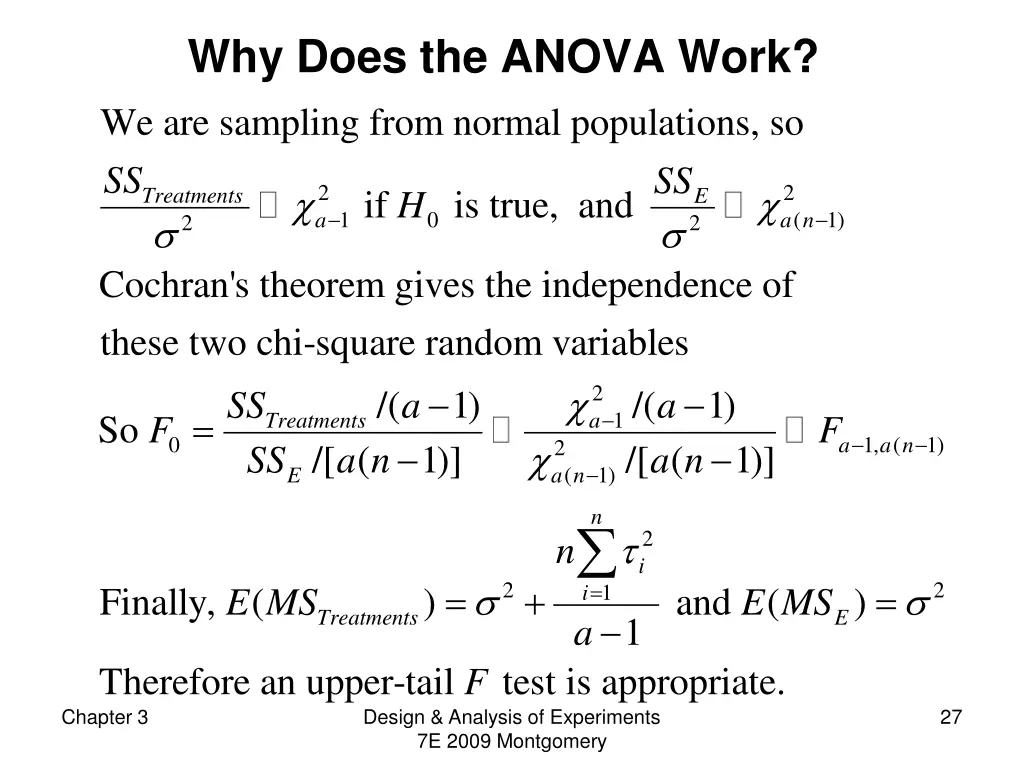
Why Does the ANOVA Work? We are sampling from normal populations, so SS H SS 2 a 2 a n if is true, and Treatments E 1 0 ( 1) 2 2 Cochran's theorem gives the independence of these two chi-square random variables /( So F = /[ ( 1)] E SS a n 2 a 1) /( /[ ( a n 1) Treatments SS a a 1 F 1, ( a n 0 1) a 2 a n 1)] ( 1) n 2 i n = + = 2 2 = 1 Finally, ( ) and ( ) i E MS E MS Treatments E 1 a Therefore an upper-tail test is appropriate. F Chapter 3 Design & Analysis of Experiments 7E 2009 Montgomery 27
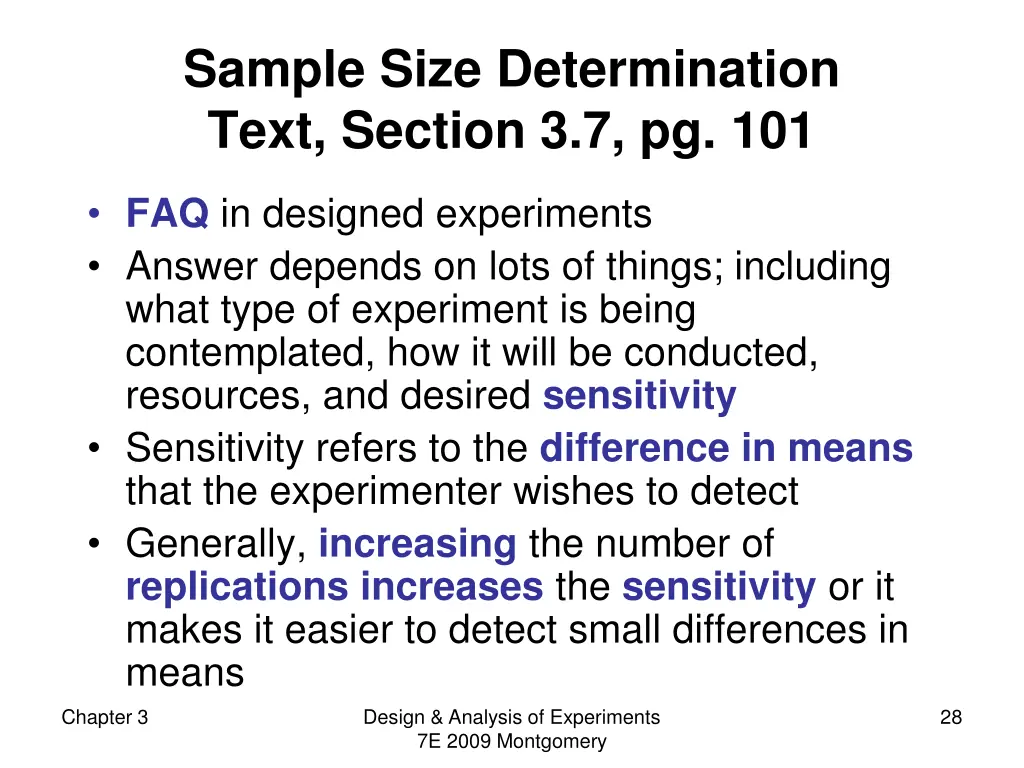
Sample Size Determination Text, Section 3.7, pg. 101 FAQ in designed experiments Answer depends on lots of things; including what type of experiment is being contemplated, how it will be conducted, resources, and desired sensitivity Sensitivity refers to the difference in means that the experimenter wishes to detect Generally, increasing the number of replicationsincreases the sensitivity or it makes it easier to detect small differences in means Chapter 3 Design & Analysis of Experiments 7E 2009 Montgomery 28
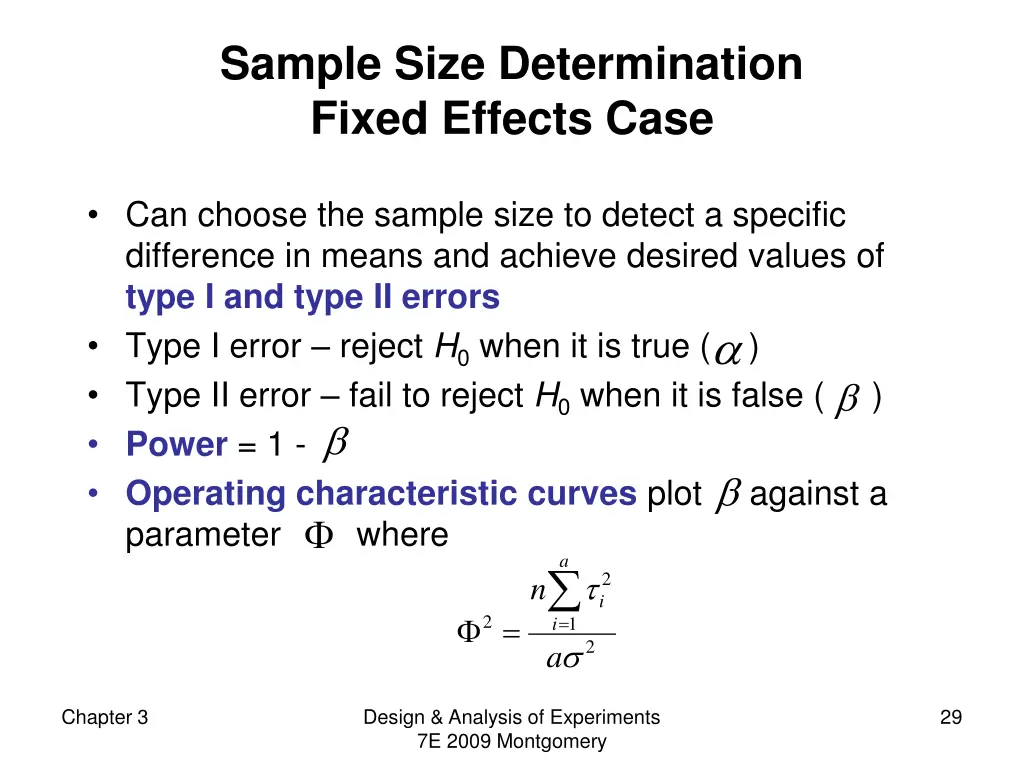
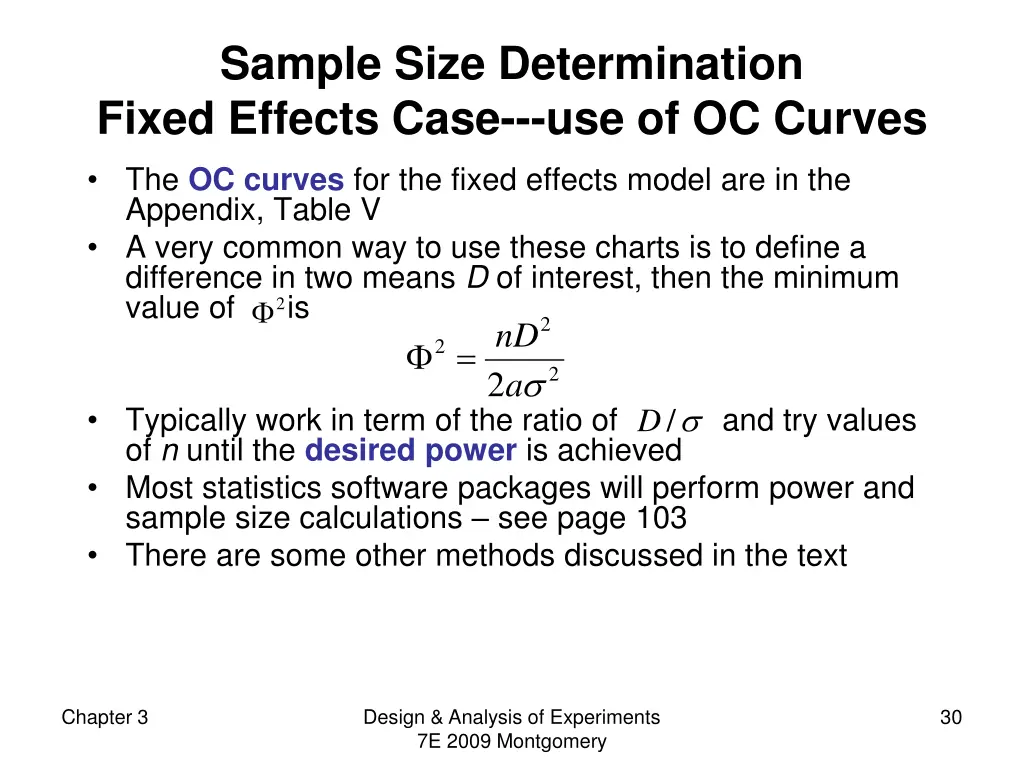
Sample Size Determination Fixed Effects Case Can choose the sample size to detect a specific difference in means and achieve desired values of type I and type II errors Type I error reject H0 when it is true ( ) Type II error fail to reject H0 when it is false ( ) Power = 1 - Operating characteristic curves plot against a parameter where a 2 i n = 2 = 1 i 2 a Chapter 3 Design & Analysis of Experiments 7E 2009 Montgomery 29
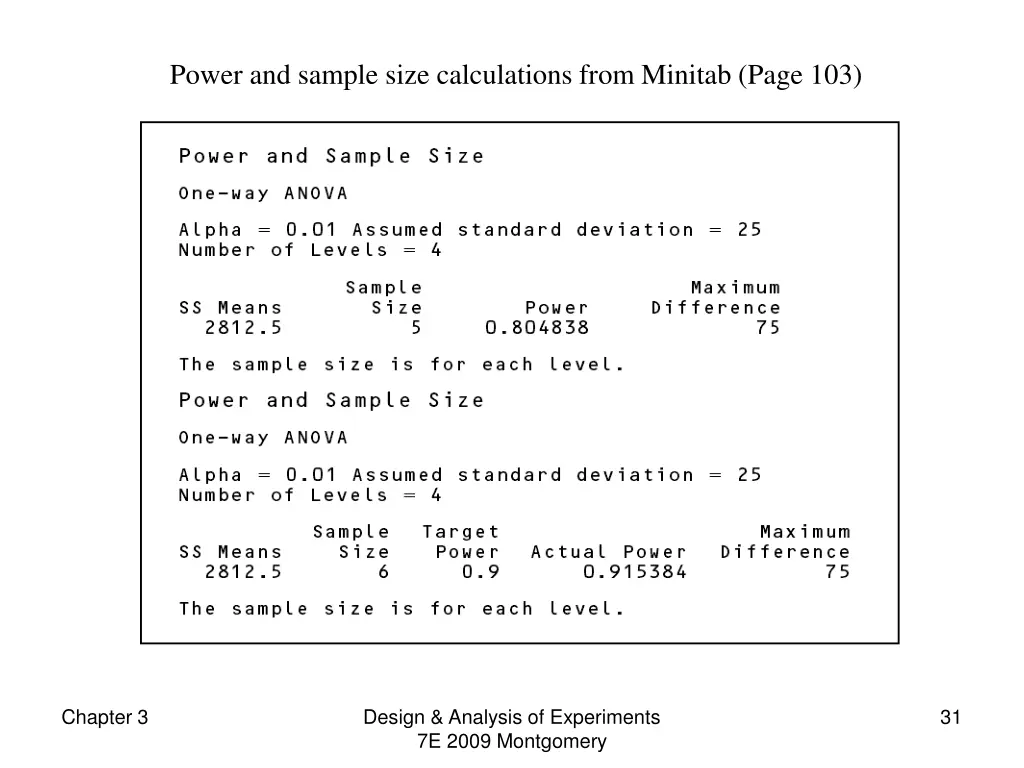
Sample Size Determination Fixed Effects Case---use of OC Curves The OCcurves for the fixed effects model are in the Appendix, Table V A very common way to use these charts is to define a difference in two means D of interest, then the minimum value of is 2 2 2 2 nD a = 2 D Typically work in term of the ratio of and try values of n until the desiredpower is achieved Most statistics software packages will perform power and sample size calculations see page 103 There are some other methods discussed in the text / Chapter 3 Design & Analysis of Experiments 7E 2009 Montgomery 30
Power and sample size calculations from Minitab (Page 103) Chapter 3 Design & Analysis of Experiments 7E 2009 Montgomery 31
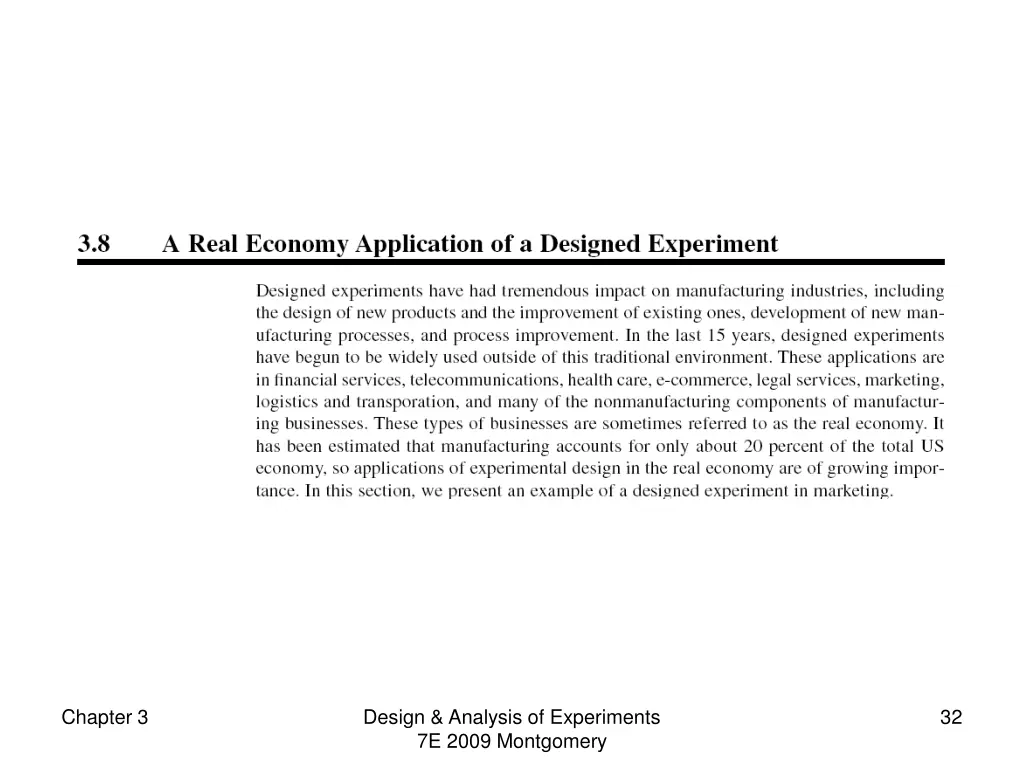
Chapter 3 Design & Analysis of Experiments 7E 2009 Montgomery 32
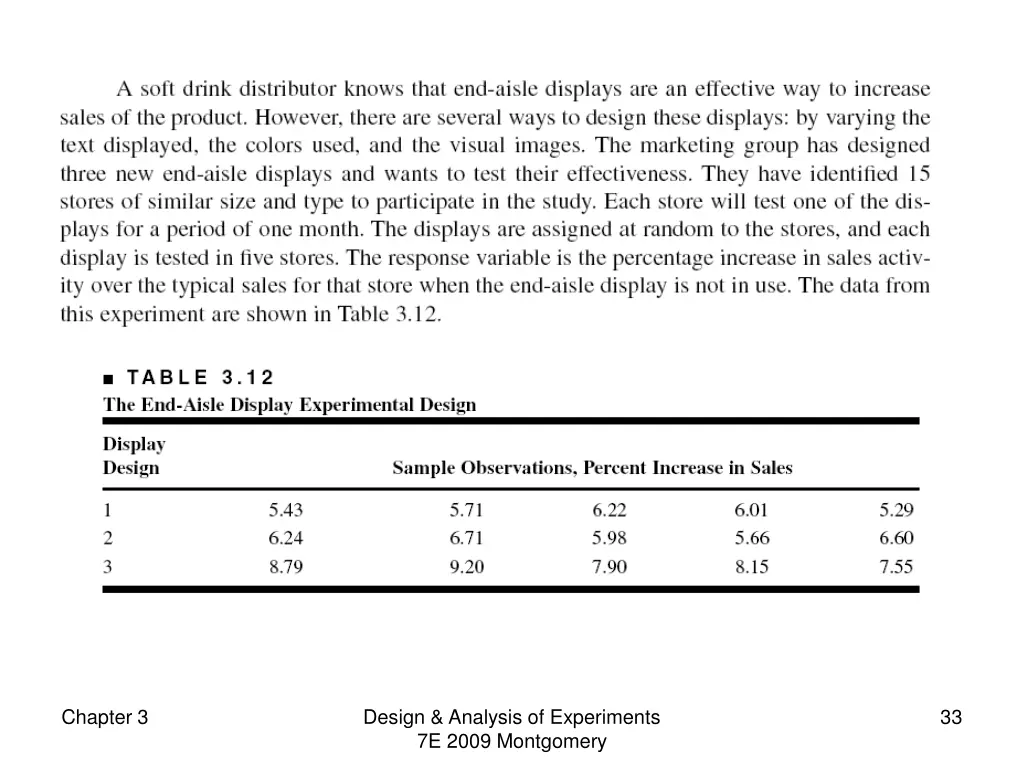
Chapter 3 Design & Analysis of Experiments 7E 2009 Montgomery 33
Chapter 3 Design & Analysis of Experiments 7E 2009 Montgomery 34
Chapter 3 Design & Analysis of Experiments 7E 2009 Montgomery 35
Chapter 3 Design & Analysis of Experiments 7E 2009 Montgomery 36