Durability of Locally Created Content: Threats and Solutions
Explore the challenges facing locally created content in the next 50 years, such as oversimplification, unclear organizational goals, and technology distractions. Learn from past innovations like Pong and the floppy disk. Discover examples of digital preservation issues and the importance of defining clear preservation goals.

Download Presentation

Please find below an Image/Link to download the presentation.
The content on the website is provided AS IS for your information and personal use only. It may not be sold, licensed, or shared on other websites without obtaining consent from the author. If you encounter any issues during the download, it is possible that the publisher has removed the file from their server.
You are allowed to download the files provided on this website for personal or commercial use, subject to the condition that they are used lawfully. All files are the property of their respective owners.
The content on the website is provided AS IS for your information and personal use only. It may not be sold, licensed, or shared on other websites without obtaining consent from the author.
E N D
Presentation Transcript
LOOKING FORWARD 50 YEARS: THREATS TO THE DURABILITY OF LOCALLY CREATED CONTENT Mark Jordan Associate Dean of Libraries, Simon Fraser University CAAL, November 7, 2022
Oversimplifying the problems Unclear organizational goals related to access in the future Unclear roles for library and other staff Being distracted by technology Trusting traditional IT Trusting commercial service providers Failure to see beyond our institutional borders THREATS
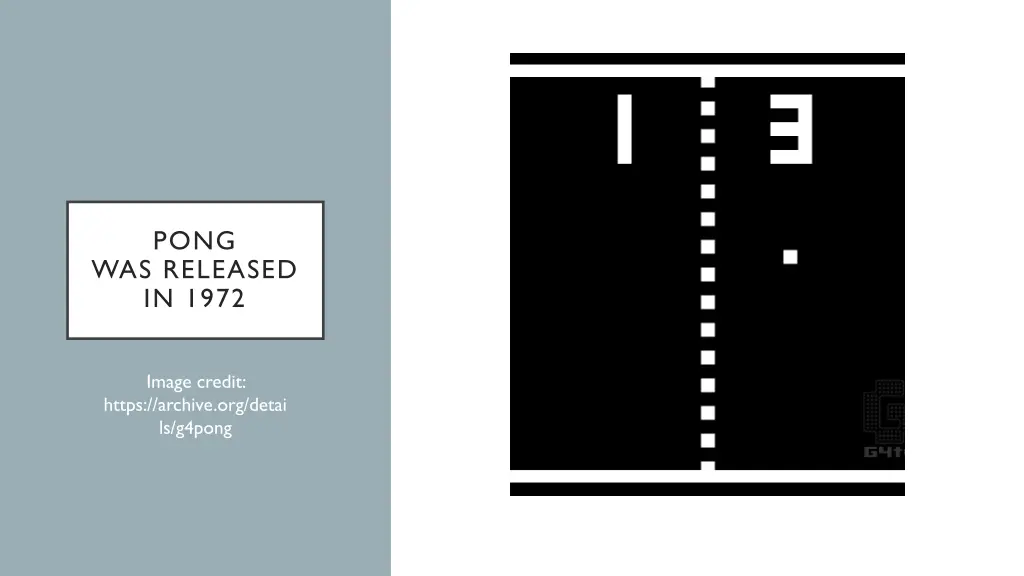
PONG WAS RELEASED IN 1972 Image credit: https://archive.org/detai ls/g4pong
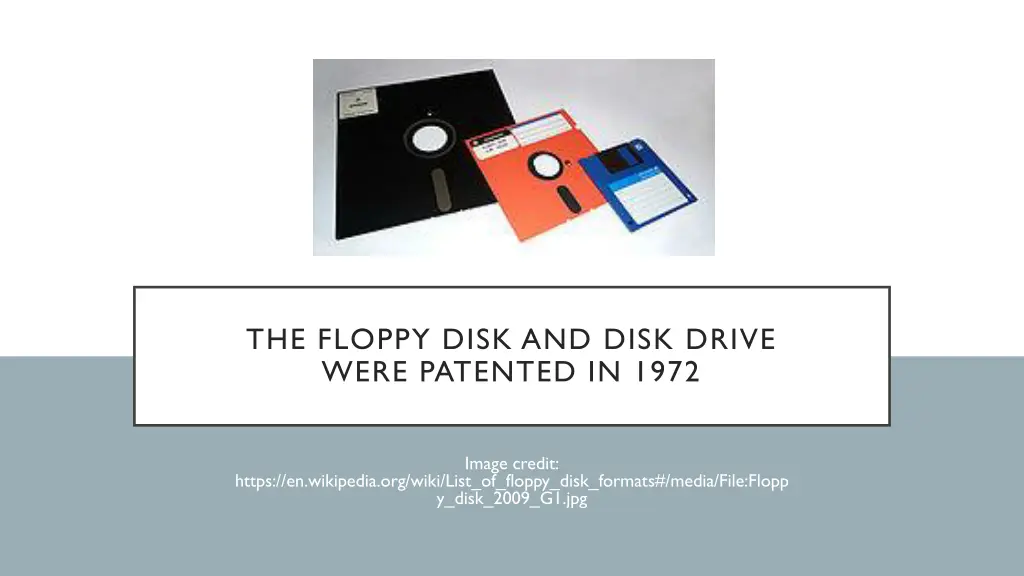
THE FLOPPY DISK AND DISK DRIVE WERE PATENTED IN 1972 Image credit: https://en.wikipedia.org/wiki/List_of_floppy_disk_formats#/media/File:Flopp y_disk_2009_G1.jpg
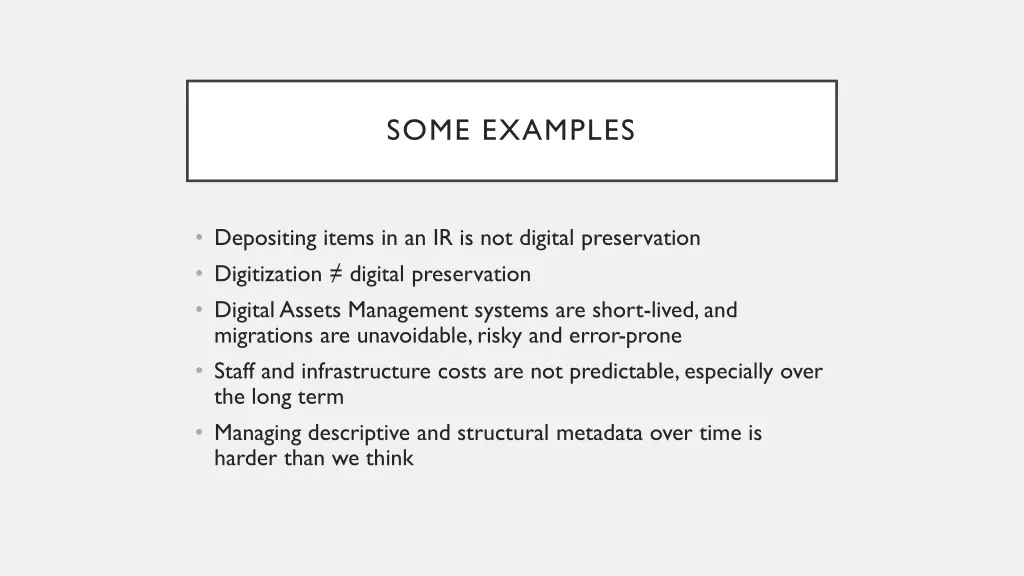
SOME EXAMPLES Depositing items in an IR is not digital preservation Digitization digital preservation Digital Assets Management systems are short-lived, and migrations are unavoidable, risky and error-prone Staff and infrastructure costs are not predictable, especially over the long term Managing descriptive and structural metadata over time is harder than we think
UNCLEAR ORGANIZATIONAL GOALS RELATED TO ACCESS IN THE FUTURE
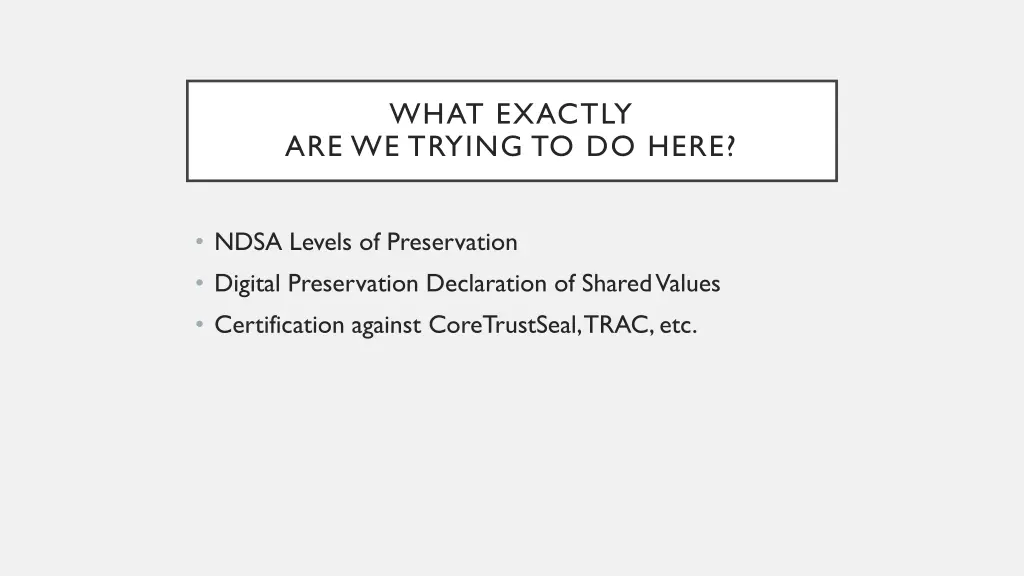
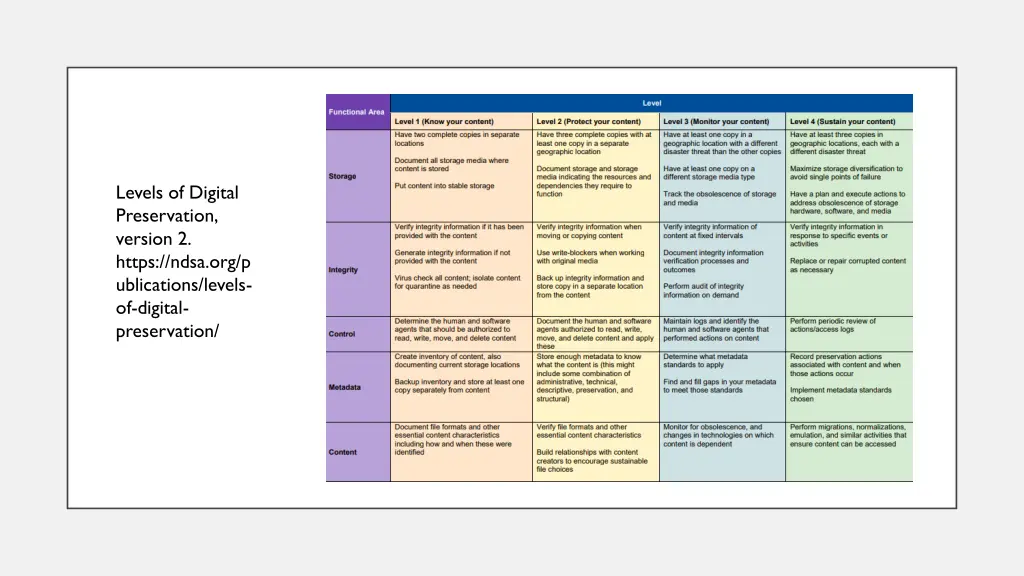
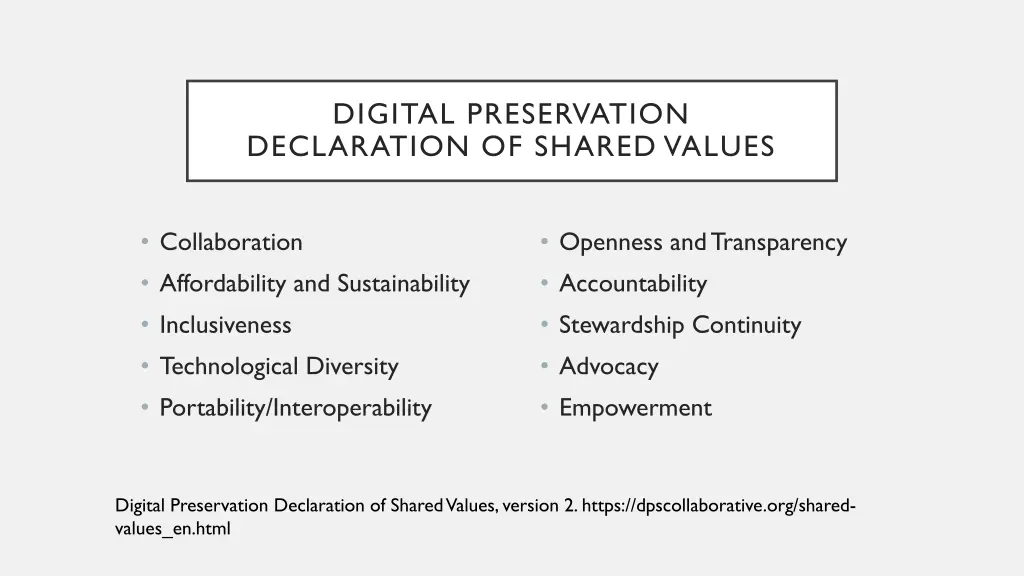
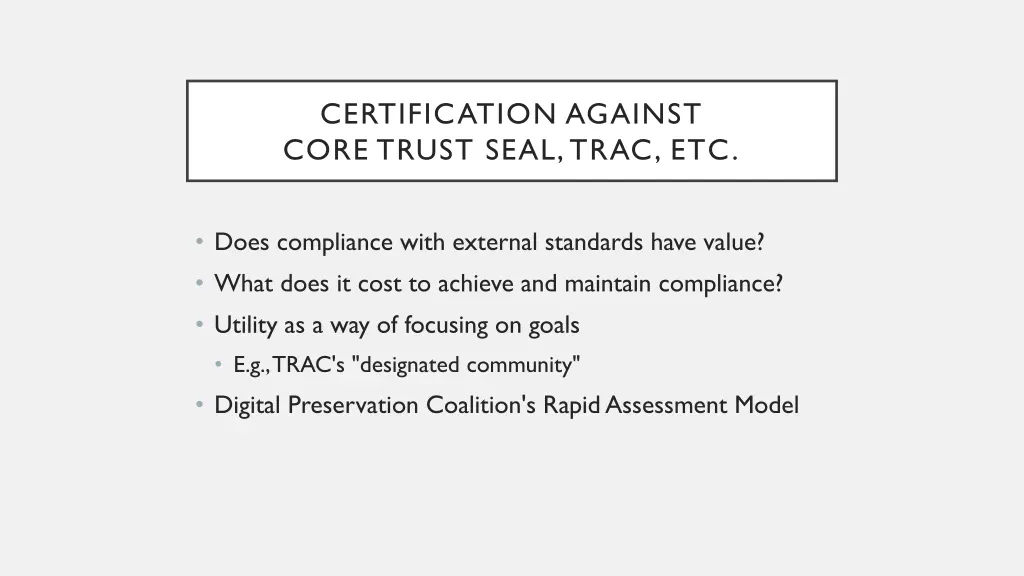
WHAT EXACTLY ARE WE TRYING TO DO HERE? NDSA Levels of Preservation Digital Preservation Declaration of Shared Values Certification against CoreTrustSeal, TRAC, etc.
Levels of Digital Preservation, version 2. https://ndsa.org/p ublications/levels- of-digital- preservation/
DIGITAL PRESERVATION DECLARATION OF SHARED VALUES Collaboration Affordability and Sustainability Inclusiveness Technological Diversity Portability/Interoperability Openness and Transparency Accountability Stewardship Continuity Advocacy Empowerment Digital Preservation Declaration of Shared Values, version 2.https://dpscollaborative.org/shared- values_en.html
CERTIFICATION AGAINST CORE TRUST SEAL, TRAC, ETC. Does compliance with external standards have value? What does it cost to achieve and maintain compliance? Utility as a way of focusing on goals E.g., TRAC's "designated community" Digital Preservation Coalition's Rapid Assessment Model
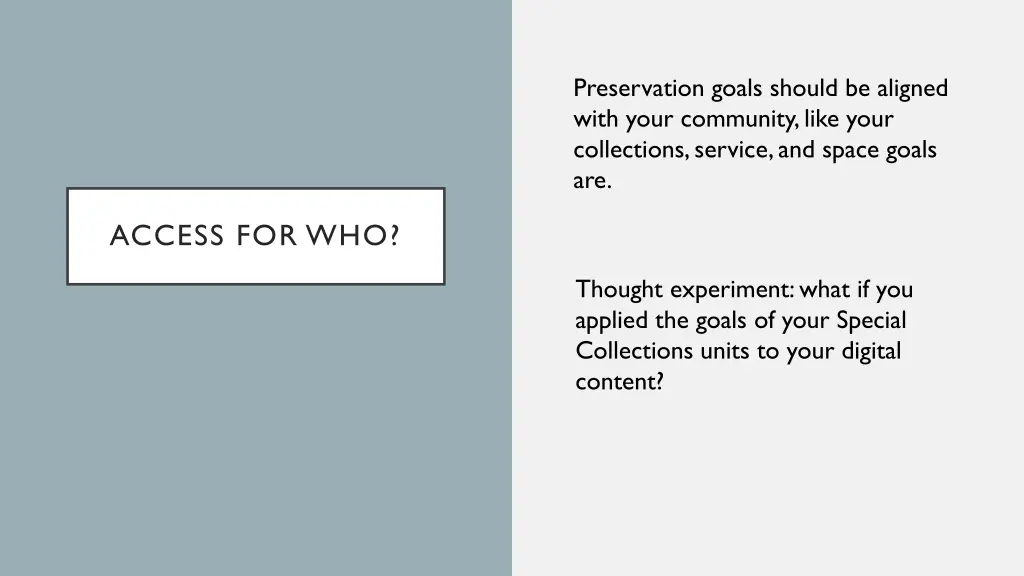
Preservation goals should be aligned with your community, like your collections, service, and space goals are. ACCESS FOR WHO? Thought experiment: what if you applied the goals of your Special Collections units to your digital content?
PRESERVATION POLICIES AND FRAMEWORKS Written expressions of an institution's digital preservation commitments and goals Sometimes accompanied by "action plans", which apply technical actions to specific types of content Examples York University Libraries Simon Fraser University Library
UNCLEAR ROLES FOR LIBRARY AND OTHER STAFF
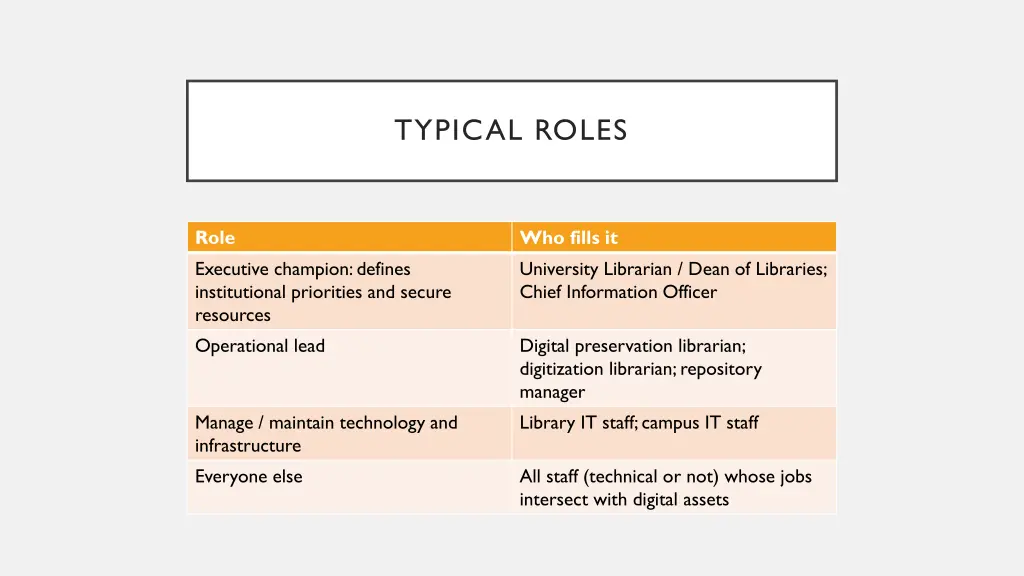
TYPICAL ROLES Role Executive champion: defines institutional priorities and secure resources Operational lead Who fills it University Librarian / Dean of Libraries; Chief Information Officer Digital preservation librarian; digitization librarian; repository manager Library IT staff; campus IT staff Manage / maintain technology and infrastructure Everyone else All staff (technical or not) whose jobs intersect with digital assets
BagIt, LOCKSS, Cloud, FITS, PREMIS, OAIS, emulation, Linked Open Data... Archivematica, Islandora, Samvera, DSpace, Preservica, OLRC... Institutional values, goals, and commitments as expressed in framework and action plans NECESSARY BUT NOT SUFFICIENT
Different priorities and timescales than GLAM digital preservation Often don't understand the business case (because we don't present it effectively) Opportunities to align on institutional strategies and priorities NECESSARY BUT NOT SUFFICIENT
TRUSTING COMMERCIAL SERVICE PROVIDERS
WORKING WITH COMMERCIAL SERVICE PROVIDERS Proprietary and open-source service providers Commitments limited to contract language What are your exit timelines and strategies? Thought experiment: what if your agreement with your preservation service provider ended suddenly? What can you do to prepare for that?
Because no digital preservation system is truly turnkey, digital preservation cannot be fully outsourced.
Digital preservation is a distributed and iterative activity that requires in-house expertise, adequate staffing, and access to different technologies and systems. While it is possible to outsource key components of the digital preservation process to a system provider, no digital preservation system is truly turnkey. Today, it is neither feasible nor desirable for a heritage organization to outsource responsibility for its digital preservation program. Oya Y. Rieger, Roger C. Schonfeld, Liam Sweeney. The Effectiveness and Durability of Digital Preservation and Curation Systems. Ithaka S+R. July 19, 2022. https://doi.org/10.18665/sr.316990
FAILURE TO SEE BEYOND OUR INSTITUTIONAL BORDERS
LOOKING BEYOND BORDERS IS HARD Alignment of shared goals Governance models Funding models Sustainability Exit strategies
SOME CURRENT OPPORTUNITIES Shift to community-based understanding of digital preservation, e.g., definitions of "trustworthy" Positive directions of national preservation collaborations Borealis and FRDR Interest in expanding CRKN's Canadiana TDR GLAM-adjacent organizations offering preservation services Internet Archive's Archive-It, Vault JSTOR's Open Community Collections