FDMA Transmissions Using Golay Sequences for PAPR Reduction
This document discusses a method for reducing Peak-to-Average Power Ratio (PAPR) in Frequency Division Multiple Access (FDMA) transmissions by utilizing existing QPSK Golay sequences. The proposed approach aims to address the significant increase in PAPR when Wake-Up Signals (WUSs) are transmitted using FDMA. Issues such as overlapping signals and PAPR management in the time domain are also considered. The transmitter block diagram and strategies for selecting sequences to keep the PAPR below a specified threshold are examined in detail.

Download Presentation

Please find below an Image/Link to download the presentation.
The content on the website is provided AS IS for your information and personal use only. It may not be sold, licensed, or shared on other websites without obtaining consent from the author.If you encounter any issues during the download, it is possible that the publisher has removed the file from their server.
You are allowed to download the files provided on this website for personal or commercial use, subject to the condition that they are used lawfully. All files are the property of their respective owners.
The content on the website is provided AS IS for your information and personal use only. It may not be sold, licensed, or shared on other websites without obtaining consent from the author.
E N D
Presentation Transcript
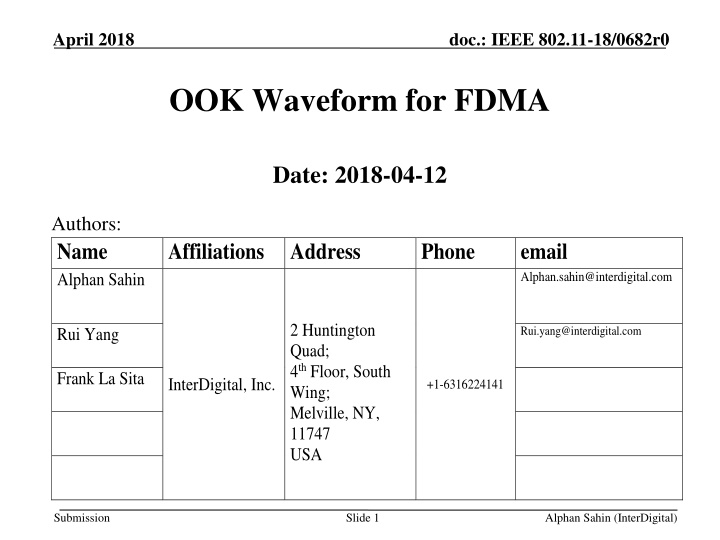
April 2018 doc.: IEEE 802.11-18/0682r0 OOK Waveform for FDMA Date: 2018-04-12 Authors: Name Alphan Sahin Affiliations Address Phone email Alphan.sahin@interdigital.com 2 Huntington Quad; 4th Floor, South Wing; Melville, NY, 11747 USA Rui.yang@interdigital.com Rui Yang Frank La Sita +1-6316224141 InterDigital, Inc. Submission Slide 1 Alphan Sahin (InterDigital)
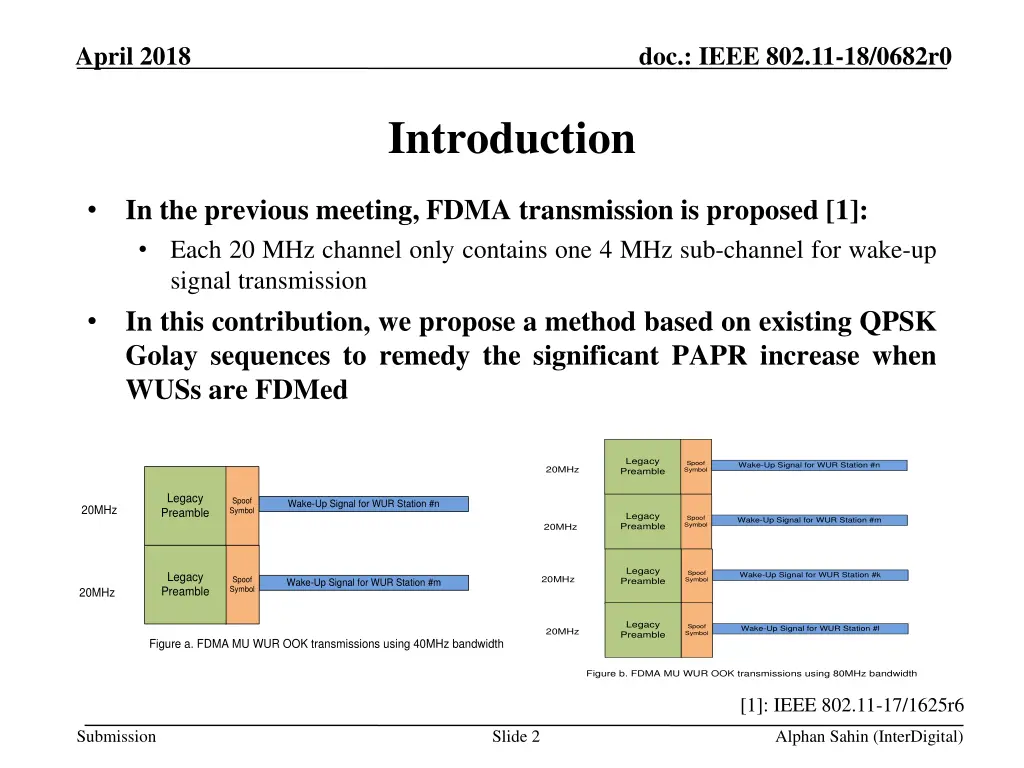
April 2018 doc.: IEEE 802.11-18/0682r0 Introduction In the previous meeting, FDMA transmission is proposed [1]: Each 20 MHz channel only contains one 4 MHz sub-channel for wake-up signal transmission In this contribution, we propose a method based on existing QPSK Golay sequences to remedy the significant PAPR increase when WUSs are FDMed Legacy Preamble Spoof Symbol Wake-Up Signal for WUR Station #n 20MHz Legacy Preamble Spoof Symbol Wake-Up Signal for WUR Station #n 20MHz Legacy Preamble Spoof Symbol Wake-Up Signal for WUR Station #m 20MHz Legacy Preamble Spoof Symbol Legacy Preamble Wake-Up Signal for WUR Station #k 20MHz Spoof Symbol Wake-Up Signal for WUR Station #m 20MHz Legacy Preamble Spoof Symbol Wake-Up Signal for WUR Station #l 20MHz Figure a. FDMA MU WUR OOK transmissions using 40MHz bandwidth Figure b. FDMA MU WUR OOK transmissions using 80MHz bandwidth [1]: IEEE 802.11-17/1625r6 Submission Slide 2 Alphan Sahin (InterDigital)
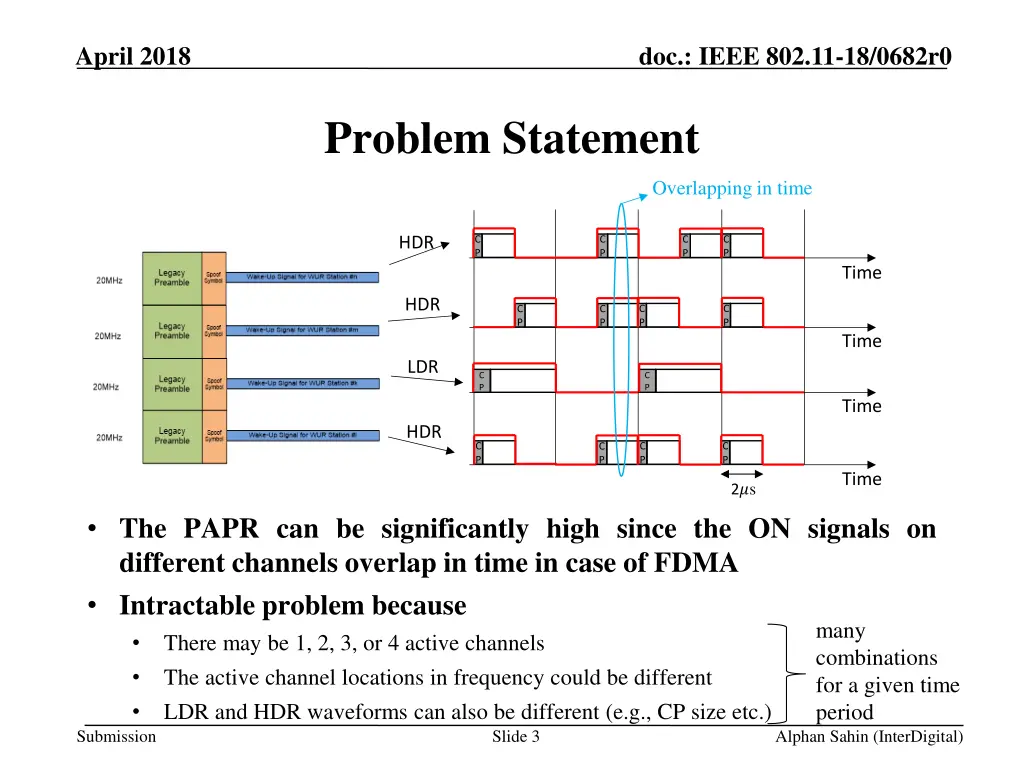
April 2018 doc.: IEEE 802.11-18/0682r0 Problem Statement Overlapping in time HDR C P C P C P C P Time HDR C P C P C P C P Time LDR C P C P Time HDR C P C P C P C P Time 2?s The PAPR can be significantly high since the ON signals on different channels overlap in time in case of FDMA Intractable problem because There may be 1, 2, 3, or 4 active channels The active channel locations in frequency could be different LDR and HDR waveforms can also be different (e.g., CP size etc.) many combinations for a given time period Submission Slide 3 Alphan Sahin (InterDigital)
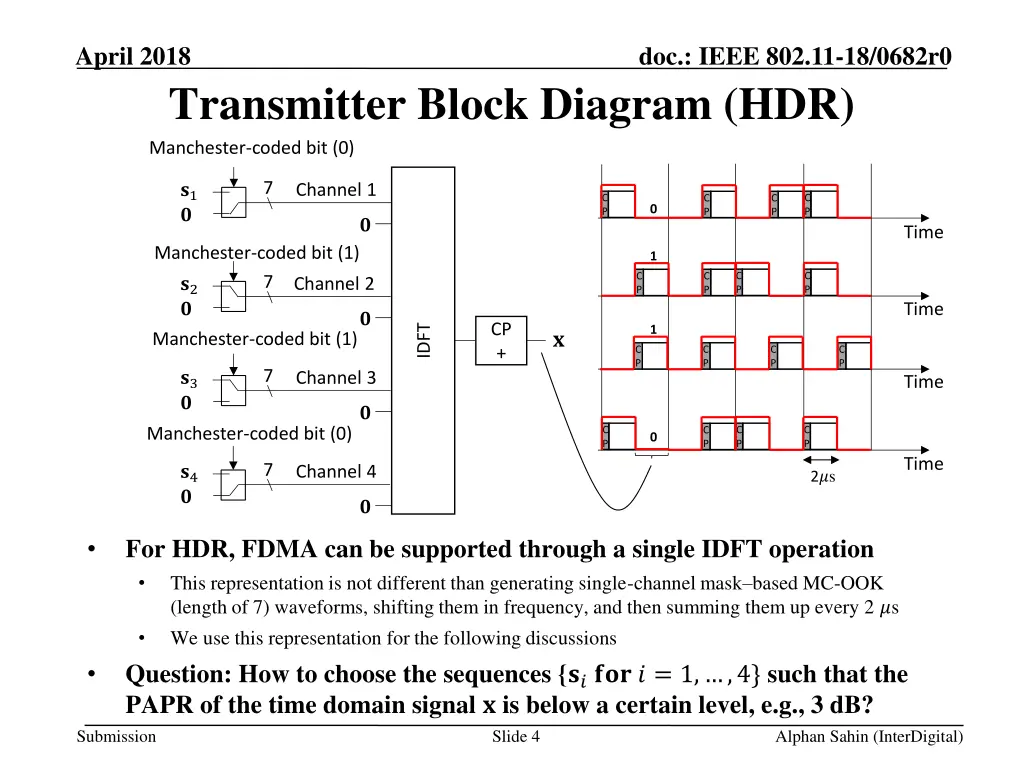
April 2018 doc.: IEEE 802.11-18/0682r0 Transmitter Block Diagram (HDR) Manchester-coded bit (0) 7 ?1 ? Channel 1 C P C P C P C P 0 ? Time Manchester-coded bit (1) 1 C P C P C P C P 7 ?2 ? Channel 2 Time ? CP + IDFT 1 ? Manchester-coded bit (1) C P C P C P C P 7 ?3 ? Channel 3 Time ? Manchester-coded bit (0) C P C P C P C P 0 Time 7 ?4 ? Channel 4 2?s ? For HDR, FDMA can be supported through a single IDFT operation This representation is not different than generating single-channel mask based MC-OOK (length of 7) waveforms, shifting them in frequency, and then summing them up every 2 ?s We use this representation for the following discussions Question: How to choose the sequences {?? ??? ? = 1, ,4} such that the PAPR of the time domain signal ? is below a certain level, e.g., 3 dB? Slide 4 Submission Alphan Sahin (InterDigital)
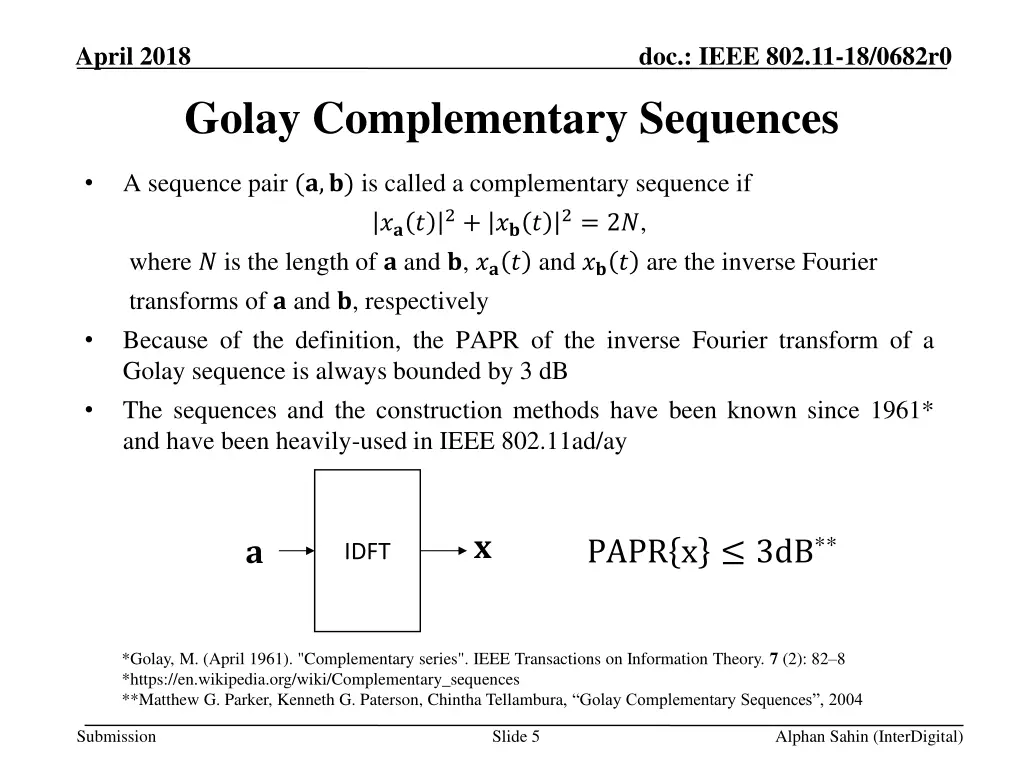
April 2018 doc.: IEEE 802.11-18/0682r0 Golay Complementary Sequences A sequence pair (?,?) is called a complementary sequence if 2+ ??? 2= 2?, ??? where ? is the length of ? and ?, ??? and ??? are the inverse Fourier transforms of ? and ?, respectively Because of the definition, the PAPR of the inverse Fourier transform of a Golay sequence is always bounded by 3 dB The sequences and the construction methods have been known since 1961* and have been heavily-used in IEEE 802.11ad/ay PAPR x 3dB** ? ? IDFT *Golay, M. (April 1961). "Complementary series". IEEE Transactions on Information Theory. 7 (2): 82 8 *https://en.wikipedia.org/wiki/Complementary_sequences **Matthew G. Parker, Kenneth G. Paterson, Chintha Tellambura, Golay Complementary Sequences , 2004 Submission Slide 5 Alphan Sahin (InterDigital)
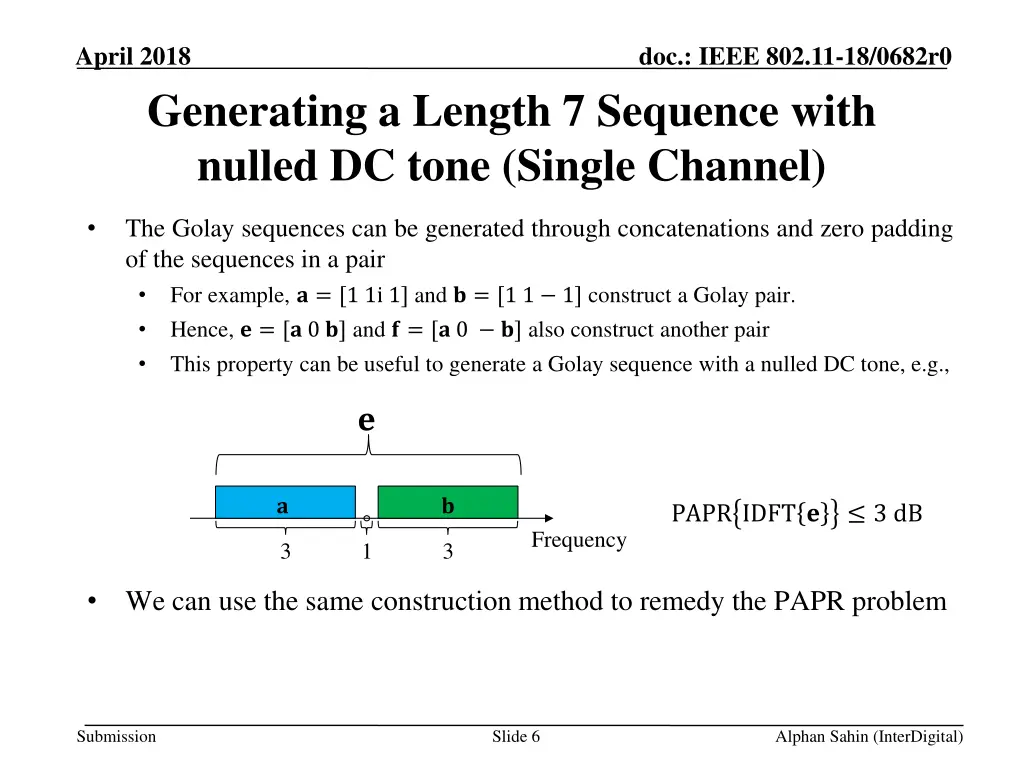
April 2018 doc.: IEEE 802.11-18/0682r0 Generating a Length 7 Sequence with nulled DC tone (Single Channel) The Golay sequences can be generated through concatenations and zero padding of the sequences in a pair For example, ? = [1 1i 1] and ? = [1 1 1] construct a Golay pair. Hence, ? = [? 0 ?] and ? = [? 0 ?] also construct another pair This property can be useful to generate a Golay sequence with a nulled DC tone, e.g., ? ? ? PAPR IDFT ? 3 dB Frequency 3 1 3 We can use the same construction method to remedy the PAPR problem Submission Slide 6 Alphan Sahin (InterDigital)
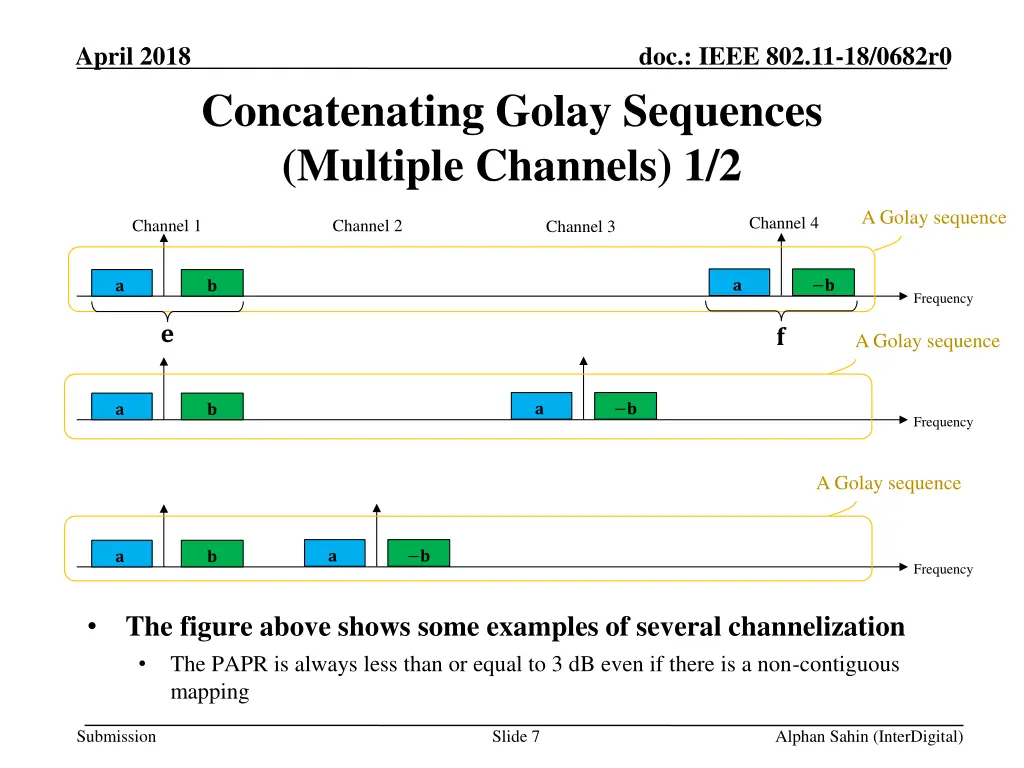
April 2018 doc.: IEEE 802.11-18/0682r0 Concatenating Golay Sequences (Multiple Channels) 1/2 A Golay sequence Channel 4 Channel 1 Channel 2 Channel 3 ? ? ? ? Frequency ? ? A Golay sequence ? ? ? ? Frequency A Golay sequence ? ? ? ? Frequency The figure above shows some examples of several channelization The PAPR is always less than or equal to 3 dB even if there is a non-contiguous mapping Submission Slide 7 Alphan Sahin (InterDigital)
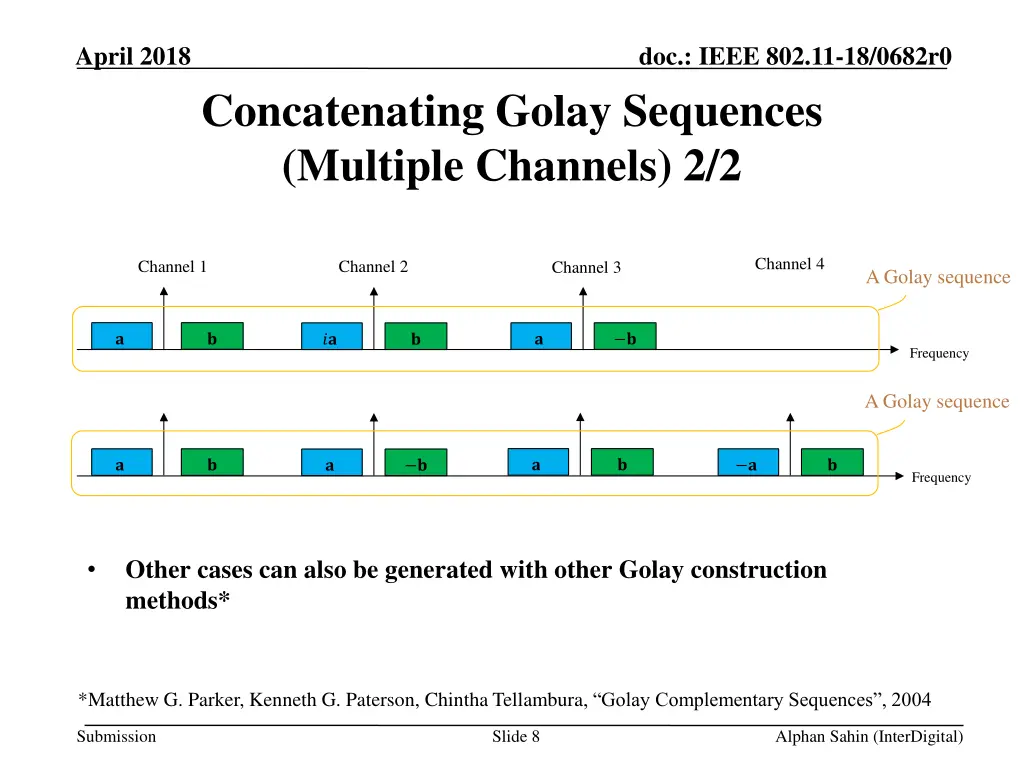
April 2018 doc.: IEEE 802.11-18/0682r0 Concatenating Golay Sequences (Multiple Channels) 2/2 Channel 4 Channel 1 Channel 2 Channel 3 A Golay sequence ? ? ? ? ?? ? Frequency A Golay sequence ? ? ? ? ? ? ? ? Frequency Other cases can also be generated with other Golay construction methods* *Matthew G. Parker, Kenneth G. Paterson, Chintha Tellambura, Golay Complementary Sequences , 2004 Submission Slide 8 Alphan Sahin (InterDigital)
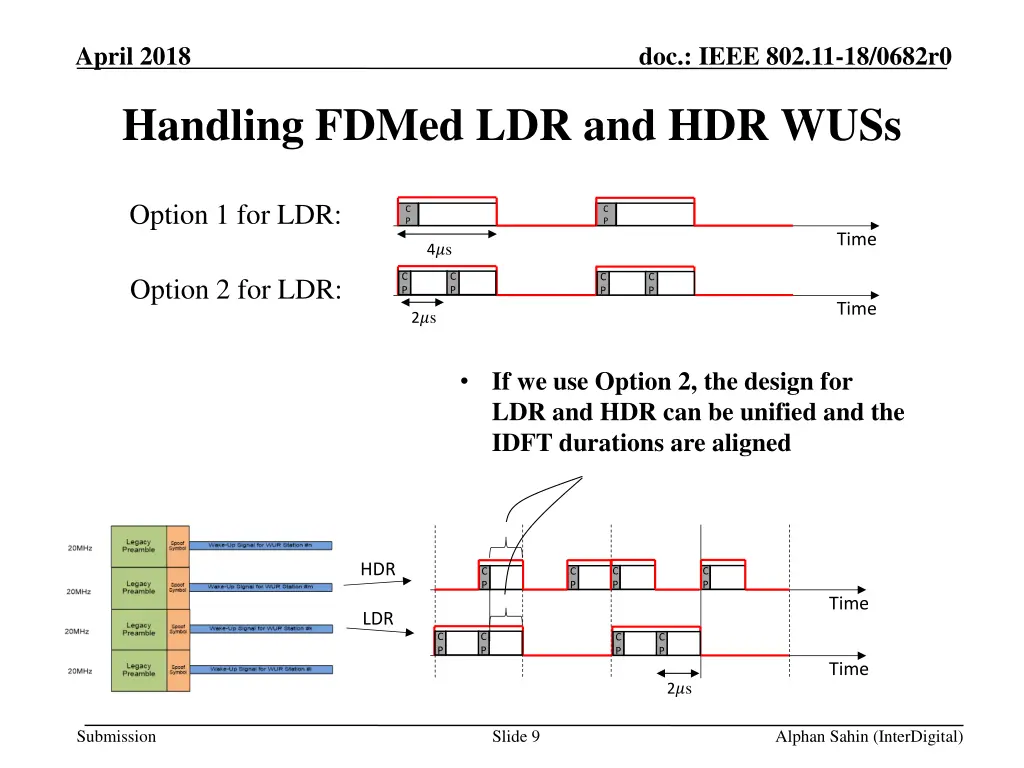
April 2018 doc.: IEEE 802.11-18/0682r0 Handling FDMed LDR and HDR WUSs Option 1 for LDR: C P C P Time 4?s C P C P C P C P Option 2 for LDR: Time 2?s If we use Option 2, the design for LDR and HDR can be unified and the IDFT durations are aligned HDR C P C P C P C P Time LDR C P C P C P C P Time 2?s Submission Slide 9 Alphan Sahin (InterDigital)
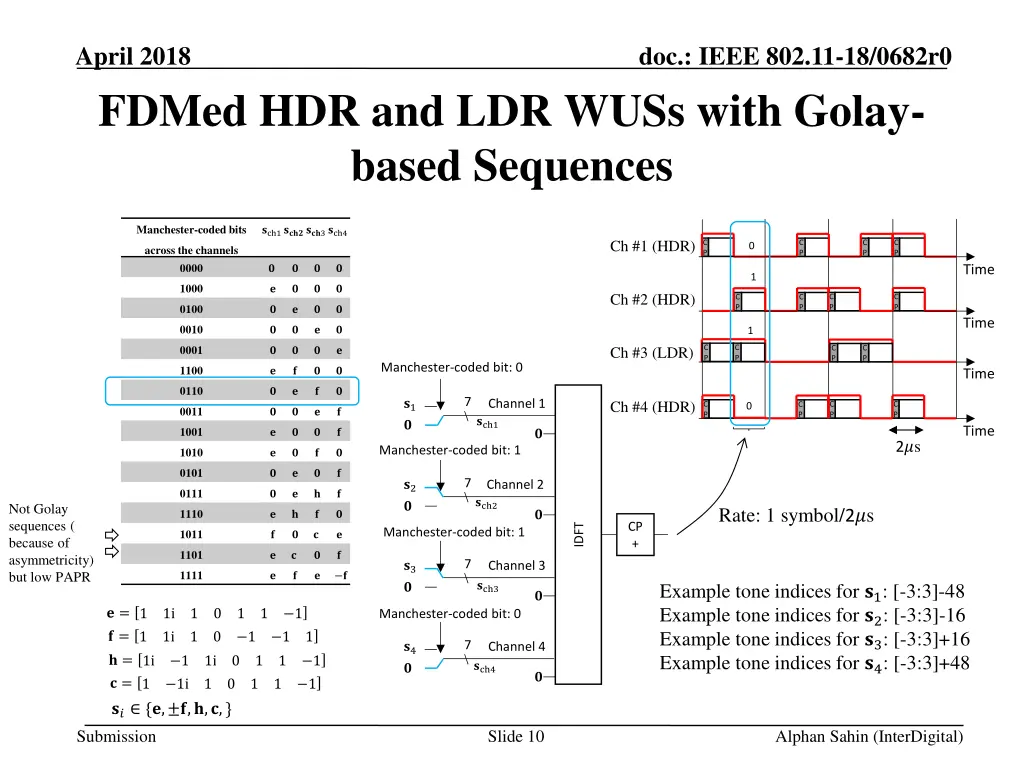
April 2018 FDMed HDR and LDR WUSs with Golay- based Sequences doc.: IEEE 802.11-18/0682r0 Manchester-coded bits ?ch1???????3?ch4 Ch #1 (HDR) C P C P C P C P 0 across the channels 0000 Time ? ? ? ? 1 1000 ? ? ? ? Ch #2 (HDR) C P C P C P C P 0100 ? ? ? ? Time 0010 ? ? ? ? 1 0001 Ch #3 (LDR) C P C P C P C P ? ? ? ? Manchester-coded bit: 0 1100 ? ? ? ? Time 0110 ? ? ? ? 7 ?1 ? Channel 1 ?ch1 Ch #4 (HDR) C P C P C P C P 0 0011 ? ? ? ? Time 1001 ? ? ? ? ? 2?s Manchester-coded bit: 1 1010 ? ? ? ? 0101 ? ? ? ? 7 ?2 ? Channel 2 ?ch2 0111 ? ? ? ? Not Golay sequences ( because of asymmetricity) but low PAPR Rate: 1 symbol/2?s 1110 ? ? ? ? ? CP + IDFT Manchester-coded bit: 1 1011 ? ? ? ? 1101 ? ? ? ? 7 ?3 ? Channel 3 ?ch3 1111 ? ? ? ? Example tone indices for ?1: [-3:3]-48 Example tone indices for ?2: [-3:3]-16 Example tone indices for ?3: [-3:3]+16 Example tone indices for ?4: [-3:3]+48 ? ? = 1 1i 1 0 1 1 1 Manchester-coded bit: 0 ? = 1 1i 1 0 1 1 1 7 ?4 ? Channel 4 ?ch4 ? = 1i ? = 1 1 1i 0 1 1 1 ? 1i 1 0 1 1 1 ?? {?, ?,?,?,} Submission Slide 10 Alphan Sahin (InterDigital)
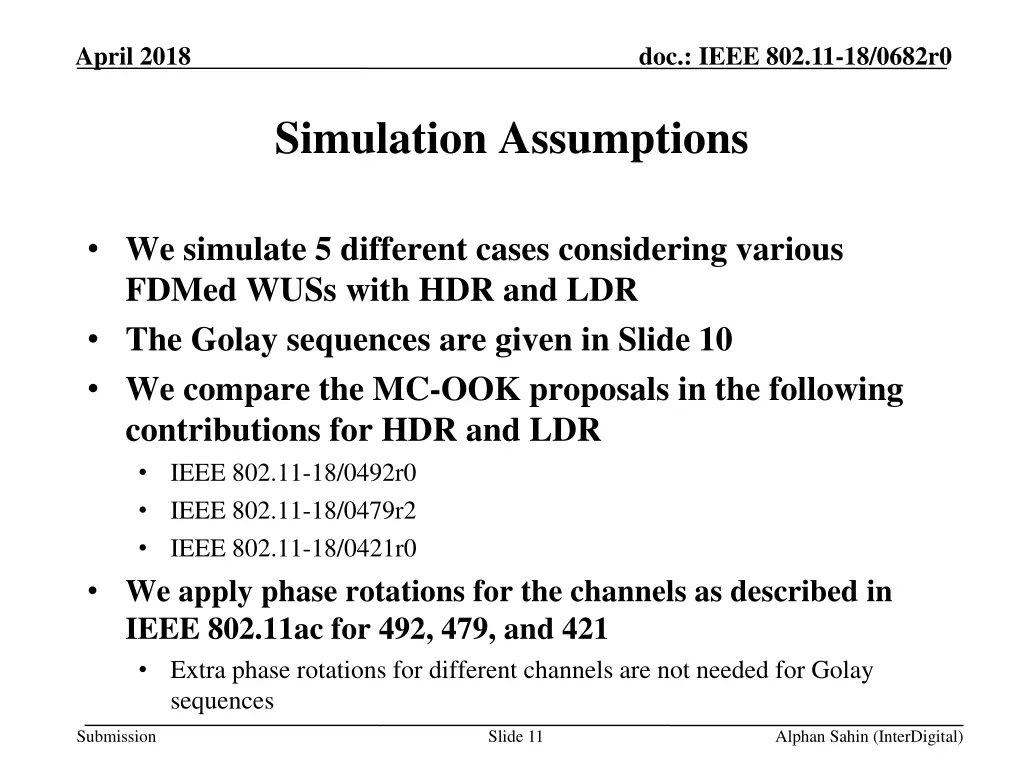
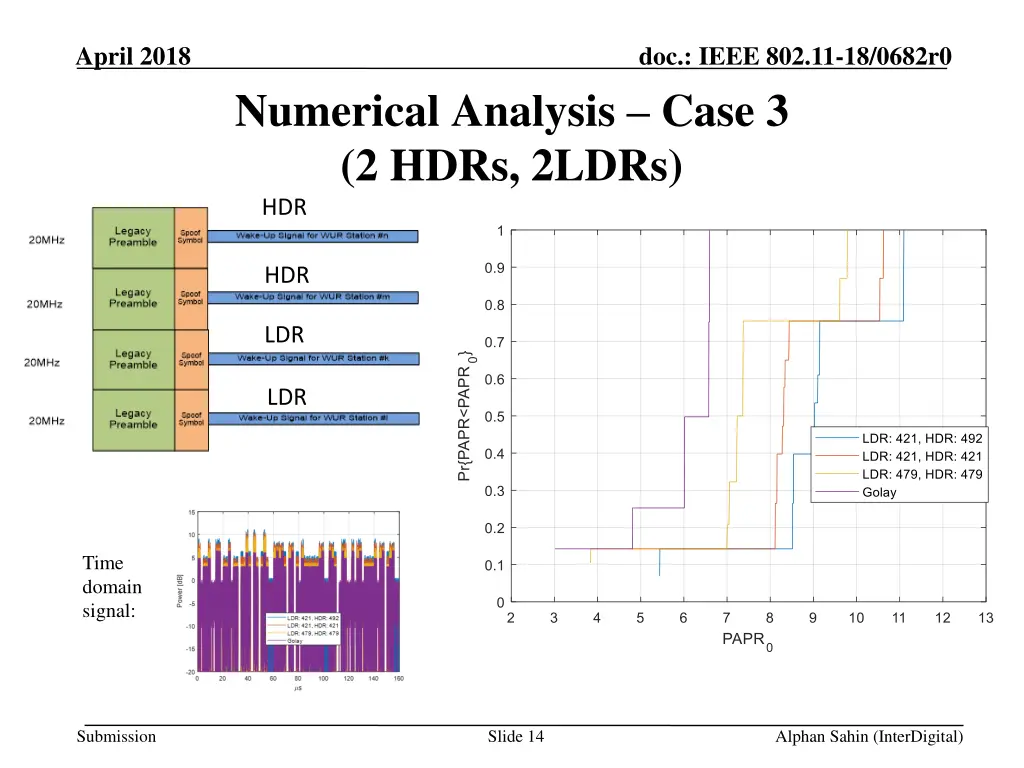
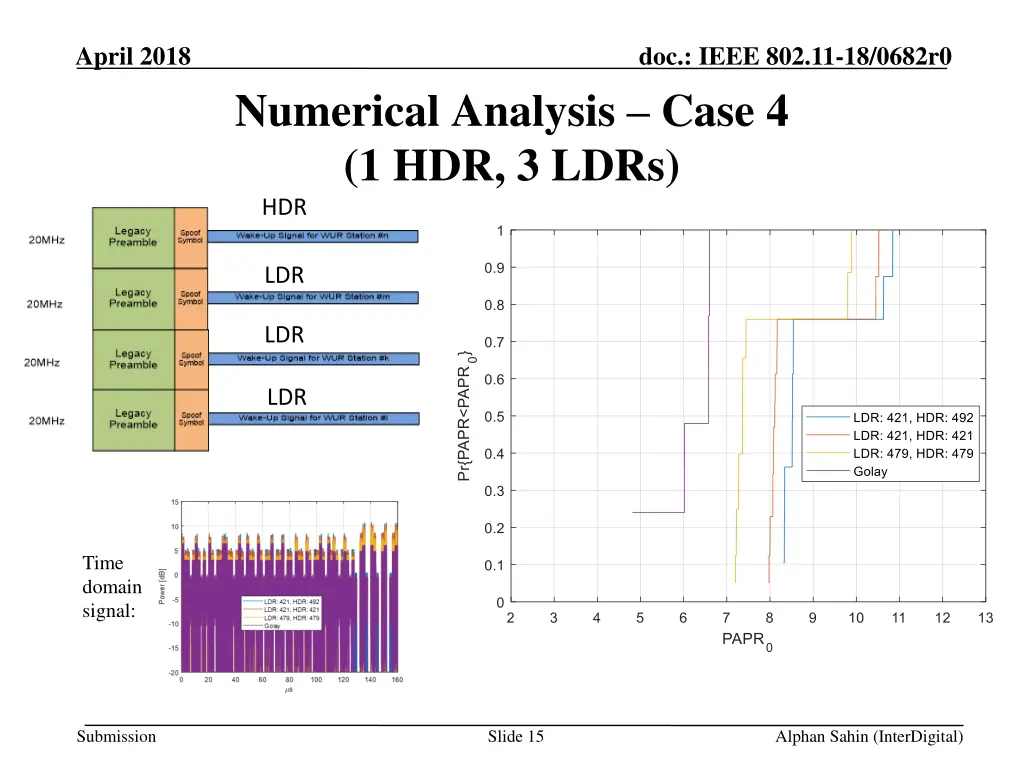
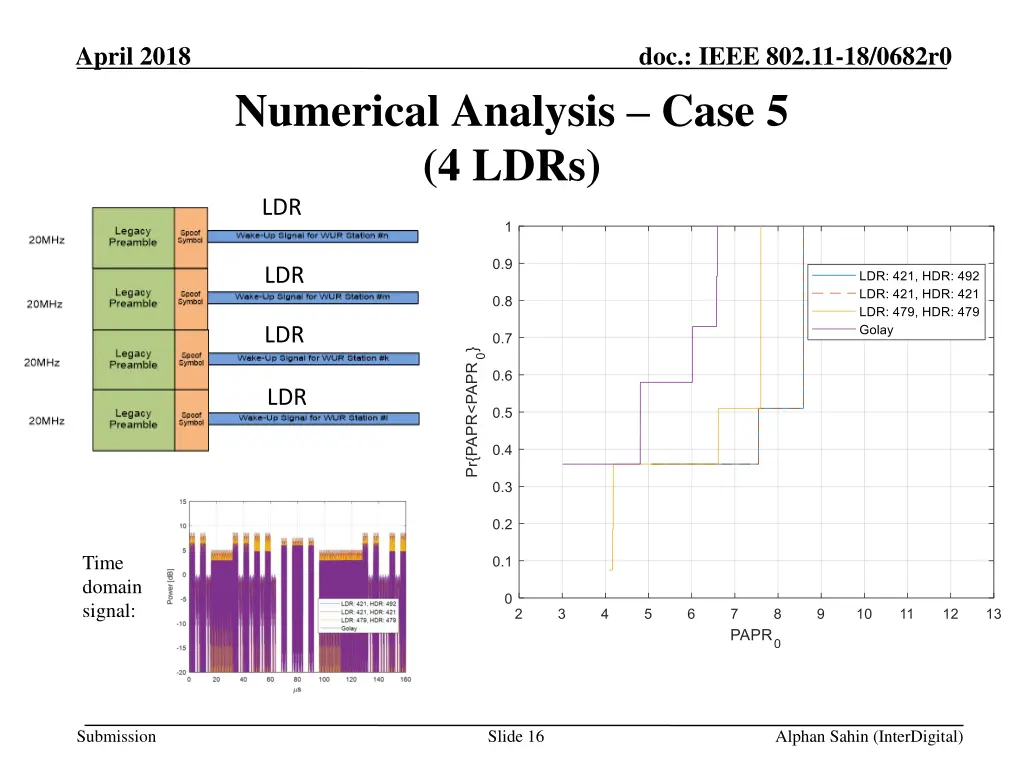
April 2018 doc.: IEEE 802.11-18/0682r0 Simulation Assumptions We simulate 5 different cases considering various FDMed WUSs with HDR and LDR The Golay sequences are given in Slide 10 We compare the MC-OOK proposals in the following contributions for HDR and LDR IEEE 802.11-18/0492r0 IEEE 802.11-18/0479r2 IEEE 802.11-18/0421r0 We apply phase rotations for the channels as described in IEEE 802.11ac for 492, 479, and 421 Extra phase rotations for different channels are not needed for Golay sequences Submission Slide 11 Alphan Sahin (InterDigital)
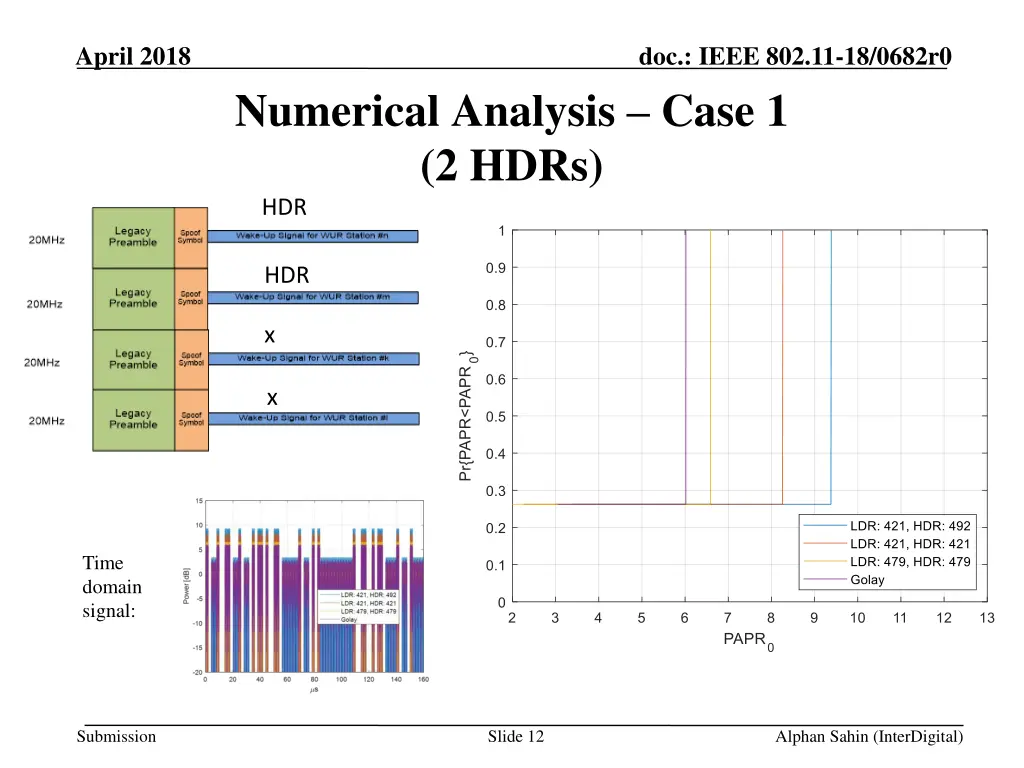
April 2018 doc.: IEEE 802.11-18/0682r0 Numerical Analysis Case 1 (2 HDRs) HDR HDR x x Time domain signal: Submission Slide 12 Alphan Sahin (InterDigital)
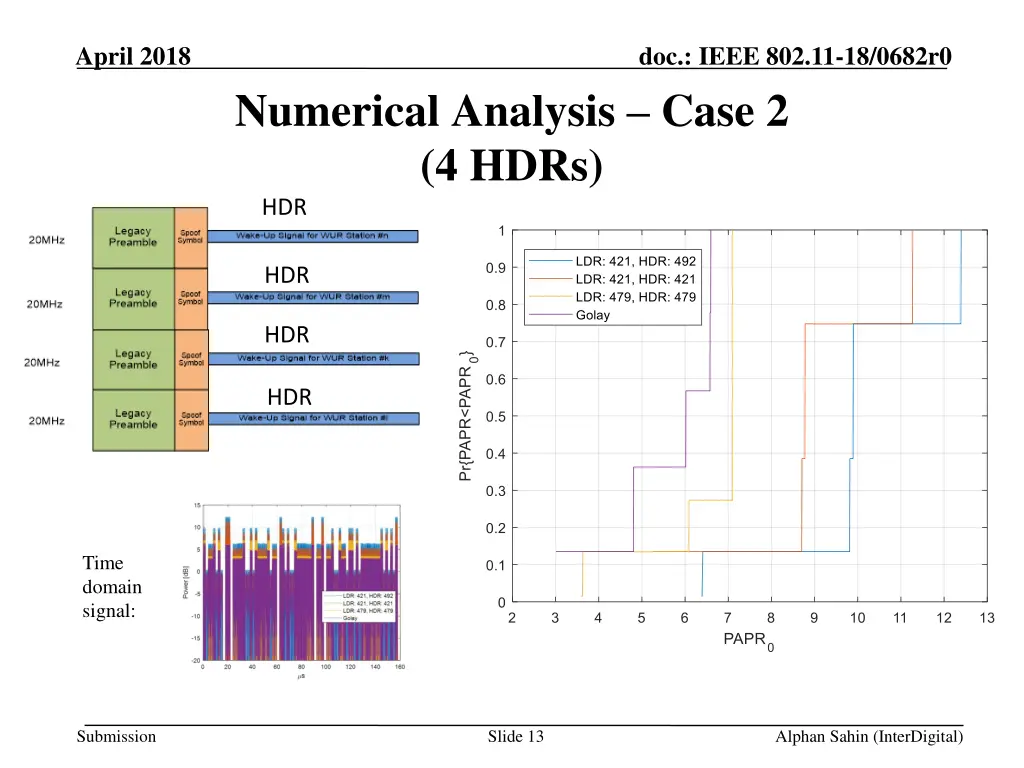
April 2018 doc.: IEEE 802.11-18/0682r0 Numerical Analysis Case 2 (4 HDRs) HDR HDR HDR HDR Time domain signal: Submission Slide 13 Alphan Sahin (InterDigital)
April 2018 doc.: IEEE 802.11-18/0682r0 Numerical Analysis Case 3 (2 HDRs, 2LDRs) HDR HDR LDR LDR Time domain signal: Submission Slide 14 Alphan Sahin (InterDigital)
April 2018 doc.: IEEE 802.11-18/0682r0 Numerical Analysis Case 4 (1 HDR, 3 LDRs) HDR LDR LDR LDR Time domain signal: Submission Slide 15 Alphan Sahin (InterDigital)
April 2018 doc.: IEEE 802.11-18/0682r0 Numerical Analysis Case 5 (4 LDRs) LDR LDR LDR LDR Time domain signal: Submission Slide 16 Alphan Sahin (InterDigital)
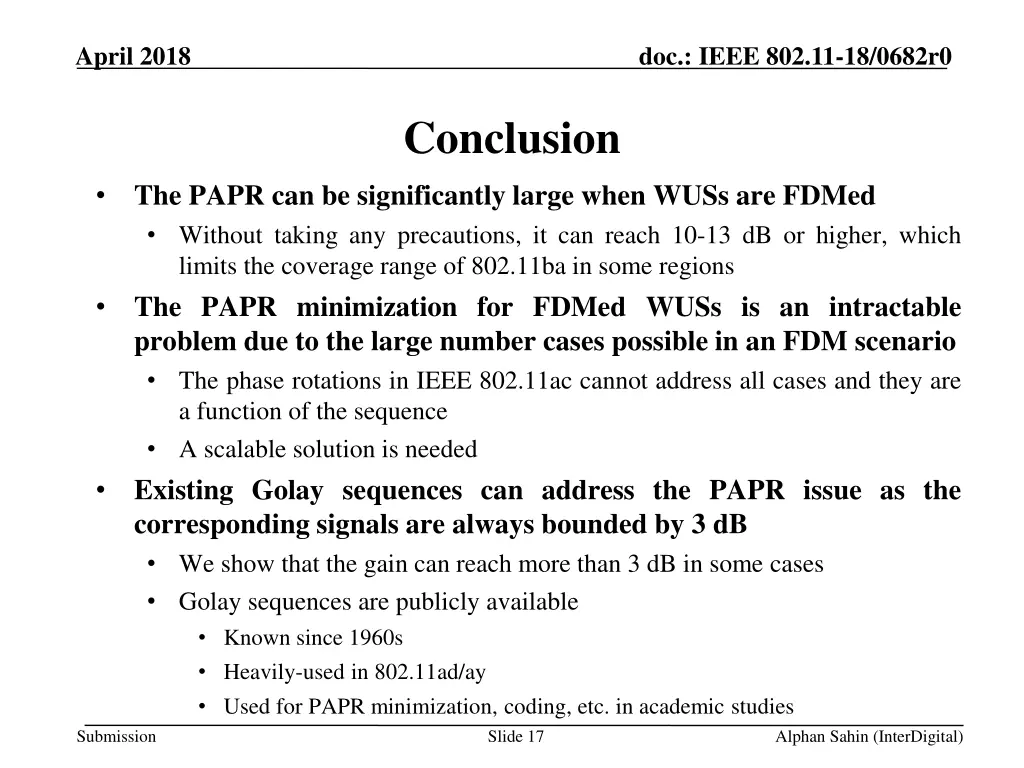
April 2018 doc.: IEEE 802.11-18/0682r0 Conclusion The PAPR can be significantly large when WUSs are FDMed Without taking any precautions, it can reach 10-13 dB or higher, which limits the coverage range of 802.11ba in some regions The PAPR minimization for FDMed WUSs is an intractable problem due to the large number cases possible in an FDM scenario The phase rotations in IEEE 802.11ac cannot address all cases and they are a function of the sequence A scalable solution is needed Existing Golay sequences can address the PAPR issue as the corresponding signals are always bounded by 3 dB We show that the gain can reach more than 3 dB in some cases Golay sequences are publicly available Known since 1960s Heavily-used in 802.11ad/ay Used for PAPR minimization, coding, etc. in academic studies Slide 17 Submission Alphan Sahin (InterDigital)
April 2018 doc.: IEEE 802.11-18/0682r0 Appendix Submission Slide 18 Alphan Sahin (InterDigital)
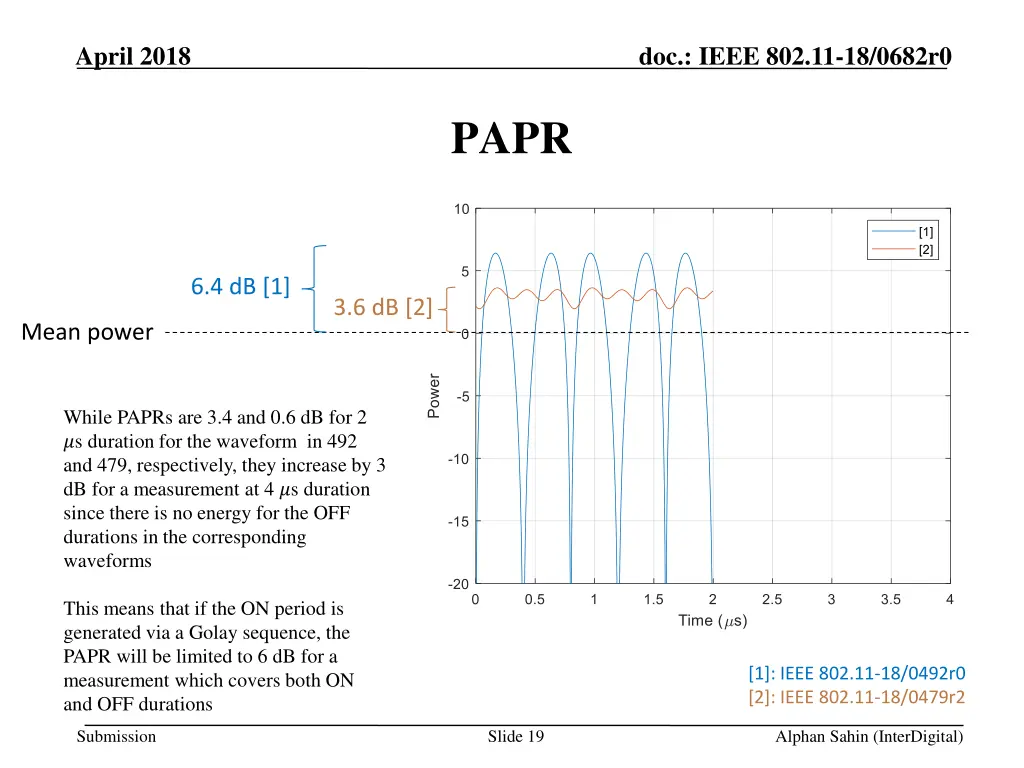
April 2018 doc.: IEEE 802.11-18/0682r0 PAPR 6.4 dB [1] 3.6 dB [2] Mean power While PAPRs are 3.4 and 0.6 dB for 2 ?s duration for the waveform in 492 and 479, respectively, they increase by 3 dB for a measurement at 4 ?s duration since there is no energy for the OFF durations in the corresponding waveforms This means that if the ON period is generated via a Golay sequence, the PAPR will be limited to 6 dB for a measurement which covers both ON and OFF durations [1]: IEEE 802.11-18/0492r0 [2]: IEEE 802.11-18/0479r2 Submission Slide 19 Alphan Sahin (InterDigital)