Flight Management System (FMS) in Modern Airliners
The Flight Management System (FMS) is a crucial component of modern aircraft avionics, automating various in-flight tasks to reduce the workload on the flight crew. This specialized computer system handles in-flight management of the flight plan using sensors like GPS and INS. The FMS is controlled through a display in the cockpit and contains a navigation database updated every 28 days. It comprises important information for building a flight plan, including waypoints, radio navigation aids, airports, runways, and instrument procedures.

Download Presentation

Please find below an Image/Link to download the presentation.
The content on the website is provided AS IS for your information and personal use only. It may not be sold, licensed, or shared on other websites without obtaining consent from the author. If you encounter any issues during the download, it is possible that the publisher has removed the file from their server.
You are allowed to download the files provided on this website for personal or commercial use, subject to the condition that they are used lawfully. All files are the property of their respective owners.
The content on the website is provided AS IS for your information and personal use only. It may not be sold, licensed, or shared on other websites without obtaining consent from the author.
E N D
Presentation Transcript
FLIGHT MANAGEMENT SYSTEM(FMS)
A flight management system (FMS) is a fundamental componentof a modern airliner's avionics. An FMS is a specialized computer system that automates a wide variety of in-flight tasks, reducing the workload on the flight crew to the point that modern civilian aircraft no longercarry flight engineers or navigators. A primary function is in-flight management of the flight plan. Using various sensors (such as GPS and INS often backed up by radio navigation) to determine the aircraft's position, the FMS can guide the aircraft along the flight plan.
From the cockpit, the FMS is normally controlled through a Control Display incorporates a small screen and keyboard or touch screen. The FMS sends the flight plan for display to the Electronic Flight Instrument Navigation Display (ND), or Multifunction Display (MFD). The modern FMS was introduced on the Boeing 767, though earlier navigation computersdid exist. Now, systems similar to FMS exist on aircraft as small as the Cessna 182. In its evolution an FMS has had many different sizes, capabilities and controls. characteristics are common toall FMS. Unit (CDU) which System (EFIS), However certain
All navigation database contains the elements from which the flight plan is constructed. These are defined via the ARINC 424 standard. The navigation database (NDB) is normally updated every 28 days, in order toensure that its contentsare current. Each FMS contains only a subset of the ARINC / AIRAC(Aeronautical Information Regulation And Control and steps from the Annex 15 - Aeronautical Information Services (AIS) document and defines a series of common dates and an associated standard aeronautical information ) capabilities of the FMS. FMS contain a navigation database. The data, relevant to the
The NDB contains all of the information required for building a flight plan, consisting of: Waypoints/Intersection Radio navigation aids including distance measuring equipment (DME), VHF Omni directional range (VOR), non-directional beacons (NDBs) and instrument landing systems (ILSs). Airports Runways Standard instrumentdeparture (SID) Standard terminal arrival (STAR) Holding patterns (only as part of IAPs-although can be entered bycommand of ATC orat pilot'sdiscretion) Instrumentapproach procedure (IAP)
The flight plan is generally determined on the ground, before departure either by the pilot for smaller aircraft ora professional dispatcher forairliners. It is entered into the FMS either by typing it in, selecting it from a saved library of common routes (Company Routes) or via an ACARS data link with the airline dispatch center. During preflight, other information relevant to managing the flight plan is entered. This can include performance information such as gross weight, fuel weight and centerof gravity. It will include altitudes including the initial cruise altitude. For aircraft that do not have a GPS, the initial position is also required.
The pilot uses the FMS to modify the flight plan in flight foravarietyof reasons. Significant engineering keystrokes in order to minimize pilot workload in flight and eliminate any (Hazardously Misleading Information). The FMS also sends the flight plan information for display on the Navigation Display (ND) of the flight deck instruments Electronic Flight Instrument System (EFIS). Special flight plans, often for tactical requirements including search patterns, in-flight refueling tanker orbits, calculated air release points (CARP) for accurate parachute jumps are just a few of the special flight plans some FMS can calculate. design minimizes the confusing information
Once in flight, a principal task of the FMS is to determine the aircraft's position and the accuracy of that position. Simple FMS use a single sensor, generally GPS in order todetermine position. But modern FMS use as many sensors as they can, such as VORs, in order to determine and validate their exact position. Some FMS use a Kalman filter to integrate the positions from the various sensors into a single position. Common sensors include: Airline quality GPS receivers act as the primary sensoras they have the highest accuracyand integrity.
Radio aids designed for aircraft navigation act as the second highest quality sensors. These include : Scanning DME (distance measuring equipment) that check the distances from five different DME stations simultaneously in order to determine one position every 10 seconds. VORs (VHF Omni directional radio range) that supply a bearing. With two VOR stations the aircraft position can be determined, but the accuracy is limited. Inertial reference systems (IRS) use ring laser gyros and accelerometers in order to calculate the aircraft position. They are highly accurate and independent of outside sources. Airliners use the weighted average of three independent IRS to determine the triple mixed IRS position.
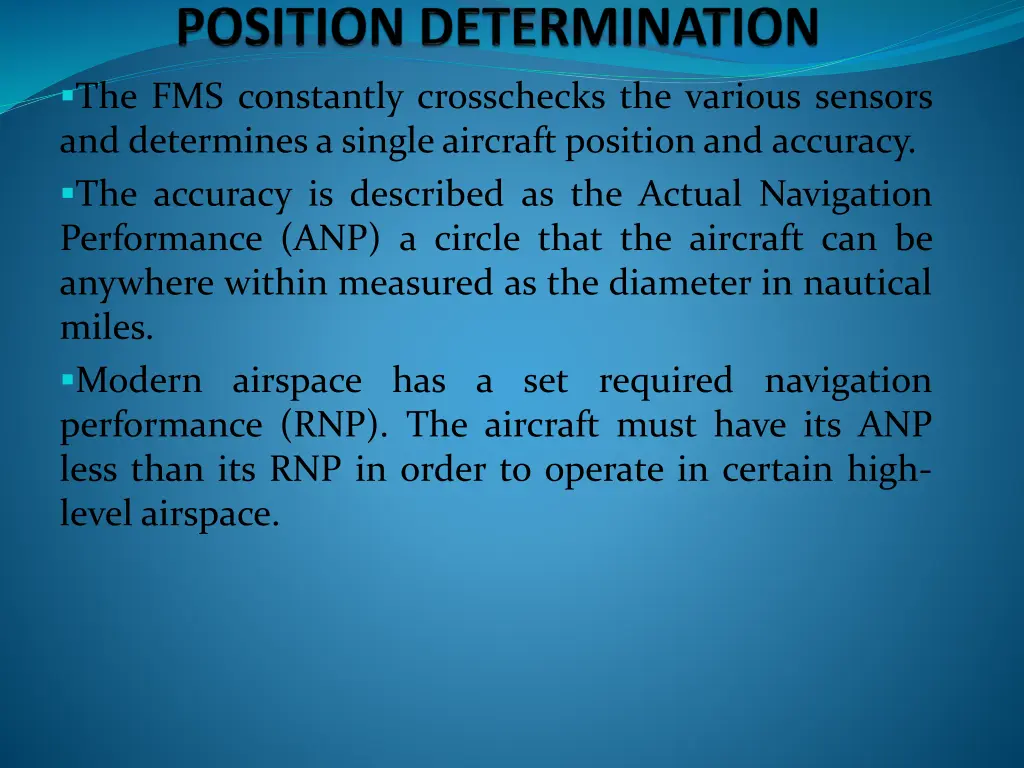
The FMS constantly crosschecks the various sensors and determines a singleaircraft positionand accuracy. The accuracy is described as the Actual Navigation Performance (ANP) a circle that the aircraft can be anywhere within measured as the diameter in nautical miles. Modern airspace has a set required navigation performance (RNP). The aircraft must have its ANP less than its RNP in order to operate in certain high- level airspace.
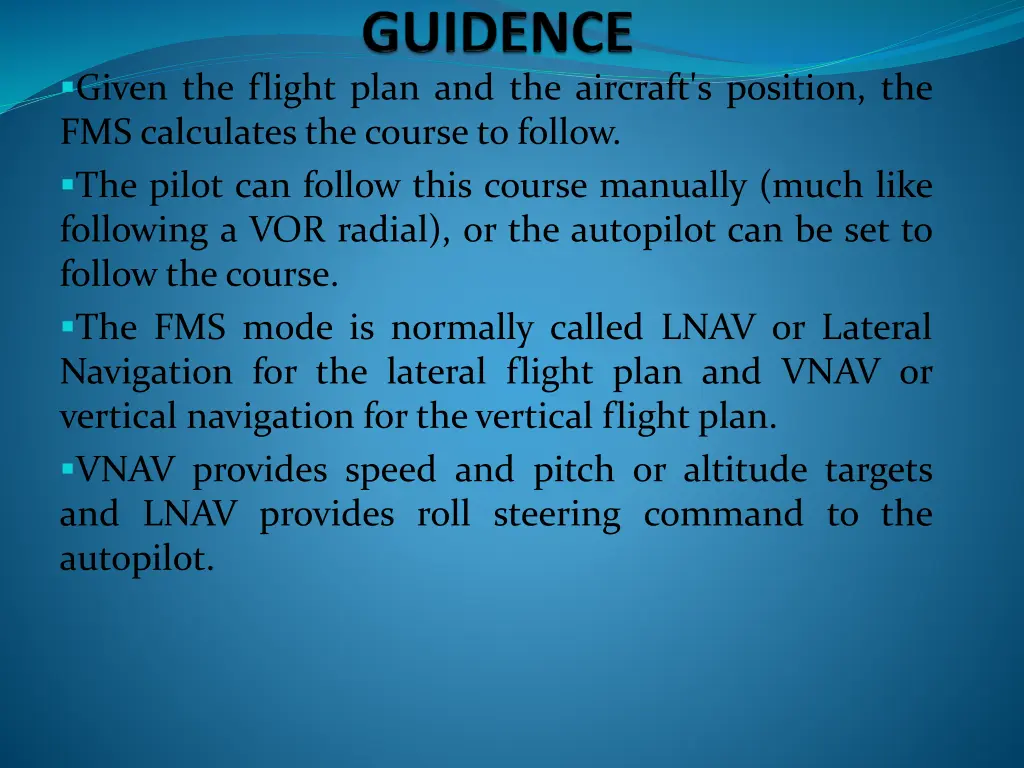
Given the flight plan and the aircraft's position, the FMS calculates the course to follow. The pilot can follow this course manually (much like following a VOR radial), or the autopilot can be set to follow the course. The FMS mode is normally called LNAV or Lateral Navigation for the lateral flight plan and VNAV or vertical navigation for thevertical flight plan. VNAV provides speed and pitch or altitude targets and LNAV provides roll steering command to the autopilot.