Generalized Transition Graphs in Automata Theory
Generalized Transition Graphs (GTG) are a key concept in automata theory. GTG consist of a finite set of states, input alphabet, and directed edges labeled with regular expressions. Explore examples of GTG accepting specific language patterns.

Download Presentation

Please find below an Image/Link to download the presentation.
The content on the website is provided AS IS for your information and personal use only. It may not be sold, licensed, or shared on other websites without obtaining consent from the author.If you encounter any issues during the download, it is possible that the publisher has removed the file from their server.
You are allowed to download the files provided on this website for personal or commercial use, subject to the condition that they are used lawfully. All files are the property of their respective owners.
The content on the website is provided AS IS for your information and personal use only. It may not be sold, licensed, or shared on other websites without obtaining consent from the author.
E N D
Presentation Transcript
Generalized Transition Graphs Course: Topic: Instructor: Muhammad Arif Theory Of Automata Generalized Transition Graphs
Generalized Transition Graphs (GTG) A variation of TG A generalized transition graph is a collection of three things A finite set of states, of which at least one is a start state and some (may be none) are final states An alphabet of input letters Directed edges connecting some pairs of states each labeled with a regular expression
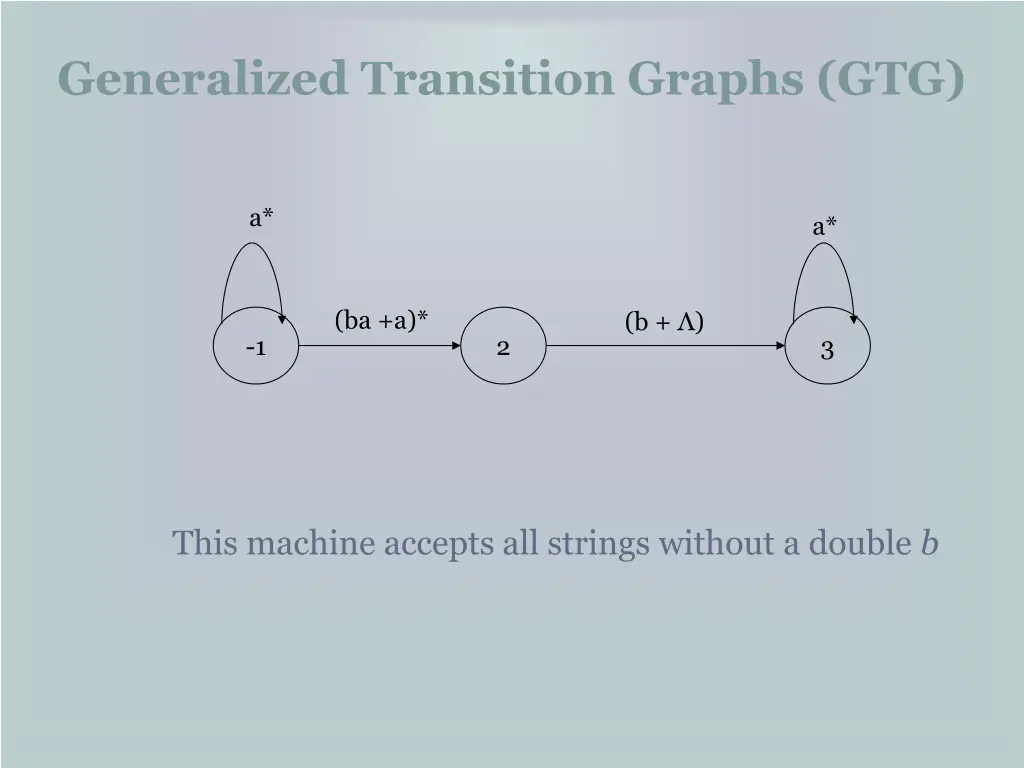
Generalized Transition Graphs (GTG) a* a* (ba +a)* (b + ) -1 2 3 This machine accepts all strings without a double b
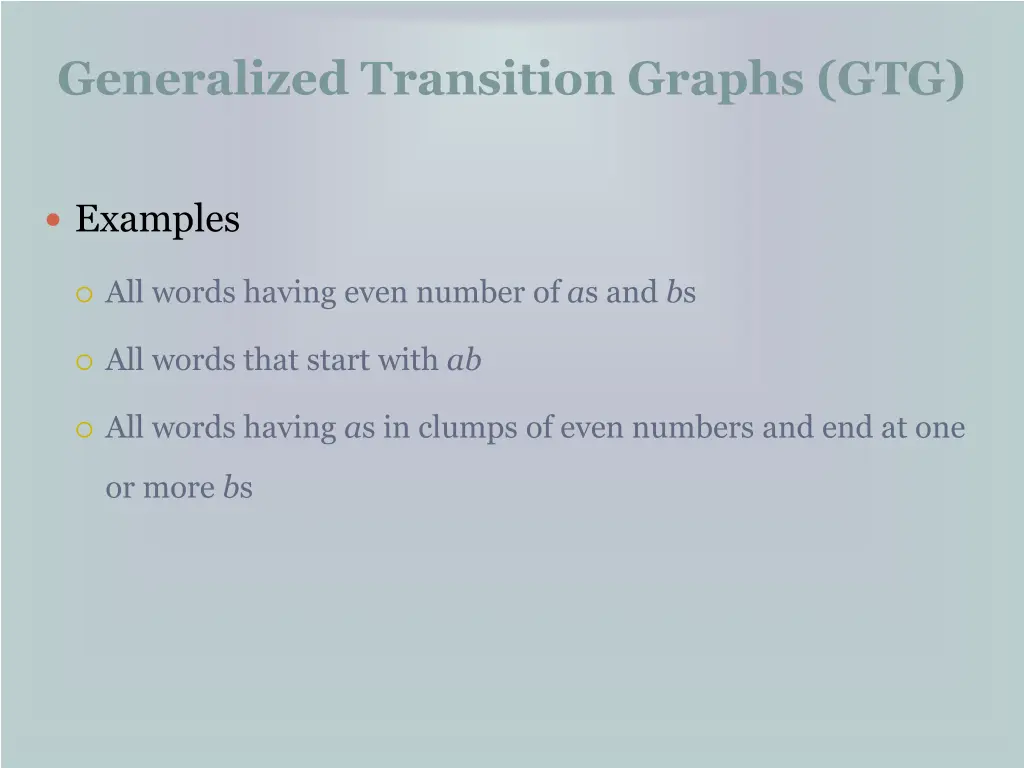
Generalized Transition Graphs (GTG) Examples All words having even number of as and bs All words that start with ab All words having as in clumps of even numbers and end at one or more bs
Generalized Transition Graphs (GTG) A generalized transition graph is a collection of three things A finite set of states, of which at least one is a start state and some (may be none) are final states Finite set of input letters ( ) from which input strings are formed. Directed edges connecting some pairs of states each labeled with a regular expression. Note: it may be noted that in GTG, the labels of transition edges are corresponding RE.
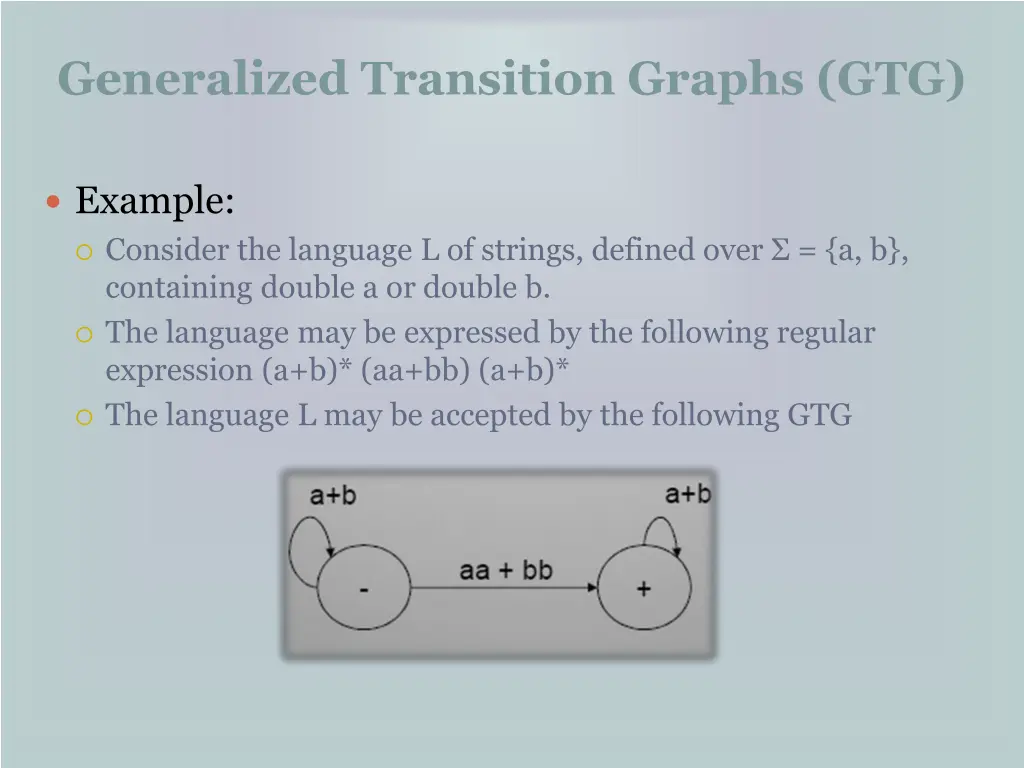
Generalized Transition Graphs (GTG) Example: Consider the language L of strings, defined over = {a, b}, containing double a or double b. The language may be expressed by the following regular expression (a+b)* (aa+bb) (a+b)* The language L may be accepted by the following GTG
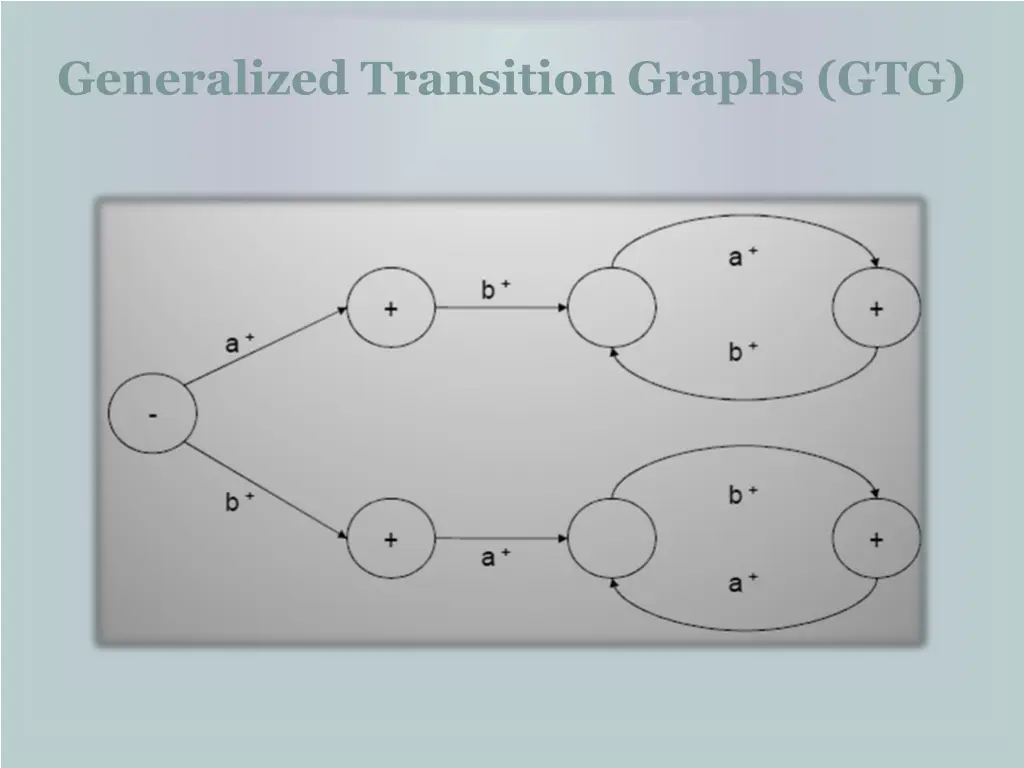
Generalized Transition Graphs (GTG) Example: Consider the language L of strings, defined over = {a, b}, beginning with and ending in same letters. The language may be expressed by the following regular expression (a+b) + a(a+b)*a + b(a+b)*b The language L may be accepted by the following GTG
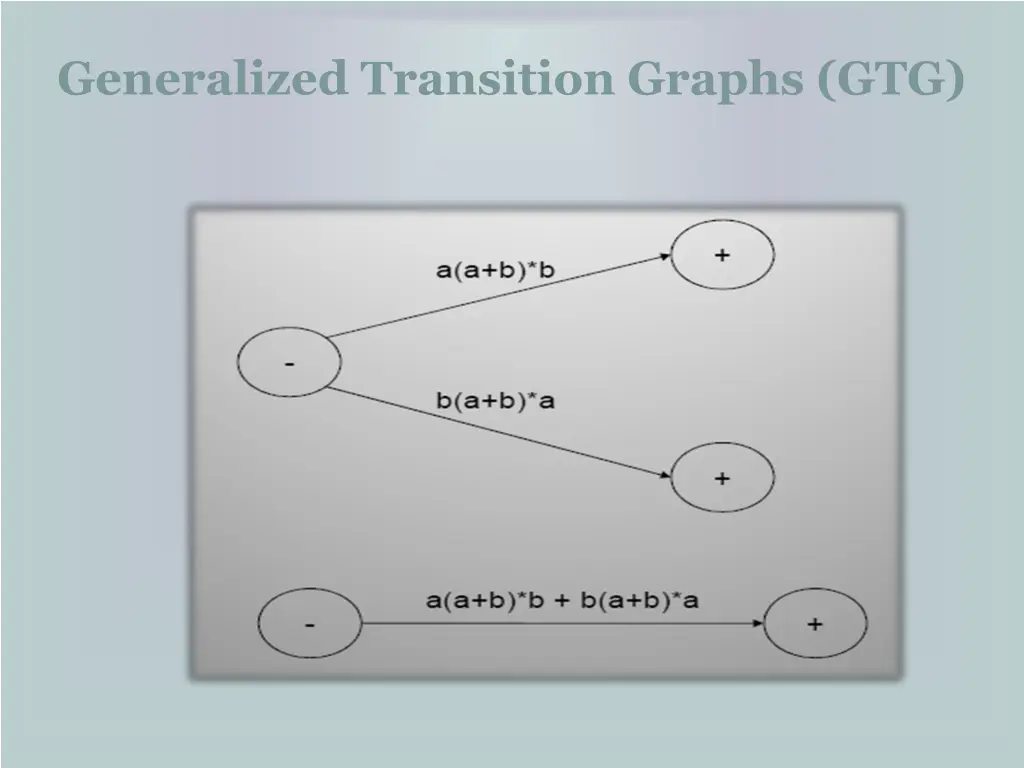
Generalized Transition Graphs (GTG) Example: Consider the language L of strings, defined over = {a, b}, beginning with and ending in different letters. The language may be expressed by the following regular expression a(a+b)*b + b(a+b)*a The language L may be accepted by the following GTG
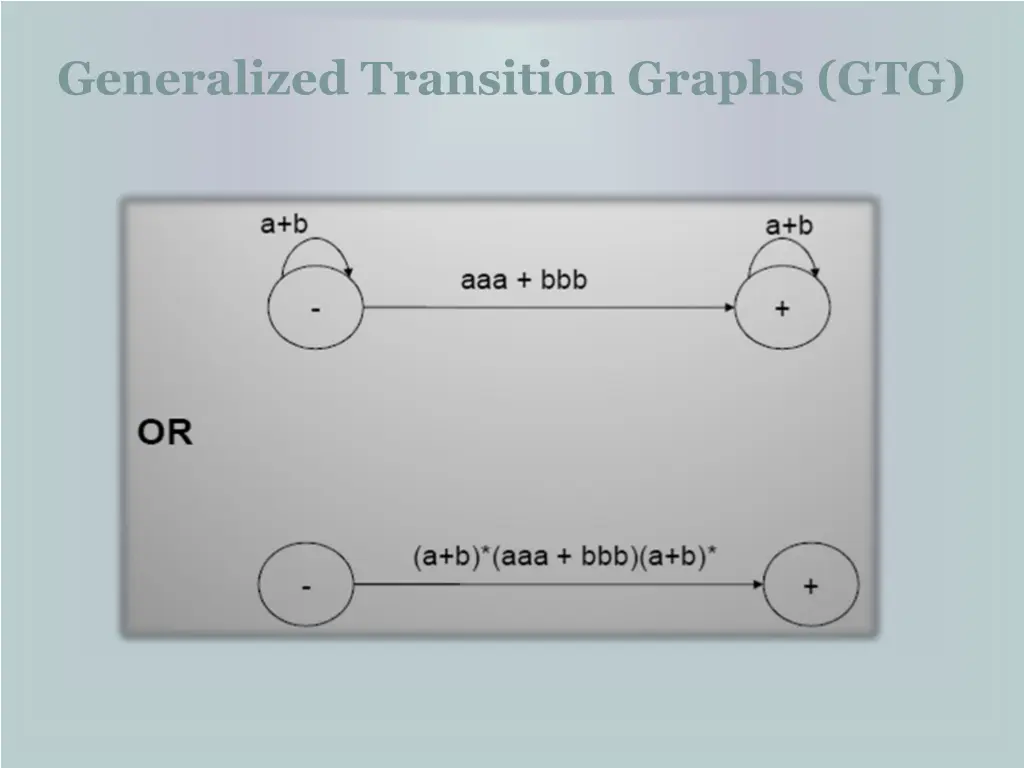
Generalized Transition Graphs (GTG) Example: Consider the language L of strings, defined over = {a, b}, having triple a s or triple b s. The language may be expressed by the following regular expression (a+b)*(aaa + bbb)(a+b)* The language L may be accepted by the following GTG