Learn about granular data in banking statistics, its pros and cons, and ECB projects related to data collection. Discover the role of microdata in ESCB banking statistics and innovative data input processes. Explore the significance of granular data for statistical analysis and reporting within the European Central Bank framework.
Please find below an Image/Link to download the presentation.
The content on the website is provided AS IS for your information and personal use only. It may not be sold, licensed, or shared on other websites without obtaining consent from the author. If you encounter any issues during the download, it is possible that the publisher has removed the file from their server.
You are allowed to download the files provided on this website for personal or commercial use, subject to the condition that they are used lawfully. All files are the property of their respective owners.
The content on the website is provided AS IS for your information and personal use only. It may not be sold, licensed, or shared on other websites without obtaining consent from the author.
E N D
Presentation Transcript
Microdata in ESCB banking statistics Ioannis Ganoulis Statistics Development & Coordination European Central Bank, DG-S Round table discussion exchange and use of microdata in foreign trade, migration and banking statistics World Statistics Day Budapest, 21 October 2015
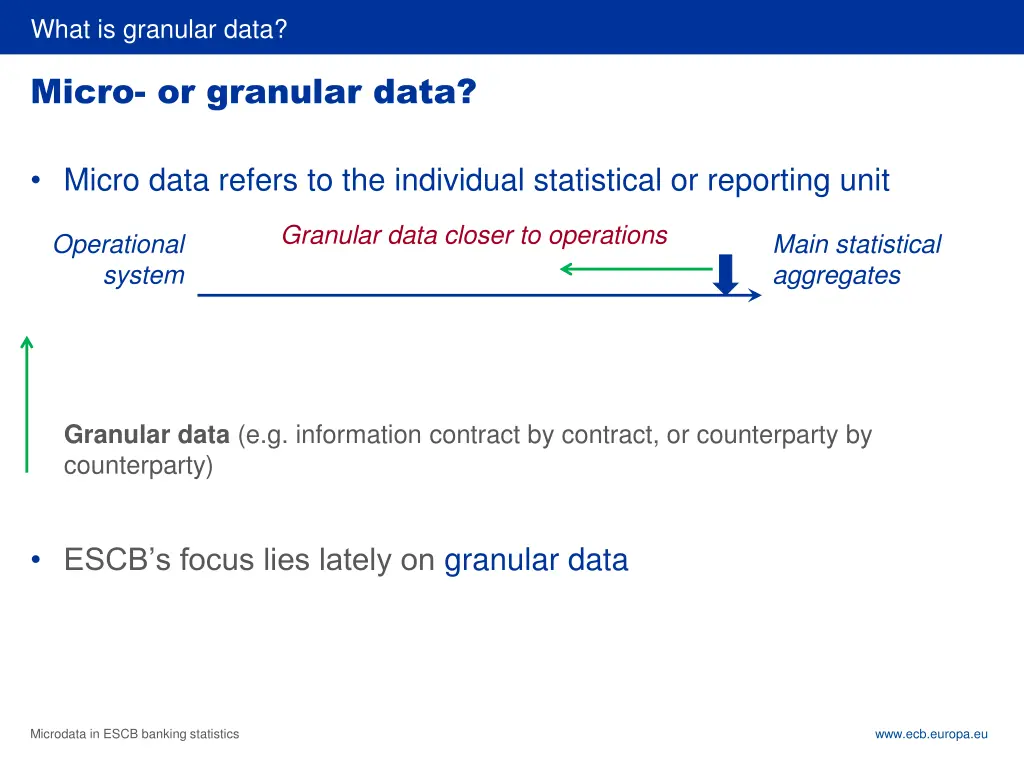
Rubric What is granular data? Micro- or granular data? Micro data refers to the individual statistical or reporting unit Granular data closer to operations Operational system Main statistical aggregates Granular data (e.g. information contract by contract, or counterparty by counterparty) ESCB s focus lies lately on granular data Microdata in ESCB banking statistics www.ecb.europa.eu
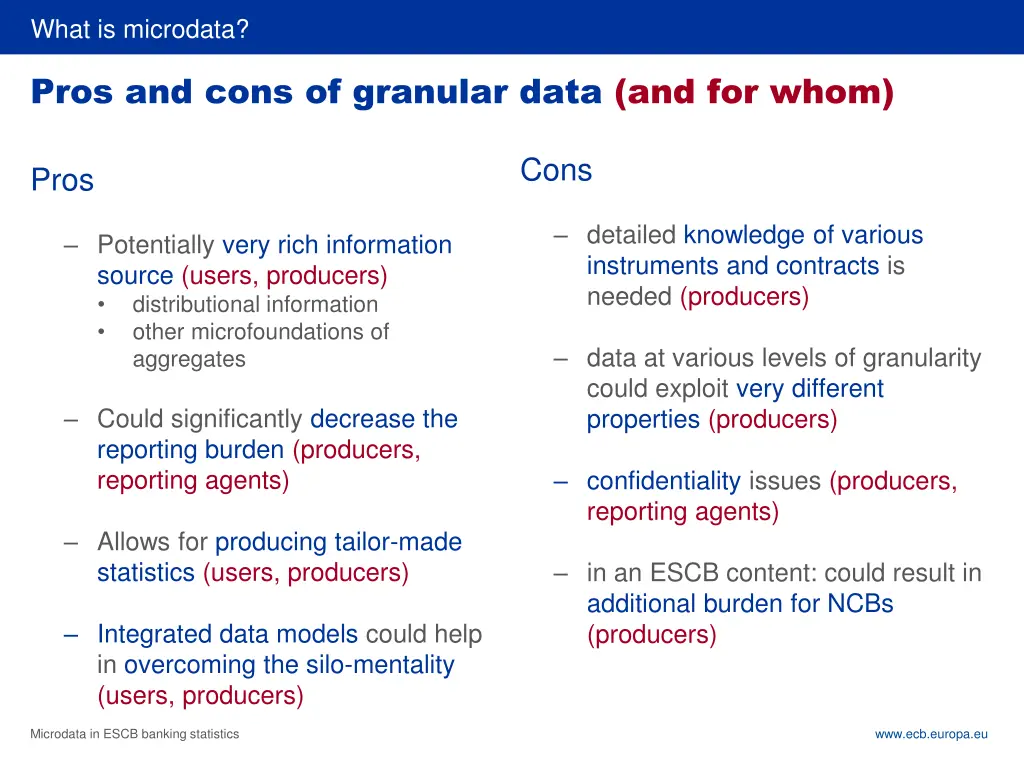
Rubric What is microdata? Pros and cons of granular data (and for whom) Cons Pros detailed knowledge of various instruments and contracts is needed (producers) Potentially very rich information source (users, producers) distributional information other microfoundations of aggregates data at various levels of granularity could exploit very different properties (producers) Could significantly decrease the reporting burden (producers, reporting agents) confidentiality issues (producers, reporting agents) Allows for producing tailor-made statistics (users, producers) in an ESCB content: could result in additional burden for NCBs (producers) Integrated data models could help in overcoming the silo-mentality (users, producers) Microdata in ESCB banking statistics www.ecb.europa.eu
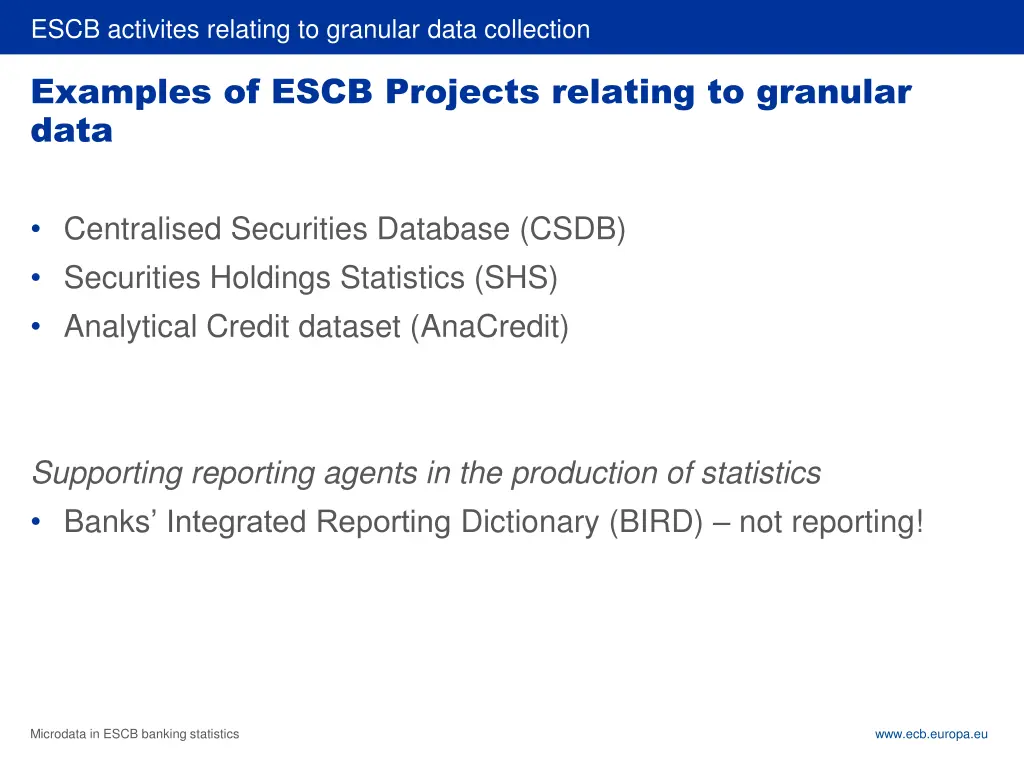
Rubric ESCB activites relating to granular data collection Examples of ESCB Projects relating to granular data Centralised Securities Database (CSDB) Securities Holdings Statistics (SHS) Analytical Credit dataset (AnaCredit) Supporting reporting agents in the production of statistics Banks Integrated Reporting Dictionary (BIRD) not reporting! Microdata in ESCB banking statistics www.ecb.europa.eu
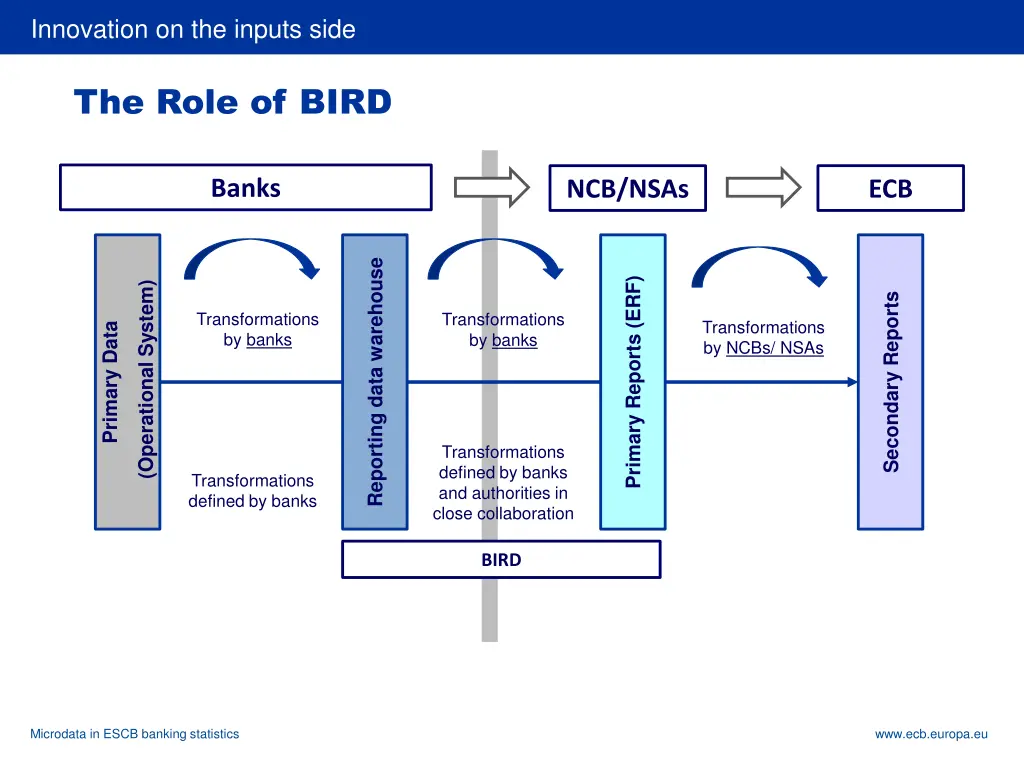
Rubric Innovation on the inputs side The Role of BIRD Banks NCB/NSAs ECB Reporting data warehouse Primary Reports (ERF) (Operational System) Secondary Reports Transformations by banks Transformations by banks Transformations by NCBs/ NSAs Primary Data Transformations defined by banks and authorities in close collaboration Transformations defined by banks BIRD Microdata in ESCB banking statistics www.ecb.europa.eu
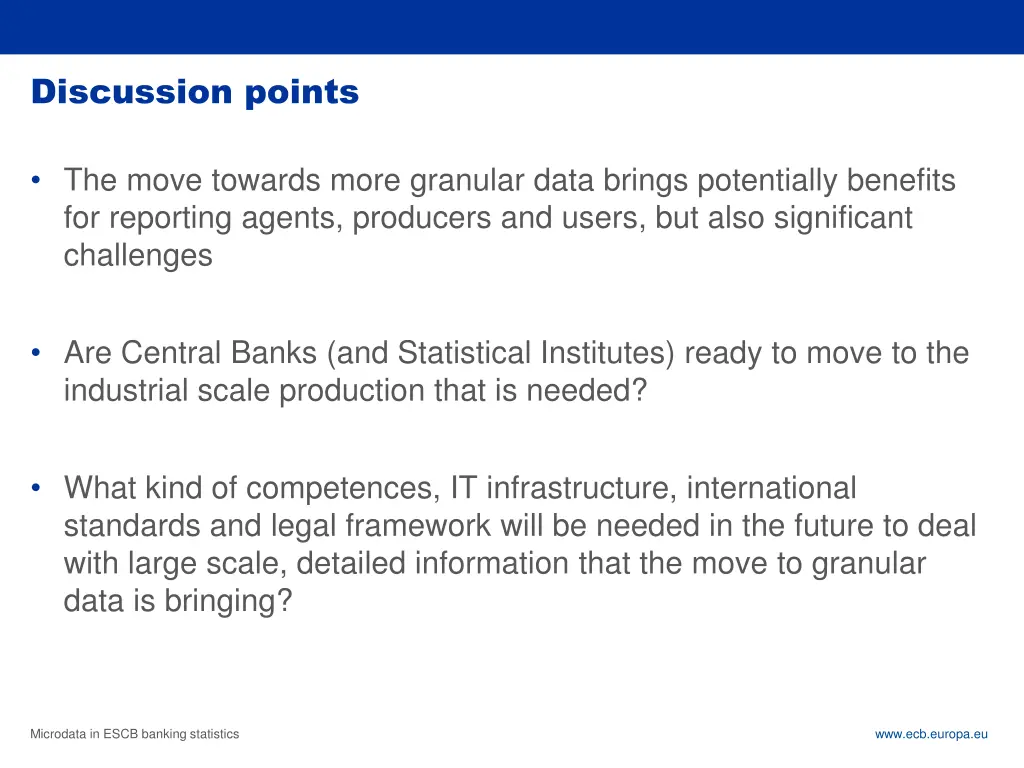
Rubric Discussion points The move towards more granular data brings potentially benefits for reporting agents, producers and users, but also significant challenges Are Central Banks (and Statistical Institutes) ready to move to the industrial scale production that is needed? What kind of competences, IT infrastructure, international standards and legal framework will be needed in the future to deal with large scale, detailed information that the move to granular data is bringing? Microdata in ESCB banking statistics www.ecb.europa.eu
Rubric Background Microdata in ESCB banking statistics www.ecb.europa.eu
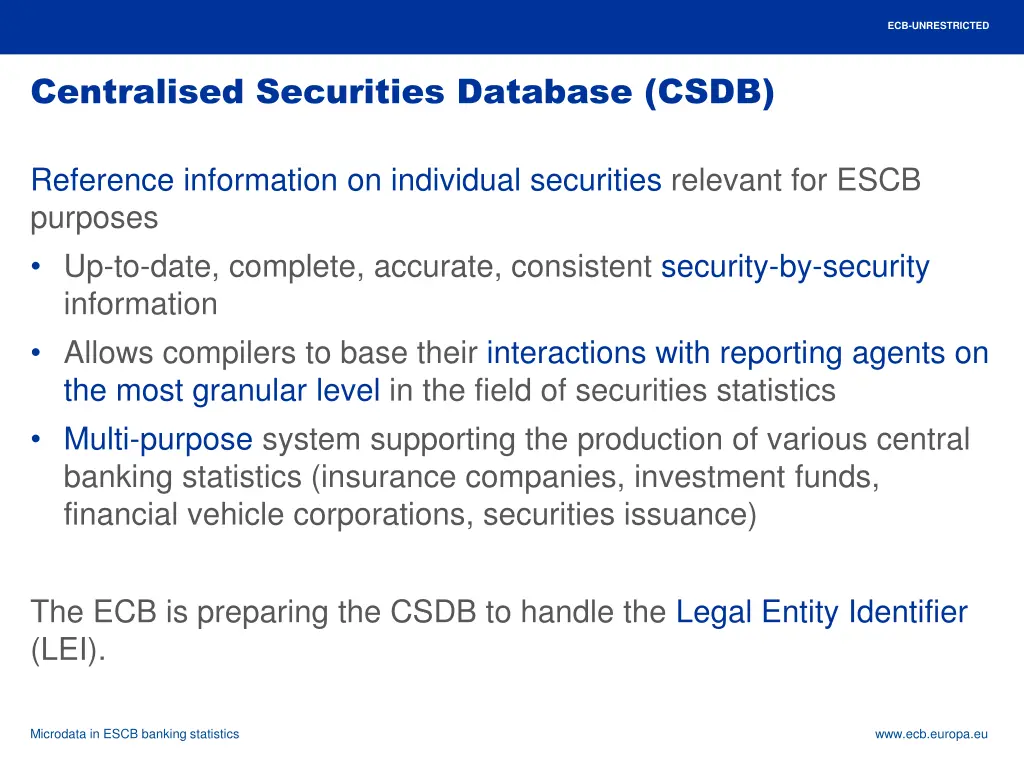
Rubric ECB-UNRESTRICTED Centralised Securities Database (CSDB) Reference information on individual securities relevant for ESCB purposes Up-to-date, complete, accurate, consistent security-by-security information Allows compilers to base their interactions with reporting agents on the most granular level in the field of securities statistics Multi-purpose system supporting the production of various central banking statistics (insurance companies, investment funds, financial vehicle corporations, securities issuance) The ECB is preparing the CSDB to handle the Legal Entity Identifier (LEI). Microdata in ESCB banking statistics www.ecb.europa.eu
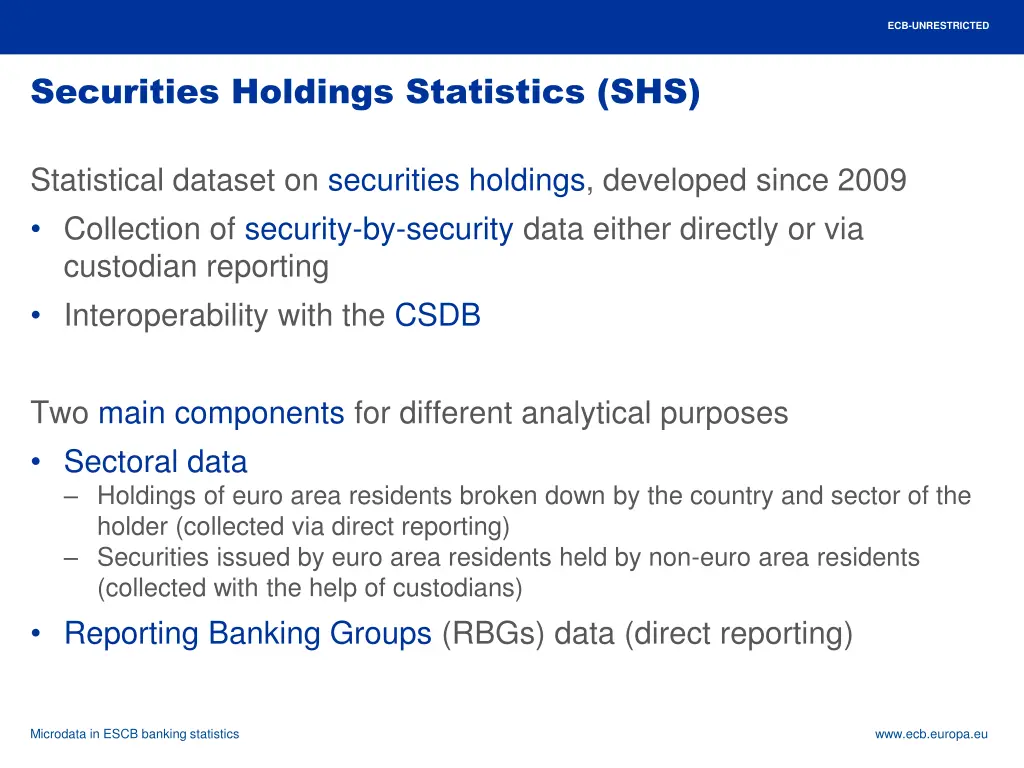
Rubric ECB-UNRESTRICTED Securities Holdings Statistics (SHS) Statistical dataset on securities holdings, developed since 2009 Collection of security-by-security data either directly or via custodian reporting Interoperability with the CSDB Two main components for different analytical purposes Sectoral data Holdings of euro area residents broken down by the country and sector of the holder (collected via direct reporting) Securities issued by euro area residents held by non-euro area residents (collected with the help of custodians) Reporting Banking Groups (RBGs) data (direct reporting) Microdata in ESCB banking statistics www.ecb.europa.eu
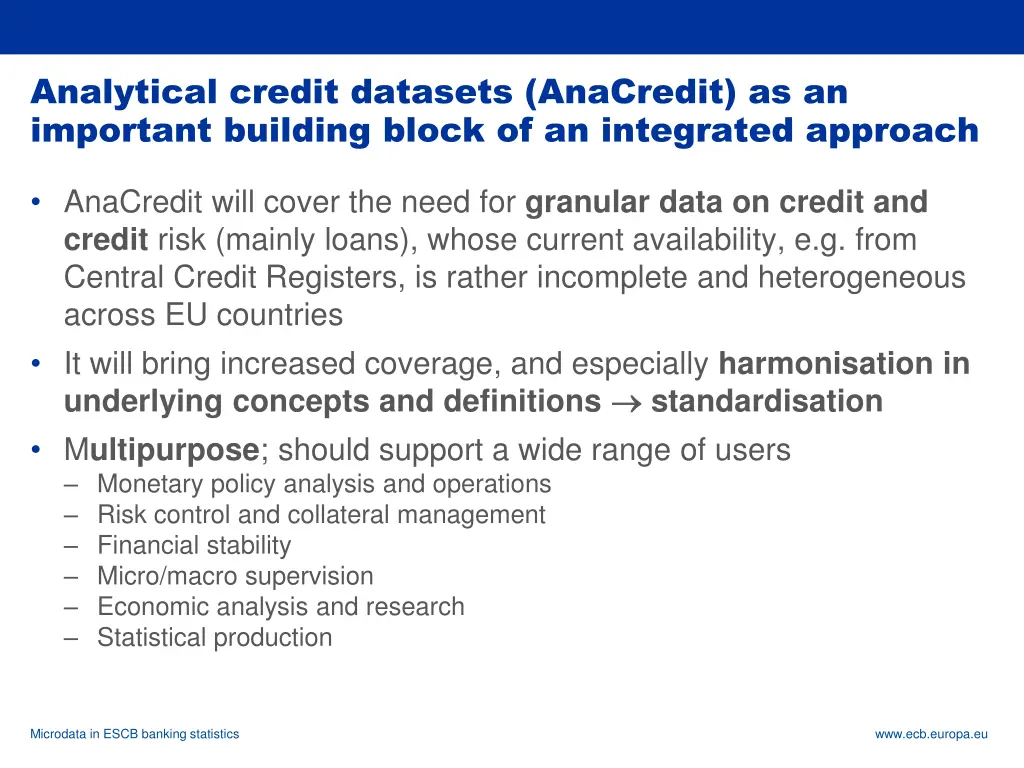
Rubric Analytical credit datasets (AnaCredit) as an important building block of an integrated approach AnaCredit will cover the need for granular data on credit and credit risk (mainly loans), whose current availability, e.g. from Central Credit Registers, is rather incomplete and heterogeneous across EU countries It will bring increased coverage, and especially harmonisation in underlying concepts and definitions Multipurpose; should support a wide range of users Monetary policy analysis and operations Risk control and collateral management Financial stability Micro/macro supervision Economic analysis and research Statistical production standardisation Microdata in ESCB banking statistics www.ecb.europa.eu
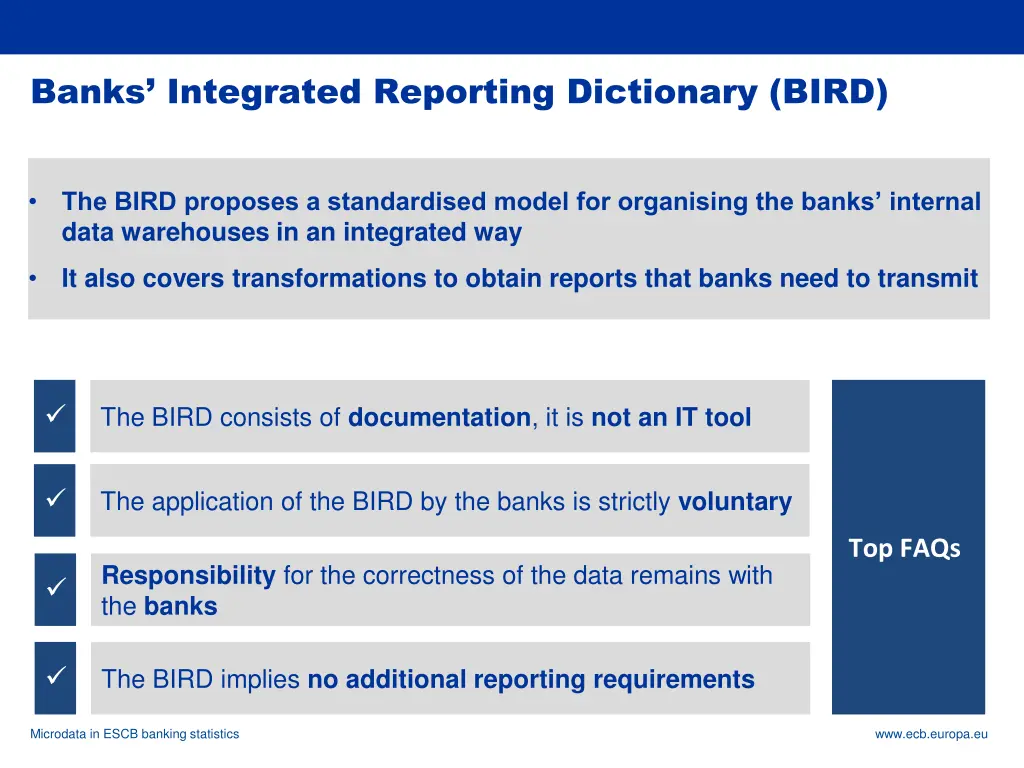
Rubric Banks Integrated Reporting Dictionary (BIRD) The BIRD proposes a standardised model for organising the banks internal data warehouses in an integrated way It also covers transformations to obtain reports that banks need to transmit The BIRD consists of documentation, it is not an IT tool The application of the BIRD by the banks is strictly voluntary Top FAQs Responsibility for the correctness of the data remains with the banks The BIRD implies no additional reporting requirements Microdata in ESCB banking statistics www.ecb.europa.eu