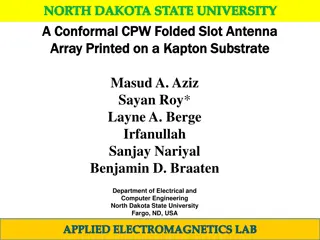
Hardware Implementation of Antenna Beamforming Using Genetic Algorithm
Explore the convergence rate and scalability of genetic algorithms in hardware for antenna beamforming. Discover how hardware processors can enhance optimization while retaining flexibility. Dive into detailed genetic algorithm block diagrams and learn about real-time application possibilities.

Download Presentation

Please find below an Image/Link to download the presentation.
The content on the website is provided AS IS for your information and personal use only. It may not be sold, licensed, or shared on other websites without obtaining consent from the author.If you encounter any issues during the download, it is possible that the publisher has removed the file from their server.
You are allowed to download the files provided on this website for personal or commercial use, subject to the condition that they are used lawfully. All files are the property of their respective owners.
The content on the website is provided AS IS for your information and personal use only. It may not be sold, licensed, or shared on other websites without obtaining consent from the author.
E N D
Presentation Transcript
Hardware Implementation of Antenna Beamforming using Genetic Algorithm Kevin Hsiue Bryan Teague
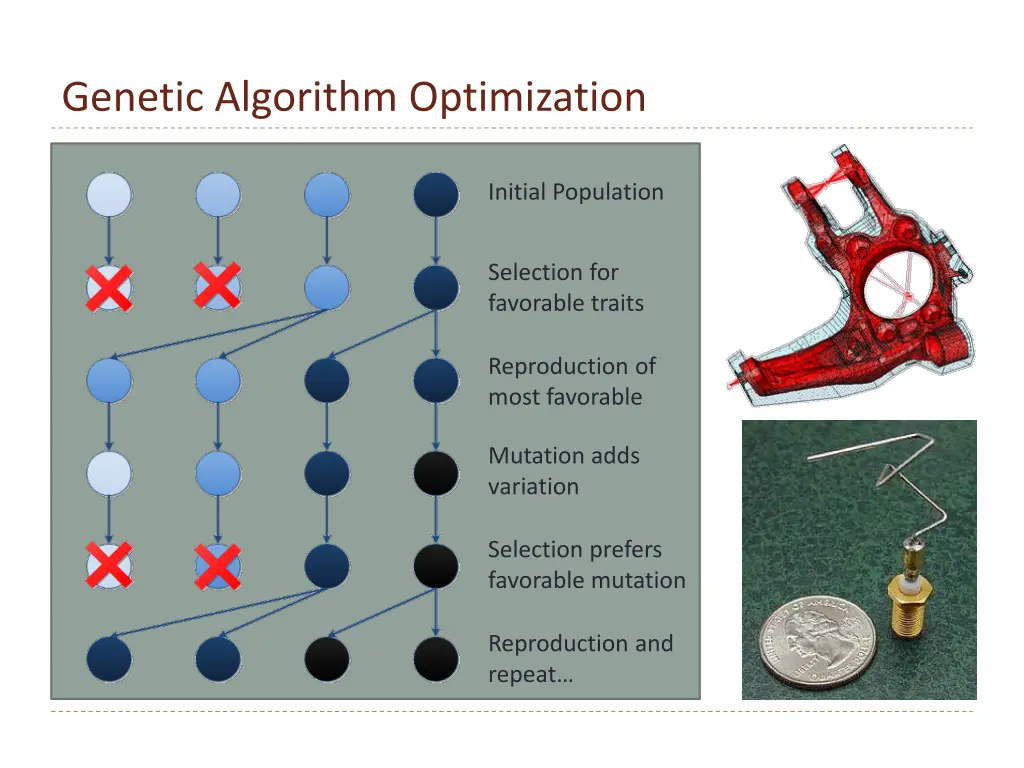
Genetic Algorithm Optimization Initial Population Selection for favorable traits Reproduction of most favorable Mutation adds variation Selection prefers favorable mutation Reproduction and repeat
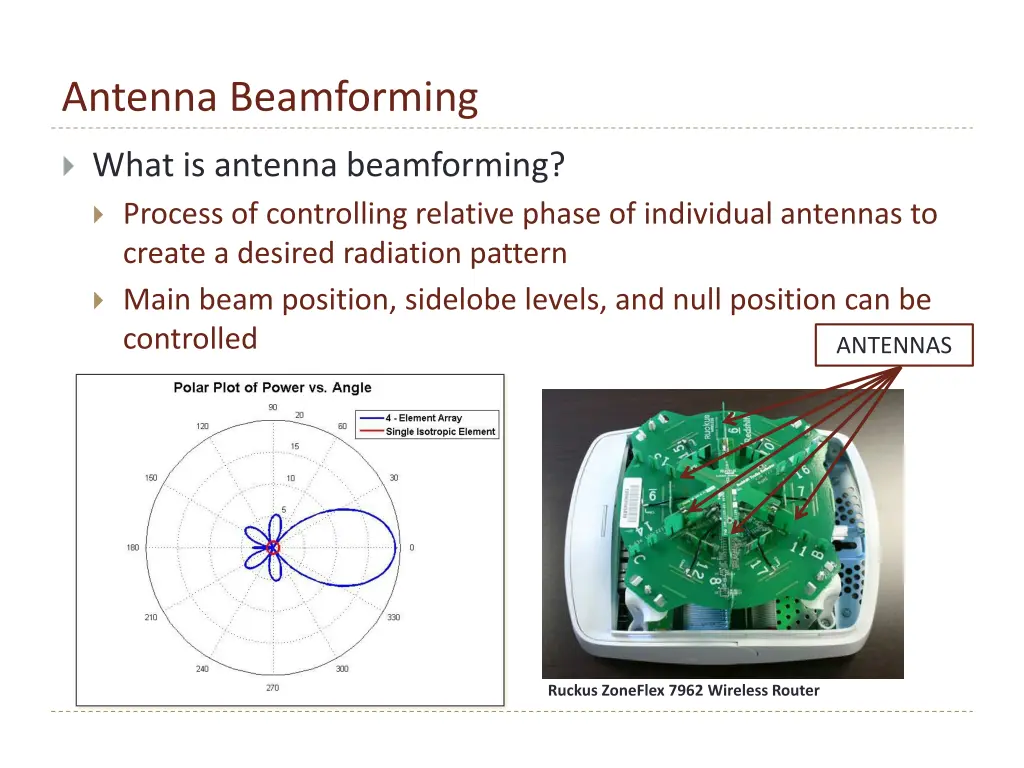
Antenna Beamforming What is antenna beamforming? Process of controlling relative phase of individual antennas to create a desired radiation pattern Main beam position, sidelobe levels, and null position can be controlled ANTENNAS Ruckus ZoneFlex 7962 Wireless Router
Project Objectives Goal: Implement genetic algorithm processor in hardware and demonstrate using antenna beamforming problem Genetic algorithms and beamforming equations are each inherently parallelizable Complex beamforming problems currently solved using genetic algorithms (GAs) in software GAs have previously had mixed success in hardware
Project Objectives Can hardware improve convergence rate of optimization? Can flexibility be retained in hardware? Can a hardware GA be scaled up to complicated beamforming problems? Can hardware be used to solve GAs in real-time ?
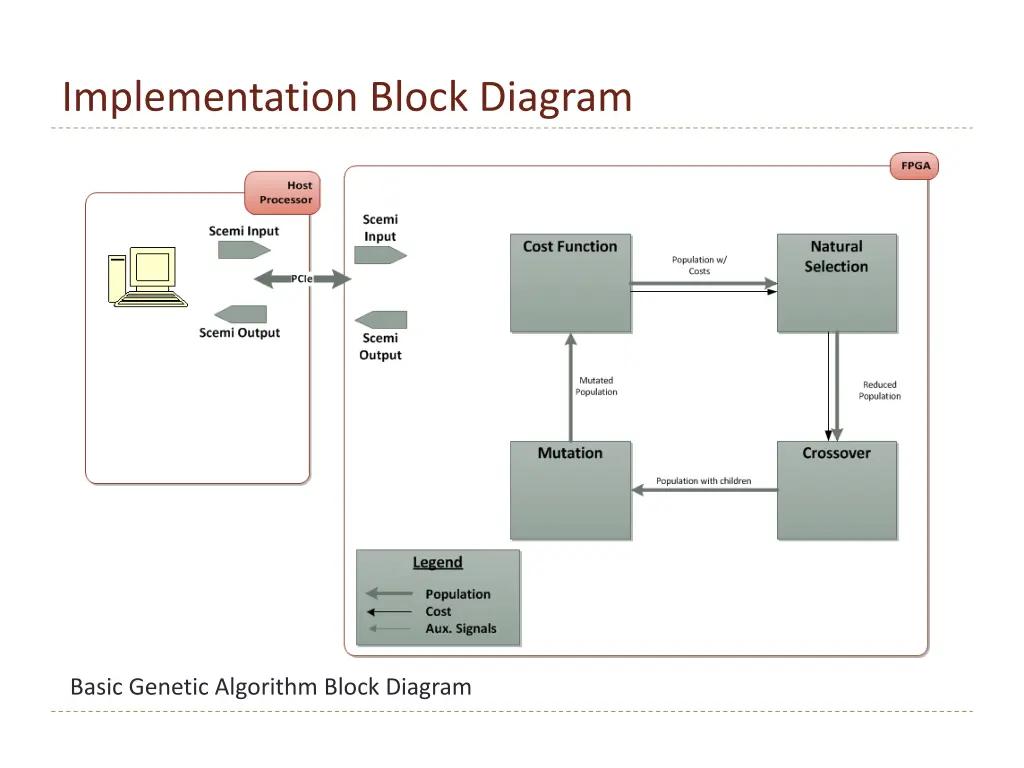
Implementation Block Diagram Basic Genetic Algorithm Block Diagram
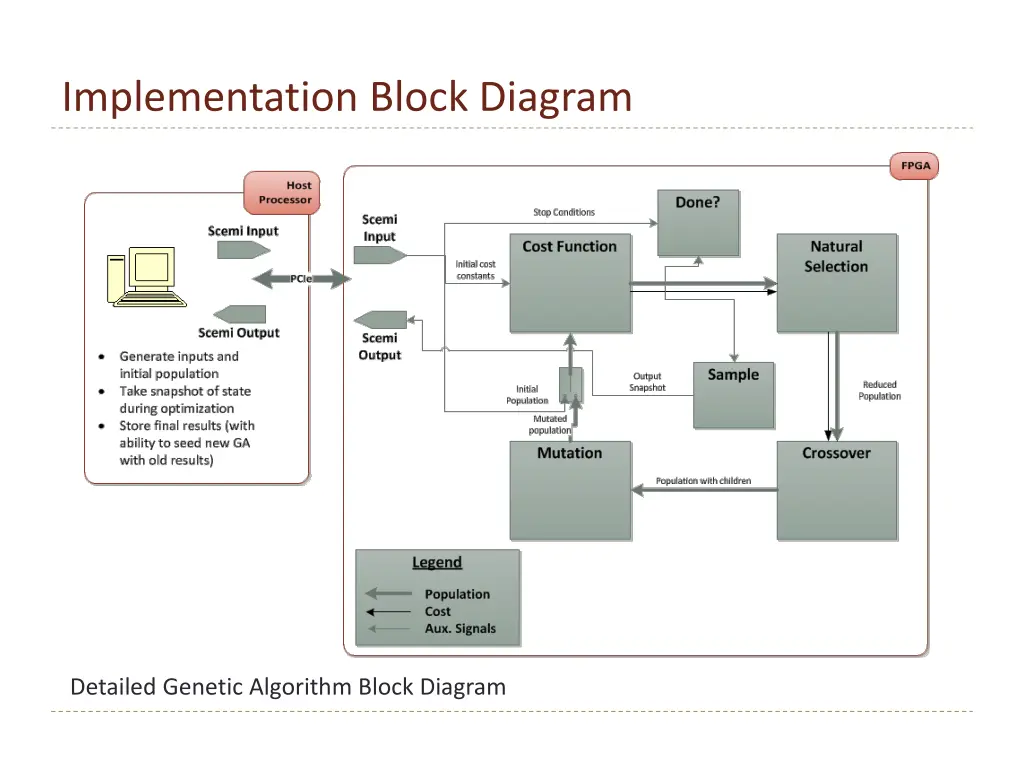
Implementation Block Diagram Detailed Genetic Algorithm Block Diagram
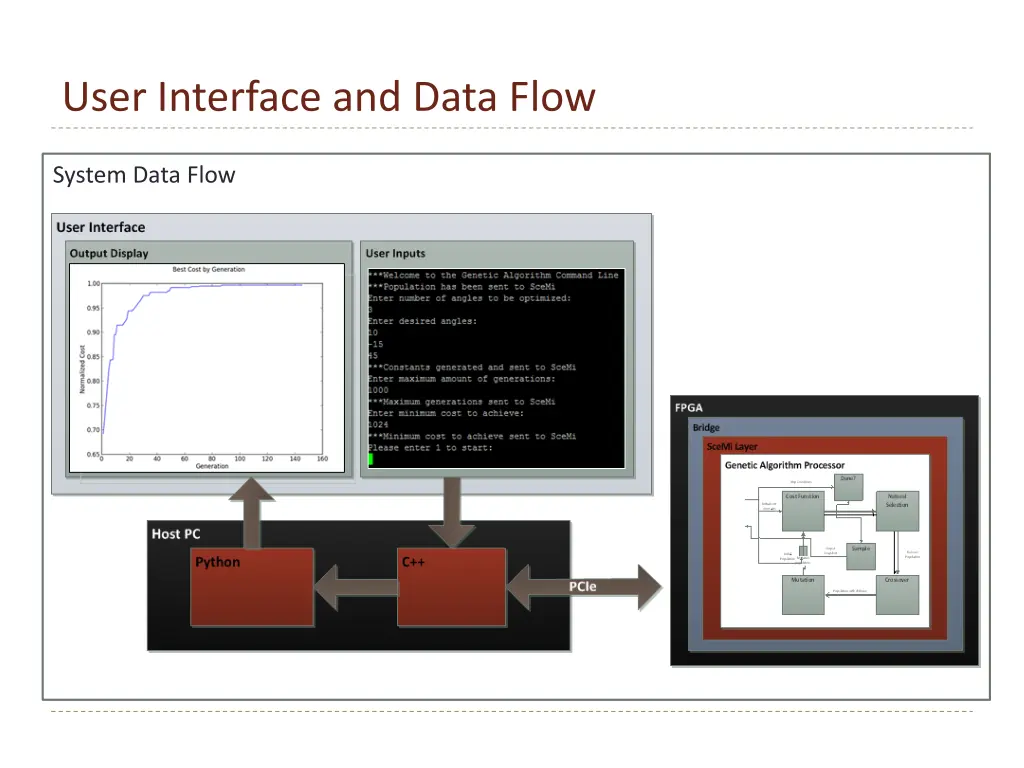
User Interface and Data Flow System Data Flow
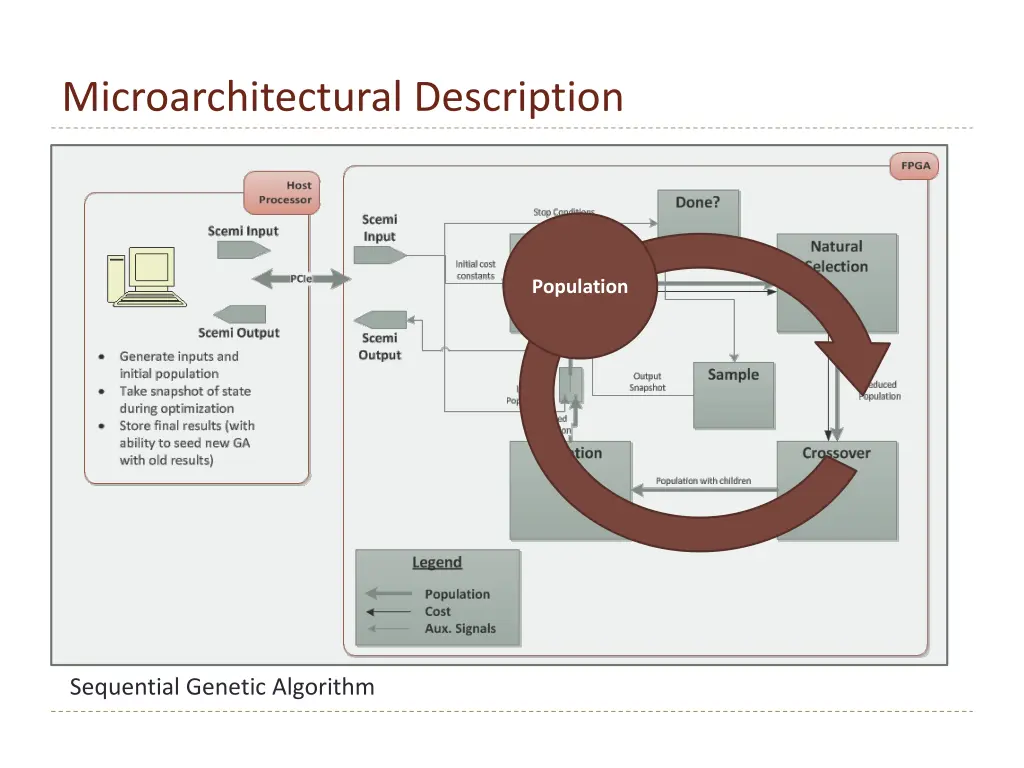
Microarchitectural Description Population Sequential Genetic Algorithm
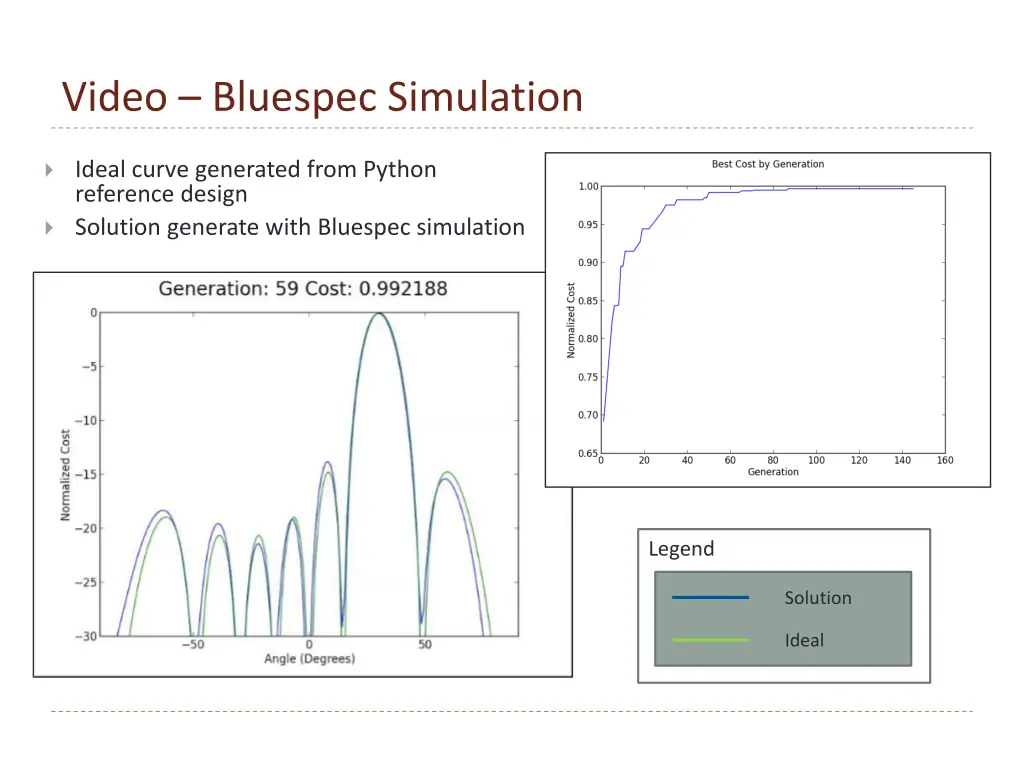
Video Bluespec Simulation Ideal curve generated from Python reference design Solution generate with Bluespec simulation Legend Solution Ideal
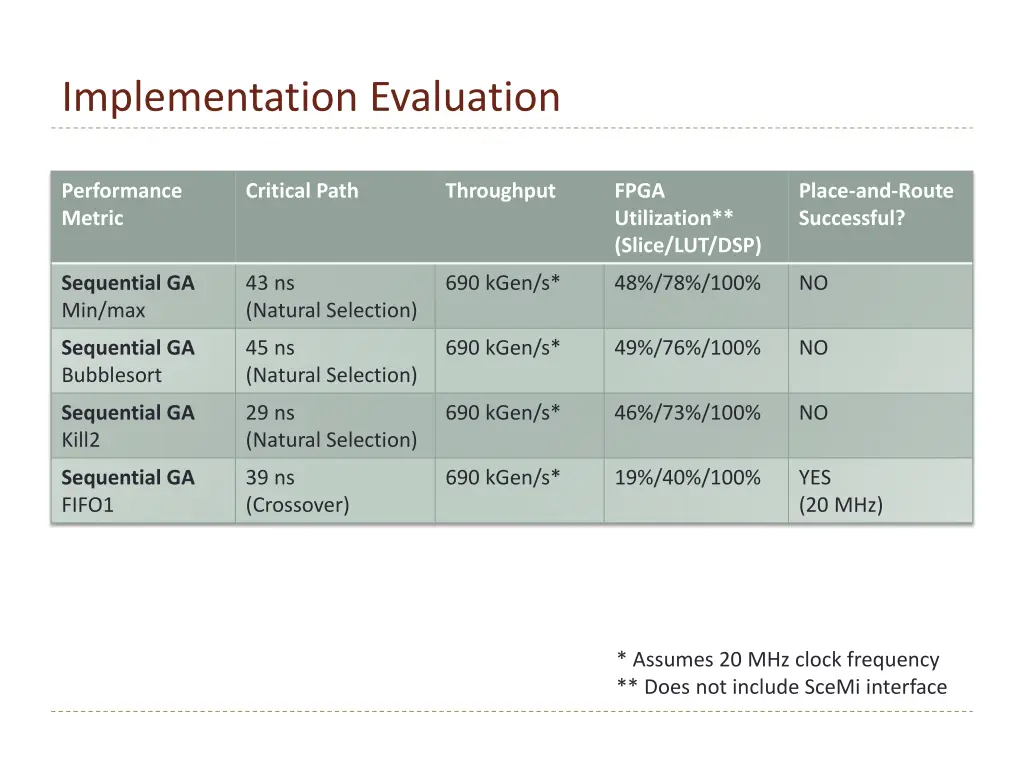
Implementation Evaluation Performance Metric Critical Path Throughput FPGA Utilization** (Slice/LUT/DSP) Place-and-Route Successful? Sequential GA Min/max 43 ns (Natural Selection) 690 kGen/s* 48%/78%/100% NO Sequential GA Bubblesort 45 ns (Natural Selection) 690 kGen/s* 49%/76%/100% NO Sequential GA Kill2 29 ns (Natural Selection) 690 kGen/s* 46%/73%/100% NO Sequential GA FIFO1 39 ns (Crossover) 690 kGen/s* 19%/40%/100% YES (20 MHz) * Assumes 20 MHz clock frequency ** Does not include SceMi interface
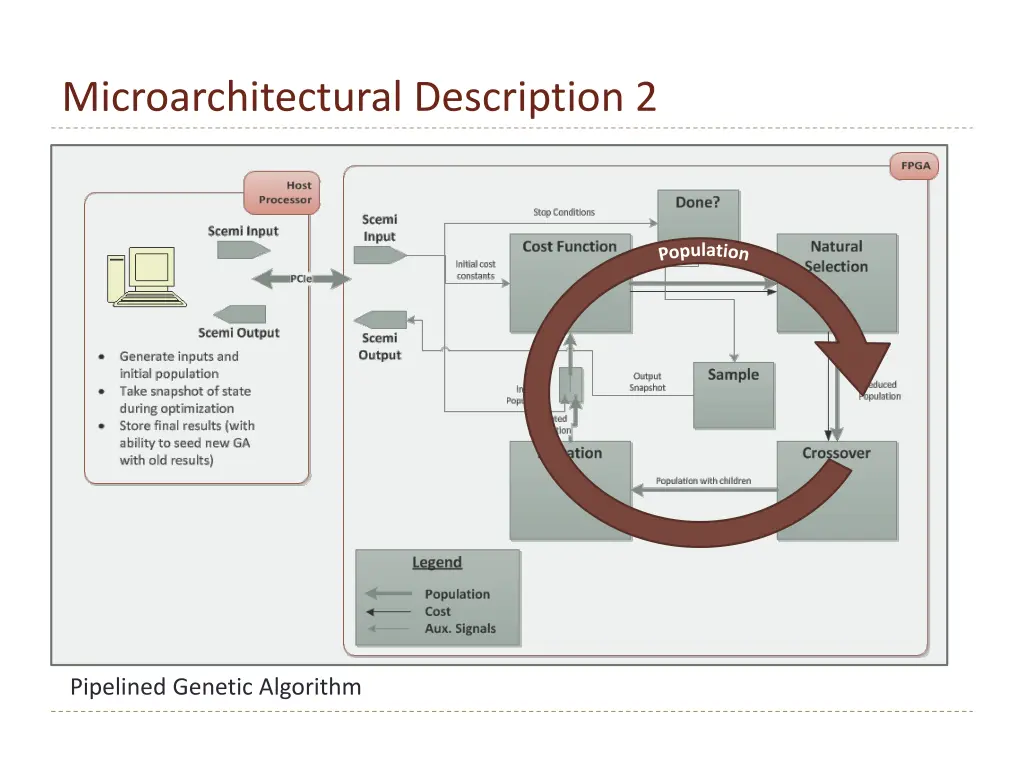
Microarchitectural Description 2 Population Pipelined Genetic Algorithm
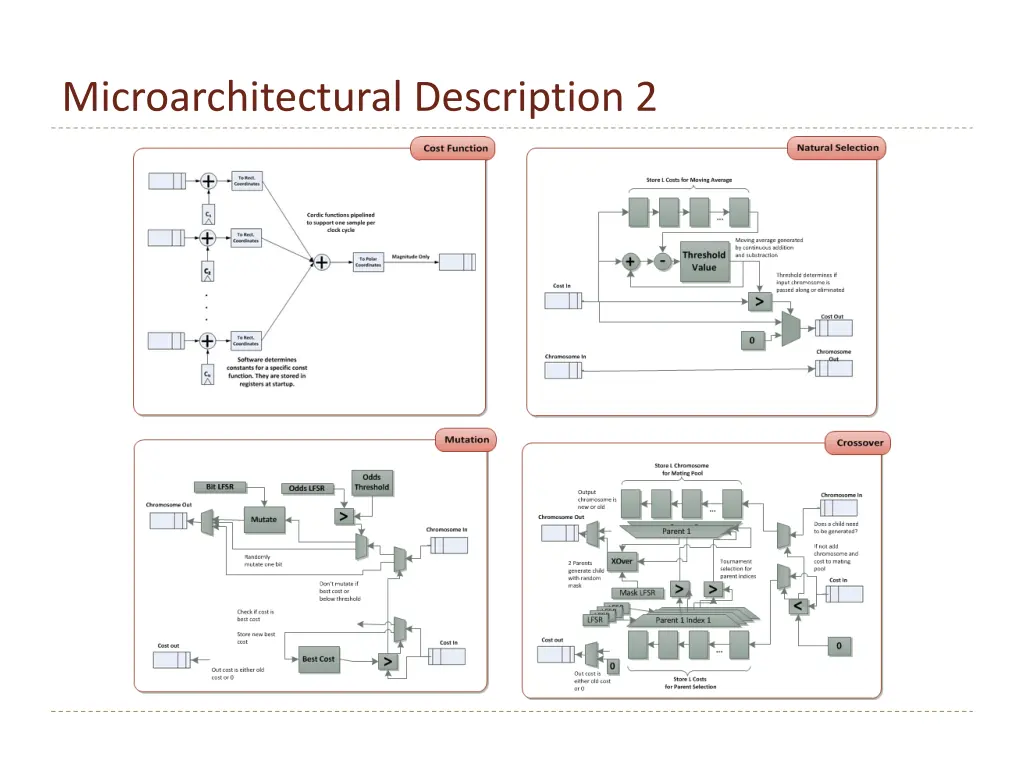
Microarchitectural Description 2 Cordic functions pipelined to accept one sample per clock cycle
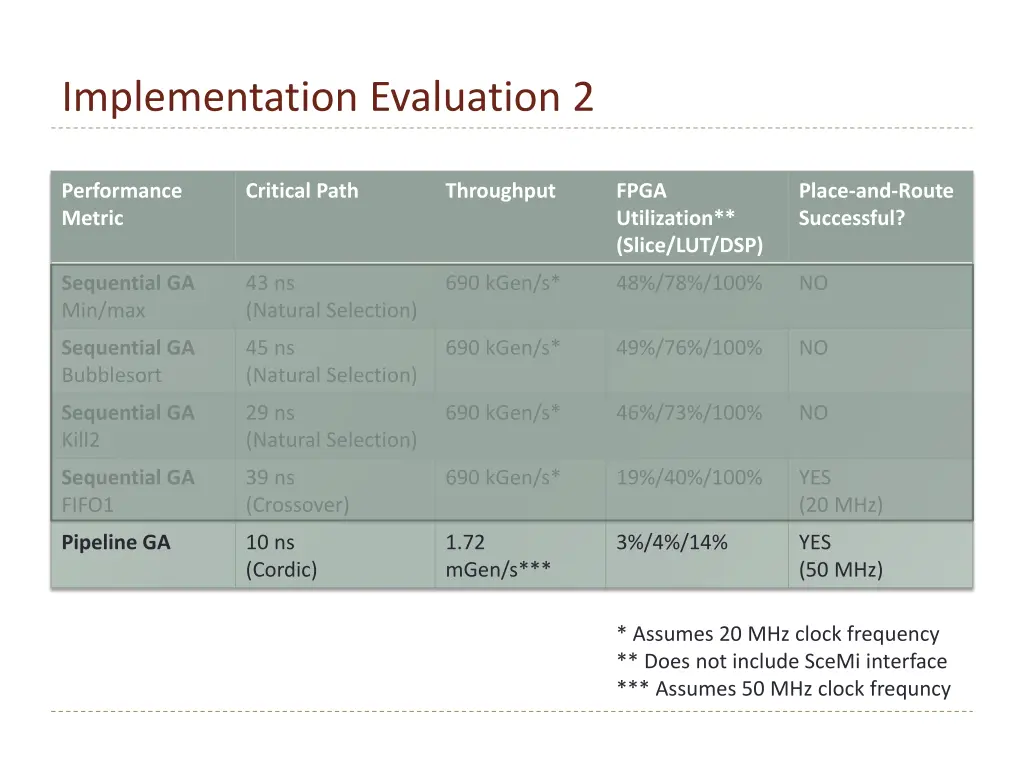
Implementation Evaluation 2 Performance Metric Critical Path Throughput FPGA Utilization** (Slice/LUT/DSP) Place-and-Route Successful? Sequential GA Min/max 43 ns (Natural Selection) 690 kGen/s* 48%/78%/100% NO Sequential GA Bubblesort 45 ns (Natural Selection) 690 kGen/s* 49%/76%/100% NO Sequential GA Kill2 29 ns (Natural Selection) 690 kGen/s* 46%/73%/100% NO Sequential GA FIFO1 39 ns (Crossover) 690 kGen/s* 19%/40%/100% YES (20 MHz) Pipeline GA 10 ns (Cordic) 1.72 mGen/s*** 3%/4%/14% YES (50 MHz) * Assumes 20 MHz clock frequency ** Does not include SceMi interface *** Assumes 50 MHz clock frequncy
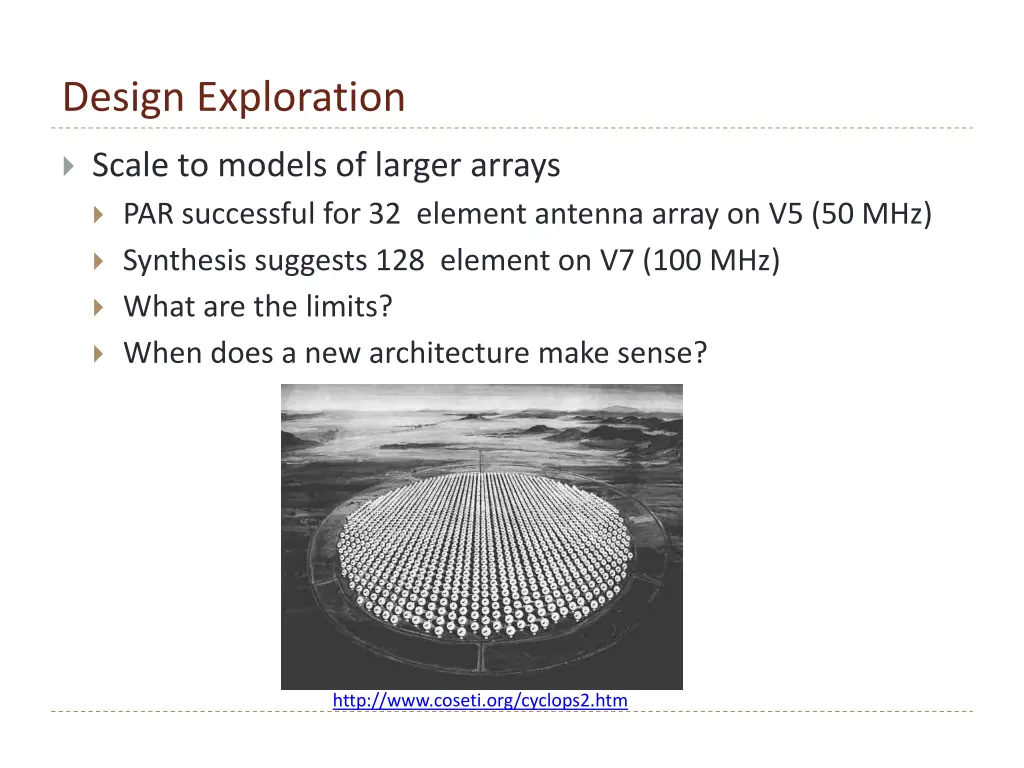
Design Exploration Scale to models of larger arrays PAR successful for 32 element antenna array on V5 (50 MHz) Synthesis suggests 128 element on V7 (100 MHz) What are the limits? When does a new architecture make sense? http://www.coseti.org/cyclops2.htm
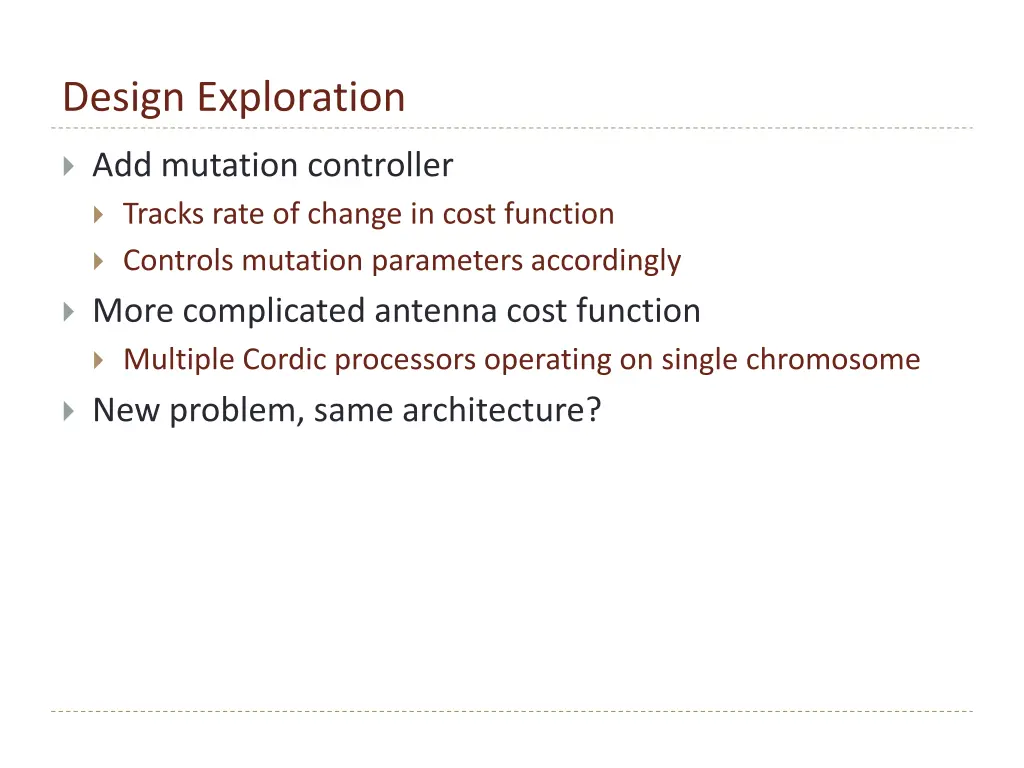
Design Exploration Add mutation controller Tracks rate of change in cost function Controls mutation parameters accordingly More complicated antenna cost function Multiple Cordic processors operating on single chromosome New problem, same architecture?
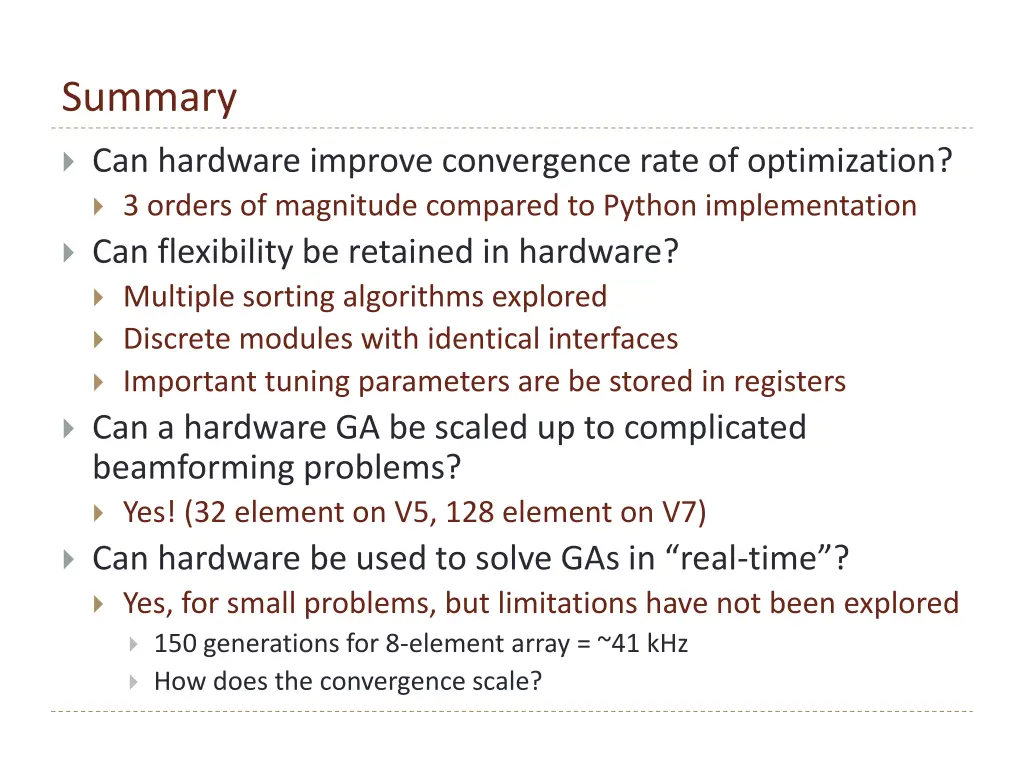
Summary Can hardware improve convergence rate of optimization? 3 orders of magnitude compared to Python implementation Can flexibility be retained in hardware? Multiple sorting algorithms explored Discrete modules with identical interfaces Important tuning parameters are be stored in registers Can a hardware GA be scaled up to complicated beamforming problems? Yes! (32 element on V5, 128 element on V7) Can hardware be used to solve GAs in real-time ? Yes, for small problems, but limitations have not been explored 150 generations for 8-element array = ~41 kHz How does the convergence scale?