IEEE 802.11-15/0330r1 OFDMA Numerology and Structure
This document from March 2015 provides information on the OFDMA numerology and structure as per IEEE 802.11-15/0330r1. It includes details about the authors, their affiliations, addresses, and contact information. The document covers contributions from various individuals from companies like Intel, LGE, Broadcom, Marvell, and Mediatek, among others.

Download Presentation

Please find below an Image/Link to download the presentation.
The content on the website is provided AS IS for your information and personal use only. It may not be sold, licensed, or shared on other websites without obtaining consent from the author.If you encounter any issues during the download, it is possible that the publisher has removed the file from their server.
You are allowed to download the files provided on this website for personal or commercial use, subject to the condition that they are used lawfully. All files are the property of their respective owners.
The content on the website is provided AS IS for your information and personal use only. It may not be sold, licensed, or shared on other websites without obtaining consent from the author.
E N D
Presentation Transcript
March 2015 doc.: IEEE 802.11-15/0330r1 OFDMA Numerology and Structure Date: 2015-03-09 Authors: Name Affiliation Address 2200 Mission College Blvd, Santa Clara, CA 95054 2111 NE 25th Ave, Hillsboro OR 97124, USA Phone email Shahrnaz Azizi shahrnaz.azizi@intel.com Eldad Perahia eldad.perahia@intel.com Robert Stacey +1-503-724-893 robert.stacey@intel.com Po-Kai Huang Intel po-kai.huang@intel.com Qinghua Li quinghua.li@intel.com Xiaogang Chen xiaogang.c.chen@intel.com Chittabrata Ghosh chittabrata.ghosh@intel.com Rongzhen Yang rongzhen.yang@intel.com 19, Yangjae-daero 11gil, Seocho-gu, Seoul 137-130, Korea Wookbong Lee wookbong.lee@lge.com Kiseon Ryu kiseon.ryu@lge.com Jinyoung Chun jiny.chun@lge.com Jinsoo Choi js.choi@lge.com LG Jeongki Kim jeongki.kim@lge.com Electronics Giwon Park giwon.park@lge.com Dongguk Lim dongguk.lim@lge.com Suhwook Kim suhwook.kim@lge.com Eunsung Park esung.park@lge.com HanGyu Cho hg.cho@lge.com Submission Slide 1 S.Azizi, Intel, J. Choi, LGE
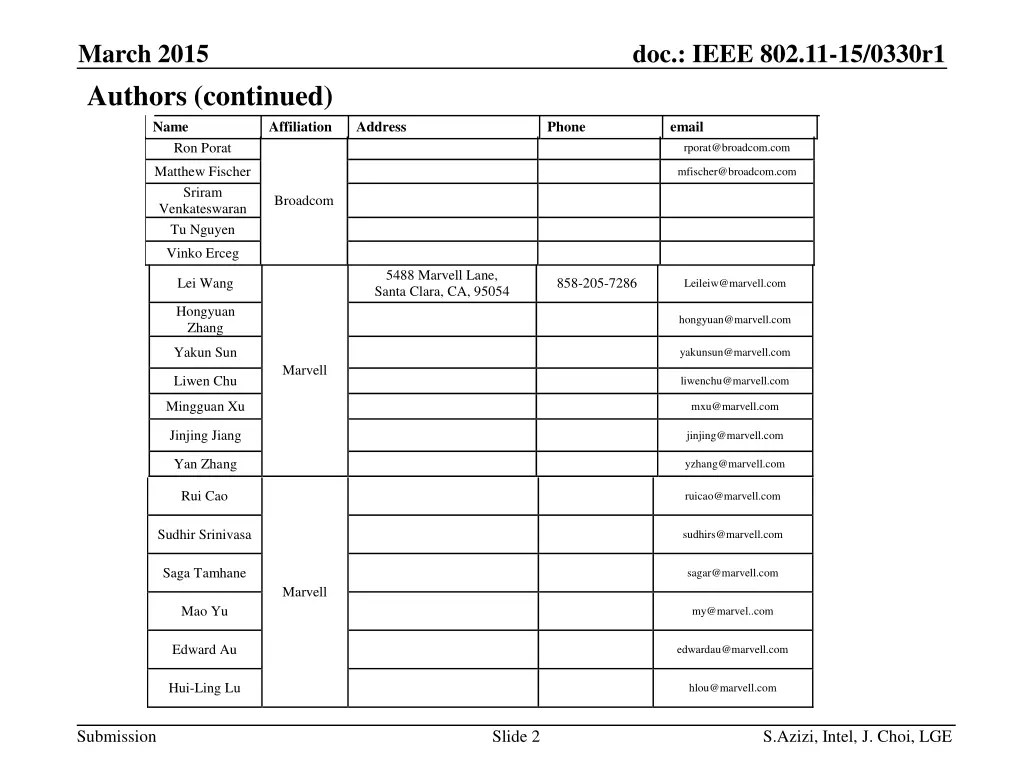
March 2015 doc.: IEEE 802.11-15/0330r1 Authors (continued) Name Ron Porat Matthew Fischer Sriram Venkateswaran Tu Nguyen Affiliation Address Phone email rporat@broadcom.com mfischer@broadcom.com Broadcom Vinko Erceg 5488 Marvell Lane, Santa Clara, CA, 95054 Lei Wang 858-205-7286 Leileiw@marvell.com Hongyuan Zhang hongyuan@marvell.com Yakun Sun yakunsun@marvell.com Marvell Liwen Chu liwenchu@marvell.com Mingguan Xu mxu@marvell.com Jinjing Jiang jinjing@marvell.com Yan Zhang yzhang@marvell.com Rui Cao ruicao@marvell.com Sudhir Srinivasa sudhirs@marvell.com Saga Tamhane sagar@marvell.com Marvell Mao Yu my@marvel..com Edward Au edwardau@marvell.com Hui-Ling Lu hlou@marvell.com Submission Slide 2 S.Azizi, Intel, J. Choi, LGE
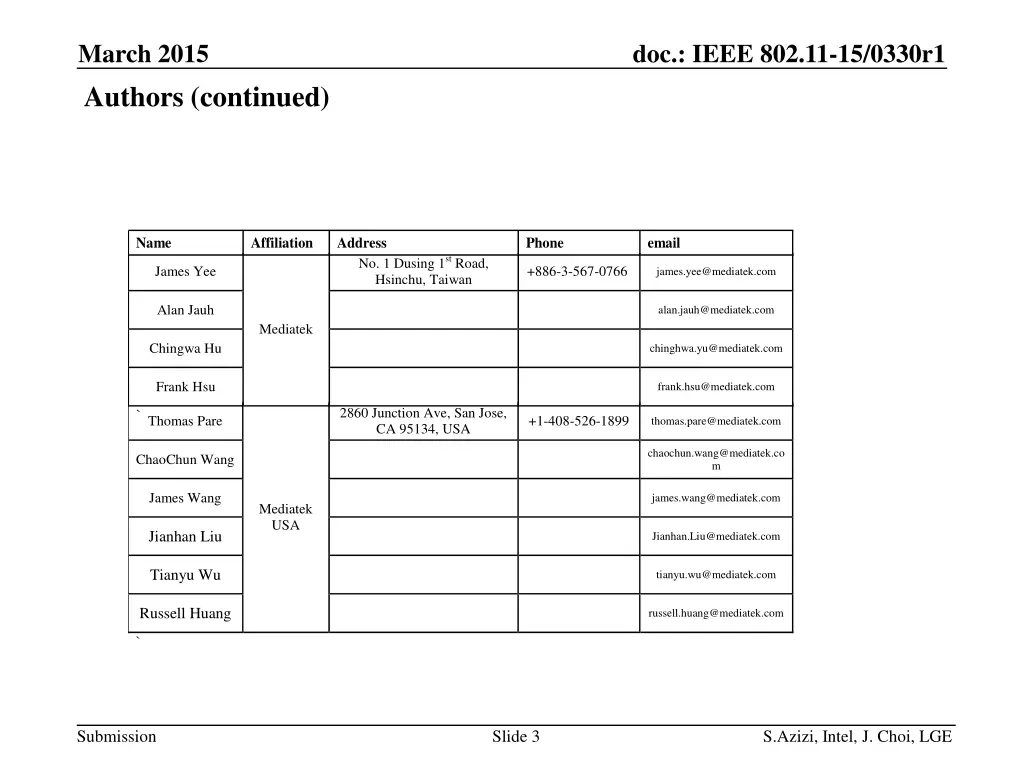
March 2015 doc.: IEEE 802.11-15/0330r1 Authors (continued) Name Affiliation Address Phone email No. 1 Dusing 1st Road, Hsinchu, Taiwan James Yee +886-3-567-0766 james.yee@mediatek.com Alan Jauh alan.jauh@mediatek.com Mediatek Chingwa Hu chinghwa.yu@mediatek.com Frank Hsu frank.hsu@mediatek.com 2860 Junction Ave, San Jose, CA 95134, USA `Thomas Pare +1-408-526-1899 thomas.pare@mediatek.com chaochun.wang@mediatek.co m ChaoChun Wang James Wang james.wang@mediatek.com Mediatek USA Jianhan Liu Jianhan.Liu@mediatek.com Tianyu Wu tianyu.wu@mediatek.com Russell Huang russell.huang@mediatek.com ` Submission Slide 3 S.Azizi, Intel, J. Choi, LGE
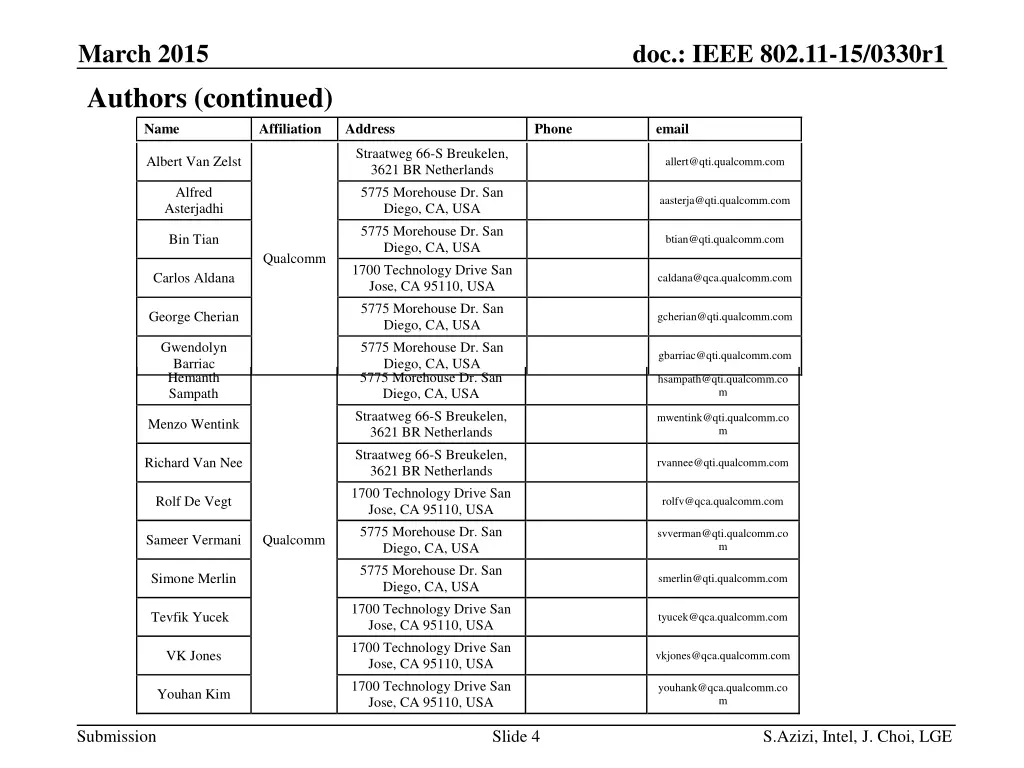
March 2015 doc.: IEEE 802.11-15/0330r1 Authors (continued) Name Albert Van Zelst Affiliation Address Phone email Straatweg 66-S Breukelen, 3621 BR Netherlands 5775 Morehouse Dr. San Diego, CA, USA 5775 Morehouse Dr. San Diego, CA, USA 1700 Technology Drive San Jose, CA 95110, USA 5775 Morehouse Dr. San Diego, CA, USA 5775 Morehouse Dr. San Diego, CA, USA 5775 Morehouse Dr. San Diego, CA, USA Straatweg 66-S Breukelen, 3621 BR Netherlands Straatweg 66-S Breukelen, 3621 BR Netherlands 1700 Technology Drive San Jose, CA 95110, USA 5775 Morehouse Dr. San Diego, CA, USA 5775 Morehouse Dr. San Diego, CA, USA 1700 Technology Drive San Jose, CA 95110, USA 1700 Technology Drive San Jose, CA 95110, USA 1700 Technology Drive San Jose, CA 95110, USA allert@qti.qualcomm.com Alfred Asterjadhi aasterja@qti.qualcomm.com Bin Tian btian@qti.qualcomm.com Qualcomm Carlos Aldana caldana@qca.qualcomm.com George Cherian gcherian@qti.qualcomm.com Gwendolyn Barriac Hemanth Sampath gbarriac@qti.qualcomm.com hsampath@qti.qualcomm.co m mwentink@qti.qualcomm.co m Menzo Wentink Richard Van Nee rvannee@qti.qualcomm.com Rolf De Vegt rolfv@qca.qualcomm.com svverman@qti.qualcomm.co m Sameer Vermani Qualcomm Simone Merlin smerlin@qti.qualcomm.com Tevfik Yucek tyucek@qca.qualcomm.com VK Jones vkjones@qca.qualcomm.com youhank@qca.qualcomm.co m Youhan Kim Submission Slide 4 S.Azizi, Intel, J. Choi, LGE
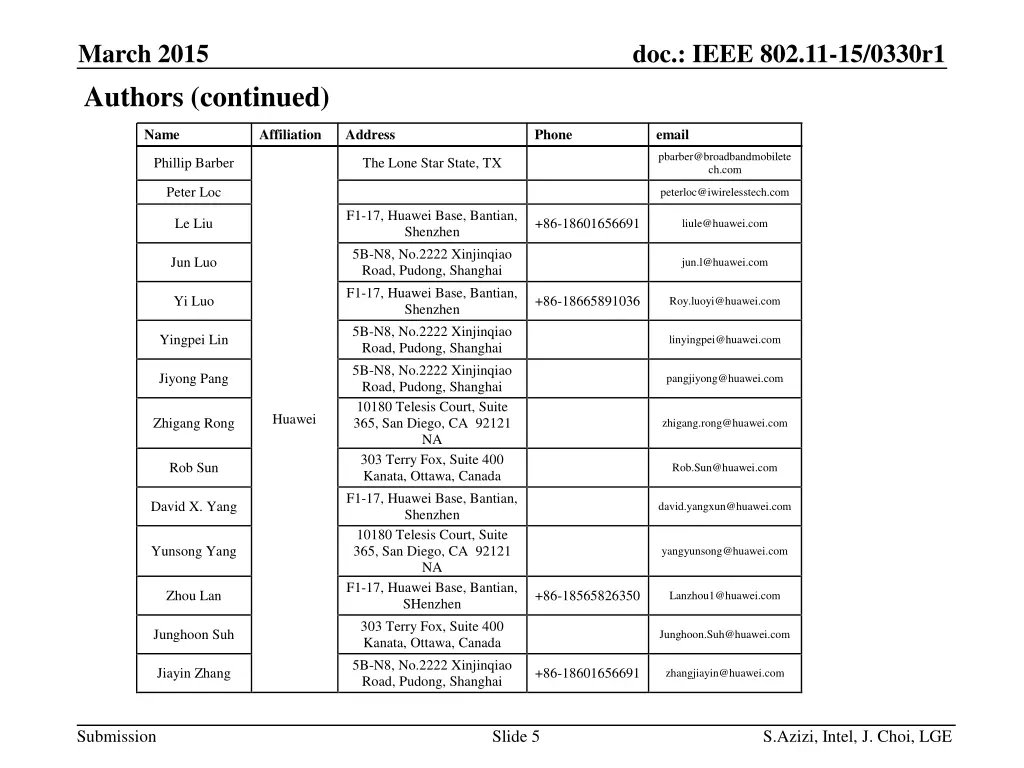
March 2015 doc.: IEEE 802.11-15/0330r1 Authors (continued) Name Phillip Barber Affiliation Address Phone email pbarber@broadbandmobilete ch.com The Lone Star State, TX Peter Loc peterloc@iwirelesstech.com F1-17, Huawei Base, Bantian, Shenzhen 5B-N8, No.2222 Xinjinqiao Road, Pudong, Shanghai F1-17, Huawei Base, Bantian, Shenzhen 5B-N8, No.2222 Xinjinqiao Road, Pudong, Shanghai 5B-N8, No.2222 Xinjinqiao Road, Pudong, Shanghai 10180 Telesis Court, Suite 365, San Diego, CA 92121 NA 303 Terry Fox, Suite 400 Kanata, Ottawa, Canada F1-17, Huawei Base, Bantian, Shenzhen 10180 Telesis Court, Suite 365, San Diego, CA 92121 NA F1-17, Huawei Base, Bantian, SHenzhen 303 Terry Fox, Suite 400 Kanata, Ottawa, Canada 5B-N8, No.2222 Xinjinqiao Road, Pudong, Shanghai Le Liu +86-18601656691 liule@huawei.com Jun Luo jun.l@huawei.com Yi Luo +86-18665891036 Roy.luoyi@huawei.com Yingpei Lin linyingpei@huawei.com Jiyong Pang pangjiyong@huawei.com Huawei Zhigang Rong zhigang.rong@huawei.com Rob Sun Rob.Sun@huawei.com David X. Yang david.yangxun@huawei.com Yunsong Yang yangyunsong@huawei.com Zhou Lan +86-18565826350 Lanzhou1@huawei.com Junghoon Suh Junghoon.Suh@huawei.com Jiayin Zhang +86-18601656691 zhangjiayin@huawei.com Submission Slide 5 S.Azizi, Intel, J. Choi, LGE
March 2015 doc.: IEEE 802.11-15/0330r1 Authors (continued) Name Affiliation Address Phone email Laurent cariou Laurent.cariou@orange.com Orange Thomas Derham Yasushi Takatori thomas.derham@orange.com 1-1 Hikari-no-oka, Yokosuka, Kanagawa 239-0847 Japan takatori.yasushi@lab.ntt.co.jp Yasuhiko Inoue inoue.yasuhiko@lab.ntt.co.jp NTT Yusuke Asai asai.yusuke@lab.ntt.co.jp Koichi Ishihara ishihara.koichi@lab.ntt.co.jp Akira Kishida kishida.akira@lab.ntt.co.jp 3-6, Hikarinooka, Yokosuka- shi, Kanagawa, 239-8536, Japan yamadaakira@nttdocomo.co m Akira Yamada NTT 3240 Hillview Ave, Palo Alto, CA 94304 watanabe@docomoinnovatio ns.com DOCOMO Fujio Watanabe Haralabos Papadopoulos hpapadopoulos@docomoinno vations.com Innovation Park, Cambridge CB4 0DS (U.K.) Fei Tong +44 1223 434633 f.tong@samsung.com Maetan 3-dong; Yongtong-Gu Suwon; South Korea hyunjeong.kang@samsung.co m Hyunjeong Kang +82-31-279-9028 1301, E. Lookout Dr, Richardson TX 75070 Innovation Park, Cambridge CB4 0DS (U.K.) +44 1223 434600 1301, E. Lookout Dr, Richardson TX 75070 Kaushik Josiam (972) 761 7437 k.josiam@samsung.com Samsung Mark Rison m.rison@samsung.com Rakesh Taori (972) 761 7470 rakesh.taori@samsung.com Maetan 3-dong; Yongtong-Gu Suwon; South Korea +82-10-8864- 1751 Sanghyun Chang s29.chang@samsung.com Submission S.Azizi, Intel, J. Choi, LGE Slide 6
March 2015 doc.: IEEE 802.11-15/0330r1 Outline Part-I Motivation and background Granularity of OFDMA resource units Methodology The proposed OFDMA resource units Part-II Total usable tones The proposed OFDMA structure and units Submission Slide 7 S.Azizi, Intel, J. Choi, LGE
March 2015 doc.: IEEE 802.11-15/0330r1 Motivation and Background Based on the target use cases for 802.11ax, methods to improve the PHY efficiency such as OFDMA techniques have been proposed [1-3]. Time and space multiplexing have already been explored, with large number of users in dense network WLAN systems need to explore multiplexing in frequency dimension OFDMA can alleviate dense condition by maximizing user frequency selective multiplexing gain OFDMA can extract scheduling gains/selection diversity by scheduling users not in outage Scheduling is easily done at AP where channel state information is available for MU-MIMO Contributions to 802.11ax have demonstrated that the existence of short data frames, at a low duty cycle in the network is a major factor for capping overall system throughput because such short packets can not be aggregated, and hence system suffers from MAC inefficiency and larger preamble overhead Benefits of use of OFDMA in such scenarios was shown in [4] The 11ax specification framework has already defined UL and DL OFDMA as one of key 11ax MU features Submission Slide 8 S.Azizi, Intel, J. Choi, LGE
March 2015 doc.: IEEE 802.11-15/0330r1 Discussions on the Granularity of OFDMA There is a tradeoff in obtaining OFDMA gain with complexity: On frequency selective fading channels, smaller resource unit size provides higher gain, but at the expense of larger feedback and signaling overhead The size of the smallest resource unit should be selected relative to the channel coherence BW, which is quite small especially for outdoor channels The larger the number of users participating in the OFDMA scheduling the higher the gain, but this requires larger scheduling/grouping complexity It was agreed to use 4x OFDM symbol duration in 11ax [5,6] as follows 11ax has duration 12.8 us (without CP) based on a 256 FFT in 20 MHz, 512 FFT in 40 MHz, 1024 FFT in 80 MHz/80+80 MHz and 2048 FFT in 160 MHz 4x symbol duration allows better granularity for OFDMA There are more number of tones in a given OFDMA bandwidth Submission Slide 9 S.Azizi, Intel, J. Choi, LGE
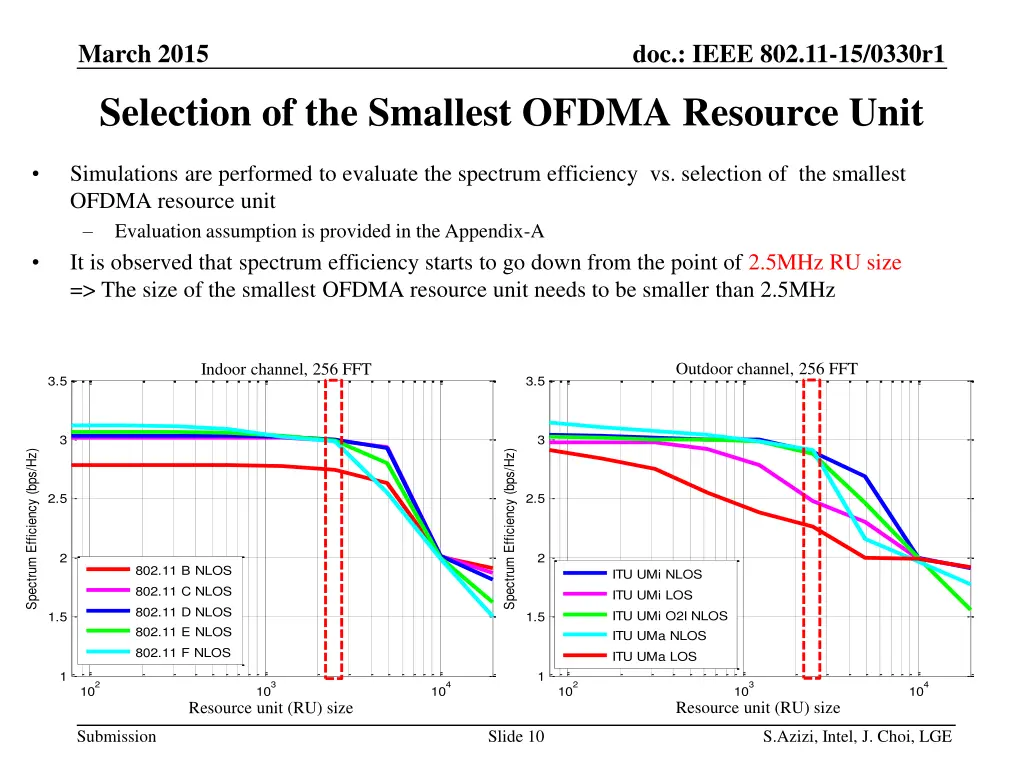
March 2015 doc.: IEEE 802.11-15/0330r1 Selection of the Smallest OFDMA Resource Unit Simulations are performed to evaluate the spectrum efficiency vs. selection of the smallest OFDMA resource unit Evaluation assumption is provided in the Appendix-A It is observed that spectrum efficiency starts to go down from the point of 2.5MHz RU size => The size of the smallest OFDMA resource unit needs to be smaller than 2.5MHz IEEE channel, 256-pt FFT Outdoor channel, 256 FFT IEEE channel, 256-pt FFT Indoor channel, 256 FFT 3.5 3.5 3 3 Spectrum Efficiency (bps/Hz) Spectrum Efficiency (bps/Hz) 2.5 2.5 2 2 802.11 B NLOS 802.11 C NLOS 802.11 D NLOS 802.11 E NLOS 802.11 F NLOS ITU UMi NLOS ITU UMi LOS ITU UMi O2I NLOS ITU UMa NLOS ITU UMa LOS 1.5 1.5 1 1 2 3 4 2 3 4 10 10 10 10 10 10 RB SIZE(KHz) Resource unit (RU) size Resource unit (RU) size RB SIZE(KHz) Submission Slide 10 S.Azizi, Intel, J. Choi, LGE
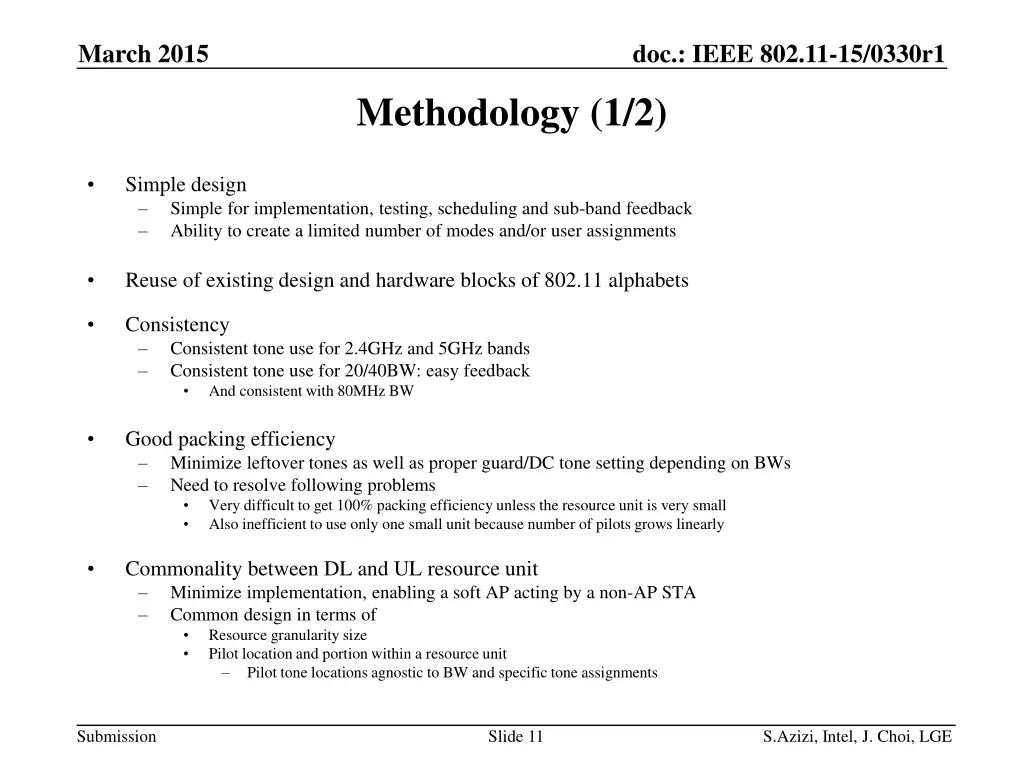
March 2015 doc.: IEEE 802.11-15/0330r1 Methodology (1/2) Simple design Simple for implementation, testing, scheduling and sub-band feedback Ability to create a limited number of modes and/or user assignments Reuse of existing design and hardware blocks of 802.11 alphabets Consistency Consistent tone use for 2.4GHz and 5GHz bands Consistent tone use for 20/40BW: easy feedback And consistent with 80MHz BW Good packing efficiency Minimize leftover tones as well as proper guard/DC tone setting depending on BWs Need to resolve following problems Very difficult to get 100% packing efficiency unless the resource unit is very small Also inefficient to use only one small unit because number of pilots grows linearly Commonality between DL and UL resource unit Minimize implementation, enabling a soft AP acting by a non-AP STA Common design in terms of Resource granularity size Pilot location and portion within a resource unit Pilot tone locations agnostic to BW and specific tone assignments Submission Slide 11 S.Azizi, Intel, J. Choi, LGE
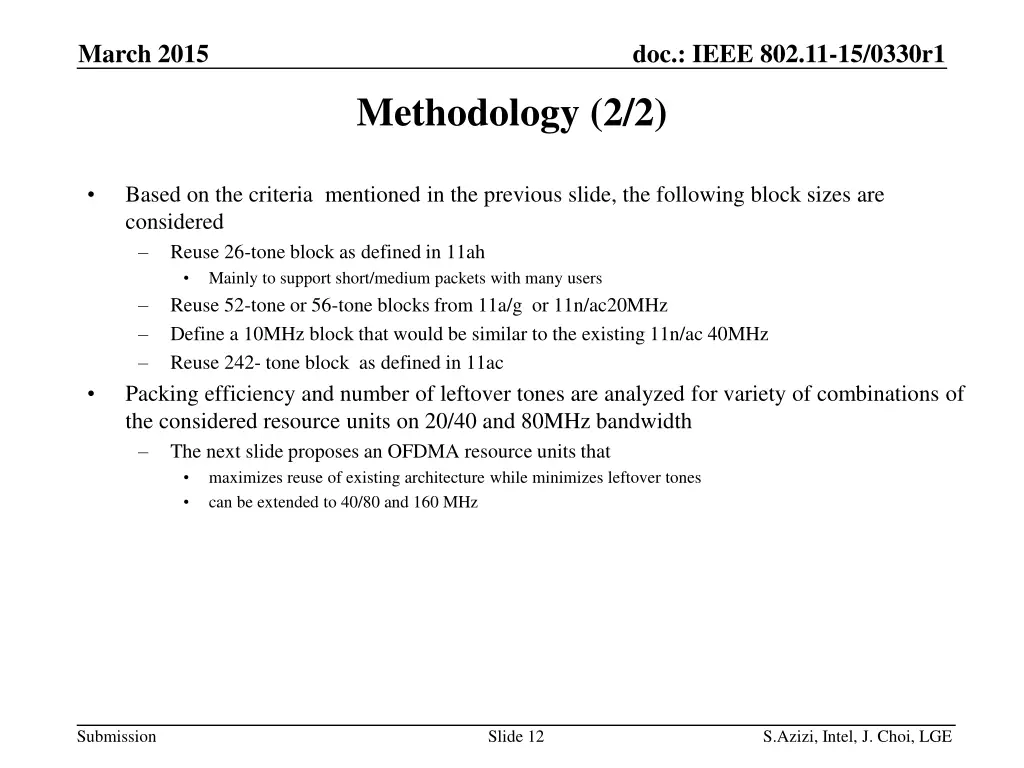
March 2015 doc.: IEEE 802.11-15/0330r1 Methodology (2/2) Based on the criteria mentioned in the previous slide, the following block sizes are considered Reuse 26-tone block as defined in 11ah Mainly to support short/medium packets with many users Reuse 52-tone or 56-tone blocks from 11a/g or 11n/ac20MHz Define a 10MHz block that would be similar to the existing 11n/ac 40MHz Reuse 242- tone block as defined in 11ac Packing efficiency and number of leftover tones are analyzed for variety of combinations of the considered resource units on 20/40 and 80MHz bandwidth The next slide proposes an OFDMA resource units that maximizes reuse of existing architecture while minimizes leftover tones can be extended to 40/80 and 160 MHz Submission Slide 12 S.Azizi, Intel, J. Choi, LGE
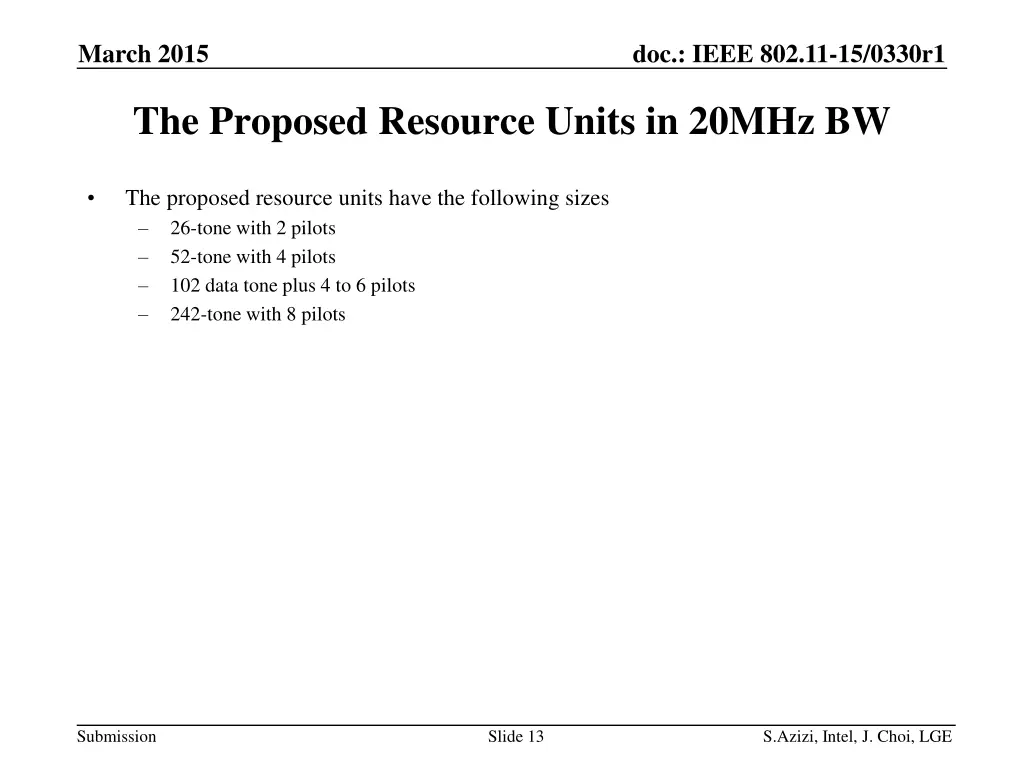
March 2015 doc.: IEEE 802.11-15/0330r1 The Proposed Resource Units in 20MHz BW The proposed resource units have the following sizes 26-tone with 2 pilots 52-tone with 4 pilots 102 data tone plus 4 to 6 pilots 242-tone with 8 pilots Submission Slide 13 S.Azizi, Intel, J. Choi, LGE
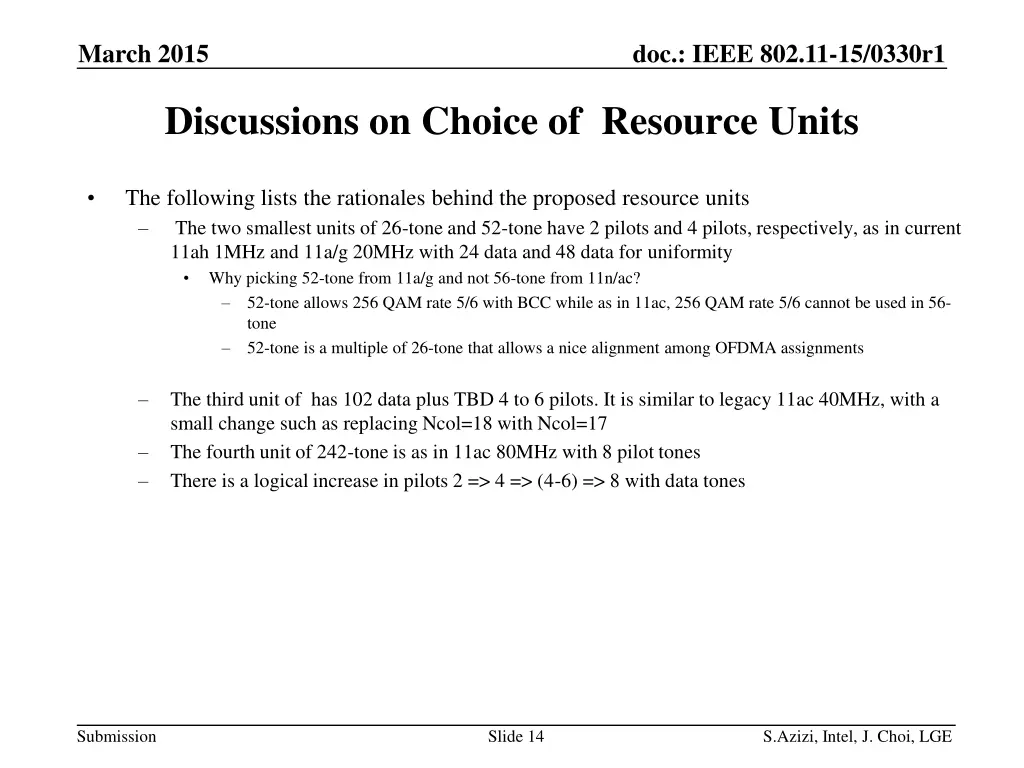
March 2015 doc.: IEEE 802.11-15/0330r1 Discussions on Choice of Resource Units The following lists the rationales behind the proposed resource units The two smallest units of 26-tone and 52-tone have 2 pilots and 4 pilots, respectively, as in current 11ah 1MHz and 11a/g 20MHz with 24 data and 48 data for uniformity Why picking 52-tone from 11a/g and not 56-tone from 11n/ac? 52-tone allows 256 QAM rate 5/6 with BCC while as in 11ac, 256 QAM rate 5/6 cannot be used in 56- tone 52-tone is a multiple of 26-tone that allows a nice alignment among OFDMA assignments The third unit of has 102 data plus TBD 4 to 6 pilots. It is similar to legacy 11ac 40MHz, with a small change such as replacing Ncol=18 with Ncol=17 The fourth unit of 242-tone is as in 11ac 80MHz with 8 pilot tones There is a logical increase in pilots 2 => 4 => (4-6) => 8 with data tones Submission Slide 14 S.Azizi, Intel, J. Choi, LGE
March 2015 doc.: IEEE 802.11-15/0330r1 Outline Part-I Motivation and background Granularity of OFDMA resource units Methodology The proposed OFDMA resource units Part-II Total usable tones The proposed OFDMA structure and units Submission Slide 15 S.Azizi, Intel, J. Choi, LGE
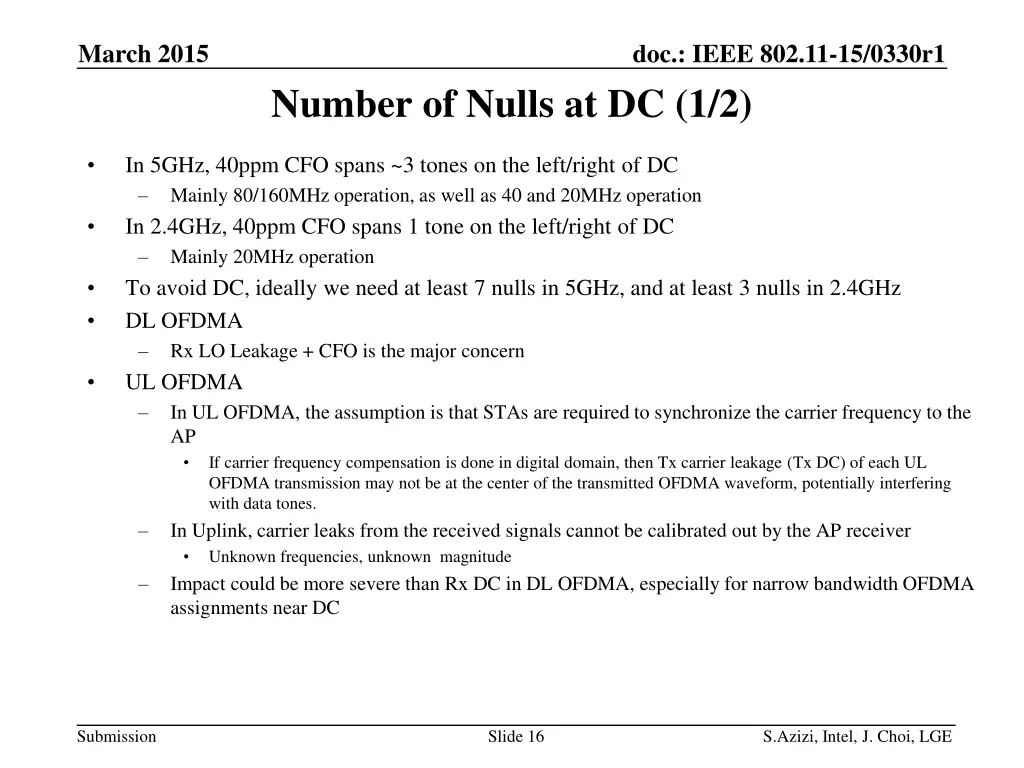
March 2015 doc.: IEEE 802.11-15/0330r1 Number of Nulls at DC (1/2) In 5GHz, 40ppm CFO spans ~3 tones on the left/right of DC Mainly 80/160MHz operation, as well as 40 and 20MHz operation In 2.4GHz, 40ppm CFO spans 1 tone on the left/right of DC Mainly 20MHz operation To avoid DC, ideally we need at least 7 nulls in 5GHz, and at least 3 nulls in 2.4GHz DL OFDMA Rx LO Leakage + CFO is the major concern UL OFDMA In UL OFDMA, the assumption is that STAs are required to synchronize the carrier frequency to the AP If carrier frequency compensation is done in digital domain, then Tx carrier leakage (Tx DC) of each UL OFDMA transmission may not be at the center of the transmitted OFDMA waveform, potentially interfering with data tones. In Uplink, carrier leaks from the received signals cannot be calibrated out by the AP receiver Unknown frequencies, unknown magnitude Impact could be more severe than Rx DC in DL OFDMA, especially for narrow bandwidth OFDMA assignments near DC Submission Slide 16 S.Azizi, Intel, J. Choi, LGE
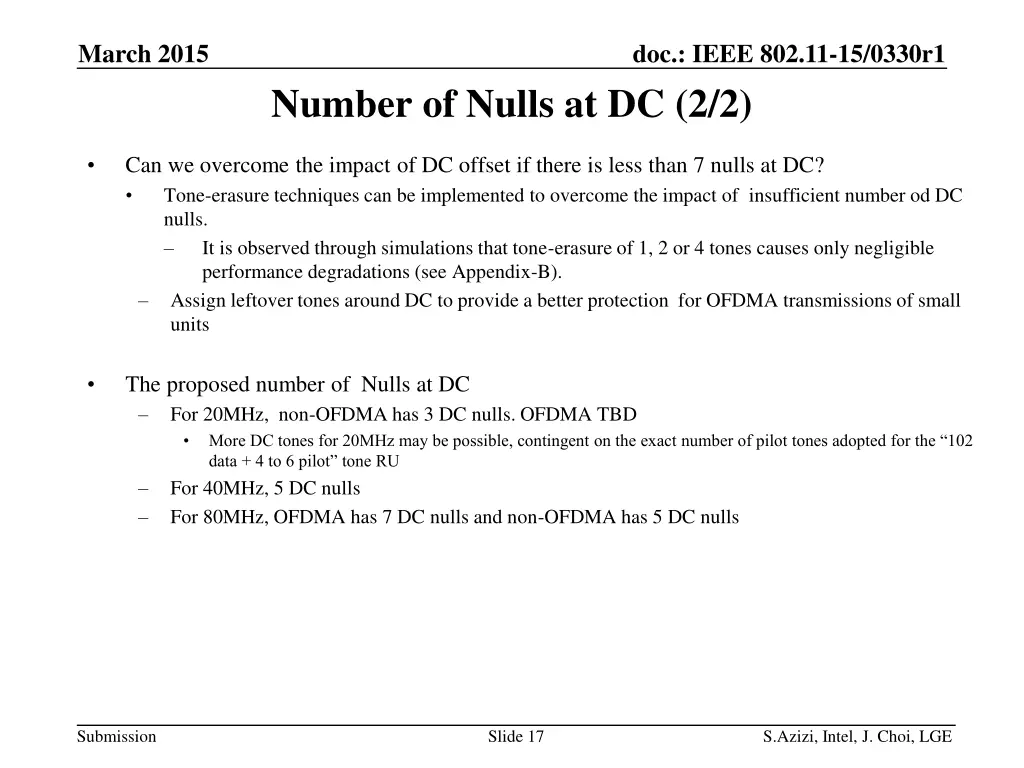
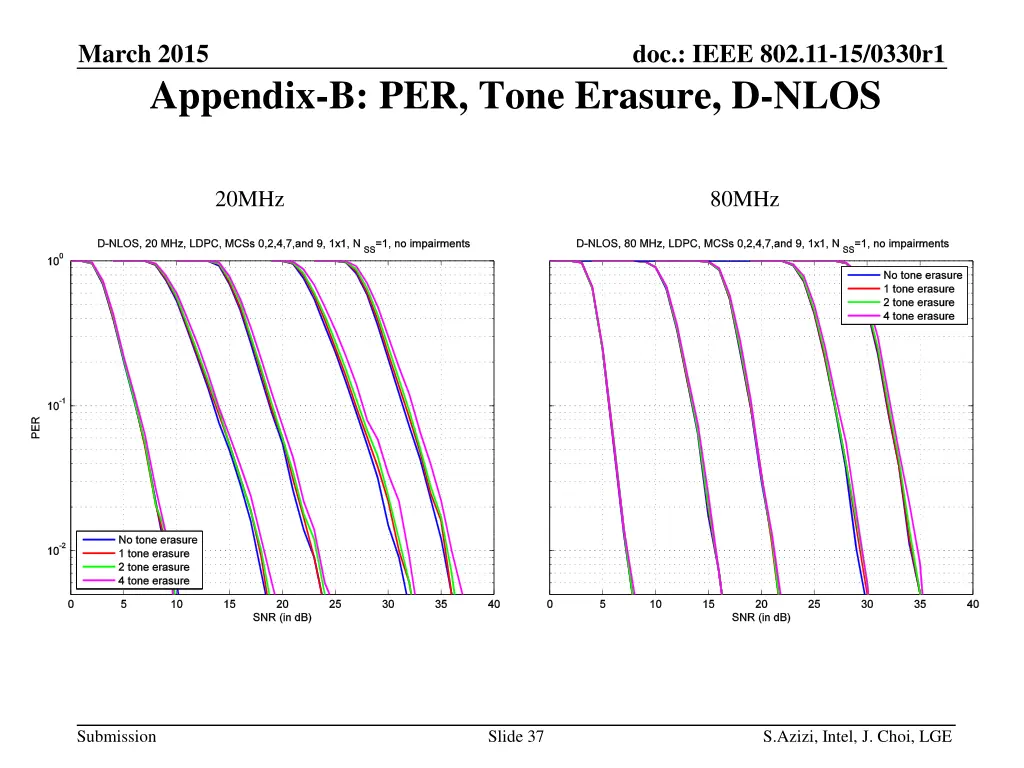
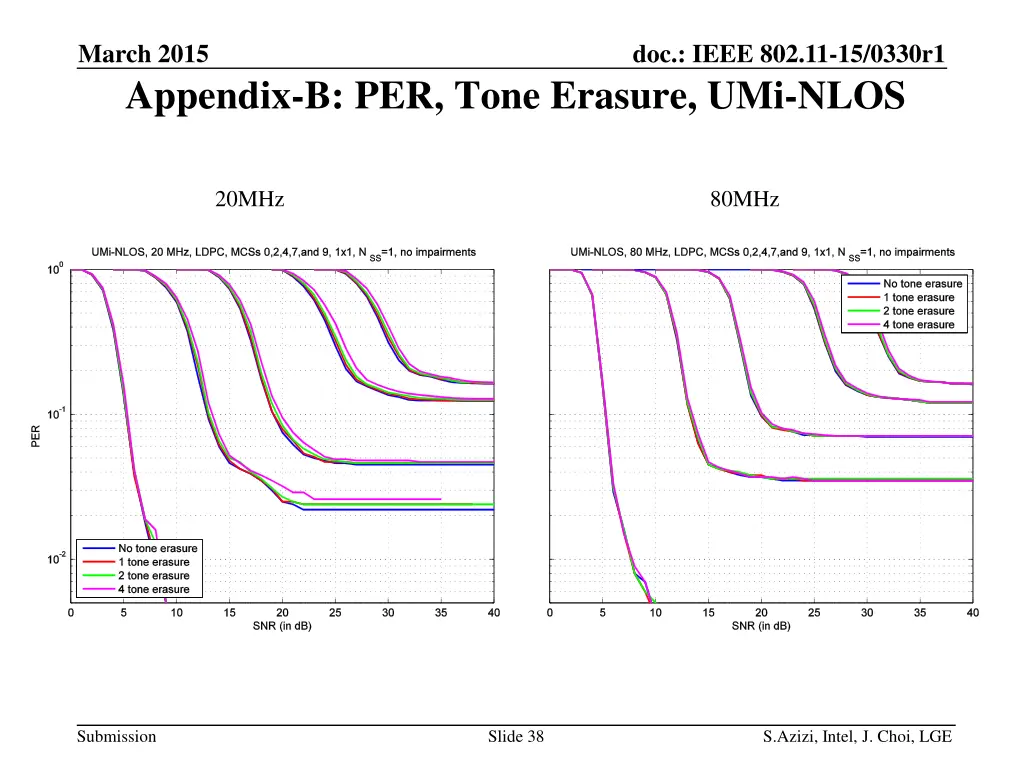
March 2015 doc.: IEEE 802.11-15/0330r1 Number of Nulls at DC (2/2) Can we overcome the impact of DC offset if there is less than 7 nulls at DC? Tone-erasure techniques can be implemented to overcome the impact of insufficient number od DC nulls. It is observed through simulations that tone-erasure of 1, 2 or 4 tones causes only negligible performance degradations (see Appendix-B). Assign leftover tones around DC to provide a better protection for OFDMA transmissions of small units The proposed number of Nulls at DC For 20MHz, non-OFDMA has 3 DC nulls. OFDMA TBD More DC tones for 20MHz may be possible, contingent on the exact number of pilot tones adopted for the 102 data + 4 to 6 pilot tone RU For 40MHz, 5 DC nulls For 80MHz, OFDMA has 7 DC nulls and non-OFDMA has 5 DC nulls Submission Slide 17 S.Azizi, Intel, J. Choi, LGE
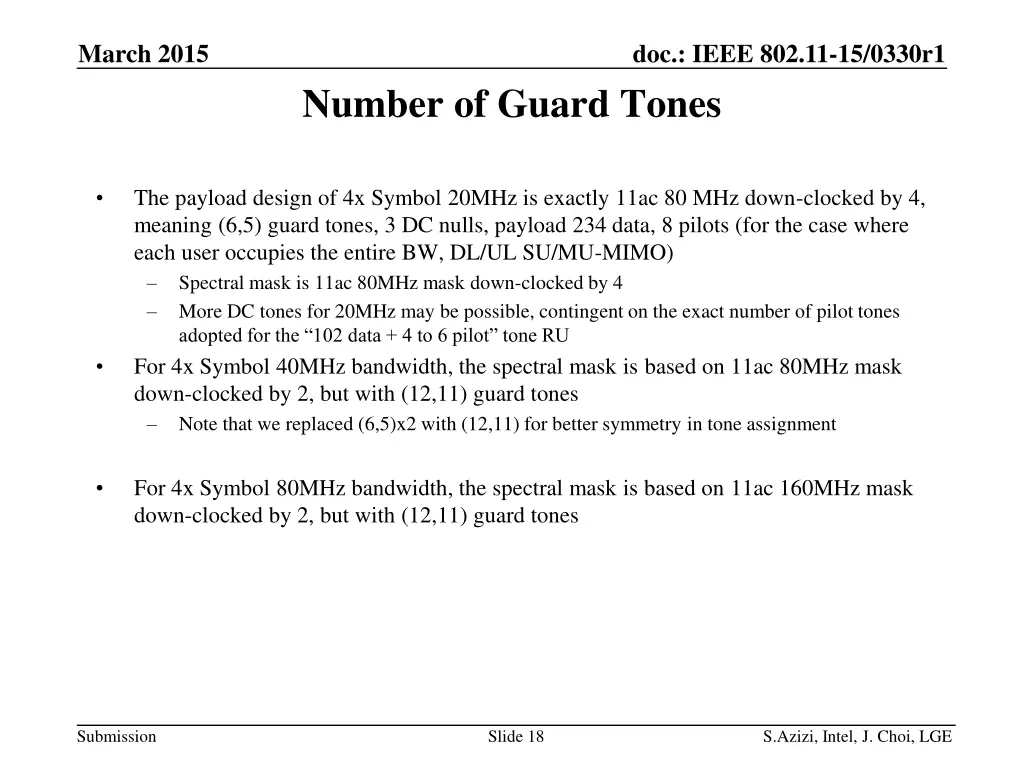
March 2015 doc.: IEEE 802.11-15/0330r1 Number of Guard Tones The payload design of 4x Symbol 20MHz is exactly 11ac 80 MHz down-clocked by 4, meaning (6,5) guard tones, 3 DC nulls, payload 234 data, 8 pilots (for the case where each user occupies the entire BW, DL/UL SU/MU-MIMO) Spectral mask is 11ac 80MHz mask down-clocked by 4 More DC tones for 20MHz may be possible, contingent on the exact number of pilot tones adopted for the 102 data + 4 to 6 pilot tone RU For 4x Symbol 40MHz bandwidth, the spectral mask is based on 11ac 80MHz mask down-clocked by 2, but with (12,11) guard tones Note that we replaced (6,5)x2 with (12,11) for better symmetry in tone assignment For 4x Symbol 80MHz bandwidth, the spectral mask is based on 11ac 160MHz mask down-clocked by 2, but with (12,11) guard tones Submission Slide 18 S.Azizi, Intel, J. Choi, LGE
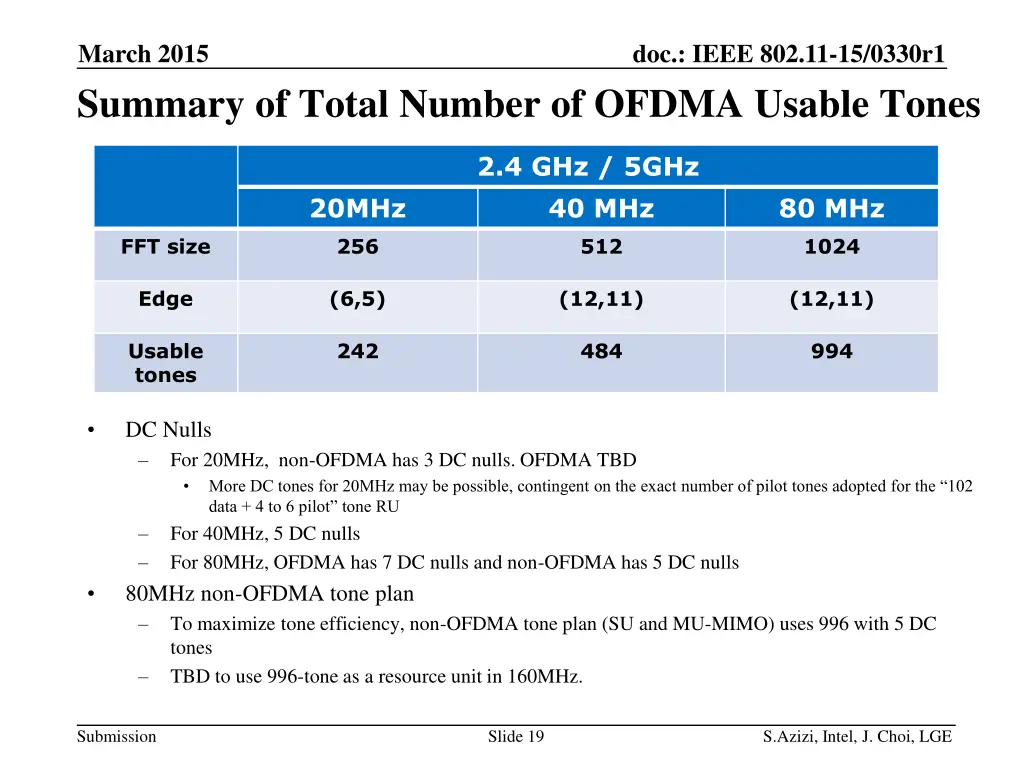
March 2015 doc.: IEEE 802.11-15/0330r1 Summary of Total Number of OFDMA Usable Tones 2.4 GHz / 5GHz 40 MHz 20MHz 80 MHz FFT size 256 512 1024 Edge (6,5) (12,11) (12,11) Usable tones 242 484 994 DC Nulls For 20MHz, non-OFDMA has 3 DC nulls. OFDMA TBD More DC tones for 20MHz may be possible, contingent on the exact number of pilot tones adopted for the 102 data + 4 to 6 pilot tone RU For 40MHz, 5 DC nulls For 80MHz, OFDMA has 7 DC nulls and non-OFDMA has 5 DC nulls 80MHz non-OFDMA tone plan To maximize tone efficiency, non-OFDMA tone plan (SU and MU-MIMO) uses 996 with 5 DC tones TBD to use 996-tone as a resource unit in 160MHz. Submission Slide 19 S.Azizi, Intel, J. Choi, LGE
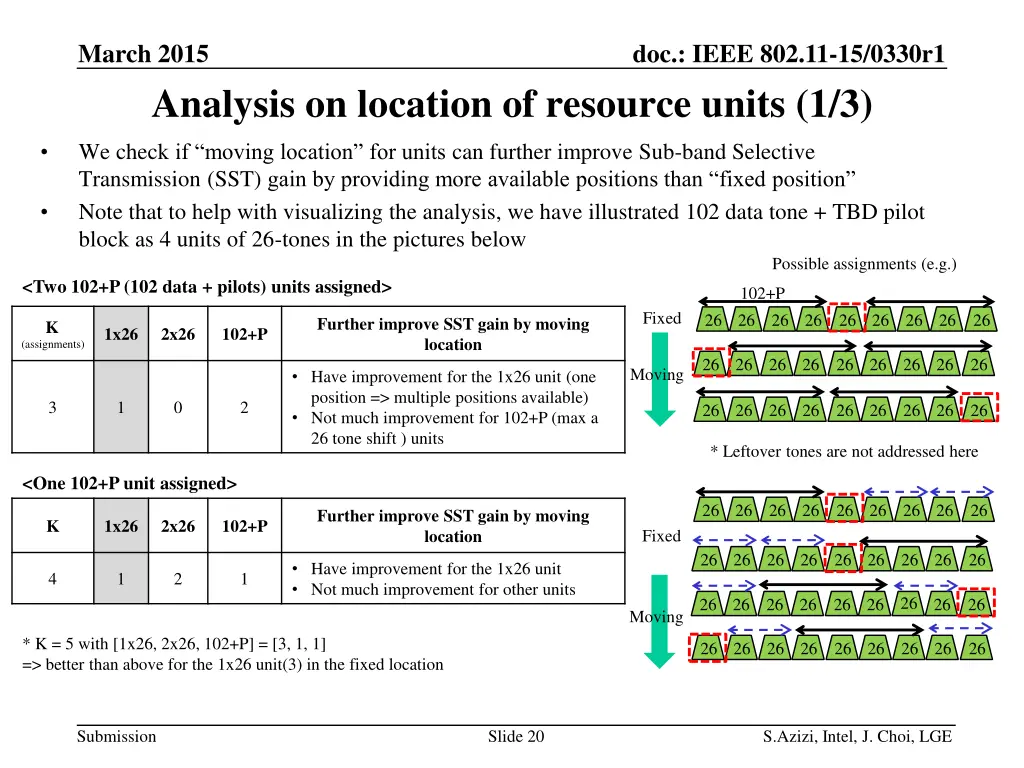
March 2015 doc.: IEEE 802.11-15/0330r1 Analysis on location of resource units (1/3) We check if moving location for units can further improve Sub-band Selective Transmission (SST) gain by providing more available positions than fixed position Note that to help with visualizing the analysis, we have illustrated 102 data tone + TBD pilot block as 4 units of 26-tones in the pictures below Possible assignments (e.g.) <Two 102+P (102 data + pilots) units assigned> 102+P Fixed 26 26 26 26 26 26 26 26 26 Further improve SST gain by moving location K 1x26 2x26 102+P (assignments) 26 26 26 26 26 26 26 26 26 Moving Have improvement for the 1x26 unit (one position => multiple positions available) Not much improvement for 102+P (max a 26 tone shift ) units 3 1 0 2 26 26 26 26 26 26 26 26 26 * Leftover tones are not addressed here <One 102+P unit assigned> 26 26 26 26 26 26 26 26 26 Further improve SST gain by moving location K 1x26 2x26 102+P Fixed 26 26 26 26 26 26 26 26 26 Have improvement for the 1x26 unit Not much improvement for other units 4 1 2 1 26 26 26 26 26 26 26 26 26 Moving * K = 5 with [1x26, 2x26, 102+P] = [3, 1, 1] => better than above for the 1x26 unit(3) in the fixed location 26 26 26 26 26 26 26 26 26 Submission Slide 20 S.Azizi, Intel, J. Choi, LGE
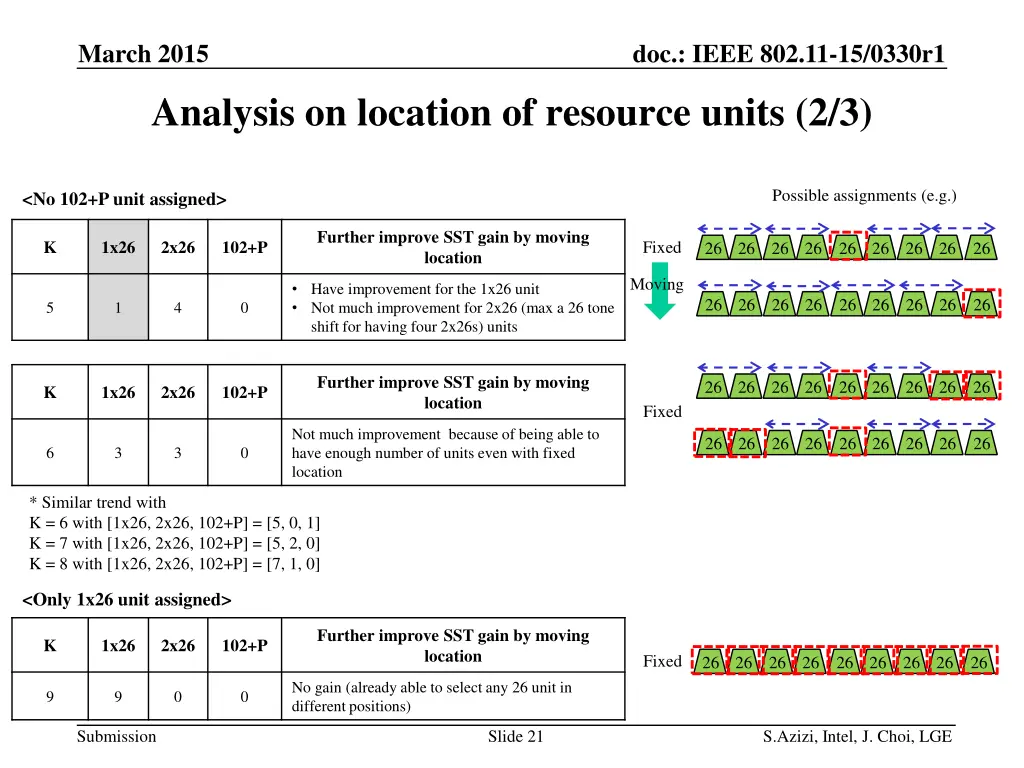
March 2015 doc.: IEEE 802.11-15/0330r1 Analysis on location of resource units (2/3) Possible assignments (e.g.) <No 102+P unit assigned> Further improve SST gain by moving location K 1x26 2x26 102+P Fixed 26 26 26 26 26 26 26 26 26 Moving Have improvement for the 1x26 unit Not much improvement for 2x26 (max a 26 tone shift for having four 2x26s) units 26 26 26 26 26 26 26 26 26 5 1 4 0 Further improve SST gain by moving location 26 26 26 26 26 26 26 26 26 K 1x26 2x26 102+P Fixed Not much improvement because of being able to have enough number of units even with fixed location 26 26 26 26 26 26 26 26 26 6 3 3 0 * Similar trend with K = 6 with [1x26, 2x26, 102+P] = [5, 0, 1] K = 7 with [1x26, 2x26, 102+P] = [5, 2, 0] K = 8 with [1x26, 2x26, 102+P] = [7, 1, 0] <Only 1x26 unit assigned> Further improve SST gain by moving location K 1x26 2x26 102+P Fixed 26 26 26 26 26 26 26 26 26 No gain (already able to select any 26 unit in different positions) 9 9 0 0 Submission Slide 21 S.Azizi, Intel, J. Choi, LGE
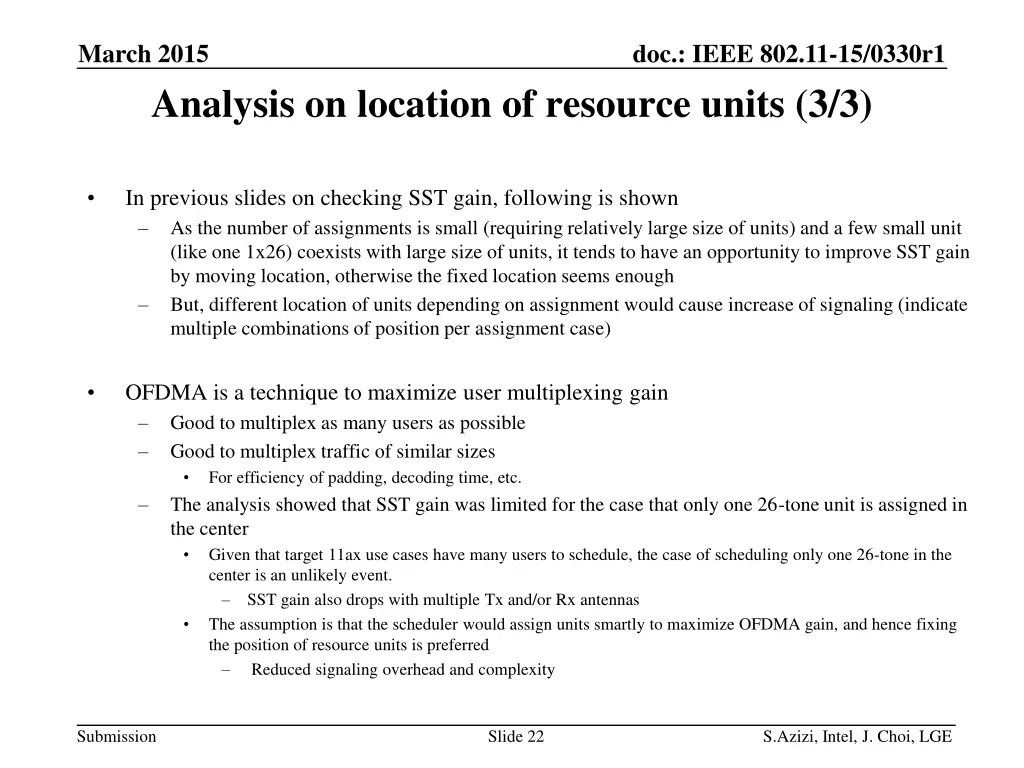
March 2015 doc.: IEEE 802.11-15/0330r1 Analysis on location of resource units (3/3) In previous slides on checking SST gain, following is shown As the number of assignments is small (requiring relatively large size of units) and a few small unit (like one 1x26) coexists with large size of units, it tends to have an opportunity to improve SST gain by moving location, otherwise the fixed location seems enough But, different location of units depending on assignment would cause increase of signaling (indicate multiple combinations of position per assignment case) OFDMA is a technique to maximize user multiplexing gain Good to multiplex as many users as possible Good to multiplex traffic of similar sizes For efficiency of padding, decoding time, etc. The analysis showed that SST gain was limited for the case that only one 26-tone unit is assigned in the center Given that target 11ax use cases have many users to schedule, the case of scheduling only one 26-tone in the center is an unlikely event. SST gain also drops with multiple Tx and/or Rx antennas The assumption is that the scheduler would assign units smartly to maximize OFDMA gain, and hence fixing the position of resource units is preferred Reduced signaling overhead and complexity Submission Slide 22 S.Azizi, Intel, J. Choi, LGE
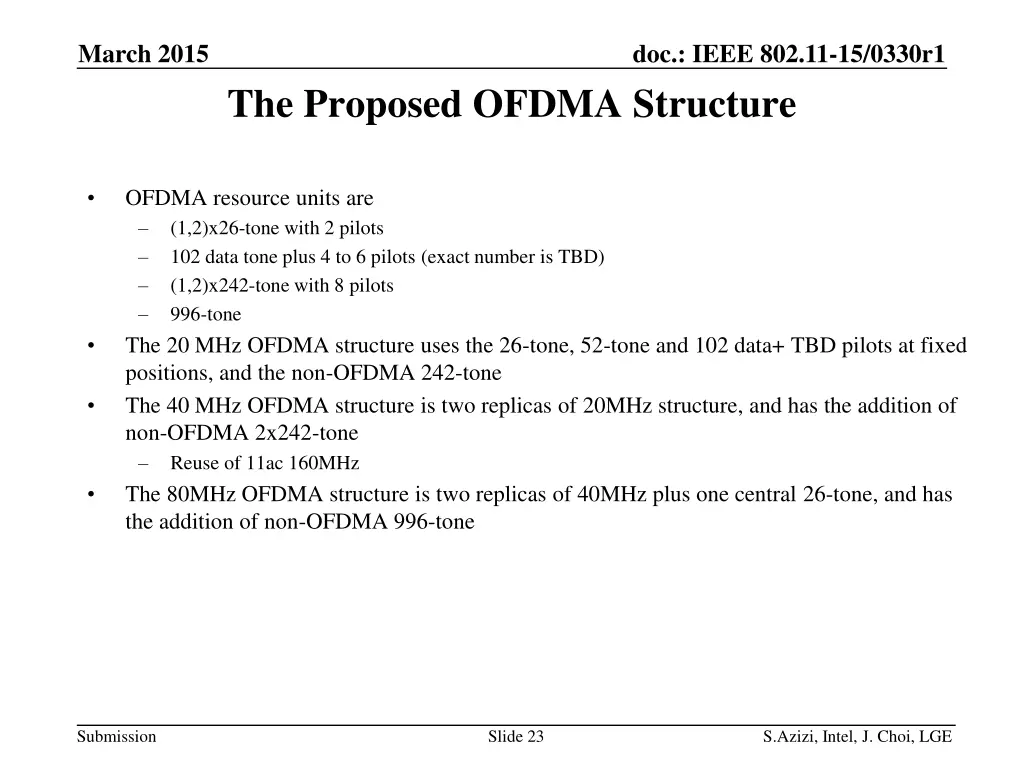
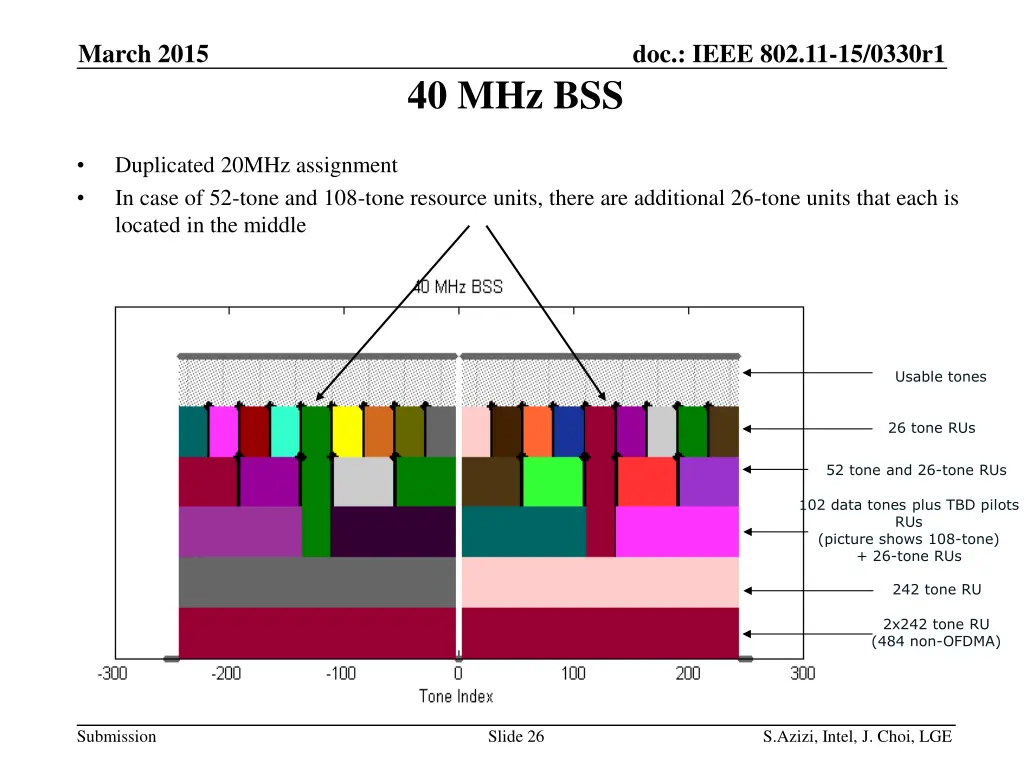
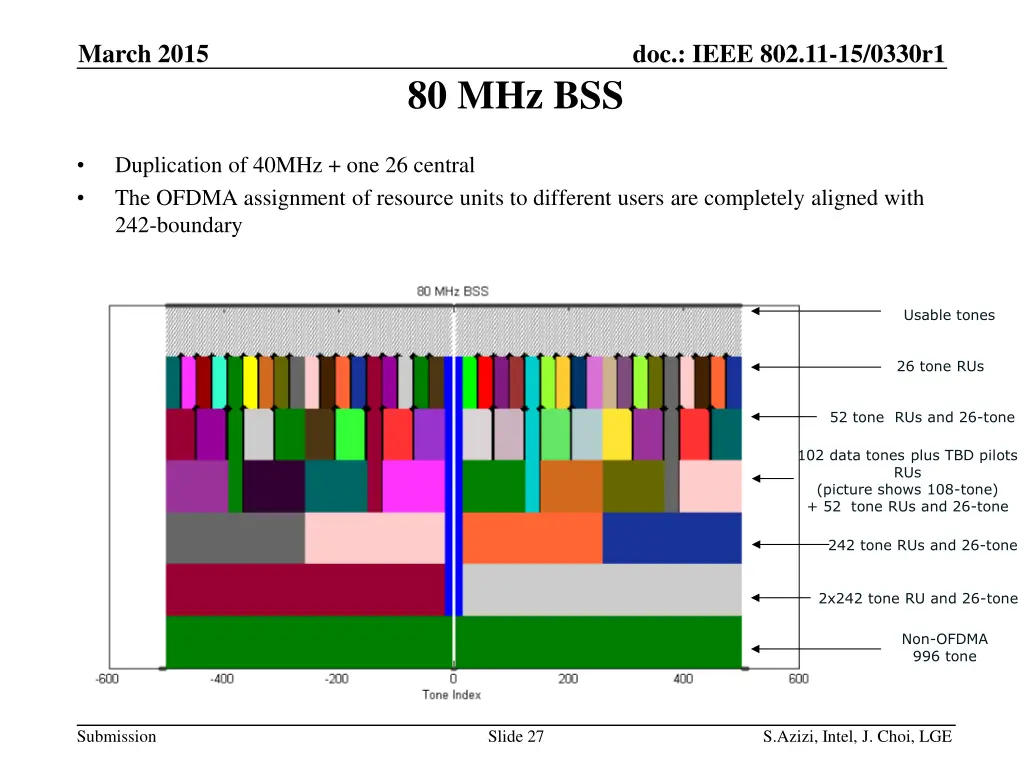
March 2015 doc.: IEEE 802.11-15/0330r1 The Proposed OFDMA Structure OFDMA resource units are (1,2)x26-tone with 2 pilots 102 data tone plus 4 to 6 pilots (exact number is TBD) (1,2)x242-tone with 8 pilots 996-tone The 20 MHz OFDMA structure uses the 26-tone, 52-tone and 102 data+ TBD pilots at fixed positions, and the non-OFDMA 242-tone The 40 MHz OFDMA structure is two replicas of 20MHz structure, and has the addition of non-OFDMA 2x242-tone Reuse of 11ac 160MHz The 80MHz OFDMA structure is two replicas of 40MHz plus one central 26-tone, and has the addition of non-OFDMA 996-tone Submission Slide 23 S.Azizi, Intel, J. Choi, LGE
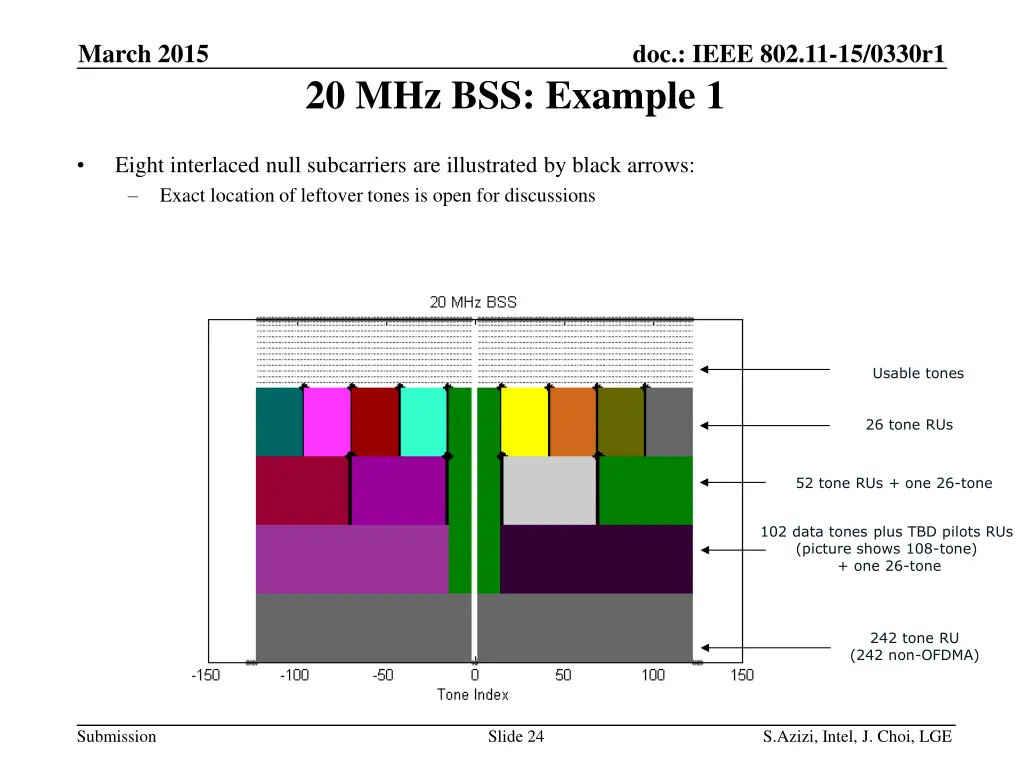
March 2015 doc.: IEEE 802.11-15/0330r1 20 MHz BSS: Example 1 Eight interlaced null subcarriers are illustrated by black arrows: Exact location of leftover tones is open for discussions Usable tones 26 tone RUs 52 tone RUs + one 26-tone 102 data tones plus TBD pilots RUs (picture shows 108-tone) + one 26-tone 242 tone RU (242 non-OFDMA) Submission Slide 24 S.Azizi, Intel, J. Choi, LGE
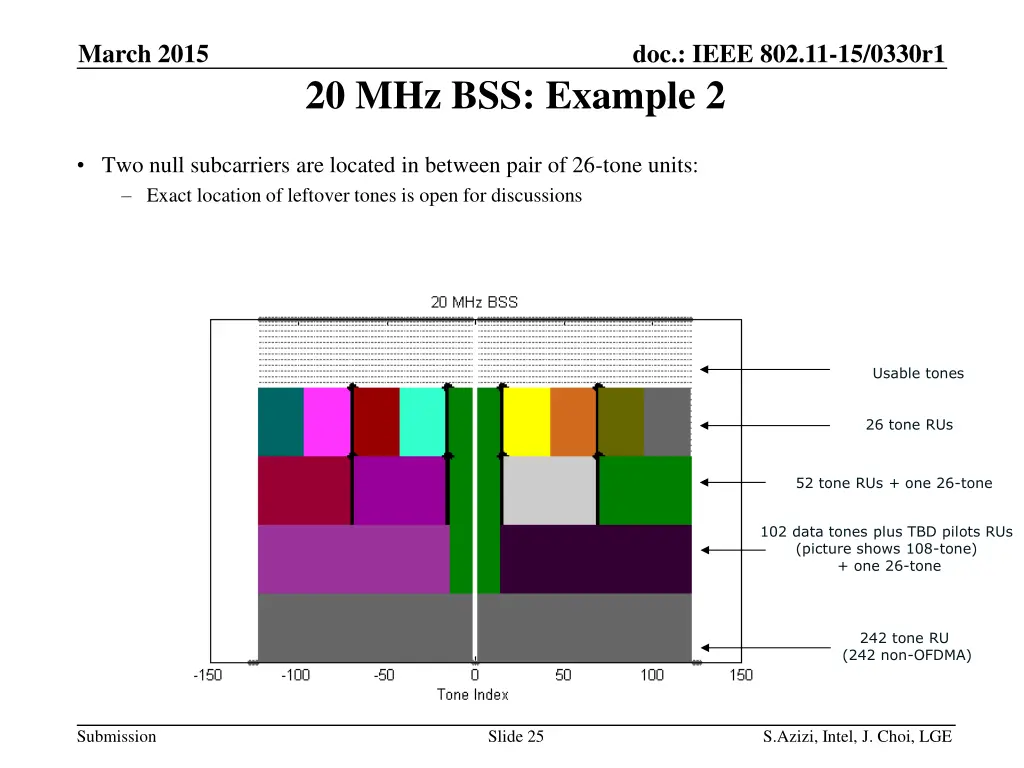
March 2015 doc.: IEEE 802.11-15/0330r1 20 MHz BSS: Example 2 Two null subcarriers are located in between pair of 26-tone units: Exact location of leftover tones is open for discussions Usable tones 26 tone RUs 52 tone RUs + one 26-tone 102 data tones plus TBD pilots RUs (picture shows 108-tone) + one 26-tone 242 tone RU (242 non-OFDMA) Submission Slide 25 S.Azizi, Intel, J. Choi, LGE
March 2015 doc.: IEEE 802.11-15/0330r1 40 MHz BSS Duplicated 20MHz assignment In case of 52-tone and 108-tone resource units, there are additional 26-tone units that each is located in the middle Usable tones 26 tone RUs 52 tone and 26-tone RUs 102 data tones plus TBD pilots RUs (picture shows 108-tone) + 26-tone RUs 242 tone RU 2x242 tone RU (484 non-OFDMA) Submission Slide 26 S.Azizi, Intel, J. Choi, LGE
March 2015 doc.: IEEE 802.11-15/0330r1 80 MHz BSS Duplication of 40MHz + one 26 central The OFDMA assignment of resource units to different users are completely aligned with 242-boundary Usable tones 26 tone RUs 52 tone RUs and 26-tone 102 data tones plus TBD pilots RUs (picture shows 108-tone) + 52 tone RUs and 26-tone 242 tone RUs and 26-tone 2x242 tone RU and 26-tone Non-OFDMA 996 tone Submission Slide 27 S.Azizi, Intel, J. Choi, LGE
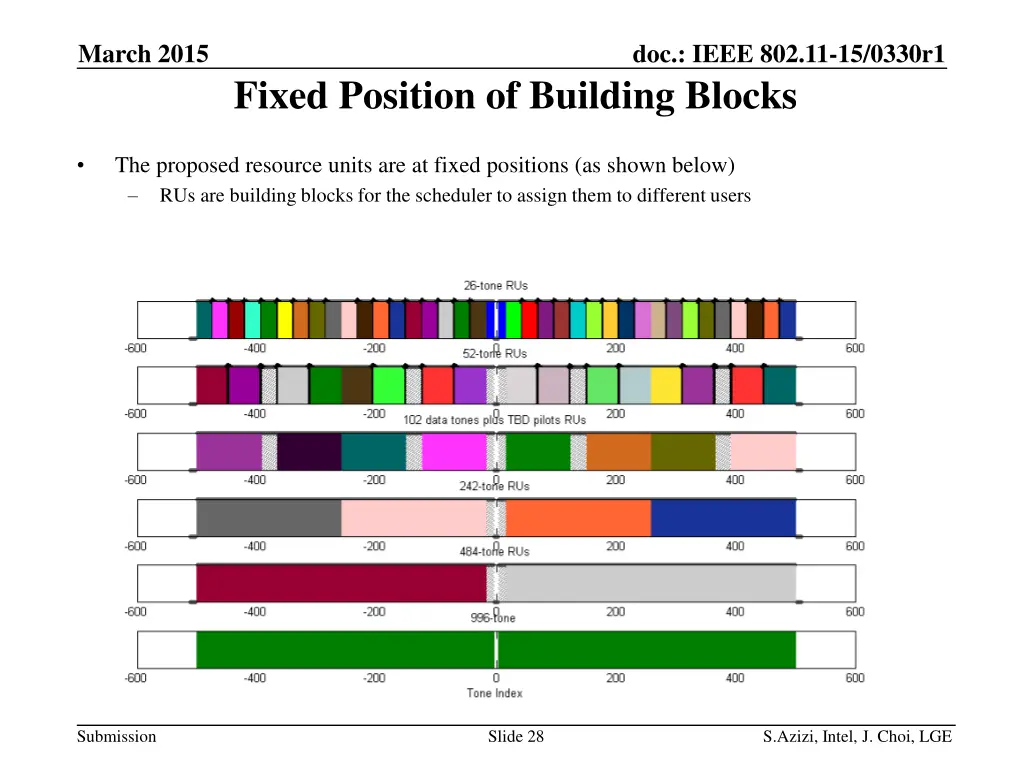
March 2015 doc.: IEEE 802.11-15/0330r1 Fixed Position of Building Blocks The proposed resource units are at fixed positions (as shown below) RUs are building blocks for the scheduler to assign them to different users Submission Slide 28 S.Azizi, Intel, J. Choi, LGE
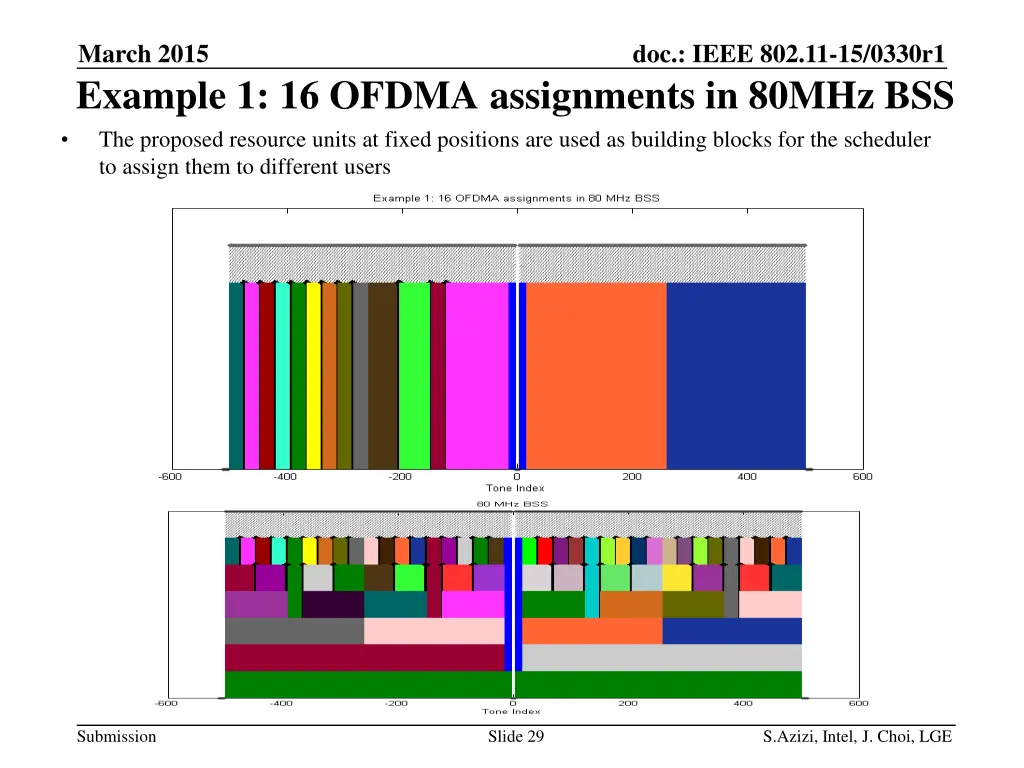
March 2015 doc.: IEEE 802.11-15/0330r1 Example 1: 16 OFDMA assignments in 80MHz BSS The proposed resource units at fixed positions are used as building blocks for the scheduler to assign them to different users Submission Slide 29 S.Azizi, Intel, J. Choi, LGE
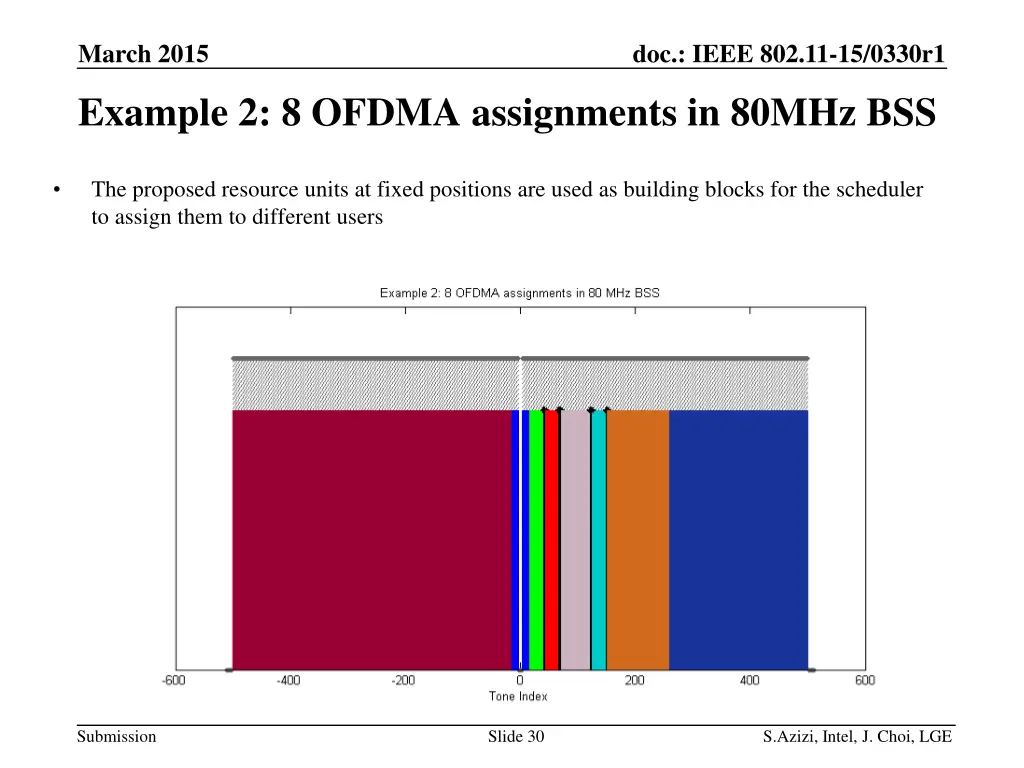
March 2015 doc.: IEEE 802.11-15/0330r1 Example 2: 8 OFDMA assignments in 80MHz BSS The proposed resource units at fixed positions are used as building blocks for the scheduler to assign them to different users Submission Slide 30 S.Azizi, Intel, J. Choi, LGE
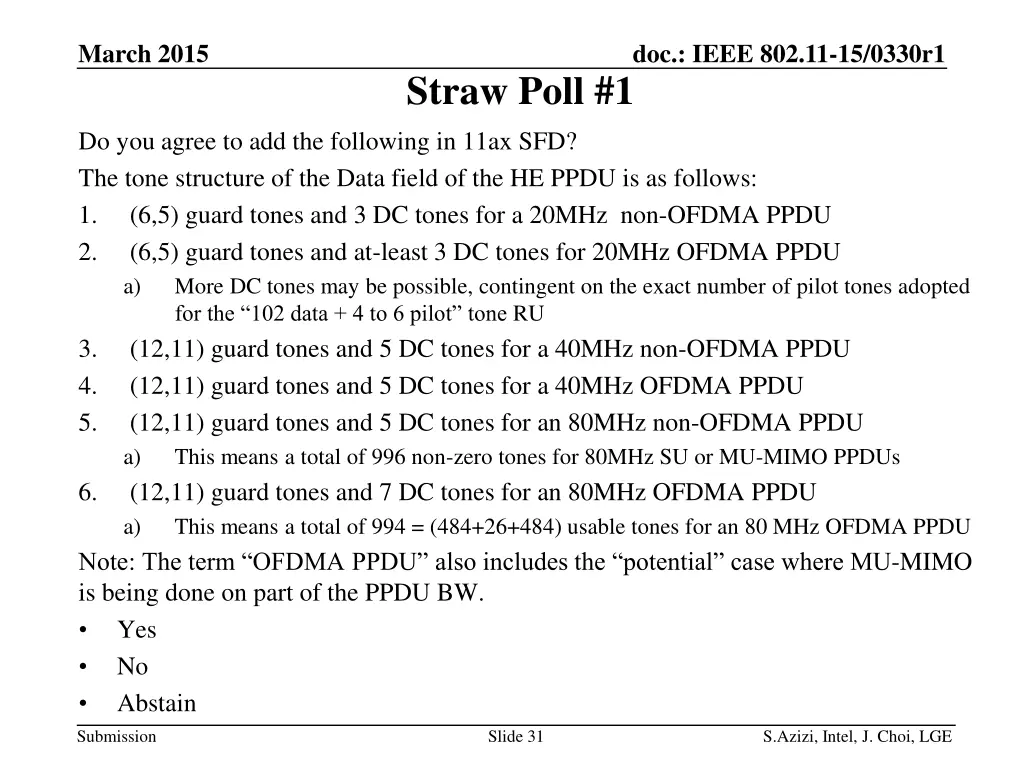
March 2015 doc.: IEEE 802.11-15/0330r1 Straw Poll #1 Do you agree to add the following in 11ax SFD? The tone structure of the Data field of the HE PPDU is as follows: 1. (6,5) guard tones and 3 DC tones for a 20MHz non-OFDMA PPDU 2. (6,5) guard tones and at-least 3 DC tones for 20MHz OFDMA PPDU a) More DC tones may be possible, contingent on the exact number of pilot tones adopted for the 102 data + 4 to 6 pilot tone RU 3. (12,11) guard tones and 5 DC tones for a 40MHz non-OFDMA PPDU 4. (12,11) guard tones and 5 DC tones for a 40MHz OFDMA PPDU 5. (12,11) guard tones and 5 DC tones for an 80MHz non-OFDMA PPDU a) This means a total of 996 non-zero tones for 80MHz SU or MU-MIMO PPDUs 6. (12,11) guard tones and 7 DC tones for an 80MHz OFDMA PPDU a) This means a total of 994 = (484+26+484) usable tones for an 80 MHz OFDMA PPDU Note: The term OFDMA PPDU also includes the potential case where MU-MIMO is being done on part of the PPDU BW. Yes No Abstain Submission Slide 31 S.Azizi, Intel, J. Choi, LGE
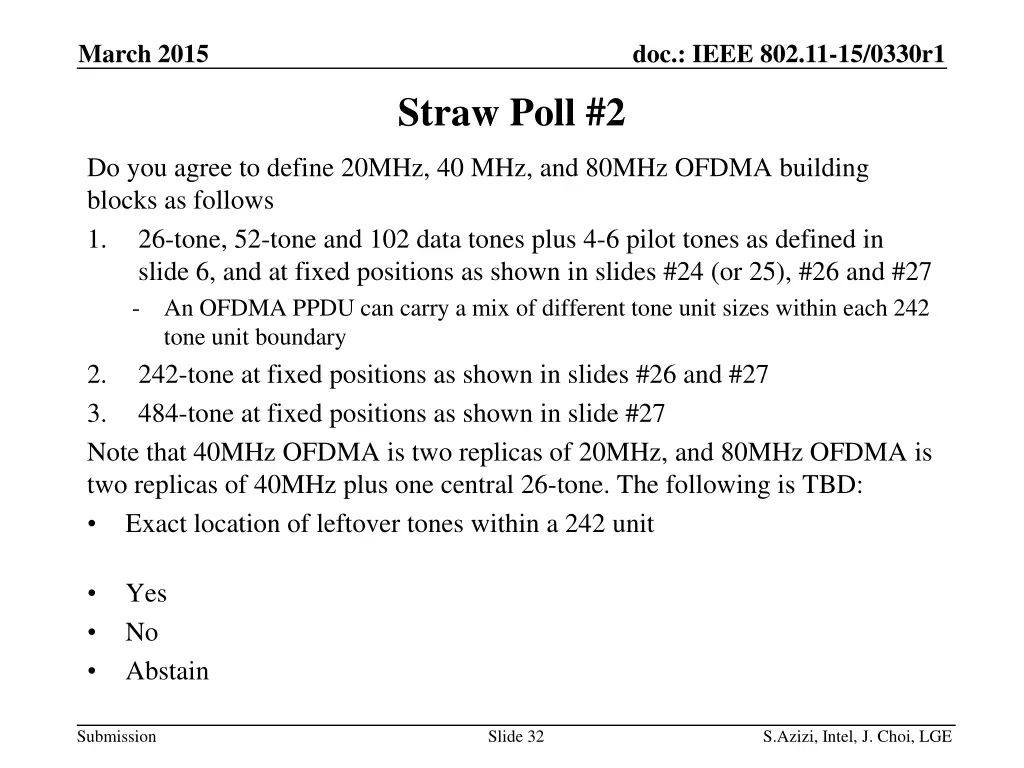
March 2015 doc.: IEEE 802.11-15/0330r1 Straw Poll #2 Do you agree to define 20MHz, 40 MHz, and 80MHz OFDMA building blocks as follows 1. 26-tone, 52-tone and 102 data tones plus 4-6 pilot tones as defined in slide 6, and at fixed positions as shown in slides #24 (or 25), #26 and #27 - An OFDMA PPDU can carry a mix of different tone unit sizes within each 242 tone unit boundary 2. 242-tone at fixed positions as shown in slides #26 and #27 3. 484-tone at fixed positions as shown in slide #27 Note that 40MHz OFDMA is two replicas of 20MHz, and 80MHz OFDMA is two replicas of 40MHz plus one central 26-tone. The following is TBD: Exact location of leftover tones within a 242 unit Yes No Abstain Submission Slide 32 S.Azizi, Intel, J. Choi, LGE
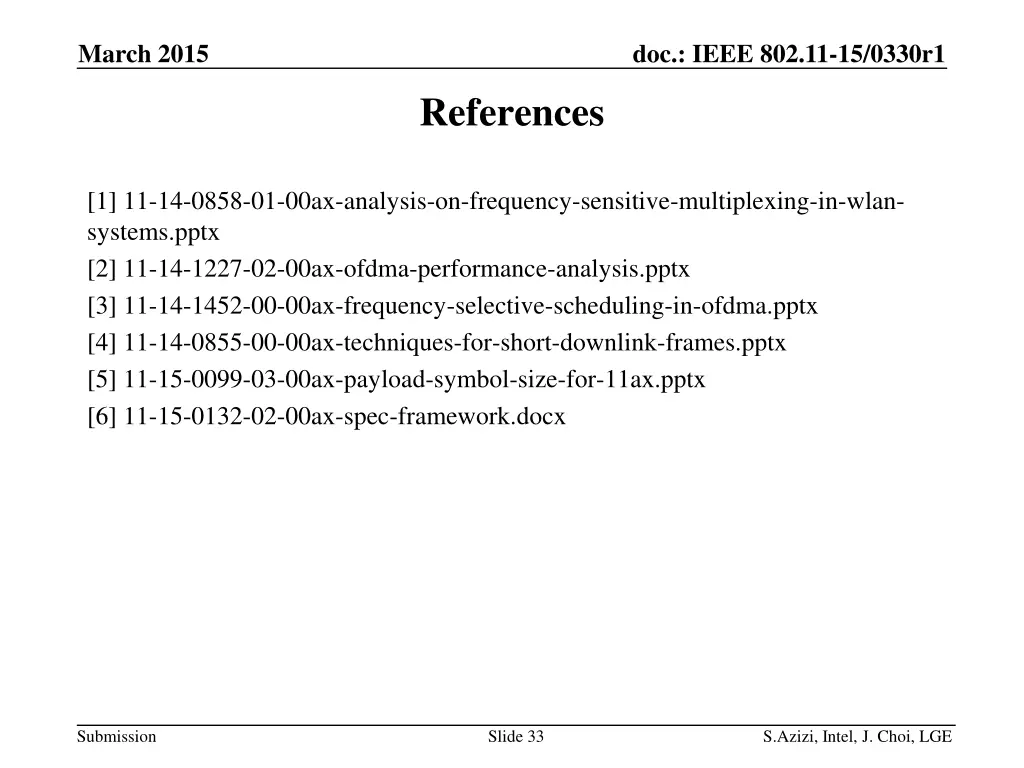
March 2015 doc.: IEEE 802.11-15/0330r1 References [1] 11-14-0858-01-00ax-analysis-on-frequency-sensitive-multiplexing-in-wlan- systems.pptx [2] 11-14-1227-02-00ax-ofdma-performance-analysis.pptx [3] 11-14-1452-00-00ax-frequency-selective-scheduling-in-ofdma.pptx [4] 11-14-0855-00-00ax-techniques-for-short-downlink-frames.pptx [5] 11-15-0099-03-00ax-payload-symbol-size-for-11ax.pptx [6] 11-15-0132-02-00ax-spec-framework.docx Submission Slide 33 S.Azizi, Intel, J. Choi, LGE
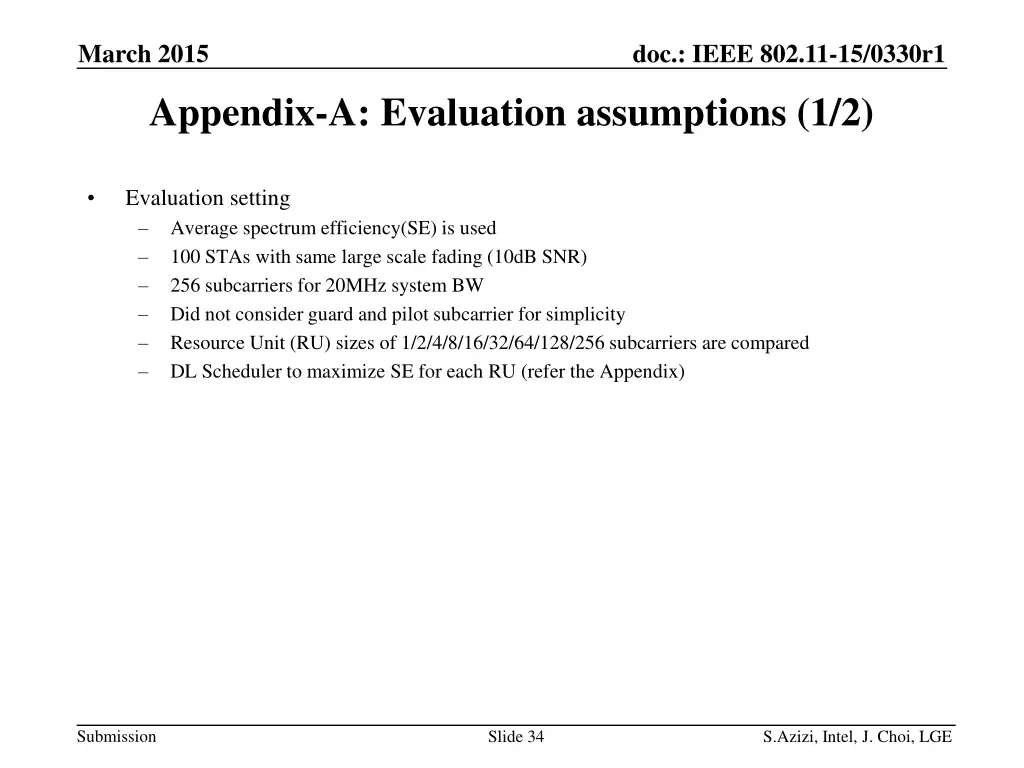
March 2015 doc.: IEEE 802.11-15/0330r1 Appendix-A: Evaluation assumptions (1/2) Evaluation setting Average spectrum efficiency(SE) is used 100 STAs with same large scale fading (10dB SNR) 256 subcarriers for 20MHz system BW Did not consider guard and pilot subcarrier for simplicity Resource Unit (RU) sizes of 1/2/4/8/16/32/64/128/256 subcarriers are compared DL Scheduler to maximize SE for each RU (refer the Appendix) Submission Slide 34 S.Azizi, Intel, J. Choi, LGE
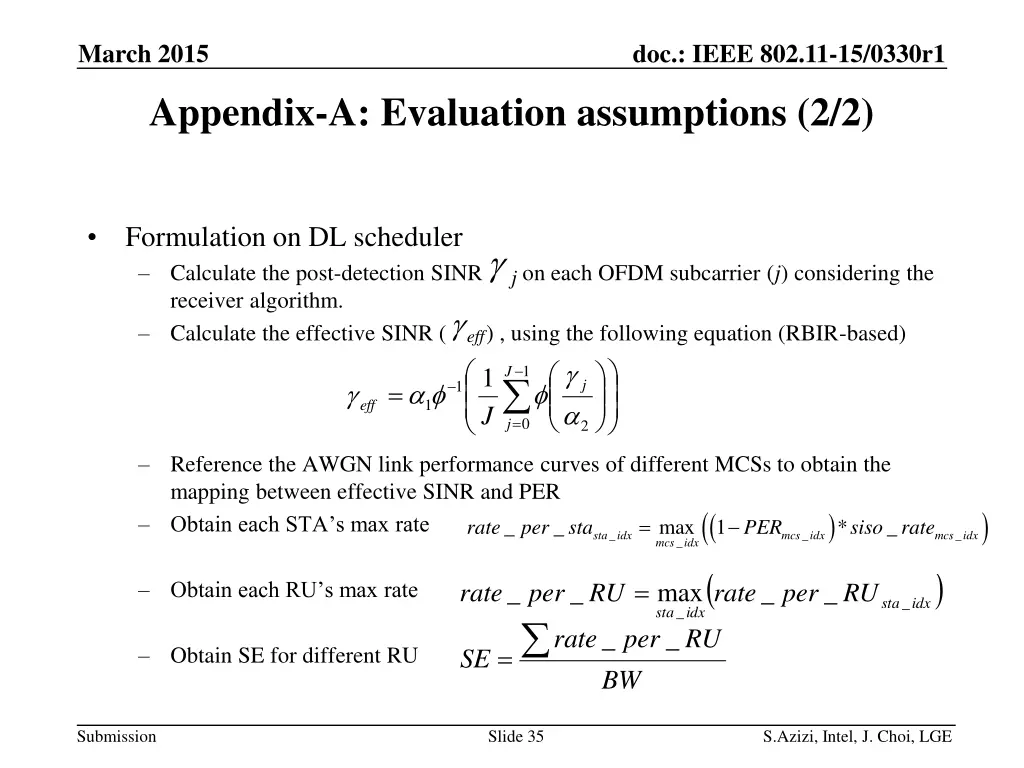
March 2015 doc.: IEEE 802.11-15/0330r1 Appendix-A: Evaluation assumptions (2/2) Formulation on DL scheduler Calculate the post-detection SINR on each OFDM subcarrier (j) considering the receiver algorithm. Calculate the effective SINR ( ) , using the following equation (RBIR-based) eff = = 0 j J j 1 1 J j 1 1 eff 2 Reference the AWGN link performance curves of different MCSs to obtain the mapping between effective SINR and PER Obtain each STA s max rate _ rate per ( ) ( ( ) = _ max mcs idx 1 * _ sta PER siso rate _ _ _ sta idx mcs idx mcs idx _ ) = Obtain each RU s max rate _ _ max _ _ rate per RU rate per RU _ sta idx _ sta idx SE = _ _ rate per RU Obtain SE for different RU BW Submission Slide 35 S.Azizi, Intel, J. Choi, LGE
March 2015 doc.: IEEE 802.11-15/0330r1 Appendix-B: PER, Tone Erasure, AWGN 20MHz 80MHz Submission Slide 36 S.Azizi, Intel, J. Choi, LGE
March 2015 doc.: IEEE 802.11-15/0330r1 Appendix-B: PER, Tone Erasure, D-NLOS 20MHz 80MHz Submission Slide 37 S.Azizi, Intel, J. Choi, LGE
March 2015 doc.: IEEE 802.11-15/0330r1 Appendix-B: PER, Tone Erasure, UMi-NLOS 20MHz 80MHz Submission Slide 38 S.Azizi, Intel, J. Choi, LGE