"Explore the Make Before Break concept in IEEE 802.11-20/0834r9 for seamless roaming with minimal data interruption. The proposal aims to enhance connectivity by allowing a partial connection with a new AP while maintaining the old AP link, reducing data delivery gaps during transitions."
Please find below an Image/Link to download the presentation.
The content on the website is provided AS IS for your information and personal use only. It may not be sold, licensed, or shared on other websites without obtaining consent from the author. If you encounter any issues during the download, it is possible that the publisher has removed the file from their server.
You are allowed to download the files provided on this website for personal or commercial use, subject to the condition that they are used lawfully. All files are the property of their respective owners.
The content on the website is provided AS IS for your information and personal use only. It may not be sold, licensed, or shared on other websites without obtaining consent from the author.
E N D
Presentation Transcript
doc.: IEEE 802.11-20/0834r9 Apr. 2020 Tentative Reassociation for Non-AP MLD Date: 2020-05-19 Authors: Name Affiliations Address Phone Email Guogang Huang huangguogang1@huawei.com Ming Gan ming.gan@huawei.com Yunbo Li liyunbo@huawei.com Huawei Shenzhen, China Yuchen Guo guoyuchen@huawei.com Yifan Zhou zhouyifan8@huawei.com Yiqing Li liyiqing3@huawei.com Submission Slide 1 Guogang Huang (Huawei)
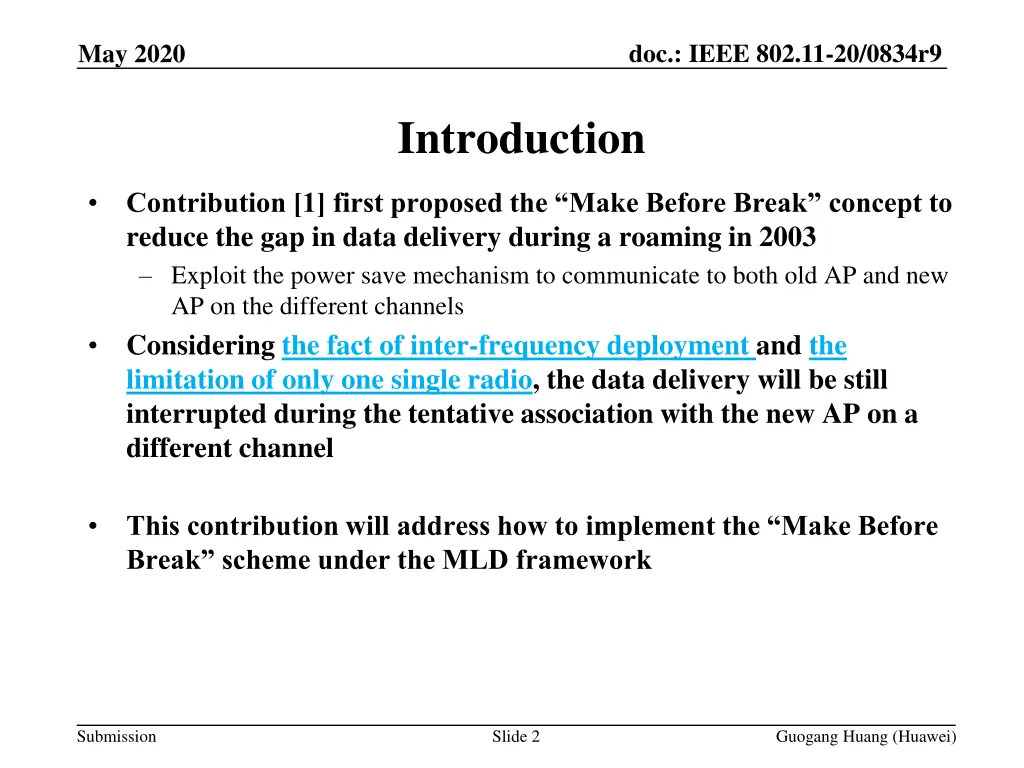
doc.: IEEE 802.11-20/0834r9 May 2020 Introduction Contribution [1] first proposed the Make Before Break concept to reduce the gap in data delivery during a roaming in 2003 Exploit the power save mechanism to communicate to both old AP and new AP on the different channels Considering the fact of inter-frequency deployment and the limitation of only one single radio, the data delivery will be still interrupted during the tentative association with the new AP on a different channel This contribution will address how to implement the Make Before Break scheme under the MLD framework Submission Slide 2 Guogang Huang (Huawei)
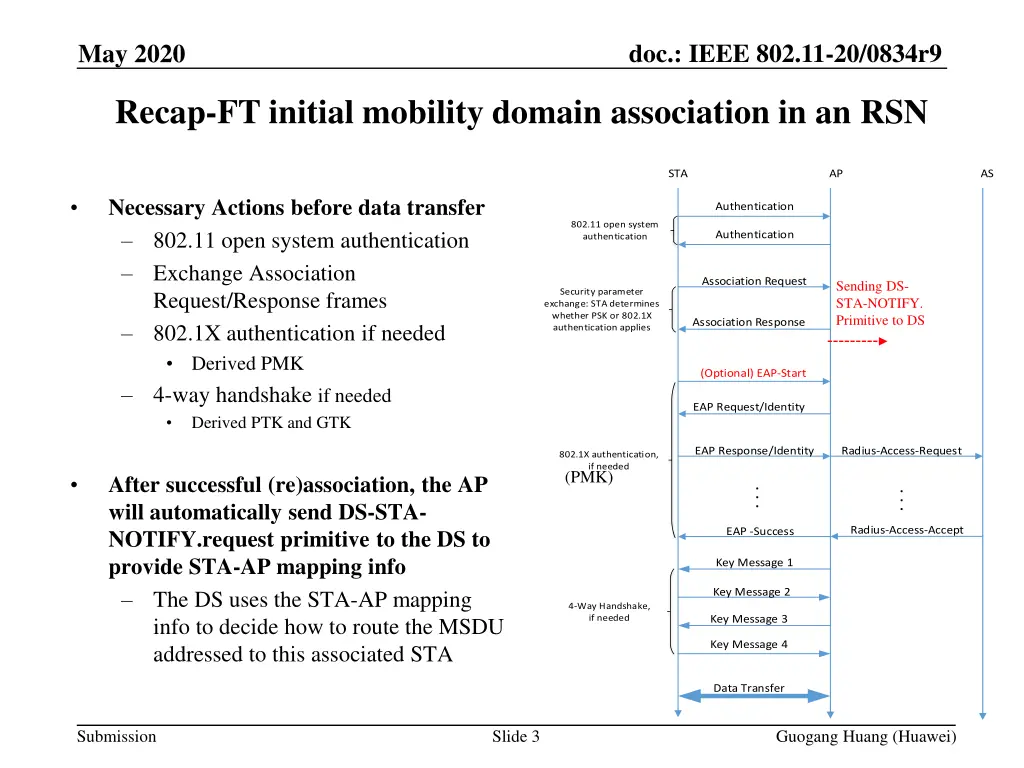
doc.: IEEE 802.11-20/0834r9 May 2020 Recap-FT initial mobility domain association in an RSN STA AP AS Necessary Actions before data transfer 802.11 open system authentication Exchange Association Request/Response frames 802.1X authentication if needed Derived PMK 4-way handshake if needed Derived PTK and GTK Authentication 802.11 open system authentication Authentication Association Request Sending DS- STA-NOTIFY. Primitive to DS Security parameter exchange: STA determines whether PSK or 802.1X authentication applies Association Response (Optional) EAP-Start EAP Request/Identity EAP Response/Identity Radius-Access-Request 802.1X authentication, if needed (PMK) After successful (re)association, the AP will automatically send DS-STA- NOTIFY.request primitive to the DS to provide STA-AP mapping info The DS uses the STA-AP mapping info to decide how to route the MSDU addressed to this associated STA ... ... Radius-Access-Accept EAP -Success Key Message 1 Key Message 2 4-Way Handshake, if needed Key Message 3 Key Message 4 Data Transfer Submission Slide 3 Guogang Huang (Huawei)
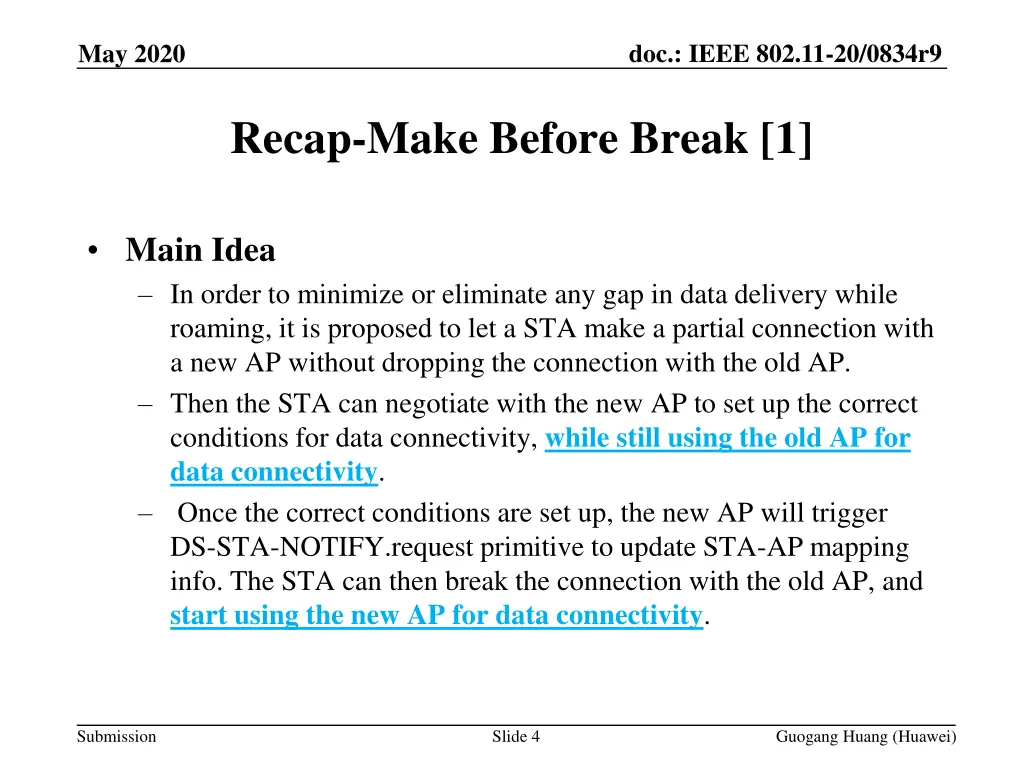
doc.: IEEE 802.11-20/0834r9 May 2020 Recap-Make Before Break [1] Main Idea In order to minimize or eliminate any gap in data delivery while roaming, it is proposed to let a STA make a partial connection with a new AP without dropping the connection with the old AP. Then the STA can negotiate with the new AP to set up the correct conditions for data connectivity, while still using the old AP for data connectivity. Once the correct conditions are set up, the new AP will trigger DS-STA-NOTIFY.request primitive to update STA-AP mapping info. The STA can then break the connection with the old AP, and start using the new AP for data connectivity. Submission Slide 4 Guogang Huang (Huawei)
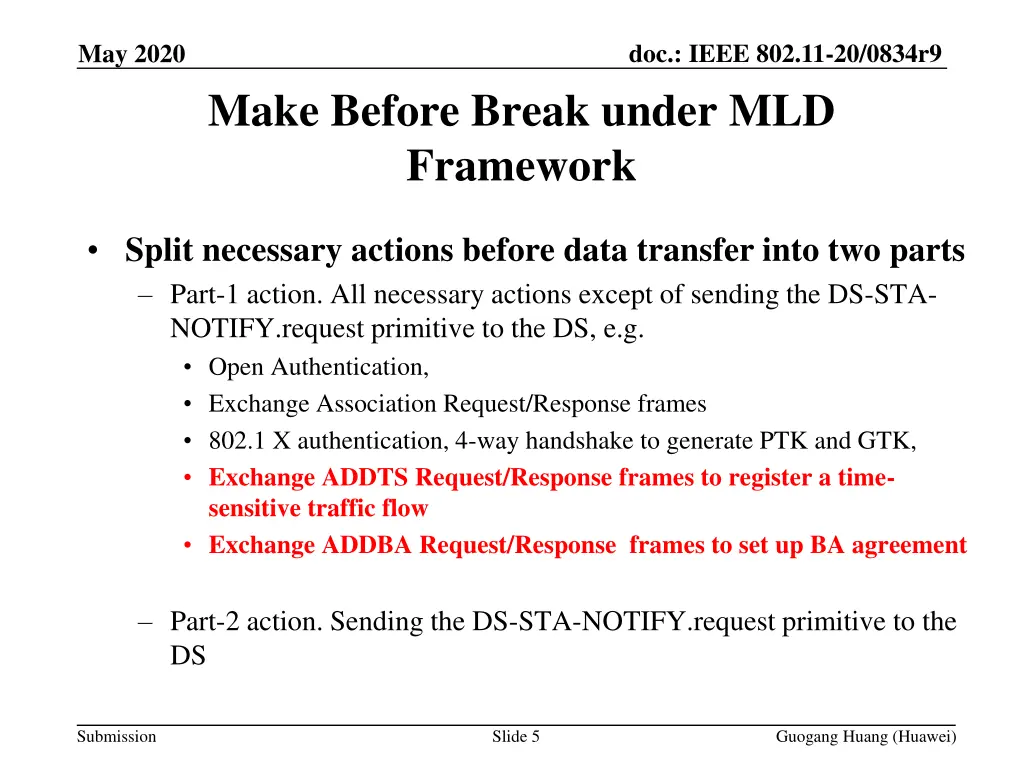
doc.: IEEE 802.11-20/0834r9 May 2020 Make Before Break under MLD Framework Split necessary actions before data transfer into two parts Part-1 action. All necessary actions except of sending the DS-STA- NOTIFY.request primitive to the DS, e.g. Open Authentication, Exchange Association Request/Response frames 802.1 X authentication, 4-way handshake to generate PTK and GTK, Exchange ADDTS Request/Response frames to register a time- sensitive traffic flow Exchange ADDBA Request/Response frames to set up BA agreement Part-2 action. Sending the DS-STA-NOTIFY.request primitive to the DS Submission Slide 5 Guogang Huang (Huawei)
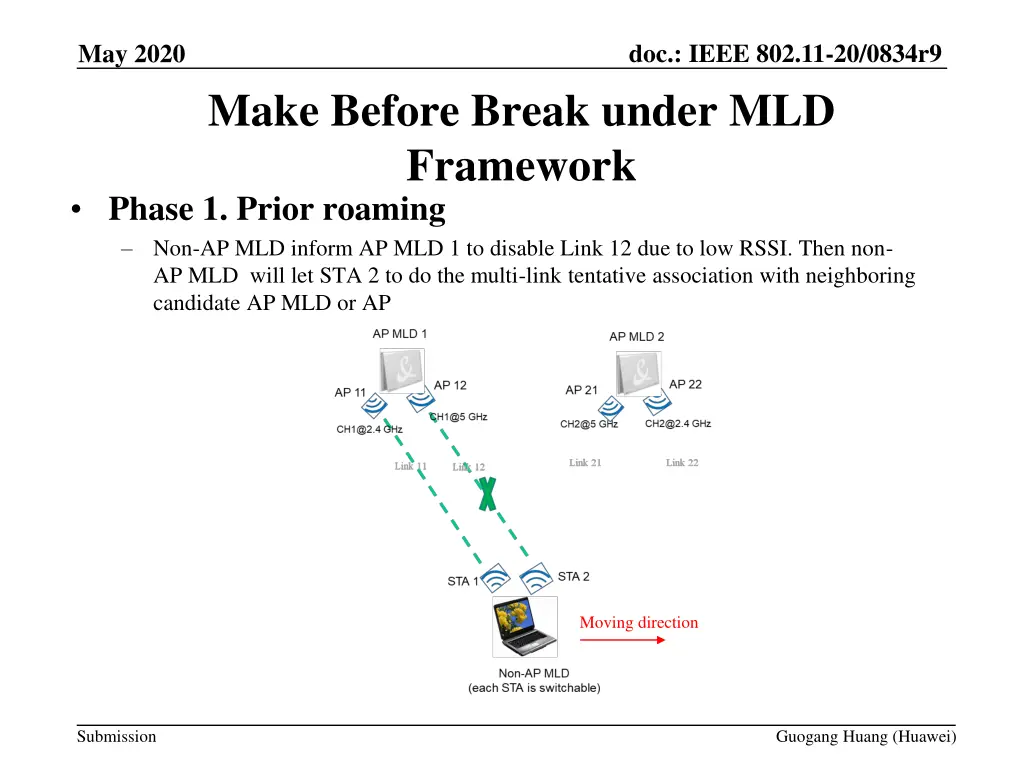
doc.: IEEE 802.11-20/0834r9 May 2020 Make Before Break under MLD Framework Phase 1. Prior roaming Non-AP MLD inform AP MLD 1 to disable Link 12 due to low RSSI. Then non- AP MLD will let STA 2 to do the multi-link tentative association with neighboring candidate AP MLD or AP Moving direction Submission Guogang Huang (Huawei)
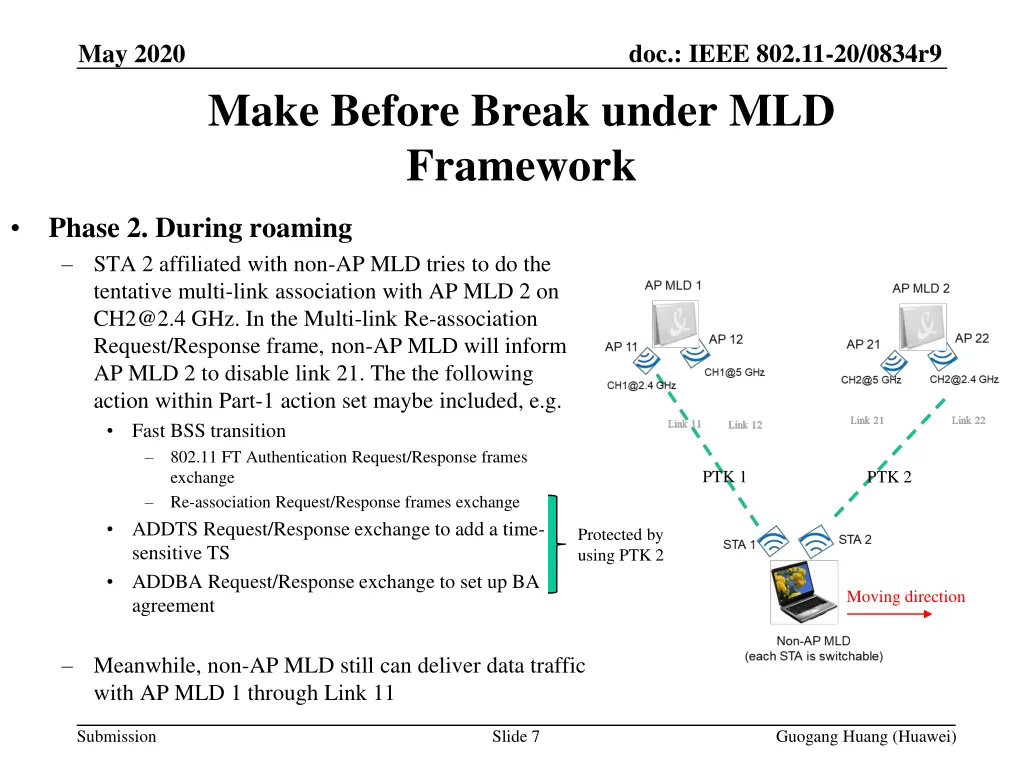
doc.: IEEE 802.11-20/0834r9 May 2020 Make Before Break under MLD Framework Phase 2. During roaming STA 2 affiliated with non-AP MLD tries to do the tentative multi-link association with AP MLD 2 on CH2@2.4 GHz. In the Multi-link Re-association Request/Response frame, non-AP MLD will inform AP MLD 2 to disable link 21. The the following action within Part-1 action set maybe included, e.g. Fast BSS transition 802.11 FT Authentication Request/Response frames exchange Re-association Request/Response frames exchange ADDTS Request/Response exchange to add a time- sensitive TS ADDBA Request/Response exchange to set up BA agreement PTK 1 PTK 2 Protected by using PTK 2 Moving direction Meanwhile, non-AP MLD still can deliver data traffic with AP MLD 1 through Link 11 Submission Slide 7 Guogang Huang (Huawei)
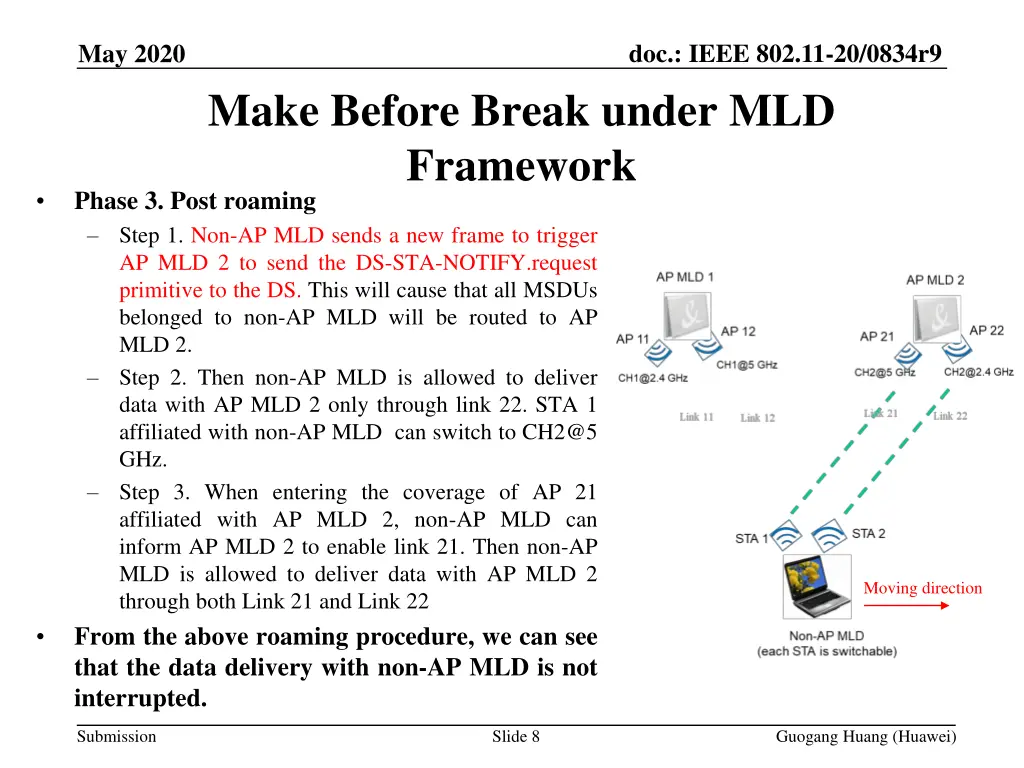
doc.: IEEE 802.11-20/0834r9 May 2020 Make Before Break under MLD Framework Phase 3. Post roaming Step 1. Non-AP MLD sends a new frame to trigger AP MLD 2 to send the DS-STA-NOTIFY.request primitive to the DS. This will cause that all MSDUs belonged to non-AP MLD will be routed to AP MLD 2. Step 2. Then non-AP MLD is allowed to deliver data with AP MLD 2 only through link 22. STA 1 affiliated with non-AP MLD can switch to CH2@5 GHz. Step 3. When entering the coverage of AP 21 affiliated with AP MLD 2, non-AP MLD can inform AP MLD 2 to enable link 21. Then non-AP MLD is allowed to deliver data with AP MLD 2 through both Link 21 and Link 22 From the above roaming procedure, we can see that the data delivery with non-AP MLD is not interrupted. Moving direction Submission Slide 8 Guogang Huang (Huawei)
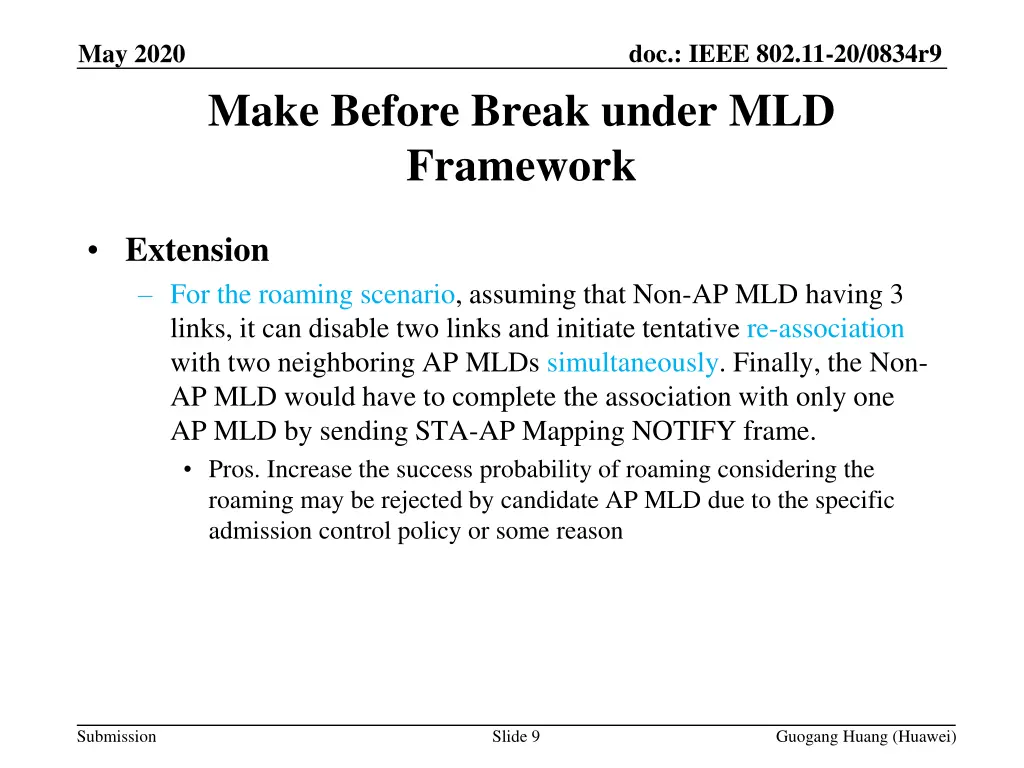
doc.: IEEE 802.11-20/0834r9 May 2020 Make Before Break under MLD Framework Extension For the roaming scenario, assuming that Non-AP MLD having 3 links, it can disable two links and initiate tentative re-association with two neighboring AP MLDs simultaneously. Finally, the Non- AP MLD would have to complete the association with only one AP MLD by sending STA-AP Mapping NOTIFY frame. Pros. Increase the success probability of roaming considering the roaming may be rejected by candidate AP MLD due to the specific admission control policy or some reason Submission Slide 9 Guogang Huang (Huawei)
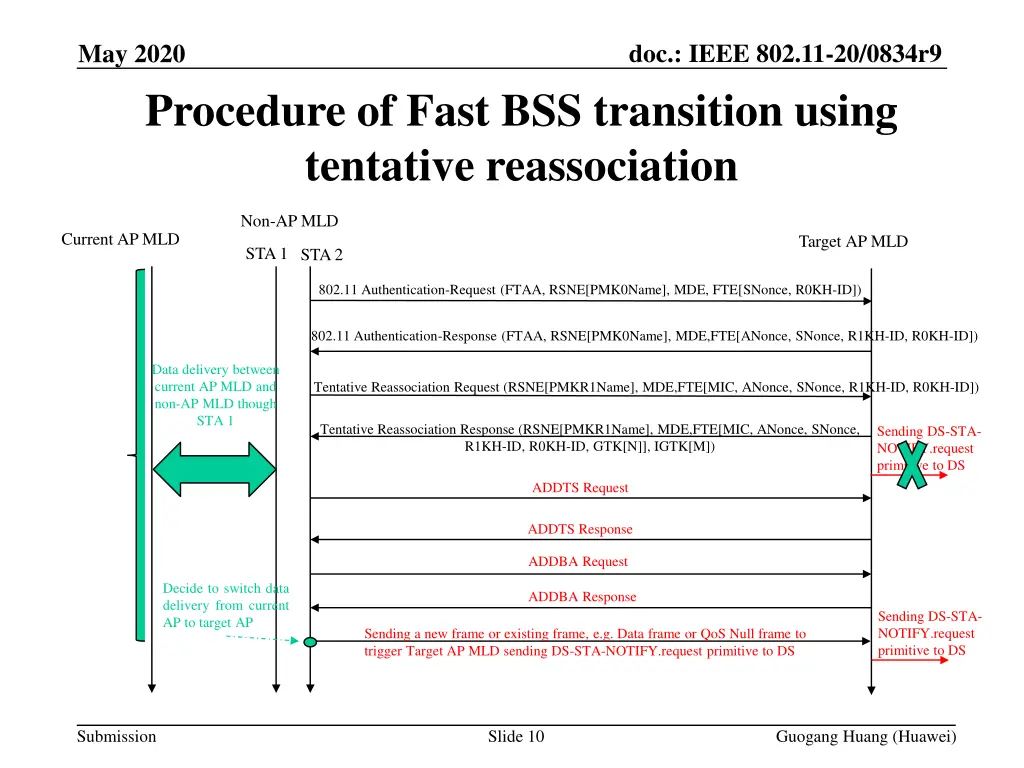
doc.: IEEE 802.11-20/0834r9 May 2020 Procedure of Fast BSS transition using tentative reassociation Non-AP MLD Current AP MLD Target AP MLD STA 1 STA 2 802.11 Authentication-Request (FTAA, RSNE[PMK0Name], MDE, FTE[SNonce, R0KH-ID]) 802.11 Authentication-Response (FTAA, RSNE[PMK0Name], MDE,FTE[ANonce, SNonce, R1KH-ID, R0KH-ID]) Data delivery between current AP MLD and non-AP MLD though STA 1 Tentative Reassociation Request (RSNE[PMKR1Name], MDE,FTE[MIC, ANonce, SNonce, R1KH-ID, R0KH-ID]) Tentative Reassociation Response (RSNE[PMKR1Name], MDE,FTE[MIC, ANonce, SNonce, R1KH-ID, R0KH-ID, GTK[N]], IGTK[M]) Sending DS-STA- NOTIFY.request primitive to DS ADDTS Request ADDTS Response ADDBA Request Decide to switch data delivery from current AP to target AP ADDBA Response Sending DS-STA- NOTIFY.request primitive to DS Sending a new frame or existing frame, e.g. Data frame or QoS Null frame to trigger Target AP MLD sending DS-STA-NOTIFY.request primitive to DS Submission Slide 10 Guogang Huang (Huawei)
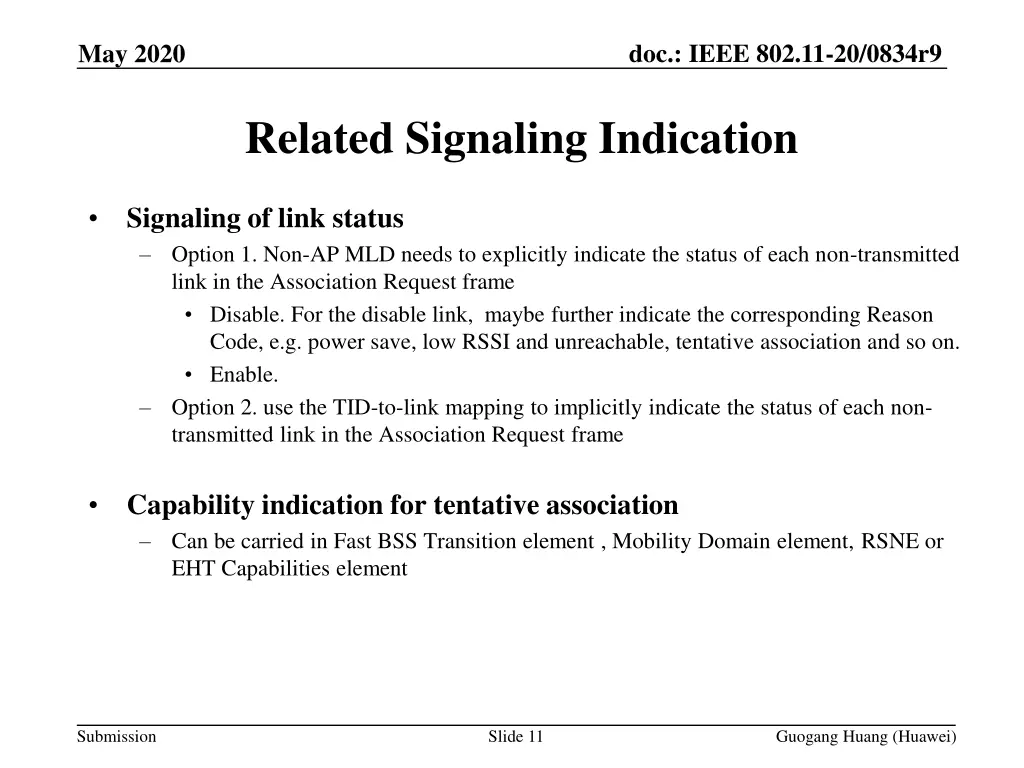
doc.: IEEE 802.11-20/0834r9 May 2020 Related Signaling Indication Signaling of link status Option 1. Non-AP MLD needs to explicitly indicate the status of each non-transmitted link in the Association Request frame Disable. For the disable link, maybe further indicate the corresponding Reason Code, e.g. power save, low RSSI and unreachable, tentative association and so on. Enable. Option 2. use the TID-to-link mapping to implicitly indicate the status of each non- transmitted link in the Association Request frame Capability indication for tentative association Can be carried in Fast BSS Transition element , Mobility Domain element, RSNE or EHT Capabilities element Submission Slide 11 Guogang Huang (Huawei)
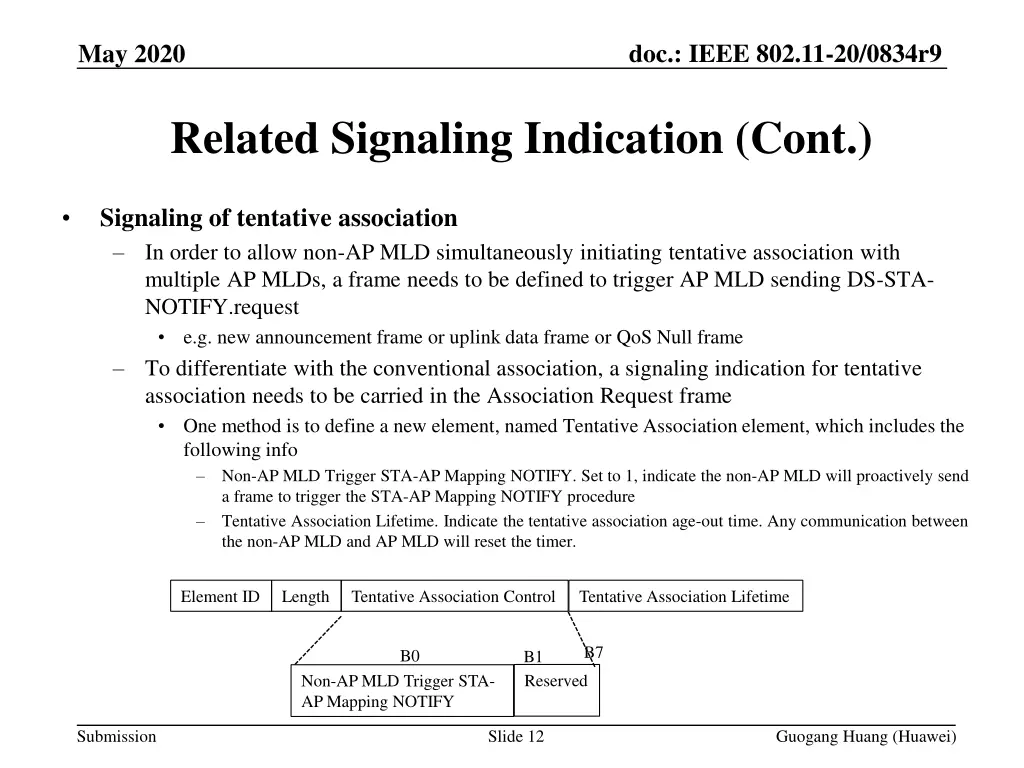
doc.: IEEE 802.11-20/0834r9 May 2020 Related Signaling Indication (Cont.) Signaling of tentative association In order to allow non-AP MLD simultaneously initiating tentative association with multiple AP MLDs, a frame needs to be defined to trigger AP MLD sending DS-STA- NOTIFY.request e.g. new announcement frame or uplink data frame or QoS Null frame To differentiate with the conventional association, a signaling indication for tentative association needs to be carried in the Association Request frame One method is to define a new element, named Tentative Association element, which includes the following info Non-AP MLD Trigger STA-AP Mapping NOTIFY. Set to 1, indicate the non-AP MLD will proactively send a frame to trigger the STA-AP Mapping NOTIFY procedure Tentative Association Lifetime. Indicate the tentative association age-out time. Any communication between the non-AP MLD and AP MLD will reset the timer. Element ID Length Tentative Association Control Tentative Association Lifetime B7 B0 B1 Reserved Non-AP MLD Trigger STA- AP Mapping NOTIFY Submission Slide 12 Guogang Huang (Huawei)
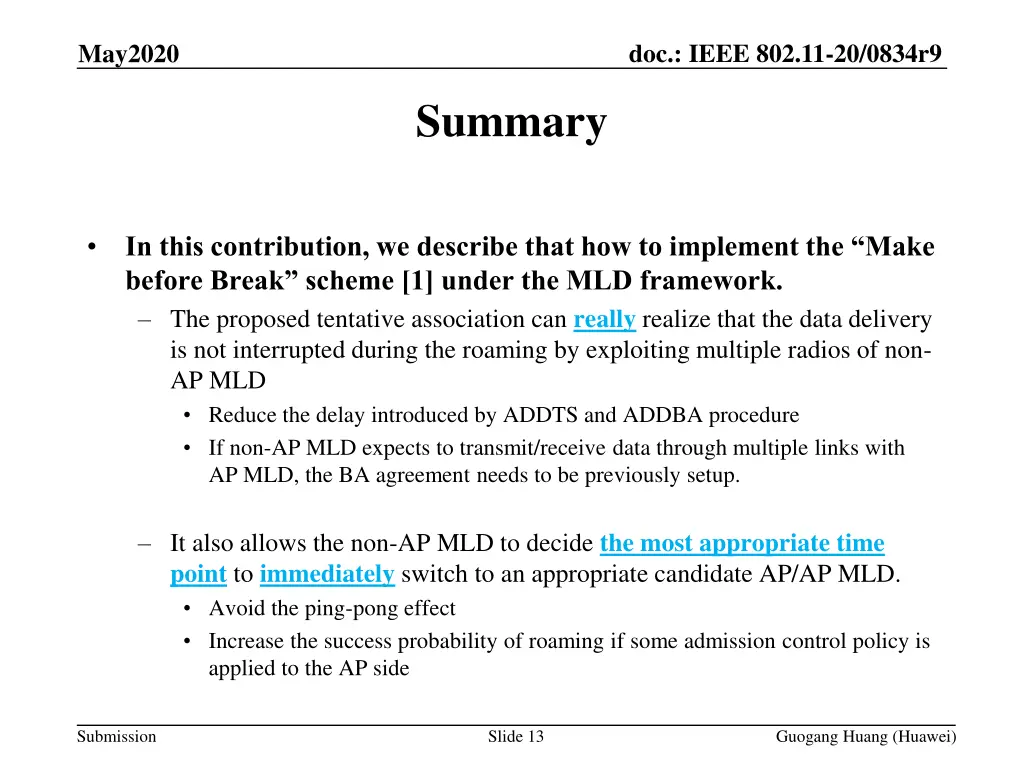
doc.: IEEE 802.11-20/0834r9 May2020 Summary In this contribution, we describe that how to implement the Make before Break scheme [1] under the MLD framework. The proposed tentative association can really realize that the data delivery is not interrupted during the roaming by exploiting multiple radios of non- AP MLD Reduce the delay introduced by ADDTS and ADDBA procedure If non-AP MLD expects to transmit/receive data through multiple links with AP MLD, the BA agreement needs to be previously setup. It also allows the non-AP MLD to decide the most appropriate time point to immediately switch to an appropriate candidate AP/AP MLD. Avoid the ping-pong effect Increase the success probability of roaming if some admission control policy is applied to the AP side Submission Slide 13 Guogang Huang (Huawei)
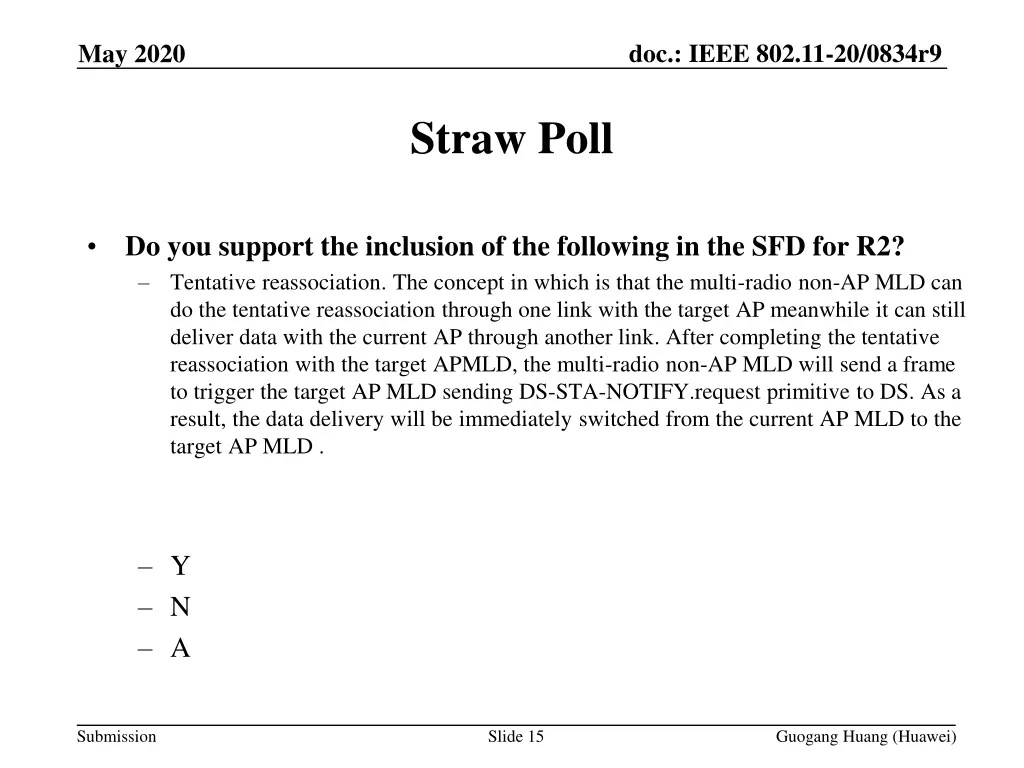
doc.: IEEE 802.11-20/0834r9 May 2020 Straw Poll Do you support the inclusion of the following in the SFD for R2? Tentative reassociation. The concept in which is that the multi-radio non-AP MLD can do the tentative reassociation through one link with the target AP meanwhile it can still deliver data with the current AP through another link. After completing the tentative reassociation with the target APMLD, the multi-radio non-AP MLD will send a frame to trigger the target AP MLD sending DS-STA-NOTIFY.request primitive to DS. As a result, the data delivery will be immediately switched from the current AP MLD to the target AP MLD . Y N A Submission Slide 15 Guogang Huang (Huawei)
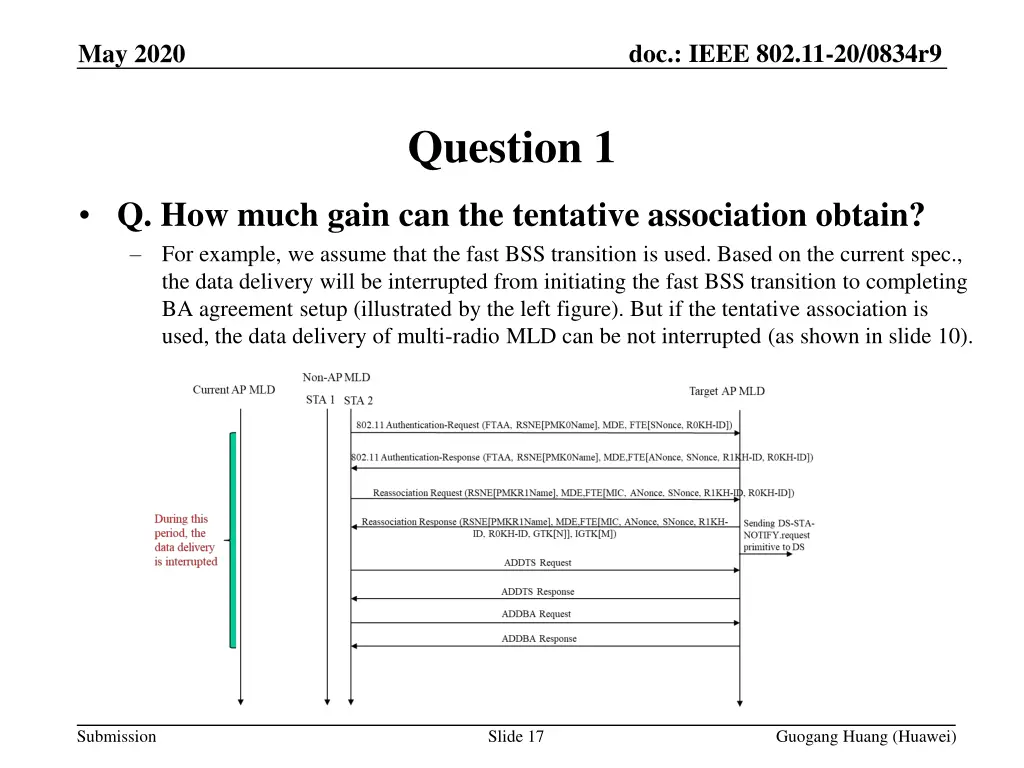
doc.: IEEE 802.11-20/0834r9 May 2020 Question 1 Q. How much gain can the tentative association obtain? For example, we assume that the fast BSS transition is used. Based on the current spec., the data delivery will be interrupted from initiating the fast BSS transition to completing BA agreement setup (illustrated by the left figure). But if the tentative association is used, the data delivery of multi-radio MLD can be not interrupted (as shown in slide 10). Submission Slide 17 Guogang Huang (Huawei)
doc.: IEEE 802.11-20/0834r9 May 2020 Question 2 Q: In the current Spec., when does the AP send the DS- STA-NOTIFY.request primitive to DS? The current Spec. doesn t clearly define when the AP sending the DS-STA-NOTIFY.request primitive to DS. But from the text, we can interpret that the AP will automatically send DS-STA- NOTIFY.request primitive to the DS after successful association. Submission Slide 18 Guogang Huang (Huawei)
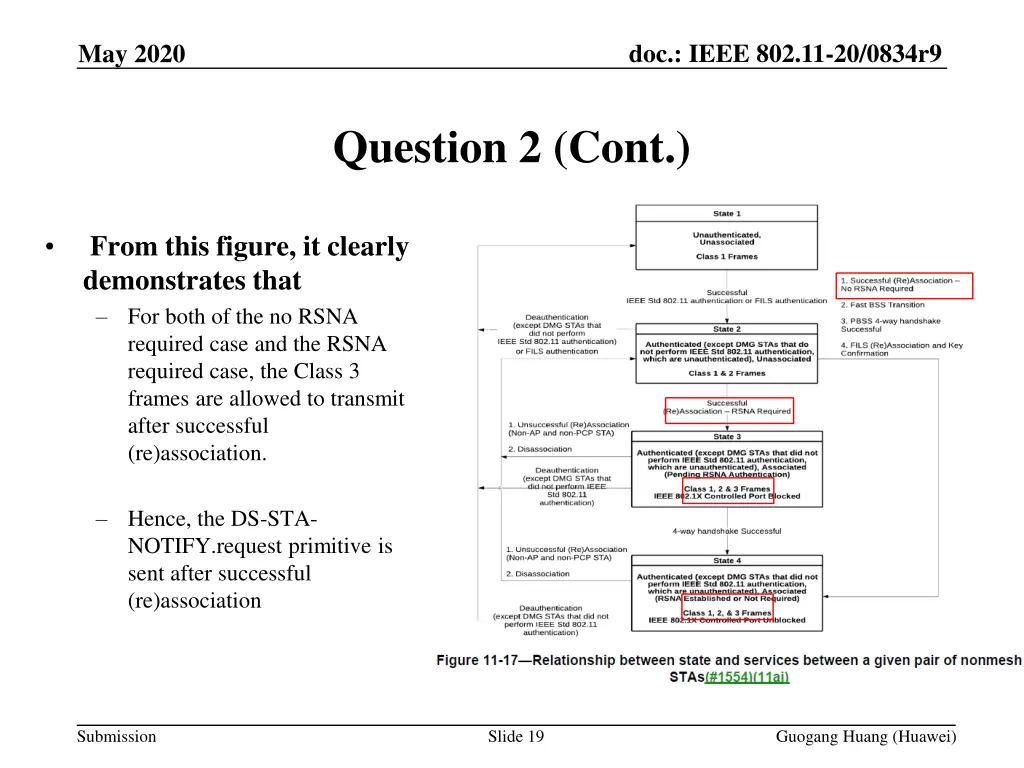
doc.: IEEE 802.11-20/0834r9 May 2020 Question 2 (Cont.) From this figure, it clearly demonstrates that For both of the no RSNA required case and the RSNA required case, the Class 3 frames are allowed to transmit after successful (re)association. Hence, the DS-STA- NOTIFY.request primitive is sent after successful (re)association Submission Slide 19 Guogang Huang (Huawei)
doc.: IEEE 802.11-20/0834r9 May 2020 Question 3 Q: If changing the time of sending DS-STA-NOTIFY.request primitive to DS, whether it will impact to the current 802.1X authentication and 4-way handshake? No impact to the current 802.1X authentication and 4-way handshake. Because during IEEE 802.1X authentication, AP served as an intermediary agent between STA and Authentication Server. That means that the DS doesn t need to know the STA-AP mapping info in this period. Another evidence is that the current Spec. supports to do the 802.1X preauthentication with multiple neighboring APs through the DS. Preauthentication is a complete 802.1X exchange. Since some IEEE 802.1X Authenticators may not bridge IEEE 802.1X frames, preauthentication uses a distinct EtherType to enable such devices to bridge preauthentication frames [2]. Note. A single IEEE 802.1X Port maps to one association, and each association maps to an IEEE 802.1X Port. Each association between a pair of STAs creates a unique pair of IEEE 802.1X Ports, and authentication takes place relative to those ports alone. An IEEE 802.1X Port consists of an IEEE 802.1X Controlled Port and an IEEE 802.1X Uncontrolled Port. IEEE 802.1X EAPOL PDUs are carried as MSDUs within one or more Data frames and passed via the IEEE 802.1X Uncontrolled Port. The IEEE 802.1X Controlled Port is blocked from passing general data traffic between two STAs until an IEEE 802.1X authentication procedure completes successfully over the IEEE 802.1X Uncontrolled Port. Submission Slide 20 Guogang Huang (Huawei)
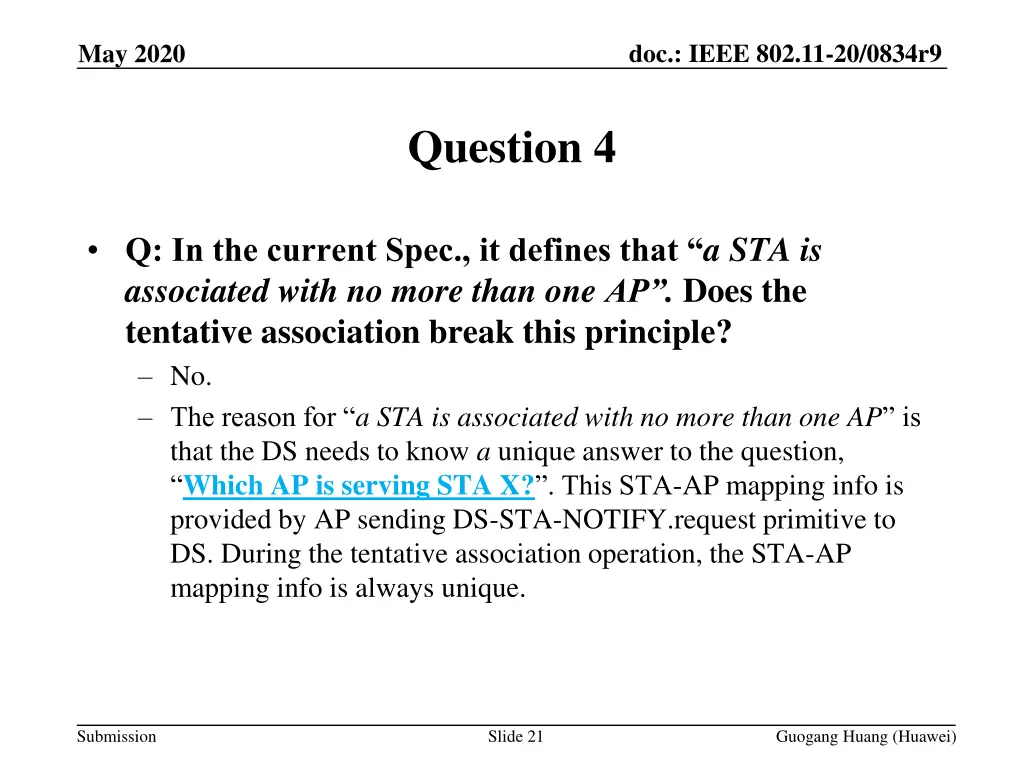
doc.: IEEE 802.11-20/0834r9 May 2020 Question 4 Q: In the current Spec., it defines that a STA is associated with no more than one AP . Does the tentative association break this principle? No. The reason for a STA is associated with no more than one AP is that the DS needs to know a unique answer to the question, Which AP is serving STA X? . This STA-AP mapping info is provided by AP sending DS-STA-NOTIFY.request primitive to DS. During the tentative association operation, the STA-AP mapping info is always unique. Submission Slide 21 Guogang Huang (Huawei)
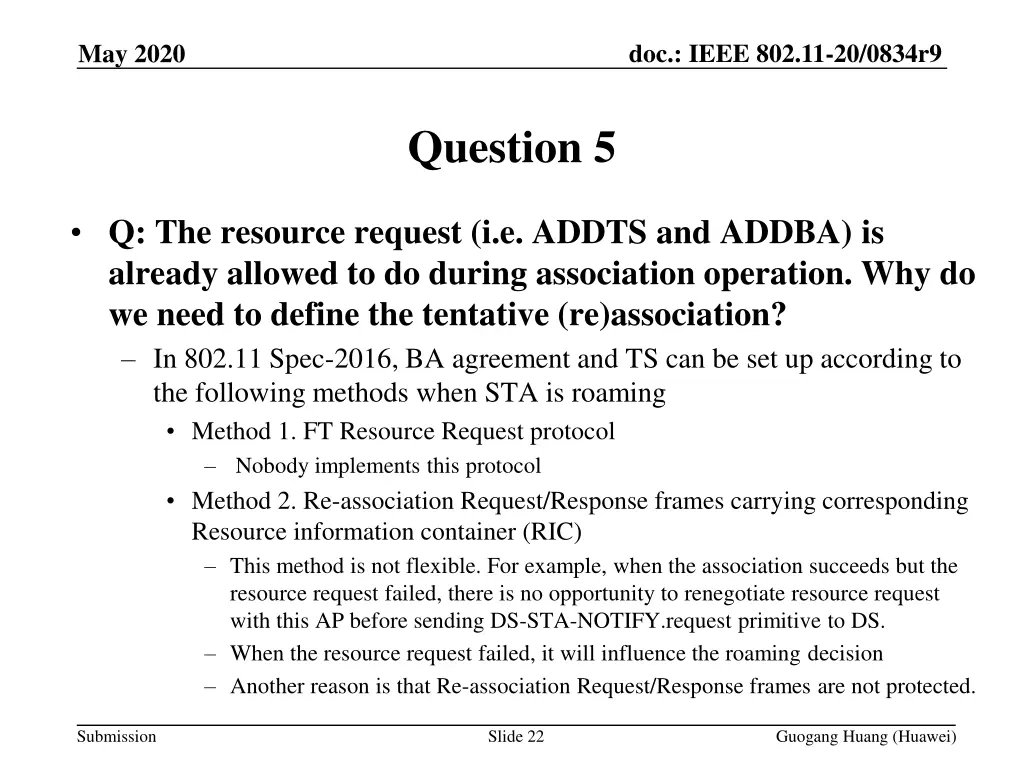
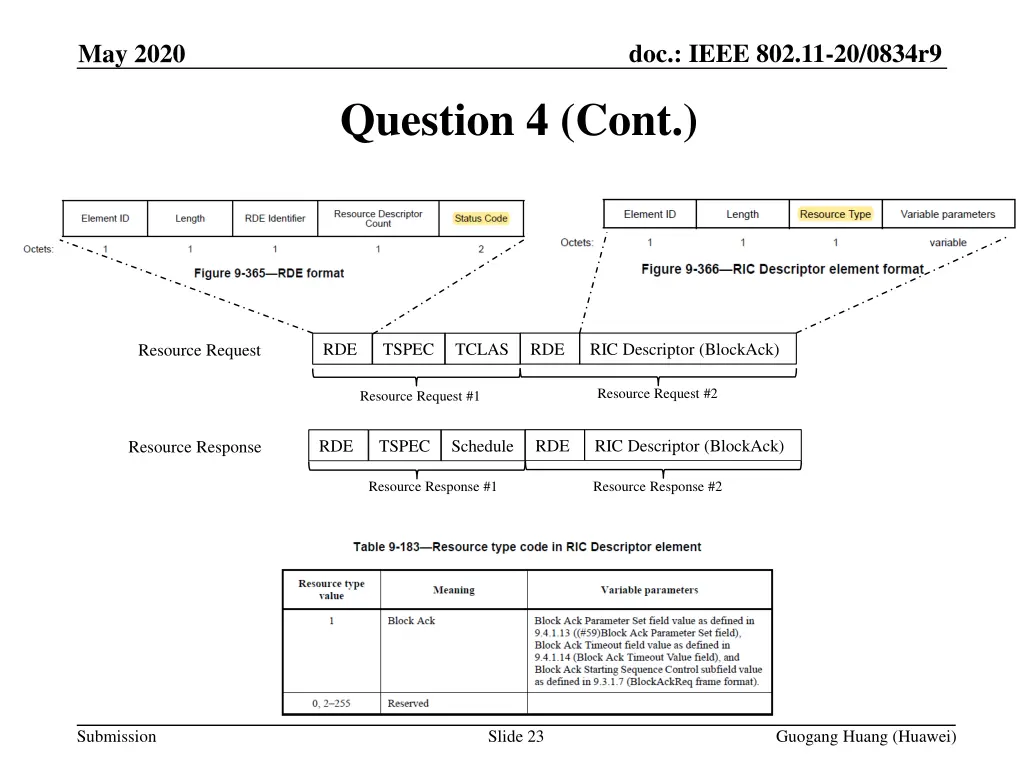
doc.: IEEE 802.11-20/0834r9 May 2020 Question 5 Q: The resource request (i.e. ADDTS and ADDBA) is already allowed to do during association operation. Why do we need to define the tentative (re)association? In 802.11 Spec-2016, BA agreement and TS can be set up according to the following methods when STA is roaming Method 1. FT Resource Request protocol Nobody implements this protocol Method 2. Re-association Request/Response frames carrying corresponding Resource information container (RIC) This method is not flexible. For example, when the association succeeds but the resource request failed, there is no opportunity to renegotiate resource request with this AP before sending DS-STA-NOTIFY.request primitive to DS. When the resource request failed, it will influence the roaming decision Another reason is that Re-association Request/Response frames are not protected. Submission Slide 22 Guogang Huang (Huawei)