Explore the enhancements in IEEE 802.11-21/1611r0 addressing load balancing, low latency, MLO advantages, and state of the draft proposal. Understand the motivation behind these enhancements for enterprise APs and non-AP STAs, emphasizing the importance of marketing value and responsible MLO implementation.
Please find below an Image/Link to download the presentation.
The content on the website is provided AS IS for your information and personal use only. It may not be sold, licensed, or shared on other websites without obtaining consent from the author. If you encounter any issues during the download, it is possible that the publisher has removed the file from their server.
You are allowed to download the files provided on this website for personal or commercial use, subject to the condition that they are used lawfully. All files are the property of their respective owners.
The content on the website is provided AS IS for your information and personal use only. It may not be sold, licensed, or shared on other websites without obtaining consent from the author.
E N D
Presentation Transcript
doc.: IEEE 802.11-21/1611r0 Sep 2021 TID to Link Mapping Enhancements Date: 2021-09-30 Authors: Name Affiliations Address Phone Email Pooya Monajemi pmonajem@cisco.com Brian Hart brianh@cisco.com Cisco Malcolm Smith mmsmith@cisco.com Submission Slide 1 Pooya Monajemi, Cisco
doc.: IEEE 802.11-21/1611r0 Sep 2021 Motivation 1/2 Enterprise APs support a number of features today To help all STAs, and solve real deployment problems. Relevant here is load balancing between bands because APs, with concurrent radios and not being as energy constrained as clients, have greater visibility on instantaneous and recent load on all bands For MLO to be widely enabled, MLO needs to support and enhance those practically-necessary features, not undermine them. Wider discussions indicate IEEE needs more focus on marketing value of 11be Responsibly enabling MLO Today an enterprise AP can manage 200+200+200 clients. Great challenges will arise with this number of clients in MLO mode MLO with all-to-all will increase congestion, which can undermine the value of MLO and in fact performance can go significantly backwards. See Ref [3] As the number of contending clients varies, it becomes necessary to dynamically enable MLO when congestion levels are suitable or smoothly revert to known-good (non-MLO) configuration Low Latency Potentially the most valuable aspect of 11be in many deployments AP may move clients with low-latency applications to clean links Submission Slide 2 Pooya Monajemi, Cisco
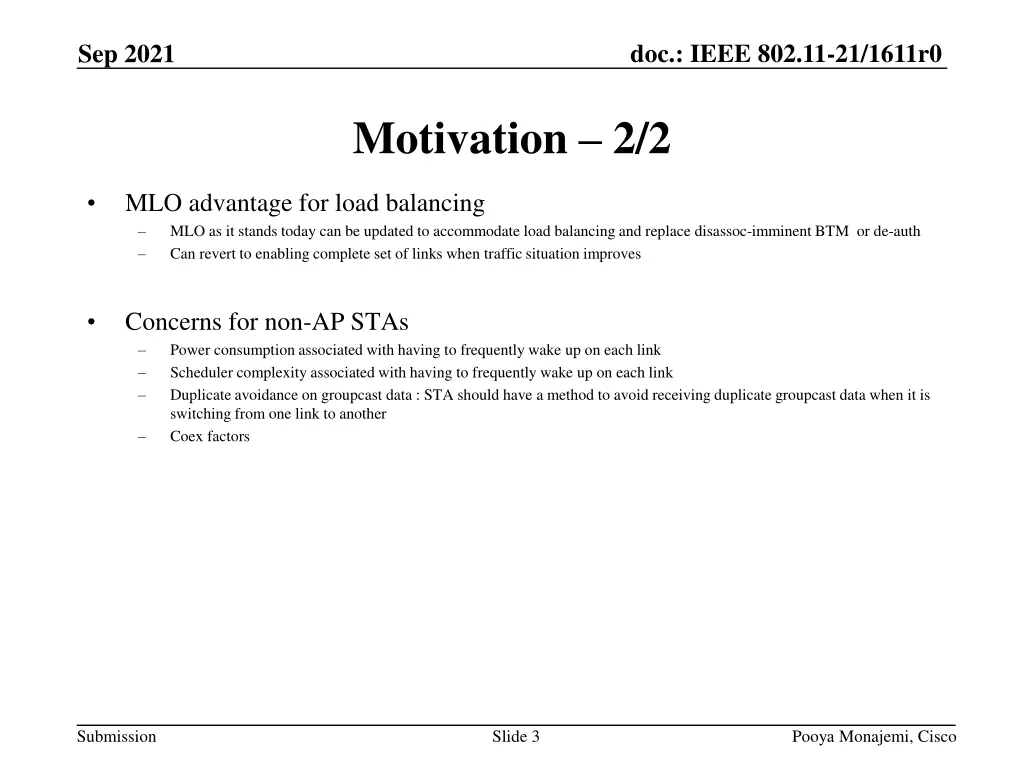
doc.: IEEE 802.11-21/1611r0 Sep 2021 Motivation 2/2 MLO advantage for load balancing MLO as it stands today can be updated to accommodate load balancing and replace disassoc-imminent BTM or de-auth Can revert to enabling complete set of links when traffic situation improves Concerns for non-AP STAs Power consumption associated with having to frequently wake up on each link Scheduler complexity associated with having to frequently wake up on each link Duplicate avoidance on groupcast data : STA should have a method to avoid receiving duplicate groupcast data when it is switching from one link to another Coex factors Submission Slide 3 Pooya Monajemi, Cisco
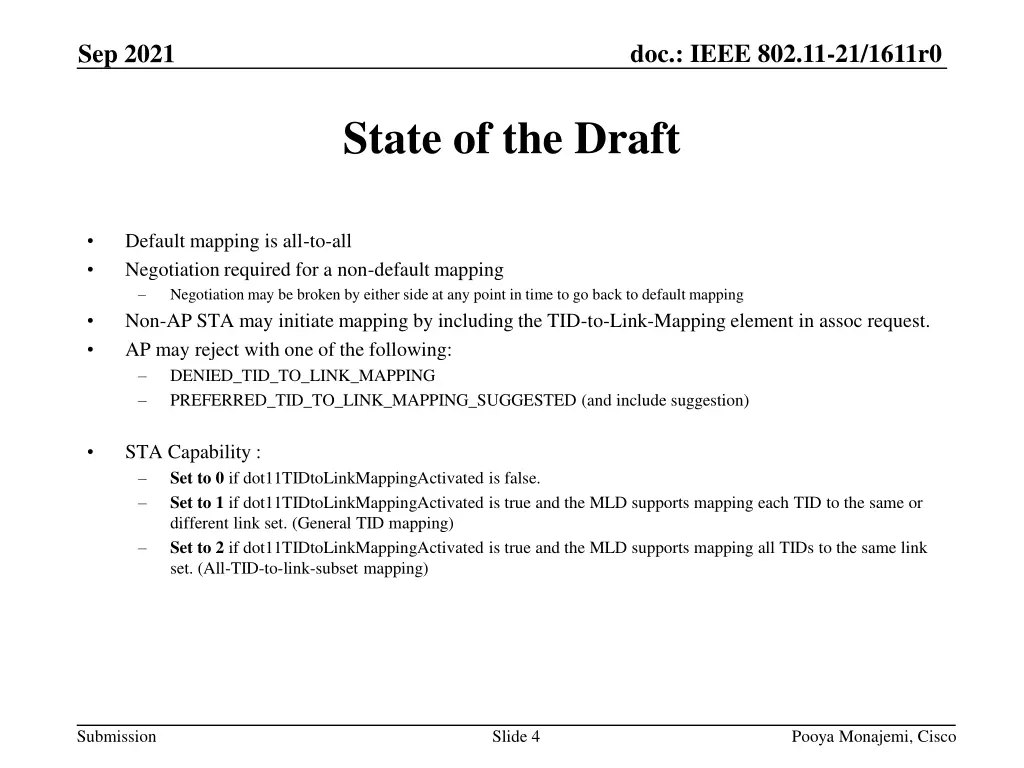
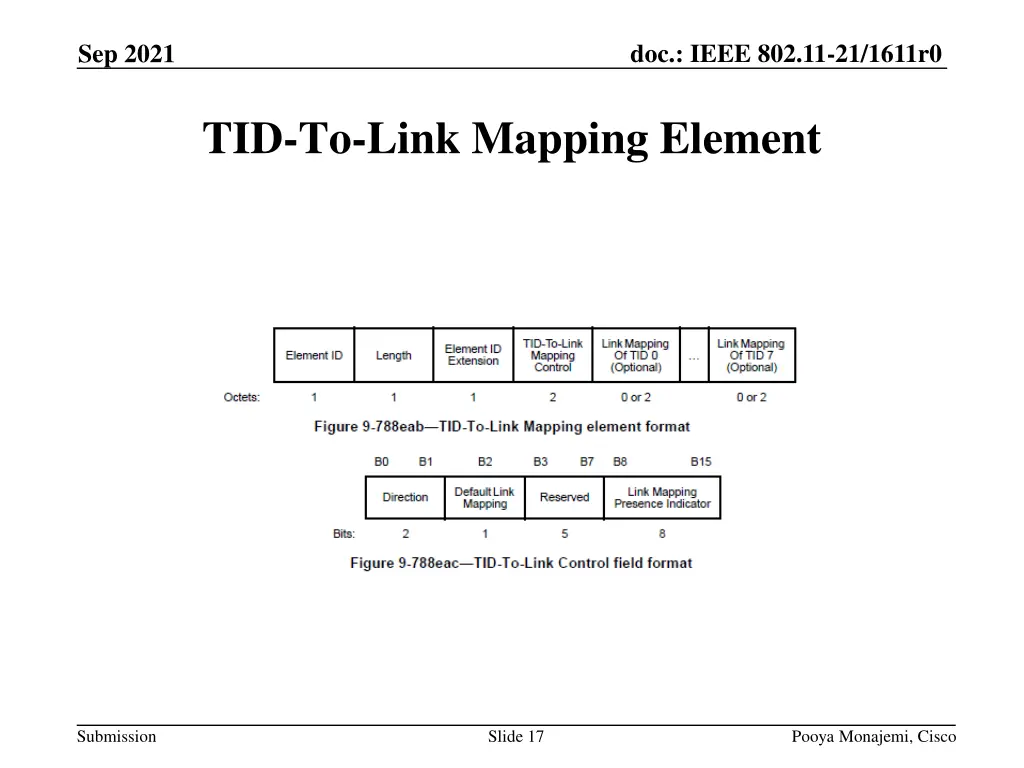
doc.: IEEE 802.11-21/1611r0 Sep 2021 State of the Draft Default mapping is all-to-all Negotiation required for a non-default mapping Negotiation may be broken by either side at any point in time to go back to default mapping Non-AP STA may initiate mapping by including the TID-to-Link-Mapping element in assoc request. AP may reject with one of the following: DENIED_TID_TO_LINK_MAPPING PREFERRED_TID_TO_LINK_MAPPING_SUGGESTED (and include suggestion) STA Capability : Set to 0 if dot11TIDtoLinkMappingActivated is false. Set to 1 if dot11TIDtoLinkMappingActivated is true and the MLD supports mapping each TID to the same or different link set. (General TID mapping) Set to 2 if dot11TIDtoLinkMappingActivated is true and the MLD supports mapping all TIDs to the same link set. (All-TID-to-link-subset mapping) Submission Slide 4 Pooya Monajemi, Cisco
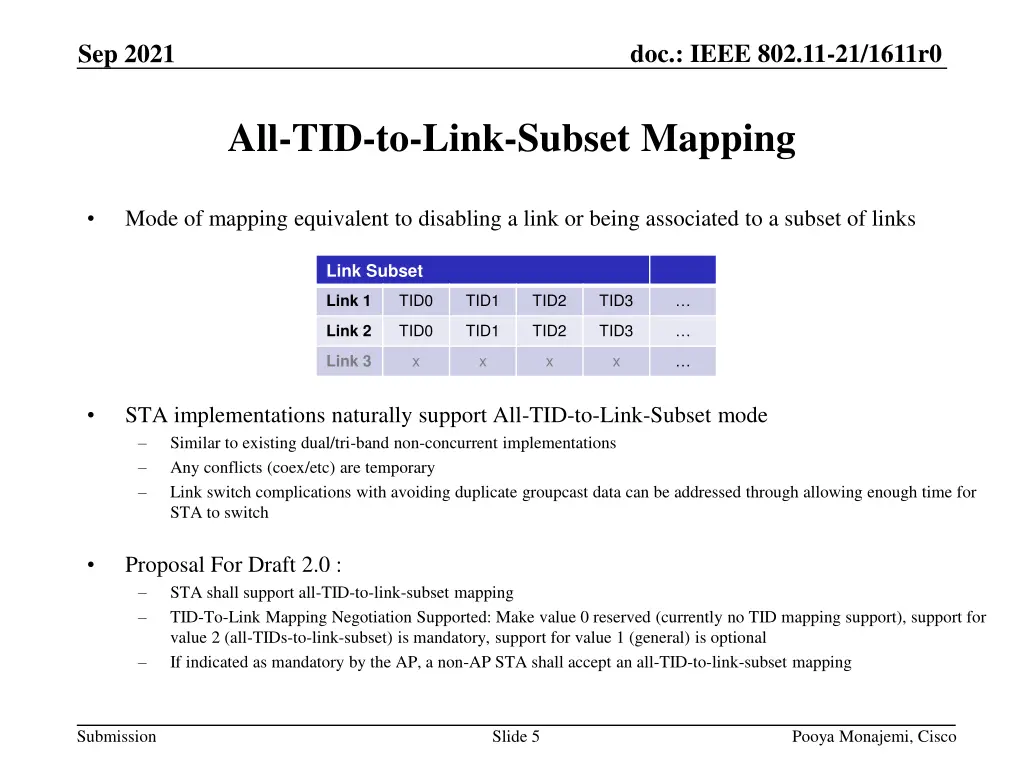
doc.: IEEE 802.11-21/1611r0 Sep 2021 All-TID-to-Link-Subset Mapping Mode of mapping equivalent to disabling a link or being associated to a subset of links Link Subset TID0 TID1 TID2 TID3 Link 1 TID0 TID1 TID2 TID3 Link 2 x x x x Link 3 STA implementations naturally support All-TID-to-Link-Subset mode Similar to existing dual/tri-band non-concurrent implementations Any conflicts (coex/etc) are temporary Link switch complications with avoiding duplicate groupcast data can be addressed through allowing enough time for STA to switch Proposal For Draft 2.0 : STA shall support all-TID-to-link-subset mapping TID-To-Link Mapping Negotiation Supported: Make value 0 reserved (currently no TID mapping support), support for value 2 (all-TIDs-to-link-subset) is mandatory, support for value 1 (general) is optional If indicated as mandatory by the AP, a non-AP STA shall accept an all-TID-to-link-subset mapping Submission Slide 5 Pooya Monajemi, Cisco
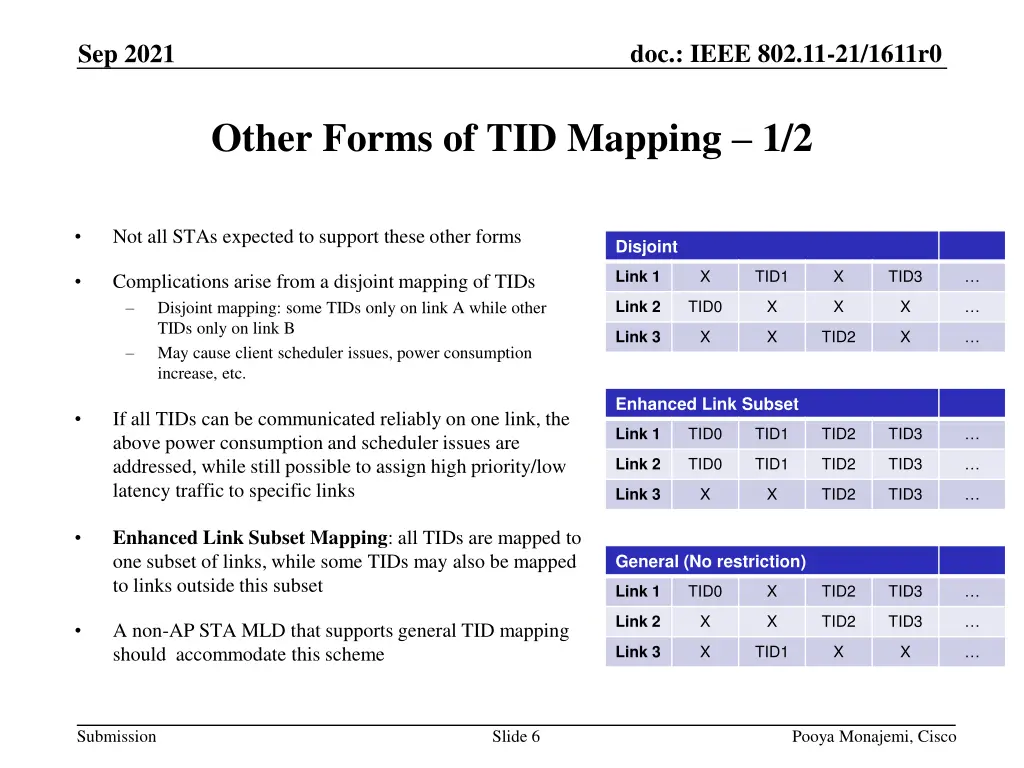
doc.: IEEE 802.11-21/1611r0 Sep 2021 Other Forms of TID Mapping 1/2 Not all STAs expected to support these other forms Disjoint X TID1 X TID3 Link 1 Complications arise from a disjoint mapping of TIDs Disjoint mapping: some TIDs only on link A while other TIDs only on link B May cause client scheduler issues, power consumption increase, etc. TID0 X X X Link 2 X X TID2 X Link 3 Enhanced Link Subset If all TIDs can be communicated reliably on one link, the above power consumption and scheduler issues are addressed, while still possible to assign high priority/low latency traffic to specific links TID0 TID1 TID2 TID3 Link 1 TID0 TID1 TID2 TID3 Link 2 X X TID2 TID3 Link 3 Enhanced Link Subset Mapping: all TIDs are mapped to one subset of links, while some TIDs may also be mapped to links outside this subset General (No restriction) TID0 X TID2 TID3 Link 1 X X TID2 TID3 Link 2 A non-AP STA MLD that supports general TID mapping should accommodate this scheme X TID1 X X Link 3 Submission Slide 6 Pooya Monajemi, Cisco
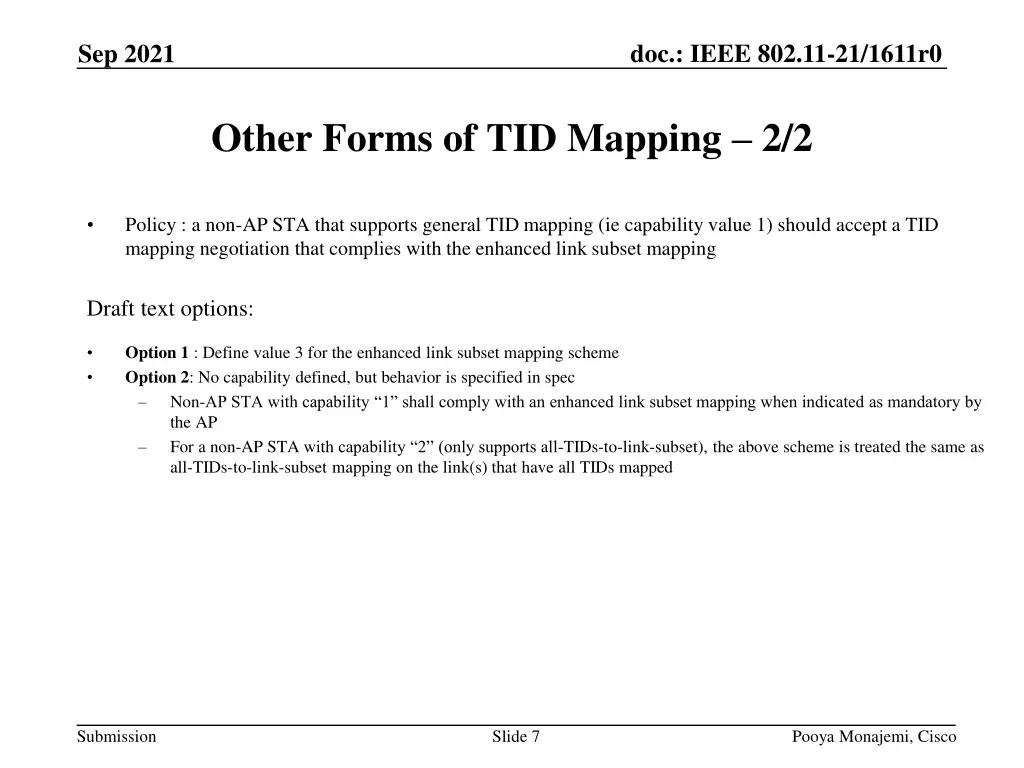
doc.: IEEE 802.11-21/1611r0 Sep 2021 Other Forms of TID Mapping 2/2 Policy : a non-AP STA that supports general TID mapping (ie capability value 1) should accept a TID mapping negotiation that complies with the enhanced link subset mapping Draft text options: Option 1 : Define value 3 for the enhanced link subset mapping scheme Option 2: No capability defined, but behavior is specified in spec Non-AP STA with capability 1 shall comply with an enhanced link subset mapping when indicated as mandatory by the AP For a non-AP STA with capability 2 (only supports all-TIDs-to-link-subset), the above scheme is treated the same as all-TIDs-to-link-subset mapping on the link(s) that have all TIDs mapped Submission Slide 7 Pooya Monajemi, Cisco
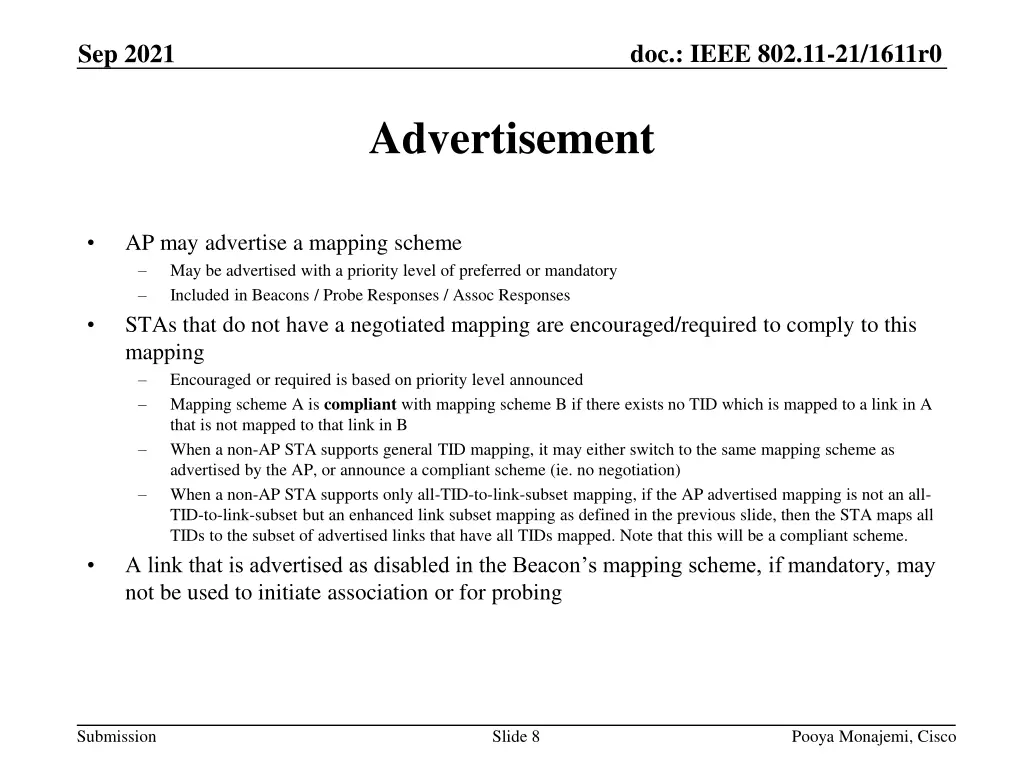
doc.: IEEE 802.11-21/1611r0 Sep 2021 Advertisement AP may advertise a mapping scheme May be advertised with a priority level of preferred or mandatory Included in Beacons / Probe Responses / Assoc Responses STAs that do not have a negotiated mapping are encouraged/required to comply to this mapping Encouraged or required is based on priority level announced Mapping scheme A is compliant with mapping scheme B if there exists no TID which is mapped to a link in A that is not mapped to that link in B When a non-AP STA supports general TID mapping, it may either switch to the same mapping scheme as advertised by the AP, or announce a compliant scheme (ie. no negotiation) When a non-AP STA supports only all-TID-to-link-subset mapping, if the AP advertised mapping is not an all- TID-to-link-subset but an enhanced link subset mapping as defined in the previous slide, then the STA maps all TIDs to the subset of advertised links that have all TIDs mapped. Note that this will be a compliant scheme. A link that is advertised as disabled in the Beacon s mapping scheme, if mandatory, may not be used to initiate association or for probing Submission Slide 8 Pooya Monajemi, Cisco
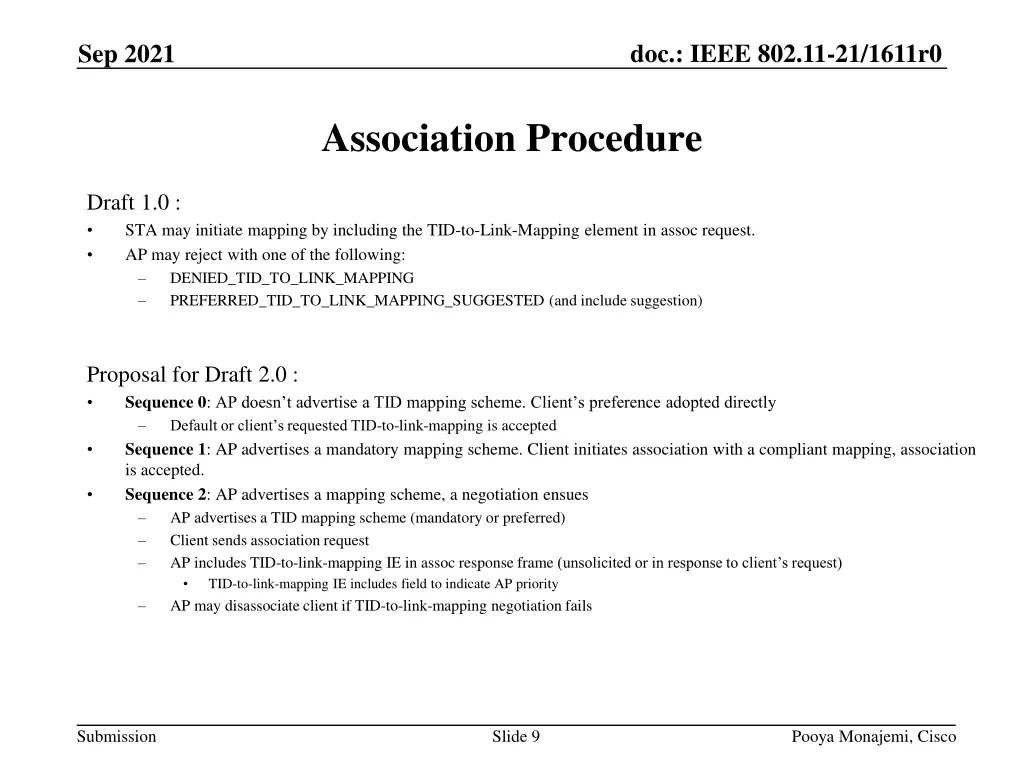
doc.: IEEE 802.11-21/1611r0 Sep 2021 Association Procedure Draft 1.0 : STA may initiate mapping by including the TID-to-Link-Mapping element in assoc request. AP may reject with one of the following: DENIED_TID_TO_LINK_MAPPING PREFERRED_TID_TO_LINK_MAPPING_SUGGESTED (and include suggestion) Proposal for Draft 2.0 : Sequence 0: AP doesn t advertise a TID mapping scheme. Client s preference adopted directly Default or client s requested TID-to-link-mapping is accepted Sequence 1: AP advertises a mandatory mapping scheme. Client initiates association with a compliant mapping, association is accepted. Sequence 2: AP advertises a mapping scheme, a negotiation ensues AP advertises a TID mapping scheme (mandatory or preferred) Client sends association request AP includes TID-to-link-mapping IE in assoc response frame (unsolicited or in response to client s request) TID-to-link-mapping IE includes field to indicate AP priority AP may disassociate client if TID-to-link-mapping negotiation fails Submission Slide 9 Pooya Monajemi, Cisco
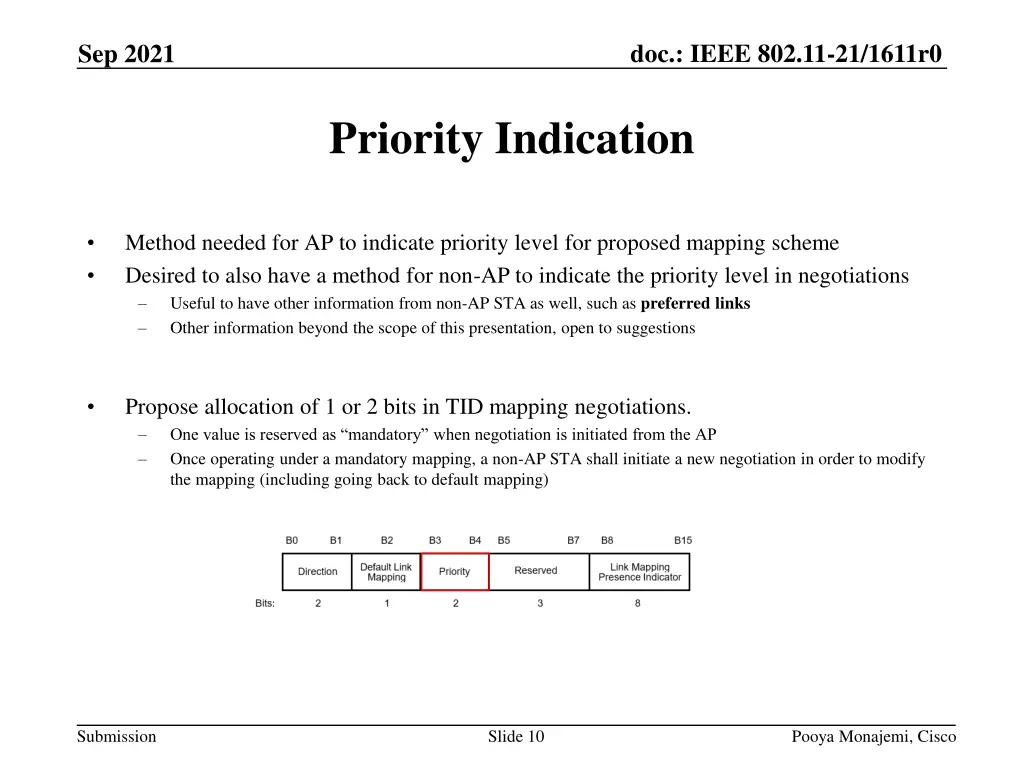
doc.: IEEE 802.11-21/1611r0 Sep 2021 Priority Indication Method needed for AP to indicate priority level for proposed mapping scheme Desired to also have a method for non-AP to indicate the priority level in negotiations Useful to have other information from non-AP STA as well, such as preferred links Other information beyond the scope of this presentation, open to suggestions Propose allocation of 1 or 2 bits in TID mapping negotiations. One value is reserved as mandatory when negotiation is initiated from the AP Once operating under a mandatory mapping, a non-AP STA shall initiate a new negotiation in order to modify the mapping (including going back to default mapping) Submission Slide 10 Pooya Monajemi, Cisco
doc.: IEEE 802.11-21/1611r0 Sep 2021 Conclusions Topics covered Need for all-TID-to-link-subset mapping support Defining the enhanced link subset mode of TID mapping Enhancements in association procedure Defining the priority bit in mapping announcements and negotiations Rules for non-AP compliance when mandatory mapping is proposed Broadcast mapping announcement Submission Slide 11 Pooya Monajemi, Cisco
doc.: IEEE 802.11-21/1611r0 Sep 2021 SP1 Do you agree that all non-AP MLDs shall support all-TID-to-link- subset mapping ? Submission Slide 12 Pooya Monajemi, Cisco
doc.: IEEE 802.11-21/1611r0 Sep 2021 SP2 Do you agree to define a priority level in the TID to link mapping negotiation frame as follows: Priority value can be used by both non-AP and AP When sent by an AP the highest value indicates mandatory A non-AP STA MLD shall initiate a new TID-to-link-mapping negotiation in order to modify the existing mapping, if the existing mapping was formed with the highest priority indicated by the AP Submission Slide 13 Pooya Monajemi, Cisco
doc.: IEEE 802.11-21/1611r0 Sep 2021 SP3 Do you agree that a non-AP MLDs shall comply with a TID mapping negotiation initiated by the AP MLD as mandatory when the mapping scheme announced by the AP is either all-TID-to- link-subset mapping or enhanced link subset mapping? An enhanced link subset mapping is one in which all TIDs are mapped to one subset of links, while some TIDs may also be mapped to links outside this subset Mapping scheme A is compliant with mapping scheme B if there exists no TID which is mapped to a link in A that is not mapped to that link in B Note : As defined above, a non-AP STA that is only capable of all-TID-to-link- subset mapping can comply with an enhanced link subset mapping by choosing the subset of links that have all TIDs mapped. Submission Slide 14 Pooya Monajemi, Cisco
doc.: IEEE 802.11-21/1611r0 Sep 2021 References [1] 11be Draft 1.0 [2] 11-21/0792r3 PDT for CC34 Resolution for CID3222 [3] 11-20/1841r2 Performance Evaluation of Various MLO TID Mapping Configurations Submission Slide 15 Pooya Monajemi, Cisco