Information Exchange for Multi-AP Coordination in IEEE 802.11-21
Explore the essential information exchange for seamless multi-AP coordination in the IEEE 802.11-21 standard. Delve into the process and stages of information sharing among coordinating nodes to enhance multi-AP operation efficiency and effectiveness.

Download Presentation

Please find below an Image/Link to download the presentation.
The content on the website is provided AS IS for your information and personal use only. It may not be sold, licensed, or shared on other websites without obtaining consent from the author. If you encounter any issues during the download, it is possible that the publisher has removed the file from their server.
You are allowed to download the files provided on this website for personal or commercial use, subject to the condition that they are used lawfully. All files are the property of their respective owners.
The content on the website is provided AS IS for your information and personal use only. It may not be sold, licensed, or shared on other websites without obtaining consent from the author.
E N D
Presentation Transcript
September 2021 doc.: IEEE 802.11-21/0445r1 Information Sharing and Exchange for Multi-AP Coordination Date: 2021-09-06 Authors: Name Muhammad Sohaib J. Solaija IMU, Vestel Affiliations Address Phone email solaija@ieee.org Istanbul Medipol University Hanadi Salman IMU, Vestel Istanbul Medipol University hanadi.suleiman@std.medipol.edu.tr Huseyin Arslan IMU, Vestel Istanbul Medipol University huseyinarslan@medipol.edu.tr Ba ak zbak Vestel Vestel Electronics Corp. basak.ozbakis@vestel.com.tr Submission Slide 1 Muhammad Sohaib J. Solaija, IMU; Vestel
September 2021 doc.: IEEE 802.11-21/0445r1 Abstract Various contributions have tried to map out the process/procedure of multi-AP coordinated transmission. However, till now there is no clear consensus upon what information exchange needs to take place before this process. This contribution tries to identify and discuss the information/data that needs to be exchanged between the different entities involved in the multi-AP coordination process. Submission Slide 2 Muhammad Sohaib J. Solaija, IMU; Vestel
September 2021 doc.: IEEE 802.11-21/0445r1 Background Information exchange between coordinating nodes is imperative for smooth multi- AP operation. Different type of information may need to be shared at different stages of the coordination process as mentioned in various contributions. Accordingly, we start by looking at the contribution documents [1-8] that mention or discuss some information exchange related multi-AP coordination. Submission Slide 3 Muhammad Sohaib J. Solaija, IMU; Vestel
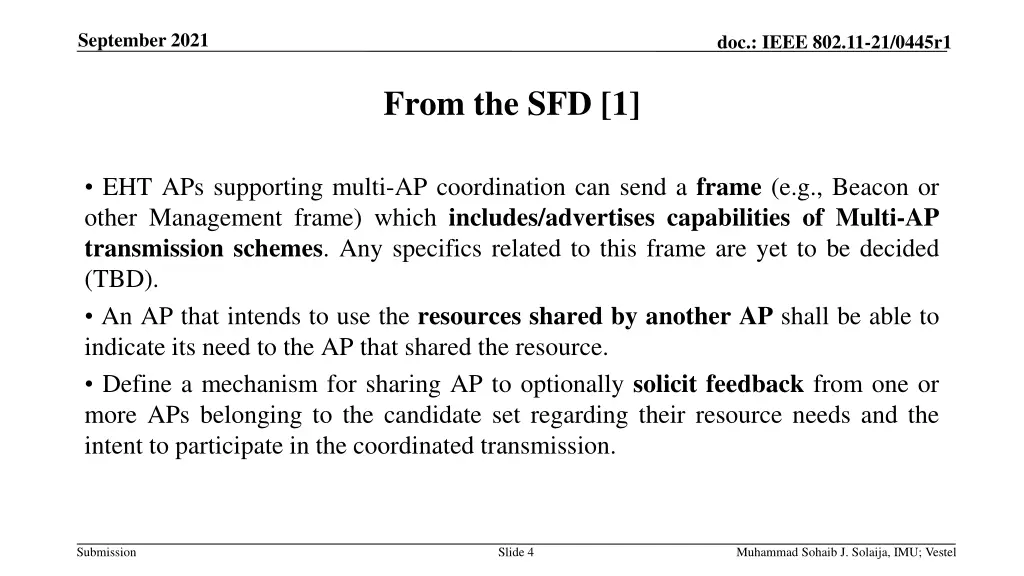
September 2021 doc.: IEEE 802.11-21/0445r1 From the SFD [1] EHT APs supporting multi-AP coordination can send a frame (e.g., Beacon or other Management frame) which includes/advertises capabilities of Multi-AP transmission schemes. Any specifics related to this frame are yet to be decided (TBD). An AP that intends to use the resources shared by another AP shall be able to indicate its need to the AP that shared the resource. Define a mechanism for sharing AP to optionally solicit feedback from one or more APs belonging to the candidate set regarding their resource needs and the intent to participate in the coordinated transmission. Submission Slide 4 Muhammad Sohaib J. Solaija, IMU; Vestel
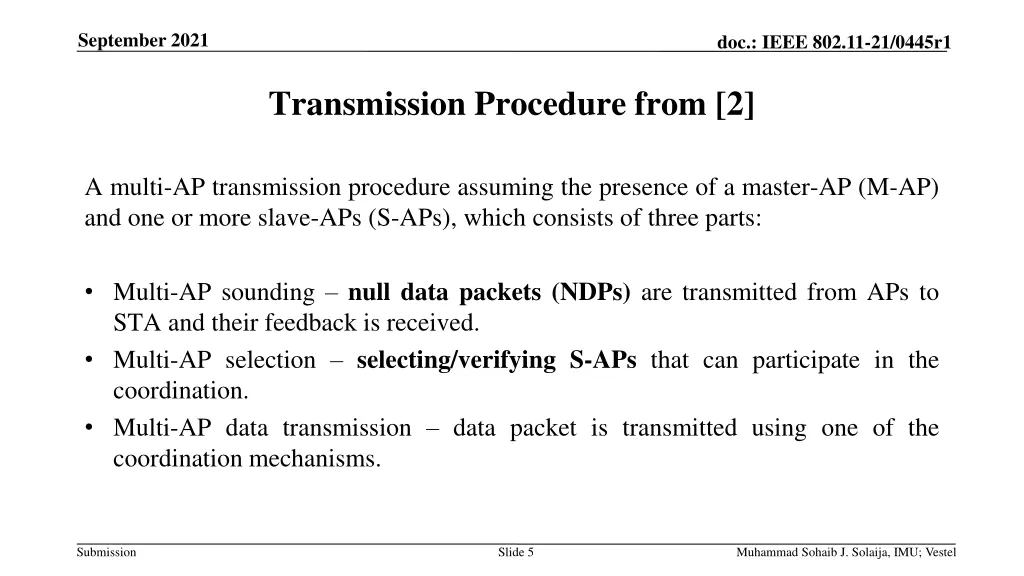
September 2021 doc.: IEEE 802.11-21/0445r1 Transmission Procedure from [2] A multi-AP transmission procedure assuming the presence of a master-AP (M-AP) and one or more slave-APs (S-APs), which consists of three parts: Multi-AP sounding null data packets (NDPs) are transmitted from APs to STA and their feedback is received. Multi-AP selection selecting/verifying S-APs that can participate in the coordination. Multi-AP data transmission data packet is transmitted using one of the coordination mechanisms. Submission Slide 5 Muhammad Sohaib J. Solaija, IMU; Vestel
September 2021 doc.: IEEE 802.11-21/0445r1 Unified Transmission Procedure from [3] M-AP transmits a slave trigger frame to initiate multi-AP transmission. The function of this trigger frame is to ensure synchronization of all APs and to notify the slave-APs (S-APs) regarding which mode to use and the corresponding time/frequency/spatial/power domain resource allocation. Submission Slide 6 Muhammad Sohaib J. Solaija, IMU; Vestel
September 2021 doc.: IEEE 802.11-21/0445r1 Coordination Architecture [4] The multi-AP coordination could be initiated by the AP or STA. Furthermore, the APs participating in the coordination need to be selected/identified. Since STA has knowledge of the air interface and fronthaul link measurements it can help in the preparation stage by suggesting which APs should participate in the coordination. The whole multi-AP coordination process is divided into following stages: Association exchange of multi-AP coordination capability information between APs and STAs Submission Slide 7 Muhammad Sohaib J. Solaija, IMU; Vestel
September 2021 doc.: IEEE 802.11-21/0445r1 Coordination Architecture [4] contd Preparation AP or STA initiate the multi-AP coordination by deciding which APs should coordinate (STA may suggest potential APs). Recommended APs can be determined by fronthaul link metric collection, load and access control information, etc Transmission - Chosen APs of the multi-AP network perform DL/UL multi-AP transmission Submission Slide 8 Muhammad Sohaib J. Solaija, IMU; Vestel
September 2021 doc.: IEEE 802.11-21/0445r1 Data Sharing b/w APs [5] [5] considers a M-AP which functions as the coordinator and S-APs which participate in the JT. The M-AP needs to share the (same) data with S-APs in a broadcast, unicast or multicast manner. For multicast, a group indication mechanism (and corresponding announcement frame) needs to be devised. The announcement frame is broadcast with the body of the frame identifying the S-APs and their RU allocations. Data frame is only sent to the S-APs. Block-Ack (BA) frame is sent using assigned RUs indicated in the announcement frame Submission Slide 9 Muhammad Sohaib J. Solaija, IMU; Vestel
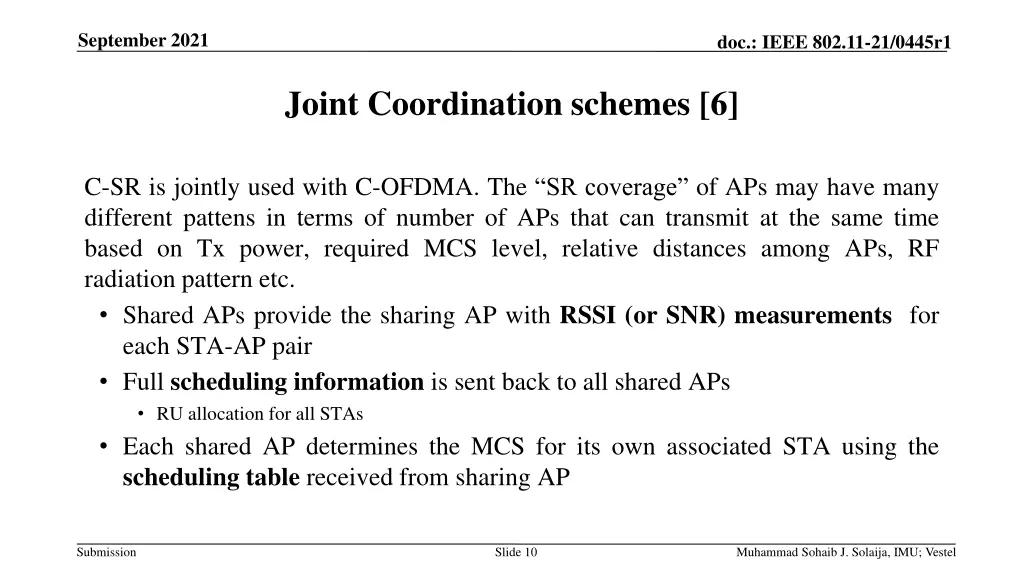
September 2021 doc.: IEEE 802.11-21/0445r1 Joint Coordination schemes [6] C-SR is jointly used with C-OFDMA. The SRcoverage of APs may have many different pattens in terms of number of APs that can transmit at the same time based on Tx power, required MCS level, relative distances among APs, RF radiation pattern etc. Shared APs provide the sharing AP with RSSI (or SNR) measurements for each STA-AP pair Full scheduling information is sent back to all shared APs RU allocation for all STAs Each shared AP determines the MCS for its own associated STA using the scheduling table received from sharing AP Submission Slide 10 Muhammad Sohaib J. Solaija, IMU; Vestel
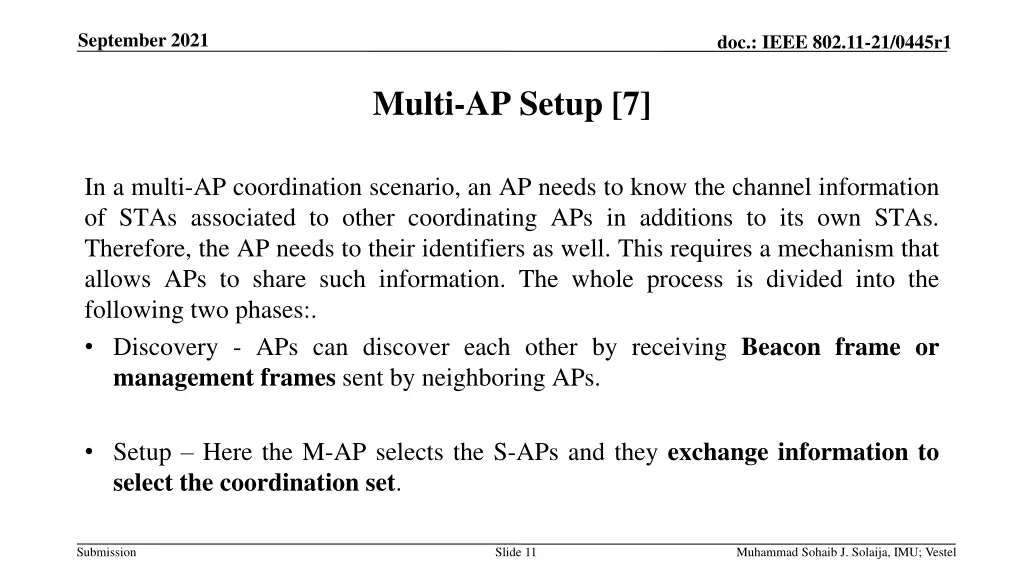
September 2021 doc.: IEEE 802.11-21/0445r1 Multi-AP Setup [7] In a multi-AP coordination scenario, an AP needs to know the channel information of STAs associated to other coordinating APs in additions to its own STAs. Therefore, the AP needs to their identifiers as well. This requires a mechanism that allows APs to share such information. The whole process is divided into the following two phases:. Discovery - APs can discover each other by receiving Beacon frame or management frames sent by neighboring APs. Setup Here the M-AP selects the S-APs and they exchange information to select the coordination set. Submission Slide 11 Muhammad Sohaib J. Solaija, IMU; Vestel
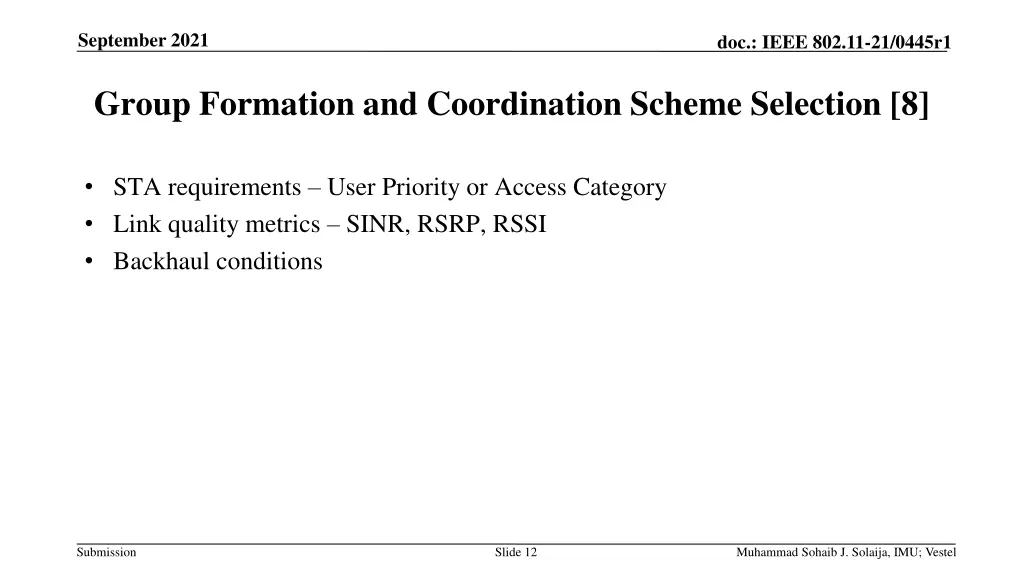
September 2021 doc.: IEEE 802.11-21/0445r1 Group Formation and Coordination Scheme Selection [8] STA requirements User Priority or Access Category Link quality metrics SINR, RSRP, RSSI Backhaul conditions Submission Slide 12 Muhammad Sohaib J. Solaija, IMU; Vestel
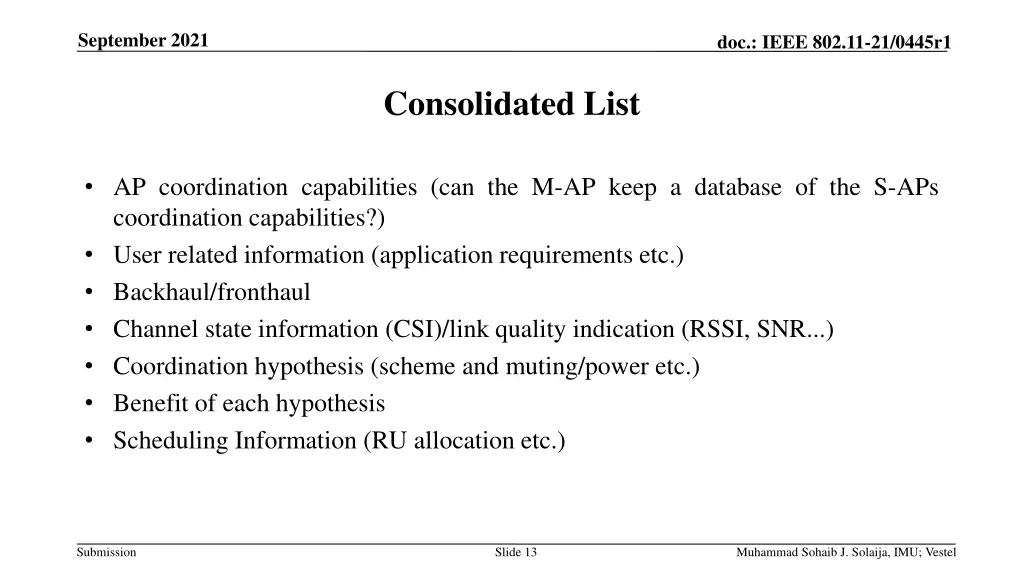
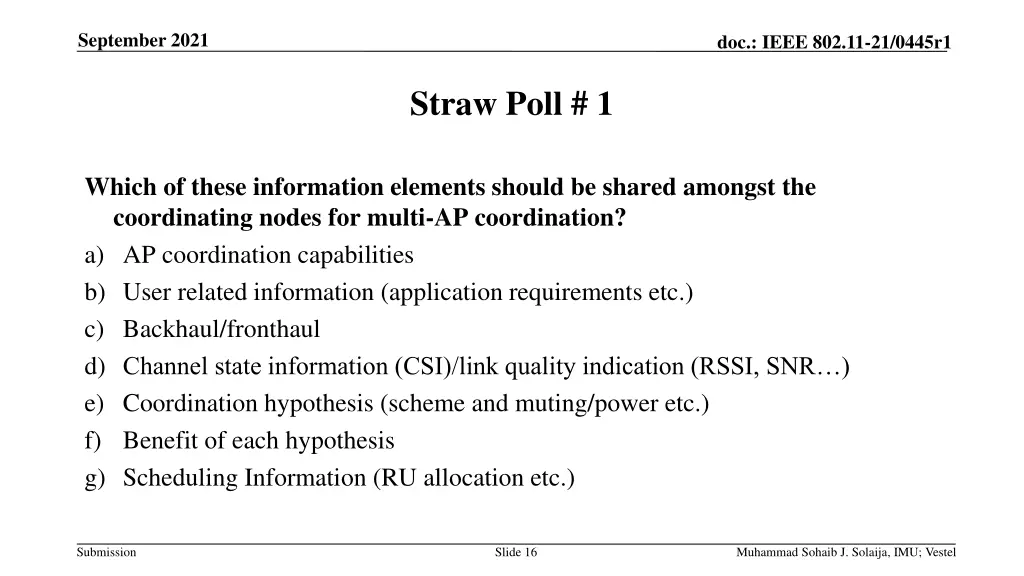
September 2021 doc.: IEEE 802.11-21/0445r1 Consolidated List AP coordination capabilities (can the M-AP keep a database of the S-APs coordination capabilities?) User related information (application requirements etc.) Backhaul/fronthaul Channel state information (CSI)/link quality indication (RSSI, SNR...) Coordination hypothesis (scheme and muting/power etc.) Benefit of each hypothesis Scheduling Information (RU allocation etc.) Submission Slide 13 Muhammad Sohaib J. Solaija, IMU; Vestel
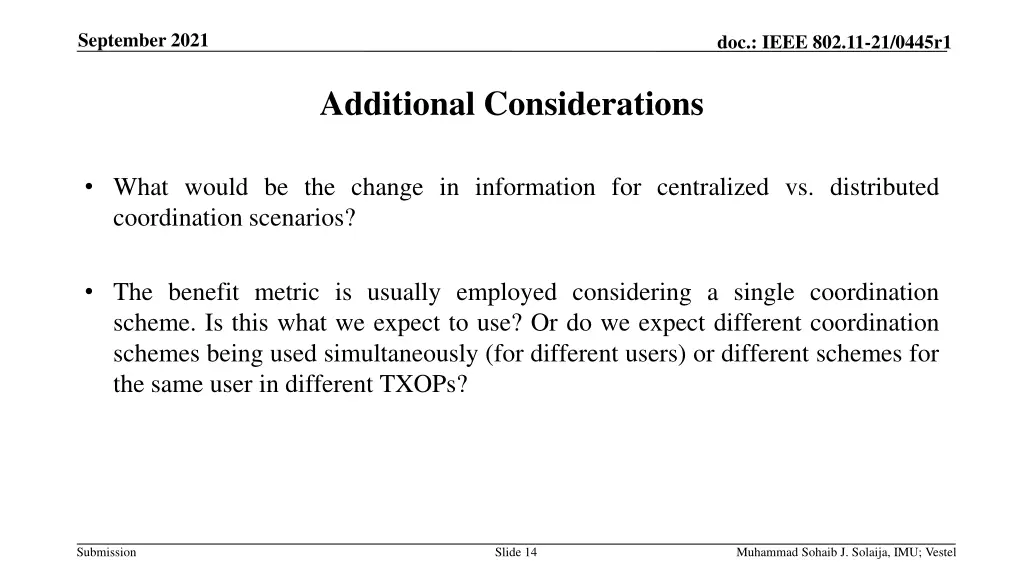
September 2021 doc.: IEEE 802.11-21/0445r1 Additional Considerations What would be the change in information for centralized vs. distributed coordination scenarios? The benefit metric is usually employed considering a single coordination scheme. Is this what we expect to use? Or do we expect different coordination schemes being used simultaneously (for different users) or different schemes for the same user in different TXOPs? Submission Slide 14 Muhammad Sohaib J. Solaija, IMU; Vestel
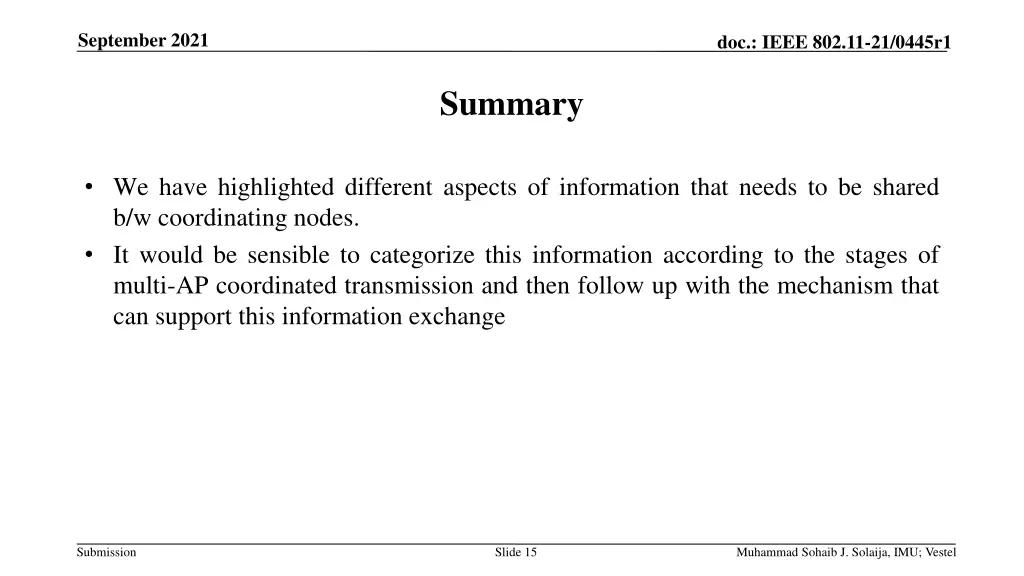
September 2021 doc.: IEEE 802.11-21/0445r1 Summary We have highlighted different aspects of information that needs to be shared b/w coordinating nodes. It would be sensible to categorize this information according to the stages of multi-AP coordinated transmission and then follow up with the mechanism that can support this information exchange Submission Slide 15 Muhammad Sohaib J. Solaija, IMU; Vestel
September 2021 doc.: IEEE 802.11-21/0445r1 Straw Poll # 1 Which of these information elements should be shared amongst the coordinating nodes for multi-AP coordination? a) AP coordination capabilities b) User related information (application requirements etc.) c) Backhaul/fronthaul d) Channel state information (CSI)/link quality indication (RSSI, SNR ) e) Coordination hypothesis (scheme and muting/power etc.) f) Benefit of each hypothesis g) Scheduling Information (RU allocation etc.) Submission Slide 16 Muhammad Sohaib J. Solaija, IMU; Vestel
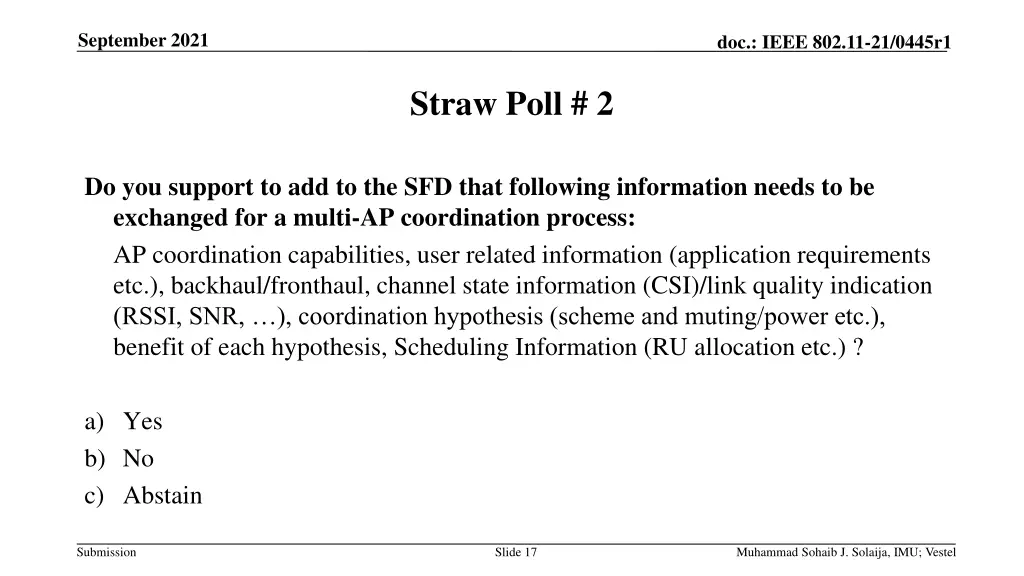
September 2021 doc.: IEEE 802.11-21/0445r1 Straw Poll # 2 Do you support to add to the SFD that following information needs to be exchanged for a multi-AP coordination process: AP coordination capabilities, user related information (application requirements etc.), backhaul/fronthaul, channel state information (CSI)/link quality indication (RSSI, SNR, ), coordination hypothesis (scheme and muting/power etc.), benefit of each hypothesis, Scheduling Information (RU allocation etc.) ? a) Yes b) No c) Abstain Submission Slide 17 Muhammad Sohaib J. Solaija, IMU; Vestel
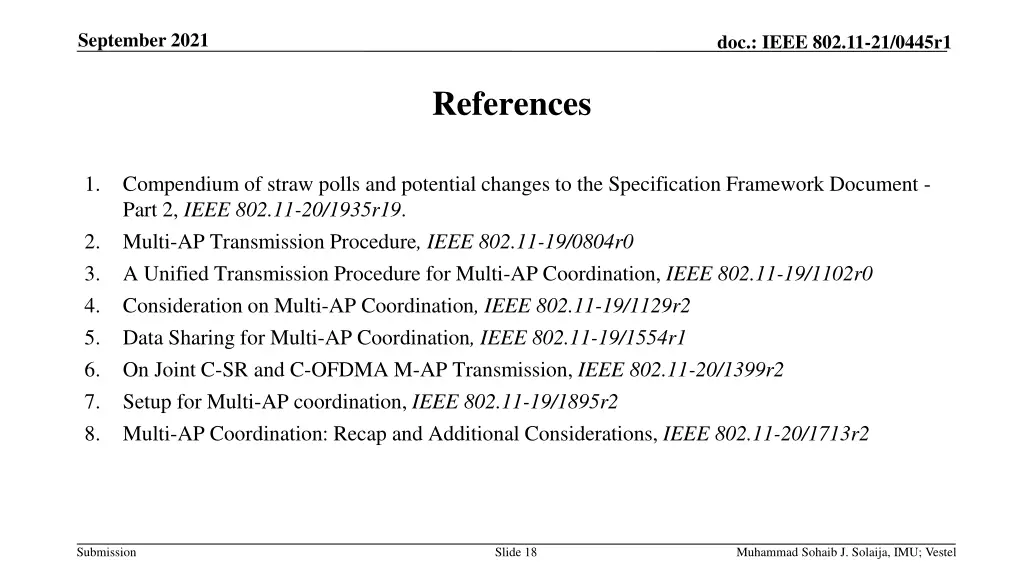
September 2021 doc.: IEEE 802.11-21/0445r1 References 1. Compendium of straw polls and potential changes to the Specification Framework Document - Part 2, IEEE 802.11-20/1935r19. Multi-AP Transmission Procedure, IEEE 802.11-19/0804r0 A Unified Transmission Procedure for Multi-AP Coordination, IEEE 802.11-19/1102r0 Consideration on Multi-AP Coordination, IEEE 802.11-19/1129r2 Data Sharing for Multi-AP Coordination, IEEE 802.11-19/1554r1 On Joint C-SR and C-OFDMA M-AP Transmission, IEEE 802.11-20/1399r2 Setup for Multi-AP coordination, IEEE802.11-19/1895r2 Multi-AP Coordination: Recap and Additional Considerations, IEEE 802.11-20/1713r2 2. 3. 4. 5. 6. 7. 8. Submission Slide 18 Muhammad Sohaib J. Solaija, IMU; Vestel