Insights on Carcinoma Larynx Anatomy and Behavior
Dive into the complex anatomy and embryology of carcinoma larynx with Dr. Dinesh Kumar Sharma, exploring the distinct structures and barriers that influence tumor growth and spread. Understand the clinical behavior, major barriers to cancer spread, prognostic features, and general principles of management to enhance knowledge and awareness of laryngeal cancer.

Download Presentation

Please find below an Image/Link to download the presentation.
The content on the website is provided AS IS for your information and personal use only. It may not be sold, licensed, or shared on other websites without obtaining consent from the author. If you encounter any issues during the download, it is possible that the publisher has removed the file from their server.
You are allowed to download the files provided on this website for personal or commercial use, subject to the condition that they are used lawfully. All files are the property of their respective owners.
The content on the website is provided AS IS for your information and personal use only. It may not be sold, licensed, or shared on other websites without obtaining consent from the author.
E N D
Presentation Transcript
Some thoughts on Carcinoma Larynx Dr. Dinesh Kumar Sharma MS (ENT), formerly Assistant Professor, GMC Amritsar
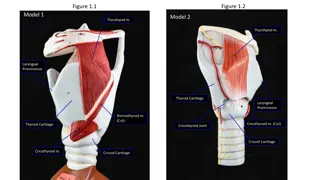
Complex anatomy and embryology Supraglottis is embryologically distinct from the glottis Anatomic barriers produce laryngeal compartments Quadrangular membrane and conus elasticus form supra and subglottic barriers respectively Growth and spread of cancer is determined by the site of origin of the primary tumor
Anatomy and Embryology Supraglottic structures arise from the buccopharyngeal anlage (arch III & IV) Glottic and subglottic structures from the tracheobrochial anlage (arch V & VI) The glottis seems to arise from paired lateral structures that fuse at the midline at the anterior commissure
Tumor Site & Clinical Behavior Subtle symptoms in supraglottic carcinoma often ignored Slowly growing well differentiated glottic carcinoma Rich lymphatics and absence of barriers promote early bilateral spread of supraglottic carcinoma High rate of occult and bilateral metastasis in supraglottic carcinoma Rare LN metastasis in glottic carcinoma 19% incidence of nodal metastasis in glottic tumors with subglottic extension, 33% in supraglottic and 52% in transglottic disease
Major barriers to the spread of cancer The conus elasticus inferiorly The quadrangular membrane laterally, and the Thyrohyoid membrane superiorly Broyles Tendon is the insertion of the vocalis tendon into the thyroid cartilage in the area of the anterior commissure
Prognostic Features Tumor differentiation Infiltrative pattern Cartilage invasion is associated with nodal metastasis and decreased survival Nodal status, extra capsular spread is associated with worse prognosis
General Principles of Management The T stage of laryngeal cancer is important Early laryngeal cancer includes T stages 1 and 2 Advanced laryngeal cancer includes those at stages 3 and 4
Early Laryngeal Cancer Patients with early laryngeal cancer have a greater opportunity for preservation of the larynx than those with advanced laryngeal cancer They are usually treated with multiple surgical methods: Transoral laser cordectomy Laryngofissure cordectomy, Vertical partial laryngectomy Supraglottic subtotal laryngectomy Radiotherapy
Advanced Stage Laryngeal Cancer-1 Many patients used to be treated with a total laryngectomy A combination therapy of neoadjuvant chemotherapy followed by an operation or radiotherapy, has been tried. The combination of cisplatin and 5-FU results in complete macroscopic disappearance of tumors in 30~40% of previously untreated patients. Most chemosensitive tumors are also radiosensitive. In neoadjuvant (also called preoperative or primary) chemotherapy, drug treatment takes place before surgical extraction of a tumor.
Advanced Stage Laryngeal Cancer-2 This provided the basis for the development of a new strategy, leading to the preservation of the larynx in selected patients After the initial chemotherapy: The good responders receive radiotherapy The poor responders undergo a total laryngectomy
Neck Dissection A therapeutic neck dissection is performed at the time of initial surgery in patients with clinical node involvement. An elective neck dissection is generally carried out in patients with cancer of the supraglottic larynx
Radiotherapy Postoperative radiotherapy is given to the primary site and neck, based on the clinicopathological risk factors: Positive or closed surgical margins Perineural invasion Multiple lymph node involvement in the neck Extracapsular spread.
Treatment of early laryngeal cancer
Laser surgery versus radiotherapy Two treatment options are widely used for the cure of T1 glottic squamous cell carcinomas: Radiotherapy Surgical removal There is ongoing controversy about whether laser excision should be offered to patients with T1 glottic carcinomas.
Carcinomas of the glottis Usually diagnosed in the early stage of the disease Seldom malignant spread to regional lymph nodes Distant metastases extremely rare Relatively good prognosis
Transoral laser excision: Advantages An effective, definitive treatment for glottic cancers Less expensive More convenient than traditional external beam radiotherapy Affords an additional line of treatment, as recurrences can be treated with radiotherapy
Transoral laser excision: Disadvantages Complete removal of the tumor is not possible in every case Additional therapy may be needed This increases the treatment load on the patient, as well as increases the costs Laser treatment should only be considered in small, mid-cord tumors at one vocal cord, without impaired mobility (T1a) The effectiveness directly depends on the physician's ability to identify and visualize the limits of the tumor
Malignant tumours localized at anterior commissure Some controversy about the applicability of laser treatment Most authors state that it is contraindicated to apply laser excision in this region At present, it is generally accepted that tumors localized to the anterior commissure are contraindicatory to laser resection Radiotherapy is the treatment of choice with this type of malignancy.
Recommended indications for radiotherapy Recurrence after one or more prior vocal fold strippings Recurrence in a short period after stripping An inability to follow closely after treatment The voice quality is critical (professional singers) Overall poor operative risks Anterior commissure lesion which are inaccessible for complete endoscopic ablation
Treatment of Advanced Laryngeal Cancer
Advanced Laryngeal Cancer Treatment Single-modality treatment for early disease Multimodality treatment for advanced disease Surgery with radiotherapy post operatively Chemotherapy and radiation as part of laryngeal preservation strategies
Treatment Planning Patient Preference Physician Preference Preservation of voice and swallowing Expertise and experience Institutional policies and protocols Avoidance of stoma Available resources Cost, length of treatment and travel Toxicity of therapy
What type of surgery? Advanced disease traditionally treated with total laryngectomy Neck dissection In selected patients endoscopic laser resection or partial laryngectomies such as supraglottic, supracricoid or subtotal
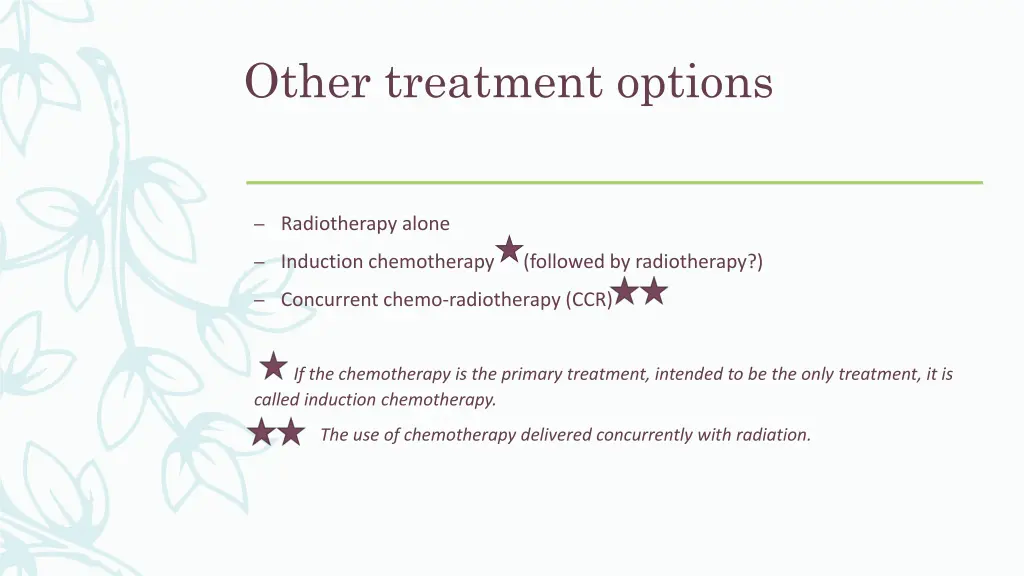
Other treatment options Radiotherapy alone Induction chemotherapy (followed by radiotherapy?) Concurrent chemo-radiotherapy (CCR) If the chemotherapy is the primary treatment, intended to be the only treatment, it is called induction chemotherapy. The use of chemotherapy delivered concurrently with radiation.
Radiotherapy RT historically played a major role in the management of HNSCC Advanced T3,4 lesions treated with conventional RT only may have poorer prognosis
The 5 R's Of Fractionation Repair to allow sublethal damage repair Redistribution Cells in S-phase are typically radioresistant, whereas those in late G2 and M phase are relatively sensitive. Reoxygenation Repopulation It is the increase in cell division that is seen in normal and malignant cells at some point after radiation is delivered. Radiosensitivity Radiosensitive cells include haemotological cells, epithelial stem cells, gametes and tumour cells
Alerted Fractionation Altered fractionation refers to delivery of multiple fractions/day without increasing the overall treatment time To address tumor repopulation and increase tumor kill without increasing long- term toxicity Acute toxicity may be increased
Alerted Fractionation Hyperfractionation ( total dose & number fractions dose/fraction; 75 Gy units in fractions of 1.25 Gy units twice a day) Accelerated fractionation ( unchanged total dose & number fractions overall treatment time) Split course accelerated fractionation schedule Accelerated fractionation with concomitant boost (boost dose as a second daily fraction for the last 12 days of a 6 wk therapy)
Complications after RT Compared to standard fractionation all three altered fractionation schemes had significantly worse acute side effects (about 50% patients)
Rationale of combining CT with RT Improved locoregional and distant failure rates after RT of advanced malignancies Sub-lethaly damaged cells between RT fractions can be repaired and cause recurrence of disease Chemotherapy agents (cisplatin) can inhibit lethal damage repair of cancer cells and augment RT damage Cytoreduction of hypoxic tumor cells with CT might improve tumor oxygenation and radio-sensitivity
Winding up the topic1 Organ-preservation strategies, either surgical or non-surgical, have dominated the treatment of early laryngeal lesions in recent years A trend toward conservative management has also been noted for locally advanced carcinomas TL is not the only available treatment option for such lesions anymore. Recent developments and newly integrated strategies, including concomitant CRT (CCRT), induction chemotherapy, and modern RT methods have reshaped the field of advanced laryngeal cancer treatment
Winding up the topic2 Among available organ-preservation modalities, platinum-based CCRT has proven most effective and popular for advanced lesions, showing high rates of laryngeal preservation and satisfactory oncologic results Both radiotherapy and chemotherapy, however, have been associated with severe adverse effects: Dysphagia, xerostomia, trismus, mandibular radionecrosis, fibrosis, and pharyngeal strictures. Systemic adverse effects include bone marrow toxicity, infections, neuropathy, renal failure, nutritional deficiencies, and fatigue.
Winding up the topic3 Organ preservation does not necessarily lead to functional preservation. Late functional issues following CRT might involve voice as well as swallowing difficulties and in numerous occasions necessitate a permanent tracheostomy and/or gastrostomy. In fact, quality of life in many individuals may end up to be much worse after organ preservation treatment
Winding up the topic4 The application of TL as initial treatment has decreased remarkably Now mostly employed as salvage treatment after failure of non-surgical management strategies The question whether the most advanced laryngeal lesions with invasion of cartilage are better served with initial non-surgical therapy or TL still remains open Surgery remains a key element for successful management of T4 laryngeal lesions.
References Recent Advances in Management of Laryngeal Cancer, Youn Sang Shim, Cancer Research and Treatment 2004;36(1):13-18 Advanced Laryngeal Cancer, Dimitrios Moraitis, Accessed at https://www.utmb.edu/otoref/Grnds/Advanced-Laryngeal-CA-2003-12/Advanced- LaryngeaL-CA-2003-12.pdf Date accessed :2017/07/24 Management of locally advanced laryngeal cancer; Alexander D Karatzanis, Georgios Psychogios, Frank Waldfahrer, Markus Kapsreiter, Johannes Zenk, George A Velegrakis and Heinrich Iro, Journal of Otolaryngology - Head & Neck Surgery201443:4 Accessed online at https://journalotohns.biomedcentral.com/articles/10.1186/1916-0216-43-4 on 2017/07/24 Management of early glottic cancers: Role of Surgery vs Radiation Therapy, Naren Venkatesan. Accessed online at https://www.utmb.edu/otoref/grnds/ca-glottic- 2013-10-15/ca-glottic-pic-2013-10.pdf on 2014/07/24