Insights on COVID-19 Data: Cross-Country Comparisons and Local Strategies
Gain valuable insights from Dr. Anjum Altaf's webinar on COVID-19 data, highlighting the importance of being cautious with cross-country comparisons, focusing on local responses, and understanding the impact of population density on virus transmission. Learn about useful inferences from the data and key considerations for managing the epidemic effectively.

Download Presentation

Please find below an Image/Link to download the presentation.
The content on the website is provided AS IS for your information and personal use only. It may not be sold, licensed, or shared on other websites without obtaining consent from the author. If you encounter any issues during the download, it is possible that the publisher has removed the file from their server.
You are allowed to download the files provided on this website for personal or commercial use, subject to the condition that they are used lawfully. All files are the property of their respective owners.
The content on the website is provided AS IS for your information and personal use only. It may not be sold, licensed, or shared on other websites without obtaining consent from the author.
E N D
Presentation Transcript
COVID-19: What the Data Reveal CITYNET / INHAF Webinar June 23, 2020 Dr. Anjum Altaf Former Professor of Economics and Dean, School of Humanities and Social Sciences, Lahore University of Management Sciences anjum.altaf@lums.edu.pk Video: https://www.youtube.com/watch?v=oN00INB9-kk
FIVE POINTS ABOUT DATA 1. BE WARY OF CROSS-COUNTRY COMPARISONS For the following reasons: Main indicators are not standardized (No. of confirmed cases depend on testing rates which vary widely across countries; No. of deaths are recorded differently and there is lot of undercounting). Contributing factors, unrelated to epidemic management, vary widely (e.g., population age structure, arrangements for care of elderly, weather, income per capita, time when infection started, extent of tourism, etc.). Some exceptions are helpful where outcomes are starkly different (e.g., Vietnam with 0 deaths and Sri Lanka with only 11). One can explore what could have caused such starkly different outcomes.
2. SOME INFERENCES FROM DATA ARE USEFUL The elderly (age > 65) and those with comorbidities (other illnesses) are at much higher risk of severe reactions requiring hospitalization. The majority of infected individuals are asymptomatic. The fatality rate is low but the transmission rate is high. Super-spreading is possible (one person can infect many). Therefore large gatherings are to be avoided. Lockdowns cannot eliminate the virus. They only slow the transmission and allow time for preparation and for other measures to be put in place. Simple preventive measures help. These include masks, hand-washing, and physical distancing. Alternative strategies can produce quite different results.
3. THE MOST USEFUL FOCUS IS ON THE LOCAL The objective should be respond to the local situation in order to slow transmission and minimize deaths. For this, hotspots have to be identified and inflow and outflows controlled. Use excess deaths as an indicator of the severity of the epidemic. In a representative sample of crematoria/graveyards compare current deaths with previous years as a double-check on reported number of Covid deaths. Keep track of trend in non-Covid deaths which can increase because of reduced access to medical care for patients with non-Covid ailments. Compare local situation with other cities/countries only with the intention of learning best practices, not for making excuses for inadequate performance.
4. DENSITY IS IMPORTANT BUT NOT EVERYTHING It is obvious that population density matters in the transmission of the virus. The more persons an infected individual contacts the greater is the chance of passing on infection. But this is not inevitable. In South Asia we subconsciously associate high population density with slums. We forget that slums are characterised by high density but ALSO by poor living conditions. The latter have a higher contribution to transmission of infections. For example, Manhattan, Hong Kong and Singapore have high living densities but good living conditions and therefore transmission is low. In Mumbai, the densest C Ward has slower transmission than the less dense G/S and G/N wards. This yield a major lesson for urban policy as well as public health policy - FOCUS ON LIVING CONDITIONS NOT JUST ON POPULATION DENSITY.
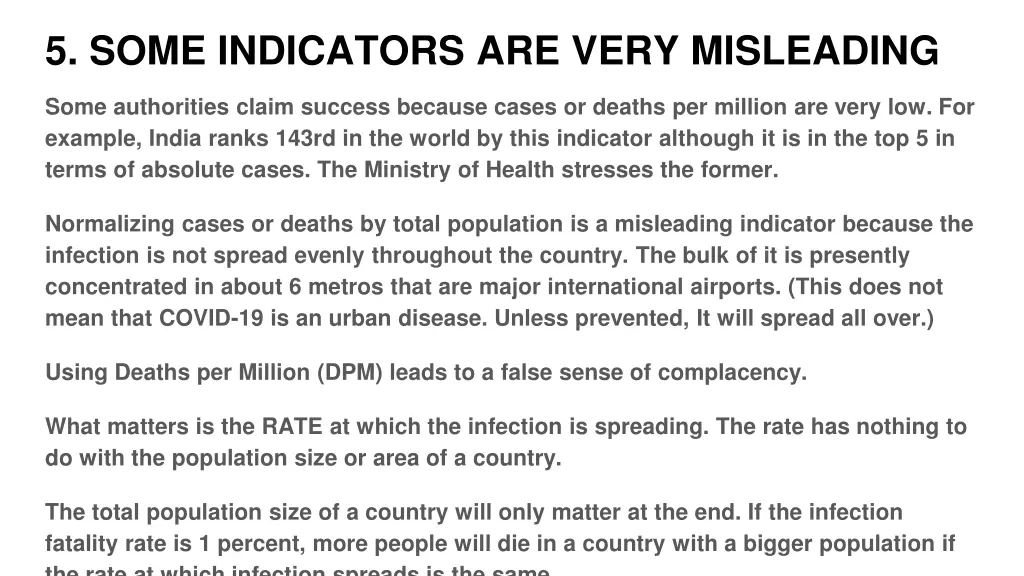
5. SOME INDICATORS ARE VERY MISLEADING Some authorities claim success because cases or deaths per million are very low. For example, India ranks 143rd in the world by this indicator although it is in the top 5 in terms of absolute cases. The Ministry of Health stresses the former. Normalizing cases or deaths by total population is a misleading indicator because the infection is not spread evenly throughout the country. The bulk of it is presently concentrated in about 6 metros that are major international airports. (This does not mean that COVID-19 is an urban disease. Unless prevented, It will spread all over.) Using Deaths per Million (DPM) leads to a false sense of complacency. What matters is the RATE at which the infection is spreading. The rate has nothing to do with the population size or area of a country. The total population size of a country will only matter at the end. If the infection fatality rate is 1 percent, more people will die in a country with a bigger population if the rate at which infection spreads is the same.
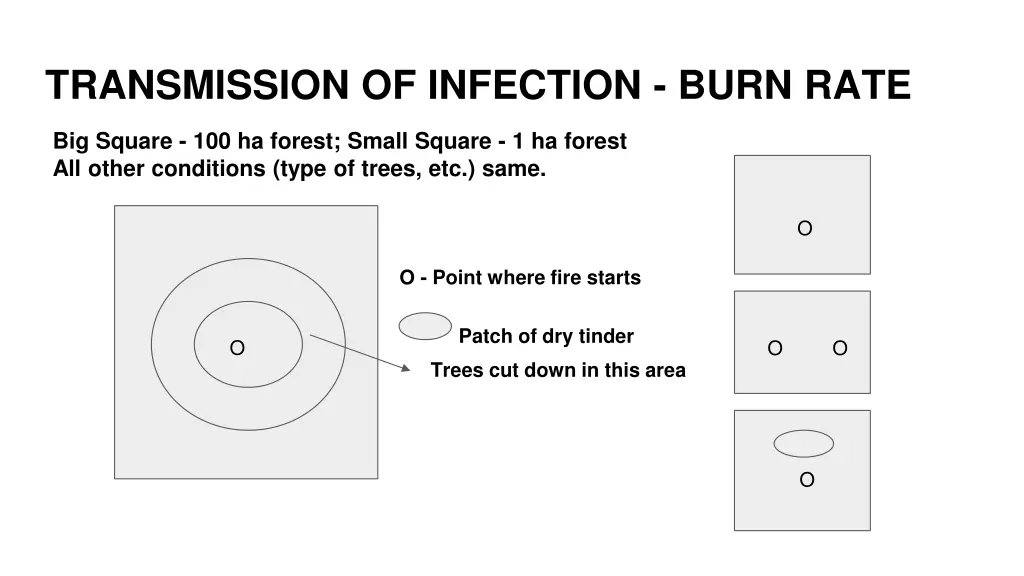
TRANSMISSION OF INFECTION - BURN RATE Big Square - 100 ha forest; Small Square - 1 ha forest All other conditions (type of trees, etc.) same. O O - Point where fire starts Patch of dry tinder O O O Trees cut down in this area O
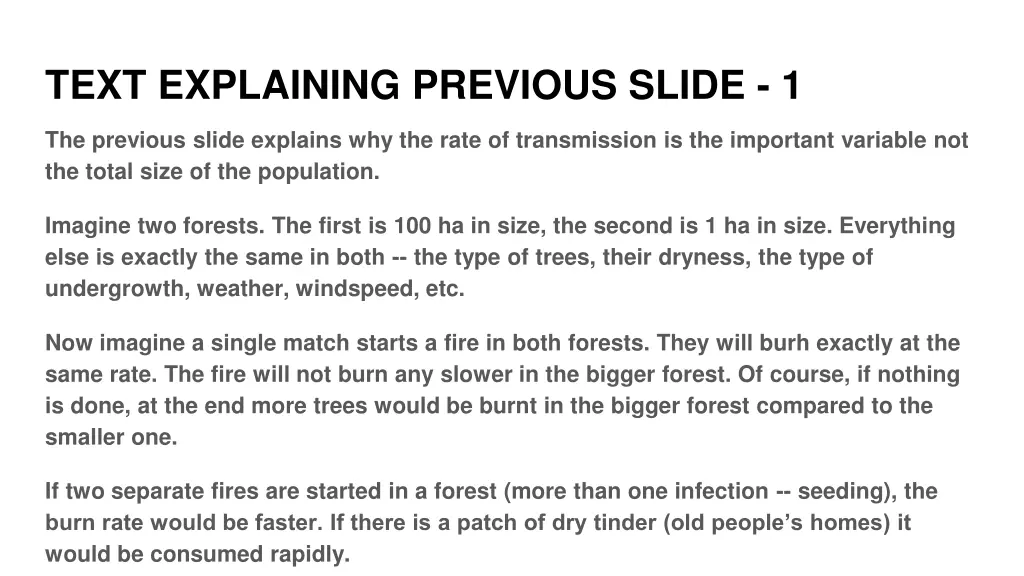
TEXT EXPLAINING PREVIOUS SLIDE - 1 The previous slide explains why the rate of transmission is the important variable not the total size of the population. Imagine two forests. The first is 100 ha in size, the second is 1 ha in size. Everything else is exactly the same in both -- the type of trees, their dryness, the type of undergrowth, weather, windspeed, etc. Now imagine a single match starts a fire in both forests. They will burh exactly at the same rate. The fire will not burn any slower in the bigger forest. Of course, if nothing is done, at the end more trees would be burnt in the bigger forest compared to the smaller one. If two separate fires are started in a forest (more than one infection -- seeding), the burn rate would be faster. If there is a patch of dry tinder (old people s homes) it would be consumed rapidly.
TEXT EXPLAINING PREVIOUS SLIDE - 2 Consider the two concentric circles in the big forest. Suppose, when the fire starts, all the trees are cut down in this area as an intervention. Now the fire would not be able to jump the cordon and will be contained in a smaller area. This is analogous to CONTAINMENT with a LOCKDOWN. But note that the lockdown will not prevent all the trees burning in the inner area. A lockdown is not a cure. It provides time to prepare. Any spark in the outer area would start another fire there. To stop the fire it has to be extinguished. This can be done with good firefighting or a miracle extinguisher (vaccine). Otherwise, the fire would continue to its logical end (herd immunity). Now consider the big square to be a community that is invaded by a man-eating tiger. The first prudent reaction is to retreat inside and lock the doors. But that does not make the tiger go away and people can t stay inside forever. The only solution is to neutralize the tiger. It is the same with the Coronavirus.
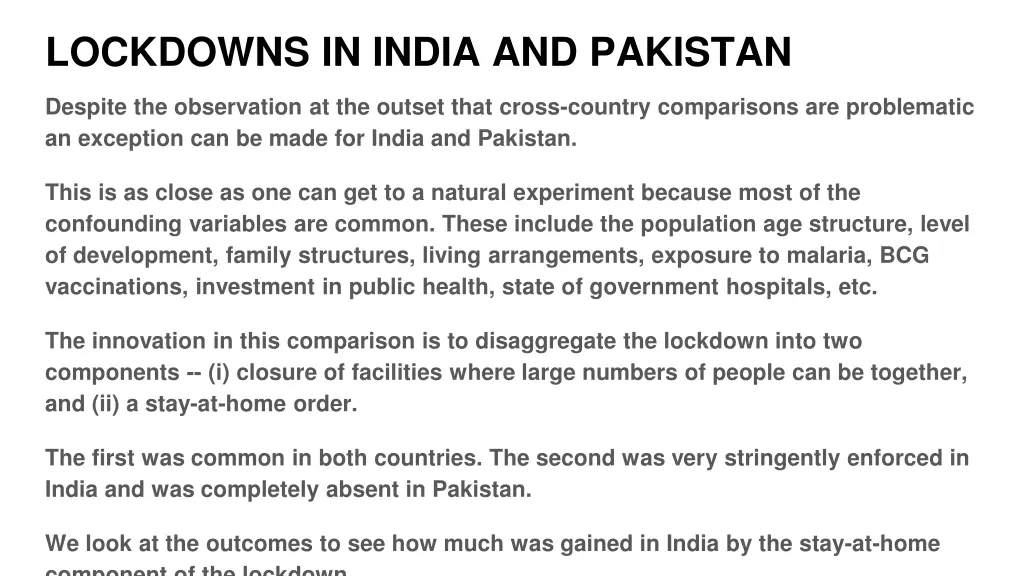
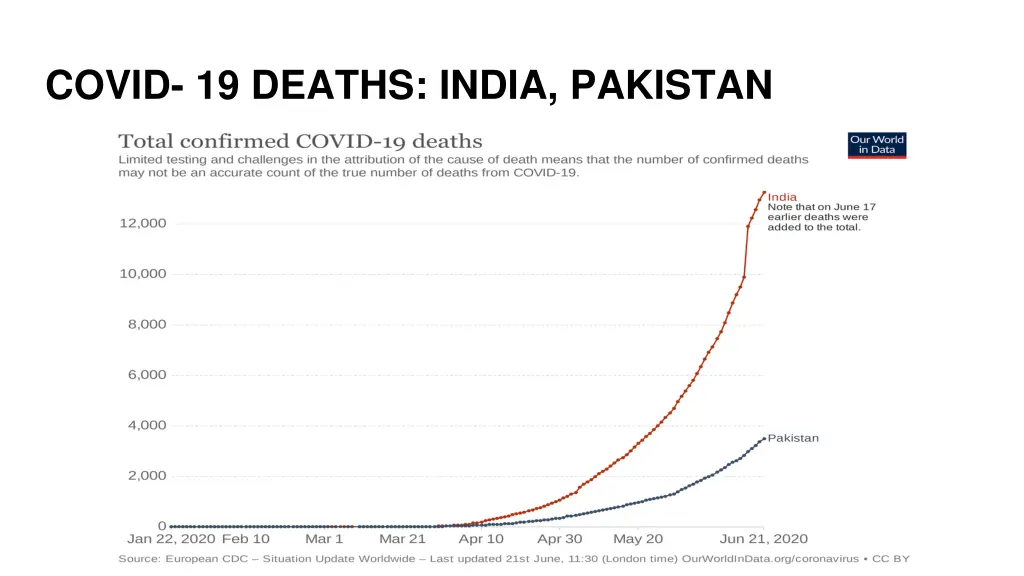
LOCKDOWNS IN INDIA AND PAKISTAN Despite the observation at the outset that cross-country comparisons are problematic an exception can be made for India and Pakistan. This is as close as one can get to a natural experiment because most of the confounding variables are common. These include the population age structure, level of development, family structures, living arrangements, exposure to malaria, BCG vaccinations, investment in public health, state of government hospitals, etc. The innovation in this comparison is to disaggregate the lockdown into two components -- (i) closure of facilities where large numbers of people can be together, and (ii) a stay-at-home order. The first was common in both countries. The second was very stringently enforced in India and was completely absent in Pakistan. We look at the outcomes to see how much was gained in India by the stay-at-home component of the lockdown.
DISCUSSION OF COMPARATIVE OUTCOMES The ONLY thing to note is that both curves have the same general shape - an upward rising trend and that the curve for India is steeper. There is enough margin of error that the true curves might move left or right but the trend is indisputable. The daily numbers (both deaths and cases) are still making new highs. While the closure of facilities likely benefited both countries in slowing down transmissions, it seems that the stay-at-home component in India did not yield any significant advantage although it came at a great economic and human cost borne largely by the migrant workers. Unlike many other countries that imposed a lockdown, in India the curve did not flatten let alone turn down. This is the principal takeaway from this comparison.
EXPLANATION OF OUTCOMES - 1 How might one explain the disappointing results of the lockdown in the two countries, especially of the stay-at-home component in India. The lockdowns were copied from countries/cities where the virus had spread very rapidly (because of seeding) and the situation was out of control calling for drastic action. This was not the case in India and Pakistan where there were very few cases and deaths when the lockdowns were imposed. An intervention, no matter how desirable in theory, should not be imposed if it cannot be implemented. Stay-at-home was infeasible where many did not have homes, it was not possible to feed those that had, it was not possible to transfer funds for essential expenses like medicines, and the capacity did not exist to visit every home to identify and separate the infected. Both countries fell into the trap of thinking that strict and extended lockdowns were a cure for the virus although it was well-known that this was a false presumption. The lockdown is a blunt instrument.
EXPLANATION OF OUTCOMES - 2 This error was compounded by characterizing the situation as a choice between Lives and Livelihoods which turned into a debate on continuing or lifting the lockdown distracting attention from what really needed to be done. It was really a choice between Lives and Lives - Covid and non-Covid (including by starvation). What needed to be done during the lockdown was the 4-T regimen (Tracking, Testing, Tracing, Treating). Countries that prioritized the 4-T regimen in conjunction with strategic, not total, lockdowns (Sri Lanka, Vietnam, Taiwan, etc.) came out better. It is clear that the lockdowns cannot continue indefinitely until a vaccine is found. Thus India and Pakistan are having to relax even though daily cases are showing new highs. There is no other weapon left in the armoury and the situation is close to the do-nothing scenario. Only herd immunity will slow the spread of the virus. What is the best way to exit the lockdown in these conditions? Identify individuals, activities, and ways of doing things that are relatively safe and focus on getting safe people to do safe things in safe ways (see Persaud 2020).
Further Readings / References The following papers elaborate in more detail the points made in this presentation: Altaf, Anjum 2020. Lockdowns in India and Pakistan: A Natural Experiment. https://docs.google.com/document/d/1MpAHFGrKSnLZi66uJZZthHuaPFm1TqHJXiH5x9w7A yM/edit?usp=sharing Altaf, Anjum 2020. COVID-19 and Population Density: A Methodological Note. https://docs.google.com/document/d/1gqWLW6n0fGKUkMQOTkSMUGjk3_JvI72itWTYUmG 6lqc/edit?usp=sharing (Both the above papers are scheduled to appear in the Economic and Political Weekly in July 2020.) Persaud, Avinash 2020. Exiting the Lockdown Sustainably. Economic and Political Weekly, Vol. 55, No. 24, June 13, 2020. https://www.epw.in/journal/2020/24/h-t-parekh-finance-column/exiting-lockdown- sustainably.html