Master the Art of Effective Debate: Models, Principles & Practice
Delve into the concepts of hard and soft debate models, understand the nuances of implementing motions, and practice crafting arguments within varying frameworks with practical exercises. Enhance your debating skills for compelling discussions.

Download Presentation

Please find below an Image/Link to download the presentation.
The content on the website is provided AS IS for your information and personal use only. It may not be sold, licensed, or shared on other websites without obtaining consent from the author.If you encounter any issues during the download, it is possible that the publisher has removed the file from their server.
You are allowed to download the files provided on this website for personal or commercial use, subject to the condition that they are used lawfully. All files are the property of their respective owners.
The content on the website is provided AS IS for your information and personal use only. It may not be sold, licensed, or shared on other websites without obtaining consent from the author.
E N D
Presentation Transcript
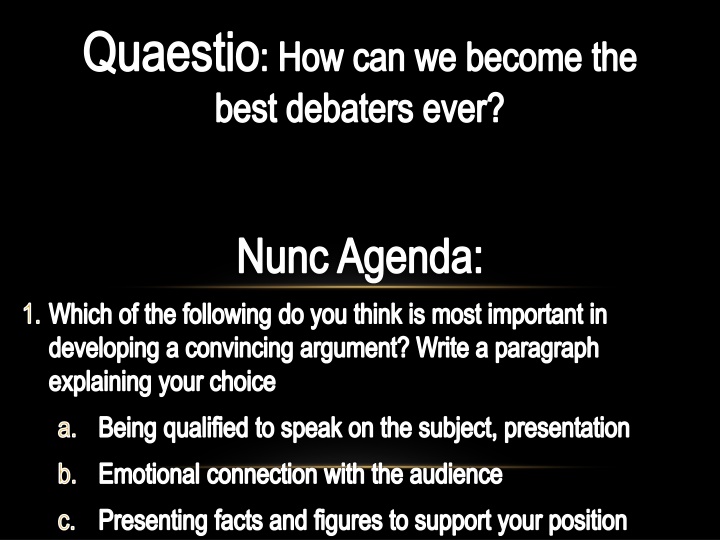
Quaestio: How can we become the best debaters ever? NuncAgenda: Which of the following do you think is most important in developing a convincing argument? Write a paragraph explaining your choice Being qualified to speak on the subject, presentation Emotional connection with the audience Presenting facts and figures to support your position
Quaestio: How can we become the best debaters ever? NuncAgenda: Take the correct rubric and group sheet from the front Sit with your group Exchange phone numbers, emails, Facebook, instagram, whatever it takes so that you can communicate over the weekend about debate prep
Quaestio: How can we become the best debaters ever? NuncAgenda: Sit with your group. Share with your group members any and all research you found over the weekend.
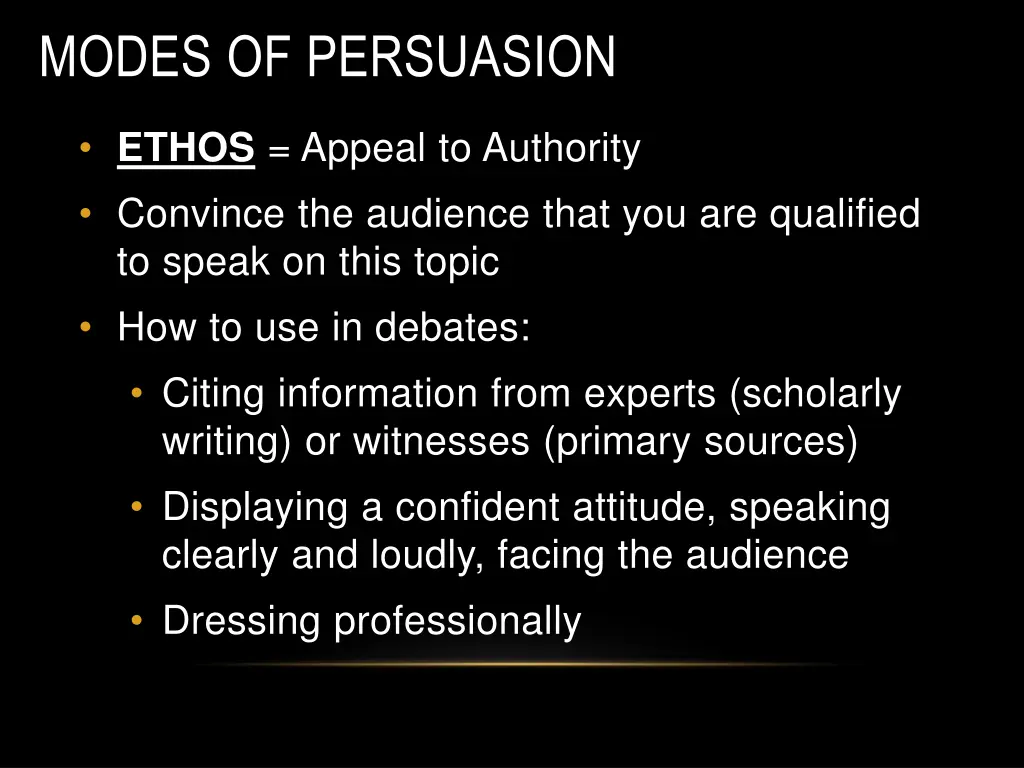
MODES OF PERSUASION ETHOS = Appeal to Authority Convince the audience that you are qualified to speak on this topic How to use in debates: Citing information from experts (scholarly writing) or witnesses (primary sources) Displaying a confident attitude, speaking clearly and loudly, facing the audience Dressing professionally
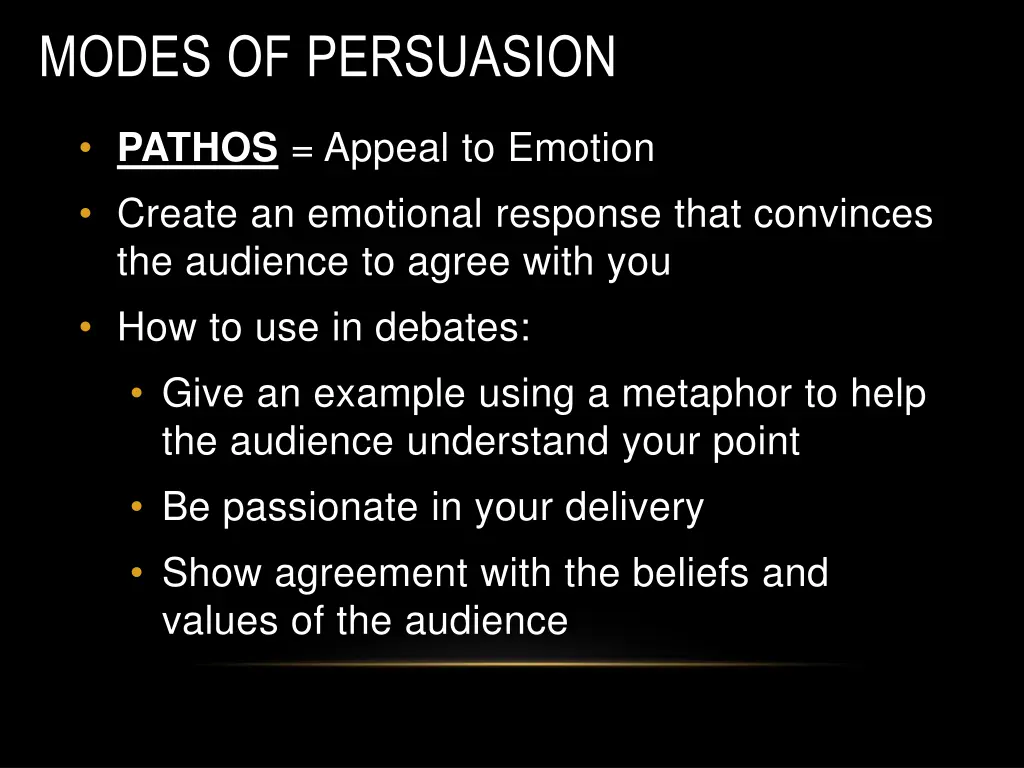
MODES OF PERSUASION PATHOS = Appeal to Emotion Create an emotional response that convinces the audience to agree with you How to use in debates: Give an example using a metaphor to help the audience understand your point Be passionate in your delivery Show agreement with the beliefs and values of the audience
MODES OF PERSUASION LOGOS = Appeal to Logic Provide the audience with Facts and Figures that clearly support your argument How to use in debates: Citing information from experts (scholarly writing) or witnesses (primary sources) Using graphs, charts, or images as proof Explaining background information to the audience to help them understand
HOW DEBATE WORKS
PARTICIPANTS IN THE DEBATE There are 5-6 members in a group all dealing with the same debate question Debaters 2 Affirmative- Argue that the answer to the question is YES 2 Negative- Argue that the answer to the question is NO 1-2 Moderators- Conduct the debate, keep time, ask questions of debaters
STEPS IN THE DEBATE Moderator introduces the debate Construction (present your argument) Affirmative One- 2:00 (or 1:30) Negative One- 2:00 (or 1:30) Affirmative Two- 2:00 (or 1:30) Negative Two- 2:00 (or 1:30)
STEPS IN THE DEBATE Rebuttal (Refuting your opponent) Affirmative One- 0:45 Negative One- 0:45 Affirmative Two- 0:45 Negative Two- 0:45 Moderator concludes debate
HOW TO HAVE GREAT DEBATES
1. DEBATE PREPARATION ALWAYS use and completely fill out your Talking Points sheet Additional notes and resources are GREAT, but they do not take the place of your Talking Points Develop POINTS you want to make and collect supporting evidence DO NOT WRITE AN ESSAY TO READ TO THE CLASS! Keep Talking Points simple
2. CONSTRUCTION VS REBUTTAL Your CONSTRUCTION (2 minutes) is your time to convince the audience of your points Use your talking points and additional notes and resources to make your argument Both partners should know and understand ALL TALKING POINTS Your REBUTTAL (30 seconds) is your chance to respond to the opposing team s argument You MUST respond directly to your opponent s argument
3. CITING SOURCES You should clearly cite AT LEAST THREE SOURCES during the debate construction Your sources MUST have good ETHOS to receive full credit Citing Wikipedia (or other bad websites) or citing the worksheet you gave us will receive no credit at all Cite sources right before you use them According to [expert s name] Don t say I got this from
4. MANAGING TIME Practice and time your construction at home. If you finish early, use extra time for recap. Give helpful details and examples, DO NOT just list facts (Logos alone needs help). Take notes when the opposing team speaks to prepare for your rebuttal. Moderator questions are to be used in emergencies only. It is bad to have to use them. Moderator questions must HELP the debater continue arguing. They are not Quiz questions.
Pensa Begin your research tonight! Find articles, primary sources, or other helpful information (from trusted sites) and print them for class tomorrow. Go to mrcaseyhistory.com to see your debate groups and to begin your research. I will be providing a list of websites you might want to check out for sources (but don t stop there! Keep searching on your own!)