Mathematical Induction in Discrete Mathematics
Mathematical induction is a powerful method for proving theorems in discrete mathematics. This technique is essential for proving statements involving integers, sets, and more. Base cases and inductive steps form the foundation of a proof by induction, demonstrating the validity of a statement for all integers greater than or equal to a specified value. Understanding the structure of a proof by induction and its application is key in mastering this fundamental concept.

Download Presentation

Please find below an Image/Link to download the presentation.
The content on the website is provided AS IS for your information and personal use only. It may not be sold, licensed, or shared on other websites without obtaining consent from the author.If you encounter any issues during the download, it is possible that the publisher has removed the file from their server.
You are allowed to download the files provided on this website for personal or commercial use, subject to the condition that they are used lawfully. All files are the property of their respective owners.
The content on the website is provided AS IS for your information and personal use only. It may not be sold, licensed, or shared on other websites without obtaining consent from the author.
E N D
Presentation Transcript
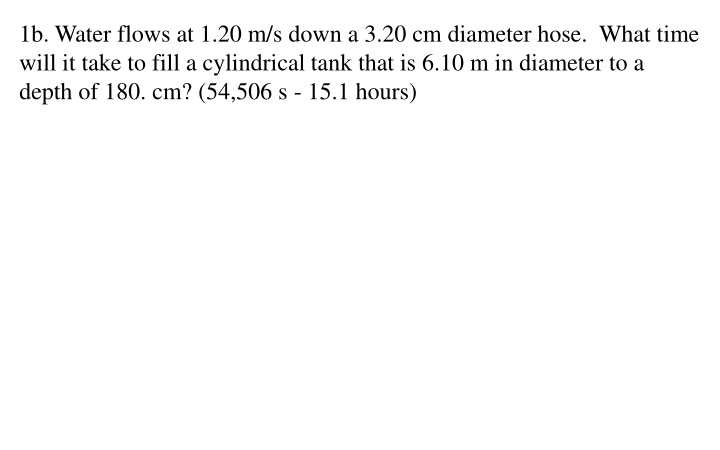
1b. Water flows at 1.20 m/s down a 3.20 cm diameter hose. What time will it take to fill a cylindrical tank that is 6.10 m in diameter to a depth of 180. cm? (54,506 s - 15.1 hours)
2b. Water issues from hole in the side of a water tank at 18.0 m/s. What is the height of the water in the tank above the hole? ( = 1000. kgm-3) Assume atmospheric pressure above the water in the tank and at the hole. (16.5 m)
2c. The air ( = 1.29 kgm-3) is traveling at 63.0 m/s over the top of a wing, and 61.0 m/s over the bottom of a wing. What is the pressure difference from one side to the other? (160. Pa)
4b. A tiny grain of bapepper ( = 2130 kgm-3) is 1.20 microns in diameter. What speed does it settle in water? ( = 1000. kgm-3, = 1.002x10⁻³ Pa s) (Don't ignore the buoyant force of water) (8.85x10⁻⁷ m/s)
1. Water flows at 0.854 m/s down a 1.59 cm diameter hose. What time will it take to fill a circular kiddie pool that is 1.75 m in diameter to a depth of 37.0 cm? (5250 s)
2. An HVAC duct that is 1.02 m in diameter supplies air to a 10.0 m x 4.20 m x 21.0 m room at a rate of 3.50 ACH. What is the air speed in the duct? (3.50 ACH means it replaces the air 3.50 times per hour, so it does it once in (3600 s)/3.5 seconds) (1.05 m/s)
3. A pump delivers 180. liters per minute. What speed does the water travel through its 4.15 cm diameter outlet pipe? What time would it take for the pump to fill a rectangular tank that is 2.1 m x 3.3 m x 5.4 m? (2.22 m/s, 12,500 s)
4. A classroom is 32.0 feet by 58.5 feet and 8.10 feet high. If air flows 8.65 f/s down a 1.50 foot x 1.00 foot air duct, what time in minutes does it take to replace the air in the room? (19.5 minutes)
5. A pipe bursts in a classroom that is 12.0 m x 35.0 m in floor area. If it is a 5.08 cm diameter pipe, and the water is going 20.3 m/s, what depth will the water be in a hour if it does not leak? (35.3 cm)
6. A 0.75 inch pipe with water going 4.5 inches per second narrows to 0.50 inches inner diameter. What is the velocity in the narrow part? (10. inches/sec)
7.Air flows at 0.450 m/s down a duct that is 24.0 cm x 62.0 cm. If it widens to 35.0 x 62.0 cm, what is the air velocity there? (0.309 m/s)
8. A circular 2.50 cm diameter pipe has a flow velocity of 56.0 cm/s. What is the diameter of the pipe if the flow velocity slows to 13.0 cm/s? (5.19 cm)
9. A fire hose sprays water at 34.0 m/s out of a nozzle that is 2.50 cm in diameter. What is the diameter of the supply line if the velocity is 3.68 m/s (7.60 cm)
10. A river with a strangely rectangular channel is 20.0 m wide. At a spot where it is 6.30 m deep, the water moves at a stately 0.0850 m/s. Later there is a rapids where the water moves at 3.20 m/s. How deep is it there on the average? (Assume the channel is more or less rectangular in cross section) (0.167 m)
11. Water issues from hole in the side of a water tank at 12.0 m/s. What is the height of the water in the tank above the hole? ( = 1000. kgm-3) Assume atmospheric pressure above the water in the tank and at the hole. (7.34 m)
12. Air ( = 1.29 kgm-3) streams at 6.70 m/s through a hole in a wall. What is the pressure difference from one side to the other? (29.0 Pa)
13. The air is traveling at 45.0 m/s over the top of a wing, and 43.0 m/s over the bottom of a wing. What is the pressure difference from one side to the other? (114 Pa)
14. Water is at 1.035x10⁵ Pa in a level pipe where the velocity is 2.40 m/s. If the pressure drops to 1.024x10⁵ Pa, what is the velocity? (2.82 m/s)
15. Water moves at 1.70 m/s down a level pipe at a pressure of 1.015x10⁵ Pa. What is the pressure if the water speeds up to 4.92 m/s? (9.08x10⁴ Pa)
16. Water flows at 4.50 m/s down a 2.10 cm diameter pipe at a pressure of 9.92x10⁴ Pa in the crawlspace. When the pipe is 1.20 m higher than this the pressure is 9.52x10⁴ Pa. What is the velocity of the water in the pipe? What is the pipe diameter? (2.17 m/s, 3.02 cm)
17. Water moves at 3.50 m/s down a 4.80 cm diameter pipe at an elevation of 3.80 m and a pressure of 1.26x10⁵ Pa. At a different elevation the pipe narrows to 3.60 cm in diameter and is at a pressure of 1.36x10⁵ Pa. What is the elevation here? (1.43 m)
18. A 5.40 cm diameter pipe carries water at 3.70 m/s at an elevation of 3.40 m and a pressure of 1.56x10⁵ Pa. At an elevation of 4.60 m the pipe narrows to 4.20 cm in diameter. What is the pressure in this part of the pipe? (1.32x10⁵ Pa)
19. A 3.50 cm diameter pipe carries water at 4.10 m/s at an elevation of 6.30 m and a pressure of 1.24x10⁵ Pa. The pipe widens out at an elevation of 5.10 m where the pressure is 1.43x10⁵ Pa. What is the velocity here and the diameter of the pipe? (1.53 m/s and 5.72 cm) Already done
20. Water moves at 4.90 m/s down a 4.70 cm diameter pipe at an elevation of 3.80 m and a pressure of 1.21x10⁵ Pa. At a different elevation the pipe widens to 5.90 cm in diameter and is at a pressure of 1.37x10⁵ Pa. What is the elevation here? (2.90 m)
Water: = 1000. kgm-3, = 1.002x10⁻³ Pa s. Air: = 1.29 kgm-3, = 1.81x10⁻⁵ Pa s at 20 oC 21. A droplet of water is 6.12 m in diameter. What is its mass? What is its weight? What speed must it fall through air so that its Stokes drag is equal to its weight? (This is its terminal velocity) (1.20x10⁻¹³ kg, 1.18x10⁻¹² N, 0.00113 m/s)
Water: = 1000. kgm-3, = 1.002x10⁻³ Pa s. Air: = 1.29 kgm-3, = 1.81x10⁻⁵ Pa s at 20 oC 22. A droplet of mist falls through air with a terminal velocity of 0.00156 m/s. What is its radius? (Ignore the buoyant force of the air) (3.60 m)
Water: = 1000. kgm-3, = 1.002x10⁻³ Pa s. Air: = 1.29 kgm-3, = 1.81x10⁻⁵ Pa s at 20 oC 25. A 3.60 micron diameter particle falls through air with a terminal velocity of 0.00130 m/s. What is its density? (3330 kgm-3)
26. Syrup with a viscosity of 1.20 Pa s and a density of 1080 kgm-3 needs to have turbulent flow down a pipe where it is heated. What speed must it go down a pipe that is 68.0 cm in diameter to ensure that it has a Re_r of 1200? (3.92 m/s)
Water: = 1000. kgm-3, = 1.002x10⁻³ Pa s. Air: = 1.29 kgm-3, = 1.81x10⁻⁵ Pa s at 20 oC 27. What is the Re_r of water flowing at 0.130 m/s down a tube that is 8.01 mm in diameter? (520.)
Water: = 1000. kgm-3, = 1.002x10⁻³ Pa s. Air: = 1.29 kgm-3, = 1.81x10⁻⁵ Pa s at 20 oC 28. What is the maximum speed air can flow down a 24.0 cm diameter duct to have a Re_r of 850? (9.94 cm/s)
Water: = 1000. kgm-3, = 1.002x10⁻³ Pa s. Air: = 1.29 kgm-3, = 1.81x10⁻⁵ Pa s at 20 oC 29. What is the Re_r of air flowing at 0.935 m/s down a duct with a diameter of 1.20 m? (4.00x10⁴)
Water: = 1000. kgm-3, = 1.002x10⁻³ Pa s. Air: = 1.29 kgm-3, = 1.81x10⁻⁵ Pa s at 20 oC 30. What maximum diameter pipe can water flow down at 0.890 m/s to have a Re_r of 950? (2.14 mm)