Post-Conflict Dynamics and Human Security Challenges
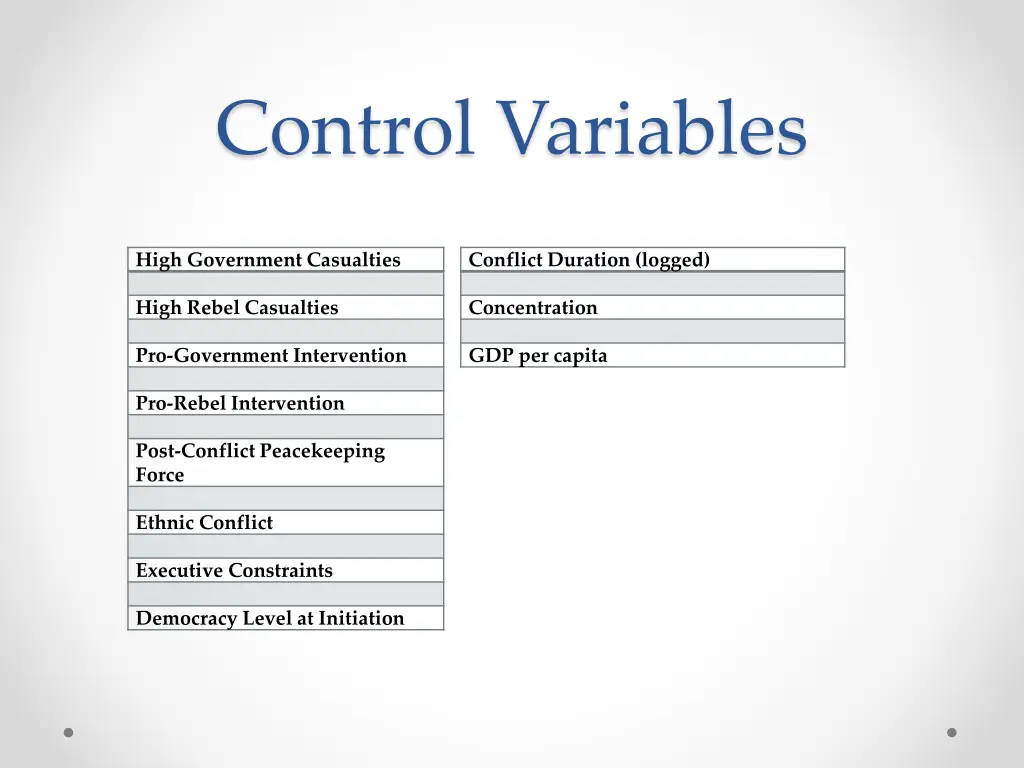
Explore the impact of civil war strategies, war outcomes, and human security in post-conflict societies. The research covers regime vulnerability, risk of civil war recurrence, post-conflict democratization, repression in post-conflict states, and empirical expectations regarding human rights violations. Empirical tests focus on armed conflicts over governance, evaluating factors like civilian targeting and government composition. Control variables include government casualties, conflict duration, interventions, GDP per capita, peacekeeping forces, ethnic conflict, executive constraints, and democracy levels.

Download Presentation

Please find below an Image/Link to download the presentation.
The content on the website is provided AS IS for your information and personal use only. It may not be sold, licensed, or shared on other websites without obtaining consent from the author. If you encounter any issues during the download, it is possible that the publisher has removed the file from their server.
You are allowed to download the files provided on this website for personal or commercial use, subject to the condition that they are used lawfully. All files are the property of their respective owners.
The content on the website is provided AS IS for your information and personal use only. It may not be sold, licensed, or shared on other websites without obtaining consent from the author.
E N D
Presentation Transcript
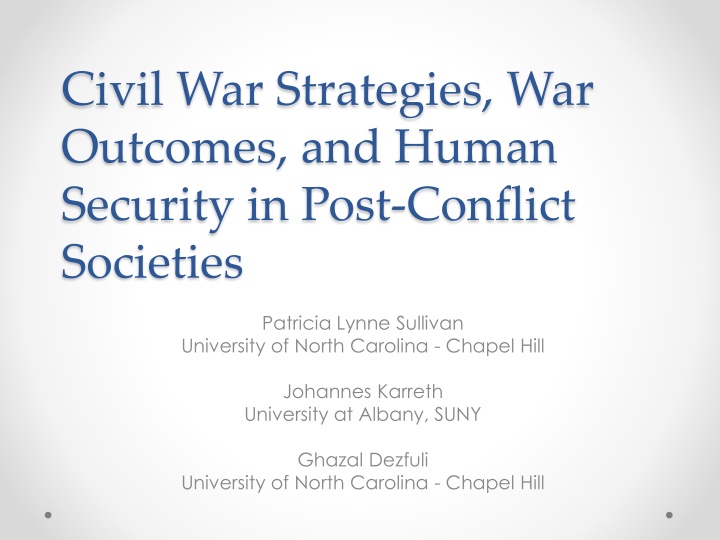
Civil War Strategies, War Outcomes, and Human Security in Post-Conflict Societies Patricia Lynne Sullivan University of North Carolina - Chapel Hill Johannes Karreth University at Albany, SUNY Ghazal Dezfuli University of North Carolina - Chapel Hill
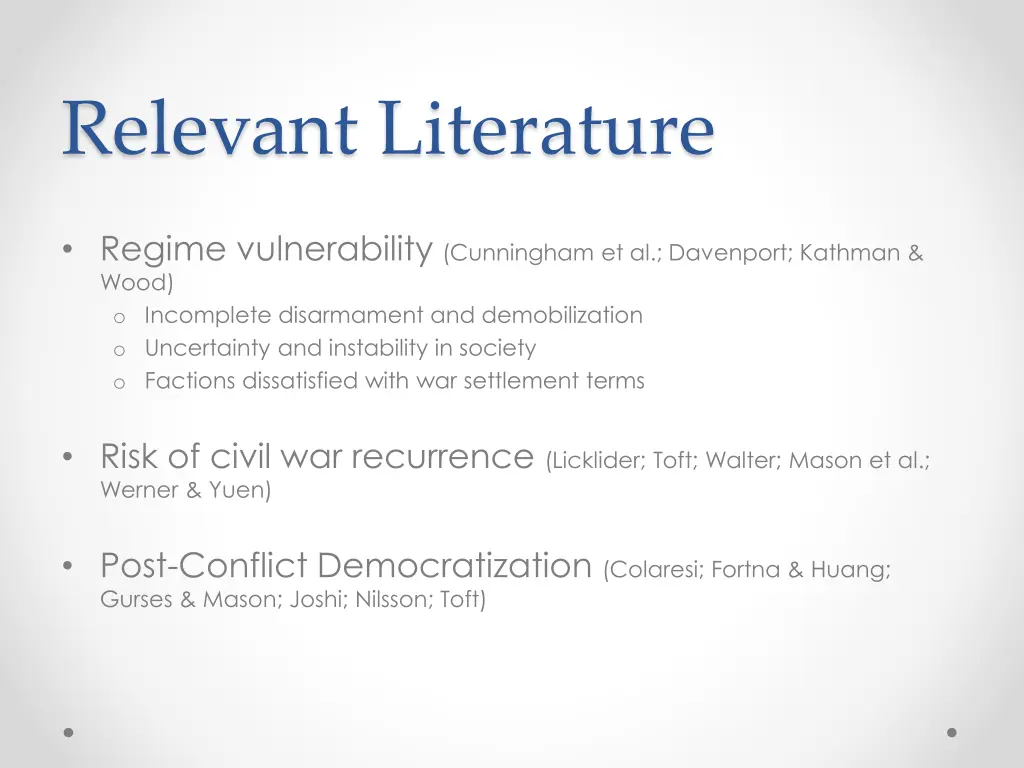
Relevant Literature Regime vulnerability (Cunningham et al.; Davenport; Kathman & Wood) o Incomplete disarmament and demobilization o Uncertainty and instability in society o Factions dissatisfied with war settlement terms Risk of civil war recurrence (Licklider; Toft; Walter; Mason et al.; Werner & Yuen) Post-Conflict Democratization (Colaresi; Fortna & Huang; Gurses & Mason; Joshi; Nilsson; Toft)
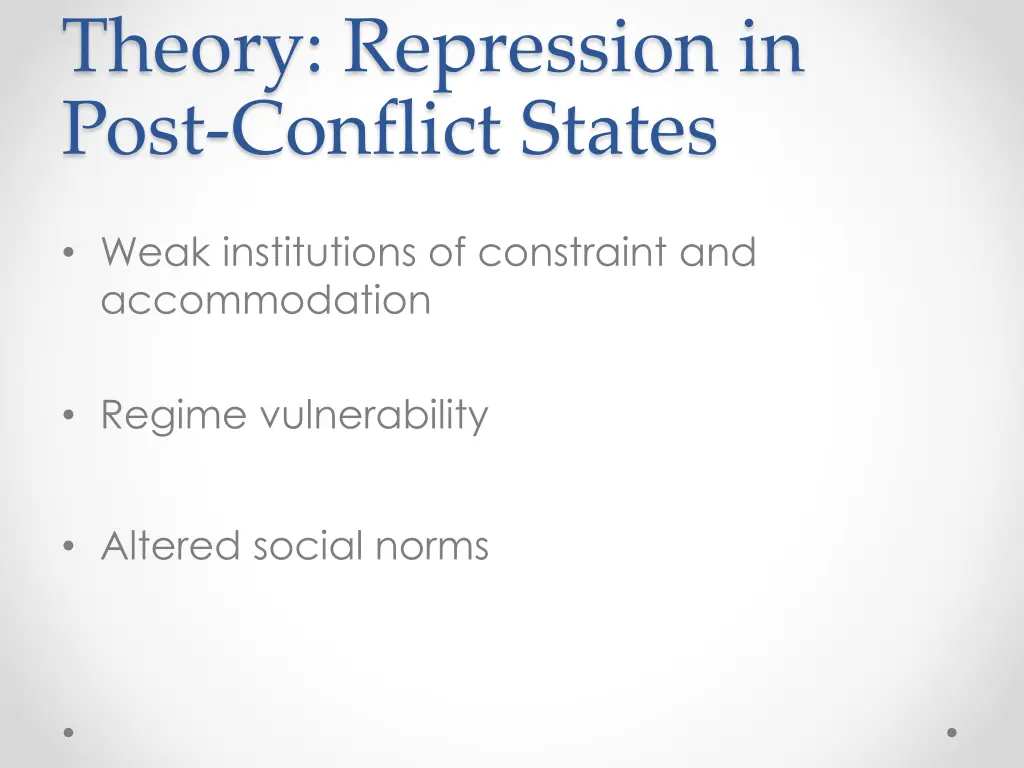
Theory: Repression in Post-Conflict States Weak institutions of constraint and accommodation Regime vulnerability Altered social norms
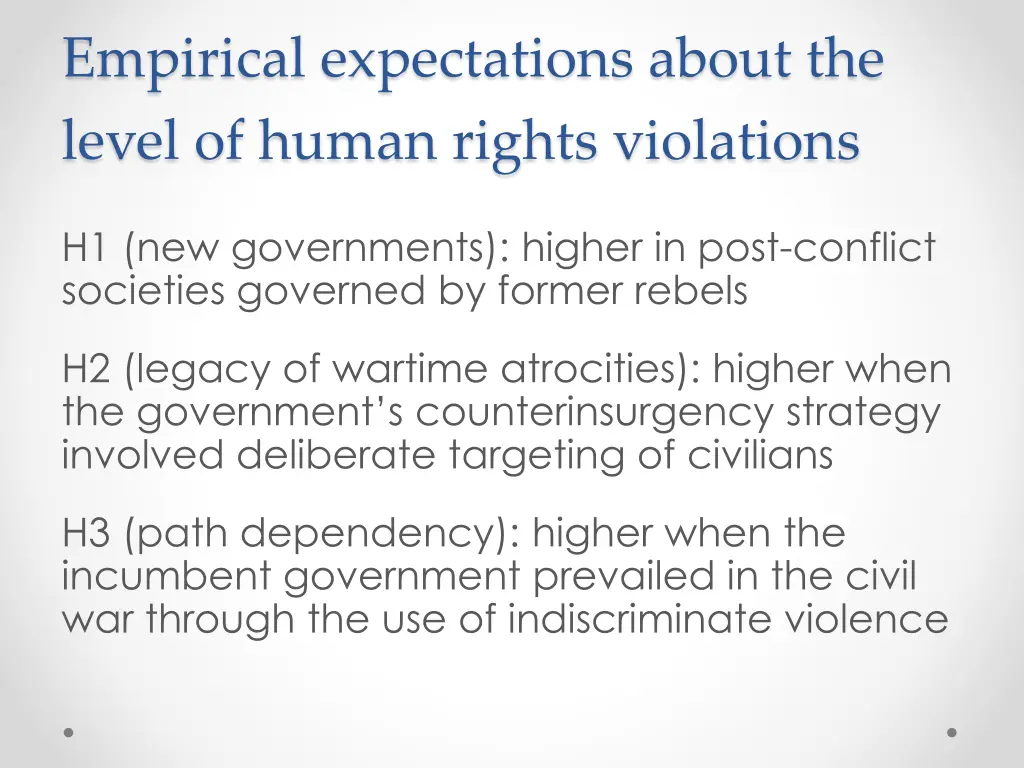
Empirical expectations about the level of human rights violations H1 (new governments): higher in post-conflict societies governed by former rebels H2 (legacy of wartime atrocities): higher when the government s counterinsurgency strategy involved deliberate targeting of civilians H3 (path dependency): higher when the incumbent government prevailed in the civil war through the use of indiscriminate violence
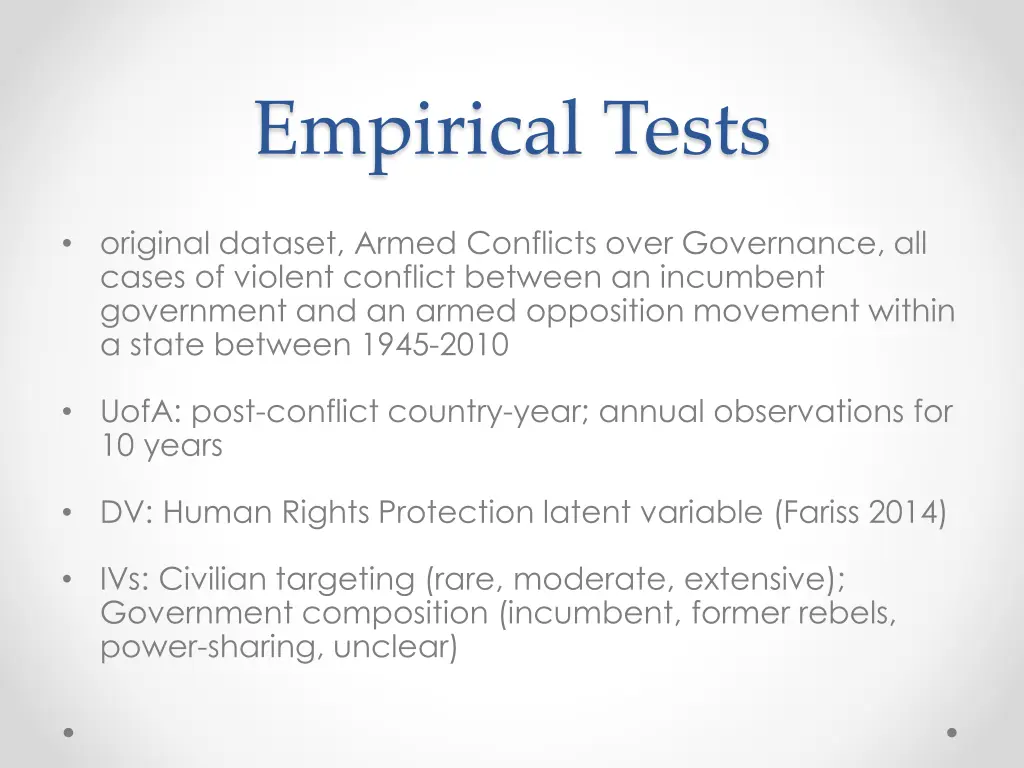
Empirical Tests original dataset, Armed Conflicts over Governance, all cases of violent conflict between an incumbent government and an armed opposition movement within a state between 1945-2010 UofA: post-conflict country-year; annual observations for 10 years DV: Human Rights Protection latent variable (Fariss 2014) IVs: Civilian targeting (rare, moderate, extensive); Government composition (incumbent, former rebels, power-sharing, unclear)
Control Variables High Government Casualties Conflict Duration (logged) High Rebel Casualties Concentration Pro-Government Intervention GDP per capita Pro-Rebel Intervention Post-Conflict Peacekeeping Force Ethnic Conflict Executive Constraints Democracy Level at Initiation
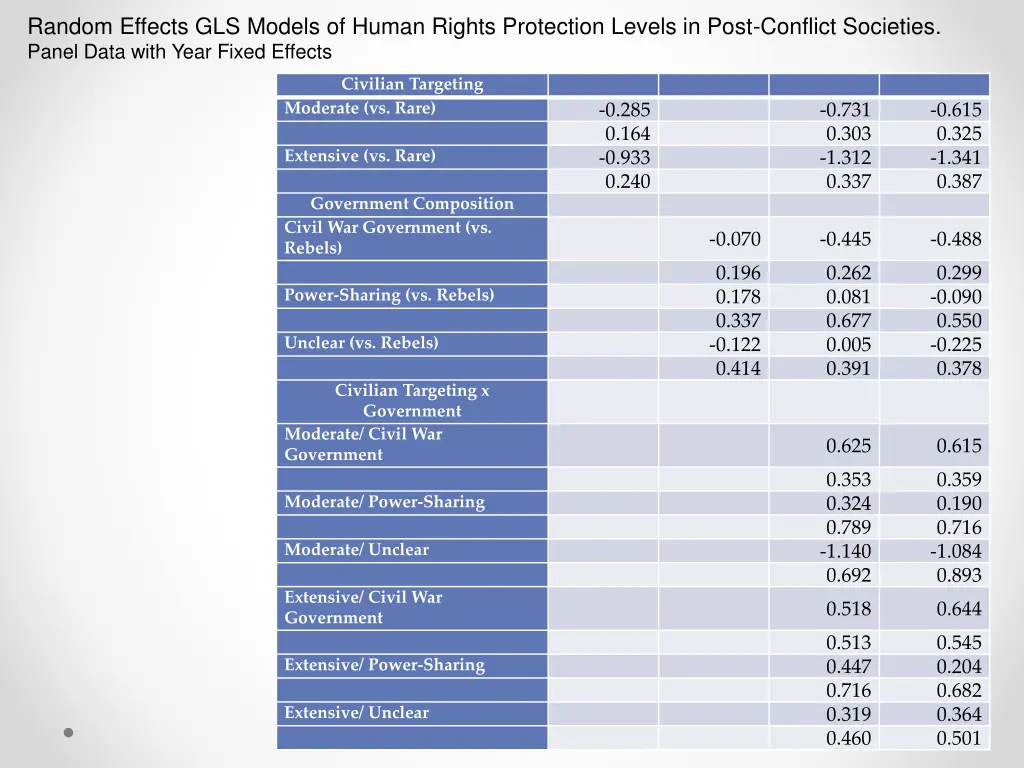
Random Effects GLS Models of Human Rights Protection Levels in Post-Conflict Societies. Panel Data with Year Fixed Effects Civilian Targeting Moderate (vs. Rare) -0.285 0.164 -0.933 0.240 -0.731 0.303 -1.312 0.337 -0.615 0.325 -1.341 0.387 Extensive (vs. Rare) Government Composition Civil War Government (vs. Rebels) -0.070 -0.445 -0.488 0.196 0.178 0.337 -0.122 0.414 0.262 0.081 0.677 0.005 0.391 0.299 -0.090 0.550 -0.225 0.378 Power-Sharing (vs. Rebels) Unclear (vs. Rebels) Civilian Targeting x Government Moderate/ Civil War Government 0.625 0.615 0.353 0.324 0.789 -1.140 0.692 0.359 0.190 0.716 -1.084 0.893 Moderate/ Power-Sharing Moderate/ Unclear Extensive/ Civil War Government 0.518 0.644 0.513 0.447 0.716 0.319 0.460 0.545 0.204 0.682 0.364 0.501 Extensive/ Power-Sharing Extensive/ Unclear
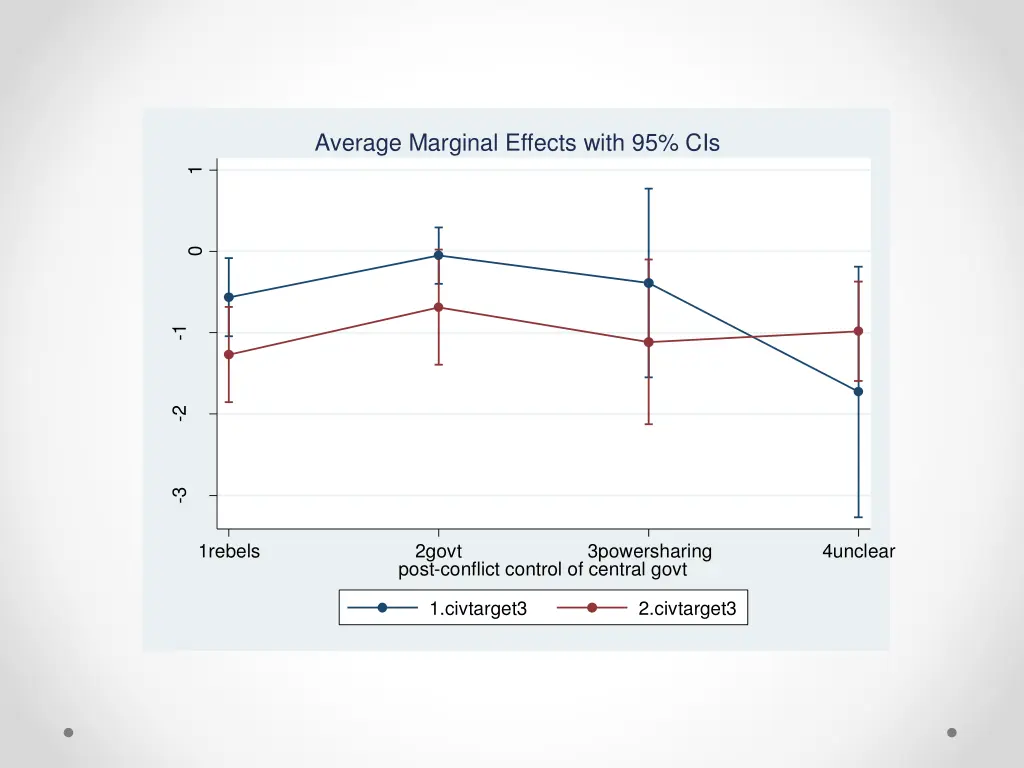
Average Marginal Effects with 95% CIs 1 Effects on Linear Prediction 0 -1 -2 -3 1rebels 2govt post-conflict control of central govt 3powersharing 4unclear 1.civtarget3 2.civtarget3
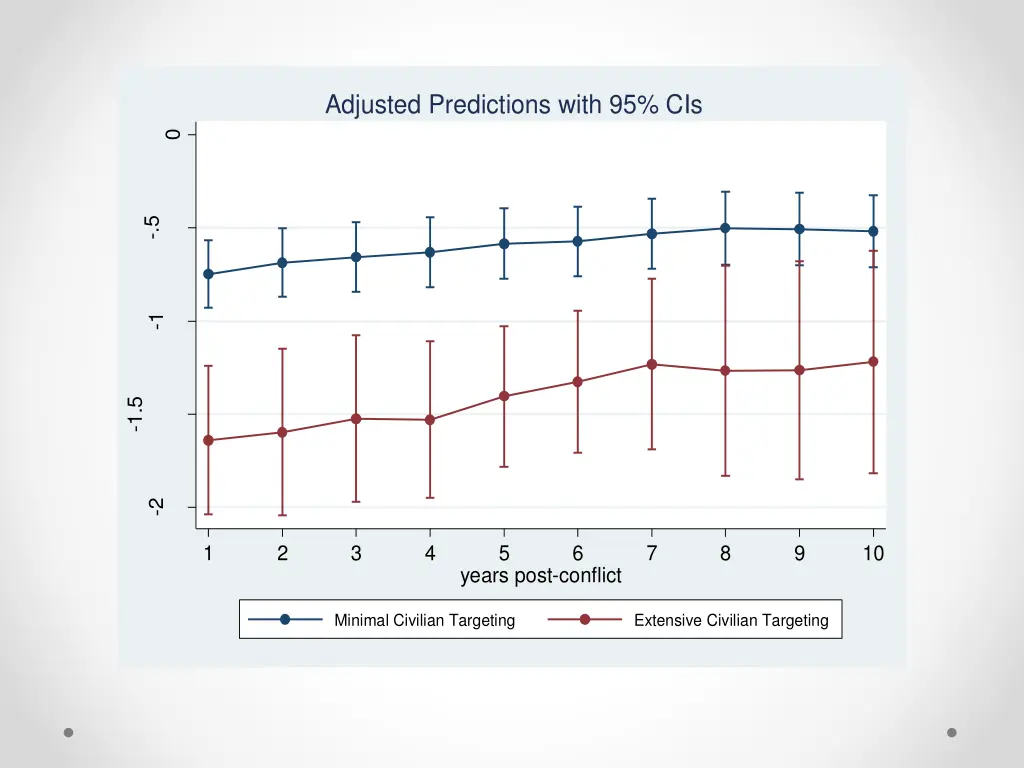
Adjusted Predictions with 95% CIs 0 -.5 HRP Linear Prediction -1 -1.5 -2 1 2 3 4 5 6 7 8 9 10 years post-conflict Minimal Civilian Targeting Extensive Civilian Targeting