Private Training Certification and Re-Certification Information
Learn about the Private Training Act certification process, institution classes, re-certification requirements, and pathways to EQA designation. Find out how institutions can apply for registration or designation under PTIB and the necessary steps for certificate renewal.

Uploaded on | 2 Views
Download Presentation

Please find below an Image/Link to download the presentation.
The content on the website is provided AS IS for your information and personal use only. It may not be sold, licensed, or shared on other websites without obtaining consent from the author. If you encounter any issues during the download, it is possible that the publisher has removed the file from their server.
You are allowed to download the files provided on this website for personal or commercial use, subject to the condition that they are used lawfully. All files are the property of their respective owners.
The content on the website is provided AS IS for your information and personal use only. It may not be sold, licensed, or shared on other websites without obtaining consent from the author.
E N D
Presentation Transcript
Private Training Act Information Webinar July 29, 2016
Certification, Institution Classes, and Re-Certification
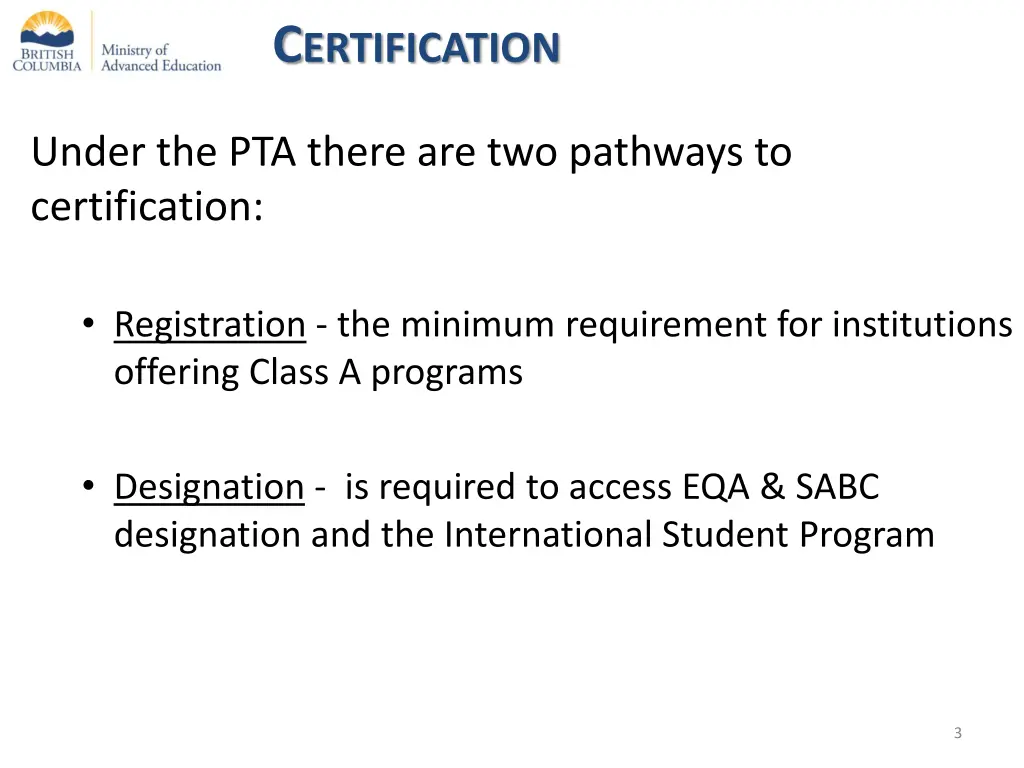
CERTIFICATION Under the PTA there are two pathways to certification: Registration - the minimum requirement for institutions offering Class A programs Designation - is required to access EQA & SABC designation and the International Student Program 3
CERTIFICATION Institutions currently registered/accredited with PCTIA will be registered/designated under PTIB effective September 1, 2016 Under the PTA institutions can apply for either registration or designation at any time There is no longer a fee for EQA designation 4
INSTITUTION CLASSES Regulatory body institution class institutions which only offer approved programs that lead to a career regulated by Transport Canada or a college designated under the Health Professions Act (CLPNBC) Language institution class institutions which only offer approved programs that are language programs which have been assessed by and meet the standards of an independent body (Languages Canada) Aboriginal institution class institutions which are operated by a First Nation and/or Aboriginal society Post-program payment institution class - institution s whose approved programs are employer provided to international students and the institution and accepts tuition after the program is completed. 5
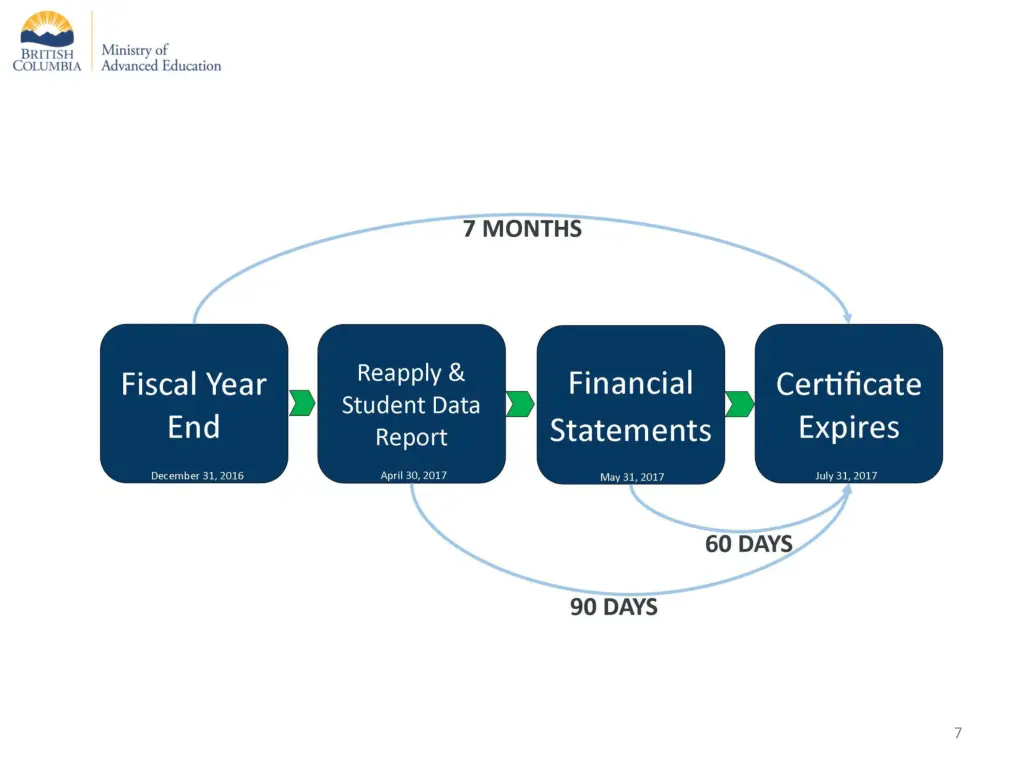
RE-CERTIFICATION Certificate terms are synchronized with an institution s fiscal year and expire 7 months after an institution s fiscal year end. Certificate renewal is no longer automatic. Institutions MUST apply for re-certification at least 90 days before their current certificate expires Applications for re-certification will be made via the institution portal In order to access the portal, a business BCeID account will need to be created At re-certification, institutions will need to provide: information on ownership evidence of general liability insurance declaration regarding suspended operations or involvement in action 6
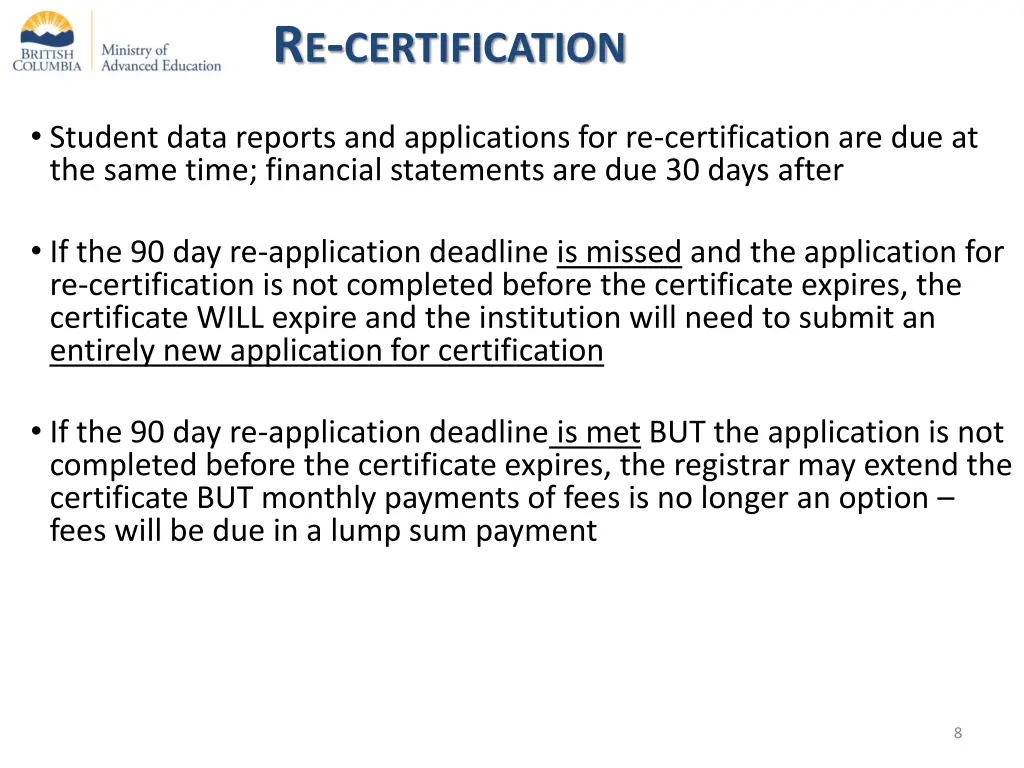
RE-CERTIFICATION Student data reports and applications for re-certification are due at the same time; financial statements are due 30 days after If the 90 day re-application deadline is missed and the application for re-certification is not completed before the certificate expires, the certificate WILL expire and the institution will need to submit an entirely new application for certification If the 90 day re-application deadline is met BUT the application is not completed before the certificate expires, the registrar may extend the certificate BUT monthly payments of fees is no longer an option fees will be due in a lump sum payment 8
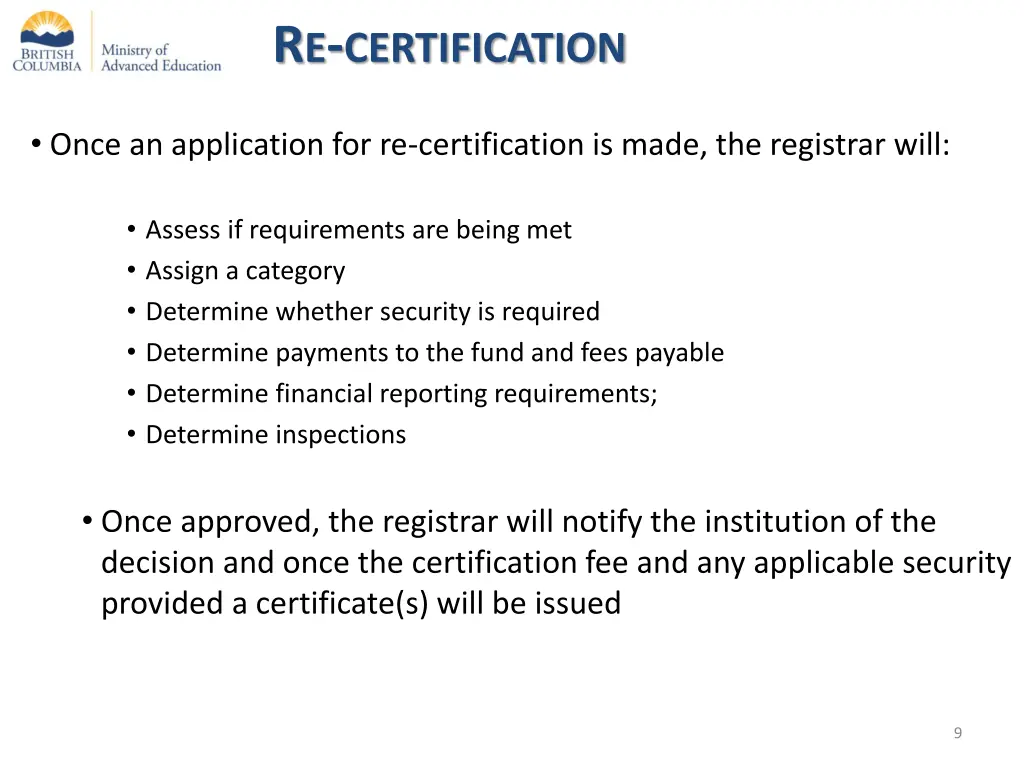
RE-CERTIFICATION Once an application for re-certification is made, the registrar will: Assess if requirements are being met Assign a category Determine whether security is required Determine payments to the fund and fees payable Determine financial reporting requirements; Determine inspections Once approved, the registrar will notify the institution of the decision and once the certification fee and any applicable security provided a certificate(s) will be issued 9
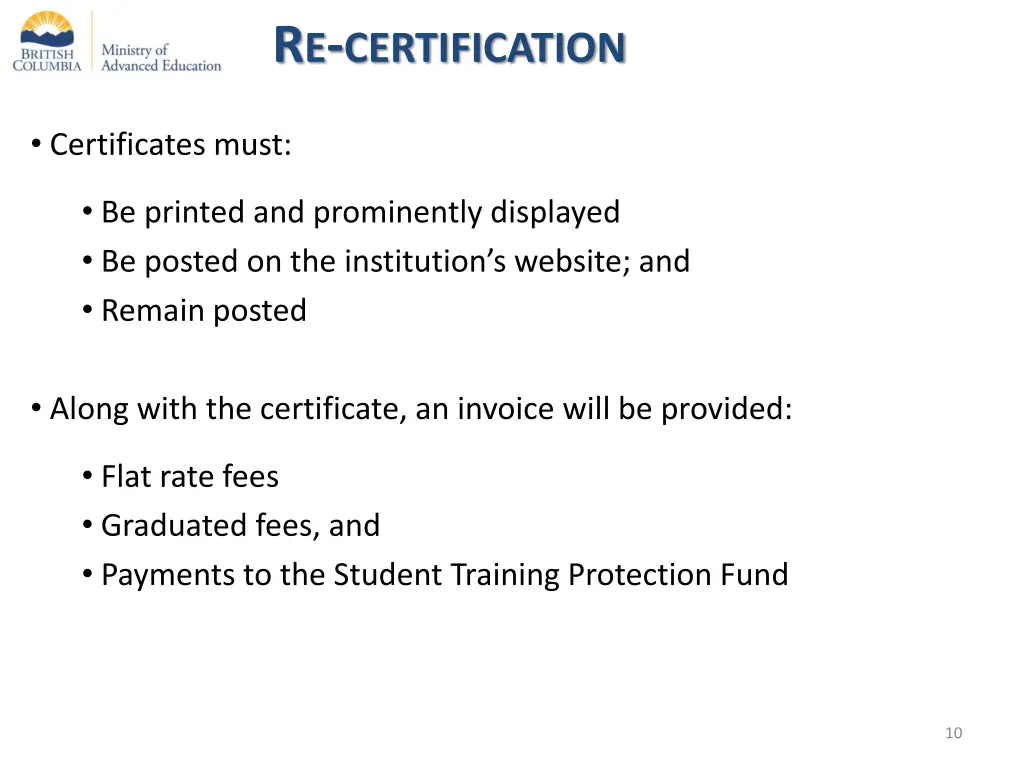
RE-CERTIFICATION Certificates must: Be printed and prominently displayed Be posted on the institution s website; and Remain posted Along with the certificate, an invoice will be provided: Flat rate fees Graduated fees, and Payments to the Student Training Protection Fund 10
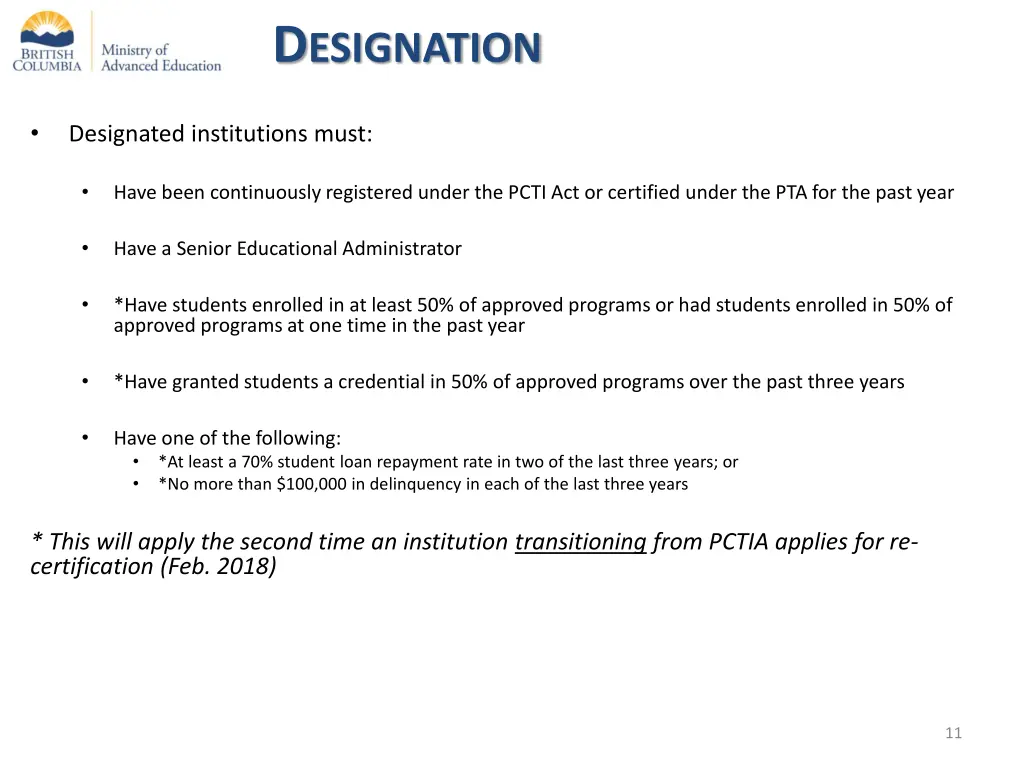
DESIGNATION Designated institutions must: Have been continuously registered under the PCTI Act or certified under the PTA for the past year Have a Senior Educational Administrator *Have students enrolled in at least 50% of approved programs or had students enrolled in 50% of approved programs at one time in the past year *Have granted students a credential in 50% of approved programs over the past three years Have one of the following: *At least a 70% student loan repayment rate in two of the last three years; or *No more than $100,000 in delinquency in each of the last three years * This will apply the second time an institution transitioning from PCTIA applies for re- certification (Feb. 2018) 11
DESIGNATION An interim designation certificate may be issued to an institution that applies (or re-applies) for designation but does not meet the requirements for a designation certificate Institutions awarded Interim Designation are required to meet all requirements of Designated institutions An institution awarded an interim designation certificate is able to apply for a designation certificate at any time when it is able to demonstrate it meets the requirements for a designation certificate 12
DESIGNATION Reviews of designation will be conducted by Ministry staff and/or subject matter experts appointed as inspectors within the first year of designation and at least once every seven years afterward The designation review process will be similar to accreditation reviews 13
Programs Classes, Approvals and Changes
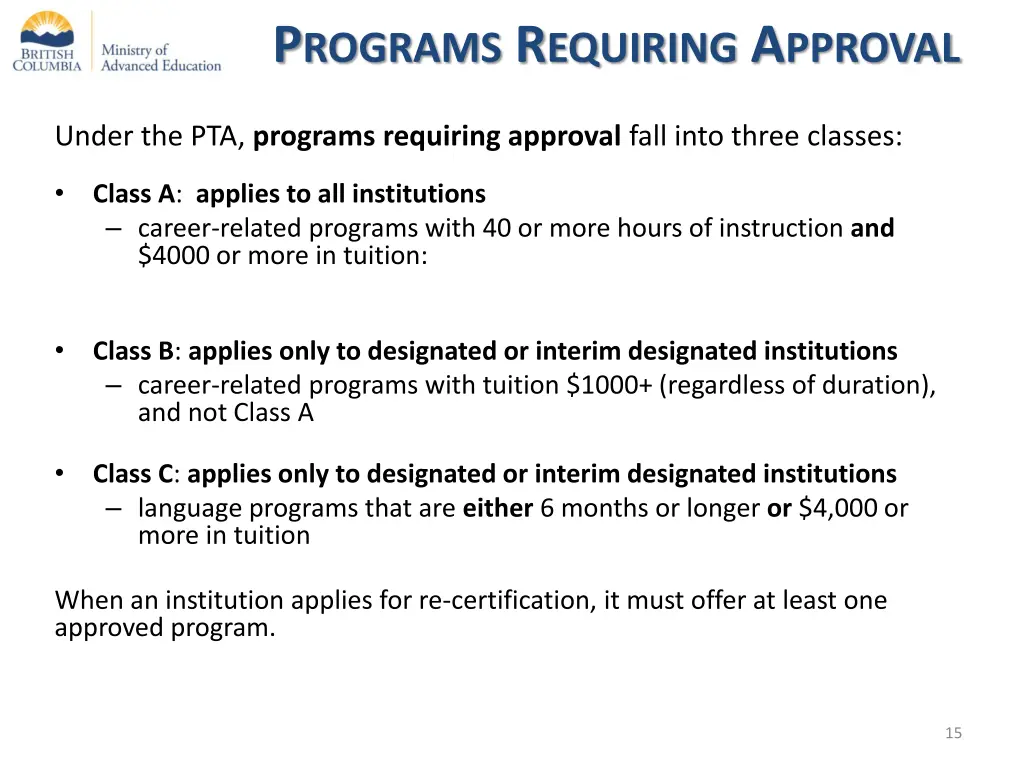
PROGRAMS REQUIRING APPROVAL Under the PTA, programs requiring approval fall into three classes: Class A: applies to all institutions career-related programs with 40 or more hours of instruction and $4000 or more in tuition: Class B: applies only to designated or interim designated institutions career-related programs with tuition $1000+ (regardless of duration), and not Class A Class C: applies only to designated or interim designated institutions language programs that are either 6 months or longer or $4,000 or more in tuition When an institution applies for re-certification, it must offer at least one approved program. 15
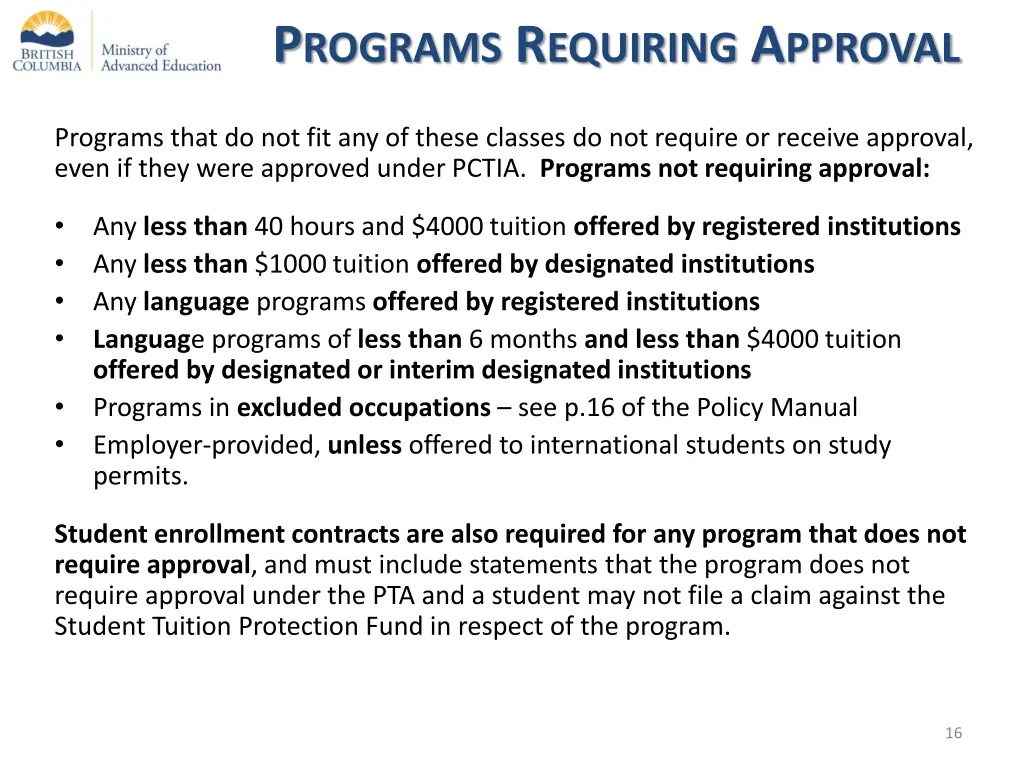
PROGRAMS REQUIRING APPROVAL Programs that do not fit any of these classes do not require or receive approval, even if they were approved under PCTIA. Programs not requiring approval: Any less than 40 hours and $4000 tuition offered by registered institutions Any less than $1000 tuition offered by designated institutions Any language programs offered by registered institutions Language programs of less than 6 months and less than $4000 tuition offered by designated or interim designated institutions Programs in excluded occupations see p.16 of the Policy Manual Employer-provided, unless offered to international students on study permits. Student enrollment contracts are also required for any program that does not require approval, and must include statements that the program does not require approval under the PTAand a student may not file a claim against the Student Tuition Protection Fund in respect of the program. 16
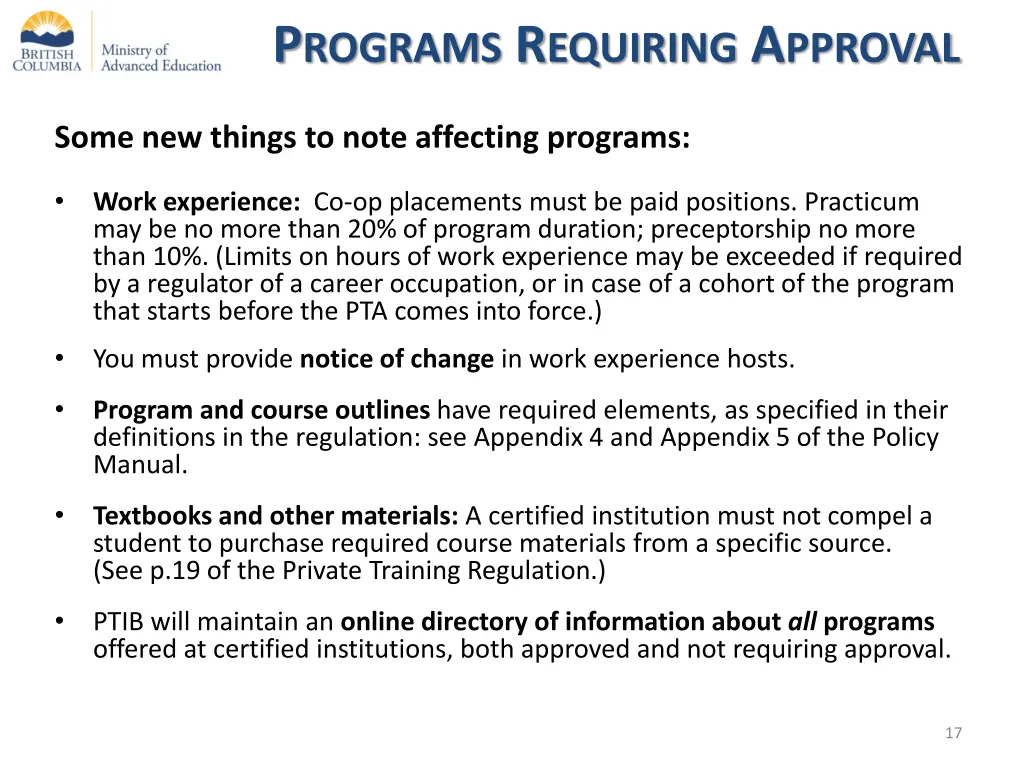
PROGRAMS REQUIRING APPROVAL Some new things to note affecting programs: Work experience: Co-op placements must be paid positions. Practicum may be no more than 20% of program duration; preceptorship no more than 10%. (Limits on hours of work experience may be exceeded if required by a regulator of a career occupation, or in case of a cohort of the program that starts before the PTA comes into force.) You must provide notice of change in work experience hosts. Program and course outlines have required elements, as specified in their definitions in the regulation: see Appendix 4 and Appendix 5 of the Policy Manual. Textbooks and other materials: A certified institution must not compel a student to purchase required course materials from a specific source. (See p.19 of the Private Training Regulation.) PTIB will maintain an online directory of information about all programs offered at certified institutions, both approved and not requiring approval. 17
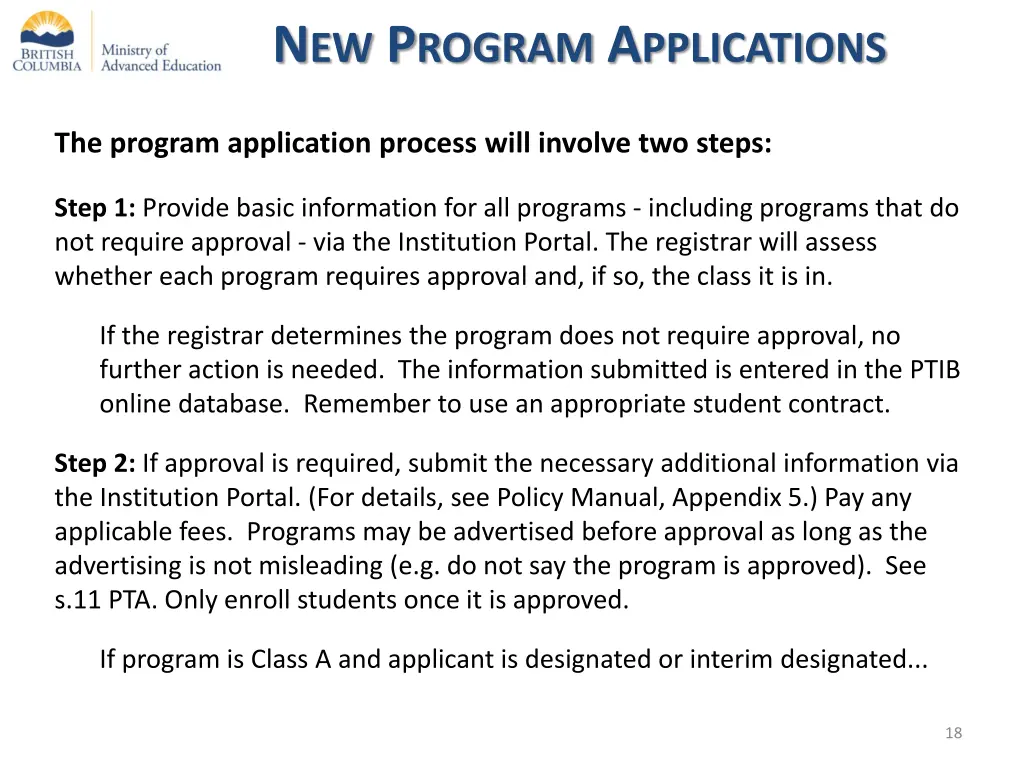
NEW PROGRAM APPLICATIONS The program application process will involve two steps: Step 1: Provide basic information for all programs - including programs that do not require approval - via the Institution Portal. The registrar will assess whether each program requires approval and, if so, the class it is in. If the registrar determines the program does not require approval, no further action is needed. The information submitted is entered in the PTIB online database. Remember to use an appropriate student contract. Step 2: If approval is required, submit the necessary additional information via the Institution Portal. (For details, see Policy Manual, Appendix 5.) Pay any applicable fees. Programs may be advertised before approval as long as the advertising is not misleading (e.g. do not say the program is approved). See s.11 PTA. Only enroll students once it is approved. If program is Class A and applicant is designated or interim designated... 18
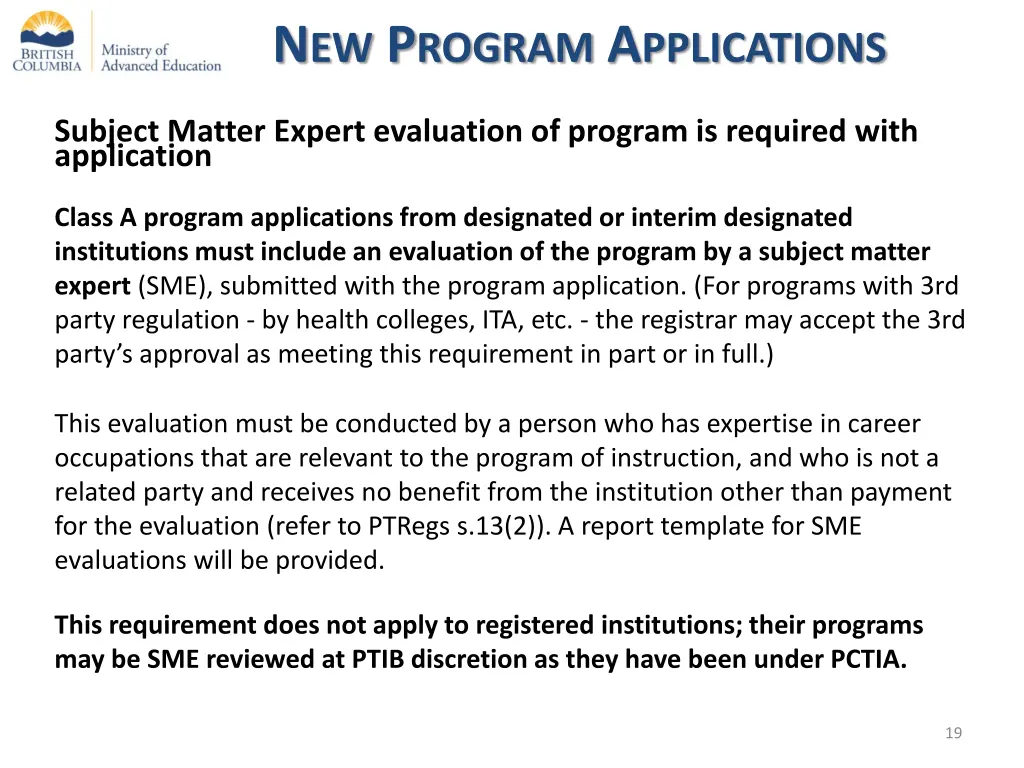
NEW PROGRAM APPLICATIONS Subject Matter Expert evaluation of program is required with application Class A program applications from designated or interim designated institutions must include an evaluation of the program by a subject matter expert (SME), submitted with the program application. (For programs with 3rd party regulation - by health colleges, ITA, etc. - the registrar may accept the 3rd party s approval as meeting this requirement in part or in full.) This evaluation must be conducted by a person who has expertise in career occupations that are relevant to the program of instruction, and who is not a related party and receives no benefit from the institution other than payment for the evaluation (refer to PTRegs s.13(2)). A report template for SME evaluations will be provided. This requirement does not apply to registered institutions; their programs may be SME reviewed at PTIB discretion as they have been under PCTIA. 19
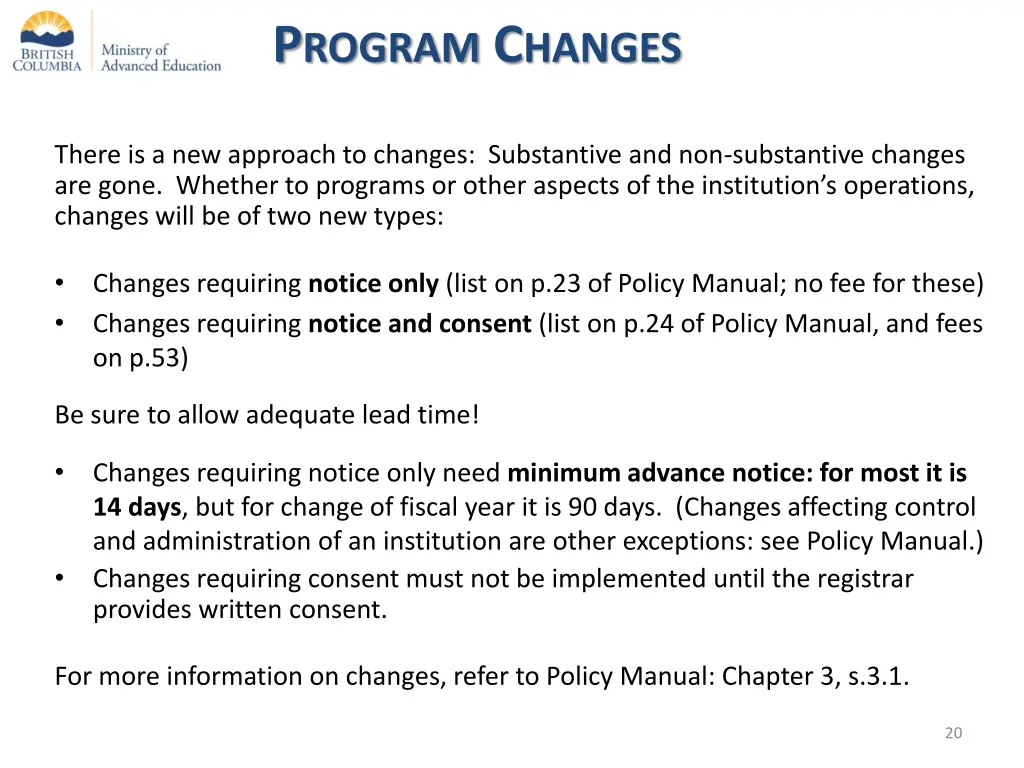
PROGRAM CHANGES There is a new approach to changes: Substantive and non-substantive changes are gone. Whether to programs or other aspects of the institution s operations, changes will be of two new types: Changes requiring notice only (list on p.23 of Policy Manual; no fee for these) Changes requiring notice and consent (list on p.24 of Policy Manual, and fees on p.53) Be sure to allow adequate lead time! Changes requiring notice only need minimum advance notice: for most it is 14 days, but for change of fiscal year it is 90 days. (Changes affecting control and administration of an institution are other exceptions: see Policy Manual.) Changes requiring consent must not be implemented until the registrar provides written consent. For more information on changes, refer to Policy Manual: Chapter 3, s.3.1. 20
Category Assignment, Student Data Reporting and Inspections
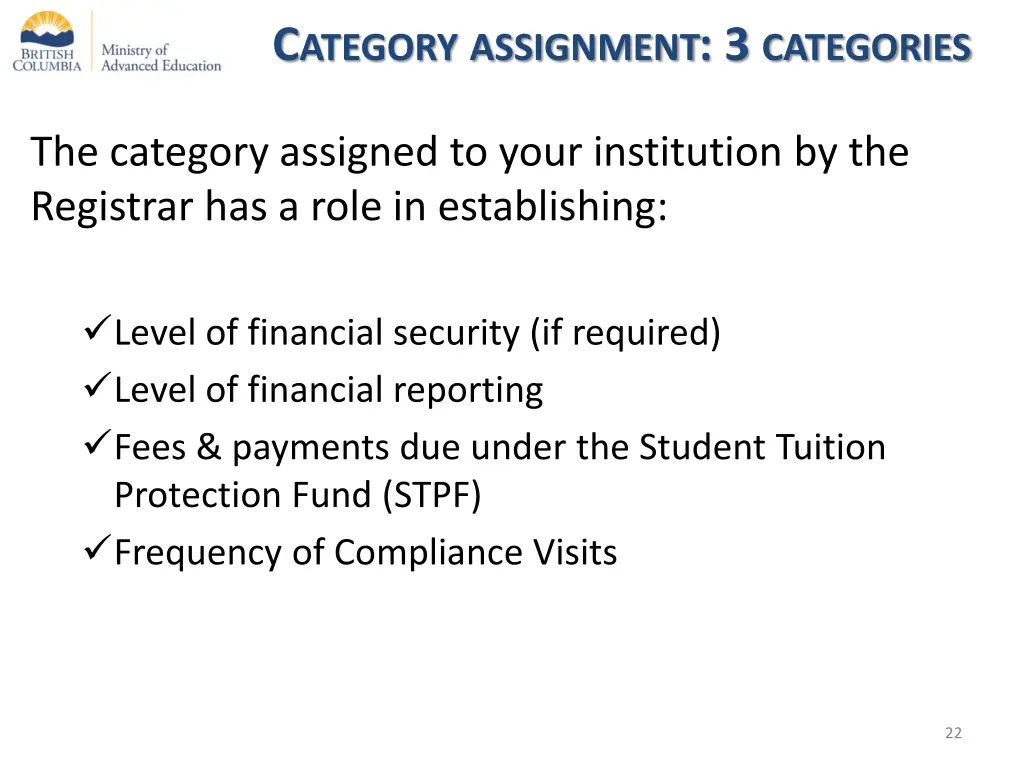
CATEGORYASSIGNMENT: 3 CATEGORIES The category assigned to your institution by the Registrar has a role in establishing: Level of financial security (if required) Level of financial reporting Fees & payments due under the Student Tuition Protection Fund (STPF) Frequency of Compliance Visits 22
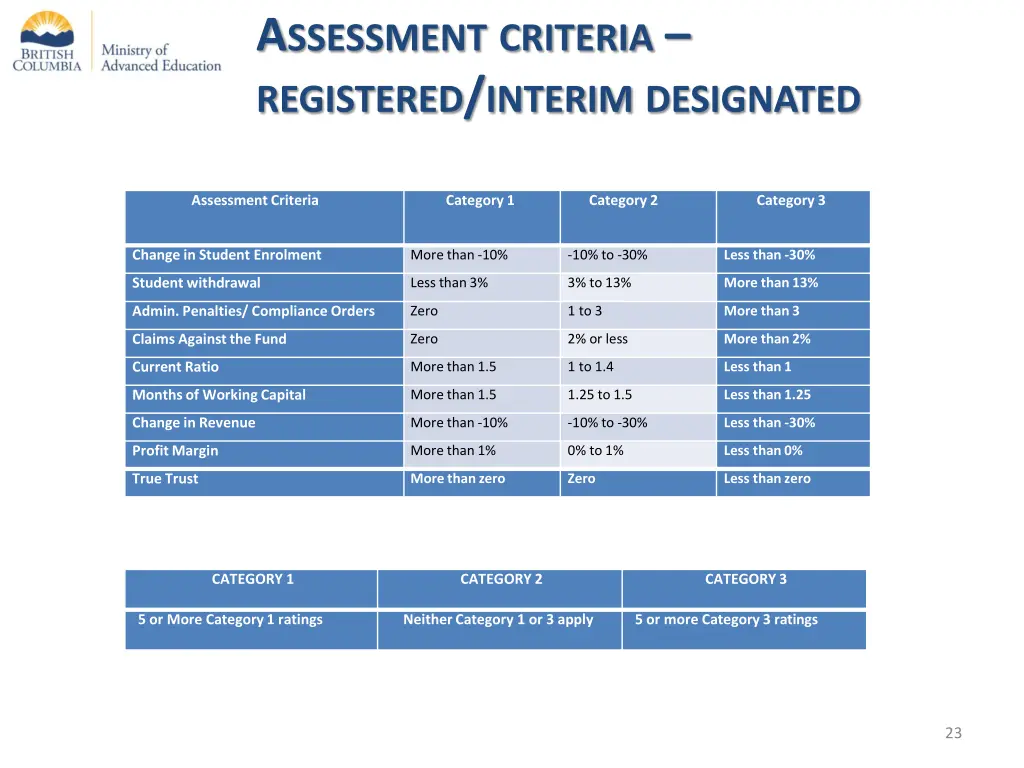
ASSESSMENTCRITERIA REGISTERED/INTERIMDESIGNATED Assessment Criteria Category 1 Category 2 Category 3 Change in Student Enrolment More than -10% -10% to -30% Less than -30% Student withdrawal Less than 3% 3% to 13% More than 13% Admin. Penalties/ Compliance Orders Zero 1 to 3 More than 3 Claims Against the Fund Zero 2% or less More than 2% Current Ratio More than 1.5 1 to 1.4 Less than 1 Months of Working Capital More than 1.5 1.25 to 1.5 Less than 1.25 Change in Revenue More than -10% -10% to -30% Less than -30% Profit Margin More than 1% 0% to 1% Less than 0% True Trust More than zero Zero Less than zero CATEGORY 1 CATEGORY 2 CATEGORY 3 5 or More Category 1 ratings Neither Category 1 or 3 apply 5 or more Category 3 ratings 23
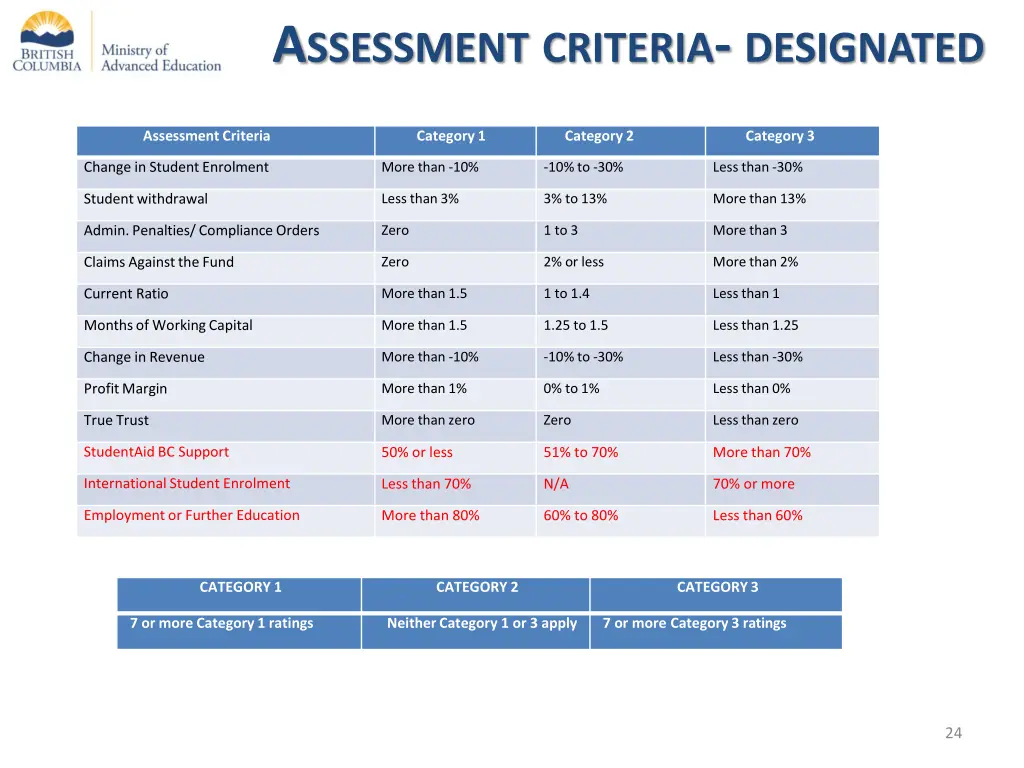
ASSESSMENTCRITERIA- DESIGNATED Assessment Criteria Category 1 Category 2 Category 3 Change in Student Enrolment More than -10% -10% to -30% Less than -30% Student withdrawal Less than 3% 3% to 13% More than 13% Admin. Penalties/ Compliance Orders Zero 1 to 3 More than 3 Claims Against the Fund Zero 2% or less More than 2% Current Ratio More than 1.5 1 to 1.4 Less than 1 Months of Working Capital More than 1.5 1.25 to 1.5 Less than 1.25 Change in Revenue More than -10% -10% to -30% Less than -30% Profit Margin More than 1% 0% to 1% Less than 0% True Trust More than zero Zero Less than zero StudentAid BC Support 50% or less 51% to 70% More than 70% International Student Enrolment Less than 70% N/A 70% or more Employment or Further Education More than 80% 60% to 80% Less than 60% CATEGORY 1 CATEGORY 2 CATEGORY 3 7 or more Category 1 ratings Neither Category 1 or 3 apply 7 or more Category 3 ratings 24
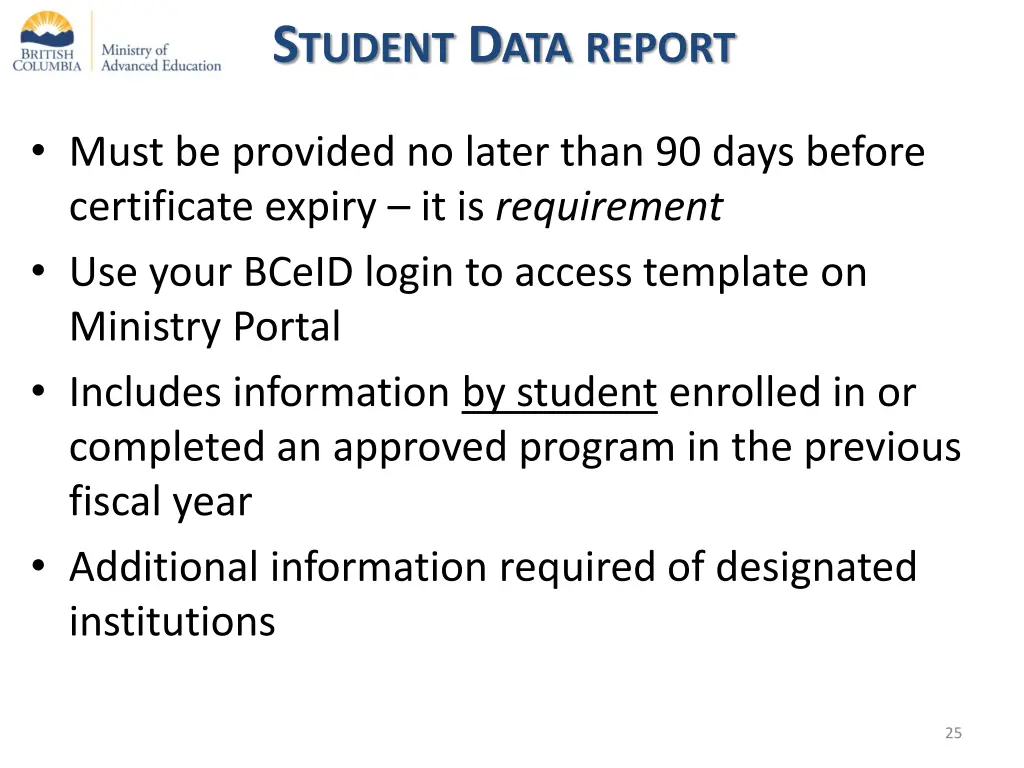
STUDENT DATAREPORT Must be provided no later than 90 days before certificate expiry it is requirement Use your BCeID login to access template on Ministry Portal Includes information by student enrolled in or completed an approved program in the previous fiscal year Additional information required of designated institutions 25
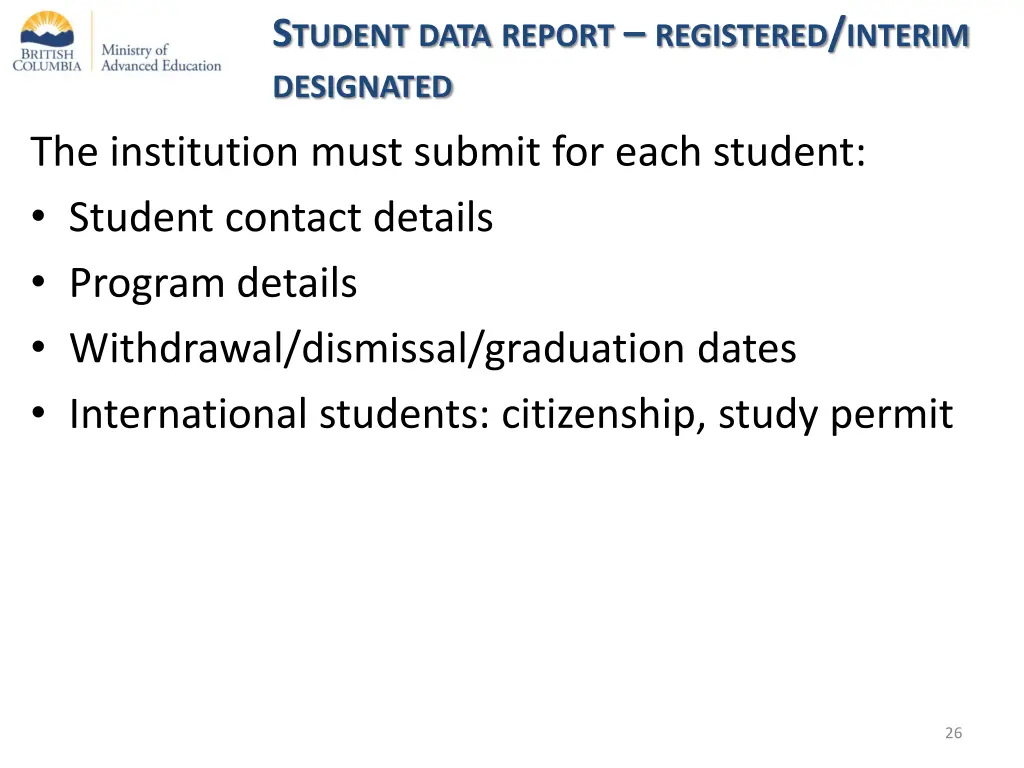
STUDENTDATAREPORTREGISTERED/INTERIM DESIGNATED The institution must submit for each student: Student contact details Program details Withdrawal/dismissal/graduation dates International students: citizenship, study permit 26
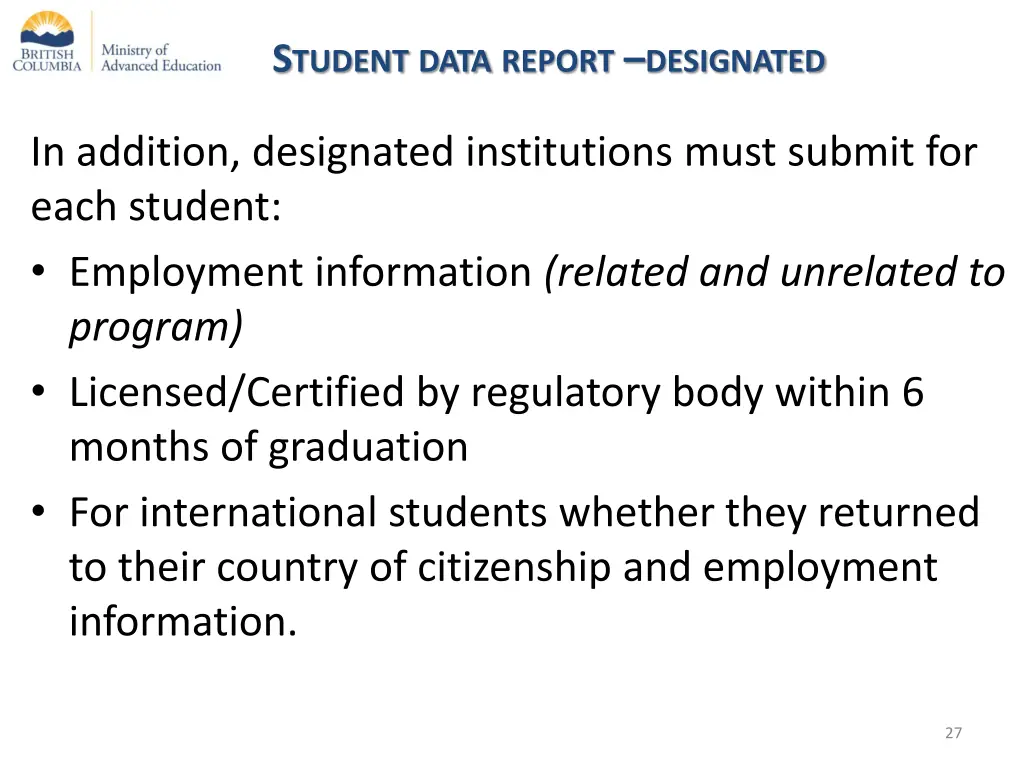
STUDENTDATAREPORTDESIGNATED In addition, designated institutions must submit for each student: Employment information (related and unrelated to program) Licensed/Certified by regulatory body within 6 months of graduation For international students whether they returned to their country of citizenship and employment information. 27
INSPECTIONS Inspections are conducted for: Assessing applications for registration or designation certificates Conducting Reviews of Designation Determining compliance PTA, SABC, EQA Inspections are not required annually Some types of inspections include costs (detailed in policy manual) 28
INSPECTIONS Template for certificate applications inspections will be made available Institutions will be given an opportunity to respond to report Progressive compliance provides a range of enforcement tools when institutions contravene PTA or regulations 29
Fees, Financial Reporting and Financial Security
FEES AND PAYMENTS TO THE FUND There are two types of fees: A. Transaction Fees - fees associated with an application, program approval, changes that require consent, review of designation, inspections. B. Certificate Term Fees - assessed at the time an institution applies or re- applies for certification - are based on annual tuition revenue earned from approved programs 31
FEES AND PAYMENTS TO THE FUND Certificate Term Fees consists of : Certification fee - based on annual tuition revenue from approved programs Flat rate fee - based on annual tuition revenue from approved programs Graduated fee and Student Tuition Protection Fund Payments are based on: a. Class of Institution b. Type of Certificate ( Registered, Interim Designated or Designated) c. Number of years registered d. Category Assignment e. Annual tuition revenue from approved programs 32
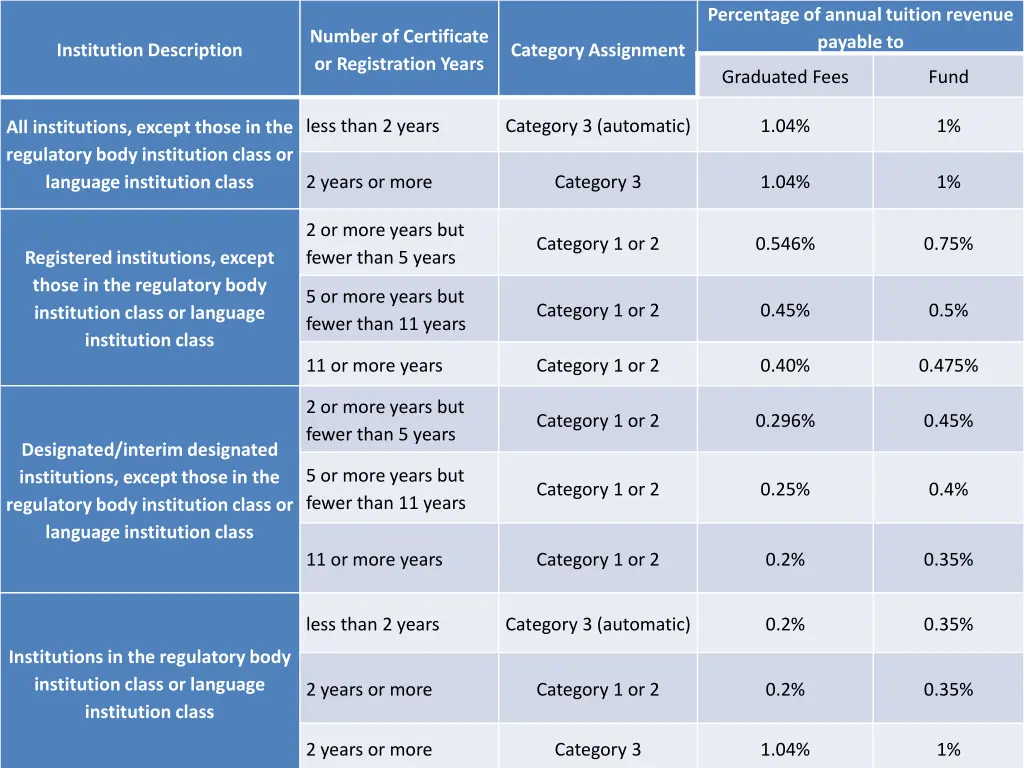
Percentage of annual tuition revenue payable to Number of Certificate FEES AND PAYMENTS TO THE FUND or Registration Years Institution Description Category Assignment Graduated Fees Fund less than 2 years Category 3 (automatic) 1.04% 1% All institutions, except those in the regulatory body institution class or language institution class 2 years or more Category 3 1.04% 1% 2 or more years but fewer than 5 years Category 1 or 2 0.546% 0.75% Registered institutions, except those in the regulatory body institution class or language institution class 5 or more years but fewer than 11 years Category 1 or 2 0.45% 0.5% 11 or more years Category 1 or 2 0.40% 0.475% 2 or more years but fewer than 5 years Category 1 or 2 0.296% 0.45% Designated/interim designated institutions, except those in the regulatory body institution class or language institution class 5 or more years but fewer than 11 years Category 1 or 2 0.25% 0.4% 11 or more years Category 1 or 2 0.2% 0.35% less than 2 years Category 3 (automatic) 0.2% 0.35% Institutions in the regulatory body institution class or language institution class 2 years or more Category 1 or 2 0.2% 0.35% 33 1% 2 years or more Category 3 1.04%
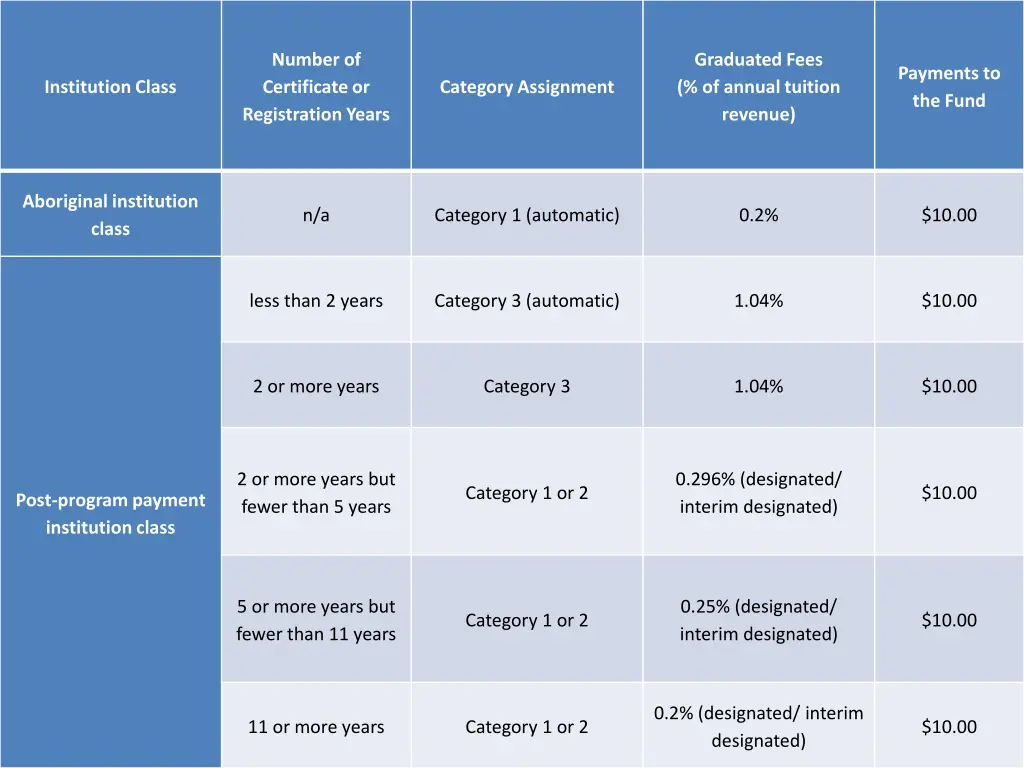
FEES AND PAYMENTS TO THE FUND Certificate or Registration Years Number of Graduated Fees (% of annual tuition revenue) Payments to the Fund Institution Class Category Assignment Aboriginal institution class n/a Category 1 (automatic) 0.2% $10.00 less than 2 years Category 3 (automatic) 1.04% $10.00 2 or more years Category 3 1.04% $10.00 2 or more years but fewer than 5 years 0.296% (designated/ interim designated) Category 1 or 2 $10.00 Post-program payment institution class 5 or more years but fewer than 11 years 0.25% (designated/ interim designated) Category 1 or 2 $10.00 0.2% (designated/ interim designated) 11 or more years Category 1 or 2 $10.00 34
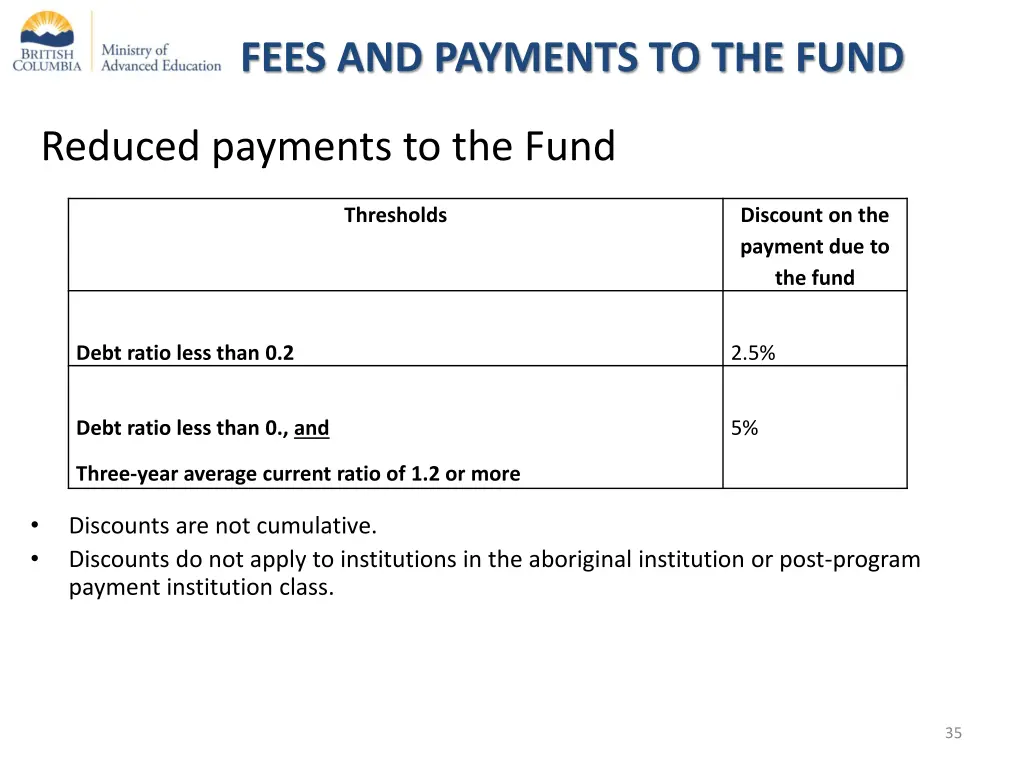
FEES AND PAYMENTS TO THE FUND Reduced payments to the Fund Thresholds Discount on the payment due to the fund Debt ratio less than 0.2 2.5% Debt ratio less than 0., and 5% Three-year average current ratio of 1.2 or more Discounts are not cumulative. Discounts do not apply to institutions in the aboriginal institution or post-program payment institution class. 35
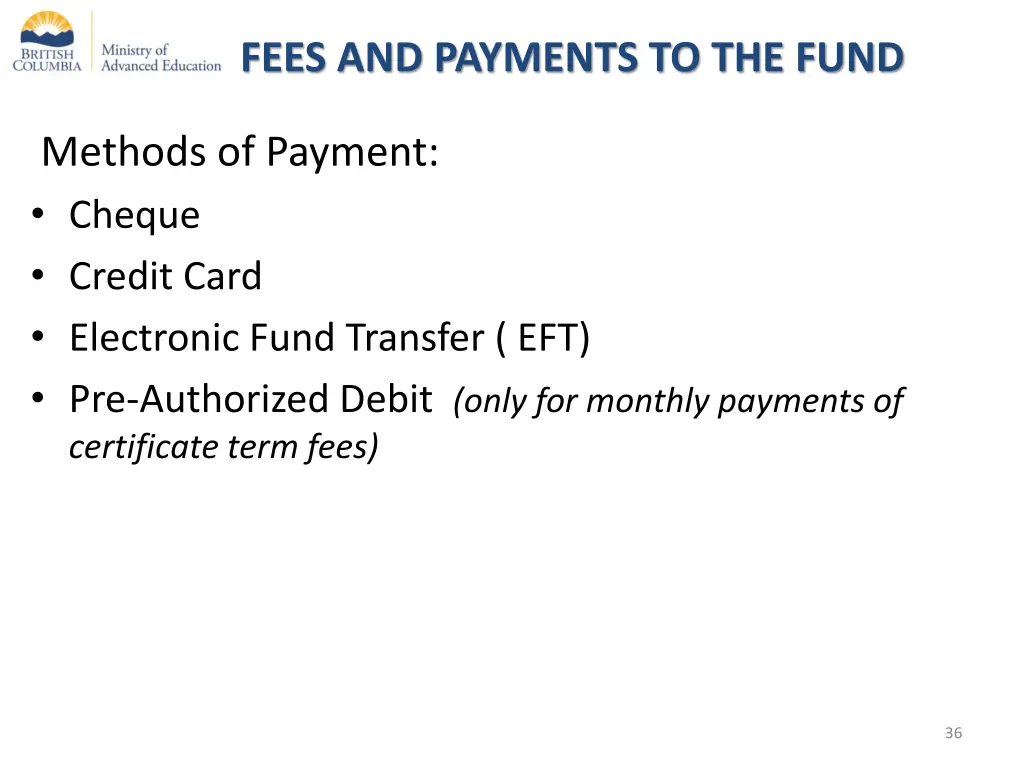
FEES AND PAYMENTS TO THE FUND Methods of Payment: Cheque Credit Card Electronic Fund Transfer ( EFT) Pre-Authorized Debit (only for monthly payments of certificate term fees) 36
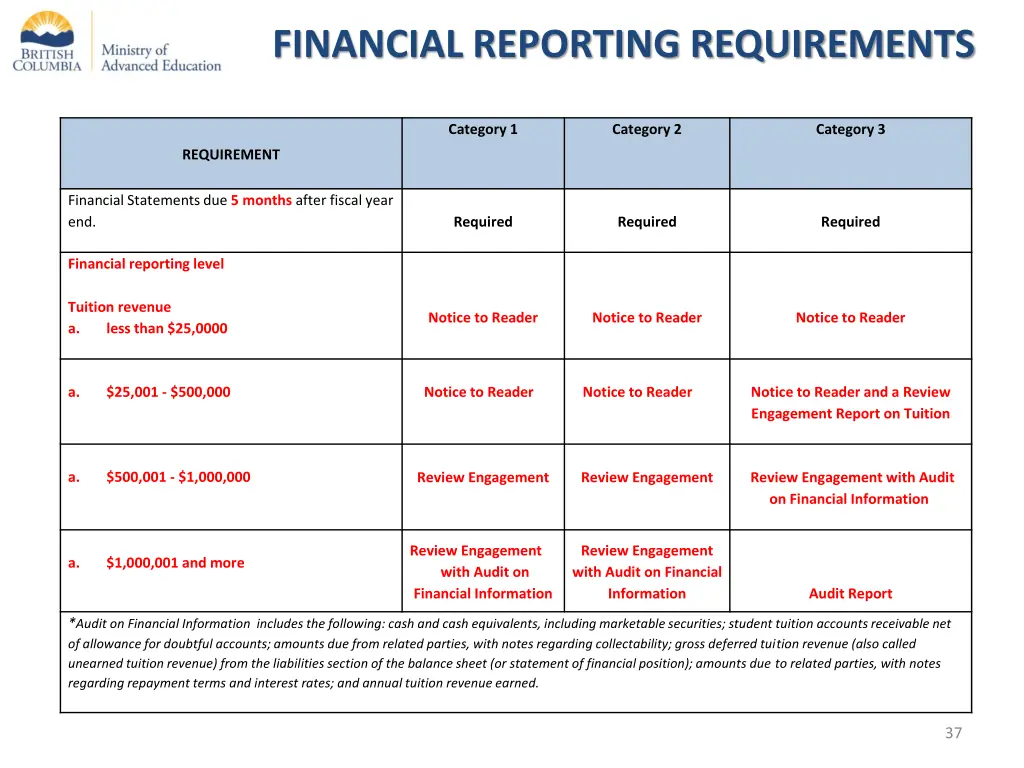
FINANCIAL REPORTING REQUIREMENTS Category 1 Category 2 Category 3 REQUIREMENT Financial Statements due 5 months after fiscal year end. Required Required Required Financial reporting level Tuition revenue a. less than $25,0000 Notice to Reader Notice to Reader Notice to Reader a. $25,001 - $500,000 Notice to Reader Notice to Reader Notice to Reader and a Review Engagement Report on Tuition a. $500,001 - $1,000,000 Review Engagement Review Engagement Review Engagement with Audit on Financial Information Review Engagement with Audit on Financial Information Review Engagement with Audit on Financial Information a. $1,000,001 and more Audit Report *Audit on Financial Information includes the following: cash and cash equivalents, including marketable securities; student tuition accounts receivable net of allowance for doubtful accounts; amounts due from related parties, with notes regarding collectability; gross deferred tuition revenue (also called unearned tuition revenue) from the liabilities section of the balance sheet (or statement of financial position); amounts due to related parties, with notes regarding repayment terms and interest rates; and annual tuition revenue earned. 37
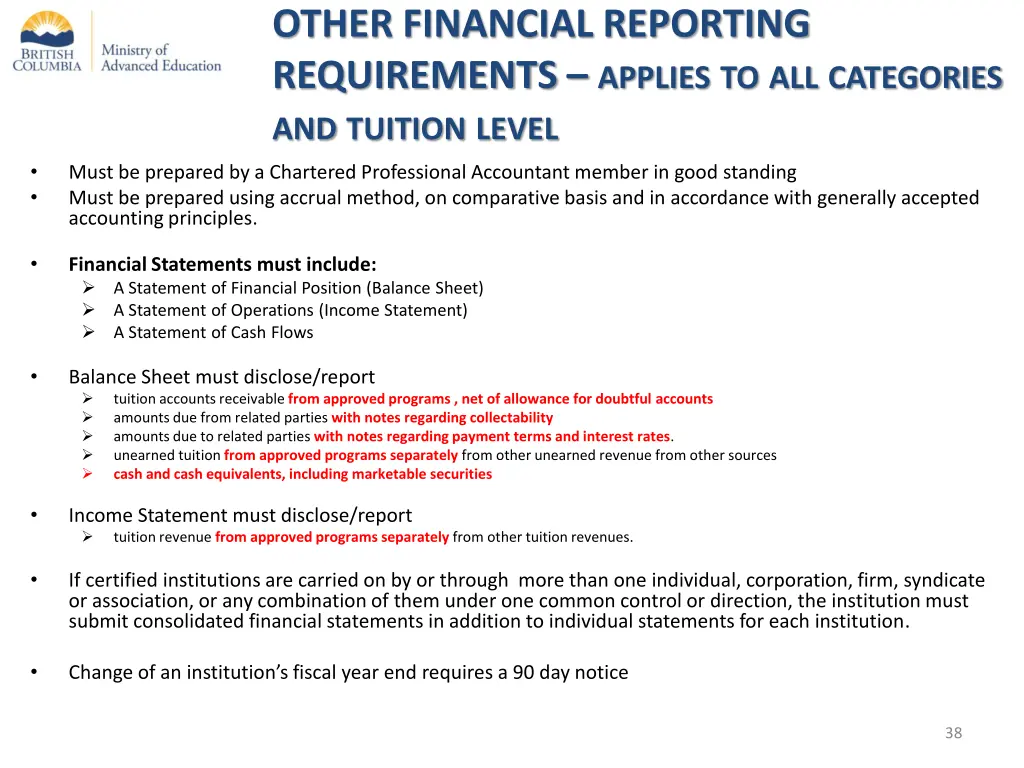
OTHER FINANCIAL REPORTING REQUIREMENTS APPLIESTOALLCATEGORIES ANDTUITIONLEVEL Must be prepared by a Chartered Professional Accountant member in good standing Must be prepared using accrual method, on comparative basis and in accordance with generally accepted accounting principles. Financial Statements must include: A Statement of Financial Position (Balance Sheet) A Statement of Operations (Income Statement) A Statement of Cash Flows Balance Sheet must disclose/report tuition accounts receivable from approved programs , net of allowance for doubtful accounts amounts due from related parties with notes regarding collectability amounts due to related parties with notes regarding payment terms and interest rates. unearned tuition from approved programs separately from other unearned revenue from other sources cash and cash equivalents, including marketable securities Income Statement must disclose/report tuition revenue from approved programs separately from other tuition revenues. If certified institutions are carried on by or through more than one individual, corporation, firm, syndicate or association, or any combination of them under one common control or direction, the institution must submit consolidated financial statements in addition to individual statements for each institution. Change of an institution s fiscal year end requires a 90 day notice 38
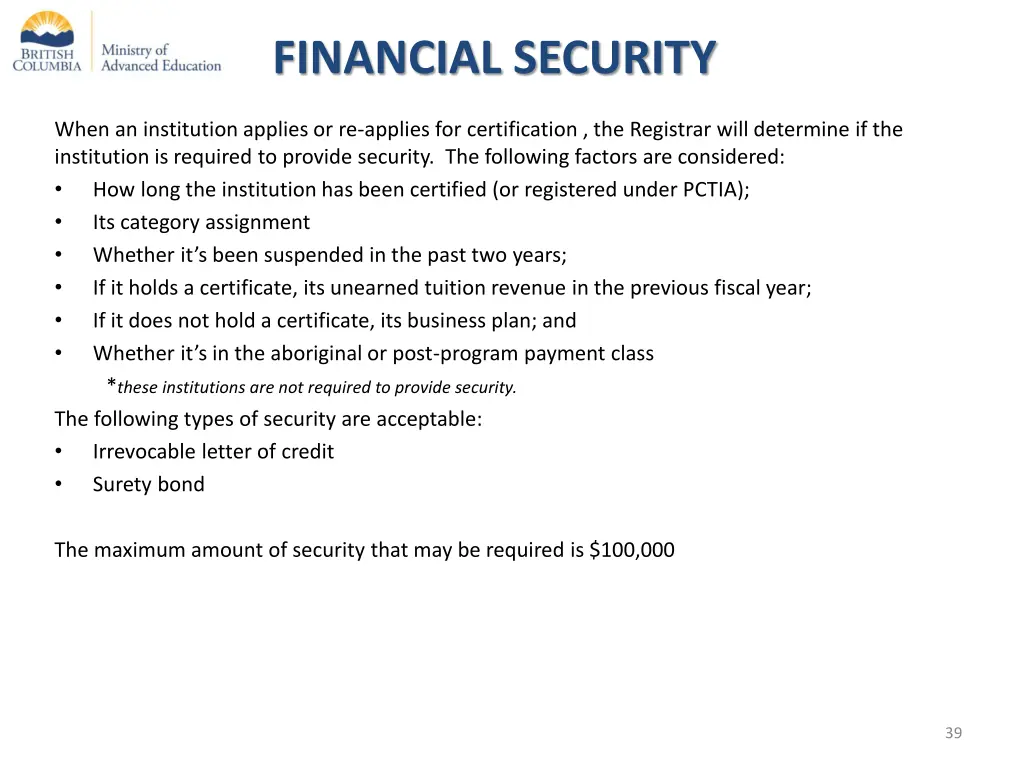
FINANCIAL SECURITY When an institution applies or re-applies for certification , the Registrar will determine if the institution is required to provide security. The following factors are considered: How long the institution has been certified (or registered under PCTIA); Its category assignment Whether it s been suspended in the past two years; If it holds a certificate, its unearned tuition revenue in the previous fiscal year; If it does not hold a certificate, its business plan; and Whether it s in the aboriginal or post-program payment class *these institutions are not required to provide security. The following types of security are acceptable: Irrevocable letter of credit Surety bond The maximum amount of security that may be required is $100,000 39
Appeals, Student Complaints, Closures and Comparative Programs, and Progressive Compliance
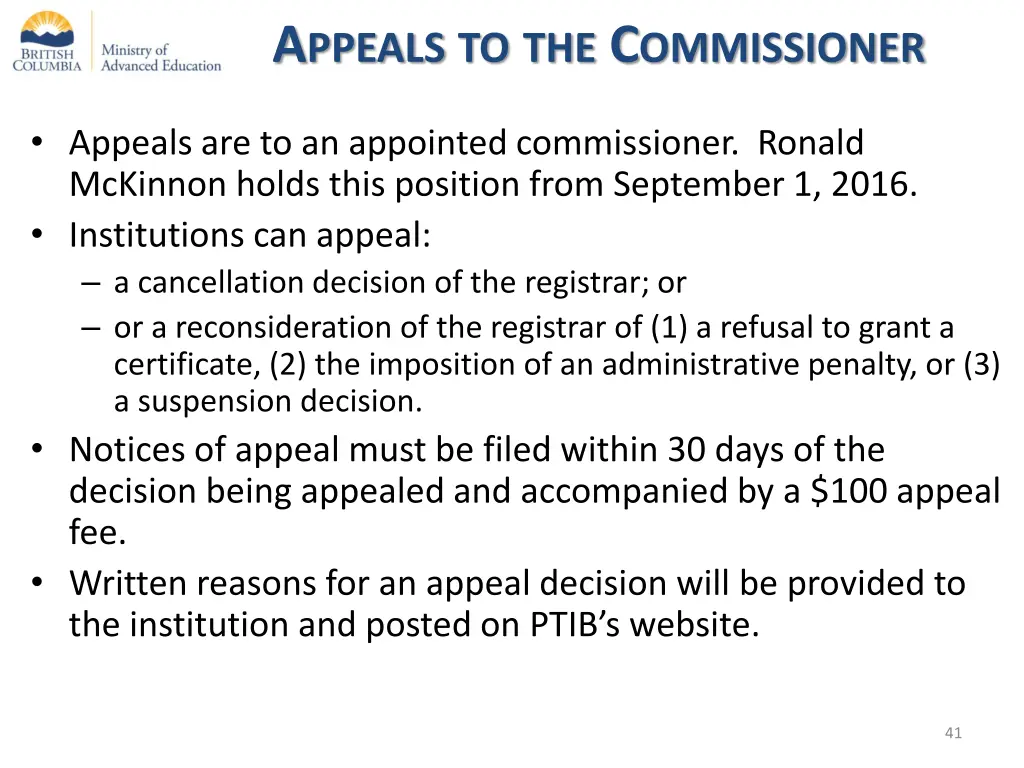
APPEALSTOTHE COMMISSIONER Appeals are to an appointed commissioner. Ronald McKinnon holds this position from September 1, 2016. Institutions can appeal: a cancellation decision of the registrar; or or a reconsideration of the registrar of (1) a refusal to grant a certificate, (2) the imposition of an administrative penalty, or (3) a suspension decision. Notices of appeal must be filed within 30 days of the decision being appealed and accompanied by a $100 appeal fee. Written reasons for an appeal decision will be provided to the institution and posted on PTIB s website. 41
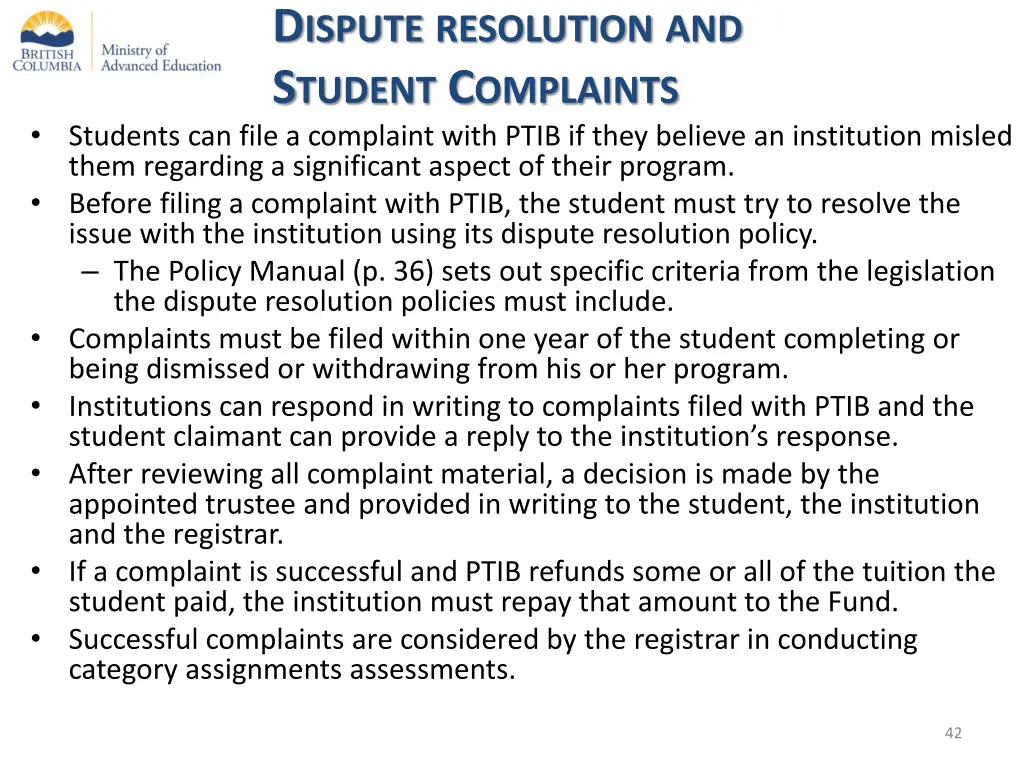
DISPUTERESOLUTIONAND STUDENT COMPLAINTS Students can file a complaint with PTIB if they believe an institution misled them regarding a significant aspect of their program. Before filing a complaint with PTIB, the student must try to resolve the issue with the institution using its dispute resolution policy. The Policy Manual (p. 36) sets out specific criteria from the legislation the dispute resolution policies must include. Complaints must be filed within one year of the student completing or being dismissed or withdrawing from his or her program. Institutions can respond in writing to complaints filed with PTIB and the student claimant can provide a reply to the institution s response. After reviewing all complaint material, a decision is made by the appointed trustee and provided in writing to the student, the institution and the registrar. If a complaint is successful and PTIB refunds some or all of the tuition the student paid, the institution must repay that amount to the Fund. Successful complaints are considered by the registrar in conducting category assignments assessments. 42
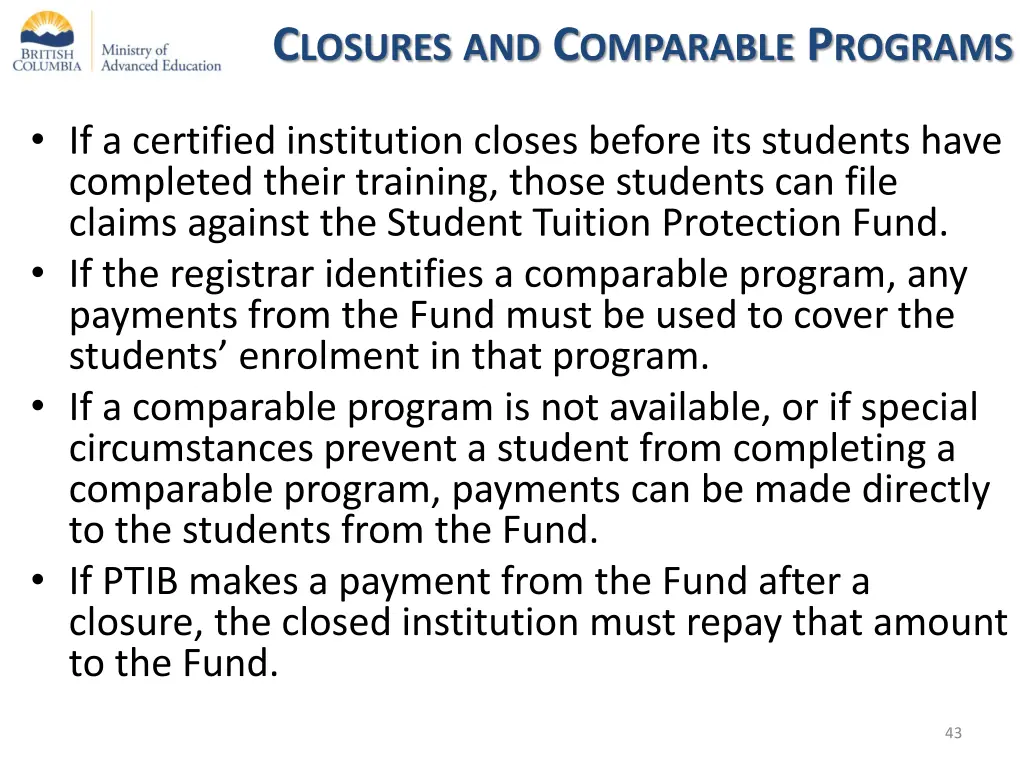
CLOSURESAND COMPARABLE PROGRAMS If a certified institution closes before its students have completed their training, those students can file claims against the Student Tuition Protection Fund. If the registrar identifies a comparable program, any payments from the Fund must be used to cover the students enrolment in that program. If a comparable program is not available, or if special circumstances prevent a student from completing a comparable program, payments can be made directly to the students from the Fund. If PTIB makes a payment from the Fund after a closure, the closed institution must repay that amount to the Fund. 43
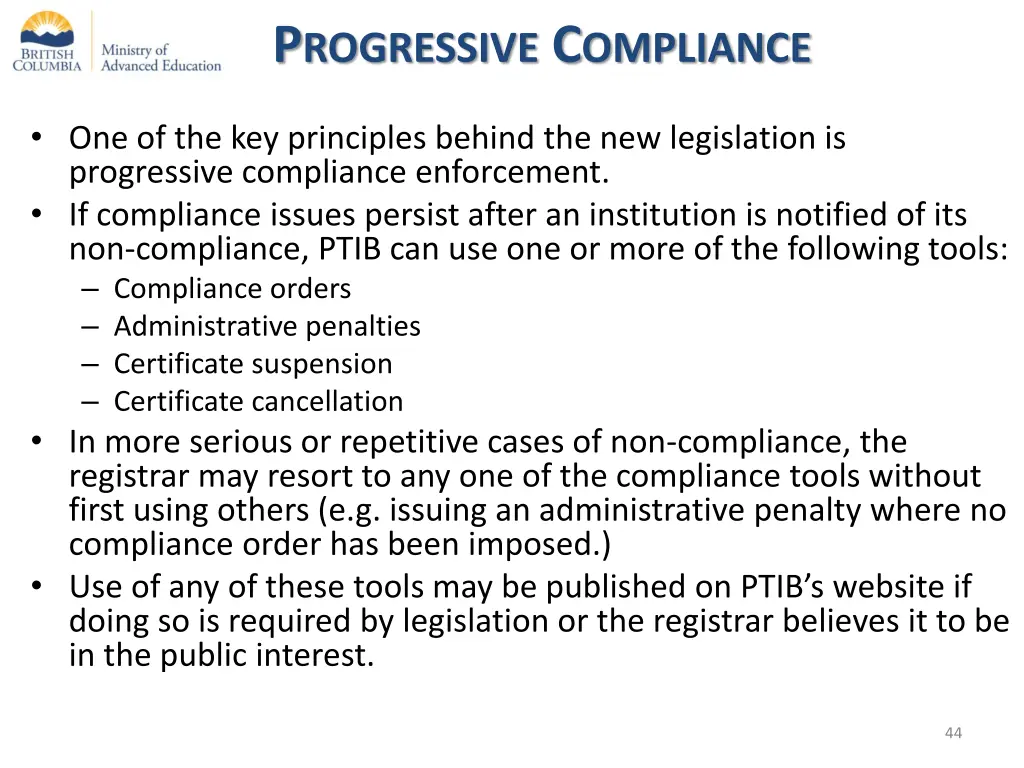
PROGRESSIVE COMPLIANCE One of the key principles behind the new legislation is progressive compliance enforcement. If compliance issues persist after an institution is notified of its non-compliance, PTIB can use one or more of the following tools: Compliance orders Administrative penalties Certificate suspension Certificate cancellation In more serious or repetitive cases of non-compliance, the registrar may resort to any one of the compliance tools without first using others (e.g. issuing an administrative penalty where no compliance order has been imposed.) Use of any of these tools may be published on PTIB s website if doing so is required by legislation or the registrar believes it to be in the public interest. 44
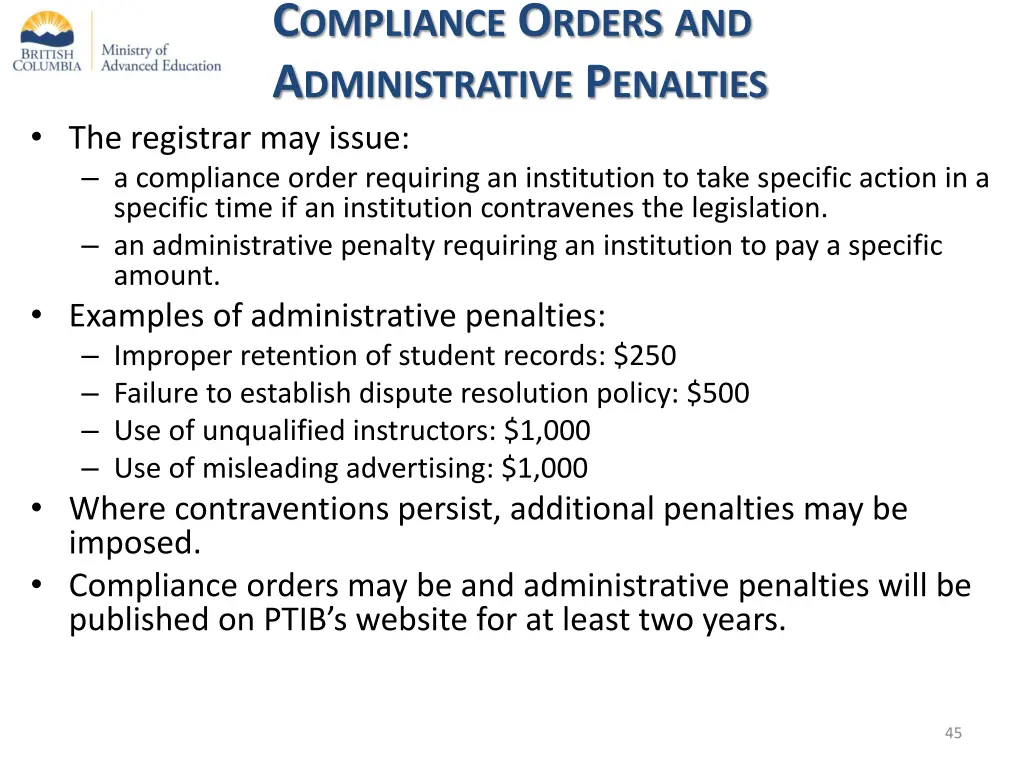
COMPLIANCE ORDERSAND ADMINISTRATIVE PENALTIES The registrar may issue: a compliance order requiring an institution to take specific action in a specific time if an institution contravenes the legislation. an administrative penalty requiring an institution to pay a specific amount. Examples of administrative penalties: Improper retention of student records: $250 Failure to establish dispute resolution policy: $500 Use of unqualified instructors: $1,000 Use of misleading advertising: $1,000 Where contraventions persist, additional penalties may be imposed. Compliance orders may be and administrative penalties will be published on PTIB s website for at least two years. 45
Transition to PTA Preparing for September 1st
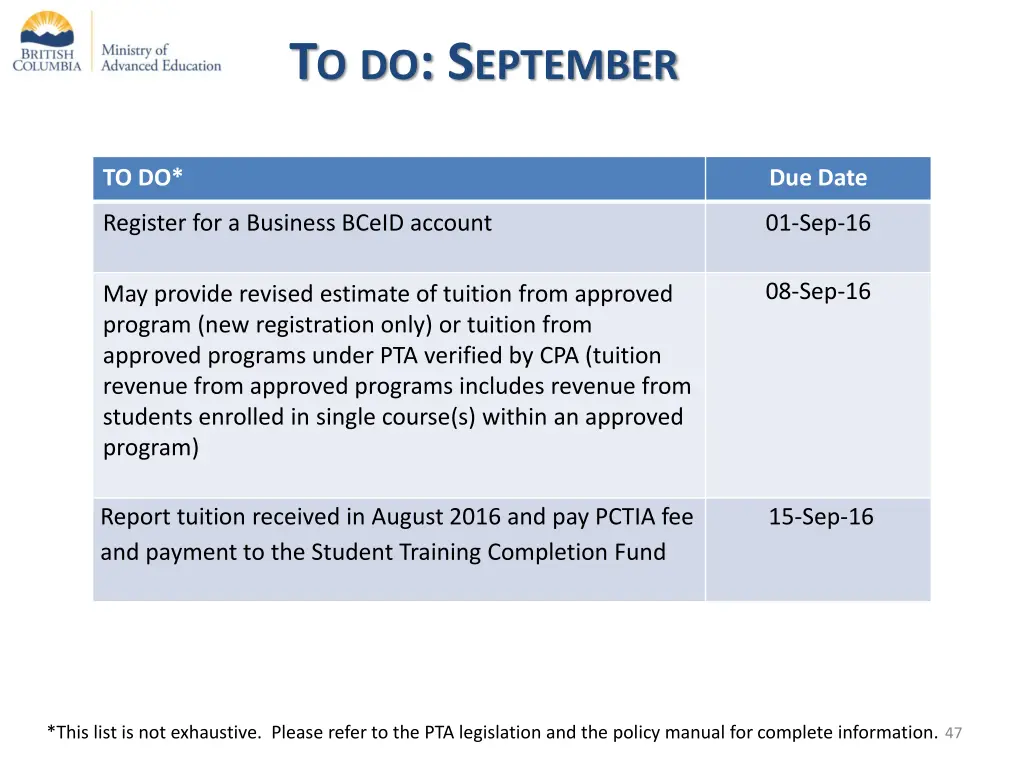
TODO: SEPTEMBER TO DO* Due Date Register for a Business BCeID account 01-Sep-16 08-Sep-16 May provide revised estimate of tuition from approved program (new registration only) or tuition from approved programs under PTA verified by CPA (tuition revenue from approved programs includes revenue from students enrolled in single course(s) within an approved program) Report tuition received in August 2016 and pay PCTIA fee and payment to the Student Training Completion Fund 15-Sep-16 *This list is not exhaustive. Please refer to the PTA legislation and the policy manual for complete information. 47
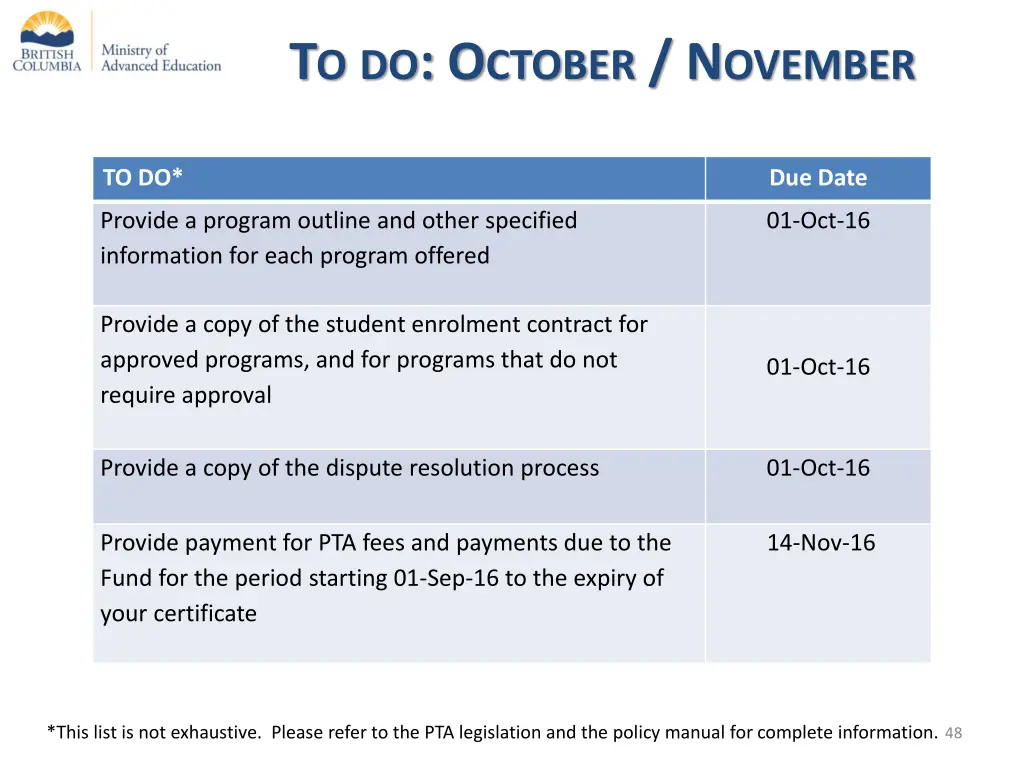
TODO: OCTOBER / NOVEMBER TO DO* Due Date Provide a program outline and other specified information for each program offered 01-Oct-16 Provide a copy of the student enrolment contract for approved programs, and for programs that do not require approval 01-Oct-16 Provide a copy of the dispute resolution process 01-Oct-16 Provide payment for PTA fees and payments due to the Fund for the period starting 01-Sep-16 to the expiry of your certificate 14-Nov-16 *This list is not exhaustive. Please refer to the PTA legislation and the policy manual for complete information. 48
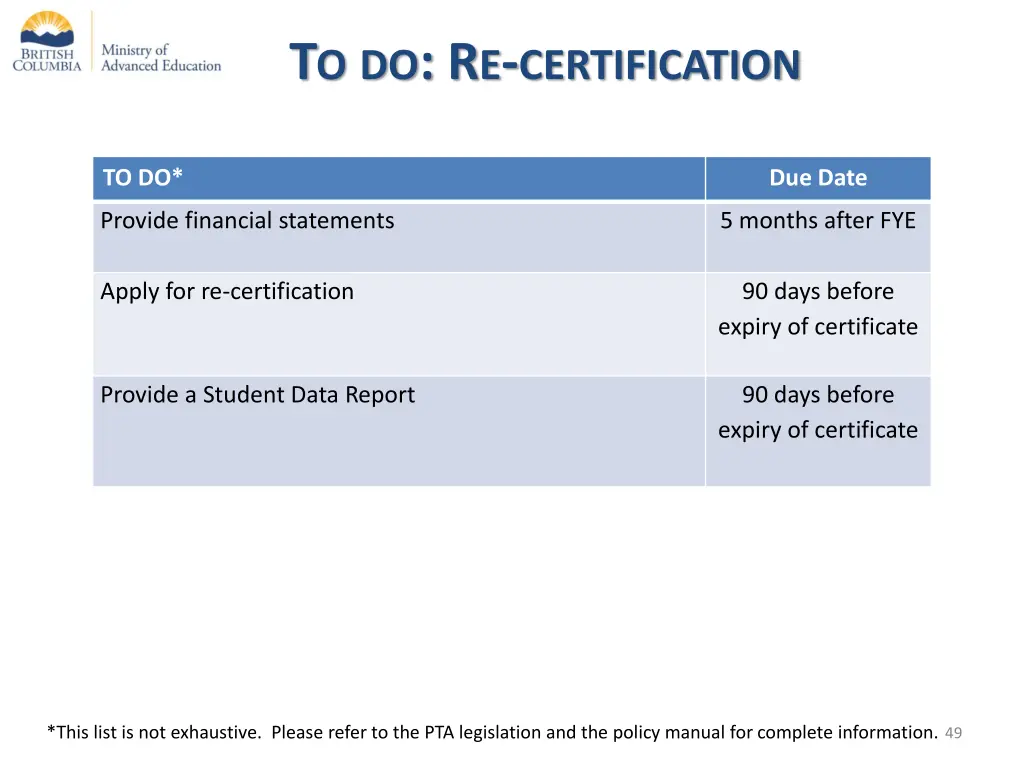
TODO: RE-CERTIFICATION TO DO* Due Date Provide financial statements 5 months after FYE Apply for re-certification 90 days before expiry of certificate Provide a Student Data Report 90 days before expiry of certificate *This list is not exhaustive. Please refer to the PTA legislation and the policy manual for complete information. 49
TRANSITION PROVISIONS Work Experience Practicum consists of no more than 20% of the hours of instruction of a program and preceptorships consist of no more than 10% of the hours of instruction of a program. If a student was already enrolled in a program on Sept 1st, the work experience component does not need to meet these PTA requirements. Students in programs whose work experience components do not meet PTA requirements may continue as contracted. Work experience component must meet all PTA standards if students were enrolled in September. 50