Revised UWB Wake-Up Radio Modulation Method
"Explore the new wake-up burst modulation method for UWB technology, offering a 3dB BER advantage and improved performance under interference. Learn about the proposed modulation strategy and its benefits for wireless personal area networks."

Download Presentation

Please find below an Image/Link to download the presentation.
The content on the website is provided AS IS for your information and personal use only. It may not be sold, licensed, or shared on other websites without obtaining consent from the author. If you encounter any issues during the download, it is possible that the publisher has removed the file from their server.
You are allowed to download the files provided on this website for personal or commercial use, subject to the condition that they are used lawfully. All files are the property of their respective owners.
The content on the website is provided AS IS for your information and personal use only. It may not be sold, licensed, or shared on other websites without obtaining consent from the author.
E N D
Presentation Transcript
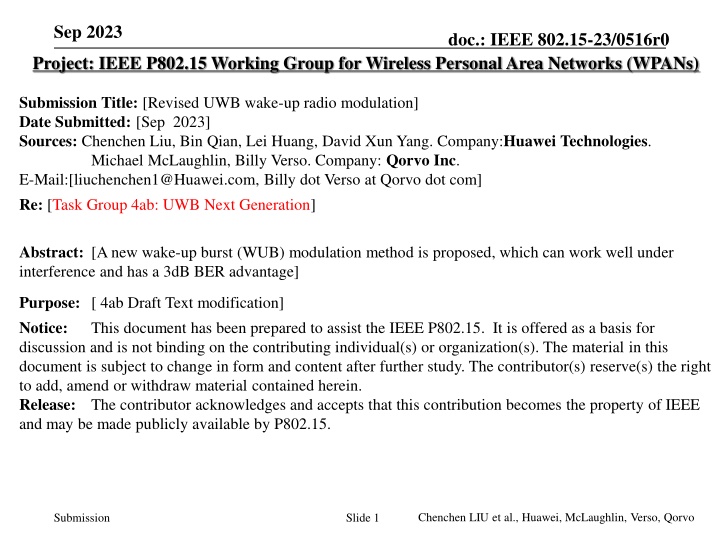
Sep 2023 doc.: IEEE 802.15-23/0516r0 Project: IEEE P802.15 Working Group for Wireless Personal Area Networks (WPANs) Submission Title: [Revised UWB wake-up radio modulation] Date Submitted: [Sep 2023] Sources: Chenchen Liu, Bin Qian, Lei Huang, David Xun Yang. Company:Huawei Technologies. Michael McLaughlin, Billy Verso. Company: Qorvo Inc. E-Mail:[liuchenchen1@Huawei.com, Billy dot Verso at Qorvo dot com] Re: [Task Group 4ab: UWB Next Generation] Abstract: [A new wake-up burst (WUB) modulation method is proposed, which can work well under interference and has a 3dB BER advantage] Purpose: [ 4ab Draft Text modification] Notice: This document has been prepared to assist the IEEE P802.15. It is offered as a basis for discussion and is not binding on the contributing individual(s) or organization(s). The material in this document is subject to change in form and content after further study. The contributor(s) reserve(s) the right to add, amend or withdraw material contained herein. Release: The contributor acknowledges and accepts that this contribution becomes the property of IEEE and may be made publicly available by P802.15. Chenchen LIU et al., Huawei, McLaughlin, Verso, Qorvo Submission Slide 1
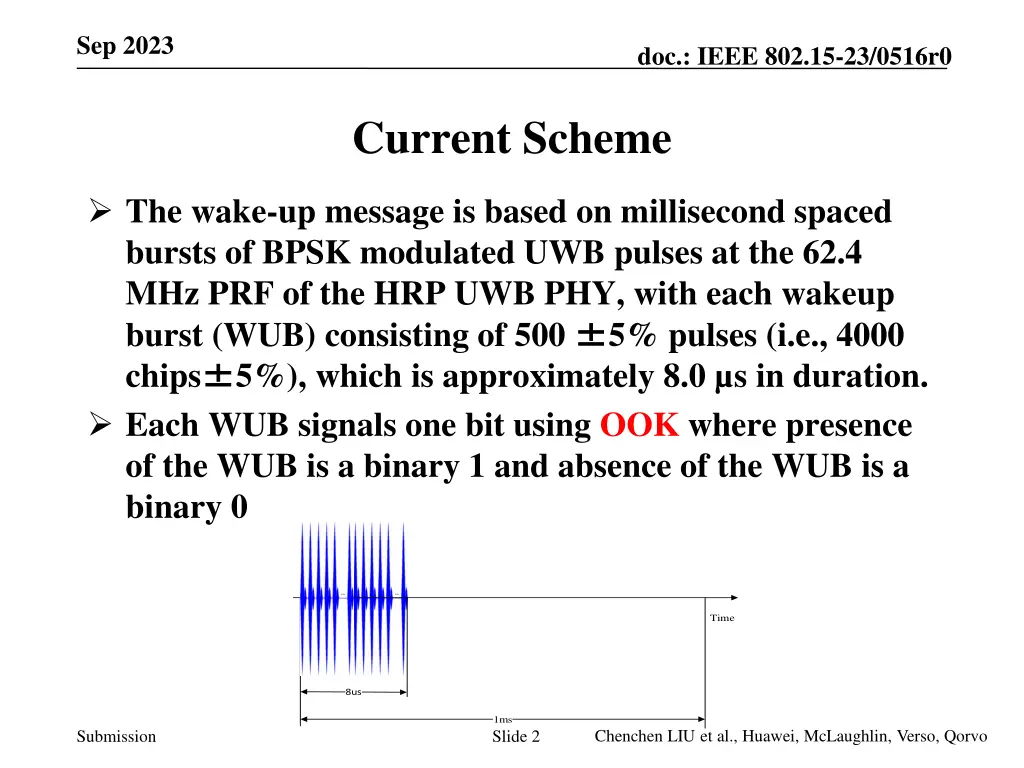
Sep 2023 doc.: IEEE 802.15-23/0516r0 Current Scheme The wake-up message is based on millisecond spaced bursts of BPSK modulated UWB pulses at the 62.4 MHz PRF of the HRP UWB PHY, with each wakeup burst (WUB) consisting of 500 chips 5%), which is approximately 8.0 s in duration. Each WUB signals one bit using OOK where presence of the WUB is a binary 1 and absence of the WUB is a binary 0 5% pulses (i.e., 4000 Time 1ms Chenchen LIU et al., Huawei, McLaughlin, Verso, Qorvo Submission Slide 2
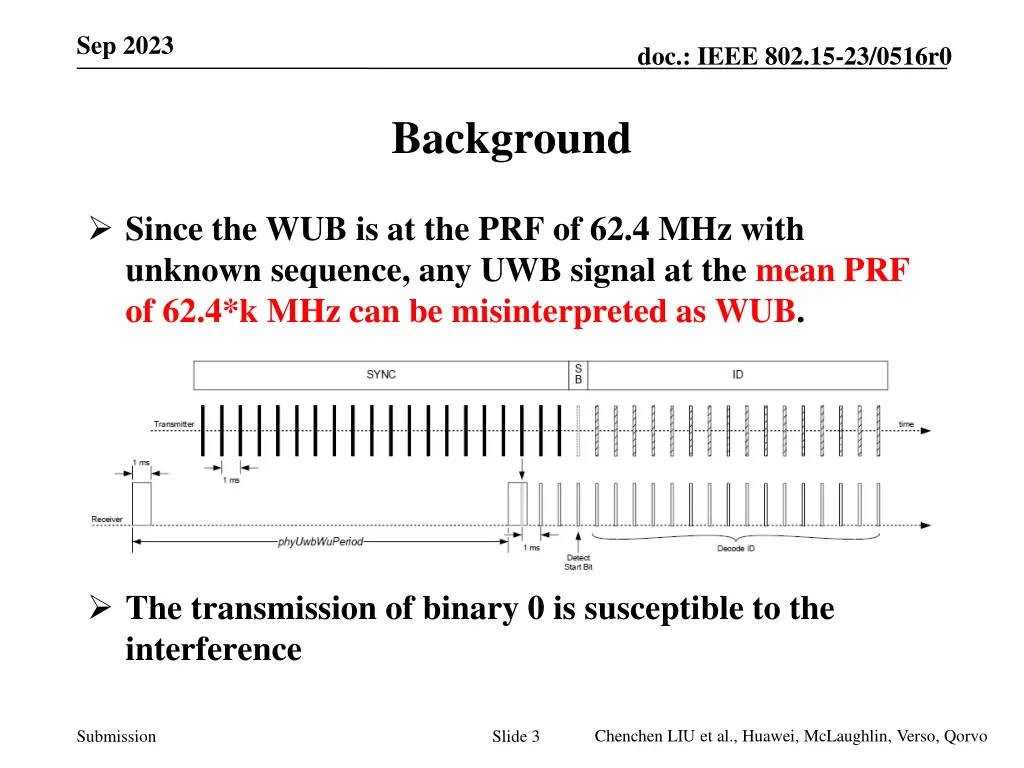
Sep 2023 doc.: IEEE 802.15-23/0516r0 Background Since the WUB is at the PRF of 62.4 MHz with unknown sequence, any UWB signal at the mean PRF of 62.4*k MHz can be misinterpreted as WUB. The transmission of binary 0 is susceptible to the interference Chenchen LIU et al., Huawei, McLaughlin, Verso, Qorvo Submission Slide 3
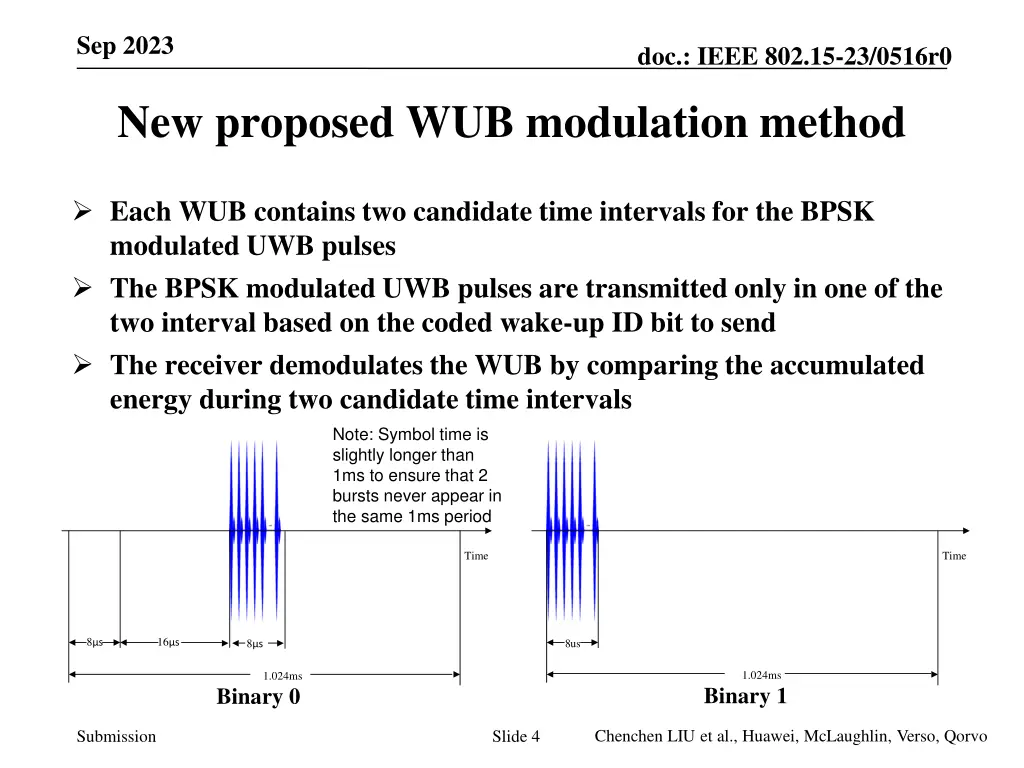
Sep 2023 doc.: IEEE 802.15-23/0516r0 New proposed WUB modulation method Each WUB contains two candidate time intervals for the BPSK modulated UWB pulses The BPSK modulated UWB pulses are transmitted only in one of the two interval based on the coded wake-up ID bit to send The receiver demodulates the WUB by comparing the accumulated energy during two candidate time intervals Note: Symbol time is slightly longer than 1ms to ensure that 2 bursts never appear in the same 1ms period Time Time 8 s 16 s 8 s 8us 1.024ms 1.024ms Binary 1 Binary 0 Chenchen LIU et al., Huawei, McLaughlin, Verso, Qorvo Submission Slide 4
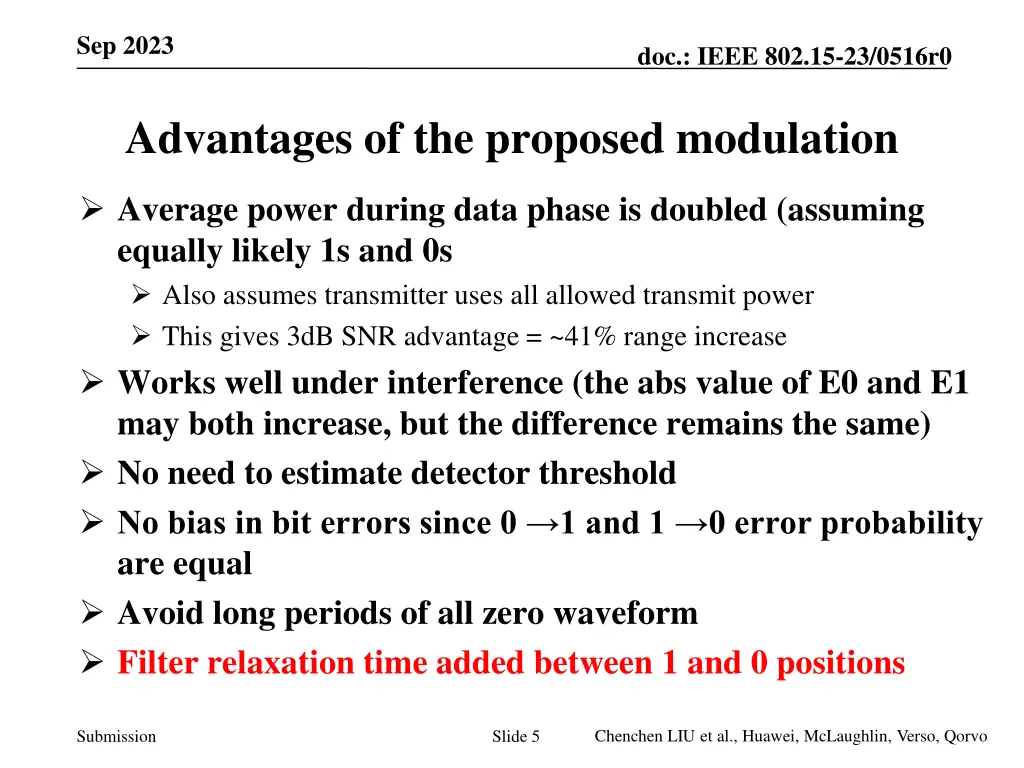
Sep 2023 doc.: IEEE 802.15-23/0516r0 Advantages of the proposed modulation Average power during data phase is doubled (assuming equally likely 1s and 0s Also assumes transmitter uses all allowed transmit power This gives 3dB SNR advantage = ~41% range increase Works well under interference (the abs value of E0 and E1 may both increase, but the difference remains the same) No need to estimate detector threshold No bias in bit errors since 0 1 and 1 0 error probability are equal Avoid long periods of all zero waveform Filter relaxation time added between 1 and 0 positions Chenchen LIU et al., Huawei, McLaughlin, Verso, Qorvo Submission Slide 5
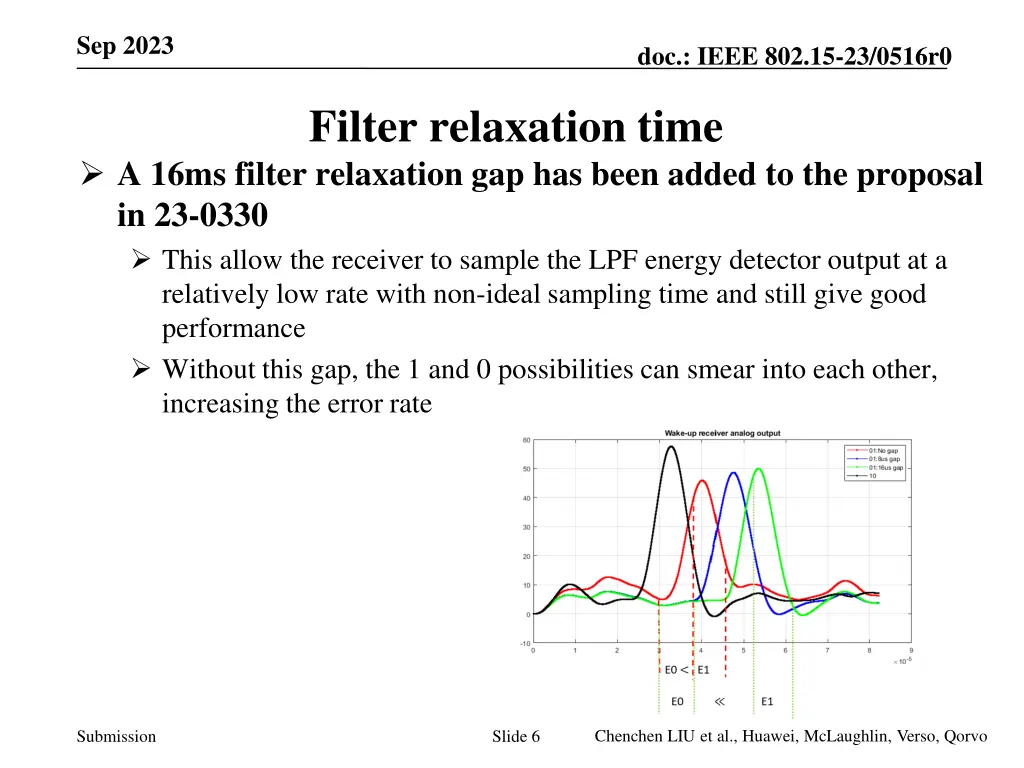
Sep 2023 doc.: IEEE 802.15-23/0516r0 Filter relaxation time A 16ms filter relaxation gap has been added to the proposal in 23-0330 This allow the receiver to sample the LPF energy detector output at a relatively low rate with non-ideal sampling time and still give good performance Without this gap, the 1 and 0 possibilities can smear into each other, increasing the error rate Chenchen LIU et al., Huawei, McLaughlin, Verso, Qorvo Submission Slide 6
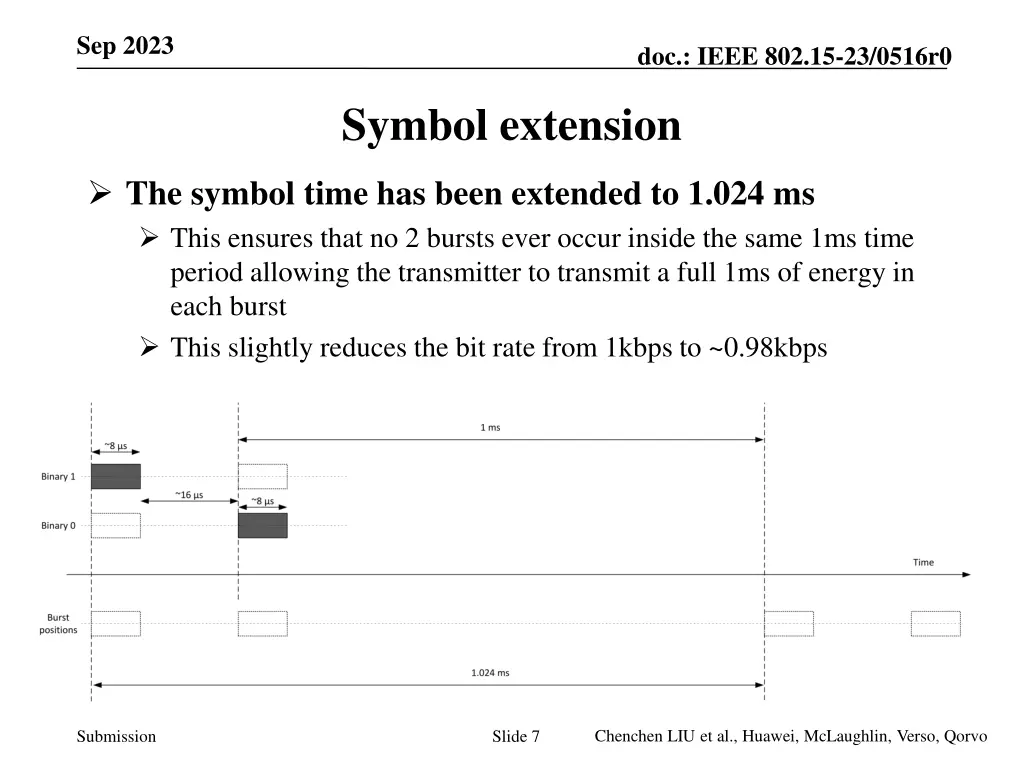
Sep 2023 doc.: IEEE 802.15-23/0516r0 Symbol extension The symbol time has been extended to 1.024 ms This ensures that no 2 bursts ever occur inside the same 1ms time period allowing the transmitter to transmit a full 1ms of energy in each burst This slightly reduces the bit rate from 1kbps to ~0.98kbps Chenchen LIU et al., Huawei, McLaughlin, Verso, Qorvo Submission Slide 7
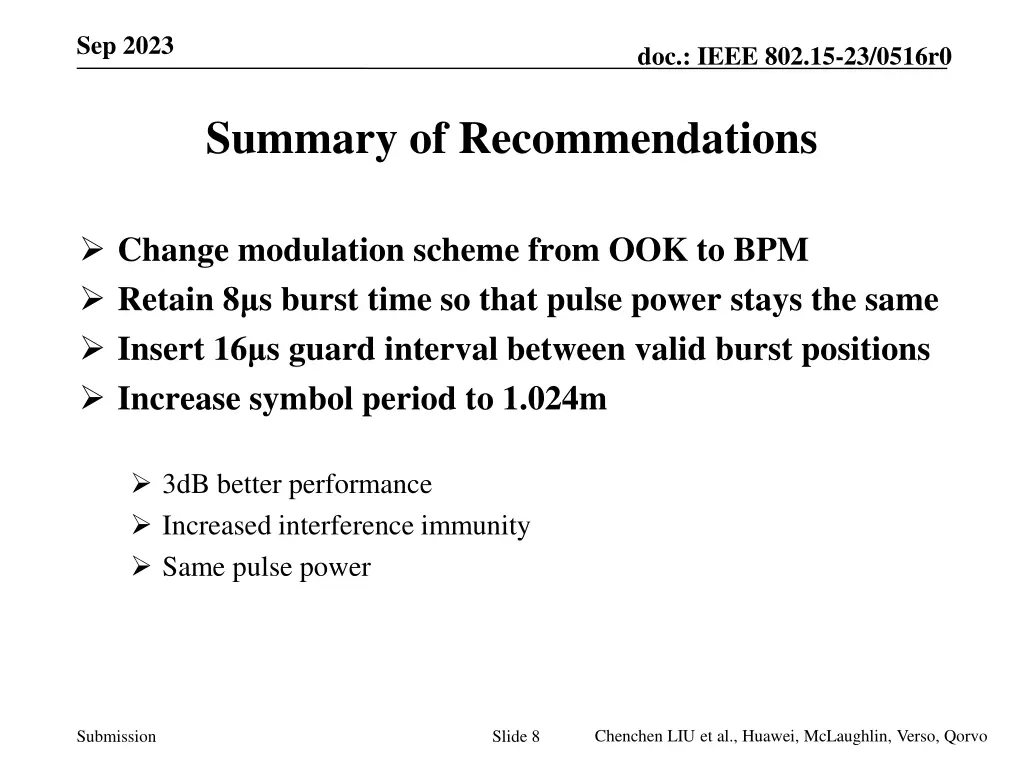
Sep 2023 doc.: IEEE 802.15-23/0516r0 Summary of Recommendations Change modulation scheme from OOK to BPM Retain 8 s burst time so that pulse power stays the same Insert 16 s guard interval between valid burst positions Increase symbol period to 1.024m 3dB better performance Increased interference immunity Same pulse power Chenchen LIU et al., Huawei, McLaughlin, Verso, Qorvo Submission Slide 8
Sep 2023 doc.: IEEE 802.15-23/0516r0 References [1] 15-22-0654-00-04ab-draft-text-for-uwb-wake-up-radio [2] 15-21-0557-01-04ab-uwb-wake-up-signaling [3] 15-22-0282-01-04ab-the-advantages-of-uwb-wakeup [4] 15-23-0330-00-04ab-uwb-wake-up-burst-modulation-method [5] P802.15.4z, Draft Standard for Low-Rate Wireless Networks Chenchen LIU et al., Huawei, McLaughlin, Verso, Qorvo Submission Slide 9