Explore the detailed design proposal for sounding in C-BF technology based on IEEE 802.11-22/1568r1 standard. The document presents options for joint and sequential NDP sounding, emphasizing simplicity and compatibility with existing protocols. It discusses the benefits of partial rank nulling and compares CBF gains with different STA configurations.
Please find below an Image/Link to download the presentation.
The content on the website is provided AS IS for your information and personal use only. It may not be sold, licensed, or shared on other websites without obtaining consent from the author. If you encounter any issues during the download, it is possible that the publisher has removed the file from their server.
You are allowed to download the files provided on this website for personal or commercial use, subject to the condition that they are used lawfully. All files are the property of their respective owners.
The content on the website is provided AS IS for your information and personal use only. It may not be sold, licensed, or shared on other websites without obtaining consent from the author.
E N D
Presentation Transcript
doc.: IEEE 802.11-22/1568r1 September 2024 Sounding Design for C-BF Date: 2024-11-13 Authors: Affiliations Address Phone email Name Ron Porat Broadcom ron.porat@broadcom.com Srinath Puducheri Broadcom Karim Toussi Broadcom Submission Slide 1 Ron Porat (Broadcom)
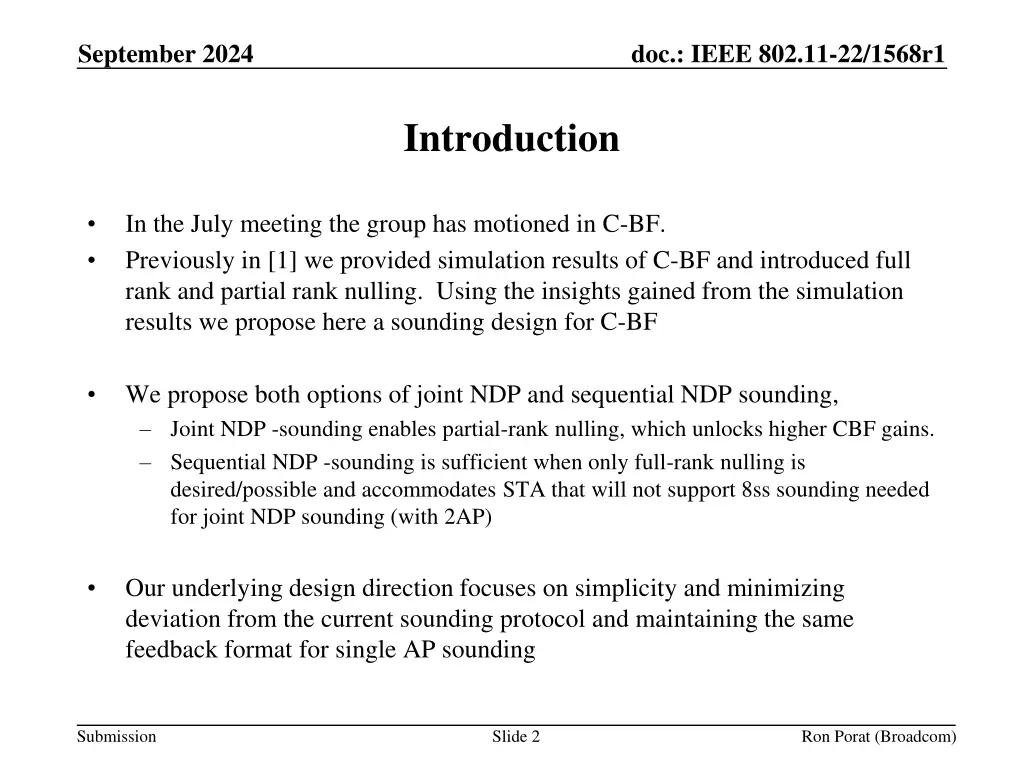
doc.: IEEE 802.11-22/1568r1 September 2024 Introduction In the July meeting the group has motioned in C-BF. Previously in [1] we provided simulation results of C-BF and introduced full rank and partial rank nulling. Using the insights gained from the simulation results we propose here a sounding design for C-BF We propose both options of joint NDP and sequential NDP sounding, Joint NDP -sounding enables partial-rank nulling, which unlocks higher CBF gains. Sequential NDP -sounding is sufficient when only full-rank nulling is desired/possible and accommodates STA that will not support 8ss sounding needed for joint NDP sounding (with 2AP) Our underlying design direction focuses on simplicity and minimizing deviation from the current sounding protocol and maintaining the same feedback format for single AP sounding Submission Slide 2 Ron Porat (Broadcom)
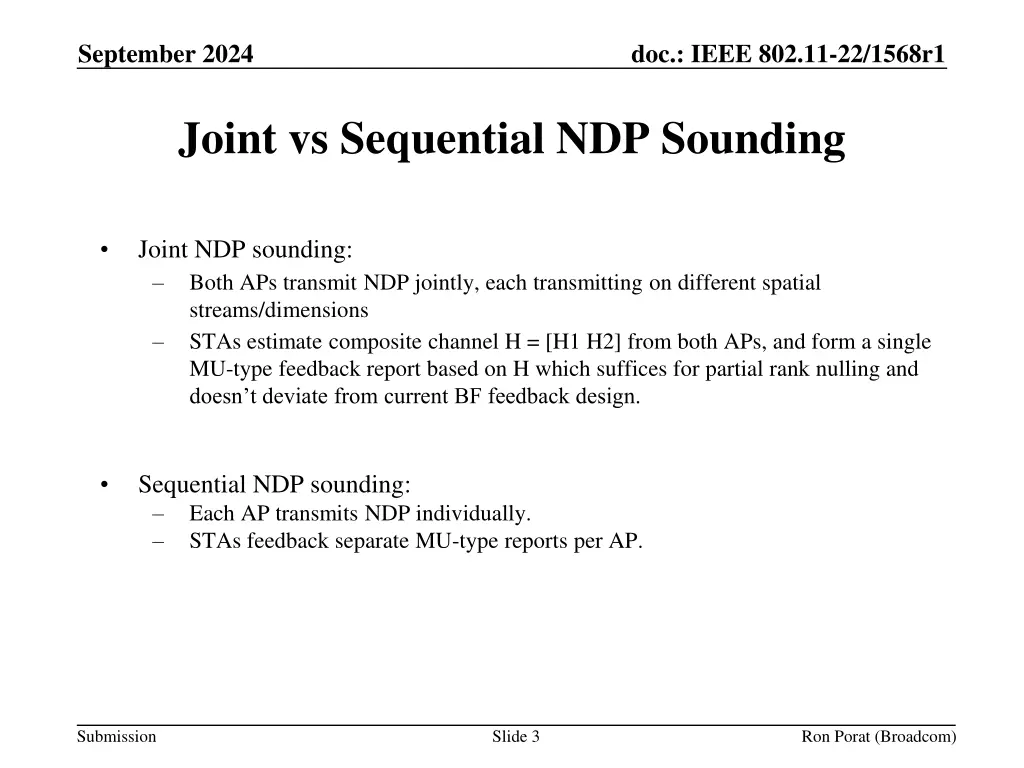
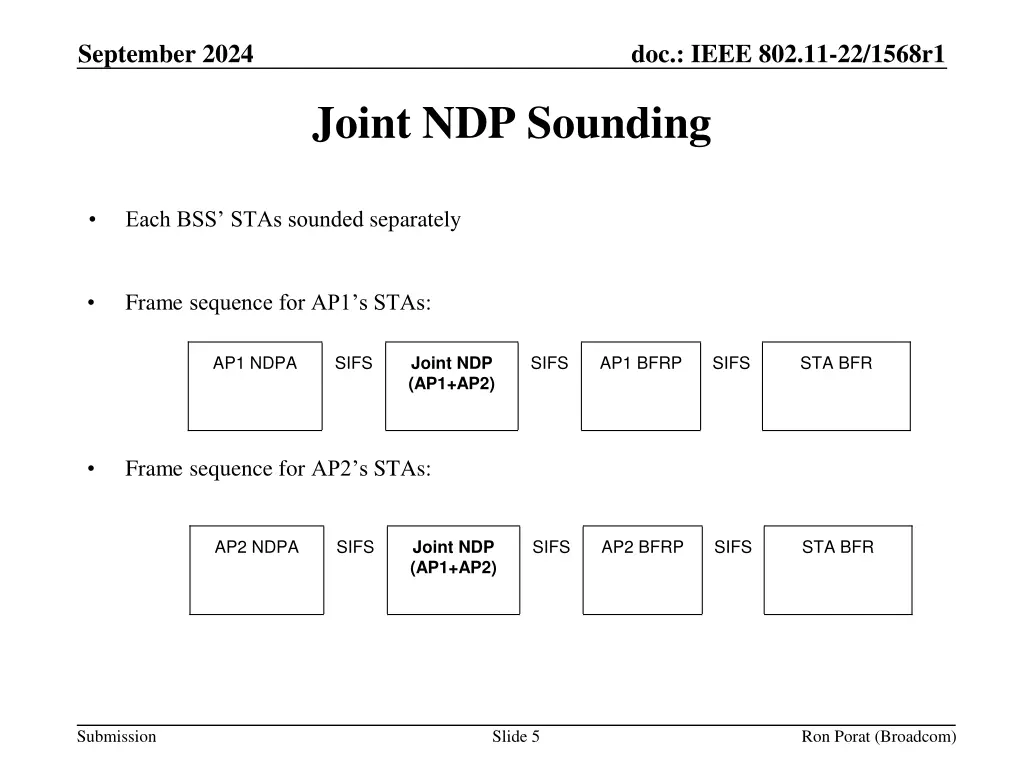
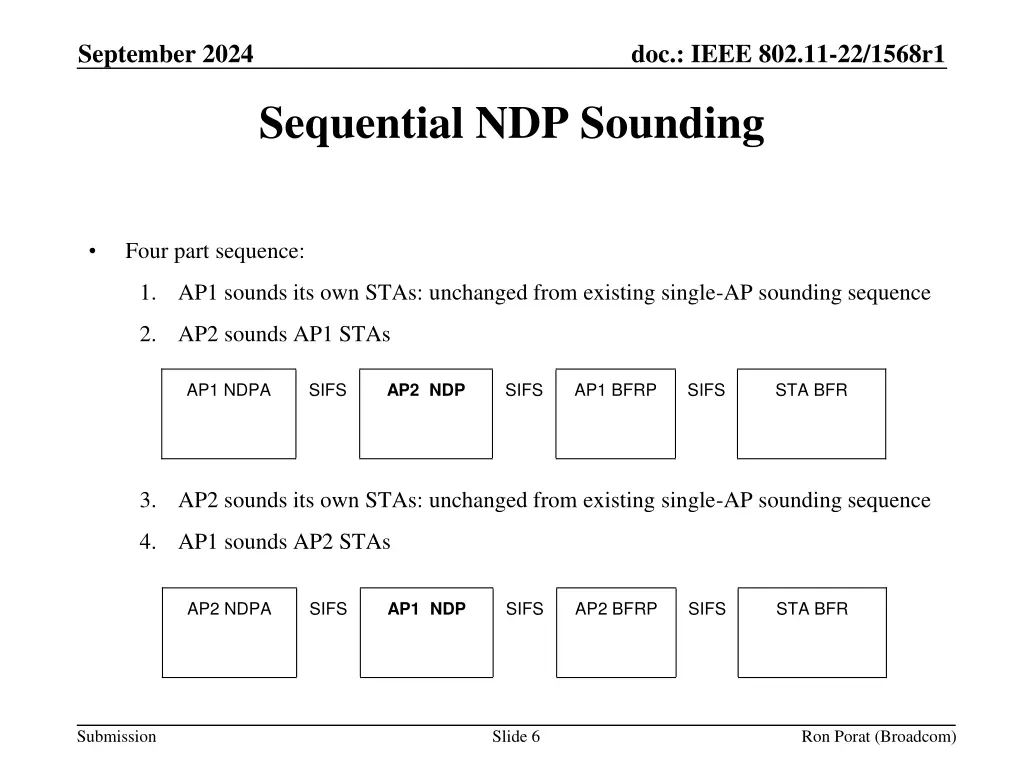
doc.: IEEE 802.11-22/1568r1 September 2024 Joint vs Sequential NDP Sounding Joint NDP sounding: Both APs transmit NDP jointly, each transmitting on different spatial streams/dimensions STAs estimate composite channel H = [H1 H2] from both APs, and form a single MU-type feedback report based on H which suffices for partial rank nulling and doesn t deviate from current BF feedback design. Sequential NDP sounding: Each AP transmits NDP individually. STAs feedback separate MU-type reports per AP. Submission Slide 3 Ron Porat (Broadcom)
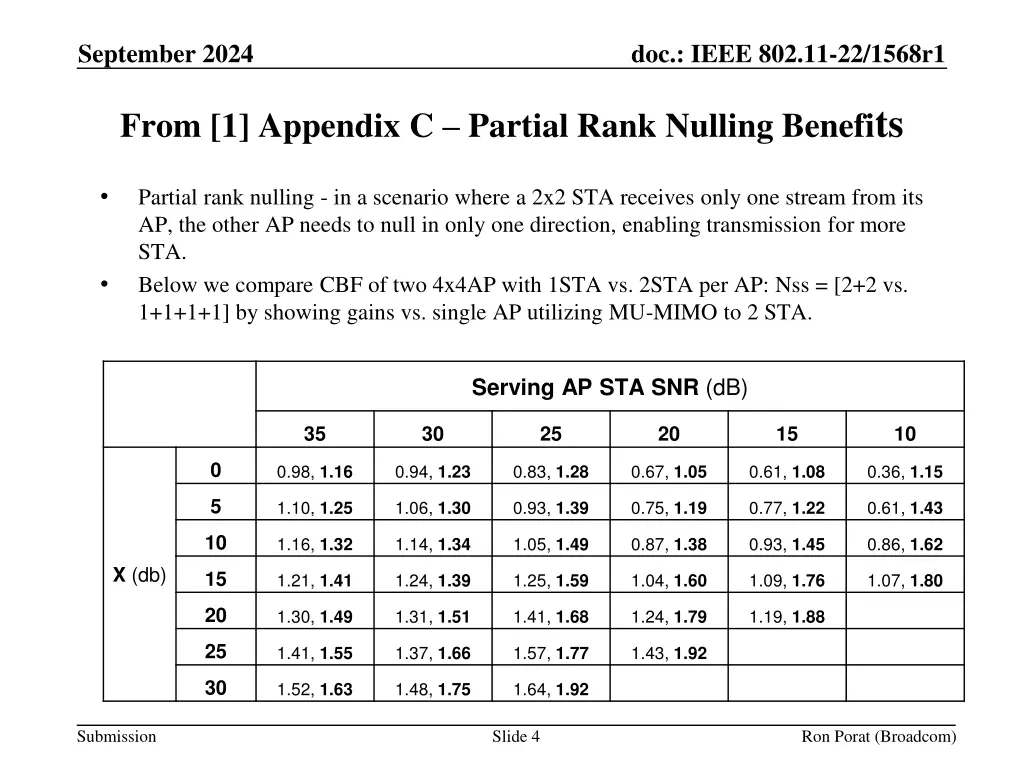
doc.: IEEE 802.11-22/1568r1 September 2024 From [1] Appendix C Partial Rank Nulling Benefits Partial rank nulling - in a scenario where a 2x2 STA receives only one stream from its AP, the other AP needs to null in only one direction, enabling transmission for more STA. Below we compare CBF of two 4x4AP with 1STA vs. 2STA per AP: Nss = [2+2 vs. 1+1+1+1] by showing gains vs. single AP utilizing MU-MIMO to 2 STA. Serving AP STA SNR (dB) 35 30 25 20 15 10 0 0.98, 1.16 0.94, 1.23 0.83, 1.28 0.67, 1.05 0.61, 1.08 0.36, 1.15 5 1.10, 1.25 1.06, 1.30 0.93, 1.39 0.75, 1.19 0.77, 1.22 0.61, 1.43 10 1.16, 1.32 1.14, 1.34 1.05, 1.49 0.87, 1.38 0.93, 1.45 0.86, 1.62 X (db) 15 1.21, 1.41 1.24, 1.39 1.25, 1.59 1.04, 1.60 1.09, 1.76 1.07, 1.80 20 1.30, 1.49 1.31, 1.51 1.41, 1.68 1.24, 1.79 1.19, 1.88 25 1.41, 1.55 1.37, 1.66 1.57, 1.77 1.43, 1.92 30 1.52, 1.63 1.48, 1.75 1.64, 1.92 Submission Slide 4 Ron Porat (Broadcom)
doc.: IEEE 802.11-22/1568r1 September 2024 Joint NDP Sounding Each BSS STAs sounded separately Frame sequence for AP1 s STAs: AP1 NDPA SIFS SIFS AP1 BFRP SIFS STA BFR Joint NDP (AP1+AP2) Frame sequence for AP2 s STAs: AP2 NDPA SIFS SIFS AP2 BFRP SIFS STA BFR Joint NDP (AP1+AP2) Submission Slide 5 Ron Porat (Broadcom)
doc.: IEEE 802.11-22/1568r1 September 2024 Sequential NDP Sounding Four part sequence: 1. AP1 sounds its own STAs: unchanged from existing single-AP sounding sequence 2. AP2 sounds AP1 STAs AP1 NDPA SIFS SIFS AP1 BFRP SIFS STA BFR AP2 NDP 3. AP2 sounds its own STAs: unchanged from existing single-AP sounding sequence 4. AP1 sounds AP2 STAs AP2 NDPA SIFS SIFS AP2 BFRP SIFS STA BFR AP1 NDP Submission Slide 6 Ron Porat (Broadcom)
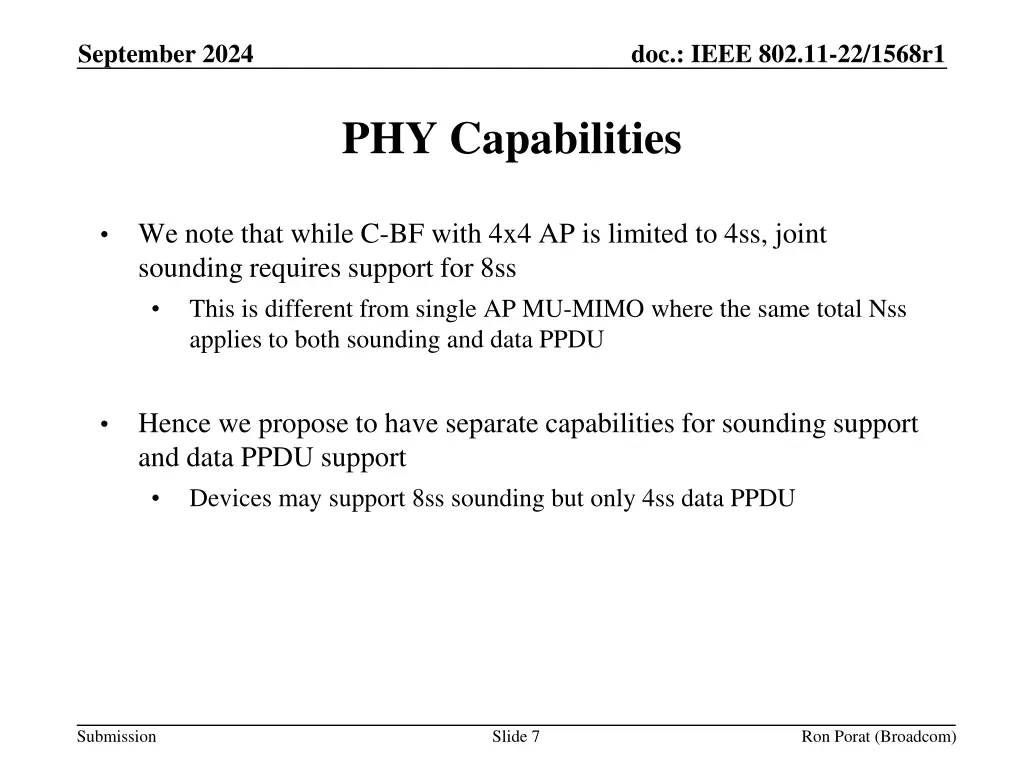
doc.: IEEE 802.11-22/1568r1 September 2024 PHY Capabilities We note that while C-BF with 4x4 AP is limited to 4ss, joint sounding requires support for 8ss This is different from single AP MU-MIMO where the same total Nss applies to both sounding and data PPDU Hence we propose to have separate capabilities for sounding support and data PPDU support Devices may support 8ss sounding but only 4ss data PPDU Submission Slide 7 Ron Porat (Broadcom)
doc.: IEEE 802.11-22/1568r1 September 2024 Summary Proposed that to enable C-BF we support both joint NDP and sequential NDP sounding Proposed to have separate capabilities for sounding and data PPDU Submission Slide 8 Ron Porat (Broadcom)
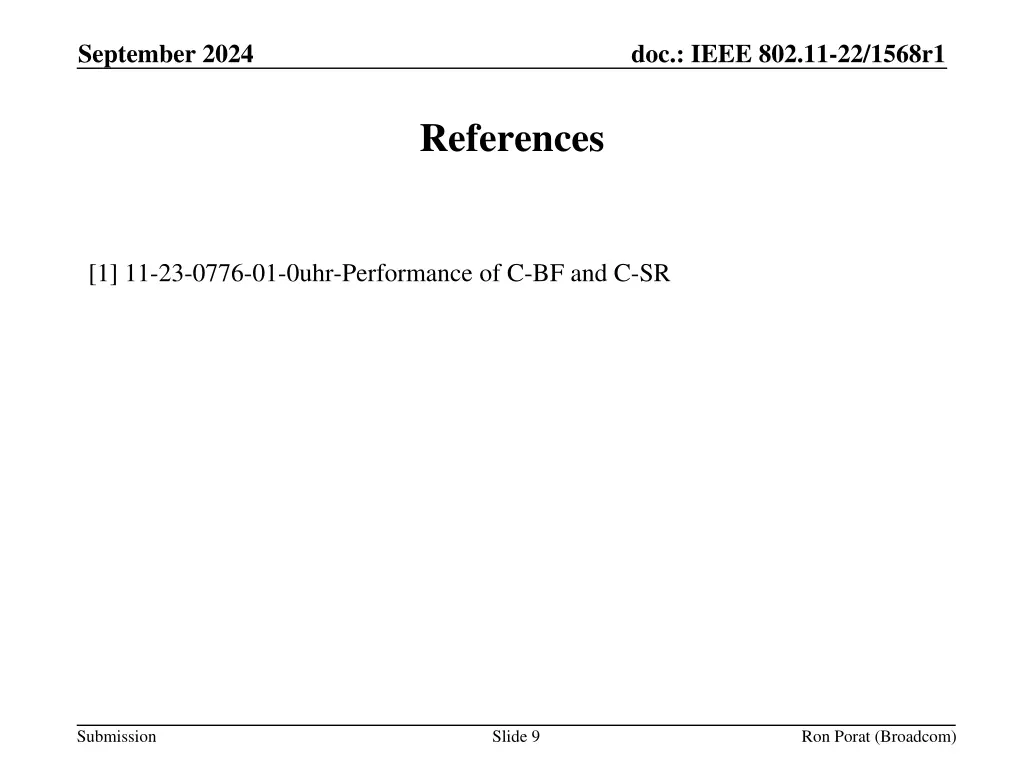
September 2024 doc.: IEEE 802.11-22/1568r1 References [1] 11-23-0776-01-0uhr-Performance of C-BF and C-SR Submission Slide 9 Ron Porat (Broadcom)
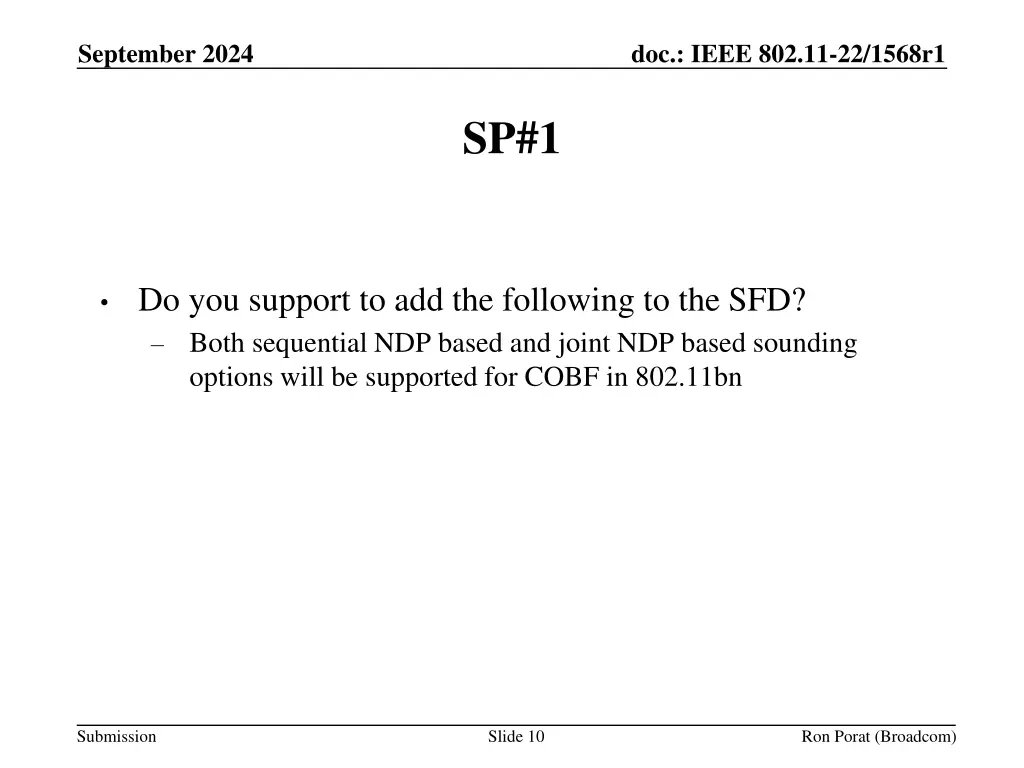
doc.: IEEE 802.11-22/1568r1 September 2024 SP#1 Do you support to add the following to the SFD? Both sequential NDP based and joint NDP based sounding options will be supported for COBF in 802.11bn Submission Slide 10 Ron Porat (Broadcom)
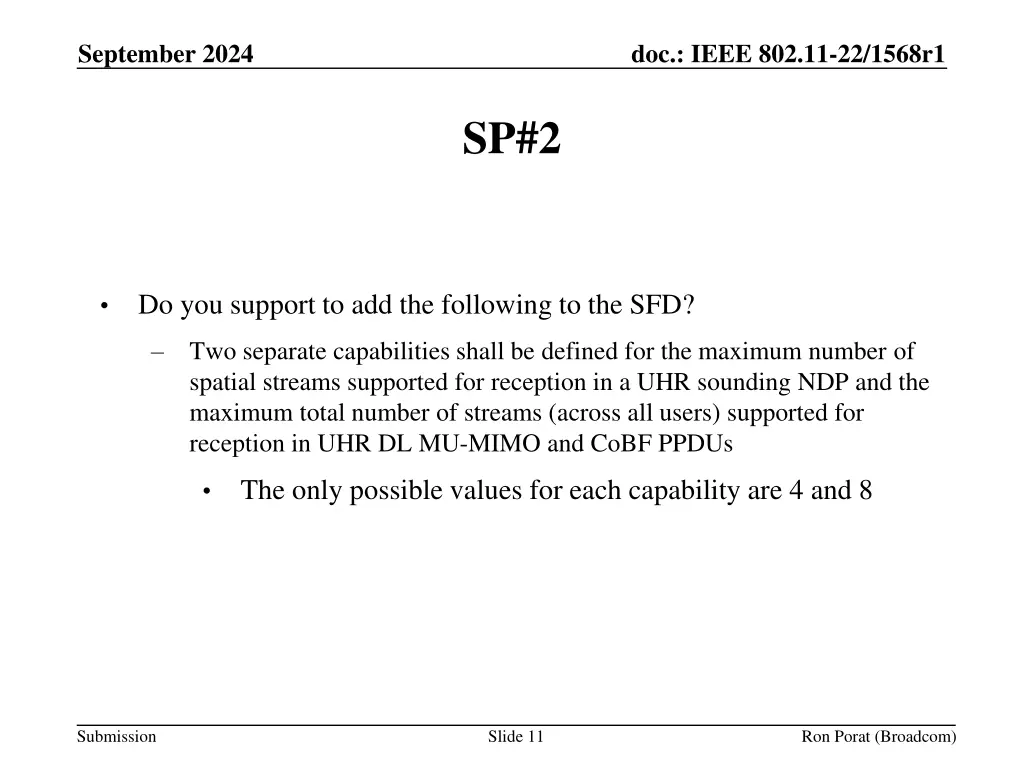
doc.: IEEE 802.11-22/1568r1 September 2024 SP#2 Do you support to add the following to the SFD? Two separate capabilities shall be defined for the maximum number of spatial streams supported for reception in a UHR sounding NDP and the maximum total number of streams (across all users) supported for reception in UHR DL MU-MIMO and CoBF PPDUs The only possible values for each capability are 4 and 8 Submission Slide 11 Ron Porat (Broadcom)