Superconductivity, Josephson Junctions, and SQUIDs in Electronics
Explore the fascinating world of superconductivity, Josephson junctions, and SQUIDs in electronics. Learn about the properties, principles of operation, and applications of these advanced technologies. Discover concepts like the Meissner effect, London penetration depth, Cooper pairs, and more through engaging visuals and detailed explanations.

Download Presentation

Please find below an Image/Link to download the presentation.
The content on the website is provided AS IS for your information and personal use only. It may not be sold, licensed, or shared on other websites without obtaining consent from the author. If you encounter any issues during the download, it is possible that the publisher has removed the file from their server.
You are allowed to download the files provided on this website for personal or commercial use, subject to the condition that they are used lawfully. All files are the property of their respective owners.
The content on the website is provided AS IS for your information and personal use only. It may not be sold, licensed, or shared on other websites without obtaining consent from the author.
E N D
Presentation Transcript
SUPERCONDUCTIVITY, JOSEPHSON JUNCTIONS, AND SQUIDS NICK HILL EE 4611 4-20-16
OUTLINE Superconductivity: Definition Properties Josephson Junctions: Definition Properties SQUIDs (Superconducting Quantum Interference Devices) Architecture Principle of operation Uses
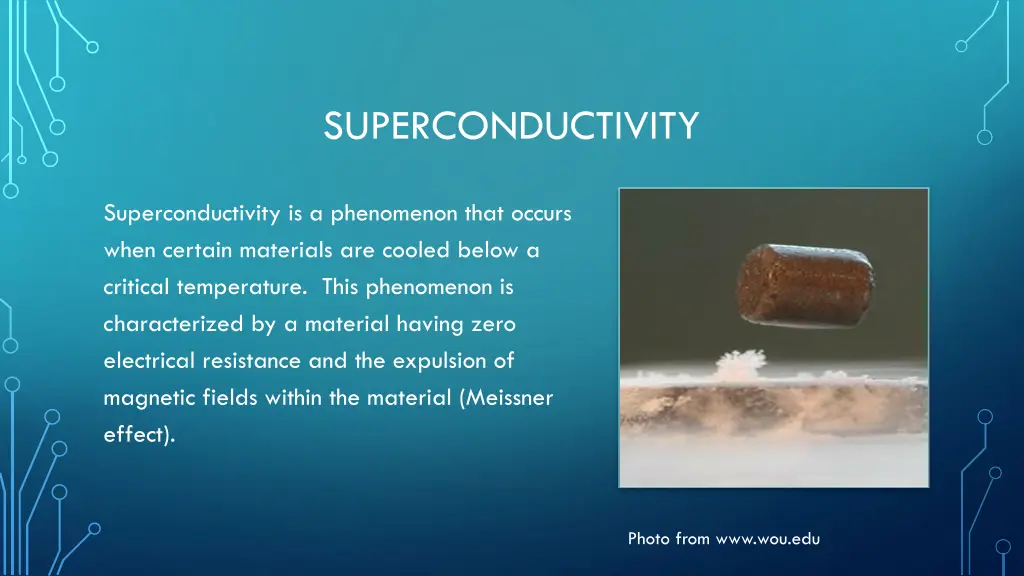
SUPERCONDUCTIVITY Superconductivity is a phenomenon that occurs when certain materials are cooled below a critical temperature. This phenomenon is characterized by a material having zero electrical resistance and the expulsion of magnetic fields within the material (Meissner effect). Photo from www.wou.edu
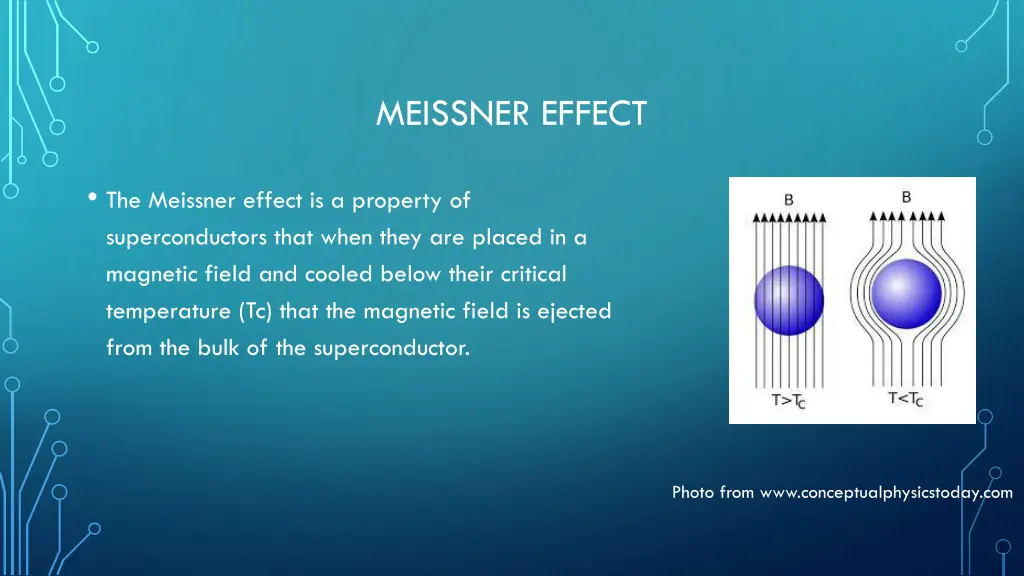
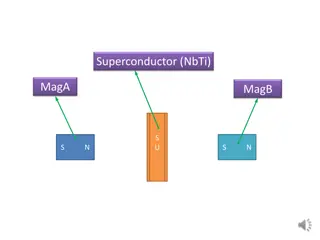
MEISSNER EFFECT The Meissner effect is a property of superconductors that when they are placed in a magnetic field and cooled below their critical temperature (Tc) that the magnetic field is ejected from the bulk of the superconductor. Photo from www.conceptualphysicstoday.com
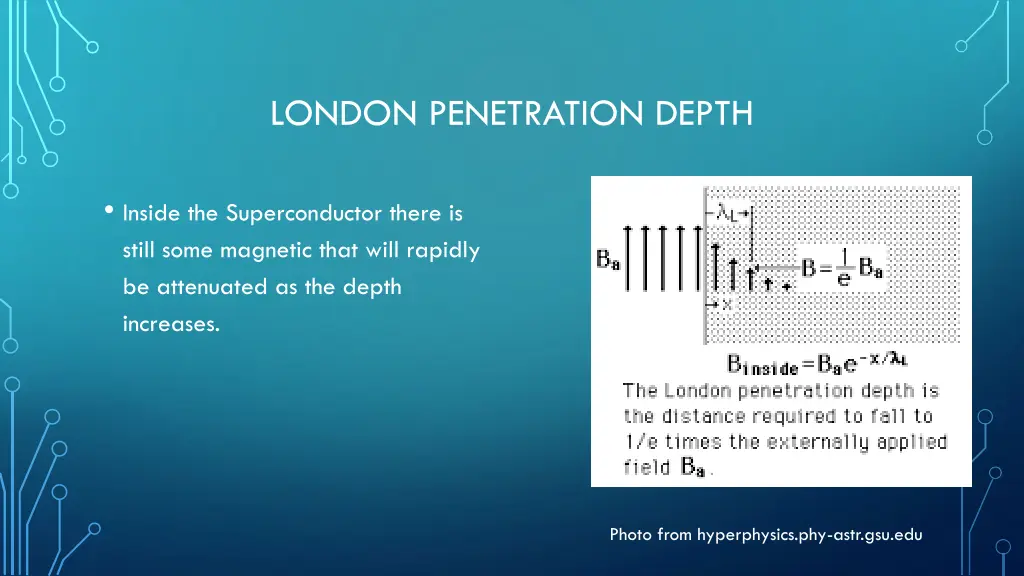
LONDON PENETRATION DEPTH Inside the Superconductor there is still some magnetic that will rapidly be attenuated as the depth increases. Photo from hyperphysics.phy-astr.gsu.edu
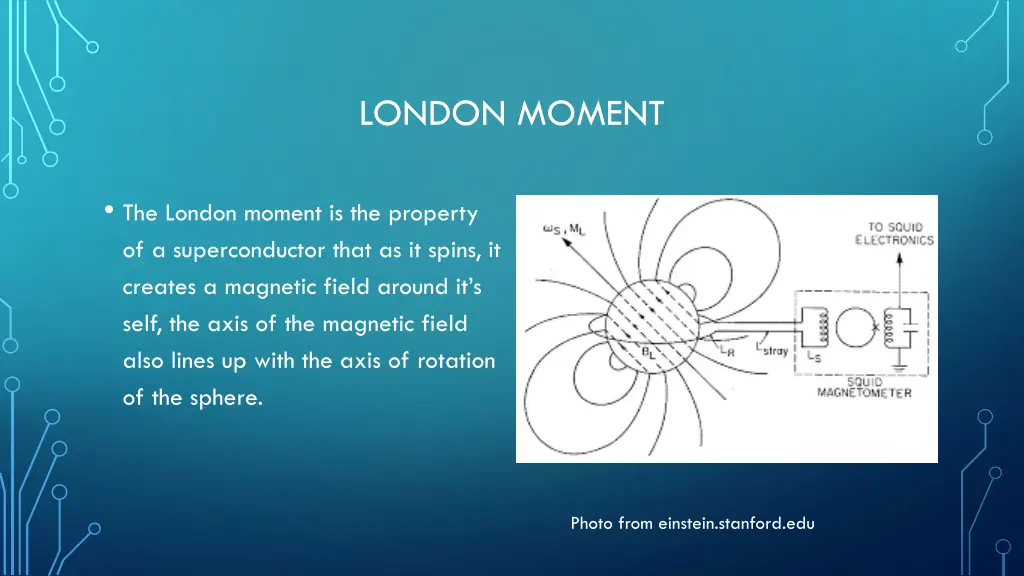
LONDON MOMENT The London moment is the property of a superconductor that as it spins, it creates a magnetic field around it s self, the axis of the magnetic field also lines up with the axis of rotation of the sphere. Photo from einstein.stanford.edu
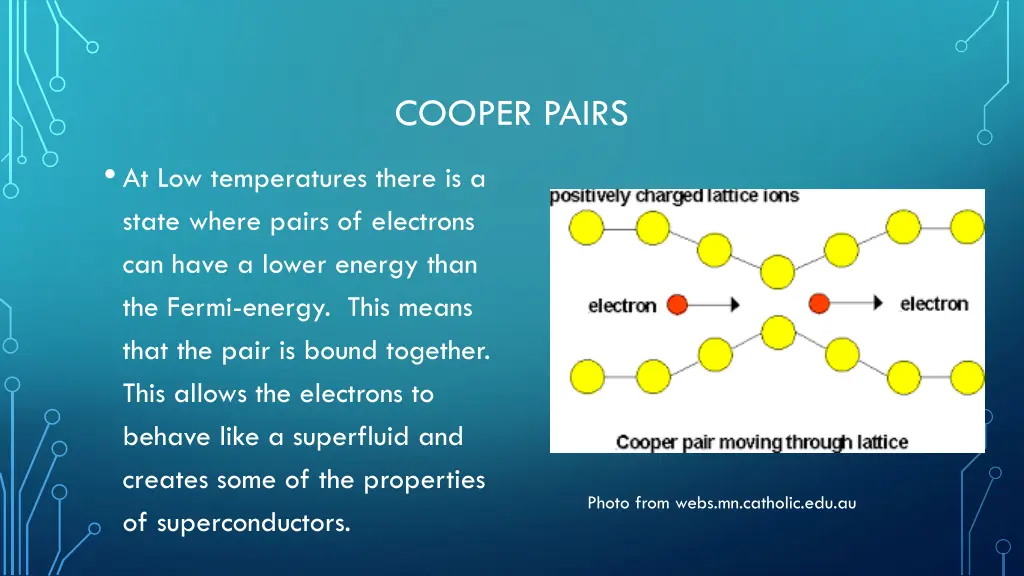
COOPER PAIRS At Low temperatures there is a state where pairs of electrons can have a lower energy than the Fermi-energy. This means that the pair is bound together. This allows the electrons to behave like a superfluid and creates some of the properties of superconductors. Photo from webs.mn.catholic.edu.au
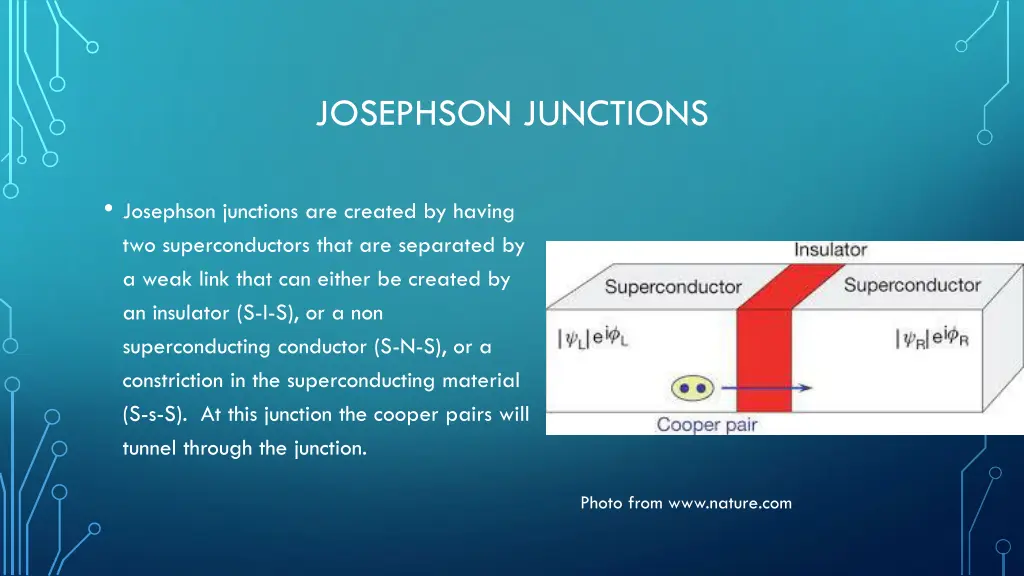
JOSEPHSON JUNCTIONS Josephson junctions are created by having two superconductors that are separated by a weak link that can either be created by an insulator (S-I-S), or a non superconducting conductor (S-N-S), or a constriction in the superconducting material (S-s-S). At this junction the cooper pairs will tunnel through the junction. Photo from www.nature.com
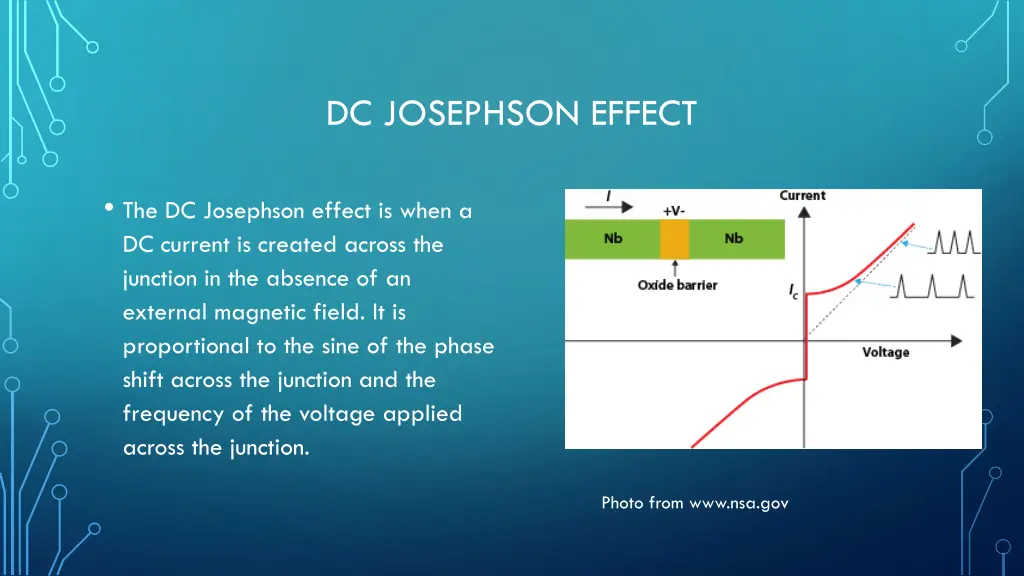
DC JOSEPHSON EFFECT The DC Josephson effect is when a DC current is created across the junction in the absence of an external magnetic field. It is proportional to the sine of the phase shift across the junction and the frequency of the voltage applied across the junction. Photo from www.nsa.gov
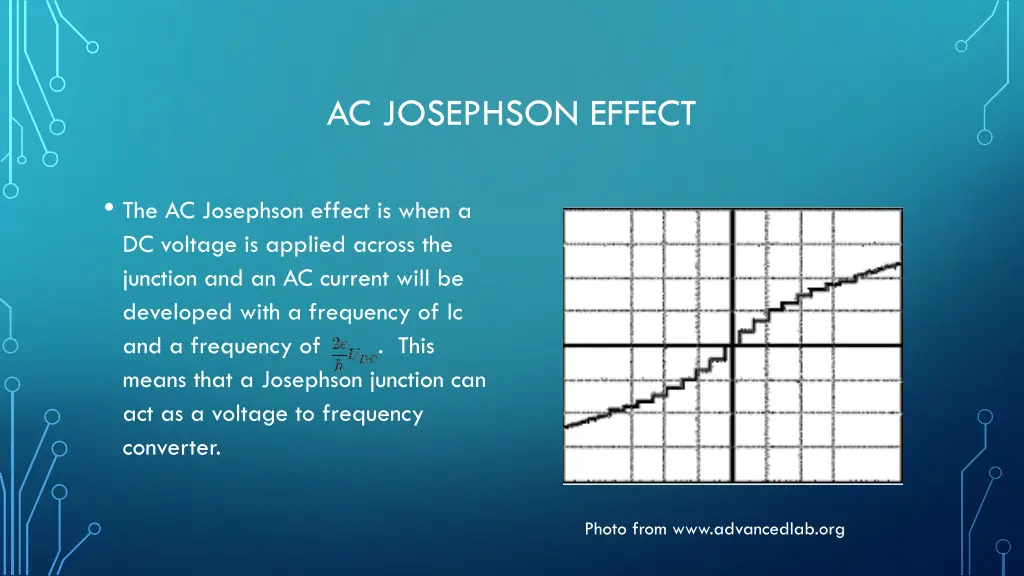
AC JOSEPHSON EFFECT The AC Josephson effect is when a DC voltage is applied across the junction and an AC current will be developed with a frequency of Ic and a frequency of . This means that a Josephson junction can act as a voltage to frequency converter. Photo from www.advancedlab.org
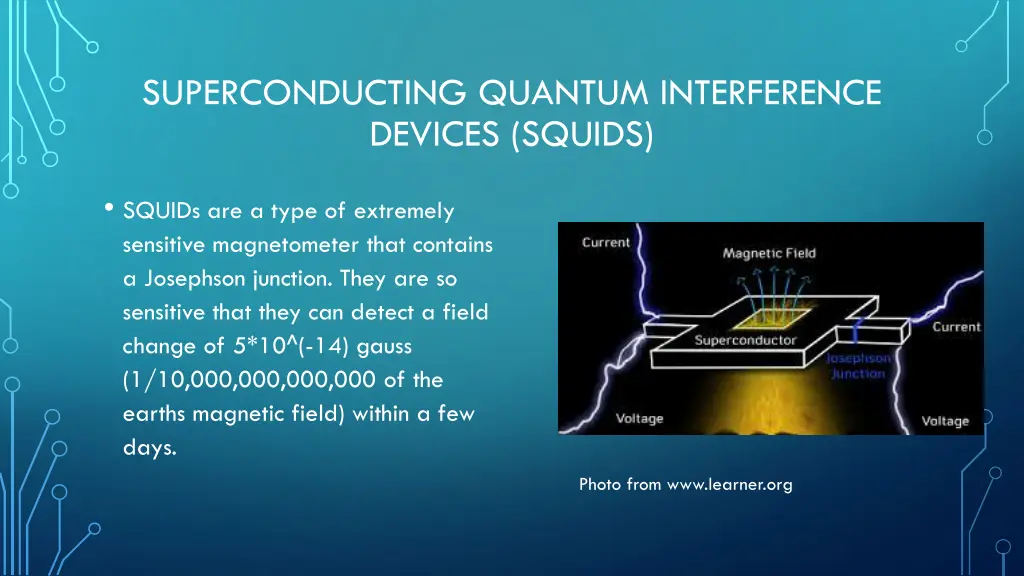
SUPERCONDUCTING QUANTUM INTERFERENCE DEVICES (SQUIDS) SQUIDs are a type of extremely sensitive magnetometer that contains a Josephson junction. They are so sensitive that they can detect a field change of 5*10^(-14) gauss (1/10,000,000,000,000 of the earths magnetic field) within a few days. Photo from www.learner.org
PRINCIPLE OF OPERATION DC SQUIDs are a current loop with two Josephson junctions in it that will carry a current of I/2 in each branch in the absence of an external magnetic field. In the presence of a field, there is a secondary current produced that increases the current of one branch and decreases the current of another branch. This will continue until there is a critical current reached that will then cause the magnetic field to switch and thus the current to change.
APPLICATIONS FOR SQUIDS MRI and MEG (Magnetoencephalography) to take high resolution images of neurons in the brain. Gravity detectors Quantum computers
SOURCES Ran, Shannon K doah (2004). Gravity Probe B: Exploring Einstein's Universe with Gyroscopes (PDF).NASA. p. 27. John C. Gallop (1990). SQUIDS, the Josephson Effects and Superconducting Electronics. CRC Press. pp. 3, 20. ISBN 0-7503-0051-5. Bhadeshia123. "Superconductivity: SQUIDS." YouTube. YouTube, 09 Nov. 2014. Web. 18 Apr. 2016. Josephson, Brian. The Discovery of Tunneling Supercurrents Nobel lecture 12 Dec. 1973 nobelprize.org. Web. 18 Apr. 2016.
KEY POINTS Superconductivity is a phenomenon where a material has zero electrical resistance and will expel any magnetic fields within the material. Josephson junctions are junctions that allow the quantum tunneling of Cooper pairs Josephson Junctions are formed with a type of barrier that could either be an insulator, normal conductor, or a restriction in a superconductor. SQUIDS are a type of Magnetometer SQUIDS are used in an array of things from MRI to super sensitive gyroscopes.