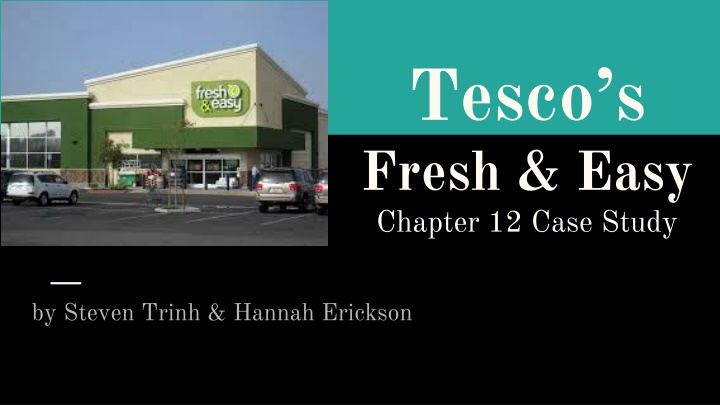
Tesco's Fresh & Easy Chapter 12 Case Study
Background on Tesco, their expansion objectives, problems faced in the U.S., and detailed analysis of distribution channels, supermarket vs. convenience store, and global market expansion strategy issues. Includes SWOT analysis.

Download Presentation

Please find below an Image/Link to download the presentation.
The content on the website is provided AS IS for your information and personal use only. It may not be sold, licensed, or shared on other websites without obtaining consent from the author. If you encounter any issues during the download, it is possible that the publisher has removed the file from their server.
You are allowed to download the files provided on this website for personal or commercial use, subject to the condition that they are used lawfully. All files are the property of their respective owners.
The content on the website is provided AS IS for your information and personal use only. It may not be sold, licensed, or shared on other websites without obtaining consent from the author.
E N D
Presentation Transcript
Tescos Fresh & Easy Chapter 12 Case Study by Steven Trinh & Hannah Erickson
Background Founded by John Cohen in 1919 Tesco is the largest supermarket chain in the UK Has over 2,300 stores in terms of supercenters, regular and compact supermarkets and Tesco Express convenience stores Currently operating in 14 countries Extremely successful global expansions into South Korea, China, Japan, India Objective: Expand their company and services to the U.S
The Problems 1)Lack of local distribution to carry out their convenience stores in the U.S. 2)Tesco also failed to follow their U.S. competitors and create full supermarkets. 3)Tesco did not use a proper marketing expansion strategy when entering the U.S.
Problem 1: Distribution Channels Tesco excelled at connecting with distribution channels in the UK, but they did not invest in creating NEW distribution channels and supply chains in the US. They wanted to stick with their old ones. To develop US distributor relationships they should have: 1. Been intentional about selecting distributors 2. Look for distributors capable of developing markets 3. Treated local distributors as long term partners, not temporary market-entry vehicles 4. Supported market entry by committing money, managers, and proven marketing ideas to the global industry 5. Maintained control over the marketing strategy from the start 6. Made sure distributors provide you with detailed market and financial performance data 7. Built links among national distributors at the earliest opportunity
Problem 2: Supermarket vs. Convenience Store -Most of Tesco s competitors in the U.S. were full supermarkets -Tesco operates full supermarkets in the UK, but chose to only expand the limited convenience stores into the US -The limited variation of products sold was a major downfall to consumers -Brand recognition was very little -Not enough research was done on the buying behaviors of American consumers
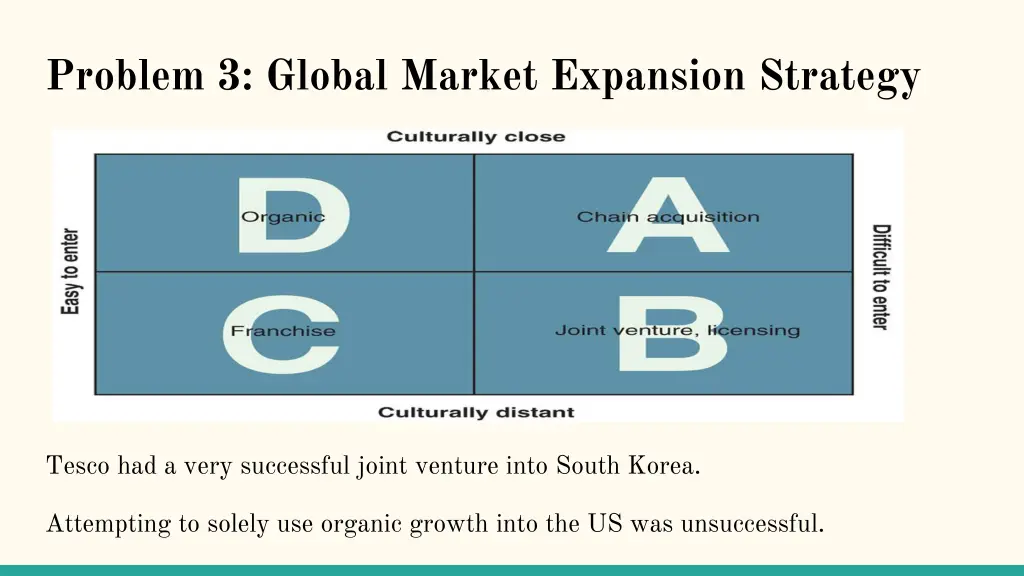
Problem 3: Global Market Expansion Strategy Tesco had a very successful joint venture into South Korea. Attempting to solely use organic growth into the US was unsuccessful.
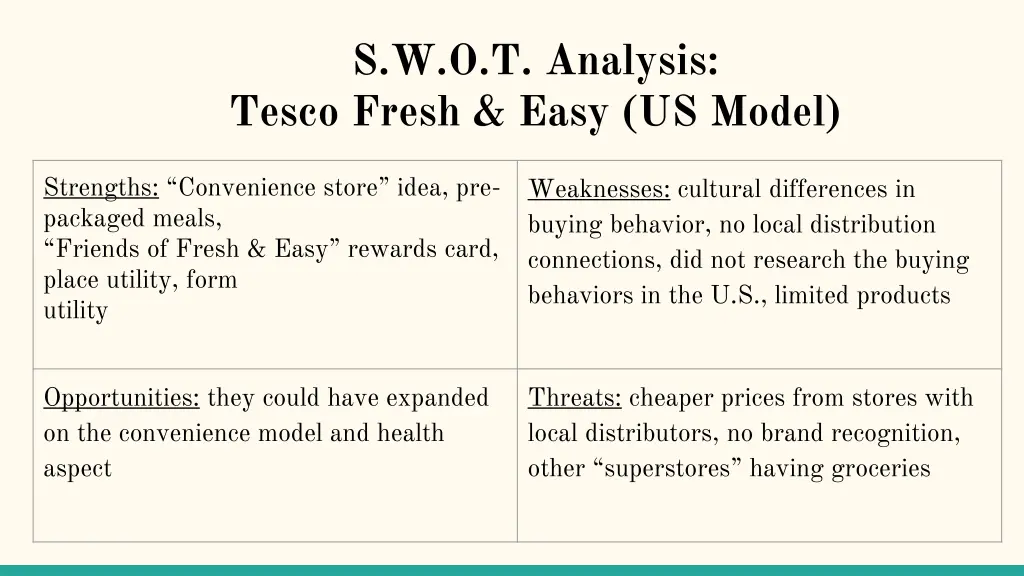
S.W.O.T. Analysis: Tesco Fresh & Easy (US Model) Strengths: Convenience store idea, pre- packaged meals, Friends of Fresh & Easy rewards card, place utility, form utility Weaknesses: cultural differences in buying behavior, no local distribution connections, did not research the buying behaviors in the U.S., limited products Opportunities: they could have expanded on the convenience model and health aspect Threats: cheaper prices from stores with local distributors, no brand recognition, other superstores having groceries
Recommendation 1.Create a stronger supply chain with local distribution channels in the United States to continue to build relationships, invest in the economy, boost efficiency, learn about the culture, and avoid raising prices to offset importation costs. 2.Create full Tesco supermarkets in the U.S., to adapt to the one-stop-shop buying behaviors of American consumers, increase product diversification, and be better matched with local competitors. 3.Use a joint venture expansion strategy with an American company to better understand the US culture, build roots in America, and minimize overall risk.
Discussion Questions 1.Outside of the Joint Venture strategy, what other expansion strategies would you recommend? 2.Do you think it made a difference that Fresh & Easy was only a convenience store, and not a full supermarket? 3.Does it surprise you that the Fresh & Easy stores closed in the U.S.?