The Reflection of Light: Mirrors and Types of Mirrors
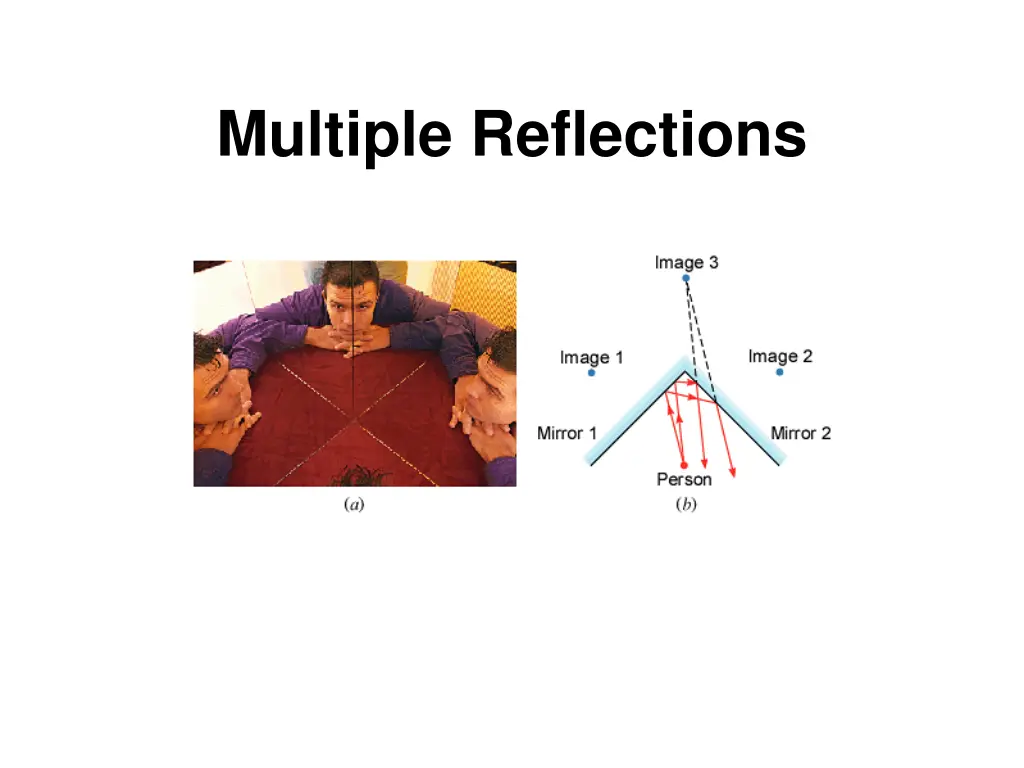
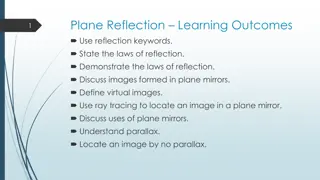
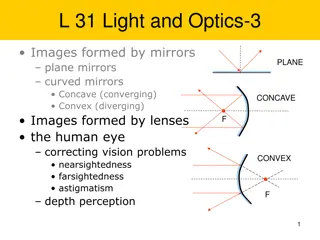
This section explores the reflection of light, detailing the various types of mirrors such as plane, spherical, convex, concave, and parabolic. It discusses the fundamental principles of wave fronts and rays, the law of reflection, and the characteristics of images formed by plane mirrors. Additionally, it answers intriguing questions regarding mirror height requirements for full image visibility and the concept of multiple reflections, providing a comprehensive overview of light behavior in different mirror types.

Download Presentation

Please find below an Image/Link to download the presentation.
The content on the website is provided AS IS for your information and personal use only. It may not be sold, licensed, or shared on other websites without obtaining consent from the author.If you encounter any issues during the download, it is possible that the publisher has removed the file from their server.
You are allowed to download the files provided on this website for personal or commercial use, subject to the condition that they are used lawfully. All files are the property of their respective owners.
The content on the website is provided AS IS for your information and personal use only. It may not be sold, licensed, or shared on other websites without obtaining consent from the author.
E N D
Presentation Transcript
Physics Mechanics Fluid Motion Heat Sound Electricity Magnetism Light
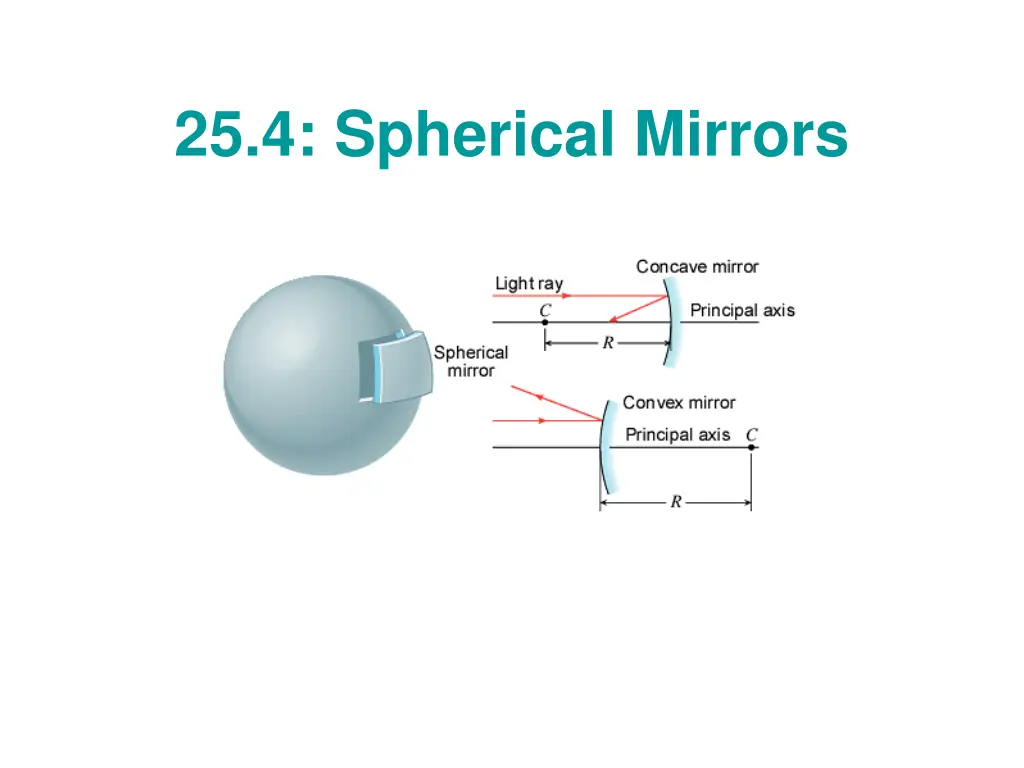
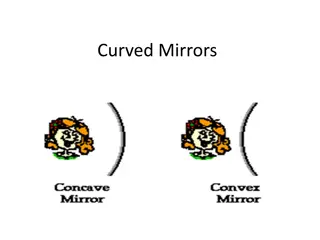
C H A P T E R 25 The Reflection of Light: Mirrors Types of Mirrors: Plane Mirror Spherical Mirror: Convex and Concave Parabolic Mirror
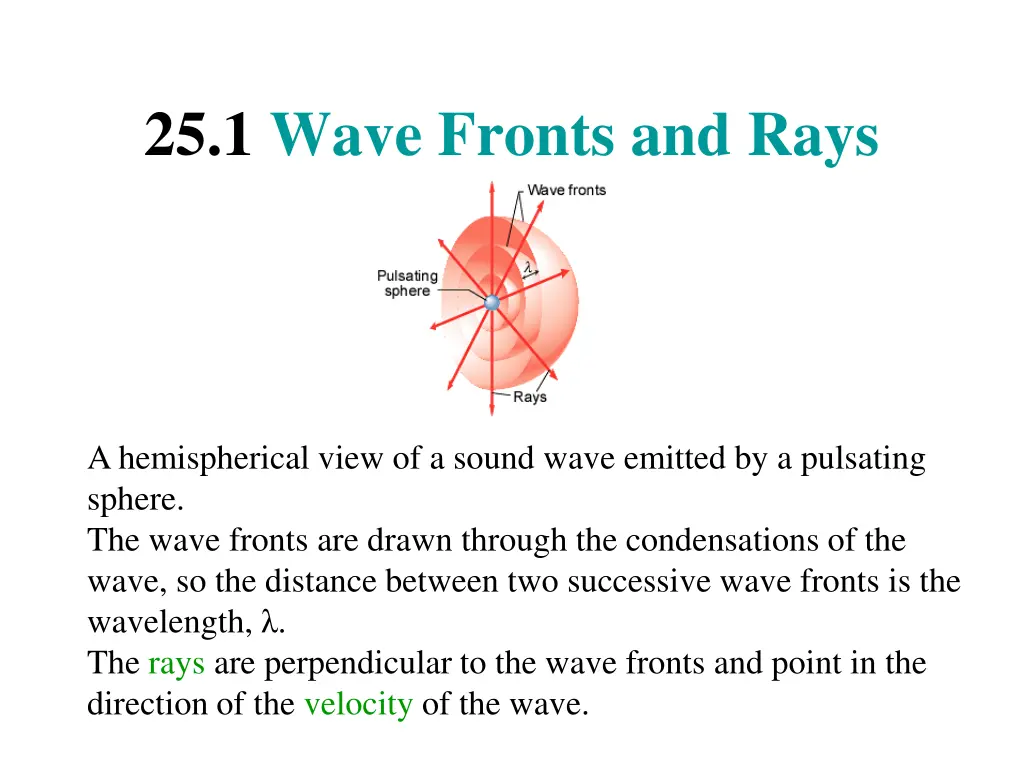
25.1 Wave Fronts and Rays A hemispherical view of a sound wave emitted by a pulsating sphere. The wave fronts are drawn through the condensations of the wave, so the distance between two successive wave fronts is the wavelength, . The rays are perpendicular to the wave fronts and point in the direction of the velocity of the wave.
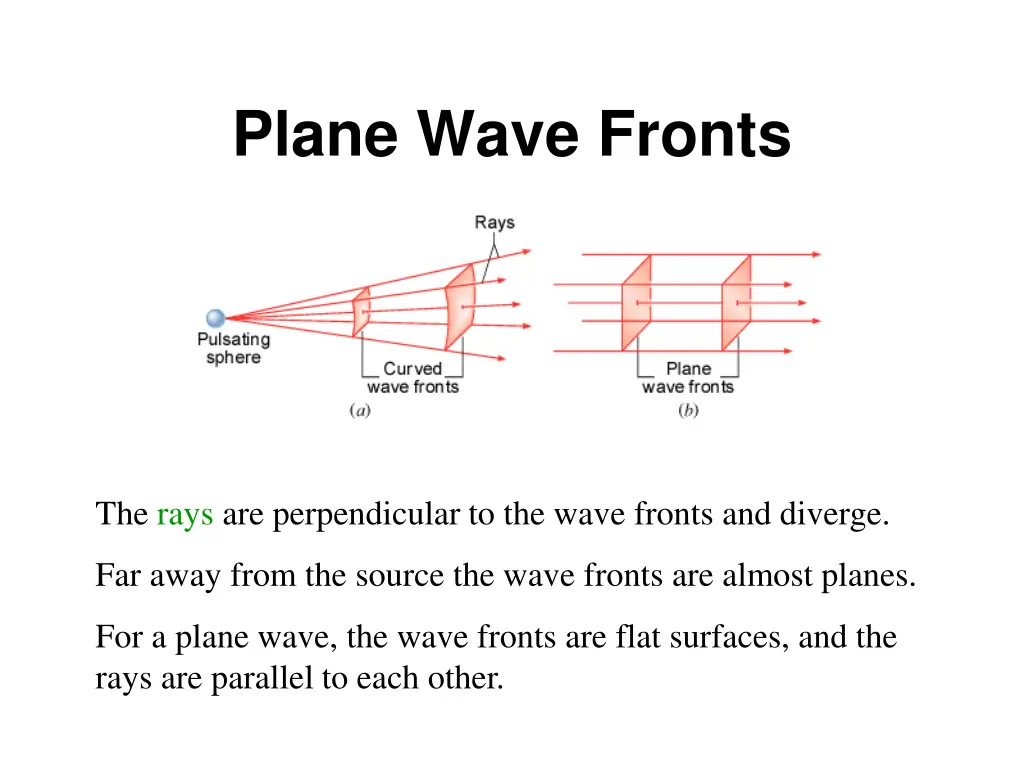
Plane Wave Fronts The rays are perpendicular to the wave fronts and diverge. Far away from the source the wave fronts are almost planes. For a plane wave, the wave fronts are flat surfaces, and the rays are parallel to each other.
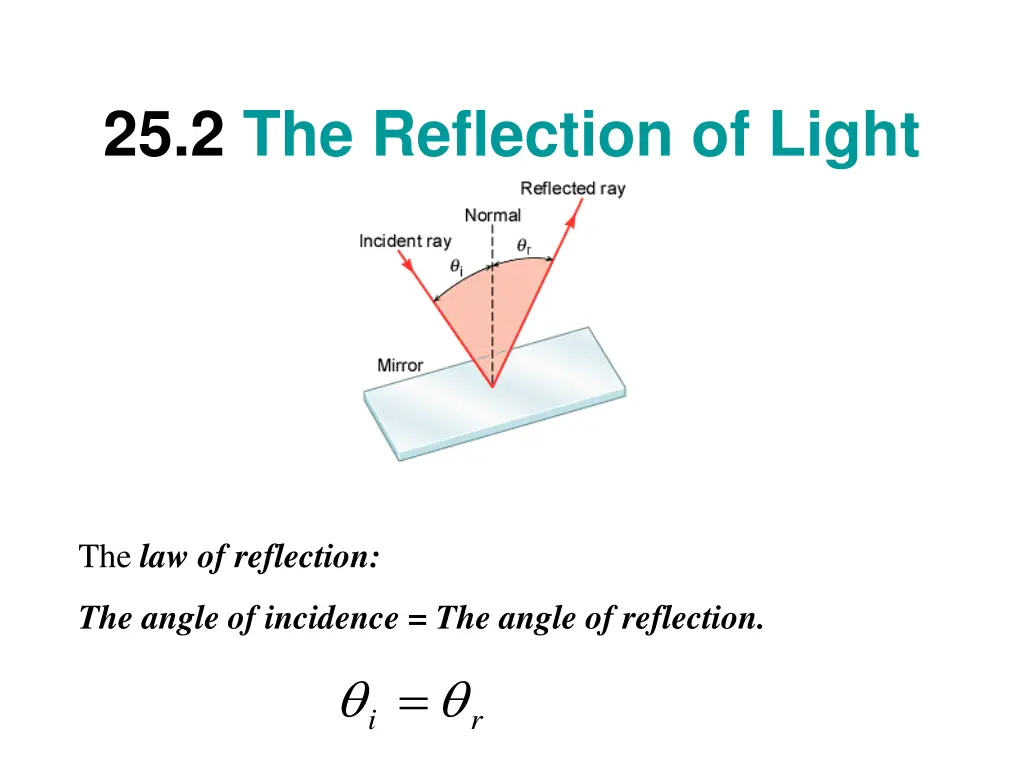
25.2 The Reflection of Light The law of reflection: The angle of incidence = The angle of reflection. = i r
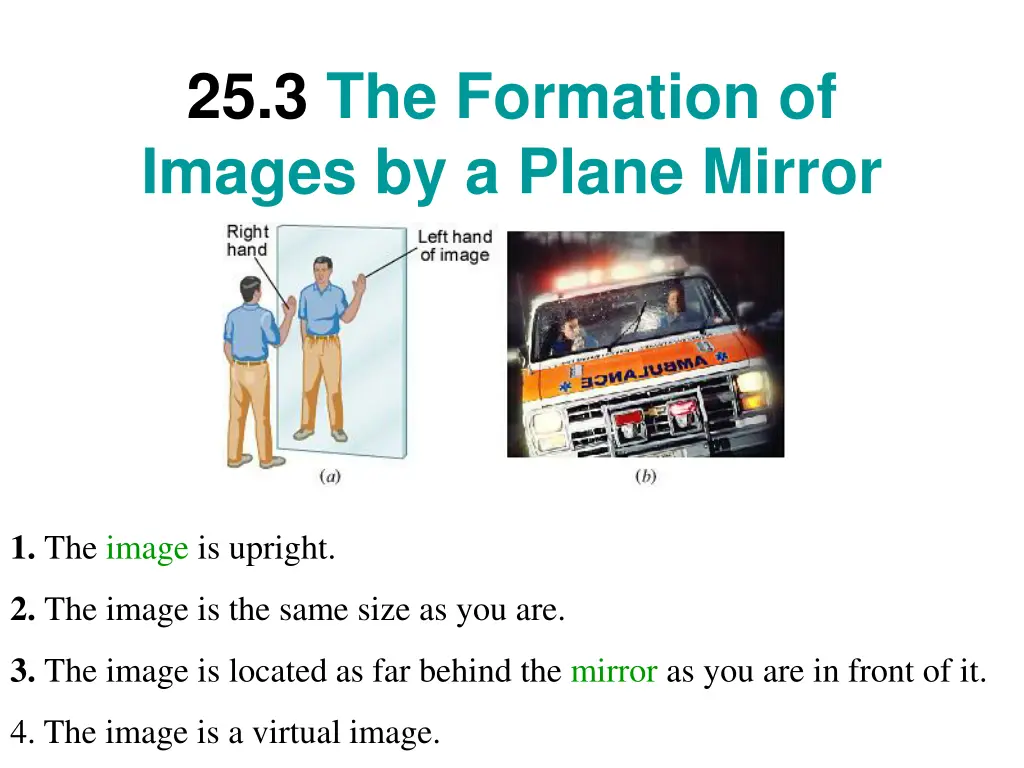
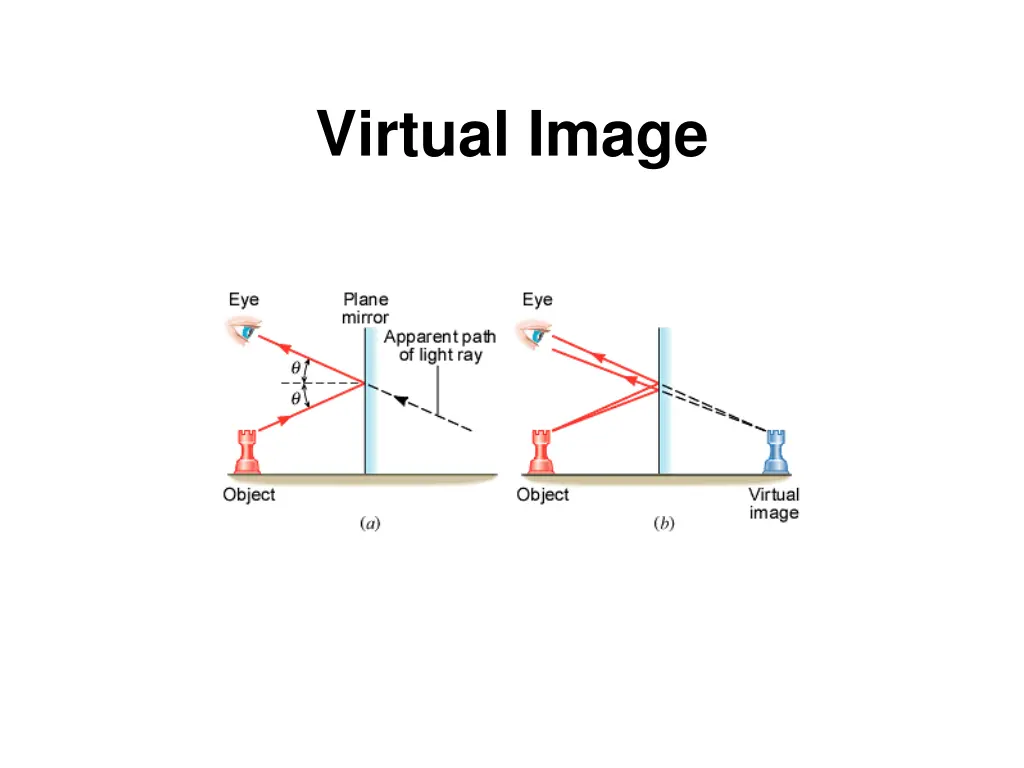
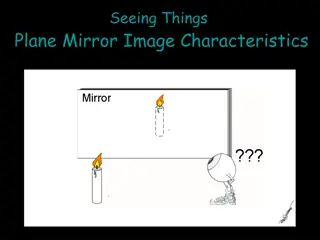
25.3 The Formation of Images by a Plane Mirror 1. The image is upright. 2. The image is the same size as you are. 3. The image is located as far behind the mirror as you are in front of it. 4. The image is a virtual image.
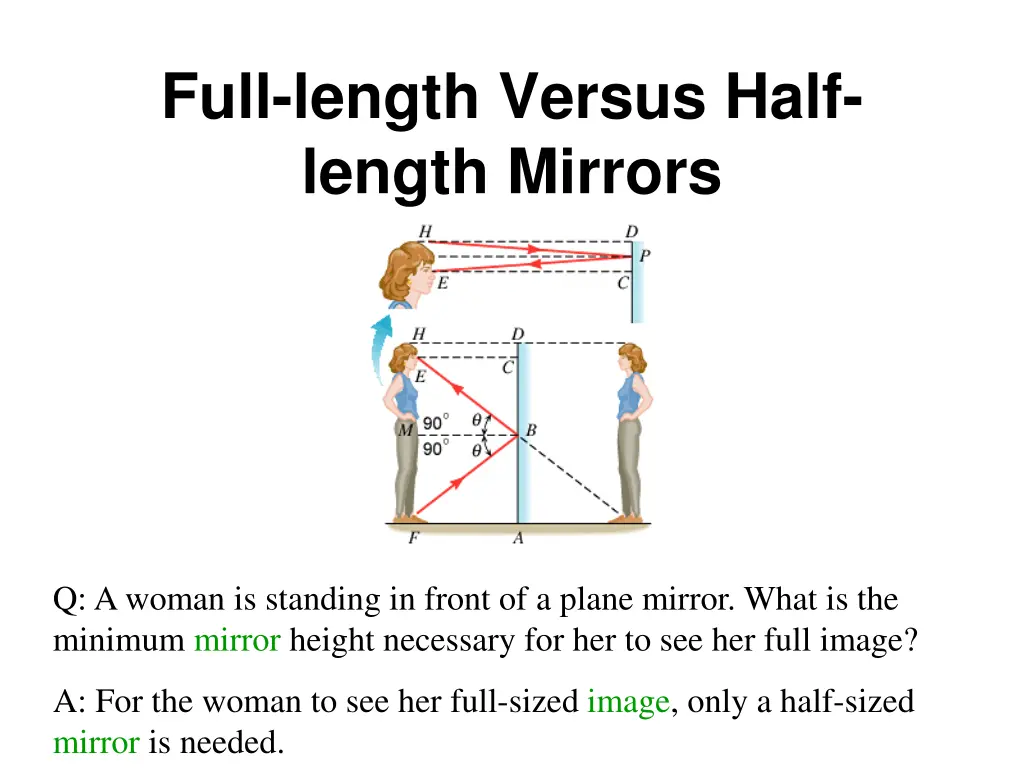
Full-length Versus Half- length Mirrors Q: A woman is standing in front of a plane mirror. What is the minimum mirror height necessary for her to see her full image? A: For the woman to see her full-sized image, only a half-sized mirror is needed.
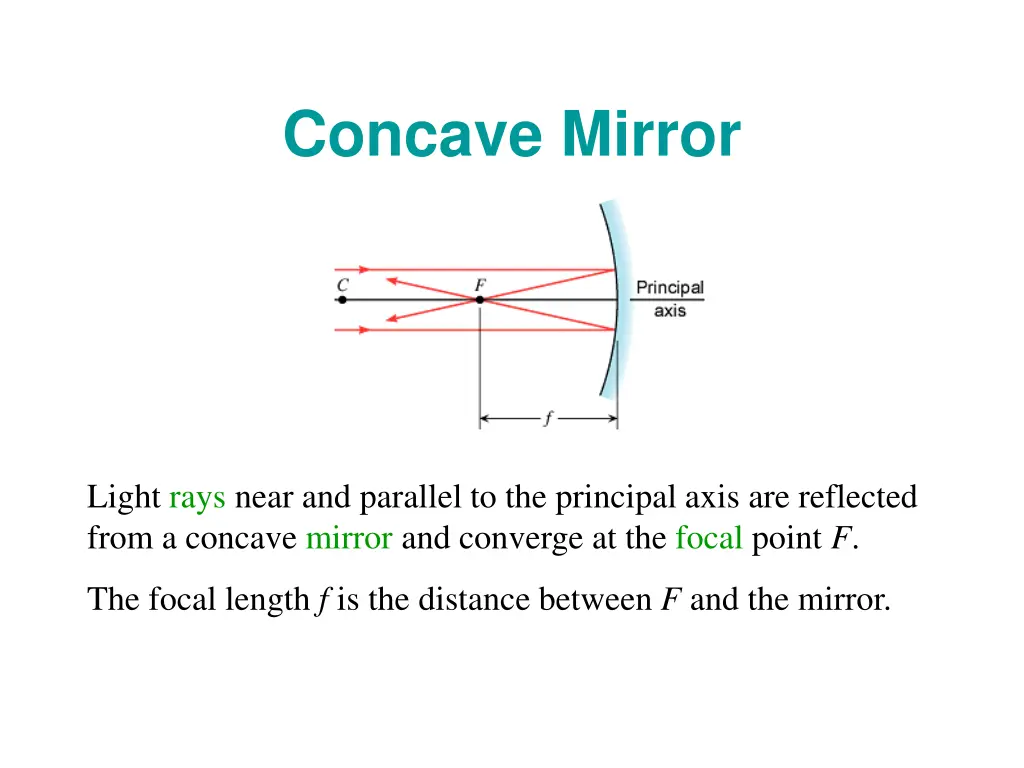
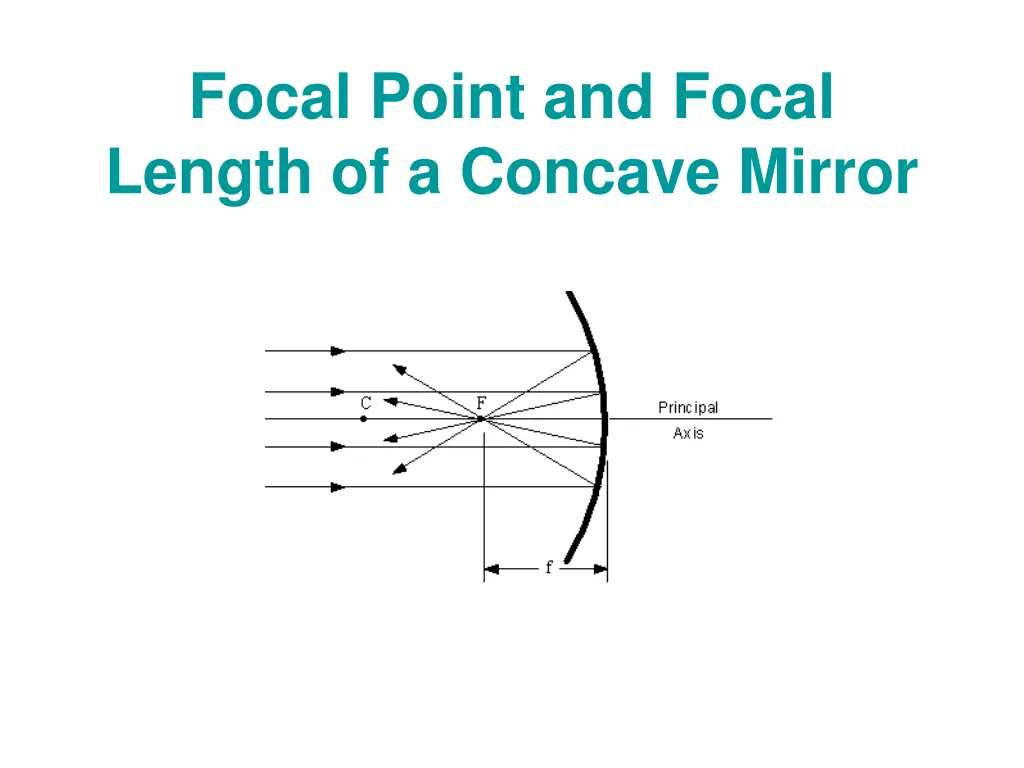
Concave Mirror Light rays near and parallel to the principal axis are reflected from a concave mirror and converge at the focal point F. The focal length f is the distance between F and the mirror.
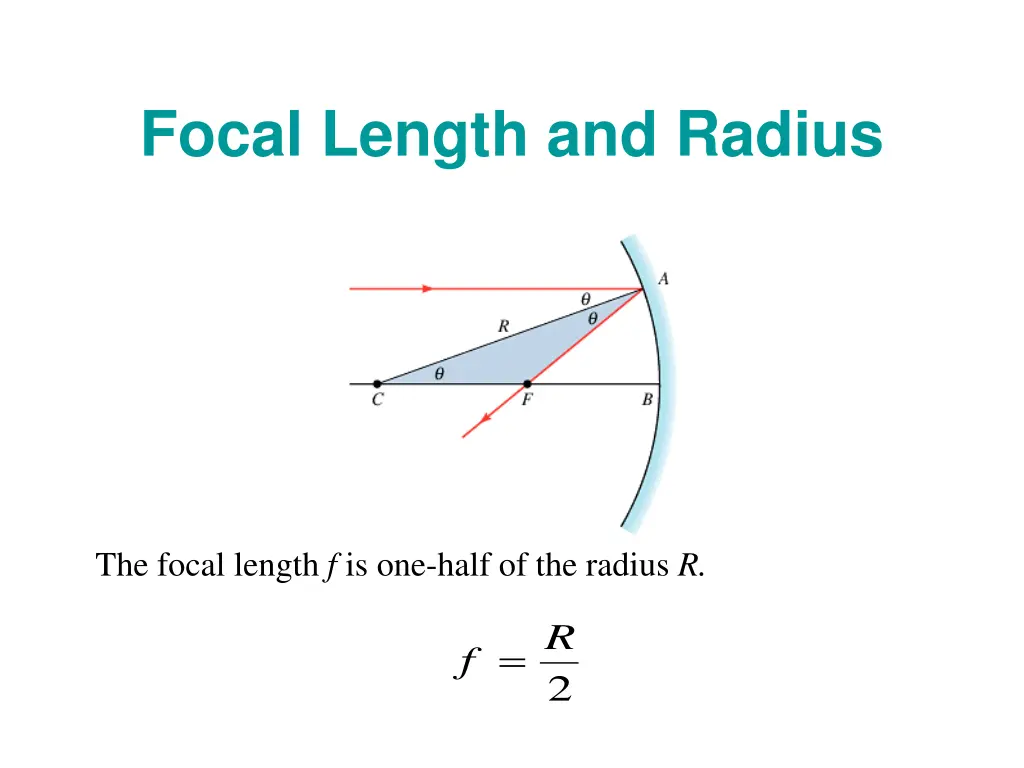
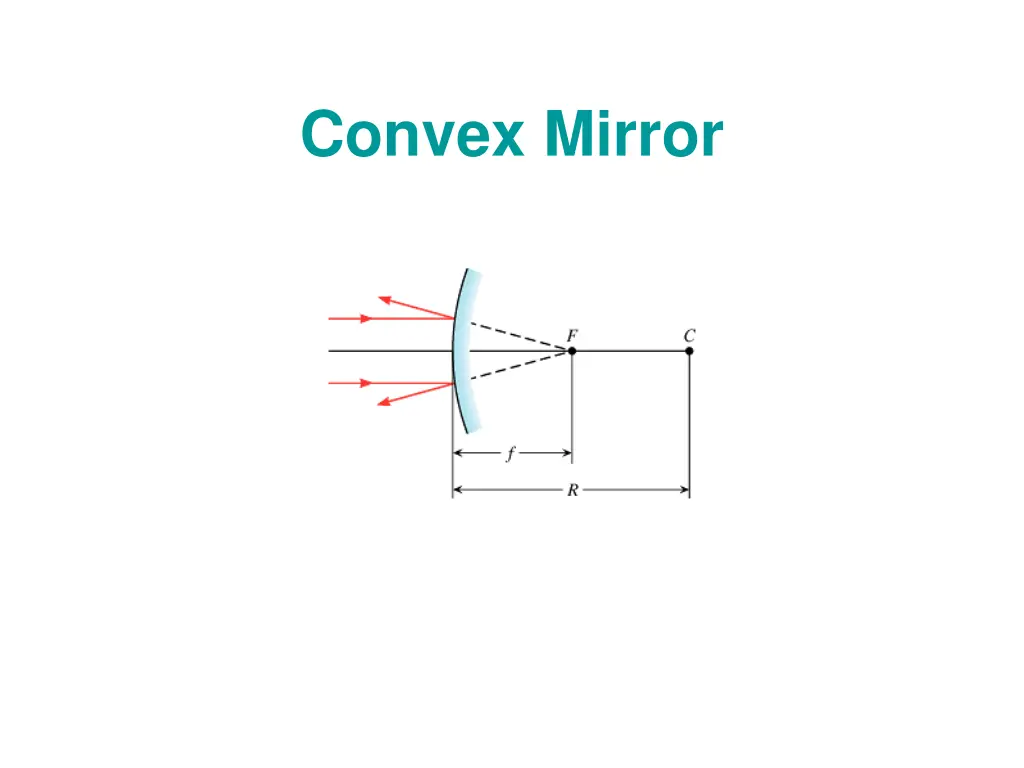
Focal Length and Radius The focal length f is one-half of the radius R. R f = 2
Focal Point and Focal Length of a Concave Mirror
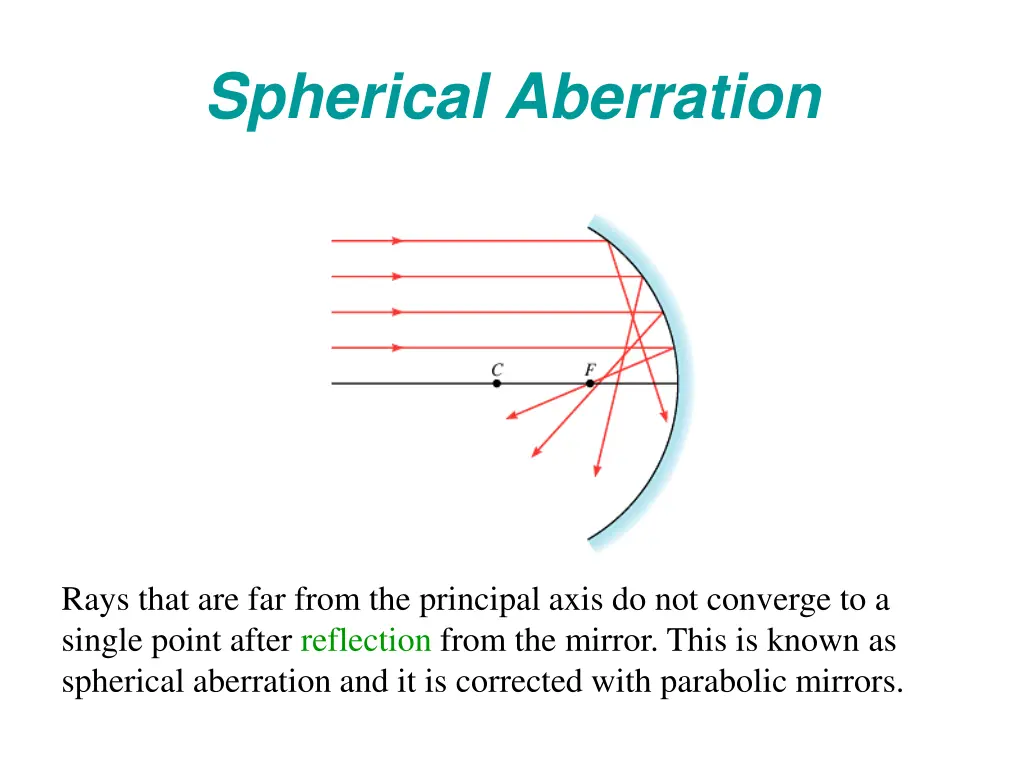
Spherical Aberration Rays that are far from the principal axis do not converge to a single point after reflection from the mirror. This is known as spherical aberration and it is corrected with parabolic mirrors.
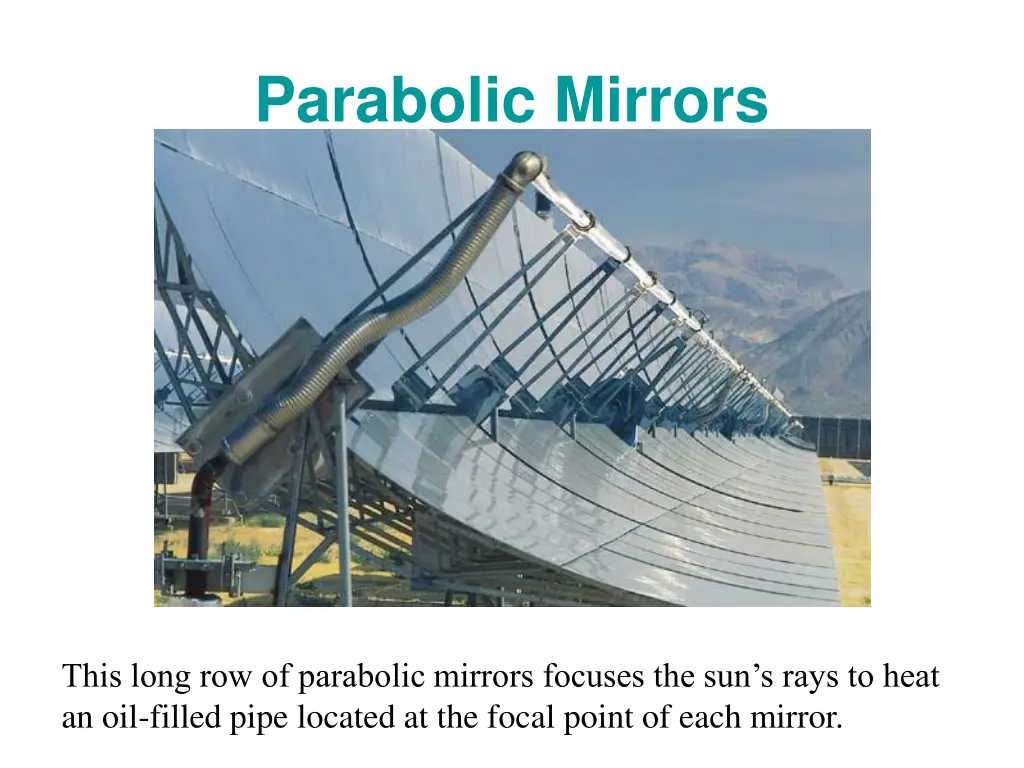
Parabolic Mirrors This long row of parabolic mirrors focuses the sun s rays to heat an oil-filled pipe located at the focal point of each mirror.
Automobile Headlights Automobile headlights use parabolic mirrors. In a headlight, a high-intensity light bulb is placed at the focal point of the mirror, and light emerges parallel to the principal axis.
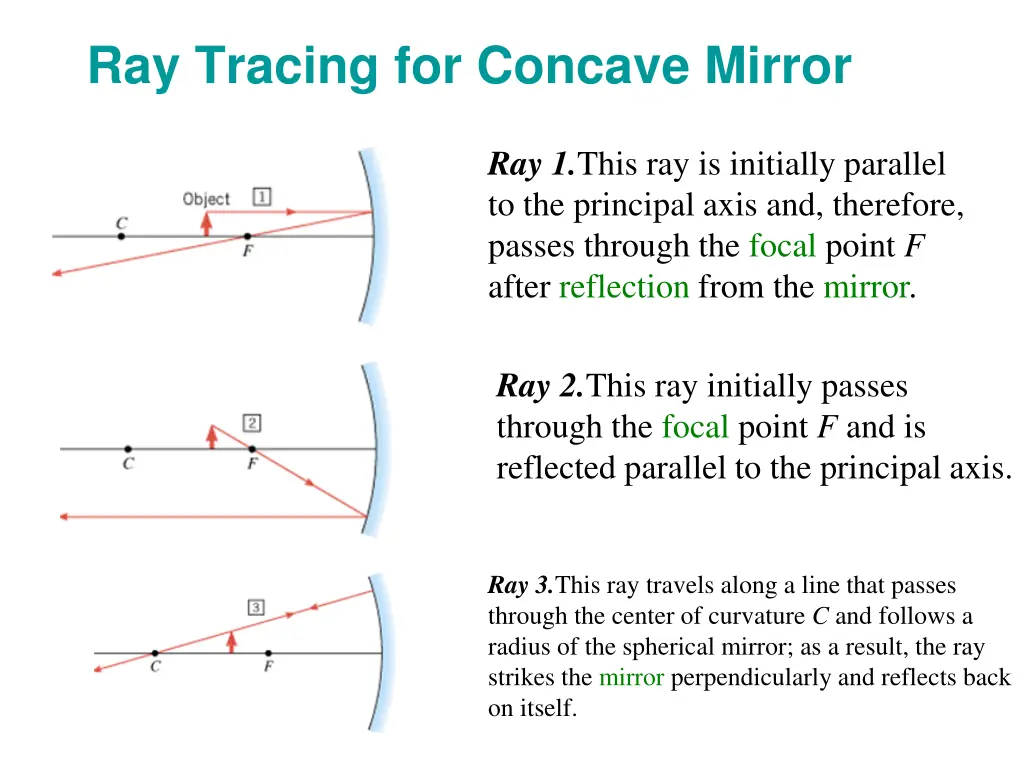
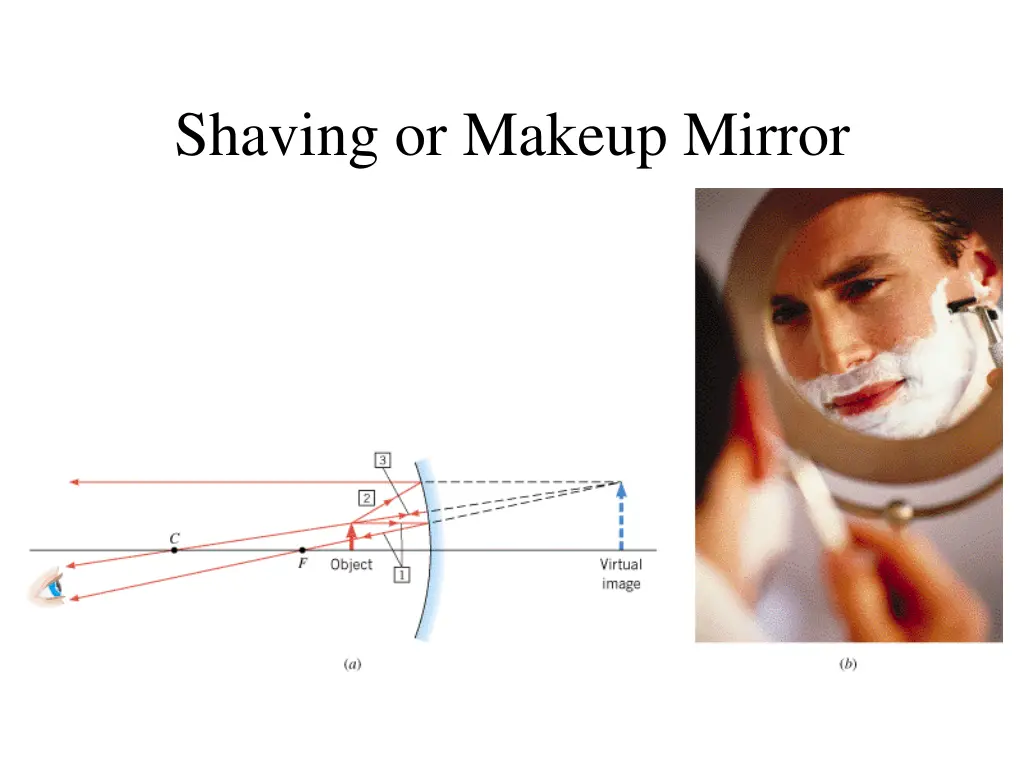
Ray Tracing for Concave Mirror Ray 1.This ray is initially parallel to the principal axis and, therefore, passes through the focal point F after reflection from the mirror. Ray 2.This ray initially passes through the focal point F and is reflected parallel to the principal axis. Ray 3.This ray travels along a line that passes through the center of curvature C and follows a radius of the spherical mirror; as a result, the ray strikes the mirror perpendicularly and reflects back on itself.
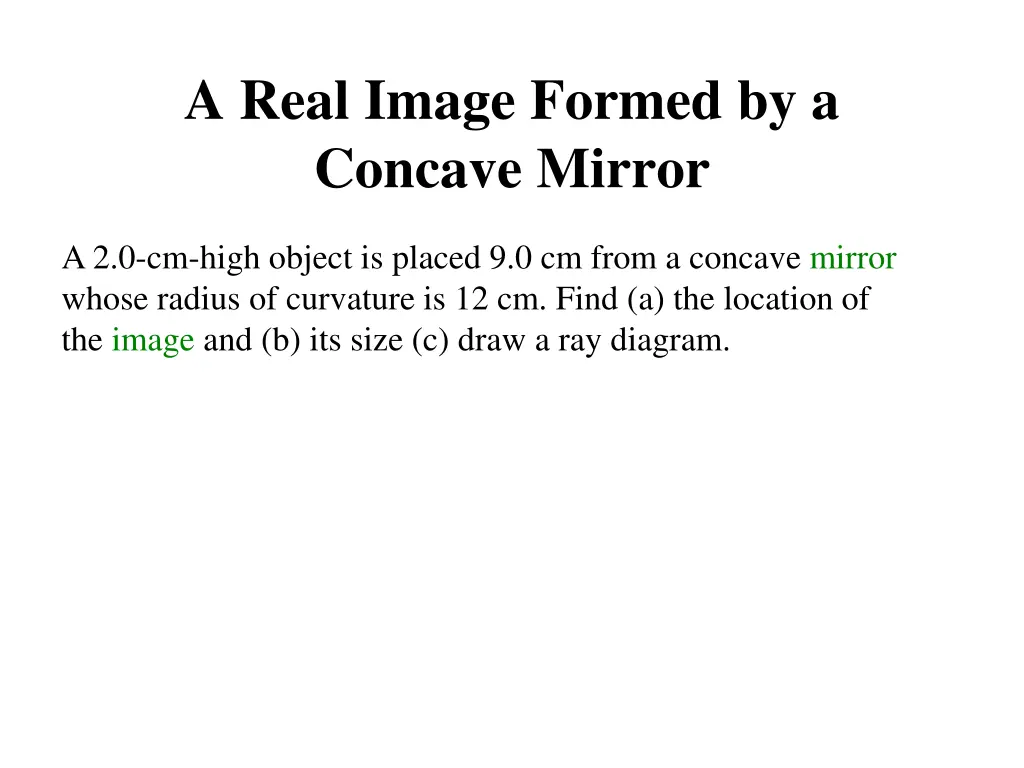
A Real Image Formed by a Concave Mirror A 2.0-cm-high object is placed 9.0 cm from a concave mirror whose radius of curvature is 12 cm. Find (a) the location of the image and (b) its size (c) draw a ray diagram.
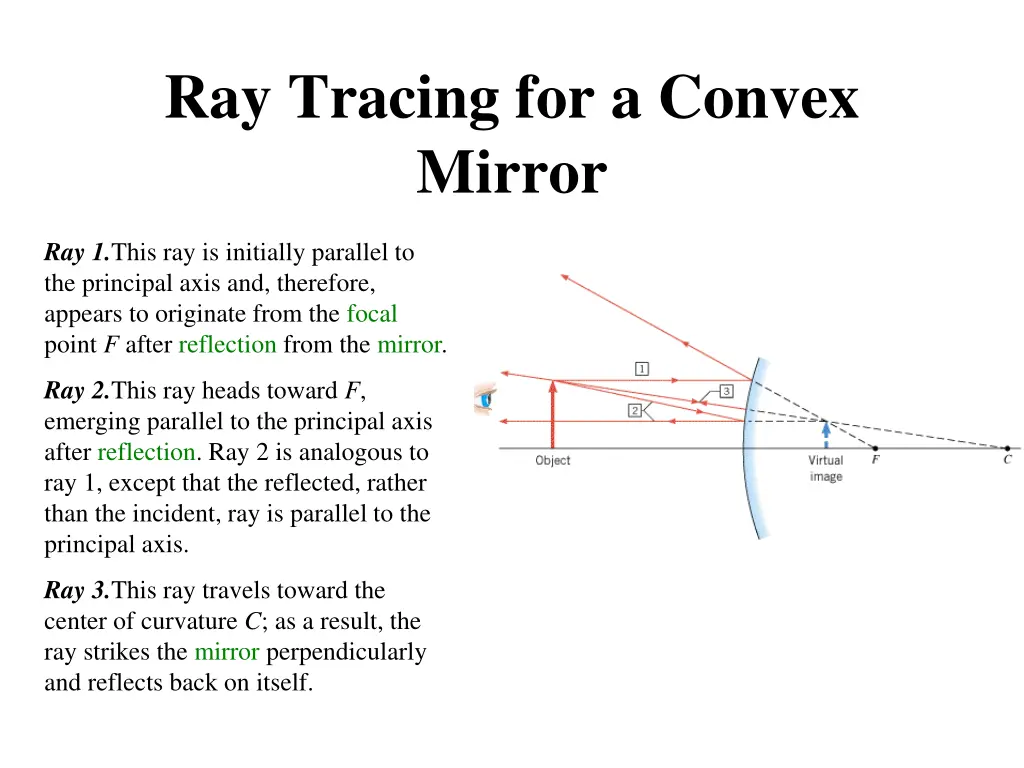
Ray Tracing for a Convex Mirror Ray 1.This ray is initially parallel to the principal axis and, therefore, appears to originate from the focal point F after reflection from the mirror. Ray 2.This ray heads toward F, emerging parallel to the principal axis after reflection. Ray 2 is analogous to ray 1, except that the reflected, rather than the incident, ray is parallel to the principal axis. Ray 3.This ray travels toward the center of curvature C; as a result, the ray strikes the mirror perpendicularly and reflects back on itself.