Understanding Banks and Passive Forms in English
Explore the world of banking with insights on vocabulary, grammar passive forms in English, and the role of banks in financial activities. Discover the importance of passive voice and key terms in the banking sector.

Download Presentation

Please find below an Image/Link to download the presentation.
The content on the website is provided AS IS for your information and personal use only. It may not be sold, licensed, or shared on other websites without obtaining consent from the author. If you encounter any issues during the download, it is possible that the publisher has removed the file from their server.
You are allowed to download the files provided on this website for personal or commercial use, subject to the condition that they are used lawfully. All files are the property of their respective owners.
The content on the website is provided AS IS for your information and personal use only. It may not be sold, licensed, or shared on other websites without obtaining consent from the author.
E N D
Presentation Transcript
Cizojazyn pprava AJ 4 Banks Janusz Karpeta Cizojazy n p prava 4
Outline of the presentation Vocabulary Grammar Passive forms Banks Conclusion
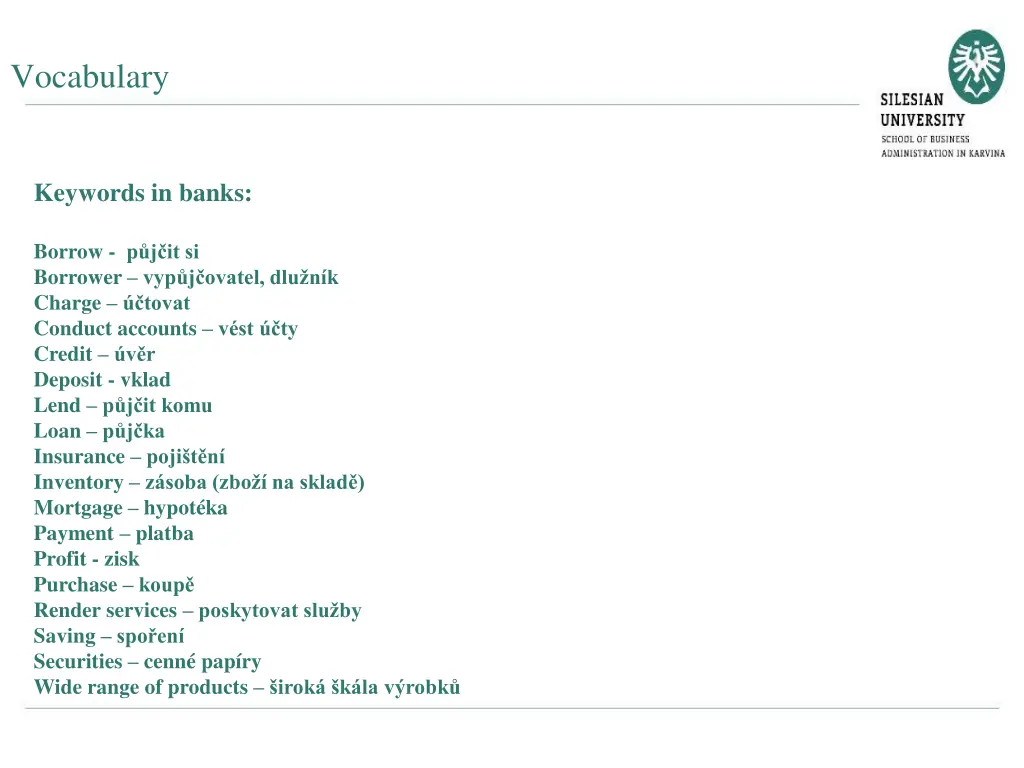
Vocabulary Keywords in banks: Borrow - p j it si Borrower vyp j ovatel, dlu n k Charge tovat Conduct accounts v st ty Credit v r Deposit - vklad Lend p j it komu Loan p j ka Insurance poji t n Inventory z soba (zbo na sklad ) Mortgage hypot ka Payment platba Profit - zisk Purchase koup Render services poskytovat slu by Saving spo en Securities cenn pap ry Wide range of products irok k la v robk
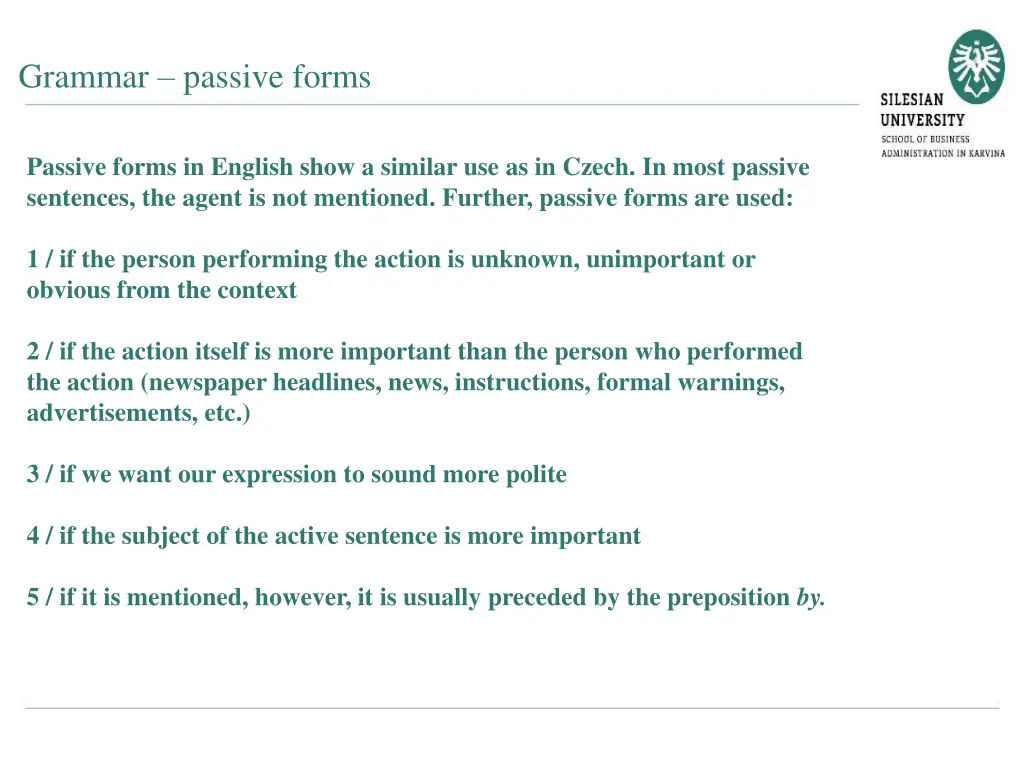
Grammar passive forms Passive forms in English show a similar use as in Czech. In most passive sentences, the agent is not mentioned. Further, passive forms are used: 1 / if the person performing the action is unknown, unimportant or obvious from the context 2 / if the action itself is more important than the person who performed the action (newspaper headlines, news, instructions, formal warnings, advertisements, etc.) 3 / if we want our expression to sound more polite 4 / if the subject of the active sentence is more important 5 / if it is mentioned, however, it is usually preceded by the preposition by.
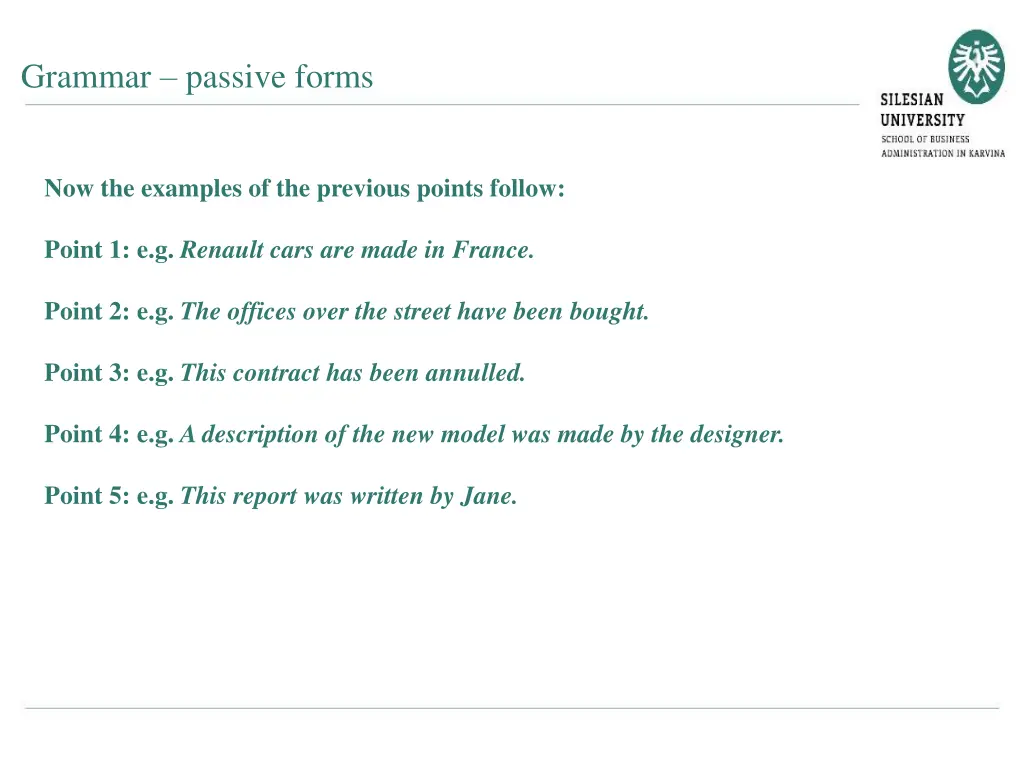
Grammar passive forms Now the examples of the previous points follow: Point 1: e.g. Renault cars are made in France. Point 2: e.g. The offices over the street have been bought. Point 3: e.g. This contract has been annulled. Point 4: e.g. A description of the new model was made by the designer. Point 5: e.g. This report was written by Jane.
Banks A bank is generally seen as a financial institution whose primary duty is to borrow and lend money to its clients and carry out other specifically defined banking and financial activities. Originally, banks served businesses, not individuals. In most cases they provided loans to trading companies for the purchase of inventory. Much later, they started conducting accounts for their clients and rendering other financial services. Banks are, of course, profit-oriented organizations charging fees for their services and realizing their profit, as a difference between the interest rates which are owed to clients for their deposits, as opposed to those charged to borrowers.
Banks Being a sensitive industry, banking in most jurisdictions is subject to some kind of government regulation and banks require special licenses to operate. As to banks activities, we can distinguish the following. First, banking business involves conducting accounts, processing payments, deposit services and credit services. Second, forex operations include exchange activities and operations on forex market. Third, there are other bank services such as financial operations, securities trading, investment fund management, consulting services and insurance.
Banks Commercial banks design their own ranges of products to match the above activities and offer each product under its own brand name. Various banks do not necessarily engage in all activities, but limit their operations to a number of selected areas or specialize in one or two types only. The predominant role of a bank today is a commercial bank of a universal character, i.e. with a large scope of activities. The term commercial bank was introduced in the USA after the Great Depression in the 30 s for banks engaged in true banking activities to distinguish them from investment banks that were limited only to operations in capital markets.
Banks Thus we can discern between two main kinds of commercial banks: universal banks and specialized banks. Universal banks offer their services in the widest range of products to all clients in all industries. This category includes most commercial banks. Specialized banks are focused on certain selected areas such as territories (e.g. national, state or locally operated community banks in the USA), products (mortgages, international trade, securities, etc.), industries (typically some Russian, Bulgarian or Romanian banks operating in specific sectors), and clients (differentiated segments including small businesses or large corporations, co- operatives, etc.).
Banks There is a mix of banks activities and various kinds of clientship which the commercial banks serve. First, retail banking. It deals with individual citizens, sometimes along with small entrepreneurs (natural persons and small businesses) and represents the main class of consumer financial service organizations. Second, business banking provides services to mid-market business. Third, corporate banking is directed at large business organizations, the bank conducts their corporate accounts. Fourth, private banking provides a range of customized wealth management services which most banks are now ready to provide to their prominent clients.
Banks Fifth, investment banking relates to activities in financial markets. As far as bank products are concerned, they have rapidly expanded in recent years due to both growing competition in the banking sector and progress of information technologies. Let us now consider the most common bank products. There are in particular: accounts and payments, payment instruments, insurance, financial and capital markets, consulting services, loans and credits, saving and investments and housing.
Conclusion Keywords in banks Grammar passive forms Banks