Understanding Wireless Connectivity Challenges in IEEE 802.11-25/0055r1
Explore the wireless connectivity challenges for backscattering AMP STA under the IEEE 802.11-25/0055r1 specification as presented in the January 2025 document by Solomon Trainin and team from Wiliot.

Uploaded on | 2 Views
Download Presentation

Please find below an Image/Link to download the presentation.
The content on the website is provided AS IS for your information and personal use only. It may not be sold, licensed, or shared on other websites without obtaining consent from the author. If you encounter any issues during the download, it is possible that the publisher has removed the file from their server.
You are allowed to download the files provided on this website for personal or commercial use, subject to the condition that they are used lawfully. All files are the property of their respective owners.
The content on the website is provided AS IS for your information and personal use only. It may not be sold, licensed, or shared on other websites without obtaining consent from the author.
E N D
Presentation Transcript
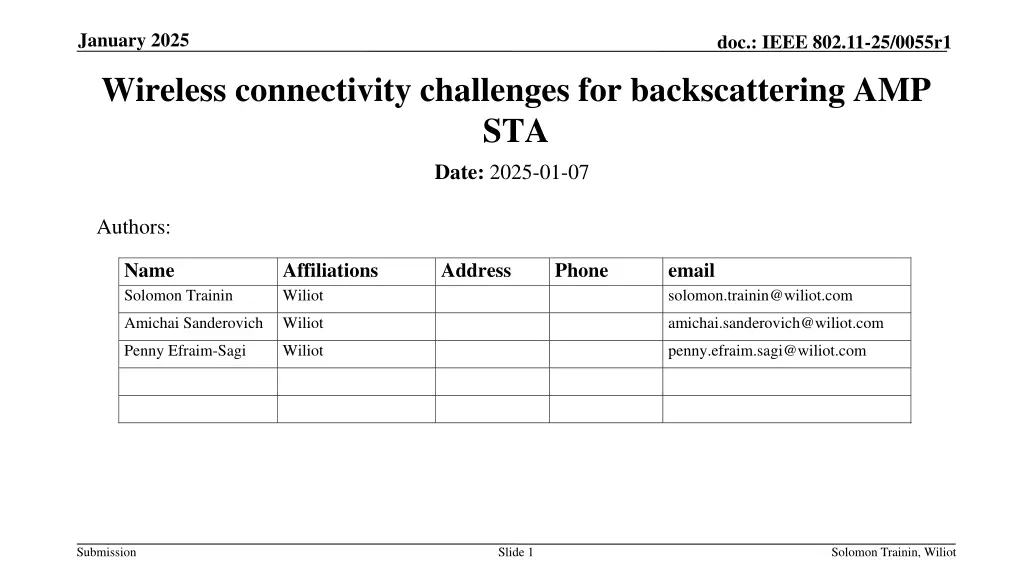
January 2025 doc.: IEEE 802.11-25/0055r1 Wireless connectivity challenges for backscattering AMP STA Date: 2025-01-07 Authors: Name Solomon Trainin Affiliations Wiliot Address Phone email solomon.trainin@wiliot.com Amichai Sanderovich Wiliot amichai.sanderovich@wiliot.com Penny Efraim-Sagi Wiliot penny.efraim.sagi@wiliot.com Submission Slide 1 Solomon Trainin, Wiliot
January 2025 doc.: IEEE 802.11-25/0055r1 Abstract This contribution shows that the proposal presented in document 11-24-1537- 02-00bp-wireless-connectivity-challenges-for-amp-only-iot-devices-under-802- 11-specification is adequate for AMP backscatter STA and AMP bistatic backscatter STA Submission Slide 2 Solomon Trainin, Wiliot
January 2025 doc.: IEEE 802.11-25/0055r1 Summary Our vision of the wireless connectivity is presented in 11-24-1537-02-00bp- wireless-connectivity-challenges-for-amp-only-iot-devices-under-802-11- specification Backscatter matches our vision presented in the contribution The same role of the AMP-capable STA is maintained across monostatic and bistatic modes The AMP-capable STA passes information to/from the tag to the distribution system and to higher layers of internet protocols AMP-only STA communicates through optimized .11bp frames Submission Slide 3 Solomon Trainin, Wiliot
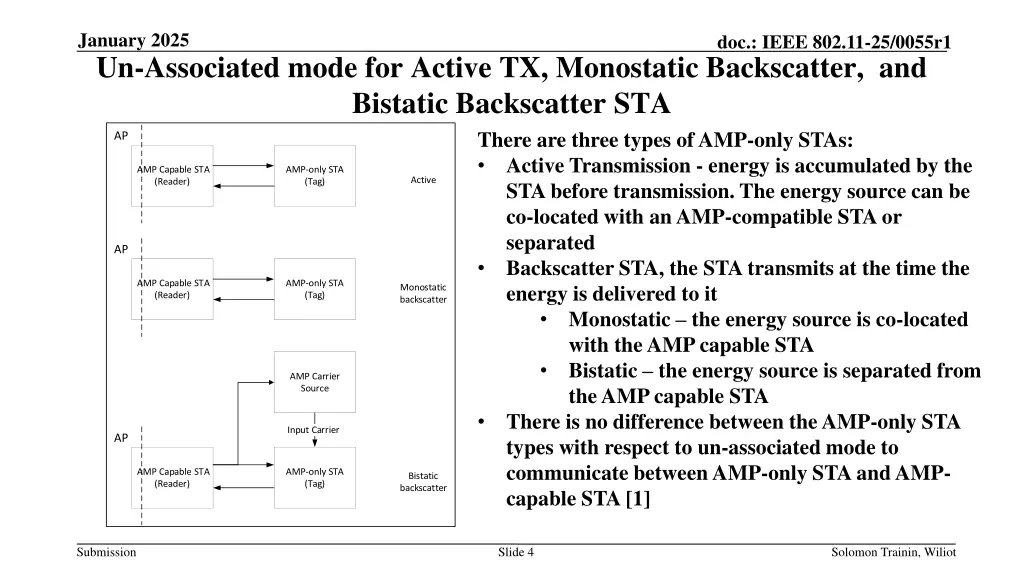
January 2025 doc.: IEEE 802.11-25/0055r1 Un-Associated mode for Active TX, Monostatic Backscatter, and Bistatic Backscatter STA There are three types of AMP-only STAs: Active Transmission - energy is accumulated by the STA before transmission. The energy source can be co-located with an AMP-compatible STA or separated Backscatter STA, the STA transmits at the time the energy is delivered to it AP AMP Capable STA (Reader) AMP-only STA (Tag) Active AP AMP Capable STA (Reader) AMP-only STA (Tag) Monostatic backscatter Monostatic the energy source is co-located with the AMP capable STA Bistatic the energy source is separated from the AMP capable STA There is no difference between the AMP-only STA types with respect to un-associated mode to communicate between AMP-only STA and AMP- capable STA [1] AMP Carrier Source Input Carrier AP AMP Capable STA (Reader) AMP-only STA (Tag) Bistatic backscatter Submission Slide 4 Solomon Trainin, Wiliot
January 2025 doc.: IEEE 802.11-25/0055r1 Frame formats for Active TX, Monostatic Backscatter, and Bistatic Backscatter STA The reason why PV0 and PV1 frame formats should not be used, but rather frame formats optimized for .11bp should be defined for Active TX stations, is presented in [1]. The reason why the PV0 and PV1 frame formats should not be used for backscatter STAs and bistatic backscatter STAs is as follows: PM-9: The AMP Downlink PPDU in 2.4 GHz shall support the following data rates: 1 Mb/s (for non-Backscatter STAs only) 250 kb/s. [2] TGbp R1: The 802.11bp amendment shall define one mode of data communication in the 2.4 GHz band with the AMP communication access category (AC) being set to AC-BK (background).[3] (TXOP limit = 2.528 ms)[4] Using PV0 and PV1 frame formats at low DL bitrates may exceed the TXOP limit. (MPDU size ~ 800 bit) [1] Submission Slide 5 Solomon Trainin, Wiliot
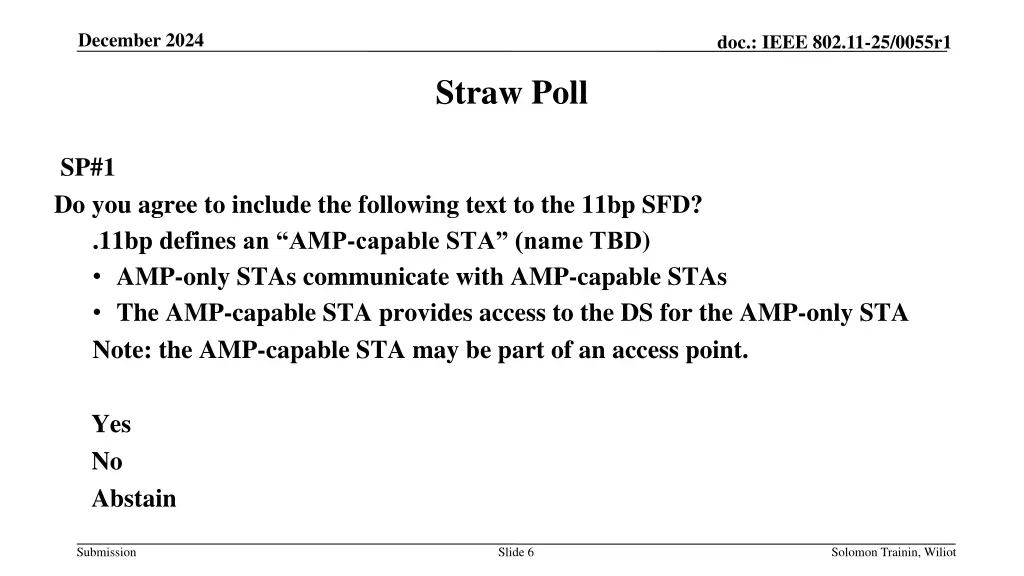
December 2024 doc.: IEEE 802.11-25/0055r1 Straw Poll SP#1 Do you agree to include the following text to the 11bp SFD? .11bp defines an AMP-capable STA (name TBD) AMP-only STAs communicate with AMP-capable STAs The AMP-capable STA provides access to the DS for the AMP-only STA Note: the AMP-capable STA may be part of an access point. Yes No Abstain Submission Slide 6 Solomon Trainin, Wiliot
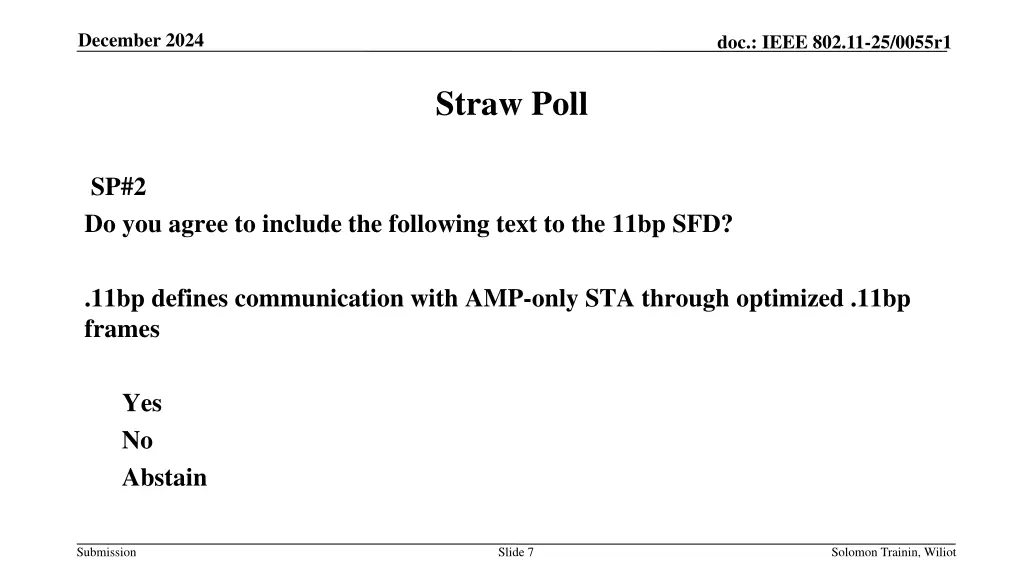
December 2024 doc.: IEEE 802.11-25/0055r1 Straw Poll SP#2 Do you agree to include the following text to the 11bp SFD? .11bp defines communication with AMP-only STA through optimized .11bp frames Yes No Abstain Submission Slide 7 Solomon Trainin, Wiliot
January 2025 doc.: IEEE 802.11-25/0055r1 References 1. 11-24-1537-02-00bp-wireless-connectivity-challenges-for-amp-only-iot- devices-under-802-11-specification 2. 11-24-1613-03-00bp-specification-framework-for-tgbp 3. 11-24-1307-03-00bp-proposed-tgbp-functional-requirements 4. Draft P802.11REVme_D7.0.pdf Submission Slide 8 Solomon Trainin, Wiliot