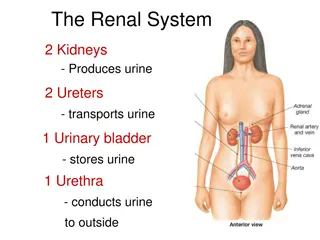
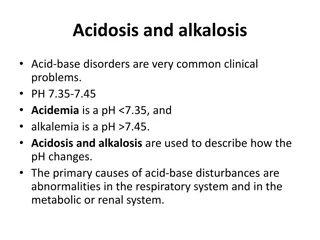
Renal control of acid-base balance is crucial for maintaining normal plasma pH levels within a narrow range to support cellular functions. This module delves into topics such as the normal range of plasma pH, CO2-HCO3 buffer system, respiratory vs. metabolic acidosis and alkalosis, reabsorption of HCO3 in PCT, and H+ excretion in distal tubules. Understanding acidaemia vs. alkalaemia and the impacts on enzyme function, potassium levels, calcium solubility, and nerve function is essential for grasping the fundamentals of acid-base regulation.
Please find below an Image/Link to download the presentation.
The content on the website is provided AS IS for your information and personal use only. It may not be sold, licensed, or shared on other websites without obtaining consent from the author. If you encounter any issues during the download, it is possible that the publisher has removed the file from their server.
You are allowed to download the files provided on this website for personal or commercial use, subject to the condition that they are used lawfully. All files are the property of their respective owners.
The content on the website is provided AS IS for your information and personal use only. It may not be sold, licensed, or shared on other websites without obtaining consent from the author.
E N D
Presentation Transcript
Ministry of higher Education and Scientific Researches UNIVERSITY OF BASRAH AL-ZAHRAA MEDICAL COLLEGE The module: URINARY SYSTEM MODULE Session 6 Lecture 1 MODULE STAFF: Prof.Mahmood Shakir Dr.Adnan Othafa Ass.Prof.Firas Shakir Dr. Safaa Almatook Dr.Khaldoon Sadek Clinically Orientated Anatomy Publisher:Lippincott Williams and Wilkins:Seventh Edition: ISBN:9781451184471 Moore KL ,DalleyAF&Agur AMR For more detailed instruction, any question, cases need help please post to the group of session.
Ministry of higher Education and Scientific Researches UNIVERSITY OF BASRAH AL-ZAHRAA MEDICAL COLLEGE Learning out come 1- normal range of plasma pH 2-CO2 ,HCO3 buffer system 3-respiratory vs metabolic acidosis and alkalosis 4-reabsorptin of HCO3 in PCT 5-H+ excretion in distal tubules 6-H+ buffer in urine 7-main causes of pH change For more detailed instruction, any question, cases need help please post to the group of session.
Ministry of higher Education and Scientific Researches UNIVERSITY OF BASRAH AL-ZAHRAA MEDICAL COLLEGE LO1 Renal control of acid base normal plasma pH is 7.4(6.8-7.8) to maintain normal cell function eg enzyme ,so death of cells outside this normal range a pH of 6.4 is incompatible with life what is pH it is the negative log. Of the concentration of the free hydrogen ion to the base 10 so a change of 1 pH equal to ten fold H+ conc. For more detailed instruction, any question, cases need help please post to the group of session.
Ministry of higher Education and Scientific Researches UNIVERSITY OF BASRAH AL-ZAHRAA MEDICAL COLLEGE LO1 Under normal conditiond the body is exposed daily to a challenge of H+ from two main sources of acid 1- a carbonic acid from cell metabolisim---15000\day 2-a non carbonic source of H+ from food mainly proteins 70 meq in order to sustain life this load should be handled by the body to maintain pH in its normal narrow range and in short time For more detailed instruction, any question, cases need help please post to the group of session.
Ministry of higher Education and Scientific Researches UNIVERSITY OF BASRAH AL-ZAHRAA MEDICAL COLLEGE LO1 Acidaemia vs alkalaemia if pH below 7.4 the condition is acidaemia if above it is alkalaemia acidaemia lead to enzyme function defect ending in potasium leaving the cell causing hyperkalaemia which is fetal alkalalaemia lead to decrease solublity of Ca so bind to bone ending hypocalcaemia nerve malfunction ---tetany ---?? death For more detailed instruction, any question, cases need help please post to the group of session.
UNIVERSITY OF BASRAH AL-ZAHRAA MEDICAL COLLEGE LO1 For more detailed instruction, any question, cases need help please post to the group of session.
Ministry of higher Education and Scientific Researches UNIVERSITY OF BASRAH AL-ZAHRAA MEDICAL COLLEGE LO1 The 15000 equvalents of H+ produced by metabolism is excreted by the lung in the form of CO2 the non carbonic acid load from food is handled by the kidney if the lung stop function for few minutes you will develop sever acidosis that can be leathal if the kidney stop function you need weeks to develop acidosis the body handle acid load by buffer systems For more detailed instruction, any question, cases need help please post to the group of session.
Ministry of higher Education and Scientific Researches UNIVERSITY OF BASRAH AL-ZAHRAA MEDICAL COLLEGE LO2 What is Buffer it is aweak acid or base that can adsorb the added H+ load or change so as to maintain steady plasma pH strong acid = more free H+ weak acid =less free H+ so weak acids can handle H+ with only little change in plasma pH because only small amount of H+ is free in plasma HX_________H+ + X- the same principle for base equilibrium the equation shift depend on the Pka For more detailed instruction, any question, cases need help please post to the group of session.
Ministry of higher Education and Scientific Researches UNIVERSITY OF BASRAH AL-ZAHRAA MEDICAL COLLEGE LO2 The regulation of H+ load is by 1- chemical balance buffering system 2-respiratory system to handle CO2 FROM H2CO3 both act in minutes 3- the renal system can handle it by excreting or absorbing H+ For more detailed instruction, any question, cases need help please post to the group of session.
Ministry of higher Education and Scientific Researches UNIVERSITY OF BASRAH AL-ZAHRAA MEDICAL COLLEGE LO2 The bicarbonate buffer system CO2 +H2O===H2CO3====H+ + HCO3 Na+ + HCO3=======NaHCO3 NaOH + H2CO3====== H20 + NaHCO3 under the effect of carbonic anhydrase present in the lung and the kidney the reaction is inhanced the main source of sodium bicarb is the plasma although god amount is in the skelton but it is less rapidly available for buffer For more detailed instruction, any question, cases need help please post to the group of session.
Ministry of higher Education and Scientific Researches UNIVERSITY OF BASRAH AL-ZAHRAA MEDICAL COLLEGE LO3 Respiratory acidaemia (acidosis) when PCO2 is increaed eg in decrease breathing there will be an increase in H2CO3 respiratory alkalaemia (alkalosis) when PCO2 decrease in the alevioli there will be increase in HCO3 as in hyperventilation metabolic acidosis and alkalosis follow the HCO3 level decreasing in the first and the reverse for the second For more detailed instruction, any question, cases need help please post to the group of session.
Ministry of higher Education and Scientific Researches UNIVERSITY OF BASRAH AL-ZAHRAA MEDICAL COLLEGE LO2 The lung handle the balance of CO2 in plasma as aresult control H+ and HCO3 The kidneys handle HCO3 and H+ ions For more detailed instruction, any question, cases need help please post to the group of session.
Ministry of higher Education and Scientific Researches UNIVERSITY OF BASRAH AL-ZAHRAA MEDICAL COLLEGE RENAL CNTROL the kidney excrete both H+ and HCO3- if H+ is excreted more than HCO3 then it will lead to increase plasma pH the reverse occure if it excrete HCO3 more the importance of the kidney is since it deal with H+ load that is non volatile i.e. non carbonic there for the lung can not handle it LO4 if pt has alkalosis the kidney decrease secretion of H+ and increase secretion of HCO3 to compensate if the patient has acidosis the kidney secrete more H+ and reabsorb most of HCO3 (usually 80-90% absorbed in PCT) in addetion new HCO3 is produced by the kidney the 3 mechanisms of kidney control of H+ are 1-H+ secretion 2-HCO3 reabsorption 3- new HCO3 production For more detailed instruction, any question, cases need help please post to the group of session.
Ministry of higher Education and Scientific Researches UNIVERSITY OF BASRAH AL-ZAHRAA MEDICAL COLLEGE LO4,5 For more detailed instruction, any question, cases need help please post to the group of session.
Ministry of higher Education and Scientific Researches UNIVERSITY OF BASRAH AL-ZAHRAA MEDICAL COLLEGE LO2 Urinary buffer systems large amount of H+ is secreted daily some are buffered by HCO3 the accesss can not be excreted in the ionic form so it need to be buffered the two main addetional buffers in urine are phosphate and ammonia,other minor buffers include urate and citrate For more detailed instruction, any question, cases need help please post to the group of session.
Ministry of higher Education and Scientific Researches UNIVERSITY OF BASRAH AL-ZAHRAA MEDICAL COLLEGE LO2 For more detailed instruction, any question, cases need help please post to the group of session.
Ministry of higher Education and Scientific Researches UNIVERSITY OF BASRAH AL-ZAHRAA MEDICAL COLLEGE LO2 For more detailed instruction, any question, cases need help please post to the group of session.
Ministry of higher Education and Scientific Researches UNIVERSITY OF BASRAH AL-ZAHRAA MEDICAL COLLEGE For more detailed instruction, any question, cases need help please post to the group of session.
Ministry of higher Education and Scientific Researches UNIVERSITY OF BASRAH AL-ZAHRAA MEDICAL COLLEGE For more detailed instruction, any question, cases need help please post to the group of session.