Utilizing SU-OFDM Beam Division for IMMW Architecture in IEEE 802.11-25
"Explore the integration of SU-OFDM Beam Division in IMMW architecture to enhance spatial diversity and system capacity for IEEE 802.11-25 communication in unlicensed frequency bands. Learn about typical service scenarios, challenges with interference, and a proposed solution for UL collisions."

Download Presentation

Please find below an Image/Link to download the presentation.
The content on the website is provided AS IS for your information and personal use only. It may not be sold, licensed, or shared on other websites without obtaining consent from the author. If you encounter any issues during the download, it is possible that the publisher has removed the file from their server.
You are allowed to download the files provided on this website for personal or commercial use, subject to the condition that they are used lawfully. All files are the property of their respective owners.
The content on the website is provided AS IS for your information and personal use only. It may not be sold, licensed, or shared on other websites without obtaining consent from the author.
E N D
Presentation Transcript
April 2025 doc.: IEEE 802.11-25/0900r0 SU OFDM Beam Division Case for IMMW AP Date: 2025-04-24 Authors: Submission Slide 1 Bo Cao, ZTE Corporation
April 2025 doc.: IEEE 802.11-25/0900r0 Introduction As IMMW PAR[1] defined, TGbq aims to use non-standalone operation in unlicensed bands between 42 and 71 GHz using SU OFDM based transmissions. Expand the multi-link operation (MLO) defined in the sub-7.25 GHz band specifications to support non-standalone operation in the unlicensed bands between 42 GHz and 71 GHz. To maximize spatial reuse and boost system capacity, we can leverage an IMMW architecture to achieve spatial diversity. SU-OFDM Beam-Division (SOBD) enables the AP to form multiple concurrent SU- OFDM beams in different directions, thereby serving several single-user clients simultaneously. Submission Slide 2 Bo Cao, ZTE Corporation
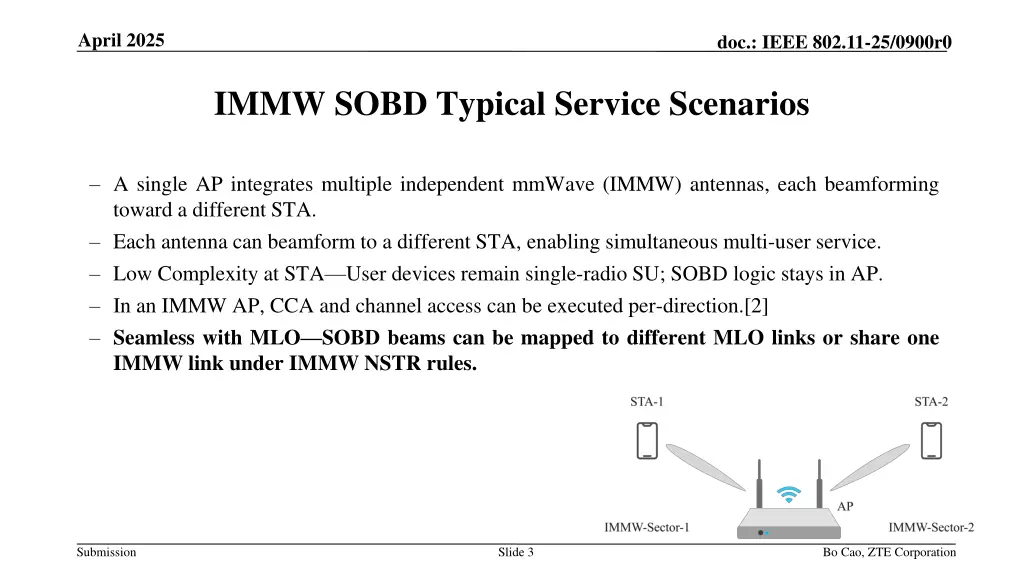
April 2025 doc.: IEEE 802.11-25/0900r0 IMMW SOBD Typical Service Scenarios A single AP integrates multiple independent mmWave (IMMW) antennas, each beamforming toward a different STA. Each antenna can beamform to a different STA, enabling simultaneous multi-user service. Low Complexity at STA User devices remain single-radio SU; SOBD logic stays in AP. In an IMMW AP, CCA and channel access can be executed per-direction.[2] Seamless with MLO SOBD beams can be mapped to different MLO links or share one IMMW link under IMMW NSTR rules. Submission Slide 3 Bo Cao, ZTE Corporation
April 2025 doc.: IEEE 802.11-25/0900r0 Tx/Rx Interference Self-interference: Tx leakage from one antenna desensitises the neighbouring Rx antenna. Performance hit: Uplink PER surges and AGC momentarily drops gain, erasing SOBD capacity gains. Uncoordinated beams: Without a brief guard window, SOBD scheduling stalls and net capacity can drop below single-beam operation. NSTR conceptually addresses simultaneous Tx/Rx issues across links. Current EHT-NSTR works at the link level, assuming each link is a clean Tx/Rx pair; it has no notion of per-antenna/sector clashes inside the same link. Need to reuse Submission Slide 4 Bo Cao, ZTE Corporation
April 2025 doc.: IEEE 802.11-25/0900r0 IMMW-UL Unavailable Window Need a lightweight protocol for an AP to avoid concurrent Tx (antenna 1) and Rx (antenna 2) collisions, while preserving SOBD efficiency. Need explicit Tx-suspension indication from AP to UL STA. NAV alone cannot cover mmWave UL triggers spanning multiple links. mmWave STAs may transmit unsolicited UL (non-trigger). Consideration: When several IMMW antennas transmit simultaneously, they should behave like an NSTR pair. AP defines an IMMW UL Unavailable Window whenever it predicts strong self-interference; the window can be signalled over a sub-7.25 GHz link. During IMMW UL Unavailable Window, affected STA(s) shall not transmit (Rx-only or stay idle). Outside IMMW UL Unavailable Window, normal DL/UL proceeds. The rule applies to non-triggered UL only; triggered UL is already under AP control. Fully coexists with EHT-NSTR: adds per-antenna granularity on top of existing per-link rules. Submission Slide 5 Bo Cao, ZTE Corporation
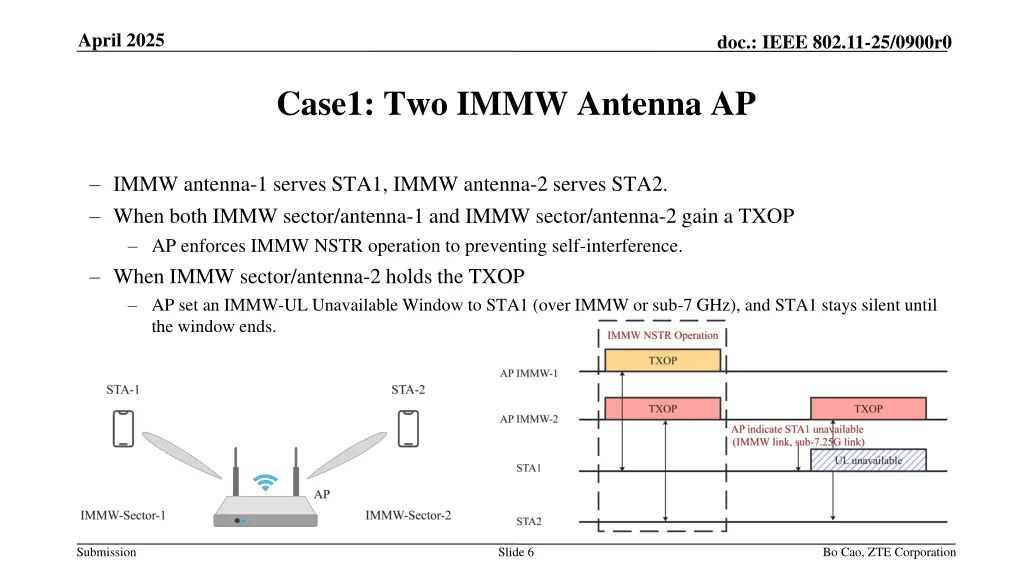
April 2025 doc.: IEEE 802.11-25/0900r0 Case1: Two IMMW Antenna AP IMMW antenna-1 serves STA1, IMMW antenna-2 serves STA2. When both IMMW sector/antenna-1 and IMMW sector/antenna-2 gain a TXOP AP enforces IMMW NSTR operation to preventing self-interference. When IMMW sector/antenna-2 holds the TXOP AP set an IMMW-UL Unavailable Window to STA1 (over IMMW or sub-7 GHz), and STA1 stays silent until the window ends. Submission Slide 6 Bo Cao, ZTE Corporation
April 2025 doc.: IEEE 802.11-25/0900r0 References [1] 11-24/0116r7, immw-draft-proposed-par [2] 11-25/0310r0, new-cca-schemes-for-immw Submission Slide 7 Bo Cao, ZTE Corporation
April 2025 doc.: IEEE 802.11-25/0900r0 Straw Poll 1 Do you agree that IMMW define SU-OFDM Beam-Division (SOBD) enables the AP to form multiple concurrent SU-OFDM beams in different directions, thereby serving several single-user clients simultaneously. Submission Slide 8 Bo Cao, ZTE Corporation
April 2025 doc.: IEEE 802.11-25/0900r0 Straw Poll 2 Do you agree that 11bq defines an IMMW UL Unavailable Window to prohibit non-triggered uplink transmissions from selected STAs ? Submission Slide 9 Bo Cao, ZTE Corporation