Vertical Integration, Appropriable Rents, and Competitive Contracting Process
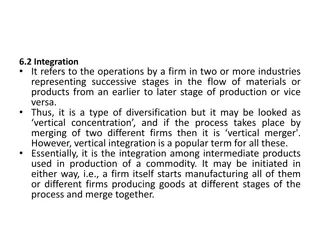
The paper examines transaction costs, vertical integration, and quasi-rents, drawing on Coase's (1937) foundational analysis. It highlights the potential for post-contractual opportunistic behavior and discusses how specialized investments create quasi-rents that lead firms to favor vertical integration or long-term contracts to mitigate risks. Essential elements include the definition of quasi-rent, its economic implications, and factors influencing firms' decisions to ensure efficient exchange while safeguarding against opportunism.

Download Presentation

Please find below an Image/Link to download the presentation.
The content on the website is provided AS IS for your information and personal use only. It may not be sold, licensed, or shared on other websites without obtaining consent from the author.If you encounter any issues during the download, it is possible that the publisher has removed the file from their server.
You are allowed to download the files provided on this website for personal or commercial use, subject to the condition that they are used lawfully. All files are the property of their respective owners.
The content on the website is provided AS IS for your information and personal use only. It may not be sold, licensed, or shared on other websites without obtaining consent from the author.
E N D
Presentation Transcript
Vertical integration, appropriable rents, and the competitive contracting process Klein, Crawford, and Alchian (1978) Journal of Law and Economics BADM 549 (Spring, 2025)
Previous literature: Coase (1937) Posits that transaction, coordination, and contracting costs must be considered explicitly explains the extent of vertical integration. This insight forced economists to look for previously neglected constraints on the trading process that might efficiently lead to an intrafirm rather than an interfirm transaction. The current paper explores the possibility of post-contractual opportunistic behavior (e.g., reneging on contracts). Main Purpose Main Purpose
Theory Setting Theory Setting Conditions: The presence of appropriable specialized quasi-rents Problem: Specific investment is made, and such quasi-rents are created (potential) opportunistic behavior Solution: vertical integration (long-term) contracts Assumptions: As assets become more specific and more appropriable quasi-rents are created (and therefore, the possible gains from opportunistic behavior increases), the enforcement costs of contracting will generally increase more than the enforcement costs of vertical integration (i.e., intrafirm transactions). Outcome: More likely to observe vertical integration to safeguard the exchange.
Quasi Quasi- -rent rent Definition: The excess of its value over its salvage value, that is, its value in its next-best use to another renter. Example: Operating costs: $1,500 Salvageable value: $1,000 (a) Printing Press Owner A: Contracted rate of $5,500 with Publisher B (better for A) (b) or: Contracted rate of $3,500 with Publisher C (worse for A) Quasi Rent of (a): 5,500 1,500 1,000 = 3,000 Quasi Rent of (b): 3,500 1,500 1,000 = 1,000 Appropriable quasi-rent is $2,000, which is the source of the economic holdup problem. Publisher B could reduce its offer from $5,500 to $3,500 while still receiving the press service and appropriating $2,000 of the quasi-rent from the press owner.
Post Post- -Contractual Opportunism Contractual Opportunism Reason for vertical integration: the avoidance of post-contractual opportunistic behavior when specialized assets and appropriable quasi-rents are present Post-contractual (bilateral) opportunism: Antecedents: relative bargaining power, incomplete contracts Consequences: unanticipated non-fulfillment of the contract, economic holdup problems, and a loss of efficiency
Contractual Solution Contractual Solution An alternative to vertical integration as a solution to the general problem of opportunistic behavior Long-term Contracts: Explicit long-term contracts (enforced by the government or some other outside institution): costly Implicit long-term contracts (enforced by the market mechanism of withdrawing future business if opportunistic behavior occurs): This goodwill market-enforcement mechanism undoubtedly is a significant element of the contractual alternative to vertical integration. Low appropriable specialized quasi-rents High appropriable specialized quasi-rents contractual relationship > vertical integration vertical integration > contractual relationship
Conclusions Conclusions Assumption: As assets become more specific and more appropriable quasi-rents are created, the costs of contracting will generally increase more than the costs of vertical integration. Hence, we are more likely to observe vertical integration. Premiums in Contracts: Offering cheaters premiums as insurance premiums (prices greater than average variable cost, exceeding potential gain from cheating) eliminates systematic opportunistic behavior by providing a self-enforcing agreement. Thus, both parties know exactly when and how much a contract will be broken, making an unanticipated broken contract not possible. Behavior: Firms often rely upon long-term implicit contracts when government enforcement of contracts is weaker (such as in under-developed countries).
Some Examples Some Examples Examples Context (Specialized Assets) Potential Opportunistic Behaviors Solution Automobile Manufacturing GM-Fisher Body 1. A ten-year contract: GE agreed to buy all its closed metal bodies from Fisher at a price set on a cost- plus 17.6 percent basis) 2. Unexpected increase in demand for closed metal bodies GE was very unhappy with the high price 3. Fisher Body refused to locate their body plants adjacent to GE Fisher Body Vertical integration: GM-Fisher merged in 1926 Refused to adjust the price and relocate to places close to GE Petroleum Industry Oil refineries and oil-producing properties are specialized to oil pipelines Pipeline owner Buys all crude oil at low cost and sell it to refineries at a much higher price Jointly owned company: Owns the pipeline with the shares by producers and refiners in the pipeline firms corresponding to the respective shares of oil to be transported
Some Examples Cont. Examples Context (Specialized Assets) Potential Opportunistic Behaviors Solution A B C Agricultural Industry Peach orchard: Laborers pick ripened peaches Labor Union Laborer becomes a member of labor union and refuses to pick peaches unless get paid more. Firm Cheat in the last period: transient employee Employee The employee threatens to quit after the firm makes the specific investment unless the wage rate is readjusted upward A. Farmers use implicit contract: Brand-name capital of the union (to increase the cost to the union of opportunistic behavior) B. Union can employ long-term contract and even strike threat to punish a firm that violates the contract C. Union can withhold employees pension rights . * Specific Human Capital: Law prohibiting slavery explicit or implicit contract rather than vertical integration Labor Union has the ability to exclude other laborers to extract monopoly and quasi rents Leasing Inputs and Ownership of the Firm Transportation: American steam locomotives were highly specialized Land-owner Credible post-contractual opportunistic threats by the landowner are not possible due to easiness of monitoring contract terms But if: Landowner can vary the quality of the land by controlling the irrigation system to the crops or the electricity supply to a building Franchisee (renter) May be less likely to build up goodwill. May depreciate a valuable rented brand name Leasing company (franchisor) Increases the rental fee for the trade name A. Vertical integration B&C. Close to vertical integration: direct controls are placed on franchisee behavior Agricultural land for annual crops Brand name
Some Examples Cont. Examples Context (Specialized Assets) Potential Opportunistic Behaviors Solution Party A The owner is not a member: Party B The owner are members: Social Institutions: Golf country club Friendship (intangible assets) in mutual ownership: some golf courses are operated with very few social activities for the set of members and their families Country club owner Once the membership value is created by the interpersonal activities of the members, the owner of the club could then start to raise the fees for continuing members Member Threatens to sell to an "undesirable" potential member, extract some value of congeniality from the current members, as a payment for not selling Government arbitration or intervention The owner could threaten to break the implicit contract and destroy some of the sociability capital by selling admission to "undesirable" people who want to consort with the existing members
Discussion Discussion Conclusion As assets become more specific and more appropriable quasi-rents are created (and therefore, the possible gains from opportunistic behavior increases), contracting costs will generally increase more than the costs of vertical integration. Hence, we are more likely to observe vertical integration. Discussion Questions: From this article, the authors discuss multiple cases of post-contractual opportunistic behaviors that can result from investment in specialized assets. Does this mean that trust between the two parties will decrease as the degree of asset specificity increases? -- Is the assumption here that firms make decisions following complete rationality? It seems like this paper focuses mainly on transaction costs and neglects the internal organizing costs that may increase after vertical integration. In response to opportunistic behavior, besides vertical integration, a firm with strong bargaining power may choose to have contractual relationships with multiple partners willing to make specific investments. This reduces the risk of relying on a single supplier and lowers the loss of efficiency caused by opportunistic behavior.