What is NIMS?
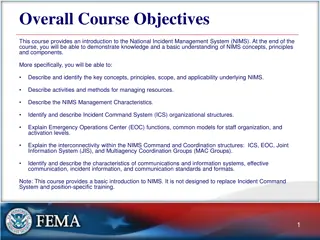
The National Incident Management System (NIMS) is a comprehensive, nationwide approach to incident management that encompasses the command and coordination of incidents, resource management, and information management. NIMS enables collaboration among federal, state, territorial, tribal, local governments, the private sector, and non-governmental organizations to effectively prepare for, respond to, recover from, and mitigate incidents. The system is scalable, flexible, and adaptable for all types of incidents, regardless of their cause or complexity.

Download Presentation

Please find below an Image/Link to download the presentation.
The content on the website is provided AS IS for your information and personal use only. It may not be sold, licensed, or shared on other websites without obtaining consent from the author.If you encounter any issues during the download, it is possible that the publisher has removed the file from their server.
You are allowed to download the files provided on this website for personal or commercial use, subject to the condition that they are used lawfully. All files are the property of their respective owners.
The content on the website is provided AS IS for your information and personal use only. It may not be sold, licensed, or shared on other websites without obtaining consent from the author.
E N D
Presentation Transcript
Unit 2: What is NIMS? Unit 2: What is NIMS? 1
Unit Terminal Objective Explain the National Incident Management System. 2
Unit Enabling Objectives Describe the National Incident Management System (NIMS). Summarize the NIMS Command and Coordination Systems. 3
What is an Incident? An incident is an occurrence, caused by either human or natural phenomena, that requires response actions to prevent or minimize loss of life, or damage to property and/or the environment. 4
National Incident Management System What? . . . NIMS provides a consistent nationwide template . . . Who? . . . to enable Federal, State, Territorial, tribal, and local governments, the private sector, and nongovernmental organizations to work together . . . How? . . . to prepare for, prevent, respond to, recover from, and mitigate the effects of incidents regardless of cause, size, location, or complexity . . . Why? . . . to reduce the loss of life and property, and harm to the environment. 7
NIMS: What It Is/What It's Not NIMS Is NIMS Is Not A comprehensive, nationwide, systematic approach to incident management, including the command and coordination of incidents, resource management, and information management Only the ICS Only applicable to certain emergency/incident response personnel A static system A set of concepts and principles for all threats, hazards, and events across all mission areas (Prevention, Protection, Mitigation, Response, Recovery) A response plan Scalable, flexible, and adaptable; used for all incidents, from day-to-day to large-scale Used only during large-scale incidents Standard resource management procedures that enable coordination among different jurisdictions or organizations A resource-ordering system Essential principles for communications and information management A communications plan 8
National Incident Management System Command: The act of directing, ordering, or controlling by virtue of explicit statutory, regulatory, or delegated authority. Who has the EXPLICIT authority for the management of all incident operations? 10
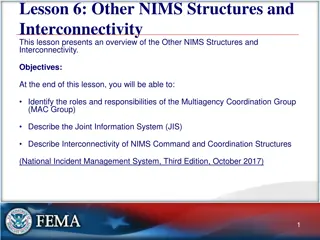
National Incident Management System Multiagency coordination is a process that allows all levels of government and all disciplines to work together more efficiently and effectively. 11
Multiagency Coordination Groups During incidents, MAC Groups: Act as a policy-level body. Support resource prioritization and allocation. Make cooperative multi- agency decisions. Enable decision making among elected and appointed officials with those managing the incident (IC/UC) 12
Emergency Operations Centers EOCs are physical or virtual locations where staff, stakeholders, and partners gather to provide support for an incident. 13
Joint Information System JIS activities include: Coordinate interagency messaging. Develop public information plans and strategies. Advise the IC and EOC Director on public affairs issues. Control rumors and inaccurate information. 14
Incident Command System Standardized approach to on-scene command, control, and coordination. Common structure where personnel from different organizations work together. Structure for incident management that integrates and coordinates procedures, personnel, equipment, facilities, and communications. 15
Interconnectivity of NIMS Command and Coordination 16
Overview of the Senior Officials' Role In most jurisdictions the Senior Official is responsible for: Ensuring the safety of the citizens and protection of property Ensuring the continuity of government Activating specific legal authorities (disaster declarations, evacuations, state of emergency, or other protective actions) Delegating Authority for Incident Command to an IC/ UC Coordinating with the PIO to keep the media and public informed Requesting assistance from State agencies through the EOC Resolving any resource allocation conflicts Coordinating with other Sr. Officials & whole community partners Participating in a Multiagency Coordination Group (MAC) 17
Objectives Review 1.What is NIMS? 2.What are the NIMS Command and Coordination Systems? 18