Workers from Third Countries in Czech Industry
Czech Republic's legislation governs the employment of foreigners, categorizing them based on their access to the labor market. EU, EEA, and Swiss citizens have free access, while others need permits. The Labor Office oversees employer reporting obligations for foreign workers.

Download Presentation

Please find below an Image/Link to download the presentation.
The content on the website is provided AS IS for your information and personal use only. It may not be sold, licensed, or shared on other websites without obtaining consent from the author.If you encounter any issues during the download, it is possible that the publisher has removed the file from their server.
You are allowed to download the files provided on this website for personal or commercial use, subject to the condition that they are used lawfully. All files are the property of their respective owners.
The content on the website is provided AS IS for your information and personal use only. It may not be sold, licensed, or shared on other websites without obtaining consent from the author.
E N D
Presentation Transcript
Workers from Third Countries in Czech Industry Vienna Memorandum Preparatory Group HUNGARY Gy r, 7.11.2023
Employment of foreigners in the Czech Republic Legislation Source: Labour Office of the Czech Republic is governed by Act No. 435/2004 Coll., on employment We divide employees from abroad into three categories in terms of entering the labour market: citizens of the EU, EEA (Iceland, Liechtenstein and Norway) and Switzerland with free access to the labour market of the Czech Republic, foreigners with free access to the labour market of the Czech Republic, foreigners who do not have free access to the labour market of the Czech Republic. The employer must report the employment of these citizens and foreigners to the Labour Office of the Czech Republic (hereinafter referred to as " P CR") and keep their records. The information obligation refers to data on the commencement and termination of their employment and changes in the registered data.
Who has free access to the Czech labour market? Source: Labour Office of the Czech Republic Citizens of EU, EEA, Switzerland and their family members (including family members of citizens of the Czech Republic) who come from so-called third countries (outside the EU) are not considered foreigners for the purposes of employment in the Czech Republic. Foreigners listed in the Employment Act without the need to have a work permit (work permit, employment cards, blue cards or intra-corporate transfer employee cards). This most often includes, for example, foreigners: with a permanent residence permit, who obtained secondary or higher vocational education or higher vocational education at a conservatory according to the Education Act or higher education according to the Higher Education Act, continuously preparing for a future profession in the territory of the Czech Republic
Who does not have free access to the Czech labour market? Source: Labour Office of the Czech Republic Other foreigners from so-called third countries who want to work according to the Employment Act must have one of the following work permits to enter the Czech labour market: a work permit together with a valid residence permit (according to the Act on the Residence of Foreigners), employee card, blue card internal employee transfer card.
Permit to employ a foreigner Source: Labour Office of the Czech Republic The precondition for issuing a work permit is: notification of a job vacancy by the employer, submitting an application for a foreigner's employment permit work based on an employment contract or employment agreement. The Labour Office will assess the situation on the labour market if it is a vacant job that cannot be filled otherwise due to the required qualifications or a temporary shortage of free labour. In some cases, the labour market situation is not assessed. The work permit is issued for a maximum of 2 years and can be repeatedly extended. The longest is always about 2 years. Permits are issued by the regional branches of the Office of the Czech Republic at the place of the foreigner's work.
Employee's card Source: Labour Office of the Czech Republic We distinguish between two types of employee cards: Dual - serves for a residence and employment permit in the Czech Republic for a period longer than 3 months. The card is not issued in the case of work performed on the basis of a contract for the performance of work. Non-dual - serves only for a permit for a long-term stay in the territory of the Czech Republic. An application for the issuance of an employee card is submitted by a foreigner at the locally competent embassy of the Czech Republic in the state of which the applicant is a citizen. If he already resides in the Czech Republic on the basis of a visa for a stay of more than 90 days, or on the basis of a long-term residence permit, it is possible to submit an application in the Czech Republic at the workplace of the Ministry of the Interior of the Czech Republic. It is issued for the period of validity of the employment contract, agreement on employment - a maximum of 2 years, a minimum of 3 months. The card is issued by the Ministry of the Interior of the Czech Republic.
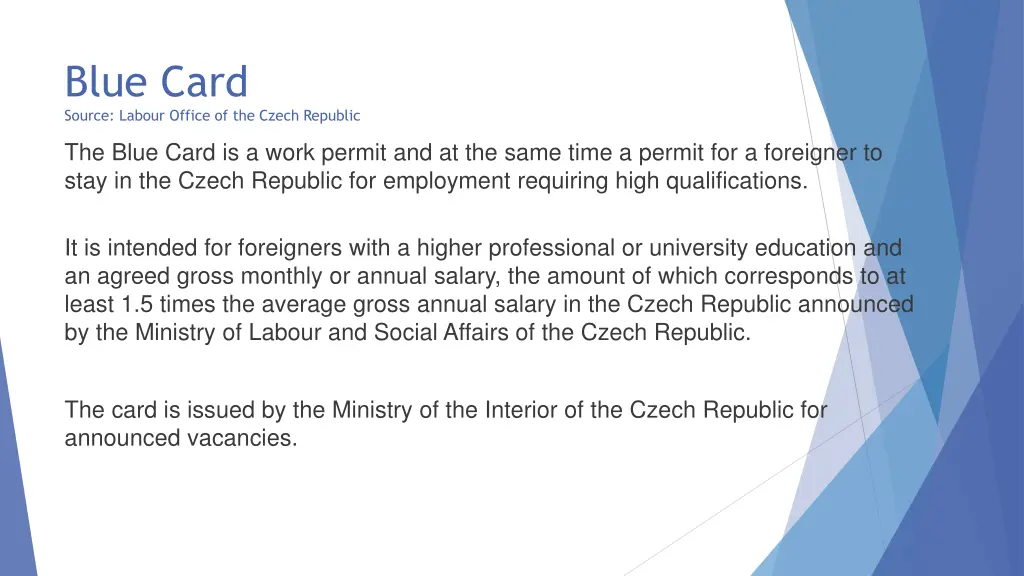
Blue Card Source: Labour Office of the Czech Republic The Blue Card is a work permit and at the same time a permit for a foreigner to stay in the Czech Republic for employment requiring high qualifications. It is intended for foreigners with a higher professional or university education and an agreed gross monthly or annual salary, the amount of which corresponds to at least 1.5 times the average gross annual salary in the Czech Republic announced by the Ministry of Labour and Social Affairs of the Czech Republic. The card is issued by the Ministry of the Interior of the Czech Republic for announced vacancies.
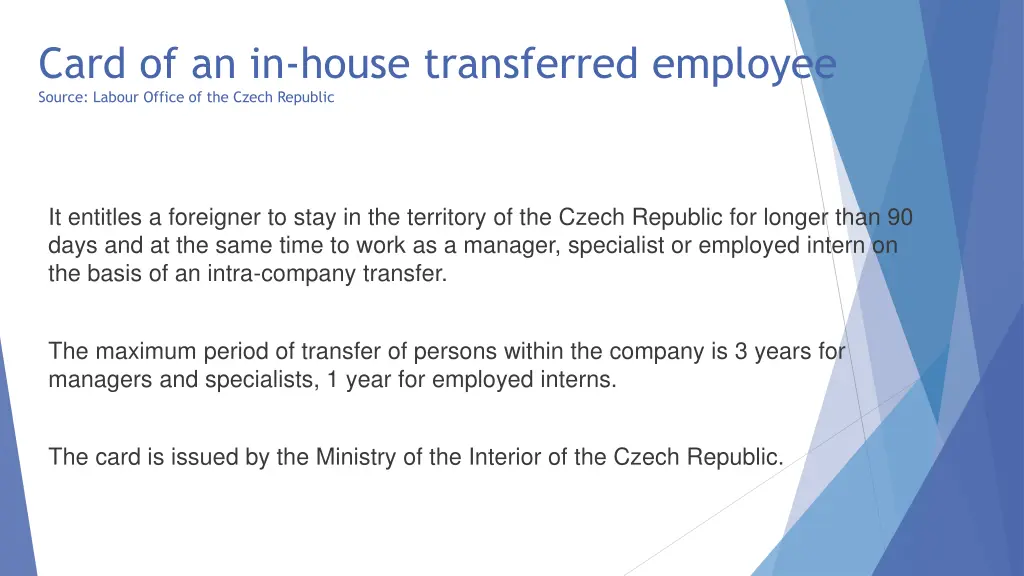
Card of an in-house transferred employee Source: Labour Office of the Czech Republic It entitles a foreigner to stay in the territory of the Czech Republic for longer than 90 days and at the same time to work as a manager, specialist or employed intern on the basis of an intra-company transfer. The maximum period of transfer of persons within the company is 3 years for managers and specialists, 1 year for employed interns. The card is issued by the Ministry of the Interior of the Czech Republic.
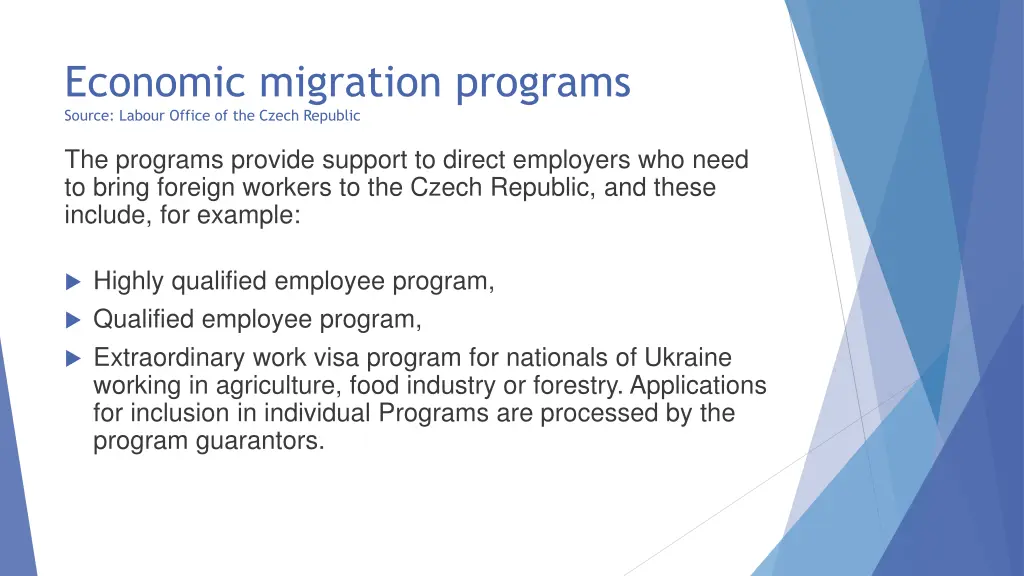
Economic migration programs Source: Labour Office of the Czech Republic The programs provide support to direct employers who need to bring foreign workers to the Czech Republic, and these include, for example: Highly qualified employee program, Qualified employee program, Extraordinary work visa program for nationals of Ukraine working in agriculture, food industry or forestry. Applications for inclusion in individual Programs are processed by the program guarantors.
Citizens of the United Kingdom and Northern Ireland Source: Labour Office of the Czech Republic Citizens of the United Kingdom of Great Britain and Northern Ireland, who have not acquired rights from the Withdrawal Agreement from the EU, need an employment permit, an employee card, a blue card or an intra-company transferred employee card for their employment in the Czech Republic. The exit agreement does not regulate the posting of workers. Therefore, posted persons must have a work permit issued by the Labour Office CR.
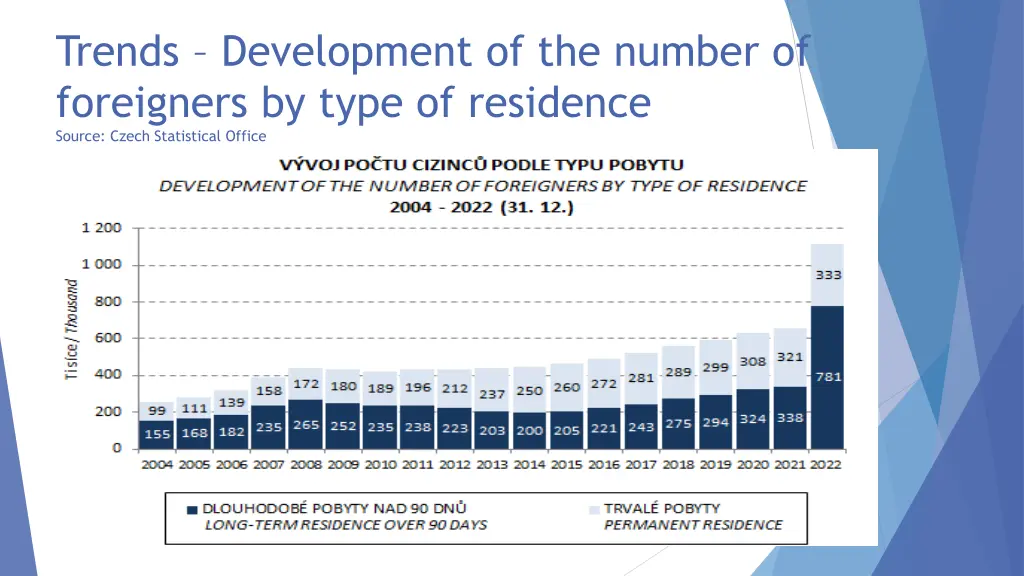
Trends Development of the number of foreigners by type of residence Source: Czech Statistical Office
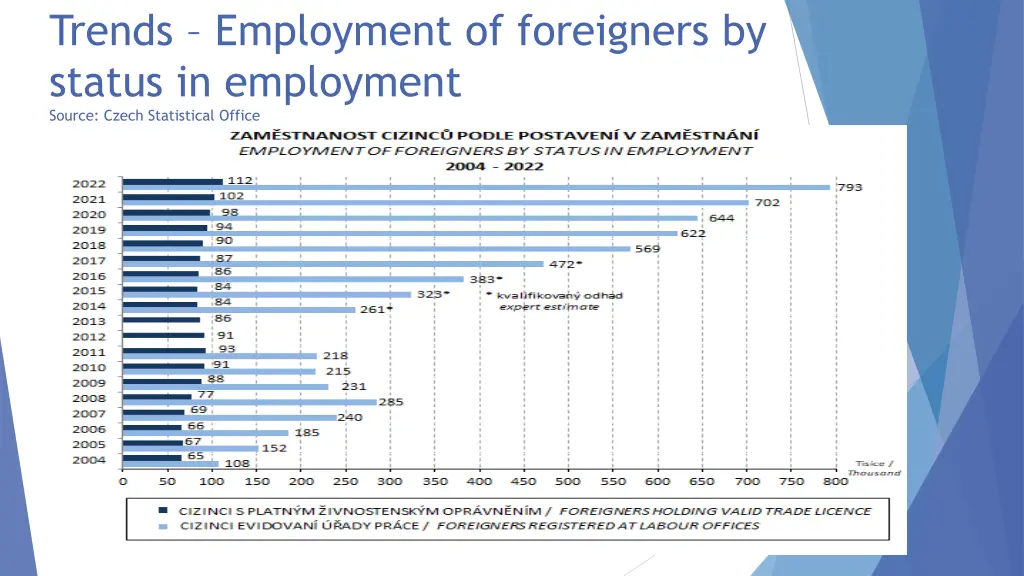
Trends Employment of foreigners by status in employment Source: Czech Statistical Office
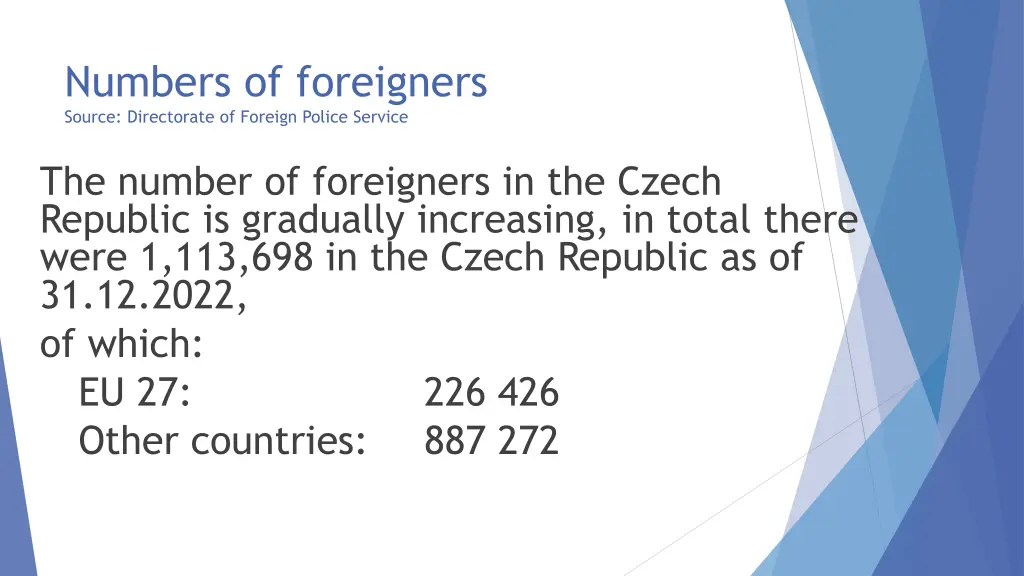
Numbers of foreigners Source: Directorate of Foreign Police Service The number of foreigners in the Czech Republic is gradually increasing, in total there were 1,113,698 in the Czech Republic as of 31.12.2022, of which: EU 27: 226 426 Other countries: 887 272
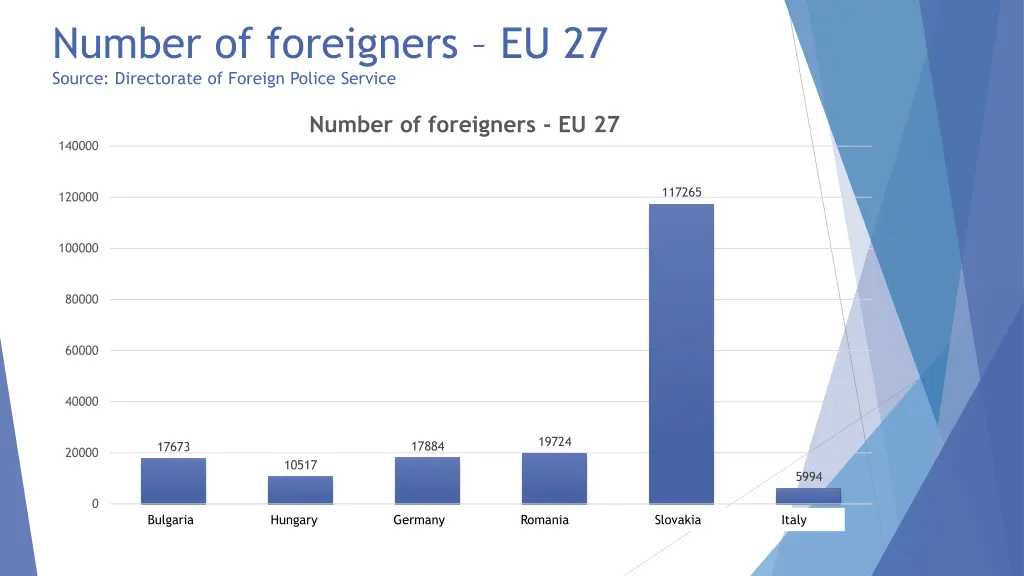
Number of foreigners EU 27 Source: Directorate of Foreign Police Service Number of foreigners - EU 27 140000 117265 120000 100000 80000 60000 40000 19724 17884 17673 20000 10517 5994 0 Bulharsko Bulgaria Ma arsko Hungary N mecko Germany Rumunsko Romania Slovensko Slovakia It lie Italy
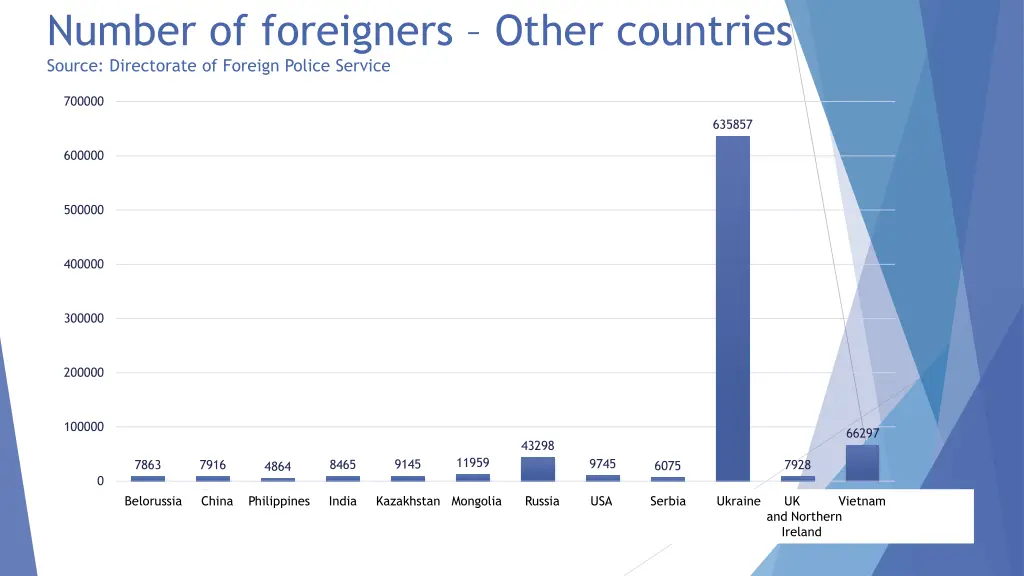
Number of foreigners Other countries Source: Directorate of Foreign Police Service 700000 635857 600000 500000 400000 300000 200000 100000 66297 43298 11959 9745 9145 8465 7916 7928 7863 6075 4864 0 B lorusko Belorussia China Philippines India Kazakhstan Mongolia Russia USA Serbia Ukraine na Filip ny Indie Kazachst n Mongolsko Rusko USA Srbsko Ukrajina UK a Severn Irsko Ireland Vietnam UK Vietnam and Northern
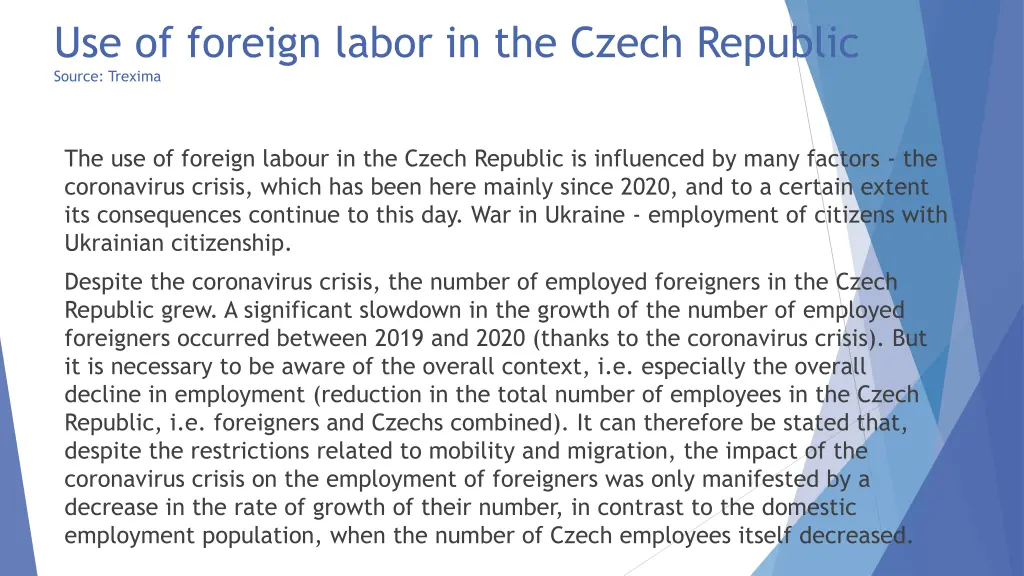
Use of foreign labor in the Czech Republic Source: Trexima The use of foreign labour in the Czech Republic is influenced by many factors - the coronavirus crisis, which has been here mainly since 2020, and to a certain extent its consequences continue to this day. War in Ukraine - employment of citizens with Ukrainian citizenship. Despite the coronavirus crisis, the number of employed foreigners in the Czech Republic grew. A significant slowdown in the growth of the number of employed foreigners occurred between 2019 and 2020 (thanks to the coronavirus crisis). But it is necessary to be aware of the overall context, i.e. especially the overall decline in employment (reduction in the total number of employees in the Czech Republic, i.e. foreigners and Czechs combined). It can therefore be stated that, despite the restrictions related to mobility and migration, the impact of the coronavirus crisis on the employment of foreigners was only manifested by a decrease in the rate of growth of their number, in contrast to the domestic employment population, when the number of Czech employees itself decreased.
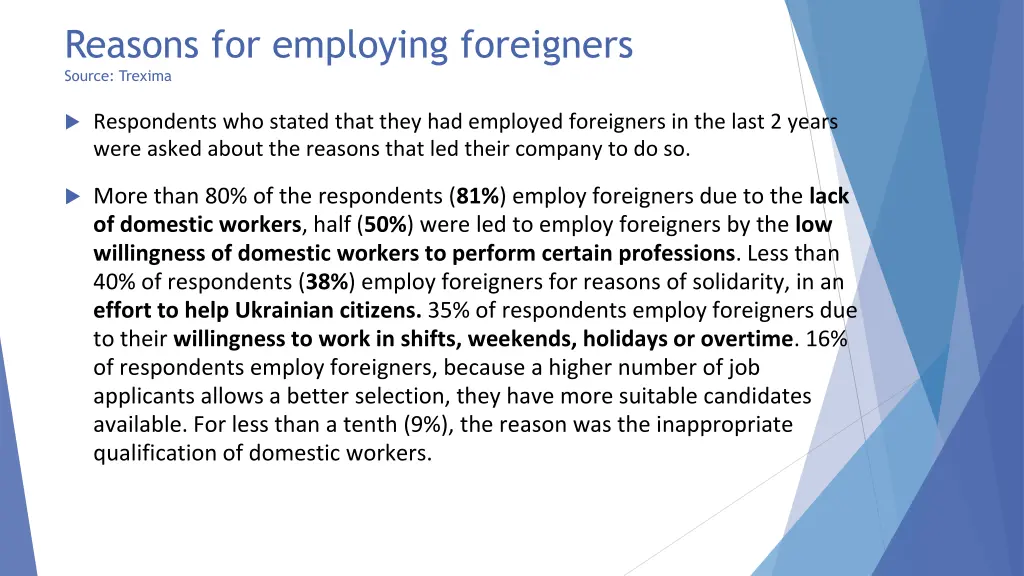
Reasons for employing foreigners Source: Trexima Respondents who stated that they had employed foreigners in the last 2 years were asked about the reasons that led their company to do so. More than 80% of the respondents (81%) employ foreigners due to the lack of domestic workers, half (50%) were led to employ foreigners by the low willingness of domestic workers to perform certain professions. Less than 40% of respondents (38%) employ foreigners for reasons of solidarity, in an effort to help Ukrainian citizens. 35% of respondents employ foreigners due to their willingness to work in shifts, weekends, holidays or overtime. 16% of respondents employ foreigners, because a higher number of job applicants allows a better selection, they have more suitable candidates available. For less than a tenth (9%), the reason was the inappropriate qualification of domestic workers.
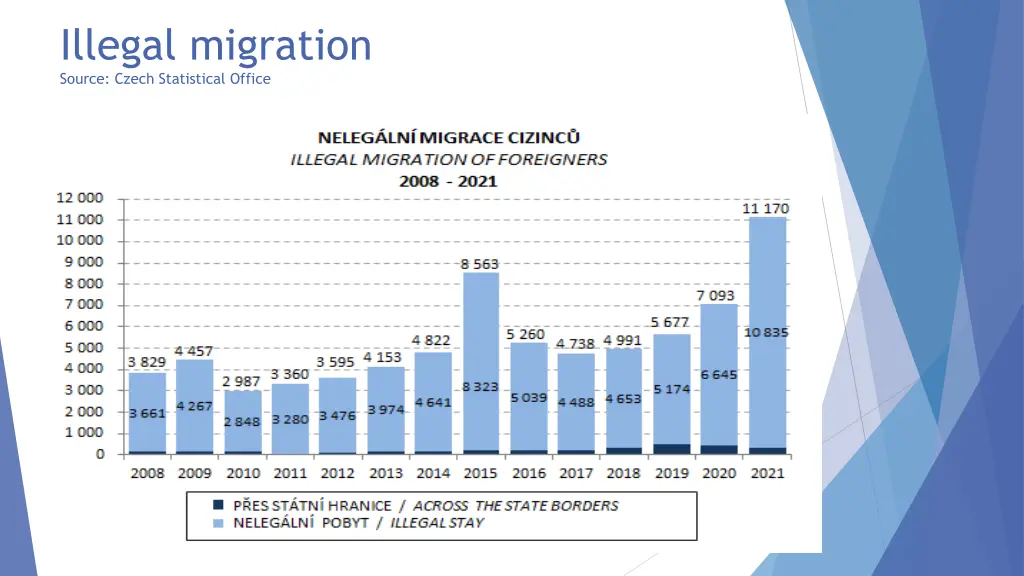
Illegal migration Source: Czech Statistical Office
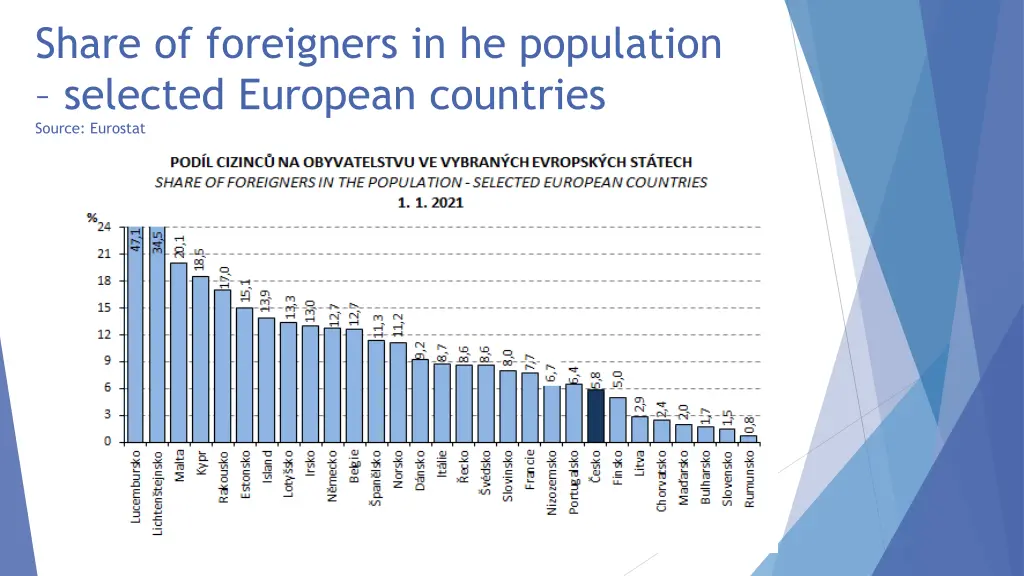
Share of foreigners in he population selected European countries Source: Eurostat
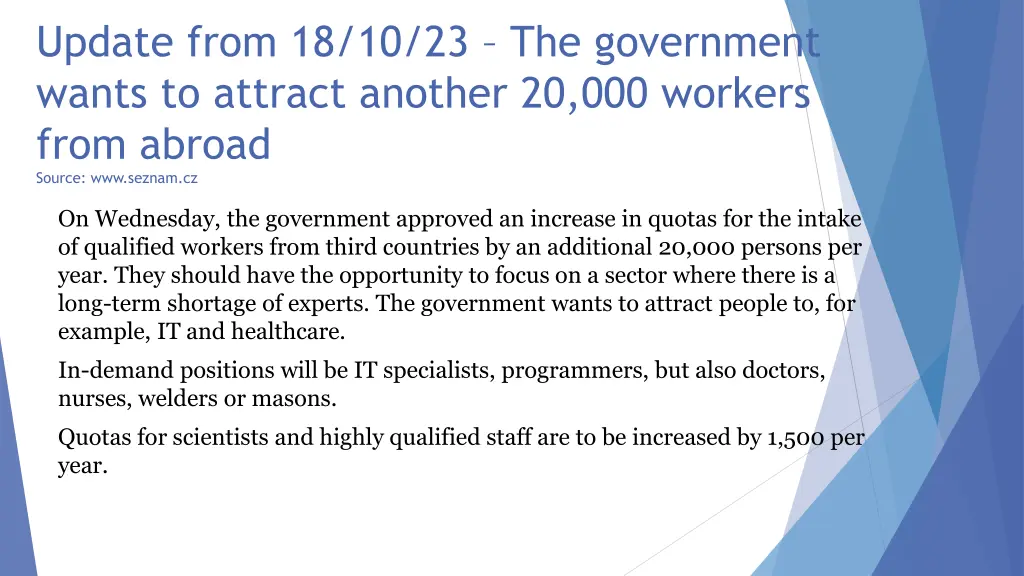
Update from 18/10/23 The government wants to attract another 20,000 workers from abroad Source: www.seznam.cz On Wednesday, the government approved an increase in quotas for the intake of qualified workers from third countries by an additional 20,000 persons per year. They should have the opportunity to focus on a sector where there is a long-term shortage of experts. The government wants to attract people to, for example, IT and healthcare. In-demand positions will be IT specialists, programmers, but also doctors, nurses, welders or masons. Quotas for scientists and highly qualified staff are to be increased by 1,500 per year.
Organising Source: OS KOVO
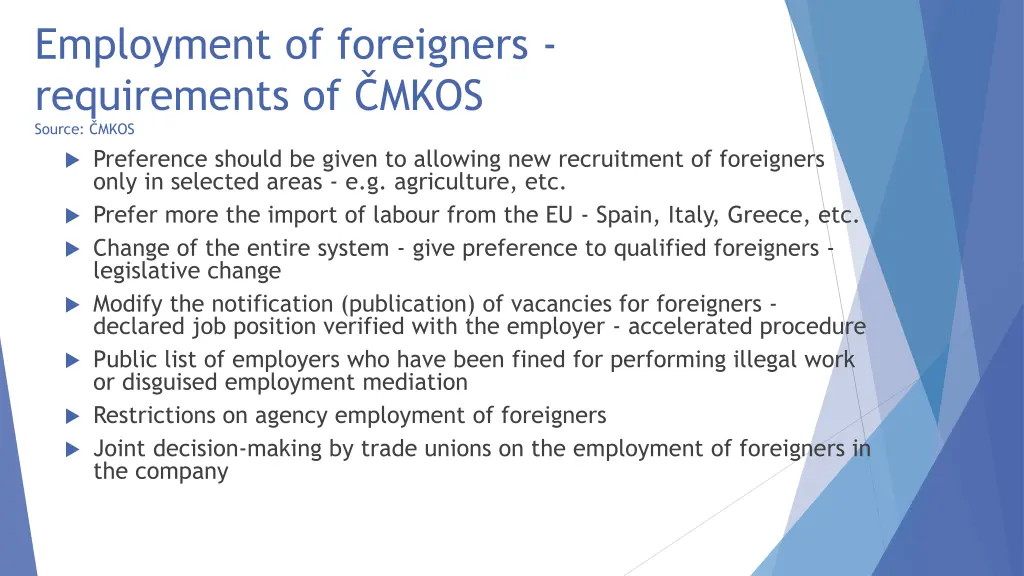
Employment of foreigners - requirements of MKOS Source: MKOS Preference should be given to allowing new recruitment of foreigners only in selected areas - e.g. agriculture, etc. Prefer more the import of labour from the EU - Spain, Italy, Greece, etc. Change of the entire system - give preference to qualified foreigners - legislative change Modify the notification (publication) of vacancies for foreigners - declared job position verified with the employer - accelerated procedure Public list of employers who have been fined for performing illegal work or disguised employment mediation Restrictions on agency employment of foreigners Joint decision-making by trade unions on the employment of foreigners in the company
Organising Problems with: Language barrier Cultural differences Short-term contracts - no interest in joining unions We maintain contacts with partner organizations industriAll Europe and IndustriALL Global Solidarity Pact