Writing a Dissertation: Essential Steps and Considerations
A dissertation, a significant scientific work, requires diligent planning and execution. From selecting a focused topic to engaging with your supervisor effectively, this process demands attention to detail. Understanding the key steps involved, such as formulating a methodology and presenting results clearly, is essential for a successful dissertation. Navigate through the advice on choosing the right topic, establishing a good relationship with your supervisor, and involving your co-advisor wisely. Begin your dissertation journey by setting a solid foundation with these crucial insights.

Download Presentation

Please find below an Image/Link to download the presentation.
The content on the website is provided AS IS for your information and personal use only. It may not be sold, licensed, or shared on other websites without obtaining consent from the author.If you encounter any issues during the download, it is possible that the publisher has removed the file from their server.
You are allowed to download the files provided on this website for personal or commercial use, subject to the condition that they are used lawfully. All files are the property of their respective owners.
The content on the website is provided AS IS for your information and personal use only. It may not be sold, licensed, or shared on other websites without obtaining consent from the author.
E N D
Presentation Transcript
How to write a dissertation Professor Paolo Paesani (DEF) June 22, 2023
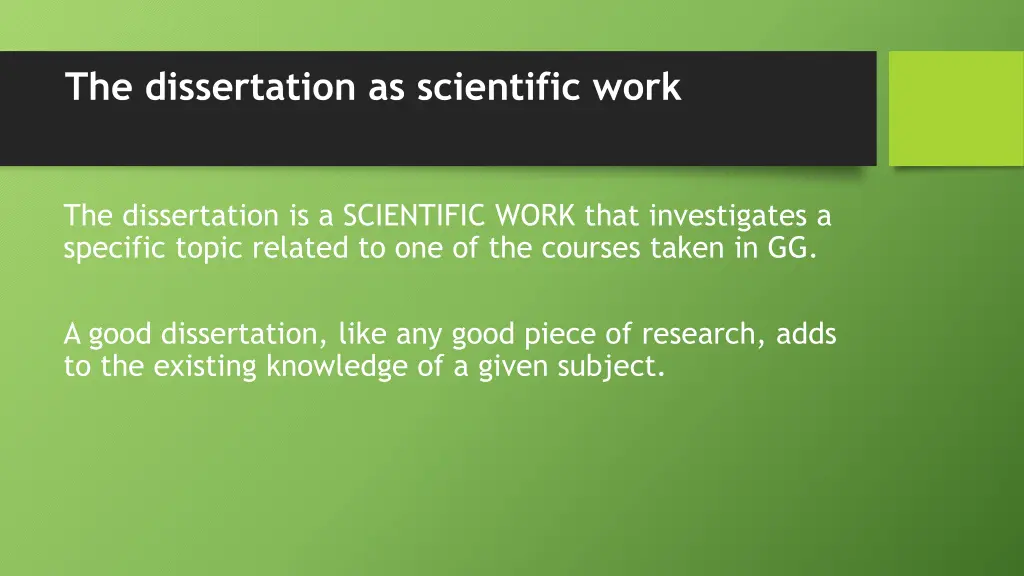
The dissertation as scientific work The dissertation is a SCIENTIFIC WORK that investigates a specific topic related to one of the courses taken in GG. A good dissertation, like any good piece of research, adds to the existing knowledge of a given subject.
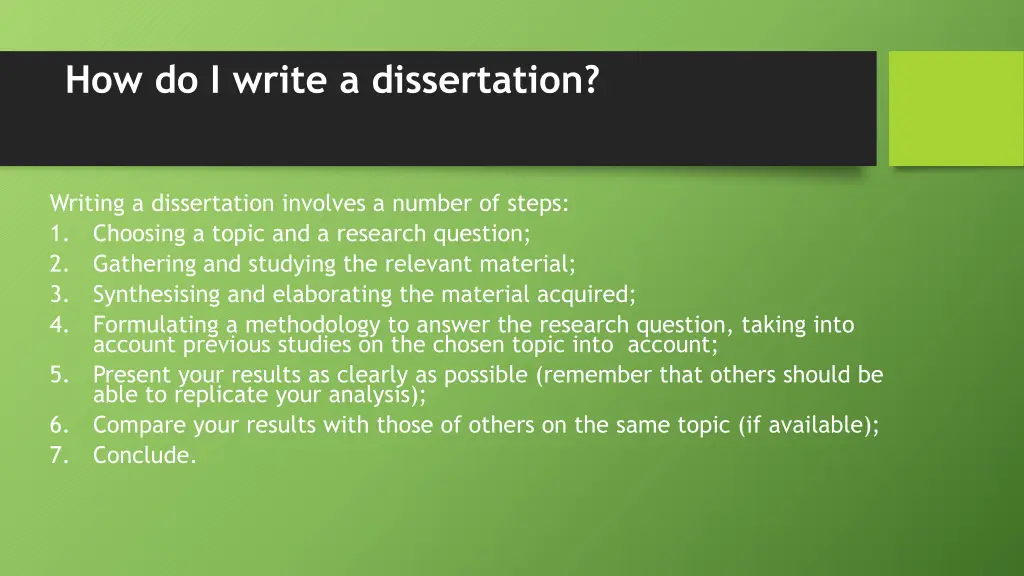
How do I write a dissertation? Writing a dissertation involves a number of steps: 1. Choosing a topic and a research question; 2. Gathering and studying the relevant material; 3. Synthesising and elaborating the material acquired; 4. Formulating a methodology to answer the research question, taking into account previous studies on the chosen topic into account; 5. Present your results as clearly as possible (remember that others should be able to replicate your analysis); 6. Compare your results with those of others on the same topic (if available); 7. Conclude.
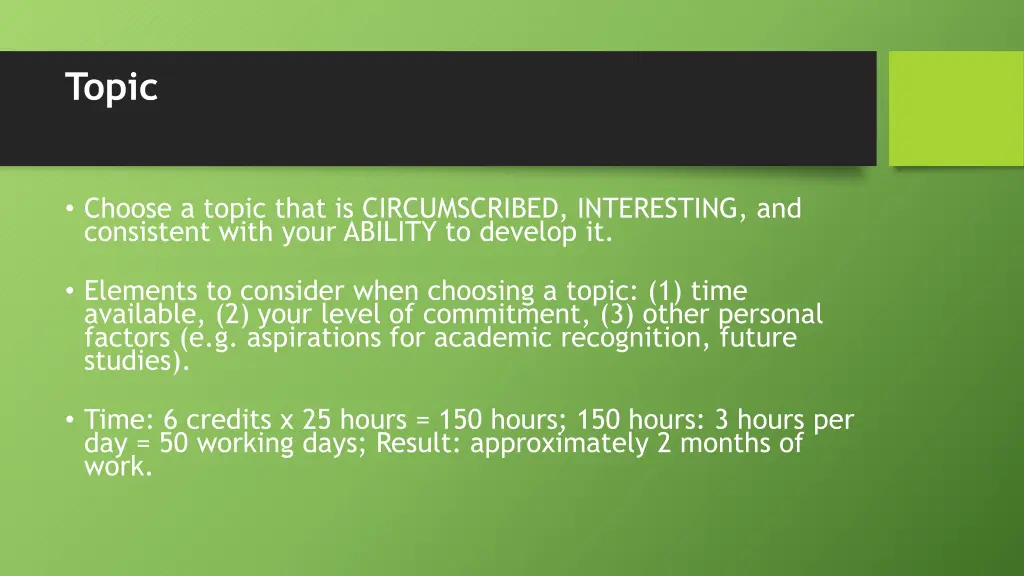
Topic Choose a topic that is CIRCUMSCRIBED, INTERESTING, and consistent with your ABILITY to develop it. Elements to consider when choosing a topic: (1) time available, (2) your level of commitment, (3) other personal factors (e.g. aspirations for academic recognition, future studies). Time: 6 credits x 25 hours = 150 hours; 150 hours: 3 hours per day = 50 working days; Result: approximately 2 months of work.
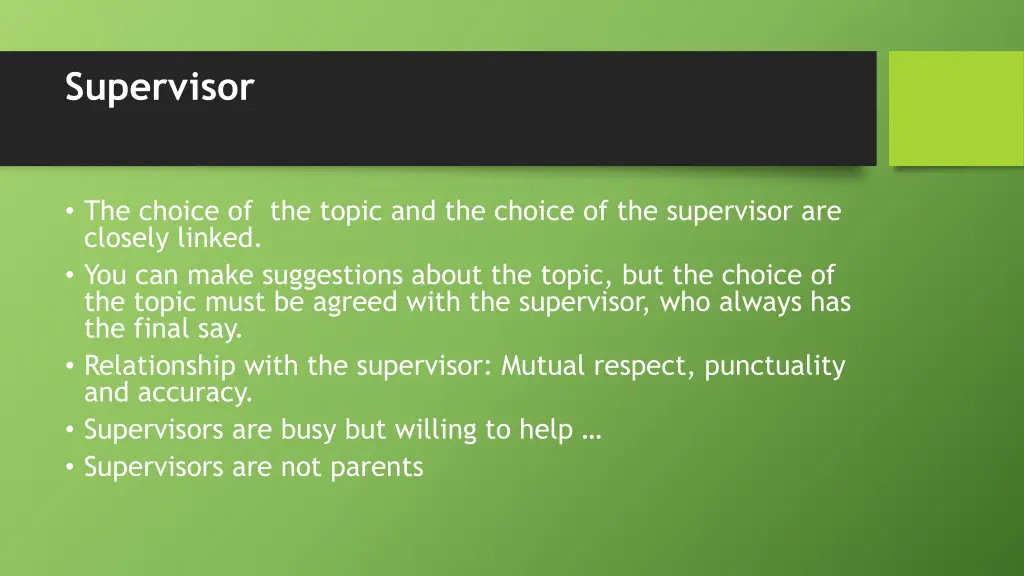
Supervisor The choice of the topic and the choice of the supervisor are closely linked. You can make suggestions about the topic, but the choice of the topic must be agreed with the supervisor, who always has the final say. Relationship with the supervisor: Mutual respect, punctuality and accuracy. Supervisors are busy but willing to help Supervisors are not parents
Co-advisor Each GG student is assigned a tutor who is also the dissertation co-advisor. It is advisable to contact your tutor at an early stage and inform her/him of the topic you have chosen for your dissertation. Co-advisors are not directly involved in the writing of the dissertation but they can provide useful feedback / advice.
First steps Once you have a supervisor and a topic, you should draw up a preliminary outline of your research to help you organise your bibliographical sources. This initial outline will not necessarily be the same as the final index, but it will serve to clarify ideas and keep you moving in the right direction. For the same reason it may be useful to first write a short introduction to clarify your research objectives and how you plan to achieve them. You will write the actual introduction at the end of your research (see below).
Bibliography What is a bibliography? It is a list at the end of a scientific work (dissertation, thesis or article) in which the author lists the texts used for research and quotations. The purpose of the bibliography is to enable the reader to trace the sources used by the author(s). Everything you have in the bibliography MUST BE CITED in the main text (and vice versa). The bibliography is an integral part of the dissertation and should not be 'pasted on' at the end Website Bibliography (Sitografia)
How to draft a bibliography Indicate the sources of your research information (in a way that is essential and complete). Start with the name of the author: last name followed by first name or just the first initial: Varian H. If there are more than three authors, use et al. which stands for various authors , or indicate one author and add et al which means and others : Varian H. et al Next put the year of publication of the source in parenthesis: Varian H. (1993) In the main body of your thesis, when referring to a page from a source: As one famous text of microeconomics states, The economic analysis proceeds by building models of social phenomena. (Varian 1993, p.1) At the end of the thesis, in the bibliography you will indicate the complete reference to the author and the title of his text. If in doubt about the reference, find the article on Google Scholar, click on Cite and choose a style (APA is the standard I would recommend)
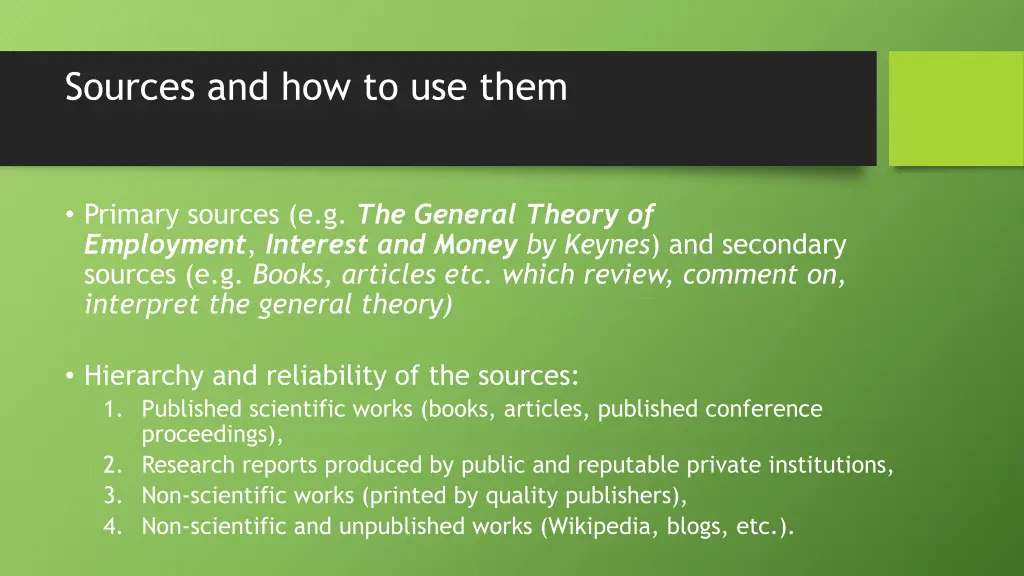
Sources and how to use them Primary sources (e.g. The General Theory of Employment, Interest and Money by Keynes) and secondary sources (e.g. Books, articles etc. which review, comment on, interpret the general theory) Hierarchy and reliability of the sources: 1. Published scientific works (books, articles, published conference proceedings), 2. Research reports produced by public and reputable private institutions, 3. Non-scientific works (printed by quality publishers), 4. Non-scientific and unpublished works (Wikipedia, blogs, etc.).
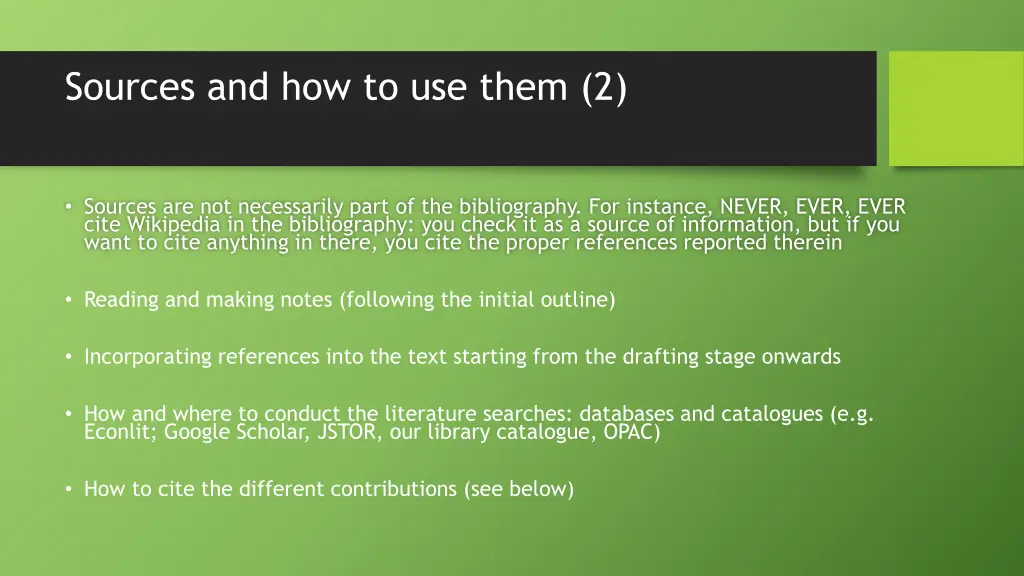
Sources and how to use them (2) Sources are not necessarily part of the bibliography. For instance, NEVER, EVER, EVER cite Wikipedia in the bibliography: you check it as a source of information, but if you want to cite anything in there, you cite the proper references reported therein Reading and making notes (following the initial outline) Incorporating references into the text starting from the drafting stage onwards How and where to conduct the literature searches: databases and catalogues (e.g. Econlit; Google Scholar, JSTOR, our library catalogue, OPAC) How to cite the different contributions (see below)
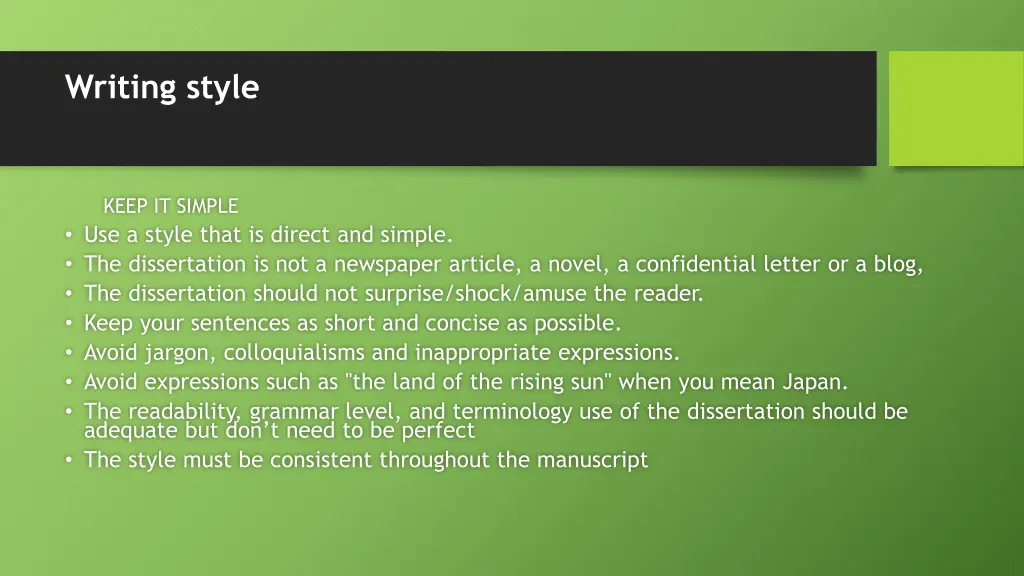
Writing style KEEP IT SIMPLE Use a style that is direct and simple. The dissertation is not a newspaper article, a novel, a confidential letter or a blog, The dissertation should not surprise/shock/amuse the reader. Keep your sentences as short and concise as possible. Avoid jargon, colloquialisms and inappropriate expressions. Avoid expressions such as "the land of the rising sun" when you mean Japan. The readability, grammar level, and terminology use of the dissertation should be adequate but don t need to be perfect The style must be consistent throughout the manuscript
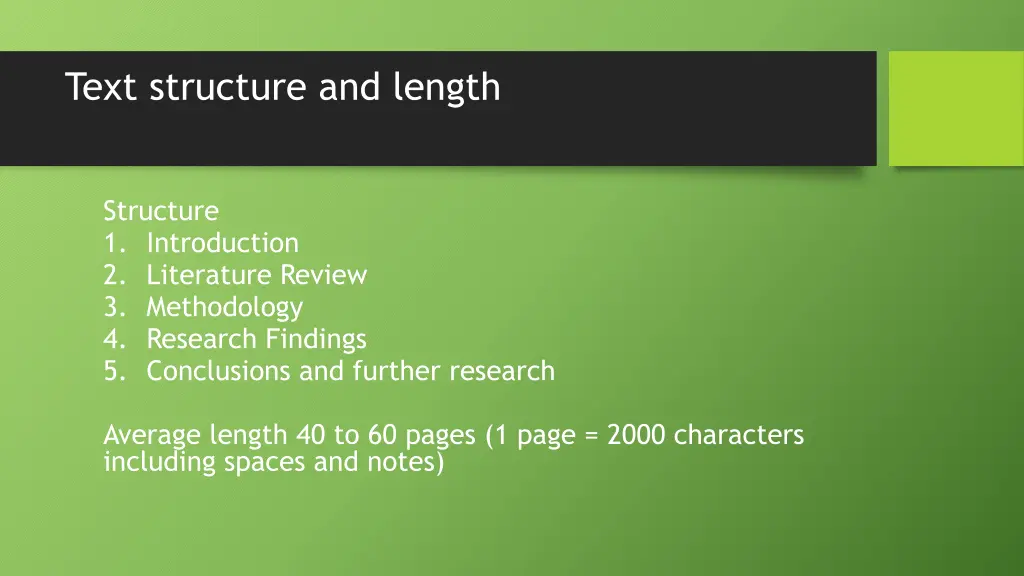
Text structure and length Structure 1. Introduction 2. Literature Review 3. Methodology 4. Research Findings 5. Conclusions and further research Average length 40 to 60 pages (1 page = 2000 characters including spaces and notes)
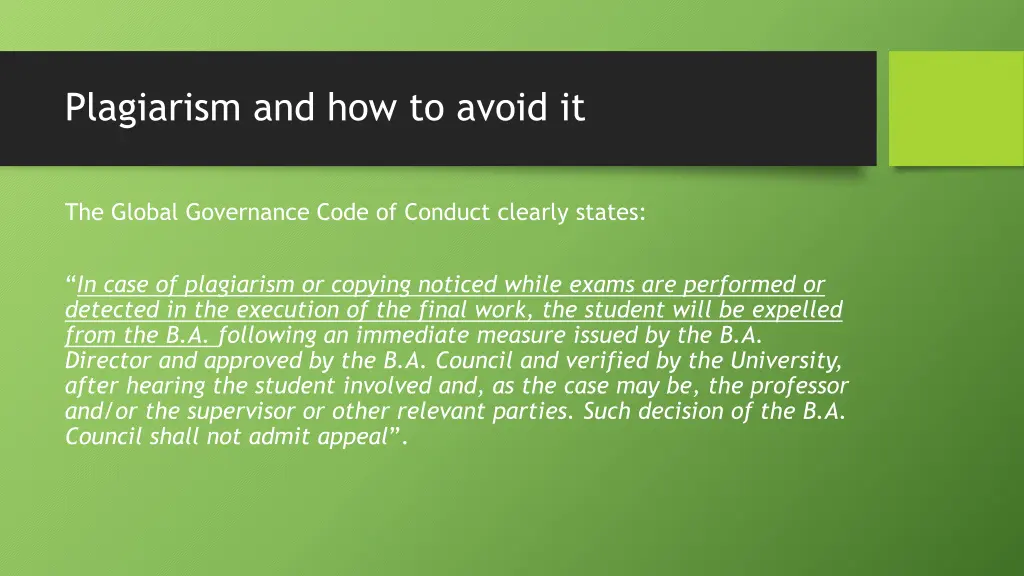
Plagiarism and how to avoid it The Global Governance Code of Conduct clearly states: In case of plagiarism or copying noticed while exams are performed or detected in the execution of the final work, the student will be expelled from the B.A. following an immediate measure issued by the B.A. Director and approved by the B.A. Council and verified by the University, after hearing the student involved and, as the case may be, the professor and/or the supervisor or other relevant parties. Such decision of the B.A. Council shall not admit appeal .
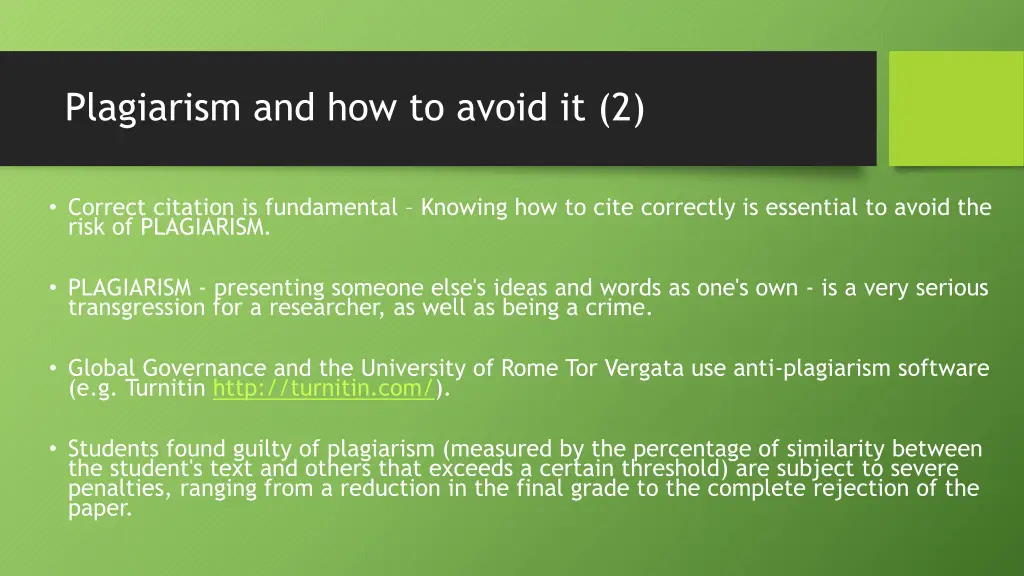
Plagiarism and how to avoid it (2) Correct citation is fundamental Knowing how to cite correctly is essential to avoid the risk of PLAGIARISM. PLAGIARISM - presenting someone else's ideas and words as one's own - is a very serious transgression for a researcher, as well as being a crime. Global Governance and the University of Rome Tor Vergata use anti-plagiarism software (e.g. Turnitin http://turnitin.com/). Students found guilty of plagiarism (measured by the percentage of similarity between the student's text and others that exceeds a certain threshold) are subject to severe penalties, ranging from a reduction in the final grade to the complete rejection of the paper.
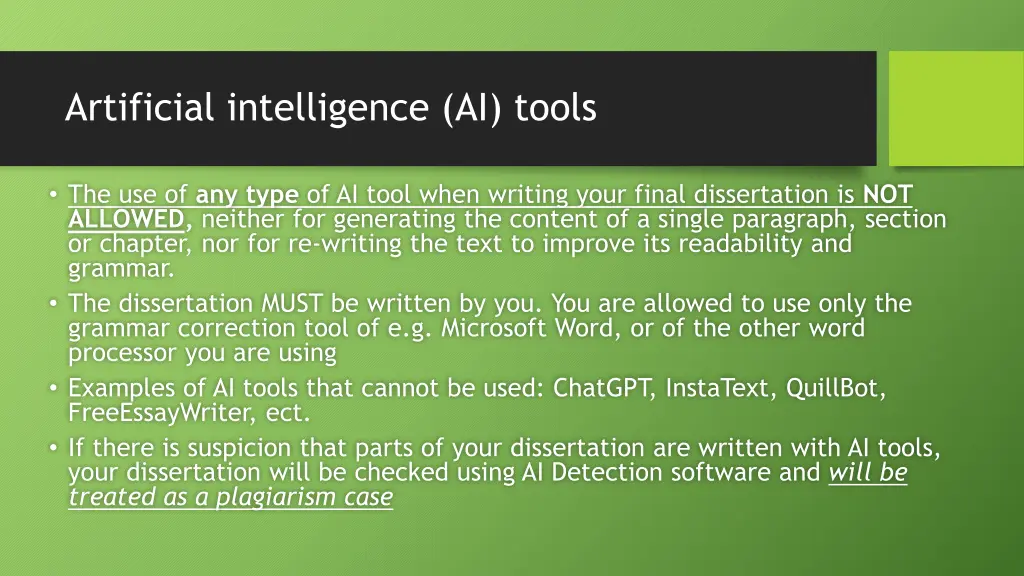
Artificial intelligence (AI) tools The use of any type of AI tool when writing your final dissertation is NOT ALLOWED, neither for generating the content of a single paragraph, section or chapter, nor for re-writing the text to improve its readability and grammar. The dissertation MUST be written by you. You are allowed to use only the grammar correction tool of e.g. Microsoft Word, or of the other word processor you are using Examples of AI tools that cannot be used: ChatGPT, InstaText, QuillBot, FreeEssayWriter, ect. If there is suspicion that parts of your dissertation are written with AI tools, your dissertation will be checked using AI Detection software and will be treated as a plagiarism case
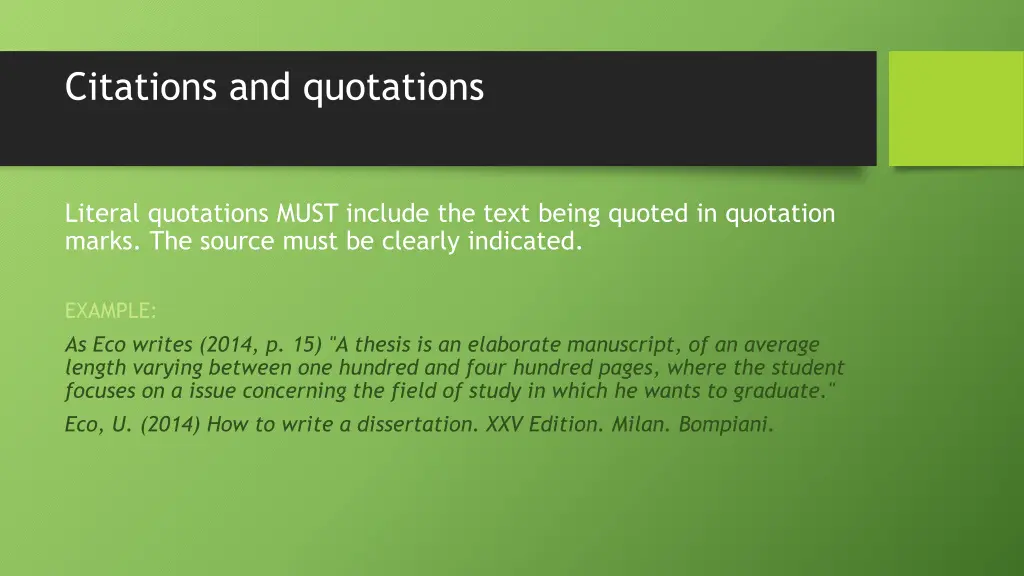
Citations and quotations Literal quotations MUST include the text being quoted in quotation marks. The source must be clearly indicated. EXAMPLE: As Eco writes (2014, p. 15) "A thesis is an elaborate manuscript, of an average length varying between one hundred and four hundred pages, where the student focuses on a issue concerning the field of study in which he wants to graduate." Eco, U. (2014) How to write a dissertation. XXV Edition. Milan. Bompiani.
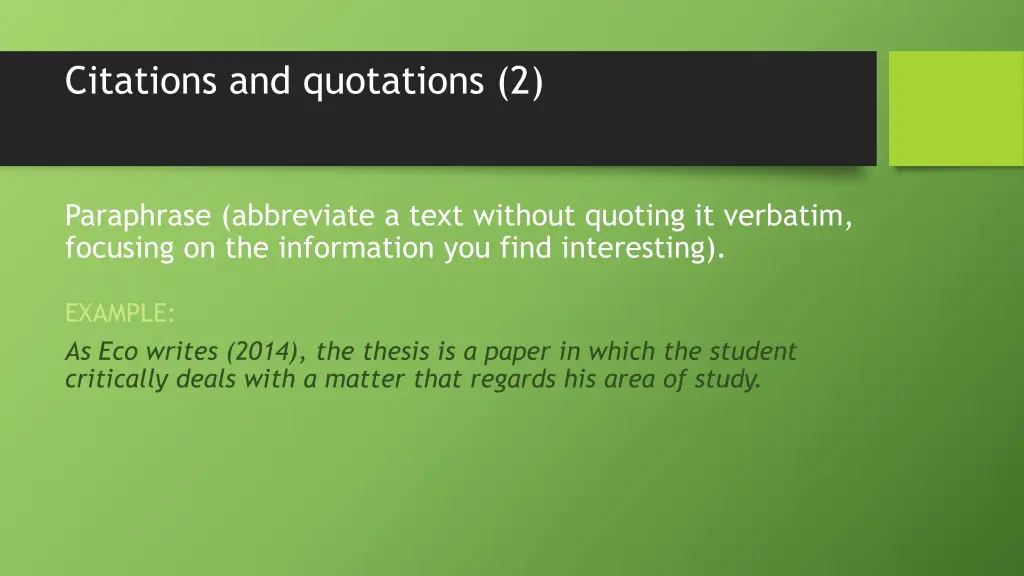
Citations and quotations (2) Paraphrase (abbreviate a text without quoting it verbatim, focusing on the information you find interesting). EXAMPLE: As Eco writes (2014), the thesis is a paper in which the student critically deals with a matter that regards his area of study.
Tables, charts, figures and data Each table, graph and figure must have a number, title and source, and its explanation and description must be integrated into the main body of the text. All data must be referenced (to confirm the verifiability of your results). In the case of empirical work, CLARIFY the model used and COMPARE your results with those of previous work on the subject.
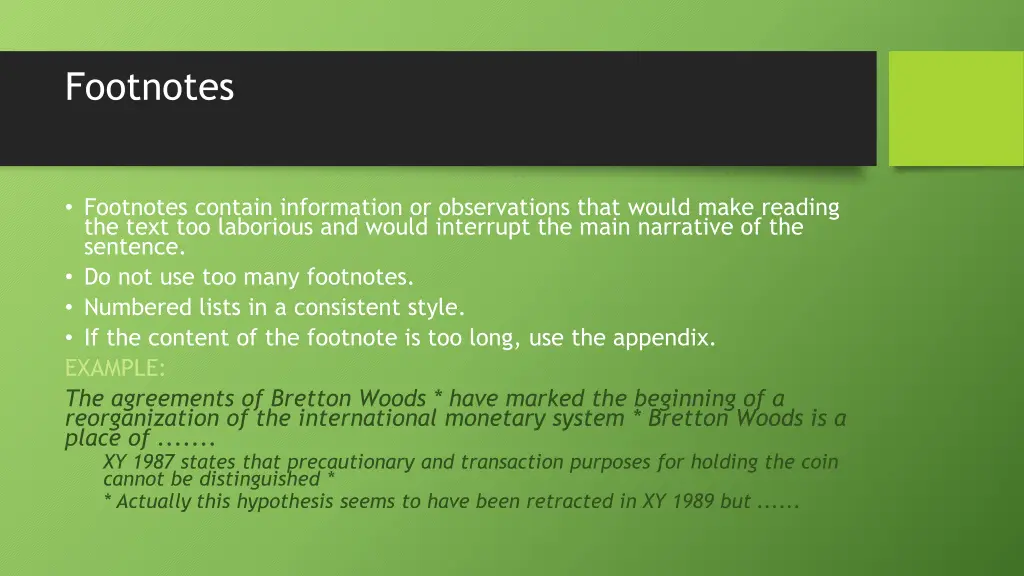
Footnotes Footnotes contain information or observations that would make reading the text too laborious and would interrupt the main narrative of the sentence. Do not use too many footnotes. Numbered lists in a consistent style. If the content of the footnote is too long, use the appendix. EXAMPLE: The agreements of Bretton Woods * have marked the beginning of a reorganization of the international monetary system * Bretton Woods is a place of ....... XY 1987 states that precautionary and transaction purposes for holding the coin cannot be distinguished * * Actually this hypothesis seems to have been retracted in XY 1989 but ......
Introduction (to be written at the end) Dissertation topic and research questions Motivation for the research (why the research is important, what it adds) Brief description of the structure of the work (how you plan to deal with the chosen topic) Summary of key findings
Conclusions (of the thesis) Briefly recall the topic, research question and structure of the dissertation. Answer your research question in detail, highlighting the novelty of your findings. No references in your conclusions. Make reference to future research
Mistakes you MUST avoid NEVER write about things you do not understand or use terms that you do not know. DO NOT write about ideas and authors you have not researched, simply because you have heard about them in another textbook or context. DO NOT report any data, quotes, quotations or information without stating where you found it. AVOID PLAGIARISM - PLAGIARISM IS A CRIME.
Conclusions (of the presentation) TIMING! Summer reminder (end of second year) Choice of topic and supervisor by the end of September (may be delayed if you choose a supervisor in your third year) December/January (first draft) Late spring (final draft) ready for summer defence THE DEFENCE IS IMPORTANT! END AND BEGINNING The dissertation marks the end of your GG experience... And the start of your future adventures
Each source listed in the bibliography has a special form. Book Scientific journal Collection of essays Article written on a website
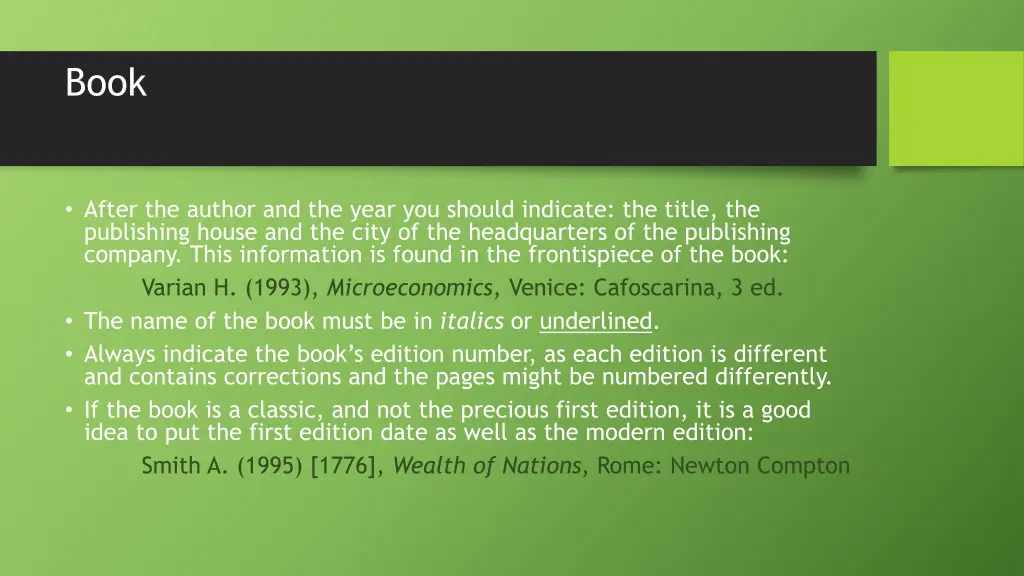
Book After the author and the year you should indicate: the title, the publishing house and the city of the headquarters of the publishing company. This information is found in the frontispiece of the book: Varian H. (1993), Microeconomics, Venice: Cafoscarina, 3 ed. The name of the book must be in italics or underlined. Always indicate the book s edition number, as each edition is different and contains corrections and the pages might be numbered differently. If the book is a classic, and not the precious first edition, it is a good idea to put the first edition date as well as the modern edition: Smith A. (1995) [1776], Wealth of Nations, Rome: Newton Compton
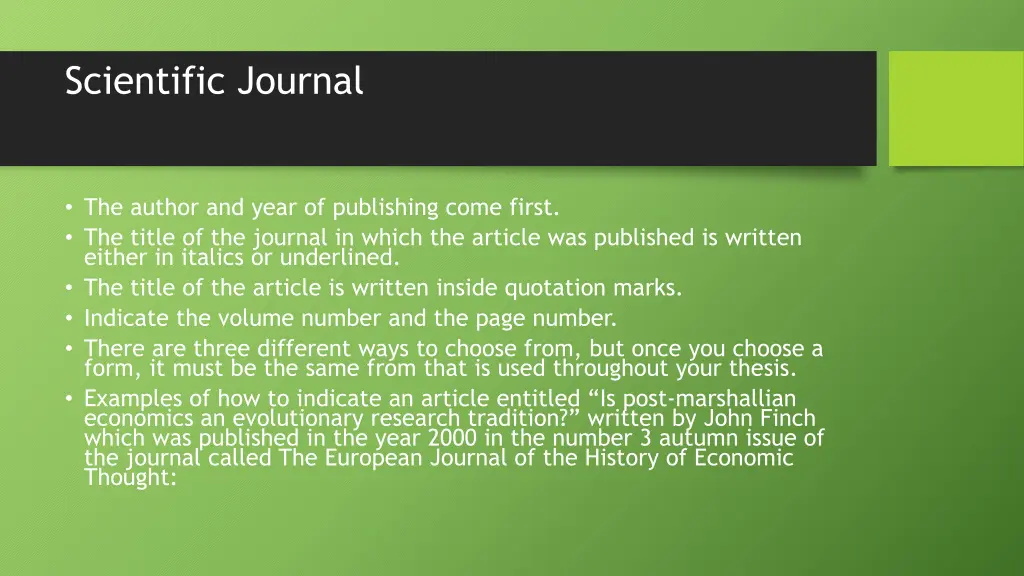
Scientific Journal The author and year of publishing come first. The title of the journal in which the article was published is written either in italics or underlined. The title of the article is written inside quotation marks. Indicate the volume number and the page number. There are three different ways to choose from, but once you choose a form, it must be the same from that is used throughout your thesis. Examples of how to indicate an article entitled Is post-marshallian economics an evolutionary research tradition? written by John Finch which was published in the year 2000 in the number 3 autumn issue of the journal called The European Journal of the History of Economic Thought:
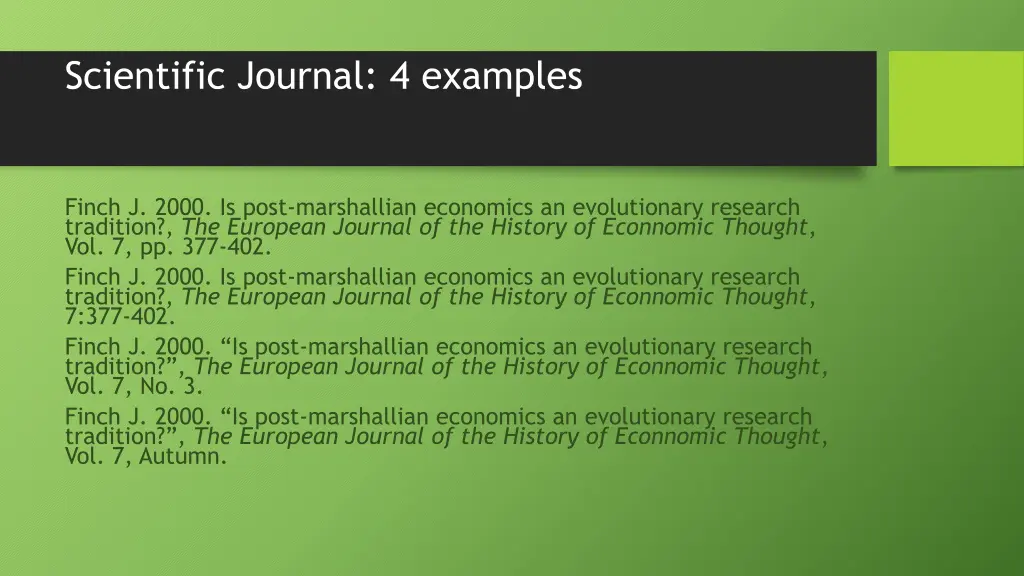
Scientific Journal: 4 examples Finch J. 2000. Is post-marshallian economics an evolutionary research tradition?, The European Journal of the History of Econnomic Thought, Vol. 7, pp. 377-402. Finch J. 2000. Is post-marshallian economics an evolutionary research tradition?, The European Journal of the History of Econnomic Thought, 7:377-402. Finch J. 2000. Is post-marshallian economics an evolutionary research tradition? , The European Journal of the History of Econnomic Thought, Vol. 7, No. 3. Finch J. 2000. Is post-marshallian economics an evolutionary research tradition? , The European Journal of the History of Econnomic Thought, Vol. 7, Autumn.
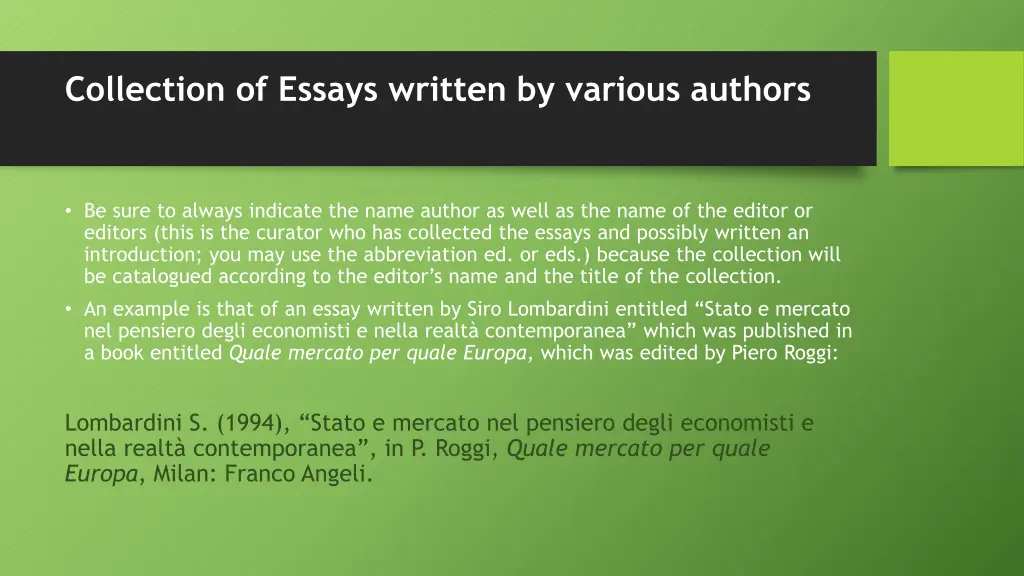
Collection of Essays written by various authors Be sure to always indicate the name author as well as the name of the editor or editors (this is the curator who has collected the essays and possibly written an introduction; you may use the abbreviation ed. or eds.) because the collection will be catalogued according to the editor s name and the title of the collection. An example is that of an essay written by Siro Lombardini entitled Stato e mercato nel pensiero degli economisti e nella realt contemporanea which was published in a book entitled Quale mercato per quale Europa, which was edited by Piero Roggi: Lombardini S. (1994), Stato e mercato nel pensiero degli economisti e nella realt contemporanea , in P. Roggi, Quale mercato per quale Europa, Milan: Franco Angeli.
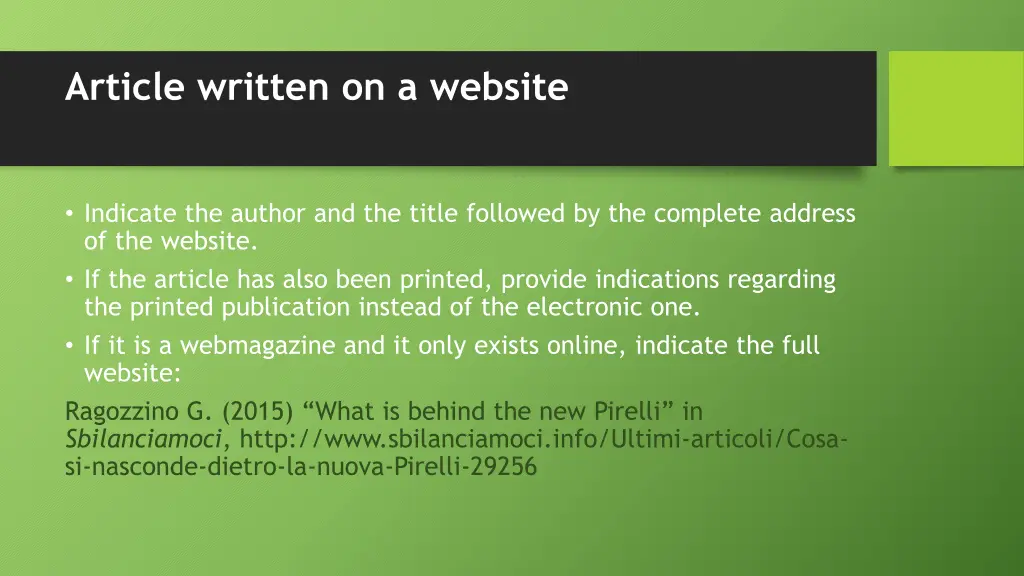
Article written on a website Indicate the author and the title followed by the complete address of the website. If the article has also been printed, provide indications regarding the printed publication instead of the electronic one. If it is a webmagazine and it only exists online, indicate the full website: Ragozzino G. (2015) What is behind the new Pirelli in Sbilanciamoci, http://www.sbilanciamoci.info/Ultimi-articoli/Cosa- si-nasconde-dietro-la-nuova-Pirelli-29256
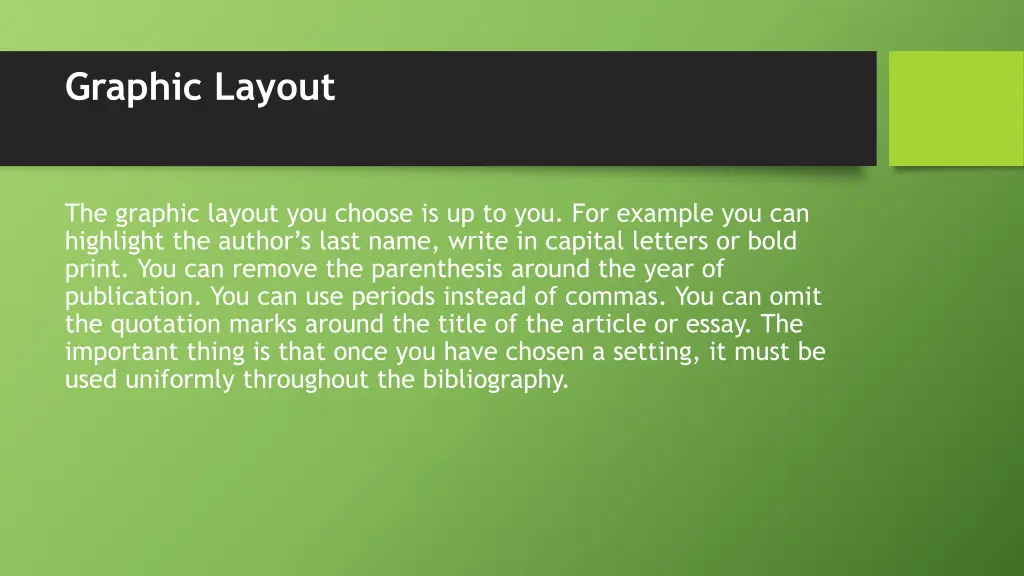
Graphic Layout The graphic layout you choose is up to you. For example you can highlight the author s last name, write in capital letters or bold print. You can remove the parenthesis around the year of publication. You can use periods instead of commas. You can omit the quotation marks around the title of the article or essay. The important thing is that once you have chosen a setting, it must be used uniformly throughout the bibliography.
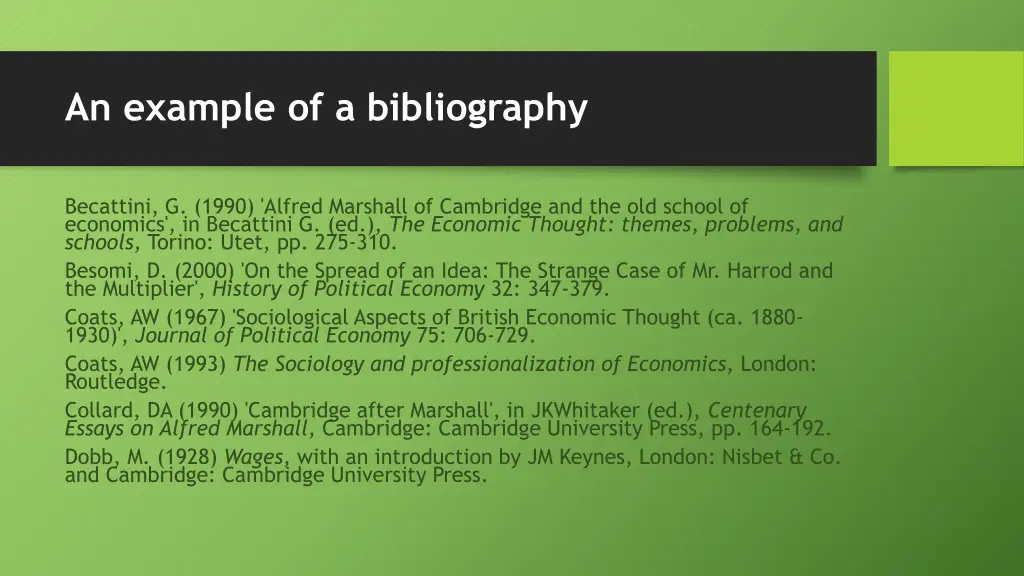
An example of a bibliography Becattini, G. (1990) 'Alfred Marshall of Cambridge and the old school of economics', in Becattini G. (ed.), The Economic Thought: themes, problems, and schools, Torino: Utet, pp. 275-310. Besomi, D. (2000) 'On the Spread of an Idea: The Strange Case of Mr. Harrod and the Multiplier', History of Political Economy 32: 347-379. Coats, AW (1967) 'Sociological Aspects of British Economic Thought (ca. 1880- 1930)', Journal of Political Economy 75: 706-729. Coats, AW (1993) The Sociology and professionalization of Economics, London: Routledge. Collard, DA (1990) 'Cambridge after Marshall', in JKWhitaker (ed.), Centenary Essays on Alfred Marshall, Cambridge: Cambridge University Press, pp. 164-192. Dobb, M. (1928) Wages, with an introduction by JM Keynes, London: Nisbet & Co. and Cambridge: Cambridge University Press.