A Tutorial on Using Mirror to Calibrate Non-Overlapping Cameras
This tutorial provides a comprehensive approach to calibrating non-overlapping cameras using mirrors. It presents an introduction to the problem, discusses 3D rotations with axis-angle representation, and details the geometric median problem addressed by the Weiszfeld algorithm. The document includes explanations of the algorithm, experimental results, simulations, and real data applications, culminating in a discussion of findings and conclusions relevant to multiple camera calibration scenarios.

Download Presentation

Please find below an Image/Link to download the presentation.
The content on the website is provided AS IS for your information and personal use only. It may not be sold, licensed, or shared on other websites without obtaining consent from the author.If you encounter any issues during the download, it is possible that the publisher has removed the file from their server.
You are allowed to download the files provided on this website for personal or commercial use, subject to the condition that they are used lawfully. All files are the property of their respective owners.
The content on the website is provided AS IS for your information and personal use only. It may not be sold, licensed, or shared on other websites without obtaining consent from the author.
E N D
Presentation Transcript
A tutorial on using mirror to calibrate non-overlapping view cameras K.H. Wong Calibrate non-overlapping cameras using mirrors ver.6e 1
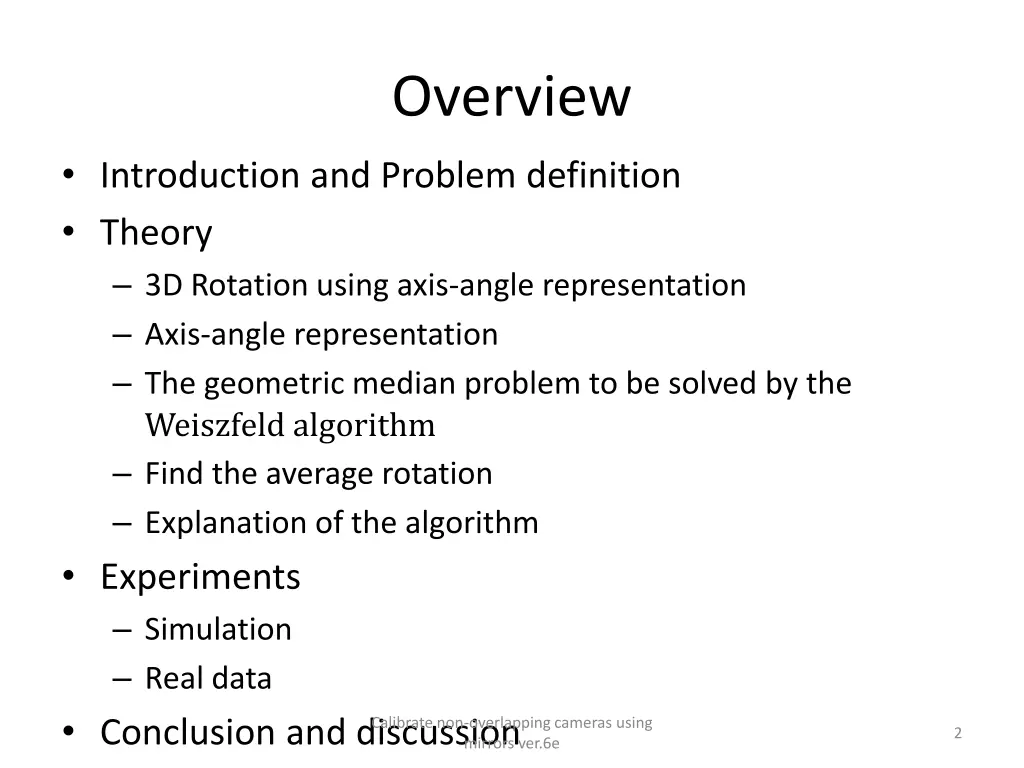
Overview Introduction and Problem definition Theory 3D Rotation using axis-angle representation Axis-angle representation The geometric median problem to be solved by the Weiszfeld algorithm Find the average rotation Explanation of the algorithm Experiments Simulation Real data Conclusion and discussion Calibrate non-overlapping cameras using mirrors ver.6e 2
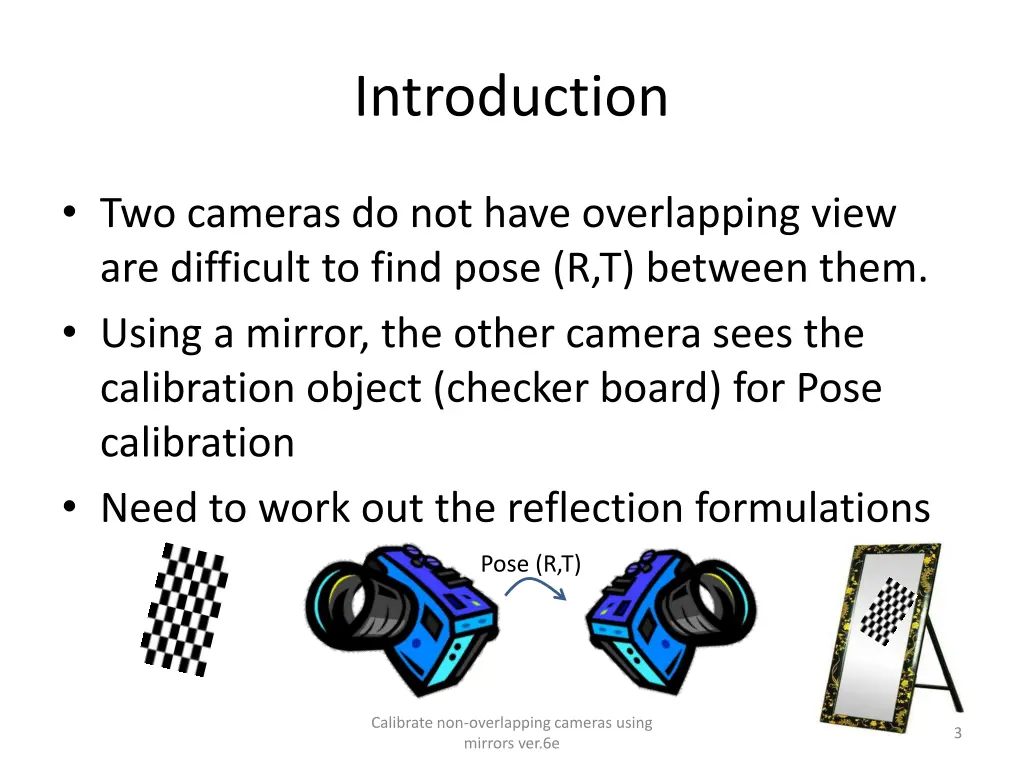
Introduction Two cameras do not have overlapping view are difficult to find pose (R,T) between them. Using a mirror, the other camera sees the calibration object (checker board) for Pose calibration Need to work out the reflection formulations Pose (R,T) Calibrate non-overlapping cameras using mirrors ver.6e 3
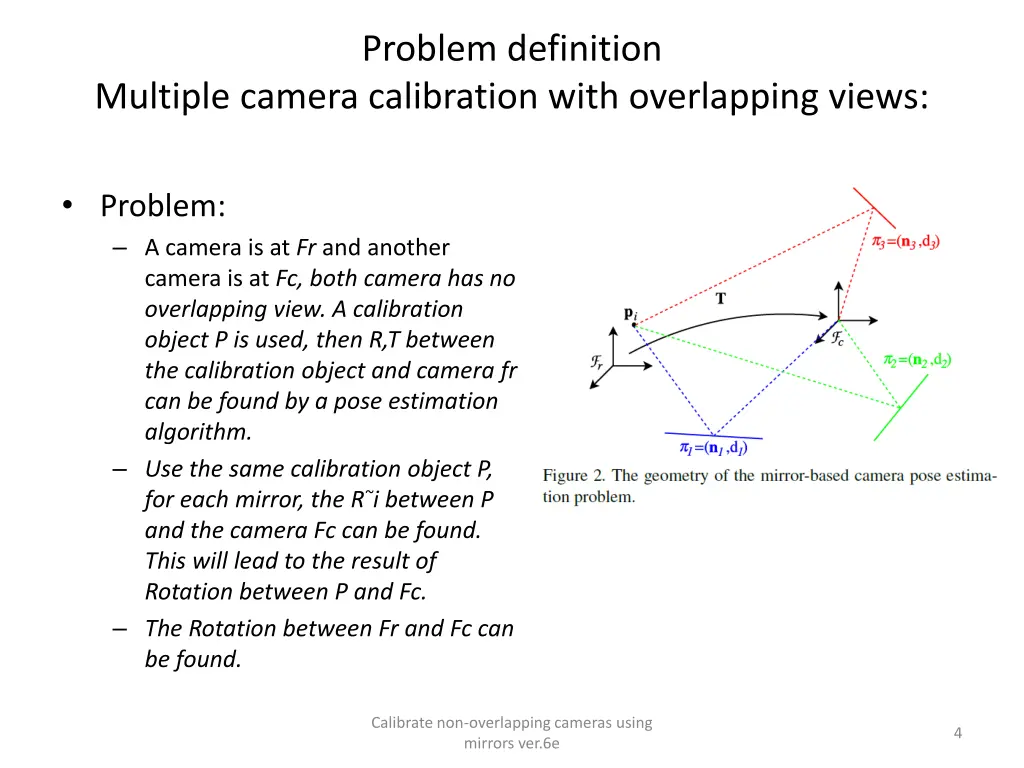
Problem definition Multiple camera calibration with overlapping views: Problem: A camera is at Fr and another camera is at Fc, both camera has no overlapping view. A calibration object P is used, then R,T between the calibration object and camera fr can be found by a pose estimation algorithm. Use the same calibration object P, for each mirror, the R~i between P and the camera Fc can be found. This will lead to the result of Rotation between P and Fc. The Rotation between Fr and Fc can be found. Calibrate non-overlapping cameras using mirrors ver.6e 4
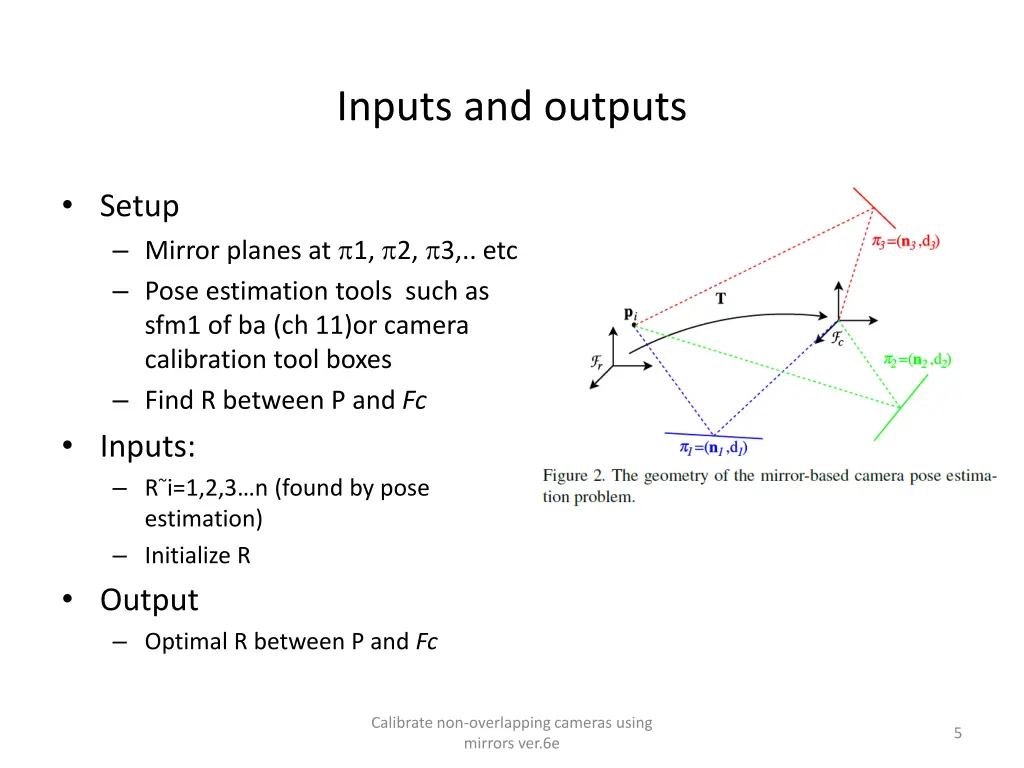
Inputs and outputs Setup Mirror planes at 1, 2, 3,.. etc Pose estimation tools such as sfm1 of ba (ch 11)or camera calibration tool boxes Find R between P and Fc Inputs: R~i=1,2,3 n (found by pose estimation) Initialize R Output Optimal R between P and Fc Calibrate non-overlapping cameras using mirrors ver.6e 5
Theory Calibrate non-overlapping cameras using mirrors ver.6e 6
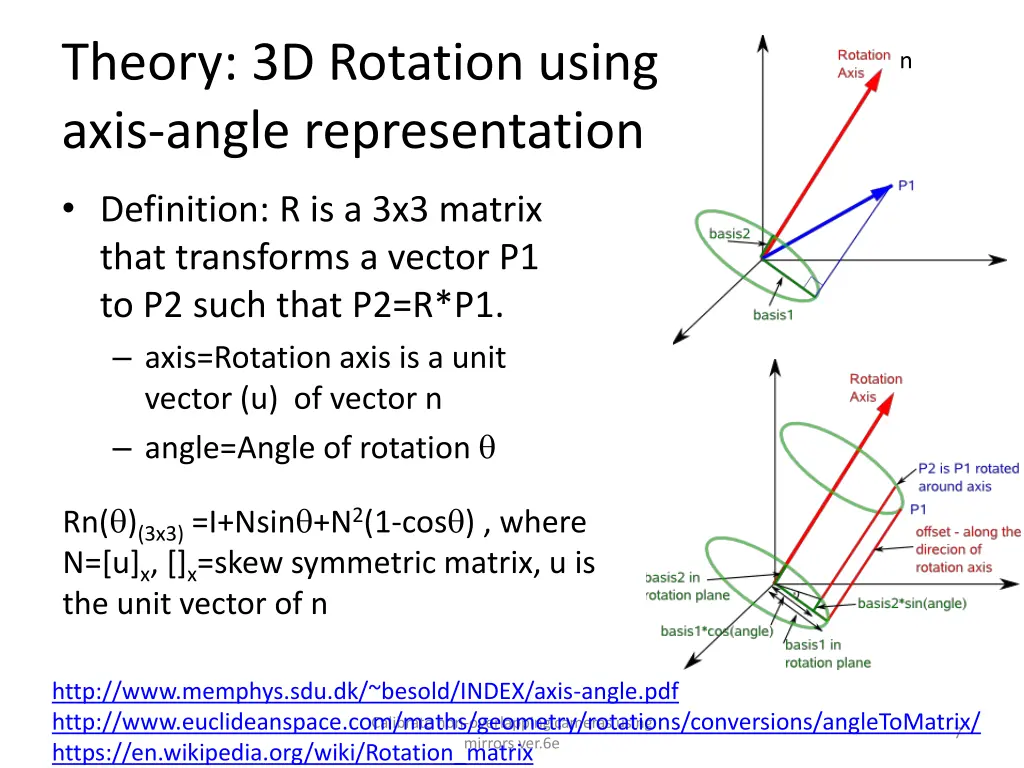
Theory: 3D Rotation using axis-angle representation n Definition: R is a 3x3 matrix that transforms a vector P1 to P2 such that P2=R*P1. axis=Rotation axis is a unit vector (u) of vector n angle=Angle of rotation Rn( )(3x3) =I+Nsin +N2(1-cos ) , where N=[u]x, []x=skew symmetric matrix, u is the unit vector of n http://www.memphys.sdu.dk/~besold/INDEX/axis-angle.pdf http://www.euclideanspace.com/maths/geometry/rotations/conversions/angleToMatrix/ https://en.wikipedia.org/wiki/Rotation_matrix Calibrate non-overlapping cameras using mirrors ver.6e 7
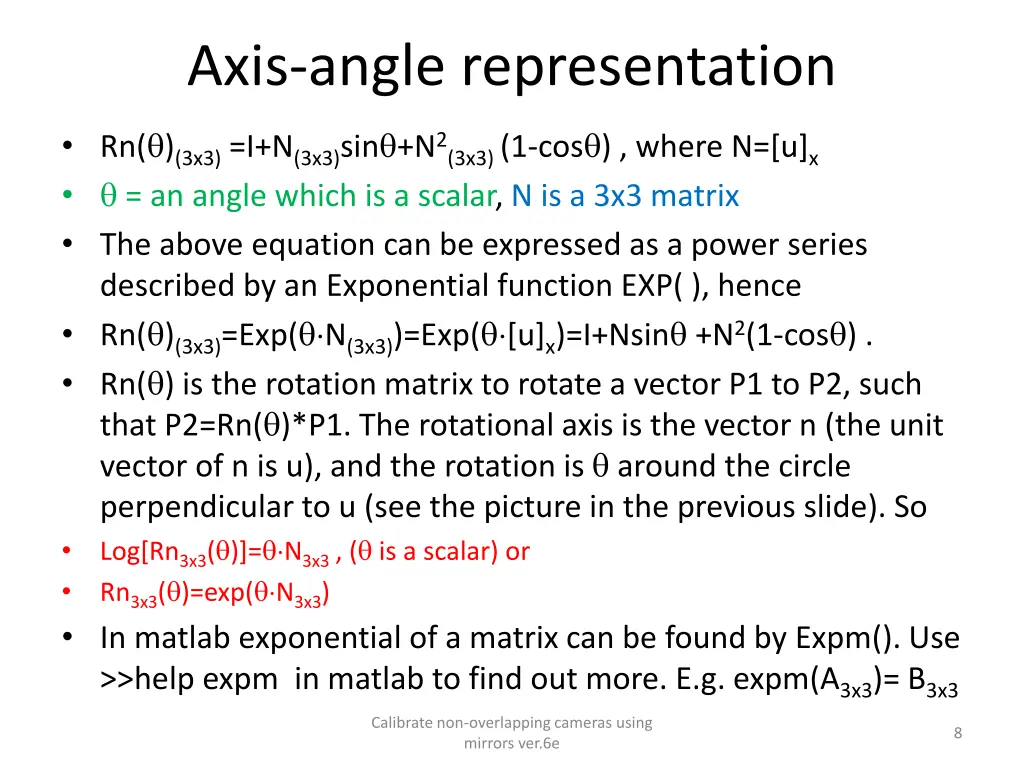
Axis-angle representation Rn( )(3x3) =I+N(3x3)sin +N2(3x3) (1-cos ) , where N=[u]x = an angle which is a scalar, N is a 3x3 matrix The above equation can be expressed as a power series described by an Exponential function EXP( ), hence Rn( )(3x3)=Exp( N(3x3))=Exp( [u]x)=I+Nsin +N2(1-cos ) . Rn( ) is the rotation matrix to rotate a vector P1 to P2, such that P2=Rn( )*P1. The rotational axis is the vector n (the unit vector of n is u), and the rotation is around the circle perpendicular to u (see the picture in the previous slide). So Log[Rn3x3( )]= N3x3 , ( is a scalar) or Rn3x3( )=exp( N3x3) In matlab exponential of a matrix can be found by Expm(). Use >>help expm in matlab to find out more. E.g. expm(A3x3)= B3x3 Calibrate non-overlapping cameras using mirrors ver.6e 8
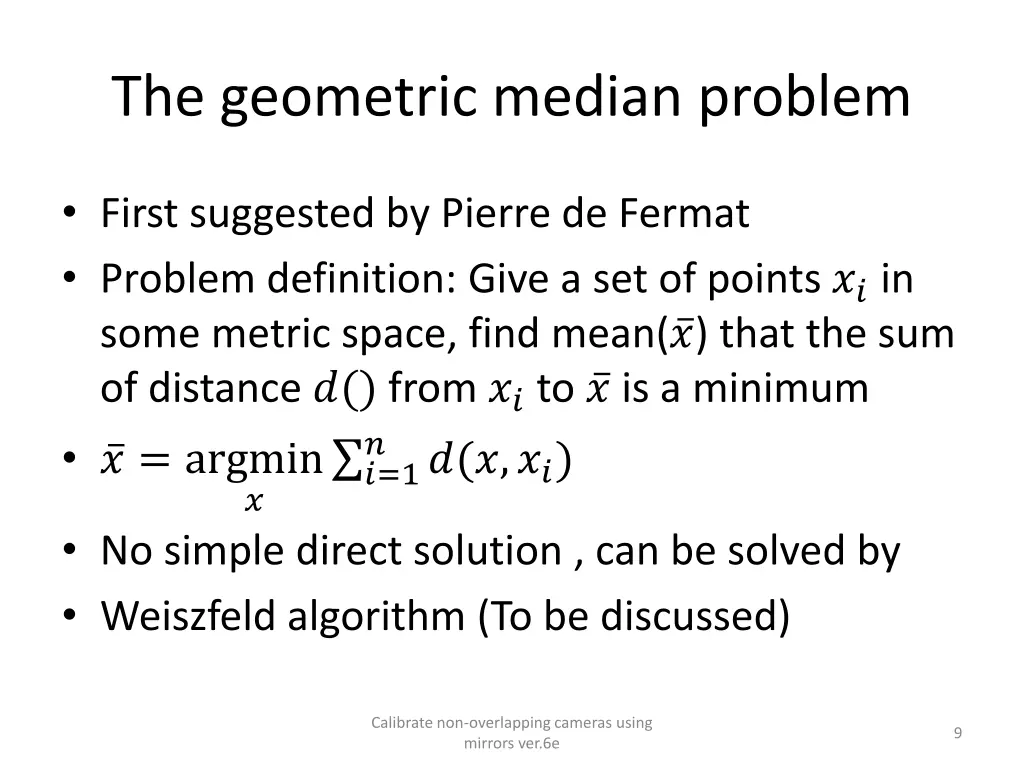
The geometric median problem First suggested by Pierre de Fermat Problem definition: Give a set of points ?? in some metric space, find mean( ?) that the sum of distance ?() from ??to ? is a minimum ? = argmin ? No simple direct solution , can be solved by Weiszfeld algorithm (To be discussed) ? ?=1 ?(?,??) Calibrate non-overlapping cameras using mirrors ver.6e 9
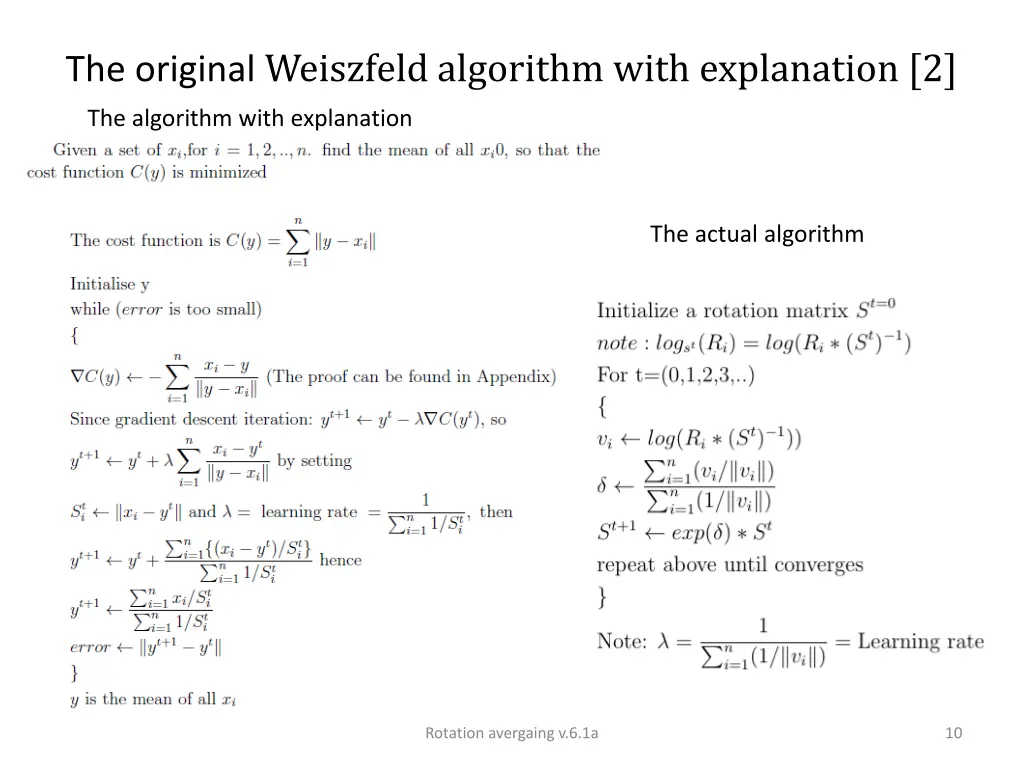
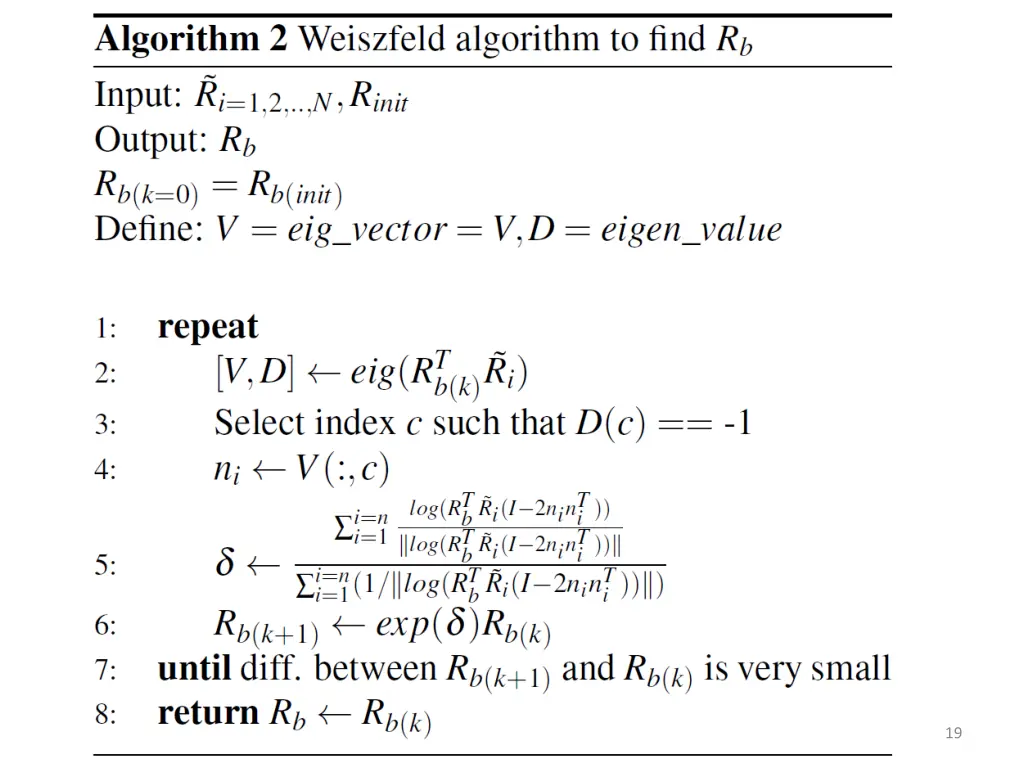
The original Weiszfeld algorithm with explanation [2] The algorithm with explanation The actual algorithm Rotation avergaing v.6.1a 10
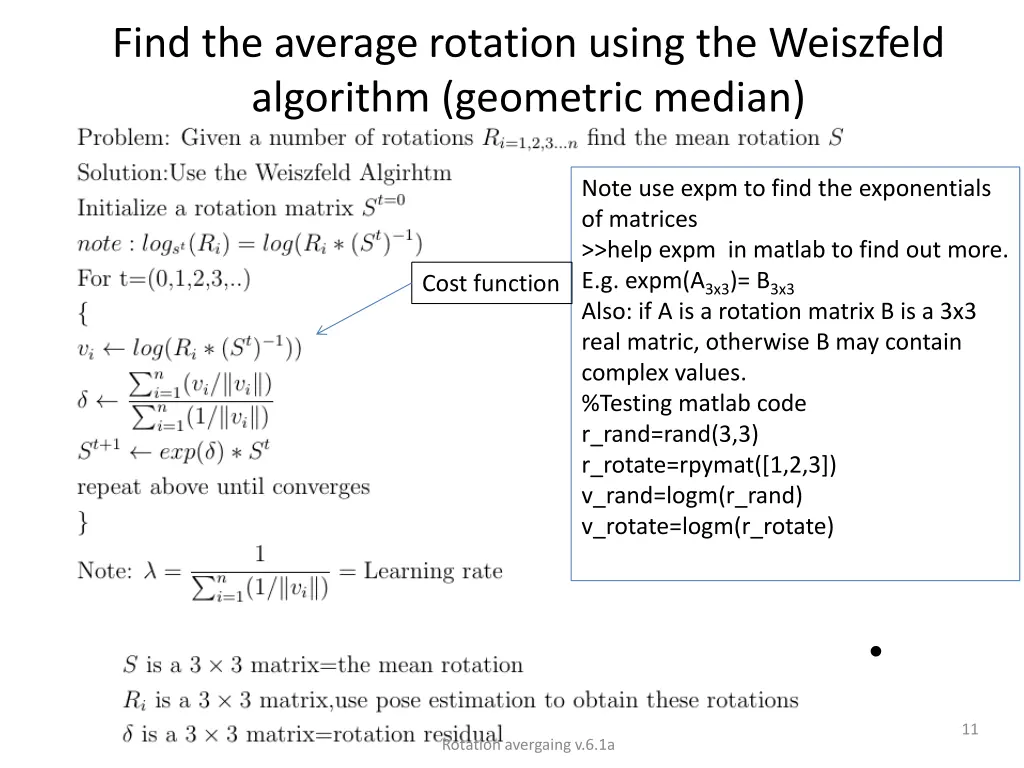
Find the average rotation using the Weiszfeld algorithm (geometric median) Note use expm to find the exponentials of matrices >>help expm in matlab to find out more. E.g. expm(A3x3)= B3x3 Also: if A is a rotation matrix B is a 3x3 real matric, otherwise B may contain complex values. %Testing matlab code r_rand=rand(3,3) r_rotate=rpymat([1,2,3]) v_rand=logm(r_rand) v_rotate=logm(r_rotate) Cost function 11 Rotation avergaing v.6.1a
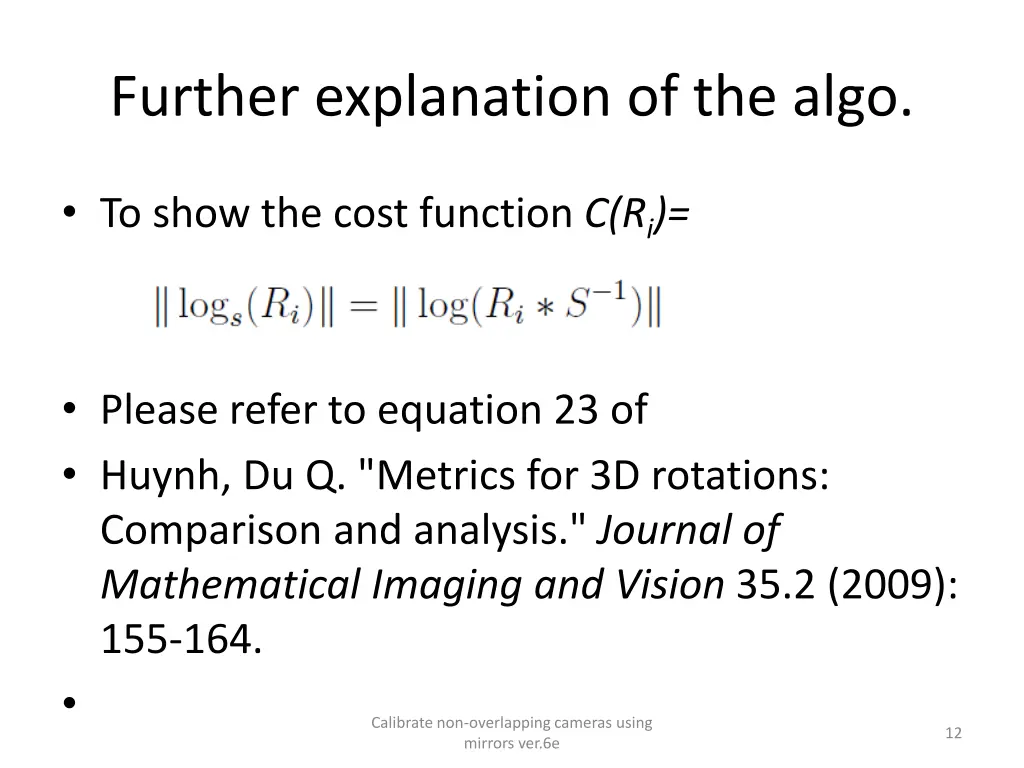
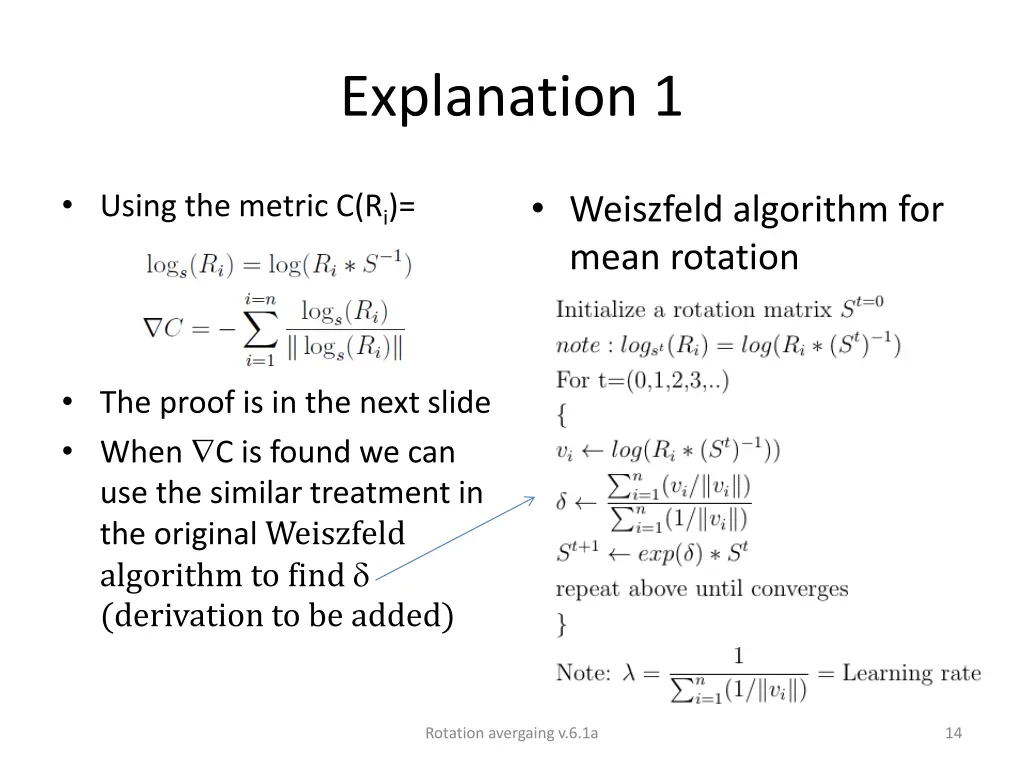
Further explanation of the algo. To show the cost function C(Ri)= Please refer to equation 23 of Huynh, Du Q. "Metrics for 3D rotations: Comparison and analysis." Journal of Mathematical Imaging and Vision 35.2 (2009): 155-164. Calibrate non-overlapping cameras using mirrors ver.6e 12
Implementation: Demo program Demo program in the attached ppt note need functions (all in the attached notes) rpyAng rpymat axis_angle2R unit_vector Calibrate non-overlapping cameras using mirrors ver.6e 13
Explanation 1 Using the metric C(Ri)= Weiszfeld algorithm for mean rotation The proof is in the next slide When C is found we can use the similar treatment in the original Weiszfeld algorithm to find (derivation to be added) Rotation avergaing v.6.1a 14
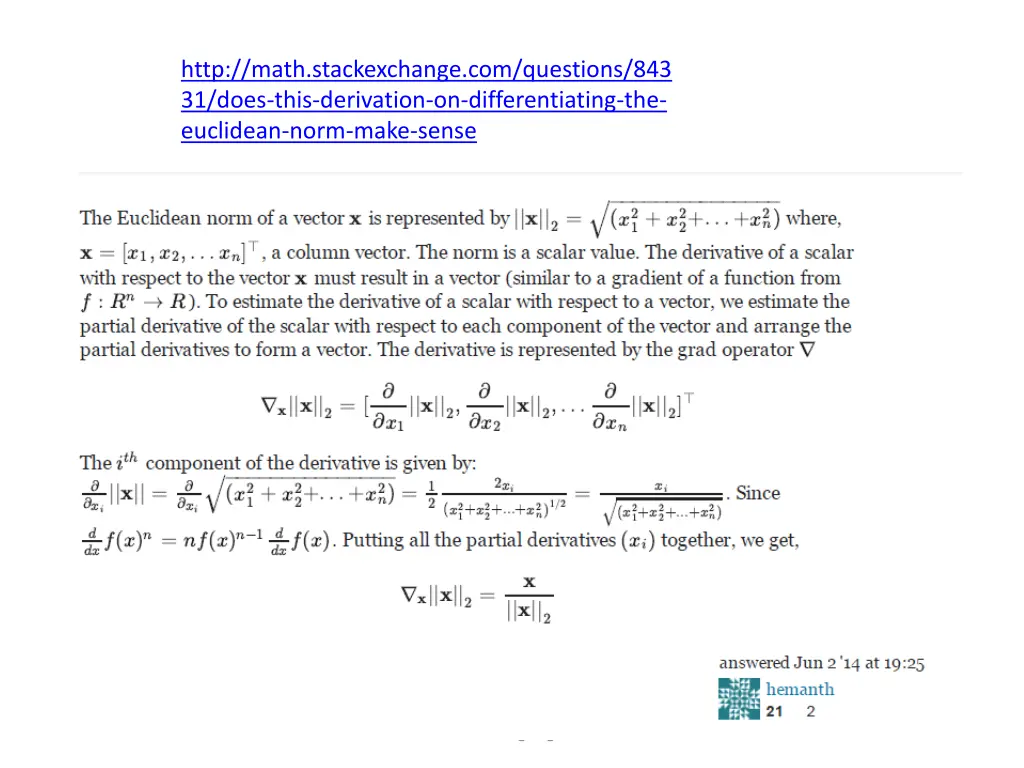
http://math.stackexchange.com/questions/843 31/does-this-derivation-on-differentiating-the- euclidean-norm-make-sense Rotation avergaing v.6.1a 15
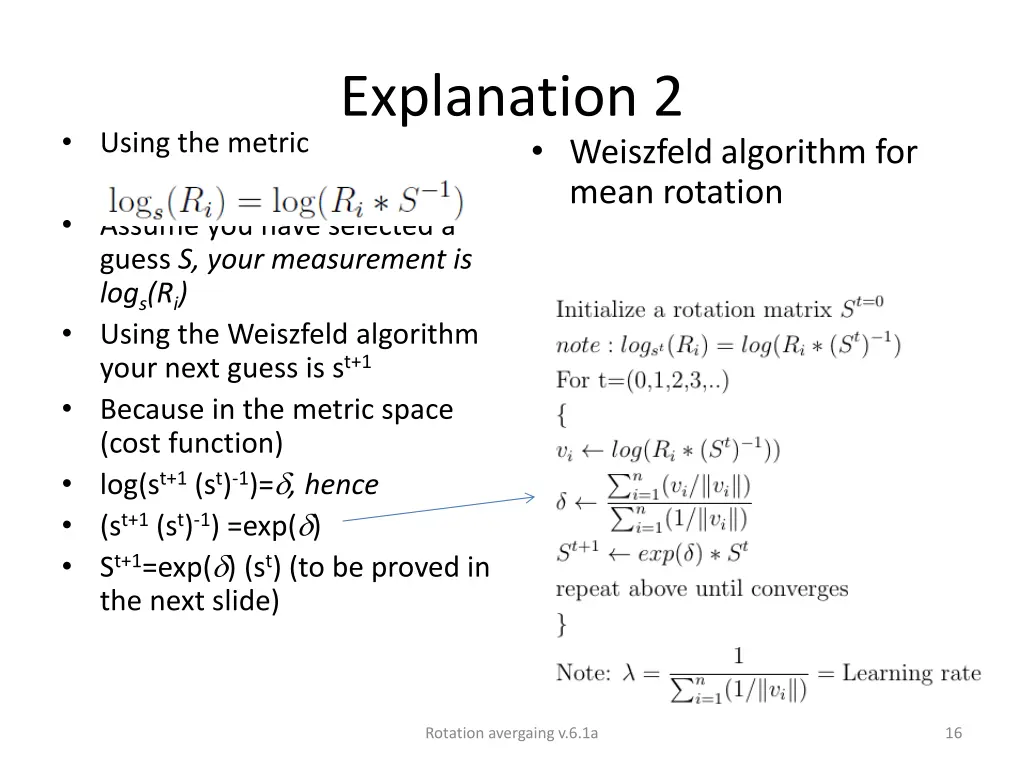
Explanation 2 Using the metric Weiszfeld algorithm for mean rotation Assume you have selected a guess S, your measurement is logs(Ri) Using the Weiszfeld algorithm your next guess is st+1 Because in the metric space (cost function) log(st+1 (st)-1)= , hence (st+1 (st)-1) =exp( ) St+1=exp( ) (st) (to be proved in the next slide) Rotation avergaing v.6.1a 16
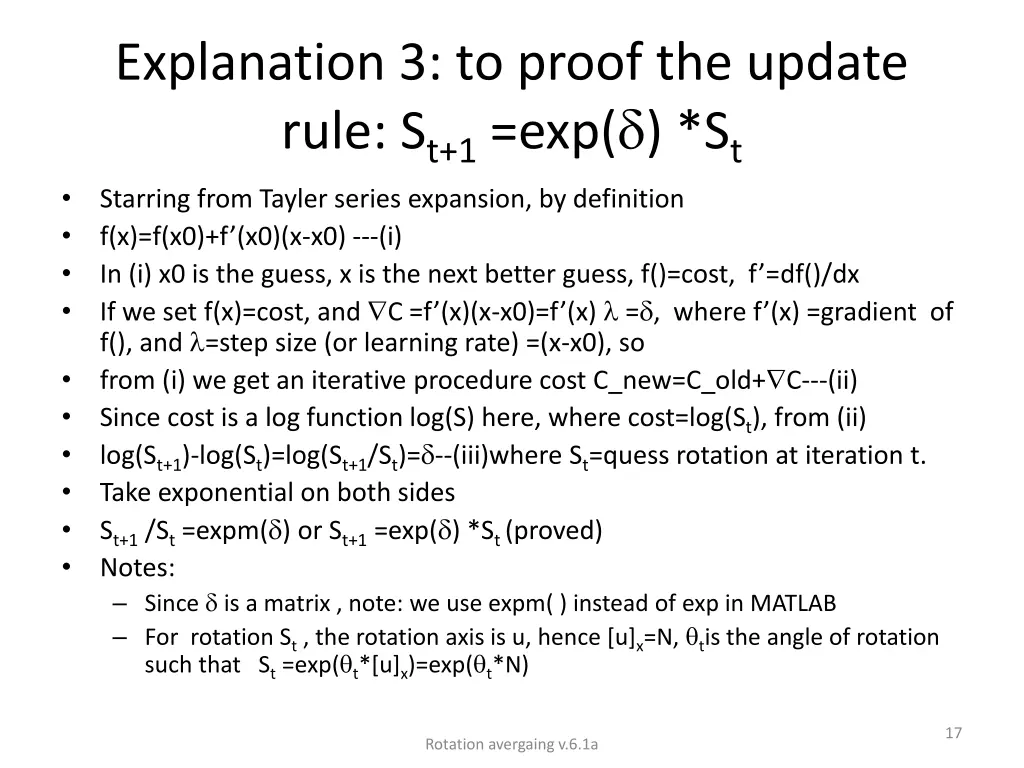
Explanation 3: to proof the update rule: St+1 =exp( ) *St Starring from Tayler series expansion, by definition f(x)=f(x0)+f (x0)(x-x0) ---(i) In (i) x0 is the guess, x is the next better guess, f()=cost, f =df()/dx If we set f(x)=cost, and C =f (x)(x-x0)=f (x) = , where f (x) =gradient of f(), and =step size (or learning rate) =(x-x0), so from (i) we get an iterative procedure cost C_new=C_old+ C---(ii) Since cost is a log function log(S) here, where cost=log(St), from (ii) log(St+1)-log(St)=log(St+1/St)= --(iii)where St=quess rotation at iteration t. Take exponential on both sides St+1 /St =expm( ) or St+1 =exp( ) *St (proved) Notes: Since is a matrix , note: we use expm( ) instead of exp in MATLAB For rotation St , the rotation axis is u, hence [u]x=N, tis the angle of rotation such that St =exp( t*[u]x)=exp( t*N) 17 Rotation avergaing v.6.1a
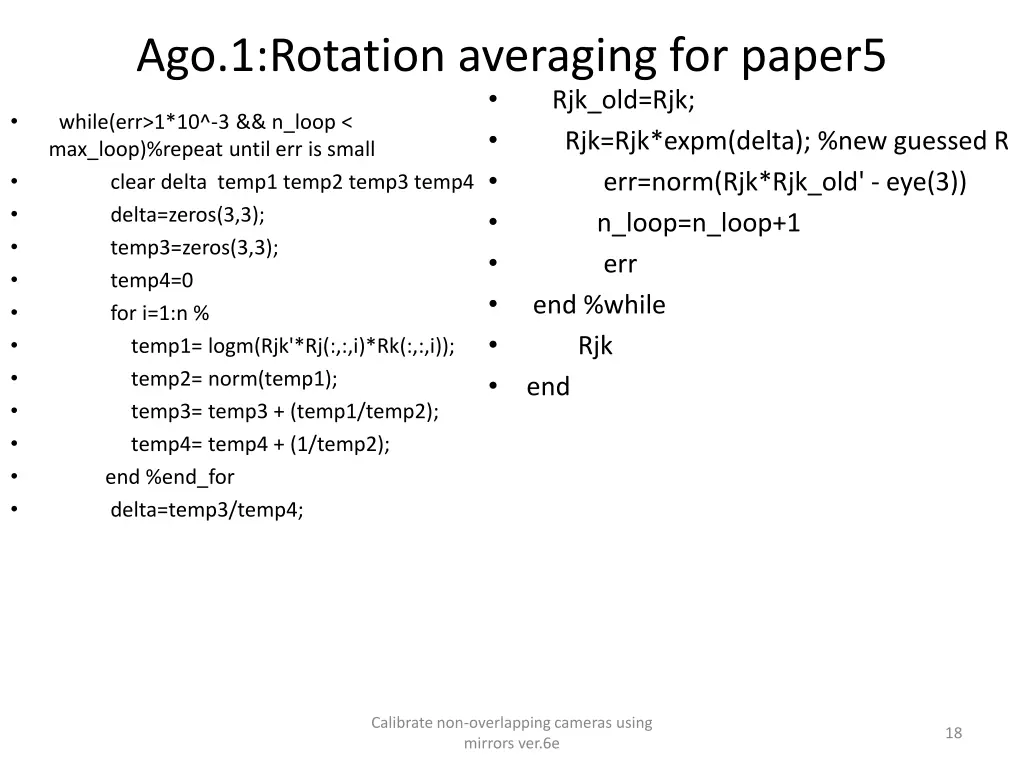
Ago.1:Rotation averaging for paper5 Rjk_old=Rjk; Rjk=Rjk*expm(delta); %new guessed R err=norm(Rjk*Rjk_old' - eye(3)) n_loop=n_loop+1 err end %while Rjk end while(err>1*10^-3 && n_loop < max_loop)%repeat until err is small clear delta temp1 temp2 temp3 temp4 delta=zeros(3,3); temp3=zeros(3,3); temp4=0 for i=1:n % temp1= logm(Rjk'*Rj(:,:,i)*Rk(:,:,i)); temp2= norm(temp1); temp3= temp3 + (temp1/temp2); temp4= temp4 + (1/temp2); end %end_for delta=temp3/temp4; Calibrate non-overlapping cameras using mirrors ver.6e 18
Calibrate non-overlapping cameras using mirrors ver.6e 19
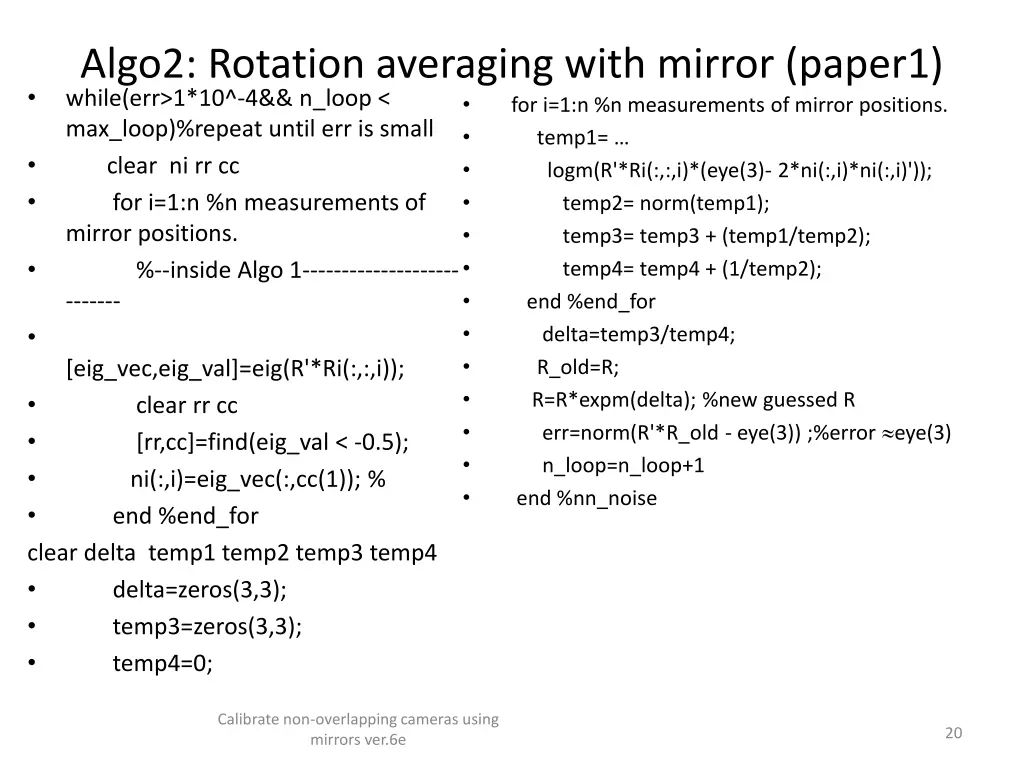
Algo2: Rotation averaging with mirror (paper1) while(err>1*10^-4&& n_loop < max_loop)%repeat until err is small clear ni rr cc for i=1:n %n measurements of mirror positions. %--inside Algo 1-------------------- ------- [eig_vec,eig_val]=eig(R'*Ri(:,:,i)); clear rr cc [rr,cc]=find(eig_val < -0.5); ni(:,i)=eig_vec(:,cc(1)); % end %end_for clear delta temp1 temp2 temp3 temp4 delta=zeros(3,3); temp3=zeros(3,3); temp4=0; for i=1:n %n measurements of mirror positions. temp1= logm(R'*Ri(:,:,i)*(eye(3)- 2*ni(:,i)*ni(:,i)')); temp2= norm(temp1); temp3= temp3 + (temp1/temp2); temp4= temp4 + (1/temp2); end %end_for delta=temp3/temp4; R_old=R; R=R*expm(delta); %new guessed R err=norm(R'*R_old - eye(3)) ;%error eye(3) n_loop=n_loop+1 end %nn_noise Calibrate non-overlapping cameras using mirrors ver.6e 20
Results Calibrate non-overlapping cameras using mirrors ver.6e 21
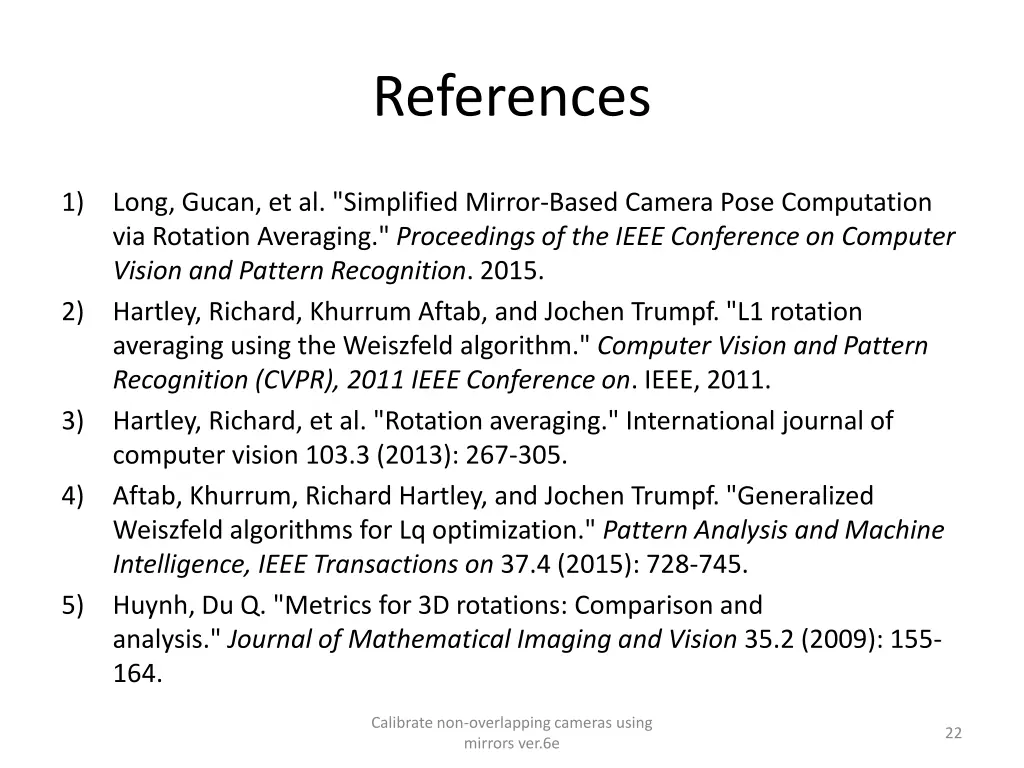
References 1) Long, Gucan, et al. "Simplified Mirror-Based Camera Pose Computation via Rotation Averaging." Proceedings of the IEEE Conference on Computer Vision and Pattern Recognition. 2015. Hartley, Richard, Khurrum Aftab, and Jochen Trumpf. "L1 rotation averaging using the Weiszfeld algorithm." Computer Vision and Pattern Recognition (CVPR), 2011 IEEE Conference on. IEEE, 2011. Hartley, Richard, et al. "Rotation averaging." International journal of computer vision 103.3 (2013): 267-305. Aftab, Khurrum, Richard Hartley, and Jochen Trumpf. "Generalized Weiszfeld algorithms for Lq optimization." Pattern Analysis and Machine Intelligence, IEEE Transactions on 37.4 (2015): 728-745. Huynh, Du Q. "Metrics for 3D rotations: Comparison and analysis." Journal of Mathematical Imaging and Vision 35.2 (2009): 155- 164. 2) 3) 4) 5) Calibrate non-overlapping cameras using mirrors ver.6e 22
Appendices Calibrate non-overlapping cameras using mirrors ver.6e 23
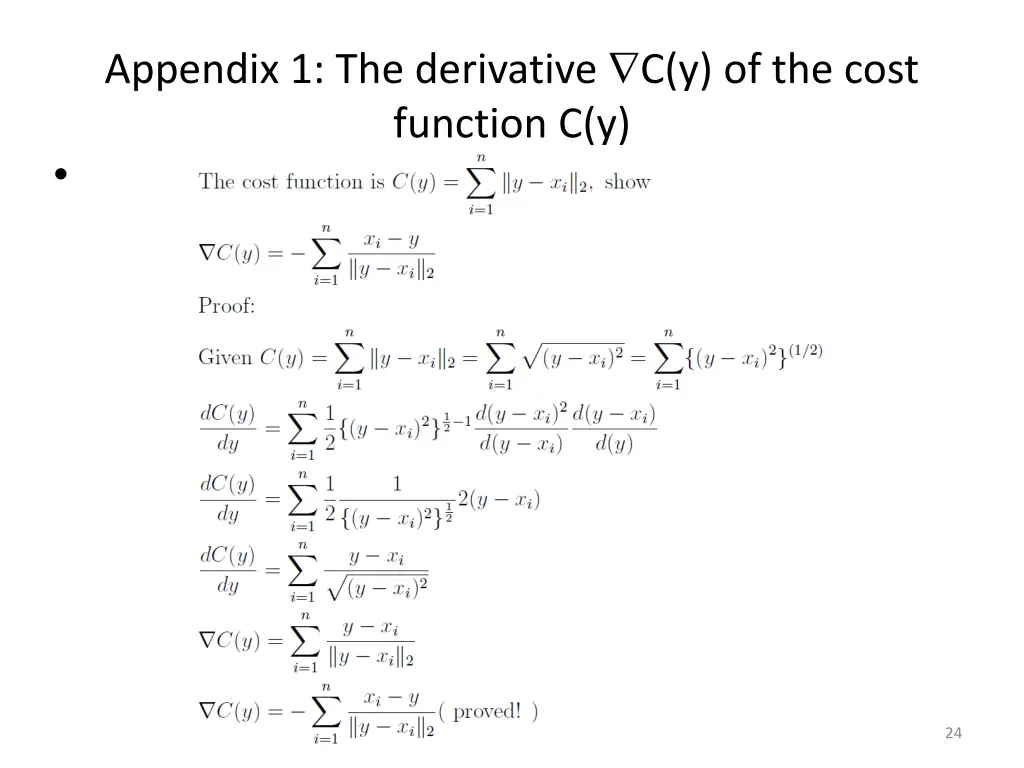
Appendix 1: The derivative C(y) of the cost function C(y) Calibrate non-overlapping cameras using mirrors ver.6e 24
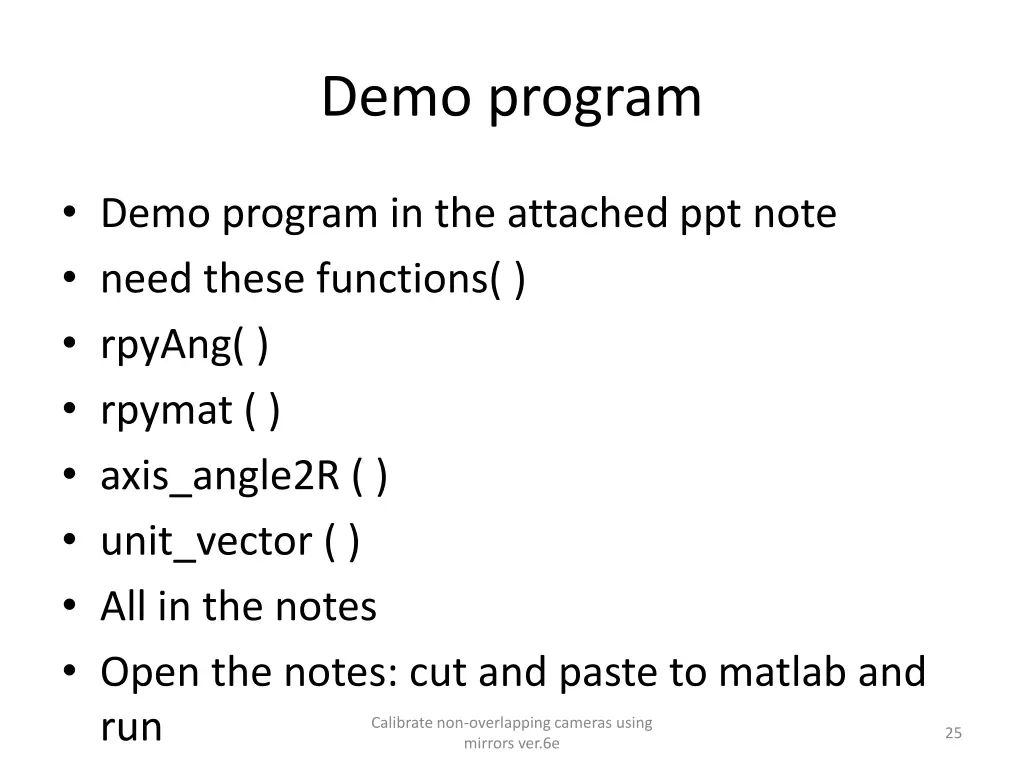
Demo program Demo program in the attached ppt note need these functions( ) rpyAng( ) rpymat ( ) axis_angle2R ( ) unit_vector ( ) All in the notes Open the notes: cut and paste to matlab and run mirrors ver.6e Calibrate non-overlapping cameras using 25
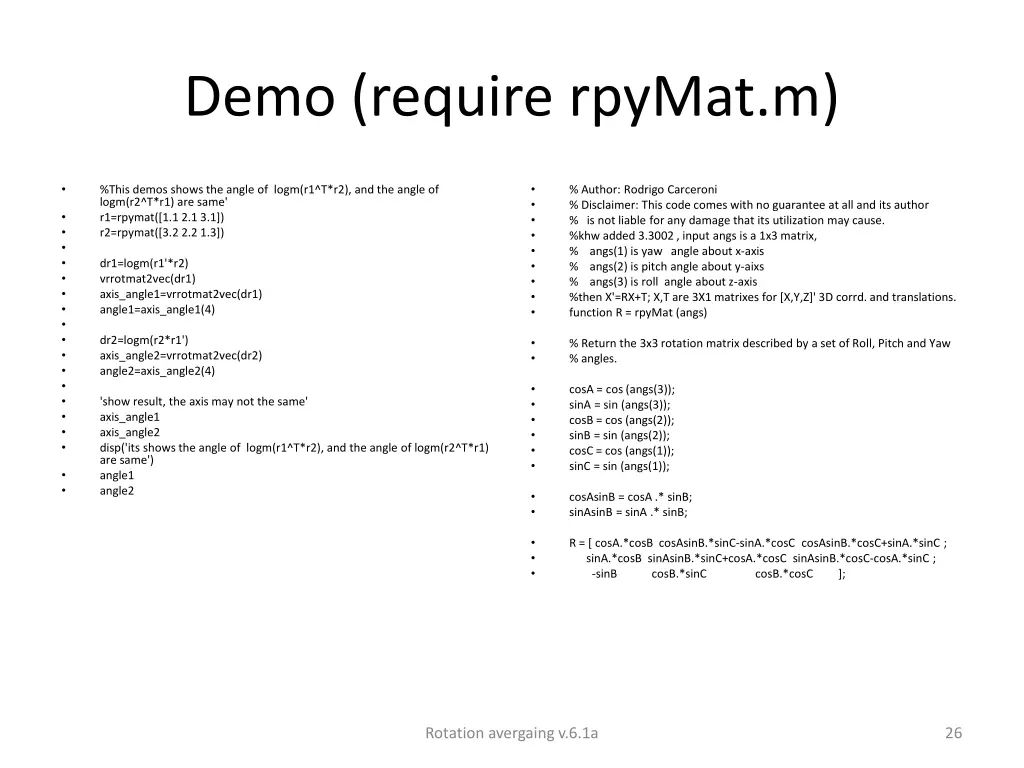
Demo (require rpyMat.m) %This demos shows the angle of logm(r1^T*r2), and the angle of logm(r2^T*r1) are same' r1=rpymat([1.1 2.1 3.1]) r2=rpymat([3.2 2.2 1.3]) dr1=logm(r1'*r2) vrrotmat2vec(dr1) axis_angle1=vrrotmat2vec(dr1) angle1=axis_angle1(4) dr2=logm(r2*r1') axis_angle2=vrrotmat2vec(dr2) angle2=axis_angle2(4) 'show result, the axis may not the same' axis_angle1 axis_angle2 disp('its shows the angle of logm(r1^T*r2), and the angle of logm(r2^T*r1) are same') angle1 angle2 % Author: Rodrigo Carceroni % Disclaimer: This code comes with no guarantee at all and its author % is not liable for any damage that its utilization may cause. %khw added 3.3002 , input angs is a 1x3 matrix, % angs(1) is yaw angle about x-axis % angs(2) is pitch angle about y-aixs % angs(3) is roll angle about z-axis %then X'=RX+T; X,T are 3X1 matrixes for [X,Y,Z]' 3D corrd. and translations. function R = rpyMat (angs) % Return the 3x3 rotation matrix described by a set of Roll, Pitch and Yaw % angles. cosA = cos (angs(3)); sinA = sin (angs(3)); cosB = cos (angs(2)); sinB = sin (angs(2)); cosC = cos (angs(1)); sinC = sin (angs(1)); cosAsinB = cosA .* sinB; sinAsinB = sinA .* sinB; R = [ cosA.*cosB cosAsinB.*sinC-sinA.*cosC cosAsinB.*cosC+sinA.*sinC ; sinA.*cosB sinAsinB.*sinC+cosA.*cosC sinAsinB.*cosC-cosA.*sinC ; -sinB cosB.*sinC cosB.*cosC ]; Rotation avergaing v.6.1a 26