Clinical Pharmacology and Therapeutic Principles in Hemostasis and Thrombosis

This content covers the main factors involved in hemostasis, thrombus formation, anticoagulants, heparin, and pharmacology of anti-platelet and thrombolytic drugs in a medical college setting. It details the processes, mechanisms of action, clinical uses, and adverse effects of these pharmacological agents.

Download Presentation

Please find below an Image/Link to download the presentation.
The content on the website is provided AS IS for your information and personal use only. It may not be sold, licensed, or shared on other websites without obtaining consent from the author.If you encounter any issues during the download, it is possible that the publisher has removed the file from their server.
You are allowed to download the files provided on this website for personal or commercial use, subject to the condition that they are used lawfully. All files are the property of their respective owners.
The content on the website is provided AS IS for your information and personal use only. It may not be sold, licensed, or shared on other websites without obtaining consent from the author.
E N D
Presentation Transcript
University of Basrah Al-Zahraa Medical College Ministry of higher Education and Scientific Research MODULE: CLINICAL PHARMACOLOGY AND THERAPEUTIC STAGE: THIRD YEAR SESSION: 8 Lecture 1 (2) YEAR: 2019-2020 MODULE STAFF: Dr.Hussain Katai Dr. Nehaya Menahi Dr.Hussain alyahyaoy Prof. Dr. Mazin Hawaz Dr. Rehab Abdul wahab Dr. Haithem Hussein Dr. Firas Rasheed Dr.Majid Hameed Dr. Ahmed Jaffer Dr. Miami Kadim Dr.Raya Muslim Dr.Raghdah Al Wiswasy Golan et al: Principles of Pharmacology: The Pathophysiologic Basis of Drug Therapy. Third Edition. Lippincott Williams and Wilkin For more discussion, questions or cases need help please post to the session group
University of Basrah Al-Zahraa Medical College Ministry of higher Education and Scientific Research LEARNING OBJECTIVES 1. Describe the main factors involved in hemostasis. 2. Understand the general features of thrombus formation and Virchow's triad. 3. To describe the Vitamin K anticoagulants including mechanism of action, pharmacokinetics, clinical use, drug interaction and adverse effects. 4. Be familiar with the International Normalised Ratio (INR).
University of Basrah Al-Zahraa Medical College Ministry of higher Education and Scientific Research LEARNING OBJECTIVES 5. To describe heparin including the two major molecular heparin groups, mechanism of action, pharmacokinetics, clinical use, drug interaction and adverse effects. 6. Be familiar with aPTT (activated partial thromboplastin time). 7. Understand the general pharmacology of anti-platelet drugs. 8. Understand the general pharmacology of thrombolytic/ fibrinolytic drugs.
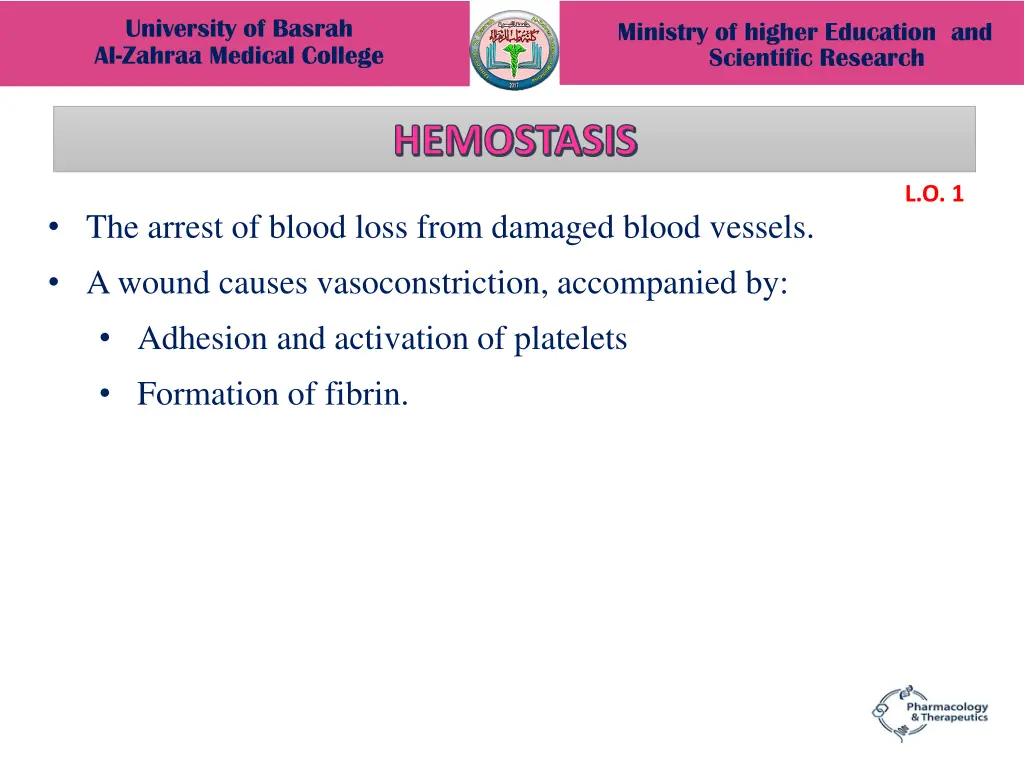
University of Basrah Al-Zahraa Medical College Ministry of higher Education and Scientific Research HEMOSTASIS L.O. 1 The arrest of blood loss from damaged blood vessels. A wound causes vasoconstriction, accompanied by: Adhesion and activation of platelets Formation of fibrin.
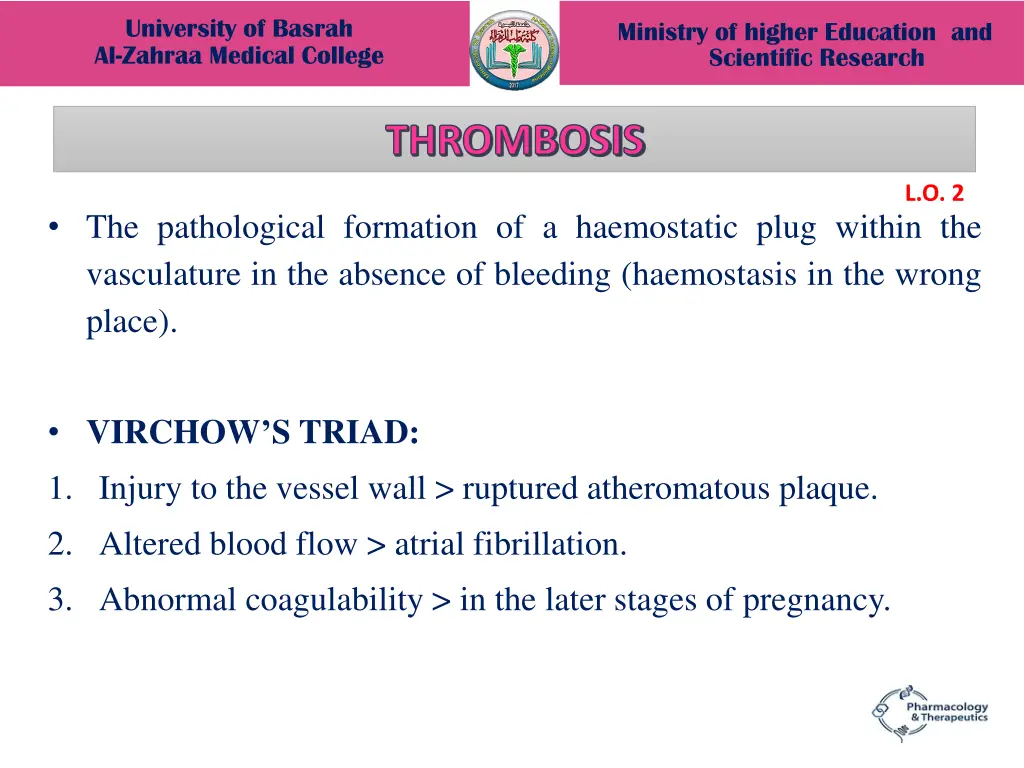
University of Basrah Al-Zahraa Medical College Ministry of higher Education and Scientific Research THROMBOSIS L.O. 2 The pathological formation of a haemostatic plug within the vasculature in the absence of bleeding (haemostasis in the wrong place). VIRCHOW S TRIAD: 1. Injury to the vessel wall > ruptured atheromatous plaque. 2. Altered blood flow > atrial fibrillation. 3. Abnormal coagulability > in the later stages of pregnancy.
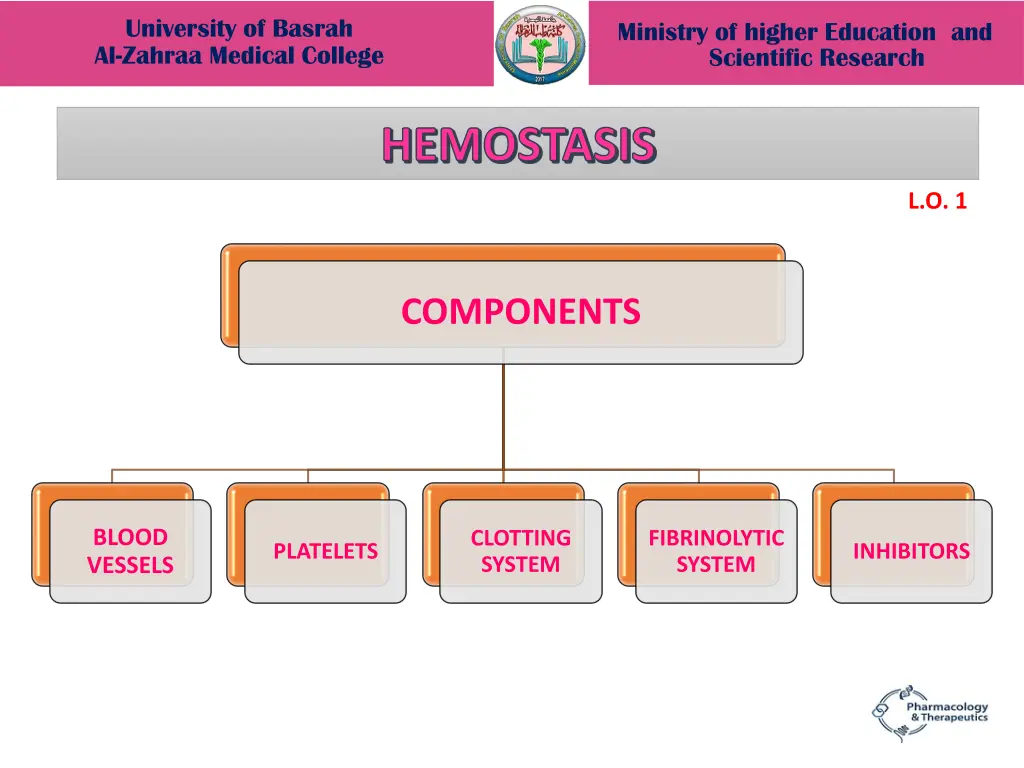
University of Basrah Al-Zahraa Medical College Ministry of higher Education and Scientific Research HEMOSTASIS L.O. 1 COMPONENTS BLOOD VESSELS CLOTTING SYSTEM FIBRINOLYTIC SYSTEM PLATELETS INHIBITORS
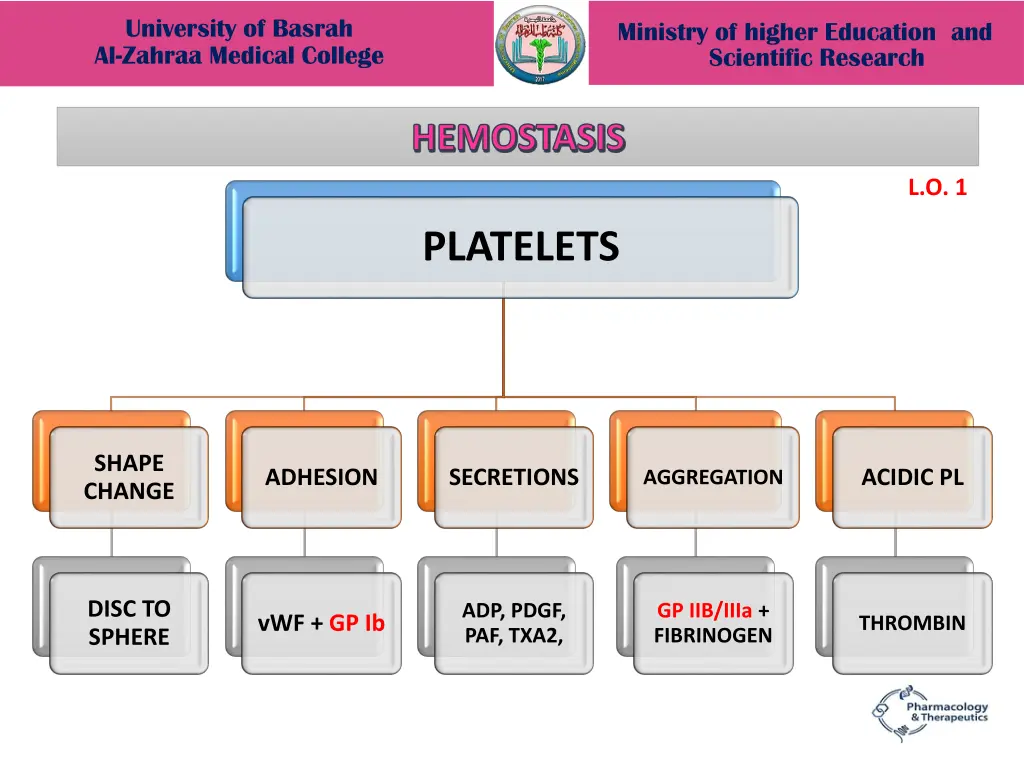
University of Basrah Al-Zahraa Medical College Ministry of higher Education and Scientific Research HEMOSTASIS L.O. 1 PLATELETS SHAPE CHANGE ADHESION SECRETIONS ACIDIC PL AGGREGATION DISC TO SPHERE ADP, PDGF, PAF, TXA2, GP IIB/IIIa + FIBRINOGEN vWF + GP Ib THROMBIN
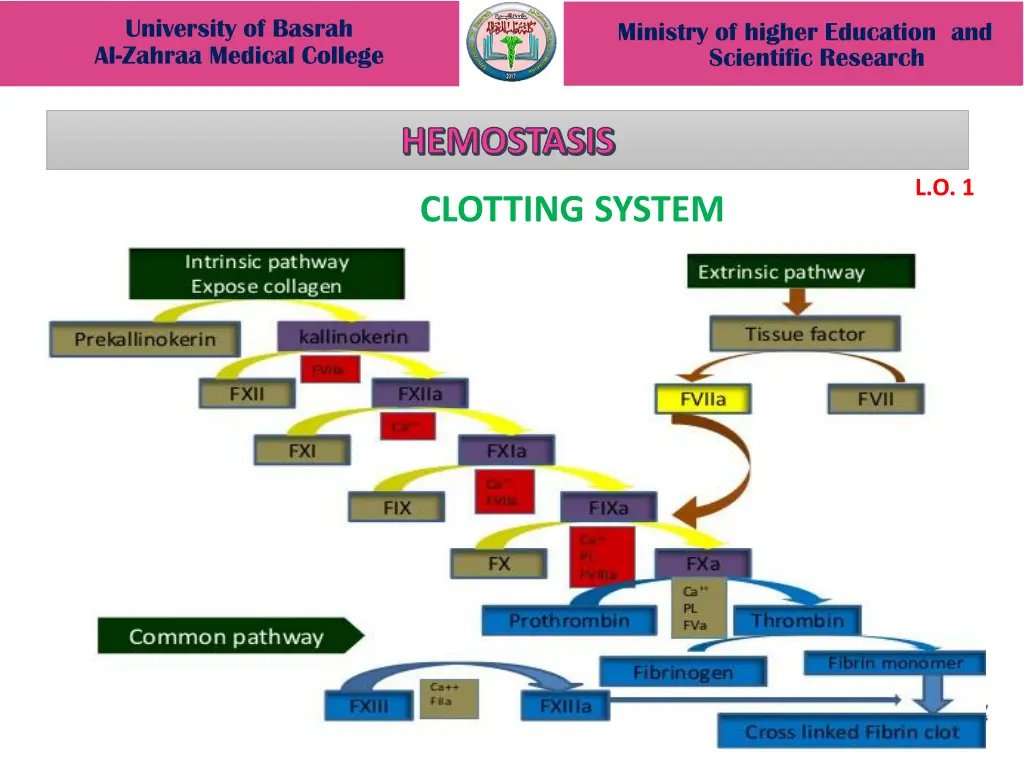
University of Basrah Al-Zahraa Medical College Ministry of higher Education and Scientific Research HEMOSTASIS L.O. 1 CLOTTING SYSTEM
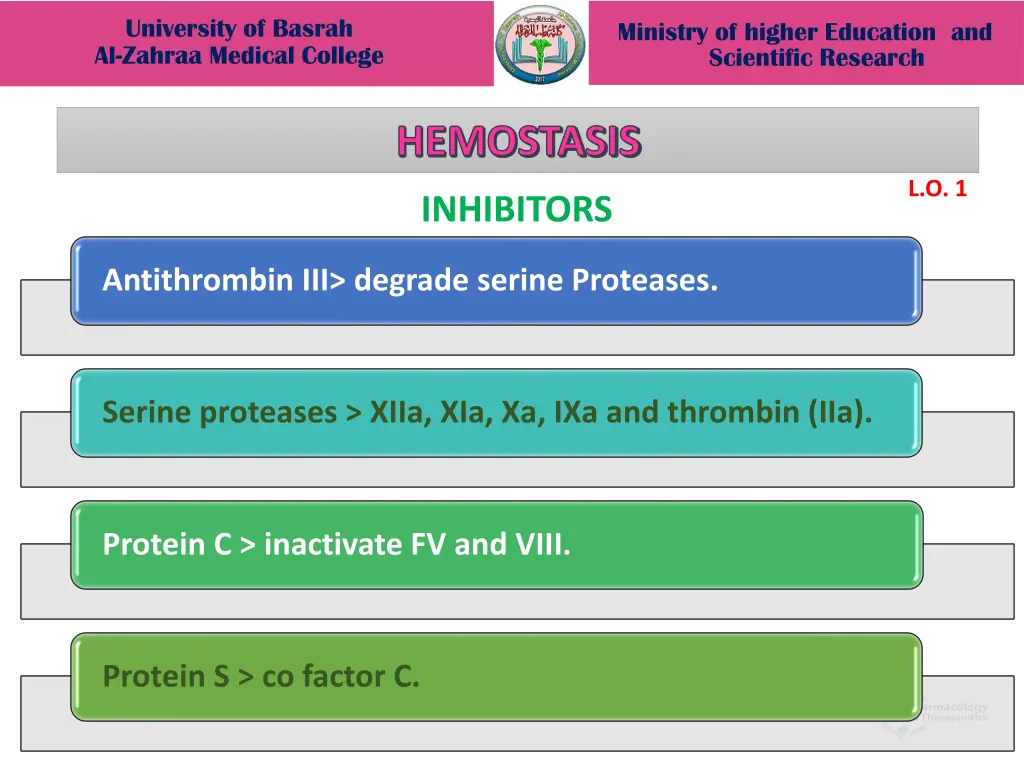
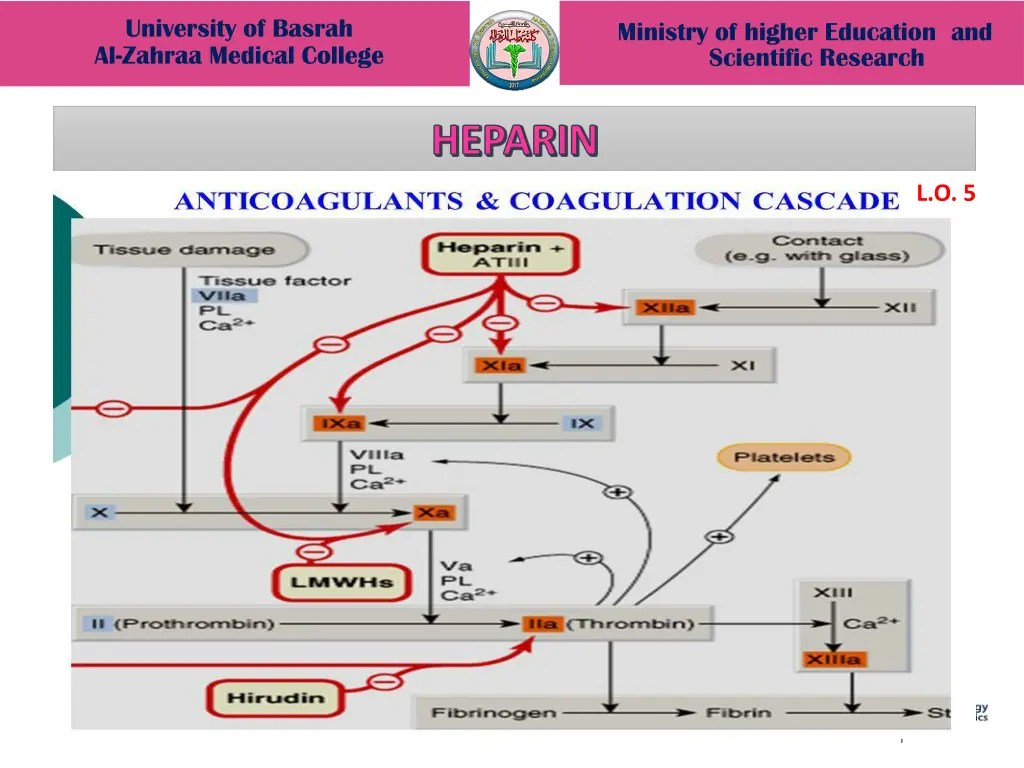
University of Basrah Al-Zahraa Medical College Ministry of higher Education and Scientific Research HEMOSTASIS L.O. 1 INHIBITORS Antithrombin III> degrade serine Proteases. Serine proteases > XIIa, XIa, Xa, IXa and thrombin (IIa). Protein C > inactivate FV and VIII. Protein S > co factor C.
University of Basrah Al-Zahraa Medical College Ministry of higher Education and Scientific Research L.O. 3 ANTICOAGULANT DRUGS Treatment and prophylaxis of disorders resulting from intravascular clotting to prevent or treat red thrombus
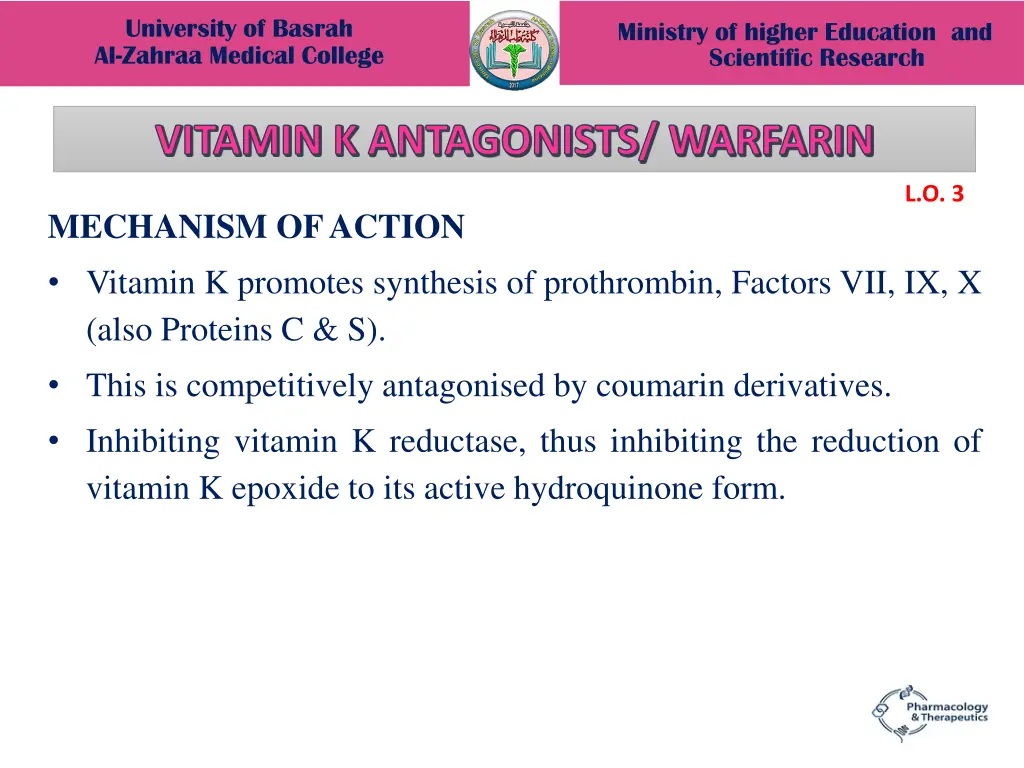
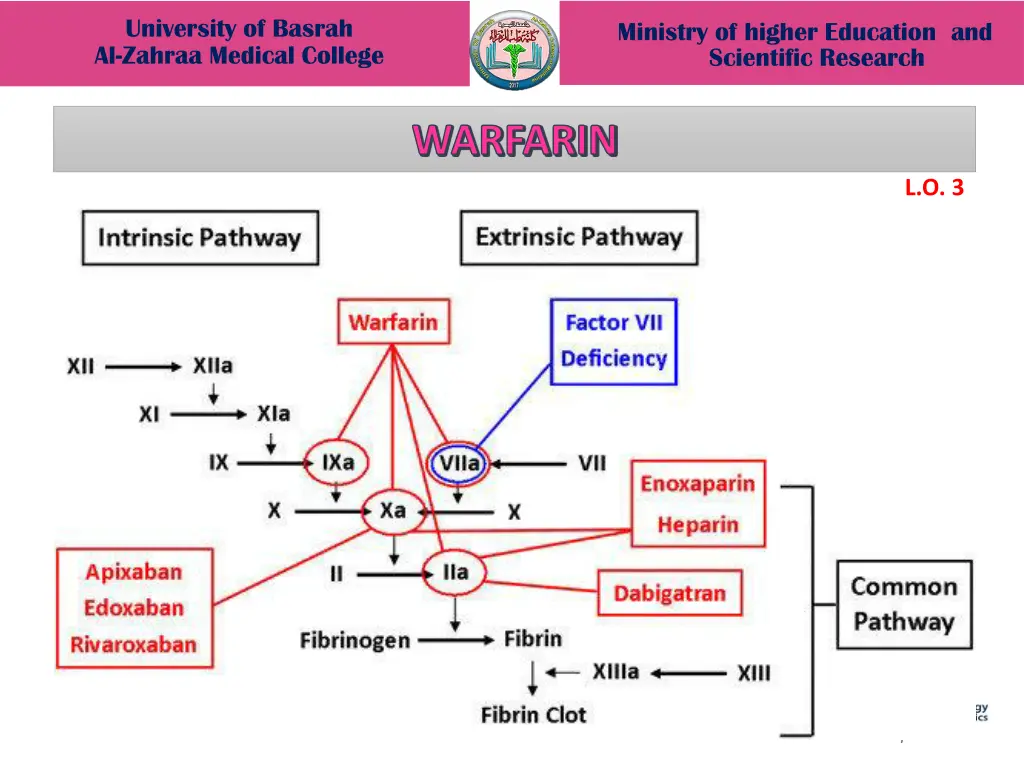
University of Basrah Al-Zahraa Medical College Ministry of higher Education and Scientific Research VITAMIN K ANTAGONISTS/ WARFARIN L.O. 3 MECHANISM OF ACTION Vitamin K promotes synthesis of prothrombin, Factors VII, IX, X (also Proteins C & S). This is competitively antagonised by coumarin derivatives. Inhibiting vitamin K reductase, thus inhibiting the reduction of vitamin K epoxide to its active hydroquinone form.
University of Basrah Al-Zahraa Medical College Ministry of higher Education and Scientific Research WARFARIN L.O. 3
University of Basrah Al-Zahraa Medical College Ministry of higher Education and Scientific Research VITAMIN K ANTAGONISTS L.O. 3 PRACTICAL PHARMACOKINETICS GI absorption > oral dosing. Extreme variation in individual dose requirement. Dose dependent reduction in vitamin K dependent factors. Different degrees of anticoagulation depending on condition.
University of Basrah Al-Zahraa Medical College Ministry of higher Education and Scientific Research VITAMIN K ANTAGONISTS L.O. 3 PRACTICAL PHARMACOKINETICS Gradual onset of activity > because of the time taken for degradation of preformed carboxylated clotting factors. Prolong anticoagulant action on cessation of treatment. Monitor dose by INR. Numerous drug interactions resulting in altered anticoagulant effect.
University of Basrah Al-Zahraa Medical College Ministry of higher Education and Scientific Research VITAMIN K ANTAGONISTS L.O. 3 ADVERSE EFFECTS Excessive bleeding/bruising/purpura. In pregnancy teratogenicity. REVERSAL OF THERAPY Antagonism of therapy by administration of Vitamin K.
University of Basrah Al-Zahraa Medical College Ministry of higher Education and Scientific Research HEPARIN L.O. 5 MECHANISM OF ACTION Linear mucopolysaccharide chains (glycosaminoglycans) of variable length and Molecular Weight (12000-15000 Daltons). Heparin inhibits coagulation by activating antithrombin III. Active site is a pentasaccharide sequence which binds to Antithrombin III. Markedly increases antithrombin-mediated predominantly Thrombin and Xa, (but also Factors IXa, XIa XIIa). inhibition of
University of Basrah Al-Zahraa Medical College Ministry of higher Education and Scientific Research HEPARIN L.O. 5
University of Basrah Al-Zahraa Medical College Ministry of higher Education and Scientific Research HEPARIN L.O. 5 PRACTICAL PHARMACOKINETICS Poor GI absorption (-ve charge and high molecular weight); therefore administered iv/sc. Rapid onset/offset of anticoagulant activity. Variable bioavailability due to binding to plasma proteins. Dose/effect monitored by APTT.
University of Basrah Al-Zahraa Medical College Ministry of higher Education and Scientific Research HEPARIN L.O. 5 ADVERSE EFFECTS Bleeding/bruising. Thrombocytopenia. Hypoaldosteronism\ hyperkalemia. Osteoporosis (long term administration > 6 months). REVERSAL OF THERAPY Protamine sulphate (strongly basic protein) causes dissociation of Heparin/Antithrombin complex & binds irreversibly to heparin.
University of Basrah Al-Zahraa Medical College Ministry of higher Education and Scientific Research L.O. 7 ANTIPLATELET AGENTS Treatment and prophylaxis of disorders resulting from intravascular clotting (especially that with predominant platelet aggregation e.g. arterial disease)
University of Basrah Al-Zahraa Medical College Ministry of higher Education and Scientific Research THROMBOXANE A2 INHIBITORS (Aspirin, Dipyridamole) L.O. 7 Thromboxane A2 is liberated from activated platelets and causes platelet aggregation and vasoconstriction. Aspirin inhibits cyclooxygenase (COX I) and therefore platelet thromboxane A2 production. Irreversible (new platelet > 7-10 days). May lead to gastric erosions/ulcers.
University of Basrah Al-Zahraa Medical College Ministry of higher Education and Scientific Research THROMBOXANE A2 INHIBITORS (Aspirin, Dipyridamole) L.O. 7 Dipyridamole inhibits platelet phosphodiesterase, rising platelet levels and inhibit Thromboxane A2 production. The main side effects of dipyridamole are dizziness, headache and gastrointestinal disturbances; unlike aspirin, it does not increase the risk of bleeding.
University of Basrah Al-Zahraa Medical College Ministry of higher Education and Scientific Research ADENOSINE RECEPTOR ANTAGONISTS (THIENOPYRIDINES) (Clopidogrel, Ticlopidine) L.O. 7 ADP/ADP-receptor interaction is one of many stimuli for platelet aggregation. These drugs inhibit ADP-induced platelet aggregation by irreversible inhibition of ADP receptors. Ticlopidine was the first to be introduced, but causes neutropenia and thrombocytopenia and is now little used.
University of Basrah Al-Zahraa Medical College Ministry of higher Education and Scientific Research GPIIB/IIIA INHIBITORS L.O. 7 Inhibit final common pathway of platelet aggregation. 3 classes: 1. Monoclonal antibodies to GpIIb/IIIa receptor. 2. Peptide antagonists to GpIIb/IIIa receptor. 3. Non-peptide small molecule antagonists of GpIIb/IIIa receptor.
University of Basrah Al-Zahraa Medical College Ministry of higher Education and Scientific Research INDICATIONS L.O. 7 Acute myocardial infarction/ High risk of myocardial infarction. Following coronary artery bypass grafting/ Stenting. Transient cerebral ischaemic attack. Atrial fibrillation.
University of Basrah Al-Zahraa Medical College Ministry of higher Education and Scientific Research L.O. 8 THROMBOLYTIC/ FIBRINOLYTIC THERAPY
University of Basrah Al-Zahraa Medical College Ministry of higher Education and Scientific Research PHARMACOKINETICS & PHARMACODYNAMICS L.O. 8 Plasmin > thrombi clearance (cleaves fibrin, fibrinogen and Factors II, V and VIII). Plasmin is formed from plasminogen by plasminogen activators e.g. tissue plasminogen activators (tPA) and urokinase-type plasminogen activator (uPA). The fibrinolytic system is itself regulated by circulating inhibitors such as plasminogen activator inhibitor 1 (PAI-1).
University of Basrah Al-Zahraa Medical College Ministry of higher Education and Scientific Research PHARMACOKINETICS & PHARMACODYNAMICS L.O. 8 Fibrinolytic drugs generate plasmin: Themselves (alteplase). It works preferentially in the presence of fibrin and is therefore described as clot-specific i.e. fibrin bound plasminogen. Activating endogenous plasminogen (e.g. streptokinase). It causes a degree of fibrinolytic activity in the general circulation i.e. plasma plasminogen. The practical significance of this difference is uncertain.
University of Basrah Al-Zahraa Medical College Ministry of higher Education and Scientific Research STREPTOKINASE L.O. 8 A bacterial protein (antigenic). Can cause allergic reactions (major in about 0.1%). Cannot be used twice since it invariably generates blocking antibodies which persist for many years. Commonly causes transient hypotension although the blood pressure usually comes up again if the infusion is slowed.
University of Basrah Al-Zahraa Medical College Ministry of higher Education and Scientific Research ALTEPLASE L.O. 8 Alteplase is recombinant tPA. Not antigenic. Streptokinase and alteplase have been of very similar efficacy in acute myocardial infarction (ISIS-3 and GISSI studies). Alteplase achieved a very slightly greater mortality reduction partly offset by an increased risk of haemorrhagic stroke (GUSTO study). Fibrinolytic therapy within the first 1-2 hours of onset of myocardial infarction will prevent up to 60 deaths per thousand patients treated. Newer agents e.g. duteplase and reteplase (longer elimination half time).
University of Basrah Al-Zahraa Medical College Ministry of higher Education and Scientific Research UROKINASE L.O. 8 Urokinase is produced from cultured human embryonic kidney cells but is not licensed for use in myocardial infarction.
University of Basrah Al-Zahraa Medical College Ministry of higher Education and Scientific Research INDICATIONS/ CLINICAL USE L.O. 8 1. Acute myocardial infarction. Clear evidence from the history and ECG of acute myocardial infarction <12 hours duration with the absence of major contraindications. It is essential that fibrinolytic treatment (plus aspirin) is started as quickly as possible after diagnosis to minimise myocardial necrosis. 2. Pulmonary embolism. A clear diagnosis, evidence of significant haemodynamic compromise and absence of major contraindications. 3. Major venous thrombosis.
University of Basrah Al-Zahraa Medical College Ministry of higher Education and Scientific Research INDICATIONS/ CLINICAL USE L.O. 8 4. Ischaemic stroke (haemorrhage is excluded by CT or MRI). Their use is not routine because of the associated risk of induced cerebral haemorrhage and narrow time-window of potential benefit. 5. Clearance of thrombosed shunts or intraocular thrombosis > less common.
University of Basrah Al-Zahraa Medical College Ministry of higher Education and Scientific Research INDICATIONS/ CLINICAL USE L.O. 8 In each case, early treatment is essential before the consequences of vascular occlusion become irreversible. Furthermore, as they age, thrombi become more resistant to lysis. The potential benefit of treatment declines continuously over time, whereas the risks remain constant. The window of opportunity is within approximately 12 hours for coronary occlusion, rather longer for venous thrombo-embolism but only about 3 hours for ischaemic stroke.
University of Basrah Al-Zahraa Medical College Ministry of higher Education and Scientific Research MAJOR CONTRAINDICATIONS L.O. 8 1. Active peptic ulcer or other potential bleeding source. 2. Recent trauma or surgery. 3. History of cerebral haemorrhage or stroke of uncertain aetiology. 4. Uncontrolled hypertension. 5. Coagulation defects. 6. Streptokinase should not be given to a patient who has received it in the past. 7. Age per se is not a contraindication.
University of Basrah Al-Zahraa Medical College Ministry of higher Education and Scientific Research ADVERSE EFFECTS L.O. 8 Risk of haemorrhage, most seriously into the brain (0.1-0.2% of patients) or into the gastrointestinal tract (major in 0.5-1.0%). Careful patient selection is important to ensure that the potential benefit outweighs these risks. Informed consent should be sought from the patient.
University of Basrah Al-Zahraa Medical College Ministry of higher Education and Scientific Research TREATMENT OF ADVERSE EFFECTS L.O. 8 STREPTOKINASE Hypotension is common > slowing or briefly stopping the infusion. Allergic reactions > the treatment be stopped and a non-immunogenic alternative given instead. Anaphylaxis > adrenaline, oxygen, intravenous fluids, an antihistamine and hydrocortisone as required.
University of Basrah Al-Zahraa Medical College Ministry of higher Education and Scientific Research TREATMENT OF ADVERSE EFFECTS L.O. 8 Any cerebrovascular event > CT or MRI > to establish whether the cause is haemorrhagic (i.e. treatment related) or ischaemic (i.e. probably embolic from the heart). The two are equally likely after fibrinolytic treatment of myocardial infarction. Serious bleeding: Transfusion of blood or volume expanders. Inhibition of further fibrinolysis with tranexamic acid or aprotinin, specific recombinant or pooled clotting factors.
University of Basrah Al-Zahraa Medical College Ministry of higher Education and Scientific Research