Learn about the compliance assurance checks conducted on Children's Disability Network Teams in Q2 2023, with findings on areas of compliance and reasons for partial or no compliance.
Please find below an Image/Link to download the presentation.
The content on the website is provided AS IS for your information and personal use only. It may not be sold, licensed, or shared on other websites without obtaining consent from the author. If you encounter any issues during the download, it is possible that the publisher has removed the file from their server.
You are allowed to download the files provided on this website for personal or commercial use, subject to the condition that they are used lawfully. All files are the property of their respective owners.
The content on the website is provided AS IS for your information and personal use only. It may not be sold, licensed, or shared on other websites without obtaining consent from the author.
E N D
Presentation Transcript
Children First Compliance Assurance Checks Overview Report Children's Disability Network Teams | Q22023
Services selected for Compliance Check Children's Disability Network Teams were selected for HSE Children First Compliance Assurance Checks in Q2 2023. All Heads of Service for Disability Services and CDNT Managers were invited to attend an Information Session which took place on 20th April 2023. All were provided with a copy of the HSE Children First Compliance Assurance Framework. Seven CDNTs were randomly selected to undergo a HSE Children First Compliance Assurance Check. Two were HSE services and five were led by a HSE Funded Agency. Compliance Assurance Checks took place between April and July 2023.
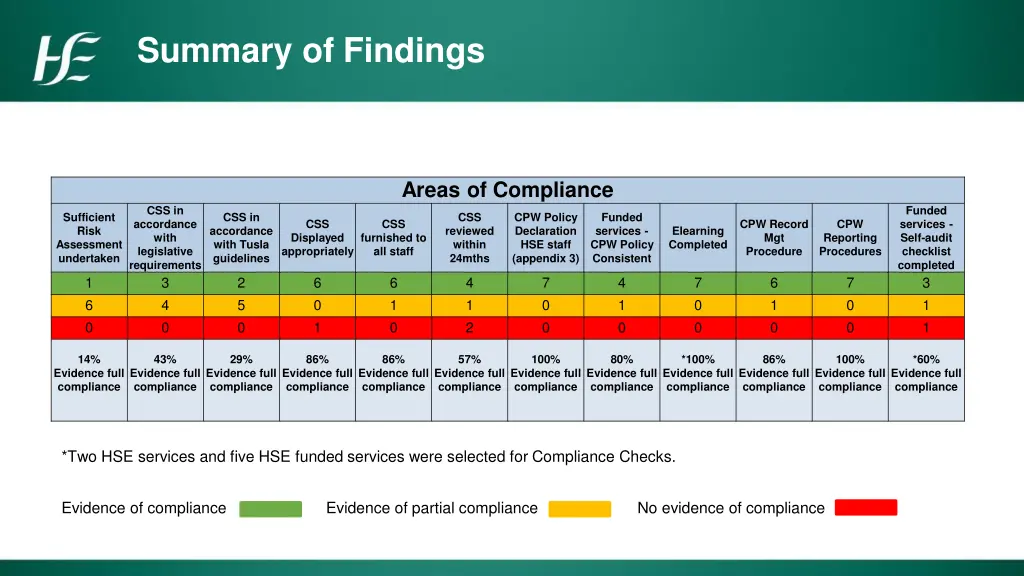
Summary of Findings Areas of Compliance CSS in accordance with legislative requirements 3 4 0 Funded services - Self-audit checklist completed 3 1 1 Sufficient Risk Assessment undertaken CSS in accordance with Tusla guidelines CSS reviewed within 24mths CPW Policy Declaration HSE staff (appendix 3) Funded services - CPW Policy Consistent CSS CSS CPW Record Mgt Procedure CPW Reporting Procedures Elearning Completed Displayed appropriately furnished to all staff 1 6 0 2 5 0 6 0 1 6 1 0 4 1 2 7 0 0 4 1 0 7 0 0 6 1 0 7 0 0 14% 43% 29% 86% 86% 57% 100% 80% *100% 86% 100% *60% Evidence full compliance Evidence full compliance Evidence full compliance Evidence full compliance Evidence full compliance Evidence full compliance Evidence full compliance Evidence full compliance Evidence full compliance Evidence full compliance Evidence full compliance Evidence full compliance *Two HSE services and five HSE funded services were selected for Compliance Checks. Evidence of compliance Evidence of partial compliance No evidence of compliance
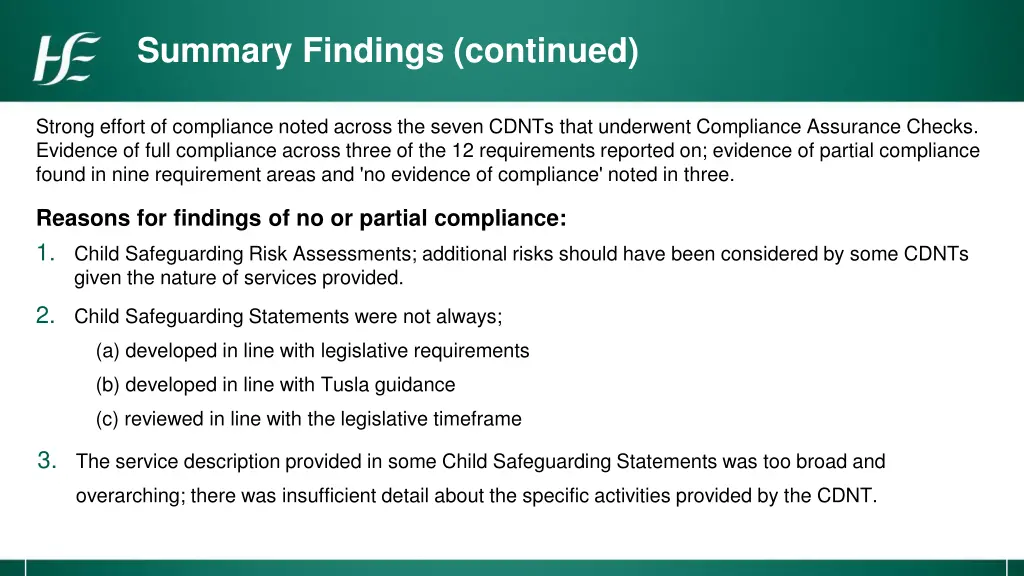
Summary Findings (continued) Strong effort of compliance noted across the seven CDNTs that underwent Compliance Assurance Checks. Evidence of full compliance across three of the 12 requirements reported on; evidence of partial compliance found in nine requirement areas and 'no evidence of compliance' noted in three. Reasons for findings of no or partial compliance: 1. Child Safeguarding Risk Assessments; additional risks should have been considered by some CDNTs given the nature of services provided. 2. Child Safeguarding Statements were not always; (a) developed in line with legislative requirements (b) developed in line with Tusla guidance (c) reviewed in line with the legislative timeframe 3. The service description provided in some Child Safeguarding Statements was too broad and overarching; there was insufficient detail about the specific activities provided by the CDNT.
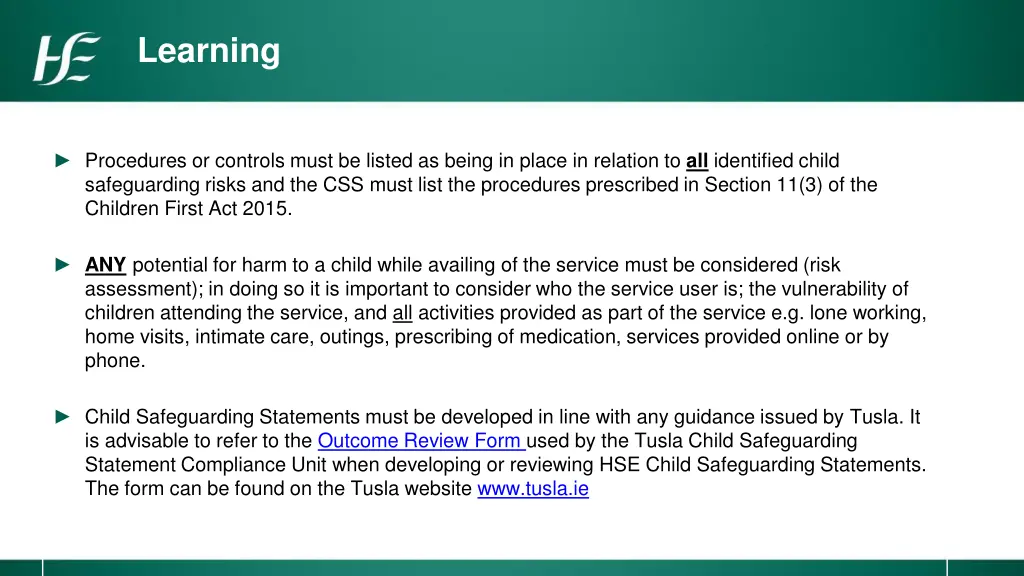
Learning Procedures or controls must be listed as being in place in relation to all identified child safeguarding risks and the CSS must list the procedures prescribed in Section 11(3) of the Children First Act 2015. ANY potential for harm to a child while availing of the service must be considered (risk assessment); in doing so it is important to consider who the service user is; the vulnerability of children attending the service, and all activities provided as part of the service e.g. lone working, home visits, intimate care, outings, prescribing of medication, services provided online or by phone. Child Safeguarding Statements must be developed in line with any guidance issued by Tusla. It is advisable to refer to the Outcome Review Form used by the Tusla Child Safeguarding Statement Compliance Unit when developing or reviewing HSE Child Safeguarding Statements. The form can be found on the Tusla website www.tusla.ie
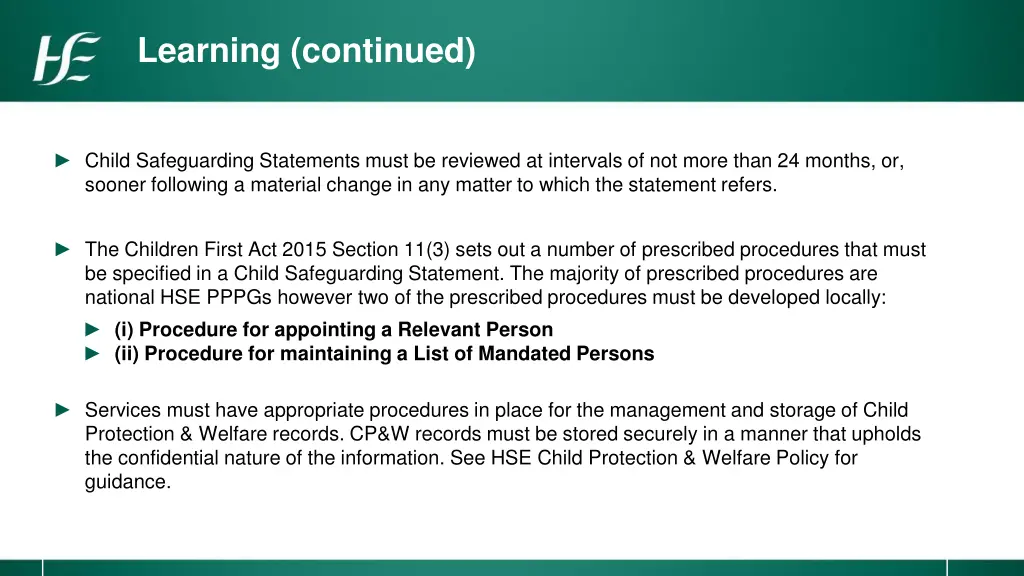
Learning (continued) Child Safeguarding Statements must be reviewed at intervals of not more than 24 months, or, sooner following a material change in any matter to which the statement refers. The Children First Act 2015 Section 11(3) sets out a number of prescribed procedures that must be specified in a Child Safeguarding Statement. The majority of prescribed procedures are national HSE PPPGs however two of the prescribed procedures must be developed locally: (i) Procedure for appointing a Relevant Person (ii) Procedure for maintaining a List of Mandated Persons Services must have appropriate procedures in place for the management and storage of Child Protection & Welfare records. CP&W records must be stored securely in a manner that upholds the confidential nature of the information. See HSE Child Protection & Welfare Policy for guidance.
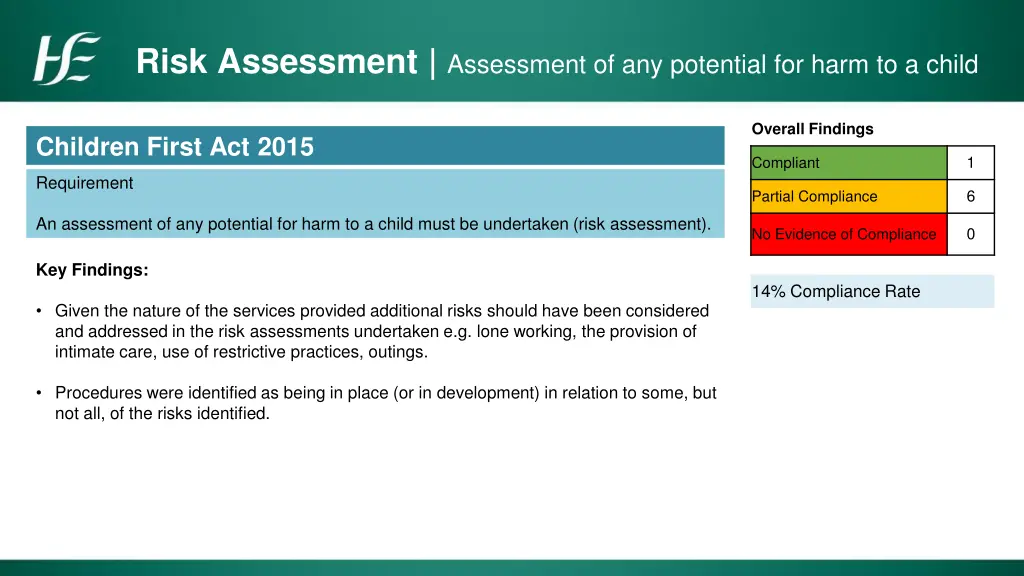
Risk Assessment | Assessment of any potential for harm to a child Overall Findings Children First Act 2015 1 Compliant Requirement 6 Partial Compliance An assessment of any potential for harm to a child must be undertaken (risk assessment). 0 No Evidence of Compliance Key Findings: 14% Compliance Rate Given the nature of the services provided additional risks should have been considered and addressed in the risk assessments undertaken e.g. lone working, the provision of intimate care, use of restrictive practices, outings. Procedures were identified as being in place (or in development) in relation to some, but not all, of the risks identified.
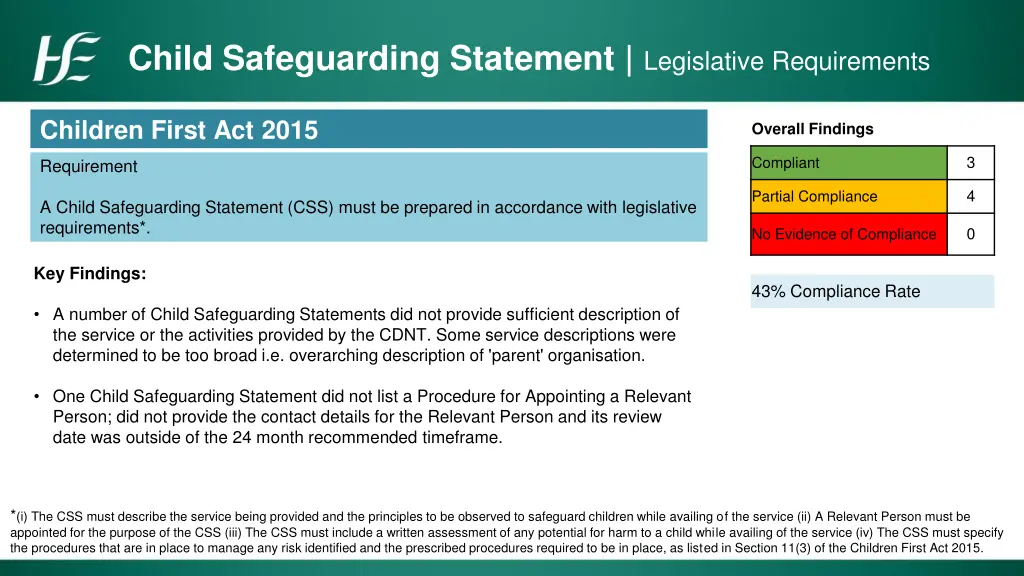
Child Safeguarding Statement | Legislative Requirements Children First Act 2015 Overall Findings 3 Compliant Requirement 4 Partial Compliance A Child Safeguarding Statement (CSS) must be prepared in accordance with legislative requirements*. 0 No Evidence of Compliance Key Findings: 43% Compliance Rate A number of Child Safeguarding Statements did not provide sufficient description of the service or the activities provided by the CDNT. Some service descriptions were determined to be too broad i.e. overarching description of 'parent' organisation. One Child Safeguarding Statement did not list a Procedure for Appointing a Relevant Person; did not provide the contact details for the Relevant Person and its review date was outside of the 24 month recommended timeframe. *(i) The CSS must describe the service being provided and the principles to be observed to safeguard children while availing of the service (ii) A Relevant Person must be appointed for the purpose of the CSS (iii) The CSS must include a written assessment of any potential for harm to a child while availing of the service (iv) The CSS must specify the procedures that are in place to manage any risk identified and the prescribed procedures required to be in place, as listed in Section 11(3) of the Children First Act 2015.
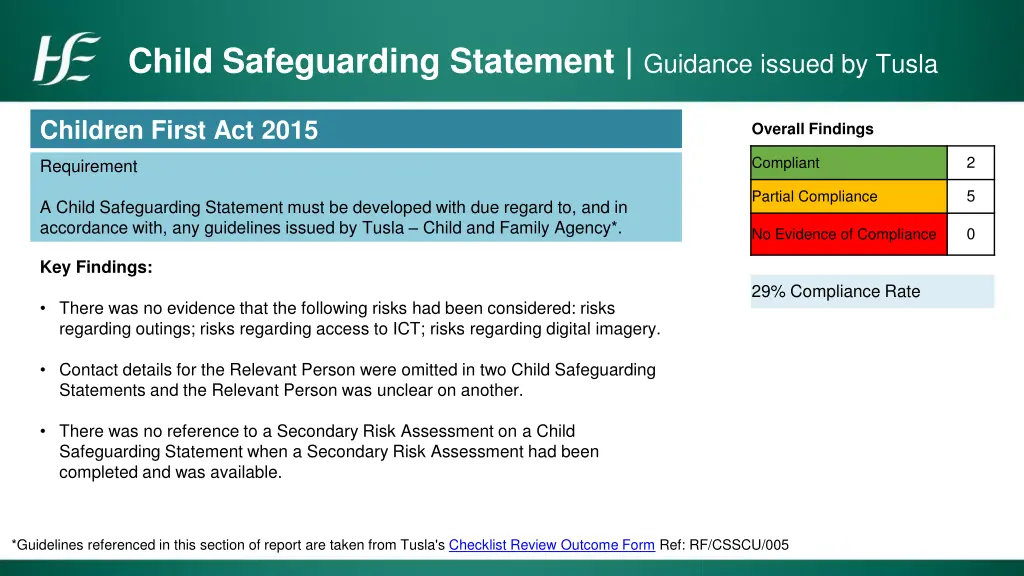
Child Safeguarding Statement | Guidance issued by Tusla Children First Act 2015 Overall Findings 2 Compliant Requirement 5 Partial Compliance A Child Safeguarding Statement must be developed with due regard to, and in accordance with, any guidelines issued by Tusla Child and Family Agency*. 0 No Evidence of Compliance Key Findings: 29% Compliance Rate There was no evidence that the following risks had been considered: risks regarding outings; risks regarding access to ICT; risks regarding digital imagery. Contact details for the Relevant Person were omitted in two Child Safeguarding Statements and the Relevant Person was unclear on another. There was no reference to a Secondary Risk Assessment on a Child Safeguarding Statement when a Secondary Risk Assessment had been completed and was available. *Guidelines referenced in this section of report are taken from Tusla's Checklist Review Outcome Form Ref: RF/CSSCU/005
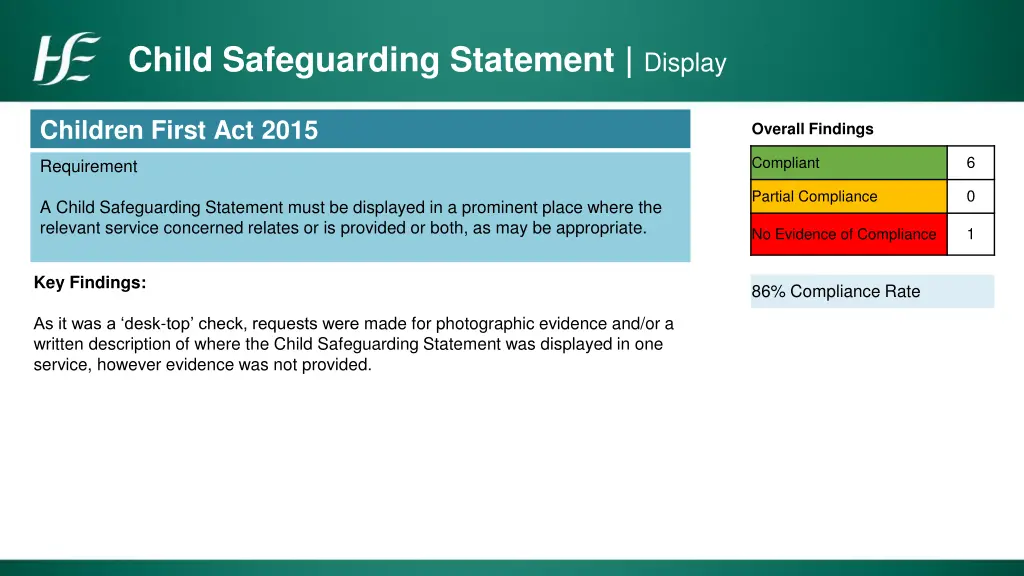
Child Safeguarding Statement | Display Children First Act 2015 Overall Findings 6 Compliant Requirement 0 Partial Compliance A Child Safeguarding Statement must be displayed in a prominent place where the relevant service concerned relates or is provided or both, as may be appropriate. 1 No Evidence of Compliance Key Findings: 86% Compliance Rate As it was a desk-top check, requests were made for photographic evidence and/or a written description of where the Child Safeguarding Statement was displayed in one service, however evidence was not provided.
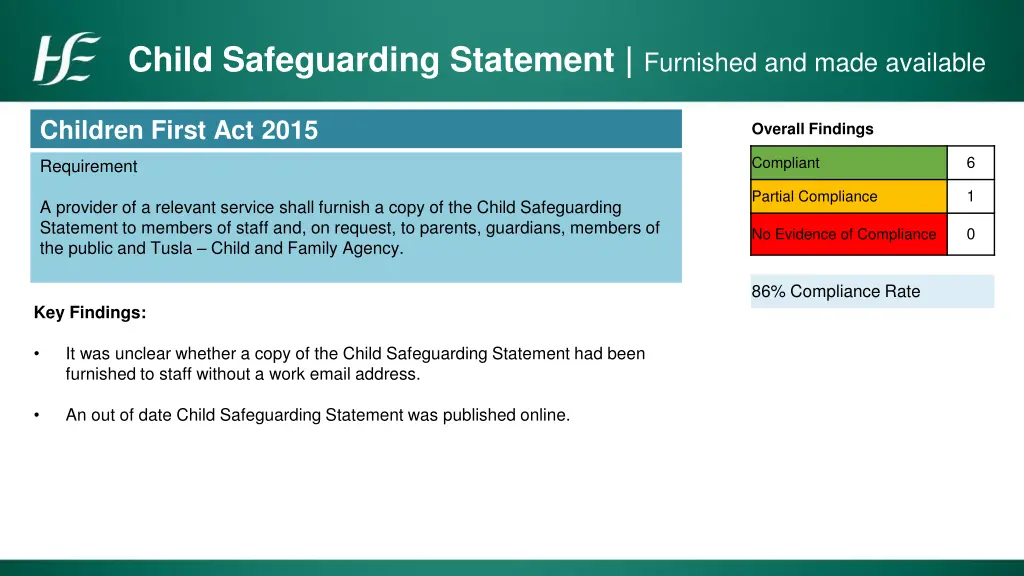
Child Safeguarding Statement | Furnished and made available Children First Act 2015 Overall Findings 6 Compliant Requirement 1 Partial Compliance A provider of a relevant service shall furnish a copy of the Child Safeguarding Statement to members of staff and, on request, to parents, guardians, members of the public and Tusla Child and Family Agency. 0 No Evidence of Compliance 86% Compliance Rate Key Findings: It was unclear whether a copy of the Child Safeguarding Statement had been furnished to staff without a work email address. An out of date Child Safeguarding Statement was published online.
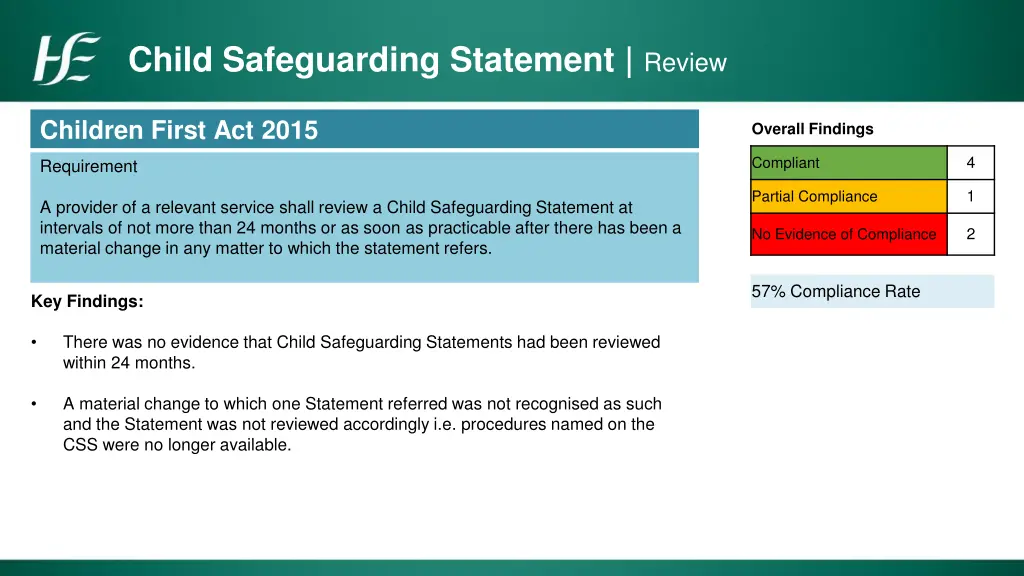
Child Safeguarding Statement | Review Children First Act 2015 Overall Findings 4 Compliant Requirement 1 Partial Compliance A provider of a relevant service shall review a Child Safeguarding Statement at intervals of not more than 24 months or as soon as practicable after there has been a material change in any matter to which the statement refers. 2 No Evidence of Compliance 57% Compliance Rate Key Findings: There was no evidence that Child Safeguarding Statements had been reviewed within 24 months. A material change to which one Statement referred was not recognised as such and the Statement was not reviewed accordingly i.e. procedures named on the CSS were no longer available.
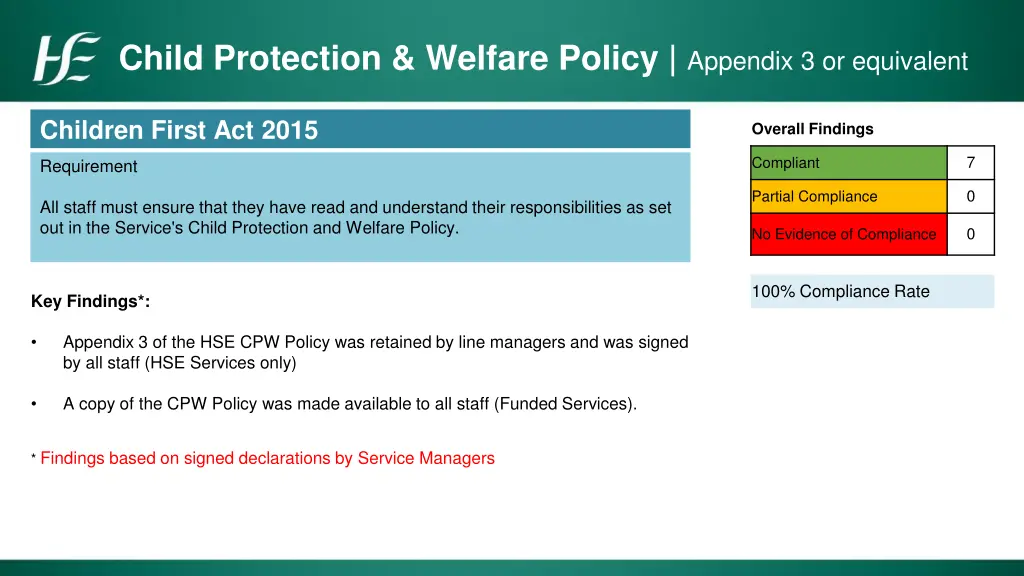
Child Protection & Welfare Policy | Appendix 3 or equivalent Children First Act 2015 Overall Findings 7 Compliant Requirement 0 Partial Compliance All staff must ensure that they have read and understand their responsibilities as set out in the Service's Child Protection and Welfare Policy. 0 No Evidence of Compliance 100% Compliance Rate Key Findings*: Appendix 3 of the HSE CPW Policy was retained by line managers and was signed by all staff (HSE Services only) A copy of the CPW Policy was made available to all staff (Funded Services). * Findings based on signed declarations by Service Managers
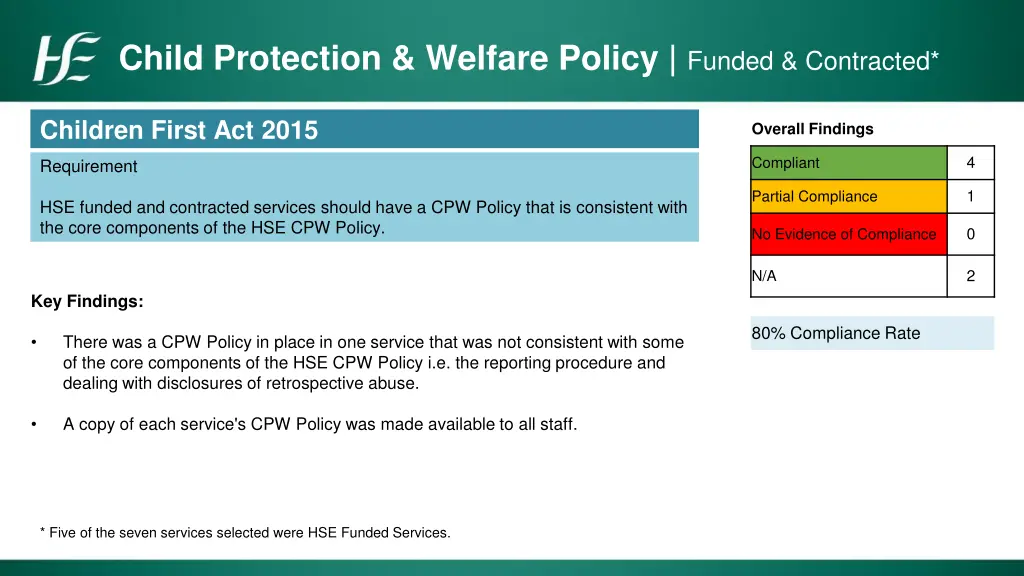
Child Protection & Welfare Policy | Funded & Contracted* Children First Act 2015 Overall Findings 4 Compliant Requirement 1 Partial Compliance HSE funded and contracted services should have a CPW Policy that is consistent with the core components of the HSE CPW Policy. 0 No Evidence of Compliance 2 N/A Key Findings: 80% Compliance Rate There was a CPW Policy in place in one service that was not consistent with some of the core components of the HSE CPW Policy i.e. the reporting procedure and dealing with disclosures of retrospective abuse. A copy of each service's CPW Policy was made available to all staff. * Five of the seven services selected were HSE Funded Services.
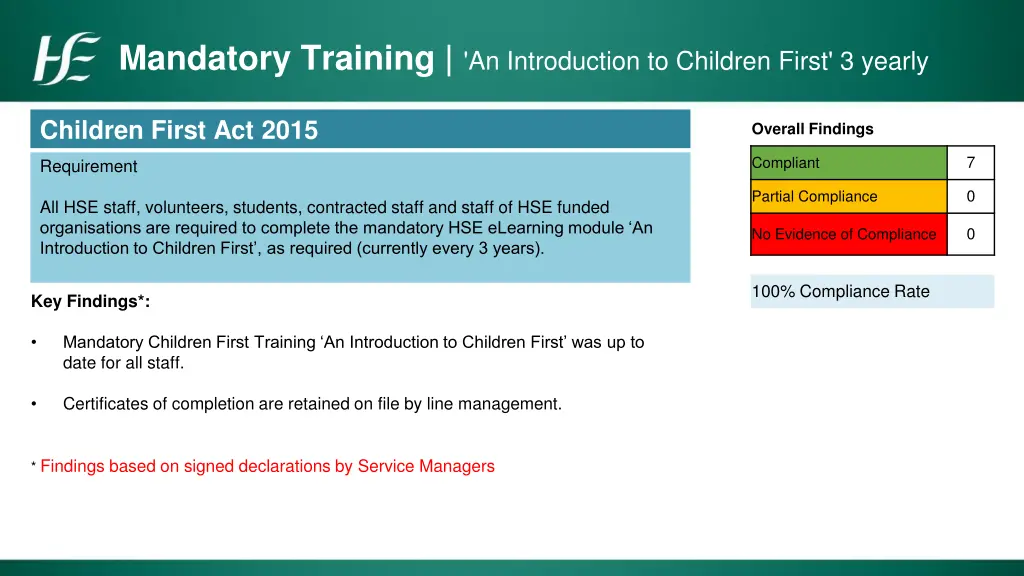
Mandatory Training | 'An Introduction to Children First' 3 yearly Children First Act 2015 Overall Findings 7 Compliant Requirement 0 Partial Compliance All HSE staff, volunteers, students, contracted staff and staff of HSE funded organisations are required to complete the mandatory HSE eLearning module An Introduction to Children First , as required (currently every 3 years). 0 No Evidence of Compliance 100% Compliance Rate Key Findings*: Mandatory Children First Training An Introduction to Children First was up to date for all staff. Certificates of completion are retained on file by line management. * Findings based on signed declarations by Service Managers
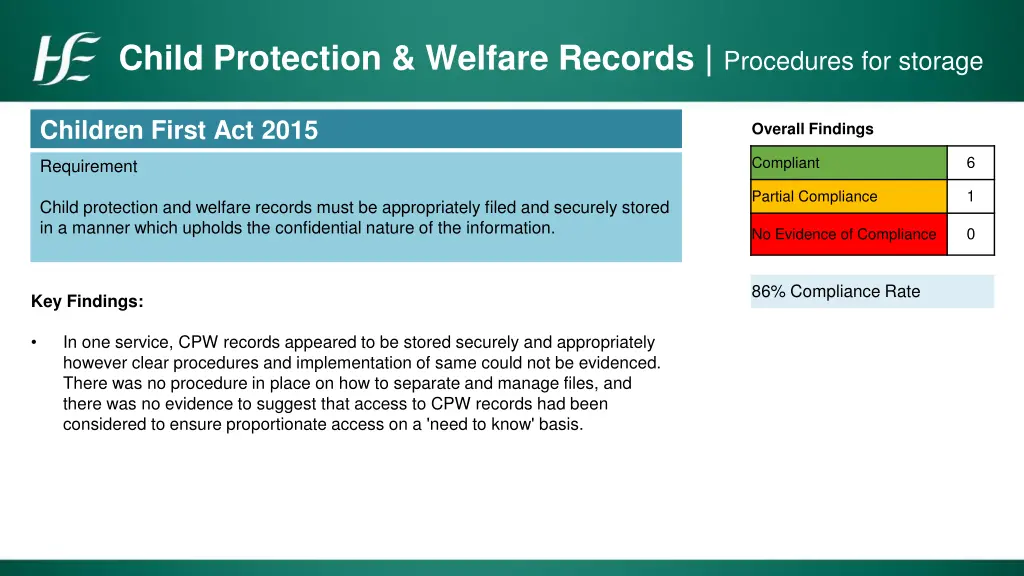
Child Protection & Welfare Records | Procedures for storage Children First Act 2015 Overall Findings 6 Compliant Requirement 1 Partial Compliance Child protection and welfare records must be appropriately filed and securely stored in a manner which upholds the confidential nature of the information. 0 No Evidence of Compliance 86% Compliance Rate Key Findings: In one service, CPW records appeared to be stored securely and appropriately however clear procedures and implementation of same could not be evidenced. There was no procedure in place on how to separate and manage files, and there was no evidence to suggest that access to CPW records had been considered to ensure proportionate access on a 'need to know' basis.
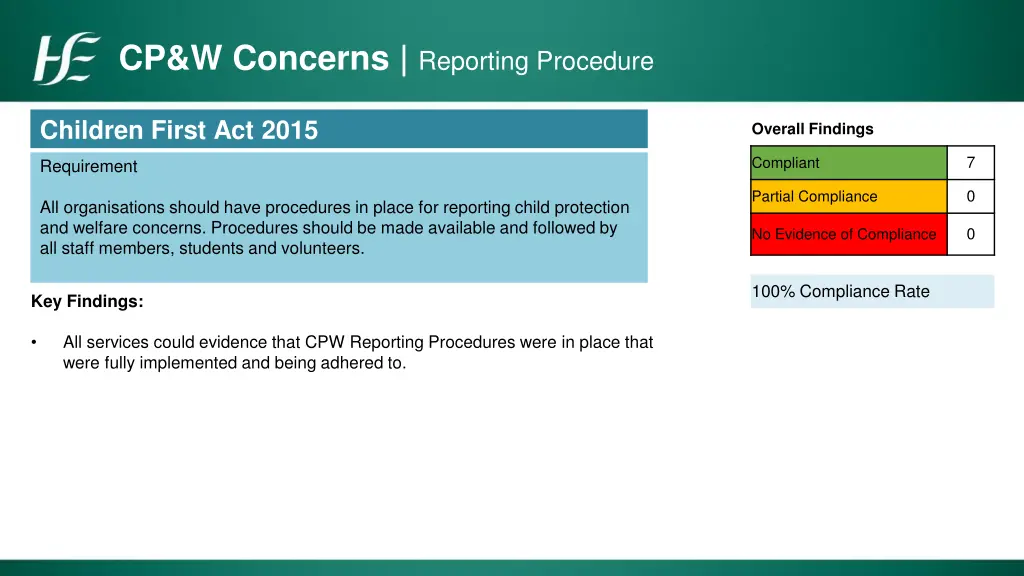
CP&W Concerns | Reporting Procedure Children First Act 2015 Overall Findings 7 Compliant Requirement 0 Partial Compliance All organisations should have procedures in place for reporting child protection and welfare concerns. Procedures should be made available and followed by all staff members, students and volunteers. 0 No Evidence of Compliance 100% Compliance Rate Key Findings: All services could evidence that CPW Reporting Procedures were in place that were fully implemented and being adhered to.
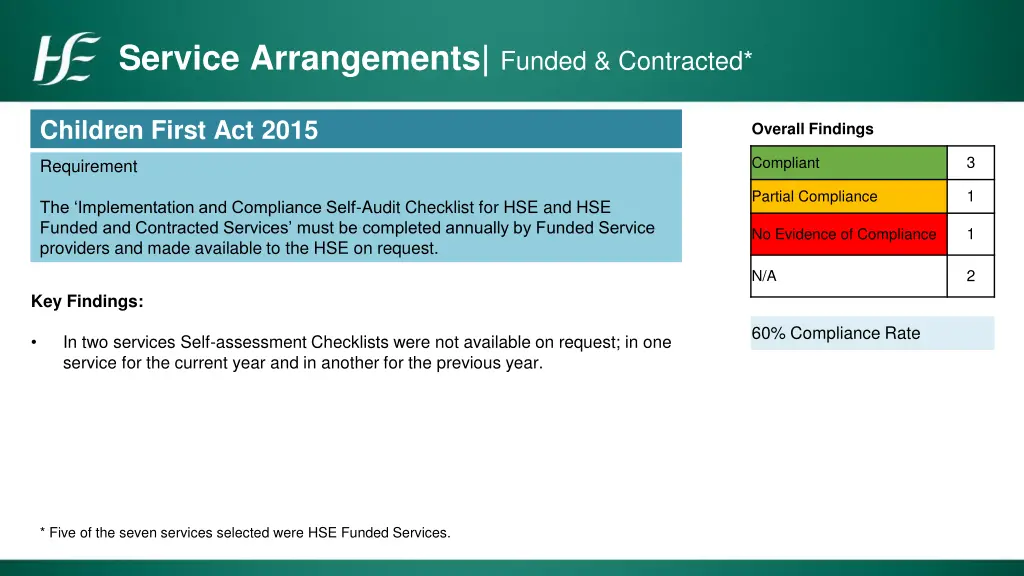
Service Arrangements| Funded & Contracted* Children First Act 2015 Overall Findings 3 Compliant Requirement 1 Partial Compliance The Implementation and Compliance Self-Audit Checklist for HSE and HSE Funded and Contracted Services must be completed annually by Funded Service providers and made available to the HSE on request. 1 No Evidence of Compliance 2 N/A Key Findings: 60% Compliance Rate In two services Self-assessment Checklists were not available on request; in one service for the current year and in another for the previous year. * Five of the seven services selected were HSE Funded Services.
Please direct queries to: HSE Children First National Office childrenfirst@hse.ie www.hse.ie/childrenfirst