Hyperthyroidism: Causes, Diagnosis, and Treatment
Hyperthyroidism, synonymous with overactive thyroid, is mainly caused by Graves' disease in females. This condition leads to excessive release of thyroid hormones, resulting in various symptoms and complications. Diagnosis is confirmed through thyroid function tests, imaging, and biopsy. Treatment options include medication, radio-iodine therapy, and surgery. Learn more about hyperthyroidism management strategies and considerations.

Download Presentation

Please find below an Image/Link to download the presentation.
The content on the website is provided AS IS for your information and personal use only. It may not be sold, licensed, or shared on other websites without obtaining consent from the author.If you encounter any issues during the download, it is possible that the publisher has removed the file from their server.
You are allowed to download the files provided on this website for personal or commercial use, subject to the condition that they are used lawfully. All files are the property of their respective owners.
The content on the website is provided AS IS for your information and personal use only. It may not be sold, licensed, or shared on other websites without obtaining consent from the author.
E N D
Presentation Transcript
Hyperthyroidism Assistant lecturer : Noor Wafaa Hashim
Hyperthyroidism Synonymous with overactive thyroid and thyrotoxicosis . Epidemiology Incidence of 0.2 0.3% of men and 2 3% women. Aetiology Graves disease (autoimmune) Occurs in females, aged 20 40.
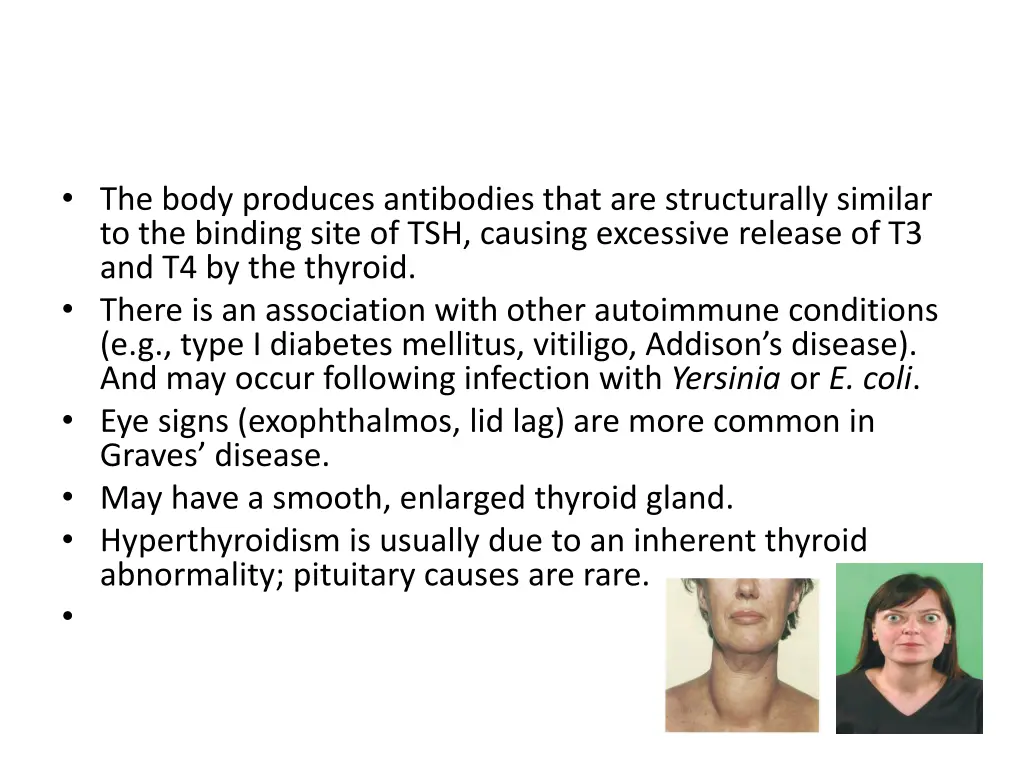
The body produces antibodies that are structurally similar to the binding site of TSH, causing excessive release of T3 and T4 by the thyroid. There is an association with other autoimmune conditions (e.g., type I diabetes mellitus, vitiligo, Addison s disease). And may occur following infection with Yersinia or E. coli. Eye signs (exophthalmos, lid lag) are more common in Graves disease. May have a smooth, enlarged thyroid gland. Hyperthyroidism is usually due to an inherent thyroid abnormality; pituitary causes are rare.
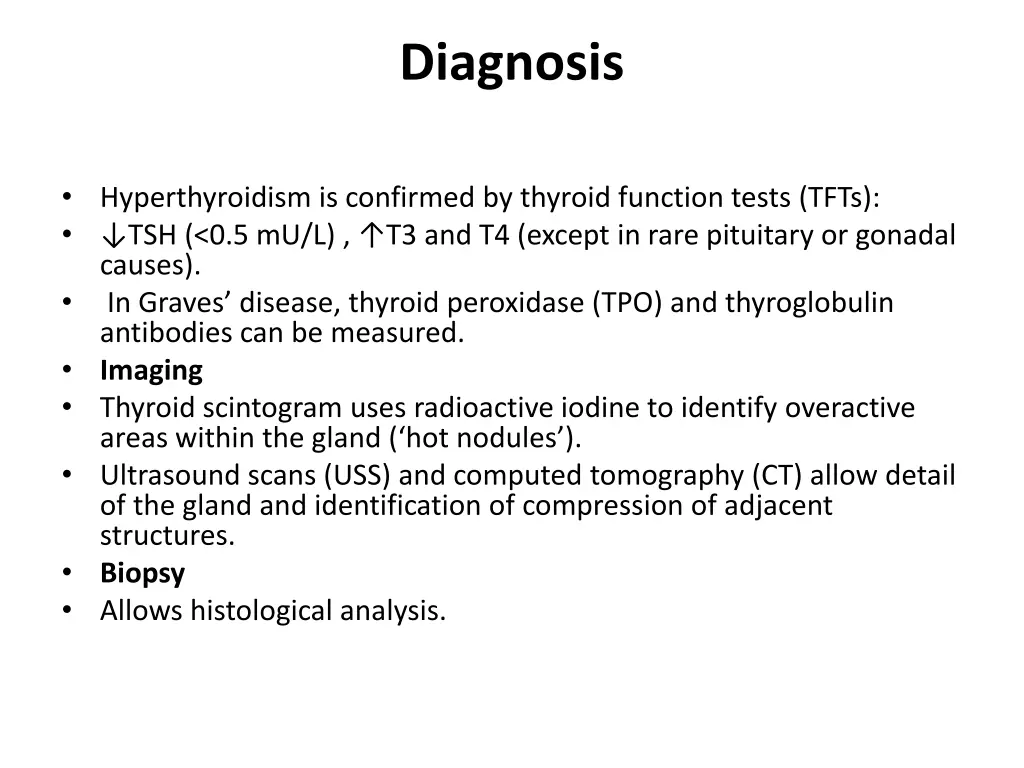
Diagnosis Hyperthyroidism is confirmed by thyroid function tests (TFTs): TSH (<0.5 mU/L) , T3 and T4 (except in rare pituitary or gonadal causes). In Graves disease, thyroid peroxidase (TPO) and thyroglobulin antibodies can be measured. Imaging Thyroid scintogram uses radioactive iodine to identify overactive areas within the gland ( hot nodules ). Ultrasound scans (USS) and computed tomography (CT) allow detail of the gland and identification of compression of adjacent structures. Biopsy Allows histological analysis.
Treatment Medication Anti-thyroid drugs can be used definitively or in preparation for surgery. Carbimazole (first line) or propylthiouracil Acts by interfering with hormone synthesis. Block and replace (high-dose anti-thyroid drugs to completely suppress hormone production alongside replacement thyroxine) or suppression with lower doses, aiming for lower hormone levels. Control of symptoms, such as palpitations and tremor, may be provided by beta-blockers with propranolol.
Treatment Radio-iodine As the thyroid is the only organ to take up iodine, radioactive isotopes (I131) can be given to destroy the thyroid gland. Surgery May be partial or total excision depending on the cause. In a subtotal thyroidectomy the posterior rim is left so to avoid damage to the parathyroid glands. Four main indications for surgery over medical therapy: when a quick, effective treatment is desired (e.g. in young women with Graves disease); when anti-thyroid drugs have proved ineffective; toxic multi-nodular goitre (better medical and cosmetic outcome); toxic solitary nodule (often resistant to medical treatment).
Treatment Pre-operative considerations: Thyroid function should be normalised as much as possible to avoid the dangers of thyrotoxicosis and thyroid storm. Anti-thyroid drugs are often stopped 10 14 days pre-operatively as they increase vascularity to the gland.
Complications Hypothyroidism and Hyperthyroidism Late recurrence due to inadequate excision. Thyroid crisis (rare). There is hyperpyrexia, tachycardia and mania. Recurrent laryngeal nerve injury .May cause slight hoarseness of voice to complete loss of vocal function and critical airway narrowing. Tracheal damage and Hemorrhage.