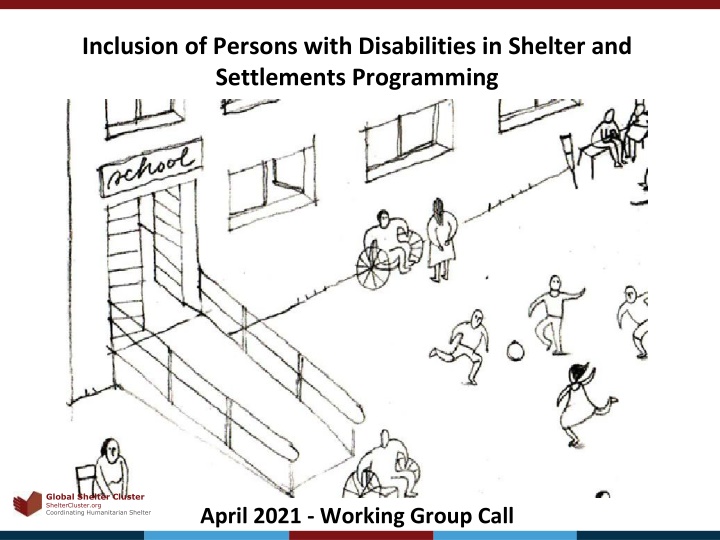
Initiatives in inclusive shelter programming for persons with disabilities. Updates on guidelines, case studies, and training programs. Focus on improving accessibility and relevance in humanitarian shelter efforts through collaboration and feedback. Opportunities for involvement and feedback provided for enhancing guidelines.
Please find below an Image/Link to download the presentation.
The content on the website is provided AS IS for your information and personal use only. It may not be sold, licensed, or shared on other websites without obtaining consent from the author. If you encounter any issues during the download, it is possible that the publisher has removed the file from their server.
You are allowed to download the files provided on this website for personal or commercial use, subject to the condition that they are used lawfully. All files are the property of their respective owners.
The content on the website is provided AS IS for your information and personal use only. It may not be sold, licensed, or shared on other websites without obtaining consent from the author.
Agenda Introduction to USAID-BHA grant project and call for feedback/ input into review of AUOR guidelines Sharing from IOM Nigeria on the Improved Shelter and Settlements Design for PWSN case study Update on Accessible and Inclusive IECs (as part of the Shelter IEC Compendium project) Sharing and call for feedback on proposed Shelter and Mental Health learning event AOB and Q&A
USAID-BHA Grant Working group submitted a proposal to review and update the All Under One Roof guidelines (and the training materials) Technical partner WBU. Working with working group partners and OPDs to understand how the guidelines can be more relevant and user friendly Work will be supported by IFRC Americas to provide translation of updated training materials and creation of an online tutored training course (including pilot) We need feedback from anyone who has experience of using the guidelines. Contact: disability.inclusion@sheltercluster.org or lemarshall@redcross.org.au
Assessment Phase Above all, Qualitative rather than Quantitative Looking at the interrelations between the individuals and the shelter, and the shelter surroundings Inclusive of caregivers and of entire households Focussing on how the individuals might have already adapted their surroundings, or mitigated barriers themselves Aiming to eventual solutions which are low-cost, simple, localised, adaptable
Assessment Phase Both FGDs and 230+ individual shelter visits in 14 sites Teams mixed by gender and by sector (Shelter + CCCM) Working with other actors in each site Working with local organisations for persons with disabilities
Main challenges Challenges shared with all field programmes in Nigeria Insecurity, distance and remote-support limitations Limited resources and funding
Main challenges Challenges shared with other Shelter-PWD projects around the World How to attach shelter improvements to structurally or materially weak shelters How to adapt shelter improvements to the local context e.g. sitting on the ground, not at a table Needing to think about the whole family and caregivers including caregivers under the age of 18 Gaps in holistic/multi-sectoral support for PWDs and their families, with the Shelter department acting alone
Main challenges Challenges specific to the shelter situation in Nigeria Mapping and designing solutions for a wide range of disabilities and a wide range of shelter models
Main challenges Most Common challenges observed so far, for the PWDs No matter what sort of shelter model, the most common observed challenges for the PWDs are smaller, often-repeated daily activities getting up and down, or moving in and out of the shelter Some daily activities have been completely taken out of the hands of the PWDs e.g. cooking. How likely is it, that some measures to improve the cooking area in the shelter will really reverse this situation?
Main challenges Cross-cutting issues Women and girls who are caregivers list many more daily tasks and activities than male caregivers Women and girls have more often mentioned social stigmatization as a reason for staying more often inside the shelter or the shelter plot
Next steps Piloting of Shelter Improvements (10-15 beneficiaries in one site) Expansion/Scale-up Drafting of an Interventions Catalogue
How To Get Started? Field Work! And, MUST be individualised Have mixed teams Team members can come from lots of different sectoral backgrounds Work with local partners with local expertise Explore the individual stories how , why who Start early thinking about appropriate solutions
How To Budget? Work towards equitability of outcomes Have a per-unit cost relative to the overall costs of the complete shelters Be a little bit flexible Use S,M,L categories within the general cost envelope Consider moving the settlements improvements to a separate budget line
Localisation of categories and priorities Take into consideration the global categories Washington Questions But be aware that there are already regional variants The local assessment process will and should go much further, and to a large extent supersede than the Washington Questions Adapt using the categories where necessary, to fit the specifics of a localised shelter programme Be aware of what the project teams can and cannot assess but look for partners and referral pathways, as well
Technical Issues Weak shelters Weak shelters strong supports strong supports Search for what has already been done, and what has been somewhat strong and then make that stronger, more durable and more comfortable How can supports stand on their own? How to strengthen the whole of the shelter, if necessary? Remember local cultures and context What needs to be stable, what needs to be moveable? Explore modular options Don t forget quality of life improvements Be clear on what you can and can t do Worst-case scenario replace the shelter?
Accessible and Inclusive IEC Materials....... Aim to make IEC materials accessible for everybody- Use a range of communication channels and address specific needs with tailored materials. Consult with different groups Promote inclusion through messaging Allocate additional budget and resourcing IEC@sheltercluster.org IEC Material Compendium
Shelter and Mental Health Learning Event How to do more and do better regarding mental health in shelter programming Two half day sessions Thursday 20thMay (afternoon UK) Friday 28thMay (morning UK) Practical focus. Case studies MH impacts of shelter programming Opportunities for MH of innovative shelter programming Develop shared understanding of language and scope of the intersections between Shelter and Settlements assistance, mental health and well-being Mental Health, Protection, Gender and Disability Inclusion Living conditions: physical and mental health Programming entry-points