Delve into the physics and mathematics of resonance in LCR circuits through practical experiments and theoretical investigations. Understand the role of inductors, capacitors, and resistors in shaping resonant frequencies. Discover how to measure dielectric constants using resonant frequencies and explore the connection to core physics courses.
Please find below an Image/Link to download the presentation.
The content on the website is provided AS IS for your information and personal use only. It may not be sold, licensed, or shared on other websites without obtaining consent from the author. If you encounter any issues during the download, it is possible that the publisher has removed the file from their server.
You are allowed to download the files provided on this website for personal or commercial use, subject to the condition that they are used lawfully. All files are the property of their respective owners.
The content on the website is provided AS IS for your information and personal use only. It may not be sold, licensed, or shared on other websites without obtaining consent from the author.
Introduction Most oscillatory systems display resonance phenomena. Although the detailed physics may be different in each system, the mathematics behind resonance is common to each. In this project you will investigate resonance in an LCR circuit, consisting of an inductor (L), capacitor (C), and resistor (R). 2
Approach: Build and understand the operation of an LCR circuit Find how the behaviour of LCR circuits, and especially the resonant frequency, depend on the values of L, C, and R. Determine how the resonant frequency can be used to measure C. Use this knowledge to measure the dielectric constant of an unknown substance (sugar). Equipment provided: Signal generator and oscilloscope (on the computer) Coils (Inductors); fixed and variable capacitors; resistors Parallel plate capacitor and sugar 3
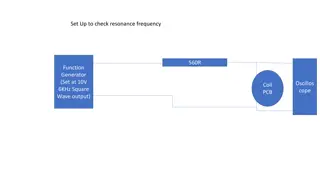
Experiment 1 Use the given components to build an LCR circuit; find the resonance frequency using the signal generator to power the circuit at a range of frequencies and the oscilloscope to determine its response Driving circuit Resonant circuit Measure response Aside: What is the purpose of the second induction coil? A signal generator is designed to maintain a voltage in a circuit to which it is physically connected at the frequency chosen, whether or not this is the resonant frequency. This defeats the object of the exercise to find the frequency for which there is a maximum voltage response! The signal generator is connected via the coil to negate this effect. 7
Course of action Measure L and compare with a calculated value Find a formula for the resonant frequency of the circuit and calculate it Find a formula for the resonance width quality factor Q Pair 1: Sweep through the frequency range, record and plot the output Pair 2: Sweep through the frequency again with a different R Compare with theory. 8
Experiment 2 Measure the dielectric constant of perspex and compare with known value Course of action Formula for capacitance of a parallel plate capacitor with and without dielectric How do you adjust the capacitance? How do you calculate the capacitance? What effect does this have on the resonance frequency? Tipler Ch. 24 9
Experiment 3 Measure the dielectric constant of sugar Course of action Use the knowledge gained in previous experiments to determine the dielectric constant of an unknown substance Experiment 4 Repeat measurements, catch up, finish off. 10
Core GReP rules a reminder The problems should be worked through in order. Keep a project plan and copious notes in your laboratory notebooks. Each member of the group must engage with all aspects of each problem. This should be apparent from your notebooks. It is more important to complete the tasks effectively and reflectively than to rush to the end. You will be assessed on your engagement with the problem. You must attend laboratory sessions but you may work outside scheduled classes if you wish. If you do not have time to obtain data for all the experiments your report should indicate how you would have collected data and how you would have analysed it. The report is a group responsibility; it should be clear that it has been signed off by the group as a whole. 11
Submission of reports Files are submitted to Blackboard under the module PA1900: Experiment Physics 1 2018-10 Y > Assessment and Feedback > PA1900 GReP Report 2018-19 Instructions are in your documentation. Files MUST be named with the following convention 114GReP_Group Letter_UserName_Report.filetype e.g. 114GReP_Group A1_zyx5_Report.pdf and KEEP A COPY Submission Deadline for Group Reports: 2pm Thursday 28 March 12