Poisson Distribution: Concepts and Formulas

Poisson distribution is a key topic in statistics used to calculate event probabilities based on average rates. Learn about its definition, formula, table, mean, and variance in detail. Understand how Poisson distribution models the likelihood of events occurring over a period of time.

Download Presentation

Please find below an Image/Link to download the presentation.
The content on the website is provided AS IS for your information and personal use only. It may not be sold, licensed, or shared on other websites without obtaining consent from the author.If you encounter any issues during the download, it is possible that the publisher has removed the file from their server.
You are allowed to download the files provided on this website for personal or commercial use, subject to the condition that they are used lawfully. All files are the property of their respective owners.
The content on the website is provided AS IS for your information and personal use only. It may not be sold, licensed, or shared on other websites without obtaining consent from the author.
E N D
Presentation Transcript
POISSON DISTRIBUTION CHAPTER 5
INTRODUCTION In Statistics, Poisson distribution is one of the important topics. It is used for calculating the possibilities for an event with the average rate of value. Poisson distribution is a discrete probability distribution. In this article, we are going to discuss the definition, Poisson distribution formula, table, mean and variance, and examples in detail.
Poisson Distribution Definition The Poisson distribution is a discrete probability function that means the variable can only take specific values in a given list of numbers, probably infinite. A Poisson distribution measures how many times an event is likely to occur within x period of time. In other words, we can define it as the probability distribution that results from the Poisson experiment. A Poisson experiment is a statistical experiment that classifies the experiment into two categories, such as success or failure. Poisson distribution is a limiting process of the binomial distribution. A Poisson random variable x defines the number of successes in the experiment. This distribution occurs when there are events that do not occur as the outcomes of a definite number of outcomes. Poisson distribution is used under certain conditions. They are: The number of trials n tends to infinity Probability of success p tends to zero np = 1 is finite
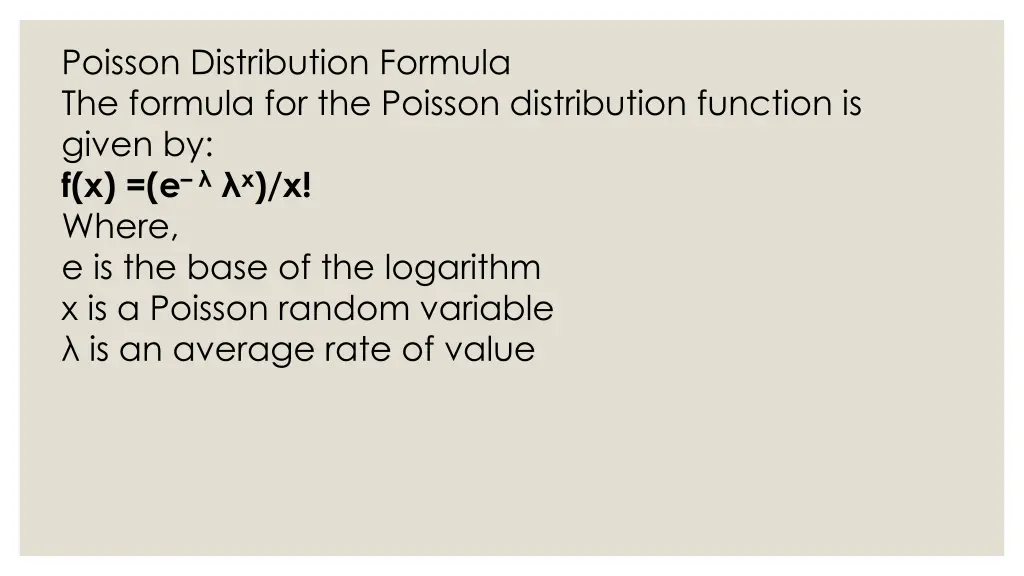
Poisson Distribution Formula The formula for the Poisson distribution function is given by: f(x) =(e x)/x! Where, e is the base of the logarithm x is a Poisson random variable is an average rate of value
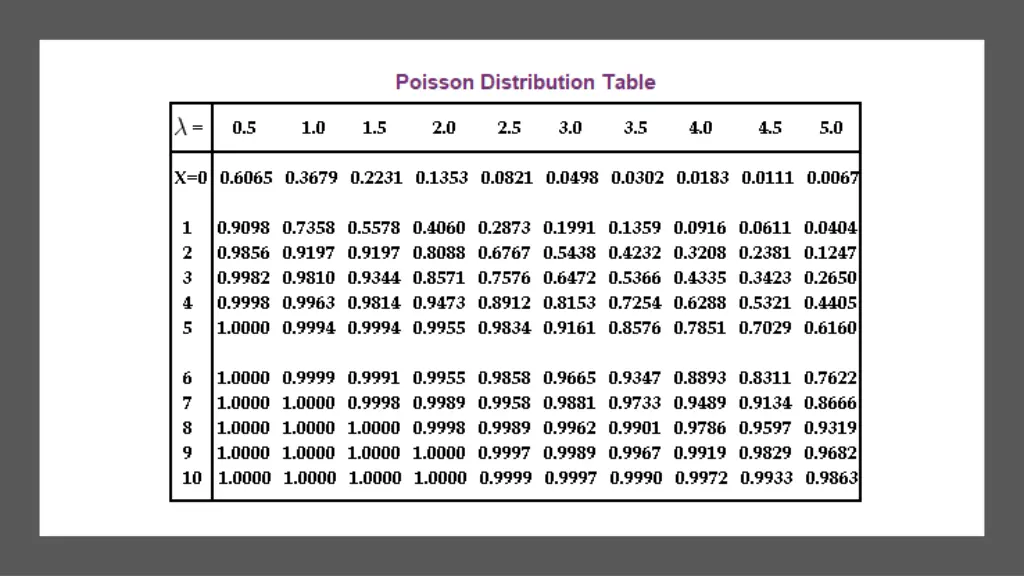
Poisson Distribution Table As with the binomial distribution, there is a table that we can use under certain conditions that will make calculating probabilities a little easier when using the Poisson Distribution. The table is showing the values of f(x) = P(X x), where X has a Poisson distribution with parameter . Refer the values from the table and substitute it in the Poisson distribution formula to get the probability value. The table displays the values of the Poisson distribution.
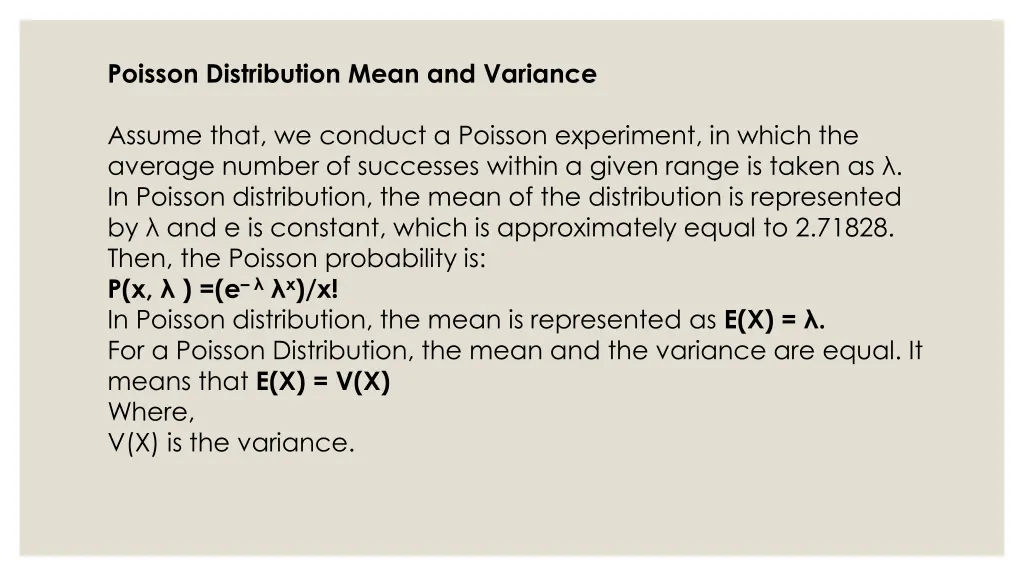
Poisson Distribution Mean and Variance Assume that, we conduct a Poisson experiment, in which the average number of successes within a given range is taken as . In Poisson distribution, the mean of the distribution is represented by and e is constant, which is approximately equal to 2.71828. Then, the Poisson probability is: P(x, ) =(e x)/x! In Poisson distribution, the mean is represented as E(X) = . For a Poisson Distribution, the mean and the variance are equal. It means that E(X) = V(X) Where, V(X) is the variance.
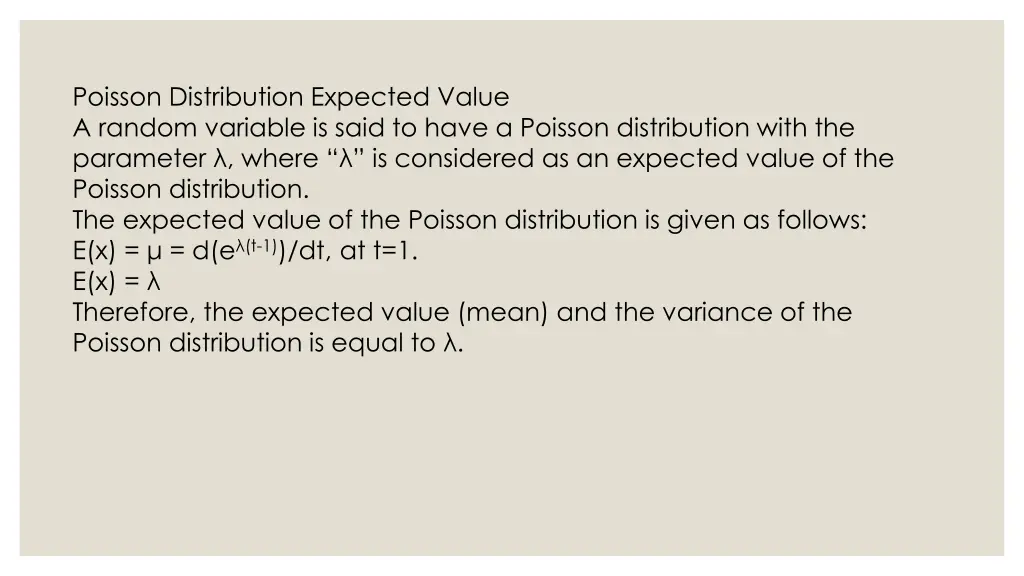
Poisson Distribution Expected Value A random variable is said to have a Poisson distribution with the parameter , where is considered as an expected value of the Poisson distribution. The expected value of the Poisson distribution is given as follows: E(x) = = d(e (t-1))/dt, at t=1. E(x) = Therefore, the expected value (mean) and the variance of the Poisson distribution is equal to .
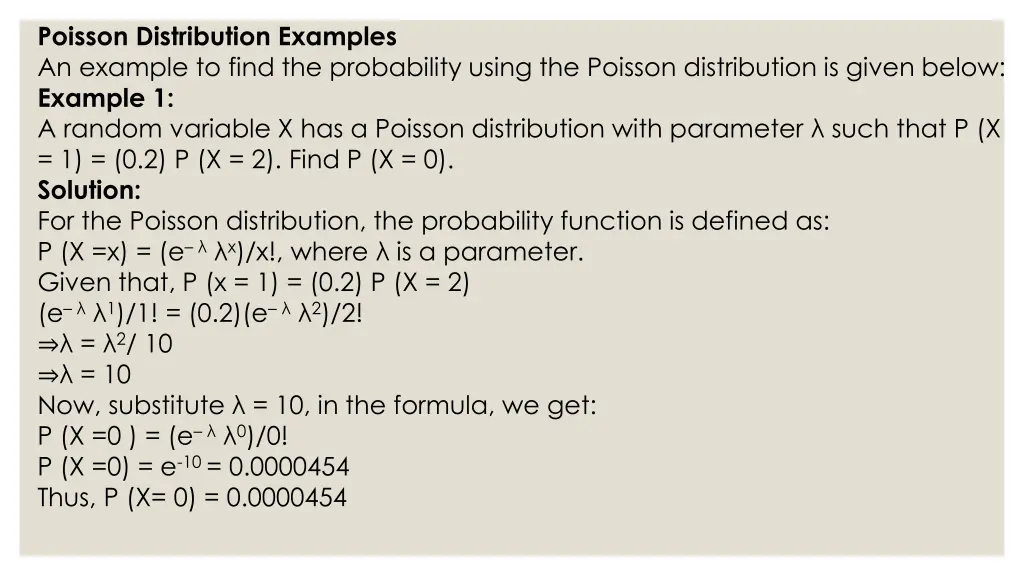
Poisson Distribution Examples An example to find the probability using the Poisson distribution is given below: Example 1: A random variable X has a Poisson distribution with parameter such that P (X = 1) = (0.2) P (X = 2). Find P (X = 0). Solution: For the Poisson distribution, the probability function is defined as: P (X =x) = (e x)/x!, where is a parameter. Given that, P (x = 1) = (0.2) P (X = 2) (e 1)/1! = (0.2)(e 2)/2! = 2/ 10 = 10 Now, substitute = 10, in the formula, we get: P (X =0 ) = (e 0)/0! P (X =0) = e-10= 0.0000454 Thus, P (X= 0) = 0.0000454
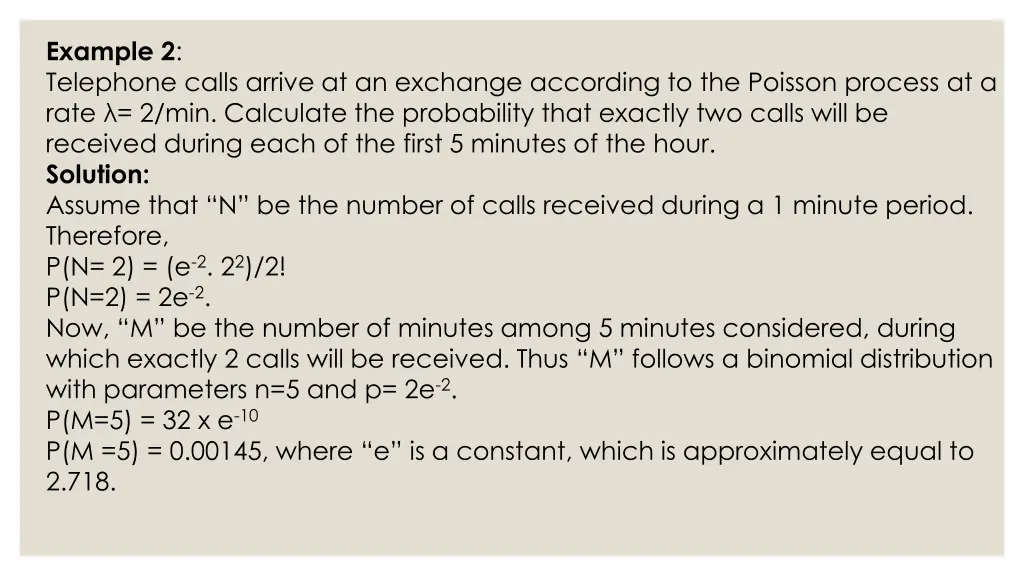
Example 2: Telephone calls arrive at an exchange according to the Poisson process at a rate = 2/min. Calculate the probability that exactly two calls will be received during each of the first 5 minutes of the hour. Solution: Assume that N be the number of calls received during a 1 minute period. Therefore, P(N= 2) = (e-2. 22)/2! P(N=2) = 2e-2. Now, M be the number of minutes among 5 minutes considered, during which exactly 2 calls will be received. Thus M follows a binomial distribution with parameters n=5 and p= 2e-2. P(M=5) = 32 x e-10 P(M =5) = 0.00145, where e is a constant, which is approximately equal to 2.718.