Hun Middle School in Ankara, Turkey, founded in 1968, focuses on nurturing self-confident individuals through experiential learning. Located in a low-income area with a high number of disadvantaged and immigrant students, the school offers modern facilities including labs, workshops, and playgrounds. With a mission to provide quality education, the school engages students in various activities such as robotic coding, science fairs, artistic endeavors, and sports competitions. The dedicated teachers embrace innovative teaching methods and have received national recognition for their e-twinning project. Students have excelled in painting contests, winning prizes themed around significant national events. Despite challenges, Hun Middle School is a beacon of excellence in education.
Please find below an Image/Link to download the presentation.
The content on the website is provided AS IS for your information and personal use only. It may not be sold, licensed, or shared on other websites without obtaining consent from the author. If you encounter any issues during the download, it is possible that the publisher has removed the file from their server.
You are allowed to download the files provided on this website for personal or commercial use, subject to the condition that they are used lawfully. All files are the property of their respective owners.
The content on the website is provided AS IS for your information and personal use only. It may not be sold, licensed, or shared on other websites without obtaining consent from the author.
E N D
Presentation Transcript
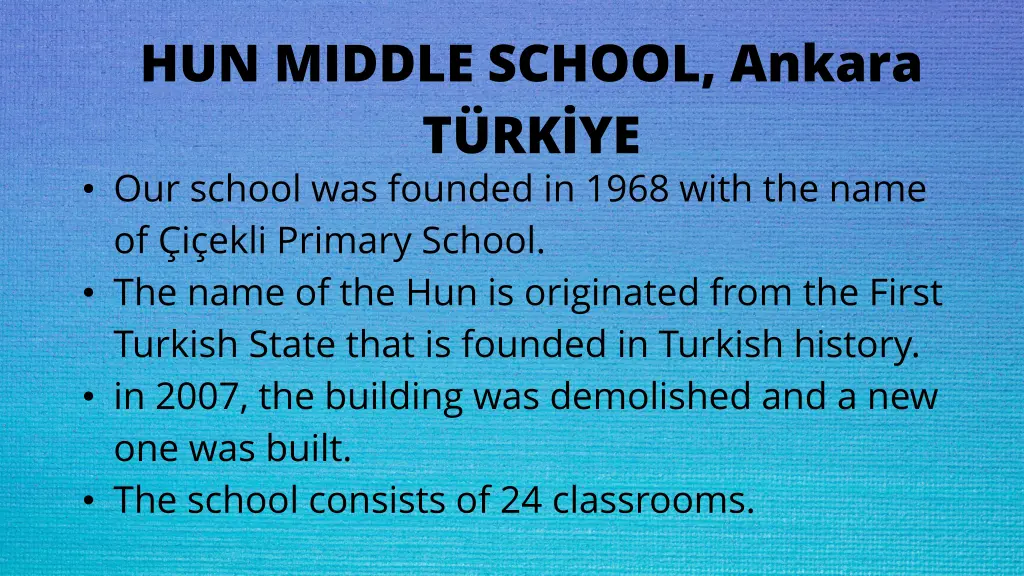
HUN MIDDLE SCHOOL, Ankara T RK YE Our school was founded in 1968 with the name of i ekli Primary School. The name of the Hun is originated from the First Turkish State that is founded in Turkish history. in 2007, the building was demolished and a new one was built. The school consists of 24 classrooms.
1 multi-purpose hall, 1 science lab, 1 design lab, 1 Visual Arts Workshop, 1 Information Technologies lab and 1 Wrestling Hall. There are also traditional playgrounds in our school garden. The school has 760 students. We have 40 kindergarden students,10 students with special needs and 75 Iraqi students .
The school mission is raising self-confident individuals who are sensitive to the environment and learn by experiencing. The school is located in an area where the people live with low income. The students' parents with low education level are mostly apart. The number of disadvantageous students and immigration is quite high.
The number of refugee Iraqi students is growing rapidly. There is not enough support from families for school and student attendance to school. 49 teachers are teaching in our school. Our teachers are young, eager to learn and teach with new teaching methods and they are open to innovations. Our school took the national e-twinning quality label by the project 'I write by learning' .
Students learn robotic coding in weekend courses. We organized 4006 T B TAK Science Fair. Teachers take the students to the movies, plays and museums every year. Students build the birdhouses in the schoolgarden, do art exhibitions and choral works every year. Students win medals in Muay Thai, Kickbox, gymnastics and wresling in the province every year.
In the organisation by Chamber of Commerce, our students got the first prize by their paintings and stories themed Gallipoli anakkale victory by our President. In the organisation by Ministery of Customs and Trade, one of our students is rewarded by Ankara Metropolitan Municipality with the work themed Conscious Consumption and Consumer Rights. In another painting contest organized by The Ministery of Agriculture, another student won the first prize.
School Principal Ali Genaa GZEY graduated from Ankara Gazi University Vocational Faculty of Education, Department of Technology. He has worked as a teacher and administrator in the schools of Ministery of Education for 30 years. Vice Principal Se il Yabano lu graduated from 19 May s University Turkish language teaching. She has a Master's Degree of Ankara University in the field of Regional Geography and also in the field of Education Management Inspection Economics Planning in Gaziantep University. She has worked as a Turkish teacher and vice principal at schools of Ministery Education for 18 years. She attended EU Education and Youth Programs Seminar and has been working as Deputy principal for 8 years in our school.
Ayegl AYKANAT graduated from Selcuk University English Language Teaching Department. She has been teaching English at schools of Ministery Education for 18 years. She attended EU Education and Youth Programs Seminar. She is interested in languages, technology and innovation.
Early School Leaving is a term that represents missed opportunities for young people and countries in the meaning of economic losses as well. It is important to continue school in order to increase the quality and efficiency in education as it's refered in the main goals of Europe 2020. Individually the consequences of early school leaving affect people throughout their lives in social, cultural and economic ways. (European Commission Final Report, November 2013)
As it's stated in the objectives of European 2020 Vision attending school is important to increase the quality and efficiency in education. In 2011, the average early school leaving in the European Union was determined as 13.4%.It is aimed to drop this rate until the end of2020(www.dontwasteyourfuture.eu). The objectives of the Lisbon Strategy (December 1, 2009)include halving the dropout rate, developing the education and training systems to meet the needs of the information society.
According to the data of the Ministry of National Education 2015/2019 Strategic Plan, 14.8% of primary school students, 35% of middle school students and34.8% of the high school students were absent for more than 20 days. In addition, the rate of leaving the school in early ages is 38.2%. As we compare with the previous years, the student absenties are increasing and this causes the demotivation in every aspect in our school.
ABSENTY PROBLEM IN OUR SCHOOL As a result of the SWOT analysis conducted at our school in 2019, we saw that one of our weaknesses is student absenteeism. According to e-school data, while the rate of students who were absent for 20 days or more without excuse in the 2017/2018 academic year was 7.4%, this rate increased to 8.94% in 2018 2019. The number of students who left school is 12. According to December 2019 e-school data, the number of students who are absent for 20 days or more without any excuse is 20.
According to the absenteeism survey data in 2018, 11.51% of the students stated that they did not attend school due to lack of motivation. The increase in student absenteeism rates will lead to future school dropouts.
SOLUTION The gradual increase in absenteeism rates will lead to future school dropouts.To find a solution in local we kept in touch with parents by phone, we sent absenty information letters to the parents,we visited them in their houses and tried to find a solution to the problem. The teachers attended many seminars.Despite these efforts, we could not find a solution in local, so we decided to have an international solution to the problem. We are looking for a solution. We do not have an international experience before. Absenteeism by transferring good practices in Europe
We want to reduce the rate of absenteeism in our school by obtaining good practices in Europe. Countries with high performance in reducing early school leaving are of European origin Portugal 10.4%, Spain 8%, 5.7%(research 4committees.blog/2019/03/20/study- presentation-how-to-tackle-early-school-leaving- in-the-eu/). Greece 6.9%, Ireland
OUR EXPECTATIONS FROM THIS TRAINING By this training, we aim to obtain the new teaching technics and school management strategies to prevent early school leaving and drop out school. What professional qualifications should teachers have and what should they do to create a happy school climate? To ensure the professional development of our teachers with the trainings we will receive from countries such as Portugal and Spain, which are leaders in preventing early school leaving.
OUR EXPECTATIONS FROM THIS TRAINING to drop the rate of early school leaving in our country and Europe by creating a positive school climate in our school. To reduce our students' absenteeism rate of 20 days or more from 8.94% to 7.5% in local. to reduce the number of absent students from 20 to the least. To transfer innovative approaches from other international schools to our school.
OUR EXPECTATIONS FROM THIS TRAINING By integrating the European perspective to our school we want to contribute to the increase the schooling rate both in our counry and in Europe as well. We aim to learn effective communication ways with students and parents. We aim to learn new student coaching methods and how to provide students' attandance to school. We aim to develop strategies for the disadvantaged students with fewer opportunities.
OUR EXPECTATIONS FROM THIS TRAINING We aim to learn how to reduce the stress related situations and what the motivational tools for the students are. We aim to learn how we can manage the classroom effectively and what the collaborative class activities are. We aim to improve teachers' skills with the new teaching methots ,strategies and communication ways as well. We aim to improve the teachers' skills by creative and critical thinking in solving problems.